Germany drops its longest word

German is famous for its compound nouns, which frequently become so cumbersome they have to be reduced to abbreviations. The beef labelling law, introduced in 1999 to protect consumers from BSE, was commonly transcribed as the “RkReÜAÜG”, but even everyday words are shortened to initials so Lastkraftwagen – lorry – becomes Lkw.

Professor Anatol Stefanowitsch, a linguistics expert at the Free University of Berlin, told the German news agency dpa that the beef labelling law was the longest “authentic” word in the German language.

The longest word with a dictionary entry, according to Duden is at 36 letters, Kraftfahrzeug-Haftpflichtversicherung, motor vehicle liability insurance.

However a 39-letter word, Rechtsschutzversicherungsgesellschaften, insurance companies providing legal protection, is considered the longest German word in everyday use by the Guinness Book of World Records.

In theory, a German word can be infinitely long. Unlike in English, an extra concept can simply be added to the existing word indefinitely. Such extended words are sometimes known as Bandwurmwörter – “tapeworm words”. In an essay on the Germany language, Mark Twain observed: “Some German words are so long that they have a perspective.”

The Teutonic fondness for sticking nouns together has resulted in other famous tongue-twisters such as: Donaudampfschifffahrtsgesellschaftskapitän – Danube steamship company captain – which clocks in at 42 letters. It has become a parlour game to lengthen the steamship captain’s name, by creating new words such as Donaudampfschifffahrtsgesellschaftskapitänswitwe, the captain’s widow. And, Donaudampfschifffahrtskapitänsmütze – the captain’s hat.

At 80 letters, the longest word ever composed in German is Donaudampfschifffahrtselektrizitätenhauptbetriebswerkbauunterbeamtengesellschaft, the “Association for Subordinate Officials of the Head Office Management of the Danube Steamboat Electrical Services”.

The longest word in the Oxford Dictionary of English is pneumonoultramicroscopicsilicovolcanoconiosis – at 45 letters. Its definition is “an artificial long word said to mean a lung disease casued by inhaling very fine ash and sand dust.

The longest word to be found in Britain is the Welsh place name Llanfairpwllgwyngyllgogerychwyrndrobwllllantysiliogogogoch. The Telegraph

South Africa needs federalism

There are two recent events clearly demonstrating that the South African constitution does not work to govern a highly complex, multiethnic and even multinational society.

The first is the recent hullabaloo over the Afrikaner community of Kleinfontein, east of Pretoria, and the second is the consistent hostility towards Afrikaans-only schools displayed by the Gauteng education department.

What threat do the thousand Christian Afrikaners living peacefully in Kleinfontein pose to the City of Tshwane, which has a land area the size of Luxembourg and millions of inhabitants?

Kleinfontein is no different to any other gated community in the country, except that it is not built in a pseudo-Tuscan style, does not sport some nonsensical Mediterranean name and signs are not posted in English.

It resembles the German concept of a Sprachinsel, or ” language island”, meant to conserve the beleaguered Afrikaans language.

The people of Kleinfontein do not aspire to exoticism; they have simply dared to be themselves. They live together in a self-sufficient community, like thousands of other communities in rural parts of South Africa.

In fact, the president lives in just such a Zulu community at Nkandla, enjoying his own language and culture. Why is it acceptable to be Zulu or pseudo-Italian, but not Afrikaans?

While the ruling party, the African National Congress, wants dialogue with Kleinfontein, the English, assimilationist Democratic Alliance has displayed great hostility to the community in its own affirmation of democratic centralism.

Even the former Soviet Union did not practic e the same level of statist interference in education as the Gauteng education department under MEC Barbara Creecy does, bullying a school such as Fochville Hoërskool into accepting English children who are deliberately bussed in.

Fochville is the only Afrikaans high school in a vast area and Anglicising it by fiat constitutes a form of ethnic belligerence that boggles the mind.

The department’s ill-disguised language chauvinism is camouflaged by predictable accusations of racism levelled at the school, which already has happy black pupils enjoying quality education in Afrikaans.

We desperately need a federal or confederal system to end the abuse of power characterising this Leninist “democracy” at all levels.

White man from Pretoria sues police for wrongful arrest, rape by cell full of black detainees

A Pretoria man who claims that fellow detainees in police cells spent a night raping and assaulting him after he was unlawfully arrested, is suing the minister of police for more than R1 million, Beeld reported on Monday.

According to documents handed in at the High Court in Pretoria, the victim was released unconditionally, but later in the same case re-arrested and assaulted in the police cells for a second time, before again being released unconditionally.

According to the victim’s lawyer, Robert van Wyk, his client, who lived in Brooklyn and was expected to testify on Monday, was extremely traumatised and humiliated by the attacks.

He reportedly had to undergo three courses of anti-retroviral drugs to combat HIV.

“Fortunately he was HIV-negative,” Van Wyk said.

The victim had brought two claims against the minister of police, the first of which, for R940,000, was due to the arrest and detention involving the alleged rape, and the second, for R150,000, was for the second arrest and detention.

The plaintiff was arrested on September 16, 2011 at the Rustenburg Mall on charges of human trafficking and taken to the Rustenburg police cells, where he was detained in a cell along with about 20 other men.

He alleged that they stripped him, sexually assaulted him, raped, and severely beat him until 6am the next morning.

He asked police several times the next day to see to his needs and told them that he had been assaulted and raped, but they reportedly did nothing, and refused to allow him to call his family.

Police had denied all the allegations. – Sapa

Pink Floyd member urges Israel boycott

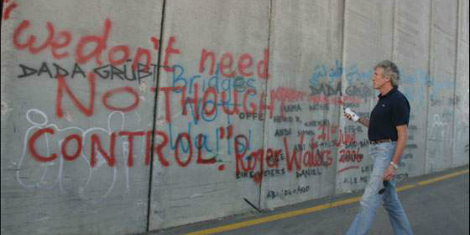
Roger Waters protests against Israel

Roger Waters and Alice Walker have penned open letters asking singer Alicia Keys to call off a forthcoming concert in Tel Aviv. Walker, the author of The Color Purple, invited Keys to join a cultural boycott of Israel, visiting “the children in Gaza” instead of supporting “a system that is cruel, unjust and unbelievably evil”.

“Dear Alicia Keys,” Walker wrote on the website for the US Campaign for the Academic & Cultural Boycott of Israel. “I have learned today that you are due to perform in Israel very soon. We have never met, though I believe we are mutually respectful of each other’s path and work. It would grieve me to know you are putting yourself in danger (soul danger) by performing in an apartheid country that is being boycotted by many global conscious artists.”

In his own letter, Waters admitted that Keys may not know who he is. “I used to be in a band called Pink Floyd and, believe it or not, I still work,” he wrote. The English musician implored Keys to “join the rising tide of resistance” and refuse “to give legitimacy to the Israeli government policies of illegal, apartheid, occupation of the homelands of the indigenous people of Palestine.”

Keys is due to appear at Tel Aviv’s Nokia Arena on 4 July, as part of her ongoing Girl On Fire tour. It will be her first appearance in Israel. As the concert approaches, activists have begun ramping up their Facebook and Twitter campaign, asking the long-time HIV/Aids activist to consider dropping the gig in solidarity with the Palestinian rights movement.

“I have kept you in my awareness as someone of conscience and caring, especially about the children of the world,” Walker went on. “A cultural boycott of Israel and Israeli institutions (not individuals) is the only option left to artists who cannot bear the unconscionable harm Israel inflicts every day on the people of Palestine, whose major ‘crime’ is that they exist in their own land, land that Israel wants to control as its own.”

Elvis Costello, Santana, the Pixies and Gil Scott-Heron are among the other artists to have boycotted Israel in recent years, while acts including Madonna and Paul McCartney have dismissed calls to cancel shows. Earlier this month, physicist Stephen Hawking announced he was joining the movement, adding his name to a list of supporters that includes dozens of Nobel laureates.

Keys has yet to respond to activists’ requests. – The Guardian

More xenophobic attacks in Kroonstad

Kroonstad in the Orange Free State, South AfricaThe situation in Maokeng, Kroonstad, in the Free State was calm on Saturday after service delivery protests earlier in the week, police said.

“It is still quiet, nothing is happening,” Sergeant Thabo Litabe said.

On Thursday, he said local residents were angry.

“They wanted to protest over services they got from the municipality. They then decided to go to the foreigners’ shops and looted them.”

He said no arrests had been made but a case of public violence had been opened.

Police were not sure how many shops had been looted, because no shop owners had come forward yet.

Kroonstad is the fourth area hit by a spate of violence against foreigners. The others are Port Elizabeth in the Eastern Cape, Diepsloot in Gauteng, and the Vaal. – Sapa

Diepsloot calm yesterday after reports of xenophobic violence

Diepsloot
Diepsloot, a black township north of Johannesburg.

The situation in Diepsloot, north of Johannesburg was calm on Saturday following reports of shop lootings and public violence during the last week, police said.

“It has been quiet, there were no incidents reported,” said Lt-Col Lungelo Dlamini said.

On Monday police arrested 45 people for public violence, housebreaking, and possession of unlicensed firearms.

The unrest started on Sunday evening after Somali businessman, Bishar Isaack, was arrested for allegedly shooting dead two men, believed to be Zimbabweans, outside his shop.

Issack appeared in the Pretoria Magistrate’s Court on Tuesday.

Dlamini said Isaack, 39, appeared on charges of murder.

The case was postponed to June 4, when he was expected to bring a formal bail application.

After the shooting on Sunday, local residents gathered in front of Isaack’s shop, threw stones, and looted his business.

Police dispersed the crowd, but other shops were then looted. Several local businessmen then removed their goods and locked their shops.

Nine people were arrested for public violence and possession of suspected stolen goods. They appeared in the Pretoria Magistrate’s Court on Tuesday and the case was withdrawn, Dlamini said.

In the Vaal, police received around 100 complaints about looting at both local and foreign-owned shops, following service delivery protests last week.

On Tuesday, political parties bemoaned the violence.

The African National Congress said the attacks had tarnished the country’s image.

“South Africa is a country of integrity and honour internationally, but the recent attacks on our brothers and sisters have put a dent in our image as a peaceful nation,” said ANC Gauteng spokesman Dumisa Ntuli.

The Democratic Alliance said the unrest could be blamed on a lack of employment and poverty.

“As resources become scarcer, so the competition for jobs, housing, and basic services increases. This, in turn, fuels feelings of deprivation on the part of South Africans,” said DA spokesman Mmusi Maimane.

The Inkatha Freedom Party said the attacks were sickening.

“We view the attacks… as sickening and ridiculous, especially when one remembers that 50 years ago all Africans committed themselves to building a new continent of hope, with the concept of ubuntu as a key hallmark,” said IFP Gauteng chairman Nhlanhla Msimango.

Cope spokesman Mluleki George also condemned the violence.

“The attacks are nothing but a cowardly and criminal act which only takes society backwards,” he said.

The SA Communist Party said it was shocked at the violence.

“We call upon our communities, activists and leaders of fraternal and revolutionary movements to intervene decisively in the affected communities, and work in partnership with law enforcement agencies to ensure that these barbaric, extremely backward and inhuman acts are brought to an immediate end,” said SACP spokesman Lucian Segami.

The Gauteng provincial government added its voice to the condemnation.

“These are clear acts of opportunistic crimes on a vulnerable group of Gauteng residents by a minority of hooligans living in our communities,” said premier Nomvula Mokonyane.

“We call upon all our people across the province to refrain from taking part in (the) attacks that we have seen. We must all ensure that a repeat of 2008 does not happen,” she said.

She was referring to a string of xenophobic attacks which erupted in the country five years ago. – Sapa

‘Multi-pronged assault on the property rights of white South Africans’

Dave Steward

by Dave Steward, FW de Klerk Foundation

Perhaps one of the most unpalatable truths of our time is that our government is planning a multi-pronged assault on the property rights of white South Africans.

The assault includes proposals in the 2011 Green Paper on Land Reform; Tokyo Sexwale’s announcement last week regarding the “deracialisation of white suburbs”; and the recently published draft Expropriation Bill.

The Green Paper advocates ‘Agrarian Transformation’ which would result in “a rapid and fundamental change in …systems and patterns of ownership and control… of land, livestock, cropping and community.” It proposes far-reaching changes to traditional forms of land ownership including the proposition that, in future, privately owned land will be freehold with ‘limited extent’.

Minister Sexwale’s plan to “deracialise white suburbs” might erode the value of the most important asset that most South Africans own – their homes. “De-racialisation” would be achieved by “obliging” banks “to provide loans to black people to purchase property in previously exclusive white suburbs”. However, there are no longer any “exclusively white suburbs”. People – whatever their race – can buy homes anywhere they like provided they can pay the prevailing market price.

The draft Expropriation Bill gives effect to the constitutional provision that property may be expropriated in the national interest which “includes the nation’s commitment to land reform, and reforms to bring about equitable access to all South Africa’s natural resources”. However, it then adds the words “and other related reforms in order to redress the results of past racial discriminatory laws or practices”. This could conceivably be used to justify the expropriation of virtually any property owned by white South Africans which might be obliquely linked in some way or the other to “past racial discriminatory laws and practices”.

What then is the origin of this multi-pronged attack on white property rights? The answer lies in the National Democratic Revolution (NDR) – which is the guiding ideology of the ruling alliance.

The NDR’s primary goal is “the resolution of the antagonistic contradictions between the oppressed majority (blacks) and their oppressors (whites); as well as the resolution of the national grievance arising from the colonial relations.”

According to the ANC’s Strategy and Tactics documents, “a critical element of the programme for national emancipation should be the elimination of apartheid property relations. This requires: the de-racialisation of ownership and control of wealth, including land; equity and affirmative action in the provision of skills and access to positions of management…”

According to the ANC, this is a continuing struggle “which, as a matter of historical necessity, will loom ever larger as we proceed along the path of fundamental change.”

In March last year, the ANC announced that the time had at last arrived for it to proceed more vigorously with its efforts to eradicate the socio-economic legacy of apartheid.  Minister Jeff Radebe, the ANC’s Policy Chief, proclaimed that “having concluded our first transition with its focus in the main, on political democratization, we need a vision that must focus on the social and economic transformation of SA over the next 30 to 50 years”.

Radebe’s views were endorsed by President Zuma in his opening address to the ANC Policy Conference in June 2012. He said that the ANC intended “to democratise and de-racialise the ownership and control of the economy by empowering Africans and the working class in particular to play a leading role”.

The Policy Conference reached broad agreement that “this second phase of the transition should be characterised by more radical policies and decisive action to effect thorough-going socio-economic and continued democratic transformation…”

The ANC’s National Conference at Mangaung in December last year endorsed the central elements of the “Second Phase” approach. It proclaimed that “we are boldly entering the second phase of the transition from apartheid colonialism to a national democratic society. This phase will be characterised by decisive action to effect economic transformation and democratic consolidation, critical both to improve the quality of life of all South Africans and to promote nation-building and social cohesion.”

There can be very little doubt about the seriousness of the ANC’s commitment to the redistribution of white-owned land and property. It will proceed as quickly as the objective circumstances and developing balance of power will permit.

The ANC is preparing the ground for the Second Phase by concentrating on three basic arguments. The first arises from its version of South African history in terms of which everything that happened before 1994 was irredeemably evil. Increasing use is made of the term “apartheid colonialism” – implying that whites are transient alien interlopers.

The second leitmotif is the notion that economically and socially nothing has changed in South Africa since 1994.

The third theme is the ANC’s insistence that most of the country’s current problems – and especially the triple crisis of inequality, poverty and unemployment – can be ascribed to the legacy of the past.

Whatever the historic merit – or lack of merit – of these arguments, it would be surprising if they do not stir up some degree of racial animosity – or at the very least – reinforce perceptions of white moral inferiority and black entitlement. Inevitably they will fuel demands for restitution – particularly of land.

White South Africans should wake up to the unpleasant fact that they are the main target of the NDR. Their government has launched a multi-faceted campaign to undermine their legitimate interests and rights on the basis of their race. They are like the proverbial frogs in the pot: the water is simmering and the ANC is turning up the heat.

We should seek to engage the ANC leadership at the highest possible level in very frank debate about these issues. The really scary possibility is that the ANC actually believes its own propaganda.

Above all we should defend the Constitution, the values that it espouses and the rights it protects. We should also draw the ANC’s attention to section 9(3) of the Constitution in terms of which the state may not unfairly discriminate directly or indirectly against anyone on one or more grounds – including race.

Debate on land continues unabated in South Africa

Dr. Pieter Mulder

“Nearly twenty years after the 1994 government change, the land debate is still one of the most emotional debates in South Africa,” Dr. Pieter Mulder, leader of the Freedom Front Plus and deputy minister of agriculture, forestry and fisheries says.

Dr. Mulder addressed the Ad Hoc Group for the Protection of Property Rights’ conference about the Big Lie about Land Ownership in Muldersdrift and spoke in particular about commercial farming.

He said that land is the topic of heavy debates in South Africa every day. His experience is however that the majority of these debates are based on distorted myths about land.

“In the process, every participant has a couple of truths which are distorted and adapted to suite each one’s perspective. The only way to get to real answers in these debates is to carry out the debates with facts and not with emotions and propaganda” Dr. Mulder says.

The following facts should be taken into account when this issue is to be debated sensibly:

  • Increased government protection for the South African commercial agriculture and the more productive use of land is needed to prevent future famine in South Africa. This makes food security an important negotiating instrument against government in the hands of commercial farmers;
  • To be able to farm sustainably, various perceptions about land has to change. One of the most important ones, is that land automatically brings wealth;
  • The demands for the nationalisation of land and/or the unilateral expropriation of land should be combated in an organised manner with facts about the economy and famine implications;
  • The uncertainty about the important role that agriculture plays in South Africa should be cleared away as quickly as possible. Unambiguous government comments and decisions are needed for this. It could prevent agriculture from collapsing and too much expertise leaving the country;
  • South Africa consists of 122 million hectares of land. The land which could be used for really intensive agricultural crop cultivation, is however very limited. Only approximately 13% of South Africa’s total land is regarded as being high quality agricultural land;
  • Mining plays an important role in the economy of South Africa. But it has already resulted in an area equal in size to the National Kruger Park permanently being lost for the production of food and transport as a result of mining activities and urbanisation. Because land is not a renewable resource, it is extremely important that high quality agricultural land is protected against mining and other activities. For this, new measures and better coordination between different state departments are needed;
  • With a projected 70% of all South Africans being urbanised within the next decade, it will place extremely high pressure on the shrinking number of commercial farmers and on the de-populated rural areas to produce enough food for the growing population;
  • As the population and in the world and in South Africa increases, more food will have to be produced with less land. With new technology and research and the sharing of knowledge through training, it is possible and the current ceilings which exists on the production of food, can be broken. The requirement is however that it is done without polluting the environment any further with carbon dioxide or depleting the water resources of the earth;
  • A significant portion of South Africa’s population still does not enjoy food security. This hunger and malnutrition in South Africa has not been caused by a shortage of food as is the case in other countries. It has been caused by the poverty of certain members of our society who cannot afford the current  food prices.

“It is still going very well with many South African farmers. Yet, rising debt figures, smaller profits and the declining number of farmers all show that the red lights are starting to flicker,”  Dr. Mulder says.

Whose land is it anyway?

by TAU Bulletin

On 19 June 1913, the Native Land Act of 1913 became law in the recently-created Union of South Africa. The legislation was the culmination of centuries of land occupations, divisions and invasions; of treaties, conventions and agreements signed, and sometimes ignored; of squatting, a population explosion on a finite land area, tribal alliances and tribal wars; of British imperialism, Boer endeavors at independence from Britain and the British repudiation thereof; of the influence of missionaries, of huge culture chasms; of Zulu hegemony and destruction (the Deficane); of the declaration and dissolution of Boer republics, British arbitrary annexations throughout the country, and the haphazard movement of people who never knew a border in contrast with those who saw borders as the very linchpin of their future in South Africa.

Common currency has it that whites “stole” land from indigenous blacks and that this theft was legally ratified by the 1913 and 1936 Land Acts which divided up the land and codified these divisions. Some international observers have defined this “theft” as akin to the German invasion of Paris, or the Russian annexation of its Soviet Republics. They have conveniently ignored the turbulent chronicle of a country unique in its history, in its human diversity and the real reasons for the unremitting conflict over land. Whites who came to South Africa in 1652 and thereafter found a land devoid of basic development and infrastructure, sparsely populated by meandering tribes who had no written word and whose way of life was the absolute antithesis of Western mores.

Who arrived where first has always been a bone of contention. It is now acknowledged that the Khoi-San groups, and their sub-groups, are the indigenous peoples of South Africa. The United Nations Economic and Social Council declared on 15 December 2005 this to be a fact. Whites and black African groups arrived in various parts of the country around the same time. They met at the Fish River in the Eastern Cape, and wars followed. These hugely disparate nations believed they had legitimate claims to land, based on contrasting ethnic assumptions.

Given that only 35 000 commercial farmers are currently the bedrock of 95% of food production for South Africa’s population, the history behind the 1913 and 1936 Land Acts should be academic. But land in South Africa is a political tool. It is wielded without thought for the morrow. It is proffered within the context of a cultural more that has no place in today’s practical world. The division of land under the 1913 Land Act is a blunt weapon used to garner votes by the present SA government to seduce naïve and mostly uneducated followers who cannot feed themselves but who are asked to look upon those who can feed them as ogres who stole their land.

WHAT ARE THE FACTS?

*  No one less than the President of South Africa Jacob Zuma still punts the discredited tale that 87% of South Africa’s land belongs to Whites, with only 13% for blacks. This is simply not true. In a Research and Policy Brief on Land Ownership and Land Reform in South Africa (27.2.2012), the SA Institute of Race Relations declared that “as of March 2011, 25% of SA’s total surface area of 122 million hectares was in the hands of the State. The remaining 75% is privately owned. (In the great expanses of the Free State and the Northern Cape, private owners held 89% and 91% of the surface area respectively, while in the Western Cape and Gauteng, only 55% was held by the State.)  So State land can now be regarded as black owned, which means at least a quarter of the country’s surface is in black hands.

(In Gauteng, this 55% represents 910 000 hectares, which is slightly larger than Cyprus and nearly the size of Lebanon.  The problem is that national, provincial and local governments have little idea of what they own and how to make the best of it.) (Jack Bloom, MPL and DA leader in the Gauteng Provincial Legislature – The Citizen 27 May, 2013)

“Since 1995, 2.6 m hectares or the equivalent of 2,1% of all land has been handed to blacks via land restitution programs. This pushes the amount of land in black hands to 27,1%.  In addition more than R5 billion was paid out to restitution claimants who accepted cash instead of having land returned to them.  That money was sufficient to purchase an additional 2,6 million hectares which would have pushed the amount of land in black hands to just on 30%.

“The land redistribution program had by 2010 handed a further 3,1 million hectares, or 2,5% of the surface area, to black South Africans pushing up the share of black-owned land to at least 32,5%. This figure is more than double that of the 13% often cited by government officials (including the President).

“These calculations have not taken into account land traded between private owners. There is sufficient anecdotal evidence that such trading between white and new black owners has taken place. Whether the amounts traded are equivalent to 10% or 15% or 20% is unknown. Any of these figures would however push the figure for black land ownership to between 40% and 50% of South Africa’s surface area.”

*  The bulk of the land attributed to white ownership is in fact owned by little more than 35 000 commercial farmers. They produce 95% of South Africa’s food, this in a country recently described by the executive vice president of global chemical company DuPont as “largely unsuitable for crop growing, with only 12% of its land mass considered arable”, and only 3% “truly fertile”. Only 1.5% of SA farmland is irrigated.

*  In addition, commercial farmers are ever more vulnerable, both physically and economically.  As a group they are murdered at an inordinately high rate, and farm attacks have not abated since the ANC came into power. Input costs are high: fuel has increased 219% over the past six years and fertilizer has increased 145%. Municipal rates and taxes (for which the farmer receives little or no value) cost farmers $475 m per year. The country’s infrastructure doesn’t serve commercial farming well, in some cases not at all. Farmers must repair local roads, while the country’s telecommunication service neglects rural areas. Stolen infrastructure is not replaced. The list of weak support goes on – electricity load shedding, labor cost increases of 300% (which costs are not matched by concomitant productivity);  the high price of agri-chemicals and the reported annual loss of R2,1 billion of stock, crops and equipment theft, calculated in 2005.

*  The existence of hundreds of small towns throughout South Africa depends on the surrounding commercial farms. Hundreds of thousands of workers who would otherwise be unemployable are employed on farms.( In 2010 there were 886 417 agricultural workers, a decrease of 20,7% since 1993). Thousands of ancillary enterprises depend on the food production business including wholesale and retail industries, transport, refrigeration and agri-chemical concerns; veterinary practices and businesses, seed and equipment technology and irrigation supply groups, and many more. The total contribution towards GDP which includes industries dependent on agriculture is in the order of 23%.

*  Recent statistics published by the SA Institute of Race Relations state there were 1 337 400 units of food production in South Africa.  Of these, 1 256 000 are subsistence farmers; 35 000 communal area farmers have turnovers of less than R300 000 per year; 24 000 small commercial units have turnovers of less than R300 000 per year, and only 22 400 commercial units have turnovers of more than R300 000 per year. THIS MEANS THAT ONLY 6% OF FARMERS IN SOUTH AFRICA PRODUCE 95% OF THE FOOD FOR 53 MILLION PEOPLE.

*  The single biggest threat to SA agriculture is clean water. Productive agricultural land is being degraded by the mining industry. There is no control over the pollution of the country’s water resources.

These are the very basic facts of the situation in commercial agriculture today. Food production rests on a very tenuous foundation.

THE CURRENT SITUATION AND THE REASONS FOR THE 1913 LAND ACTS

The self-sufficient production levels of South Africa’s current commercial farming sector did not simply emanate from thin air. There is every reason to believe that WITHOUT the Land Act of 1913, South Africa would not be in such a fortunate, if fragile, position with regard to food security.

Government (and many organizations with strange agendas) continues to harp on the perceived unfairness and injustice of the divisions of land set out in the 1913 Land Act without taking into account South Africa’s pre-1913 recorded history and, importantly, THE POPULATIONOF THE COUNTRY AT THE TIME. Political points are continually scored by creating antagonism towards the commercial farming sector, thus garnering support for even more punitive legislation aimed at, eventually, taking more and more land purportedly for the voters. Government is however disingenuous. In reality title is not being given to land recipients. The Democratic Alliance’s Jack Bloom tells of a 1998 farmer settlement scheme in Randfontein where in 2002 title still hadn’t been transferred to the recipients.(Citizen 27.5.13)  There are thousands of examples like this throughout the country.

WHAT ARE THE PRE-1913 FACTS ON LAND IN SOUTH AFRICA?

*  Man in his primitive state did not know the concept of “land tenure”.  When hunter/gatherer groups formed, the first land tenure (if it can be called that) was by nature communal. Before the arrival of the European in South Africa with his tradition of individual land ownership, communal tenure in Africa was the norm. The territory inhabited and/or cultivated by a particular ethnic group was owned and/or utilized by the tribe in the name of their king or chief. Because there was no written word among these peoples, Christian missionaries took it upon themselves to learn and then write and codify the languages of the black people to whom they were ministering.  They then taught these people to read and write their own language.

*  It is known that a great migration of black people took place from the Great Lakes region southwards, eventually reaching Southern Africa. Numerous reports exist as to which tribe went where. But these reports are not the historical property of the black peoples. Thus their claims to land in South Africa have no empirical foundation. They are based on oral history and folklore, and what was observed by early European travellers and missionaries, by the British colonial presence in the country, by Boer trekkers and administrators.  If your history is written by others, with what can you contest this history? However, the early settled areas of the black people were later generally recognized as their core areas.

*  The agricultural potential of the southern African soil, as well as its attractiveness for permanent residence lies in its climate and nature.  This became obvious to the first Europeans who arrived at the Cape in 1652 to establish a settlement for the Dutch East India Company in order to provide fresh produce for passing ships.  In 1657 some of these officials were permitted to farm on their own. This resulted in individuals, FOR THE FIRST TIME IN WHAT IS NOW SOUTH AFRICA, “owning” land in the European sense of the word. This of course led to clashes between these Europeans and the indigenous peoples, the Khoi and the San. The Khoi/San did not “own” land in the European sense – it was not part of their communal culture of simply “occupying” land and they therefore didn’t recognize or respect this European custom.  However, they felt entitled to the land they traversed and on which they hunted.

*  With the raising of the British flag in 1806 in the Cape, the British assumed power in the newly acquired Colony of the Crown. British hegemony and the British imperialistic stance gave rise to the trekking north by the Boers who established Republics in the Transvaal and the Orange Free State in 1844 and 1852. After the discovery of gold and diamonds in the late nineteenth century, the British simply annexed these republics for the British Crown! On 16 December 1880, the first struggle by the Boers in a war of independence from the British started.

*  From the very beginning of settlement, black and white were segregated. South African history is replete with clashes over land “ownership”. There were no title deeds, no courts to decide who owned what. Proclamations and annexations were followed by wars, clashes,  agreements and disagreements, theft of livestock, sloppy boundaries and arguments over the measurement and surveying of land; borders were drawn and re-drawn; people moved all over the place and a completely differing approach to farming by both groups existed.  In the black community, land was communal and the product of their agricultural activities was mainly for their own consumption. This was subsistence farming, and it persists in today’s South Africa. Segregation was such an integral part of South African life that it existed as well among the different tribes and within tribes.  For instance, the Xhosa nation was divided into at least seven tribes and the Sotho into three separate groups.

*  Smaller tribes appealed to both Boer and the British to save them from other marauding tribes. They moved onto farms to survive and were given work. The Zulu Deficane (the marauding slaughter) caused enormous disruption within the black tribes and caused thousands of blacks to flee to other areas of South Africa.

*  It was the Cape government, under British control, that kept the white farmers and the Xhosas of the Eastern Cape separate. There never was any true integration of the two vastly differing cultures, even to this day.

*  As whites moved further into the interior, land was exchanged by barter, sometimes by conquest, in other instances by agreement. (It is interesting that “occupation by war” was recognized throughout the world at that time. This principle was also recognized and applied in Africa where indigenous black nations fought against each other.)

*  Agreements about land entered into by black tribes and white farmers were fraught with ambiguity. Whites believed they now owned the land but the black tribal chief believed he had “lent” the land for a period and in some instances wanted it back. This reneging on agreements caused endless insecurity within the white farming community.

*  Soon after the formation of the Union of South Africa in 1910, it was deemed imperative to settle the land question once and for all. The government (still under the British Crown) believed that if land could not be partitioned and allocated within the ambit of a Western title deed system, the very future of South Africa would be put at risk.

*  The most immediate problem was food production for a burgeoning population. (It was obvious to the British then that blacks could not produce food for surplus, and to this day this is still the case). The core reason for the 1913 Land Act’s passing was the security of the whites, and particularly the farmers, to give them the necessary security of tenure on their farms to produce the food for what was still a country under the British flag, controlled essentially from London. Gold and diamonds had been discovered, and Britain was not going to give up this new jewel in the Crown.

*  Antagonists of the 1913 Act and indeed the 1936 Act should look to Britain for redress. These pieces of legislation were not apartheid Acts – they were devised in South Africa under a government controlled by Britain.

POINTS TO CONSIDER


*  The current population of South Africa according to Stats SA is 52,98 million. As quoted by the SA Institute of Race Relations’ Yearbook 2012, the population of the country in 1911 was blacks: 4,018 million, whites: 1,276 million; coloureds: 525,466 and Indians: 152,094. The percentages were white:  21% and black: 67%. One hundred years later, the percentage population increase of blacks was 920% while for whites it was only 259%. If life were fair, each population group should be responsible for providing food for its own people. But in present-day South Africa, a handful of white commercial farmers is responsible for 95% of the food supply for 53 million people.

*  According to a recent index compiled by Accenture, 12 sub-Saharan African countries are severely affected by food security problems. Only four countries in the region have high food security – one of these is South Africa. Yet sub-Saharan Africa has 60% of the world’s uncultivated arable land, and it imports an average of $50 billion of food annually. Grain yields in this area are 40% lower than those in the rest of the developing world.

*  Other new world countries which were colonies of European powers also faced the same problems as South Africa. They met with primitive undeveloped indigenous people. In Australia, New Zealand, Canada and the United States of America, these sectors remained outside the Western economy, and are in many cases still marginalized. In South America, the Spanish decimated three civilizations – the Aztecs, the Mayans and the Incas. The remains of these civilizations never recovered and exist today on the margins of society. In South Africa, the black peoples grew out of all proportion to their contribution to the economy. Today they are consumers, not producers. (South Africa’s public sector wage bill ranks among the highest compared with countries at a similar level of development. There are about 1,3 million funded posts in the public sector and the rise in their wages over the past few years has not been matched by productivity increases.) (Business Day  28.5.13)


*  Virtually all the productive farms which were handed over to black beneficiaries under the government’s land restitution program have failed, mostly due to government’s lack of financial support, training and of course the lack of a will to farm by the beneficiaries. Some farms turned into squatter camps. This land has been lost to South Africa’s overall farm production. Despite this bleak record, farms are still being handed over. A once-thriving KwaZulu/Natal farm which produced more than 400 tons of bananas a year is in ruins. (Sunday Times 12.5.13). Although R3,2 million was paid for this farm, the government is planning to sink more money into it in the form of “recapitalization”.

*  The population of the Netherlands per square kilometre is 380. In Japan, it is 320, in Germany 230, Italy  is 180, the USA is around 35 and South Africa is approximately 45. There is no need for more land to be handed over to anyone if it interferes with food production. If the densely populated Netherlands and Japan can feed themselves with the land they have, why must South Africa’s land be given to people who cannot feed themselves and have already proved this?

*  Land is political for South Africa’s State President. He says it is a “sensitive issue” which people must “leave alone”.  But if his government cannot feed its people, this issue ceases to be sensitive and becomes a life and death matter. The State President is truly fortunate that South Africa’s commercial farming sector is arguably one of the best in the world.

*  If the South African government is seeking redress and, more importantly, blame for the Land Acts of 1913 and 1936, it should seek reasons from the British government. The Cape was a British Colony from 1806, and the British slowly and inexorably annexed the rest of the country over the next century. How a government can complain about land divisions 100 years ago when its people’s population increased by 920% since then is strange. Clearly the political agenda is all that matters. Notwithstanding this, if they feel they have a case, they must put it to British government.


SUGGESTED READING AND BIBLIOGRAPHY


*  DISPUTED LAND by Louis Changuion and Bertus Steenkamp. (2012) (In Afrikaans OMSTREDE LAND). Available from www.kalahari.com . Arguably the most informative book written about the history of land in South Africa.)

*  SOUTH AFRICA: 21st CENTURY LAND ISSUES – A HISTO-GEOPOLITICAL INVESTIGATION by Dr. C.J. Kruger (2002)

*  ANDREW SMITH’S JOURNAL OF HIS EXPEDITION INTO THE INTERIOR OF SOUTH AFRICA – 1834/36 published by the South African Museum, 1975.

*  AN HISTORICAL SURVEY OF NATIVE LAND SETTLEMENT IN SOUTH AFRICA FROM 1902 TO THE PASSING OF THE NATIVES’ TRUST AND LAND ACT OF 1936 by Simon  McDover Mohau Lekhela, submitted in compliance for the requirements for an MA Degree to the Department of History, University of South Africa, 1955.

*  THE CONQUISTADORS by Hammond Innes. (1969)

*  DIE RUILKONTRAKTE IN 1833-34 AANGEGAAN TUSSEN MOSJESJ EN DIE WESLEYANE by I.S.J. Venter University of South Africa Communications, Pretoria. 1960.

*  HISTORY OF THE PRESBYTERIAN MISSIONARIES DURING THE NINETEENTH CENTURY IN KAFFRARIA. Merle Friedman, 1960

*  ZULU THOUGHT PATTERNS AND SYMBOLISM by Axel-Ivar Berglund, Swedish Institute of Missionary Research, Uppsala, Sweden. 1976.

*  THE WHITE TRIBE OF AFRICA by David Harrison. 1981.

*  TOWNSMEN OR TRIBESMEN by Philip Mayer and Iona Mayer, Oxford University Press. 1961.

China could become US nightmare

Most Americans assume that the U.S. military is so vastly superior to everyone else that no other nation would ever dream of fighting a full-scale war against us.  Unfortunately, that assumption is dead wrong.  In recent years, the once mammoth technological gap between the U.S. military and the Chinese military has been closing at a frightening pace.  China has been accomplishing this by brazenly stealing our technology and hacking into our computer systems.  The Pentagon and the Obama administration know all about this, but they don’t do anything about it.  Perhaps the fact that China owns about a trillion dollars of our national debt has something to do with that.  In any event, today China has the largest military in the world and the second largest military budget in the world.  They have stolen plans for our most advanced jets, helicopters, ships and missile systems.  It is estimated that stealing our technology has saved China about 25 years of research and development.  In addition, China is rapidly developing a new generation of strategic weapons that could potentially enable it to actually win a future war against the United States.  At one time such a notion would have been unthinkable, but as you will see below, the next war with China could go very badly for the United States.

The Washington Post is reporting on a confidential report that was prepared for the Pentagon, and what this report says about the extent of Chinese cyber espionage is absolutely startling.  Will China know ALL of our secrets at some point?  The following is a brief excerpt from the Washington Post article about the theft of our military technology by China.  It turns out that Chinese hackers have gotten their hands on plans for almost all of the new cutting edge weapons systems that we have been developing…

Some of the weapons form the backbone of the Pentagon’s regional missile defense for Asia, Europe and the Persian Gulf. The designs included those for the advanced Patriot missile system, known as PAC-3; an Army system for shooting down ballistic missiles, known as the Terminal High Altitude Area Defense, or THAAD; and the Navy’s Aegis ballistic-missile defense system.

Also identified in the report are vital combat aircraft and ships, including the F/A-18 fighter jet, the V-22 Osprey, the Black Hawk helicopter and the Navy’s new Littoral Combat Ship, which is designed to patrol waters close to shore.

Also on the list is the most expensive weapons system ever built — the F-35 Joint Strike Fighter, which is on track to cost about $1.4 trillion.

One military expert that the Washington Post showed the report to was absolutely stunned…

“That’s staggering,” said Mark Stokes, executive director of the Project 2049 Institute, a think tank that focuses on Asia security issues. “These are all very critical weapons systems, critical to our national security. When I hear this in totality, it’s breathtaking.”

The experts said the cybertheft creates three major problems. First, access to advanced U.S. designs gives China an immediate operational edge that could be exploited in a conflict. Second, it accelerates China’s acquisition of advanced military technology and saves billions in development costs. And third, the U.S. designs can be used to benefit China’s own defense industry. There are long-standing suspicions that China’s theft of designs for the F-35 fighter allowed Beijing to develop its version much faster.

But it isn’t just hackers that the U.S. military needs to be concerned about.

The truth is that the Chinese are stealing secrets from us any way that they can.

For example, the Chinese use attractive young women to seduce our defense contractors.  In fact, as the Washington Times recently reported, one 59-year-old American man was recently charged with passing very sensitive secrets to a 27-year-old Chinese “honeypot” that he was seeing…

A U.S. defense contractor who works in intelligence at the military’s Pacific Command in Hawaii has been charged with passing classified national security information to a 27-year-old Chinese woman he was dating.

Benjamin Pierce Bishop, 59, is accused of sending the woman an email in May with information on Pacom’s war plans, nuclear weapons and U.S. relations with international partners, according to the complaint filed in U.S. District Court in Honolulu and unsealed Monday.

The complaint goes on to allege that Mr. Bishop told the woman over the telephone in September about the deployment of U.S. nuclear weapons and about the ability of the U.S. to detect other nations’ short- and medium-range ballistic missiles.

Another way that China is gaining a strategic advantage over the U.S. is by getting the U.S. military to become increasingly dependent upon them.  According to Forbes, now the U.S. military is even leasing a Chinese satellite for communications purposes…

American dependence on China grows by the day. The latest news is that the United States has been reduced to leasing a Chinese satellite to handle communications with U.S. military bases in Africa. Surprising, isn’t it? The nation that launched the world’s first communications satellite (I remember it well – it was called Telstar) has so lost its manufacturing mojo that it has to rely on its most formidable military adversary to provide the hardware for some of its most sensitive communications. This at a time when underlying unemployment rates among U.S. manufacturing workers remain at near-depression levels.

Isn’t that crazy?

And a recent Senate report discovered that many of our most advanced weapons systems are absolutely riddled with counterfeit Chinese parts…

A recent Senate report, titled Inquiry Into Counterfeit Electronic Parts In The Department Of Defense Supply Chain, “uncovered overwhelming evidence of large numbers of counterfeit parts making their way into critical defense systems.”

The investigation found 1,800 cases of counterfeit electronic parts involving over one million suspect parts in 2009-10 alone, thereby exposing “a defense supply chain that relies on hundreds of unveiled independent distributors to supply electronic parts for some of our most sensitive systems.”

The report concluded, among other things, that China is the “dominant source” of counterfeit products that enter the DoD supply chain, that the Chinese government does little to stop it and that the DoD doesn’t know the “scope and impact” of these parts on critical defense systems.

Who in the world would be stupid enough to allow one of their greatest strategic enemies to supply large numbers of parts for key weapons systems?

Apparently we are that stupid.

Things are particularly bad when it comes to semiconductors…

Senator John McCain commented: “We can’t tolerate the risk of a ballistic missile interceptor failing to hit its target, a helicopter pilot unable to fire his missiles, or any other mission failure because of a counterfeit part.” Calling the issue “a ticking time bomb,” Brian Toohey, president of the Semiconductor Industry Association, commented: “The catastrophic failure risk inherently found in counterfeit semiconductors places our citizens and military personnel in unreasonable peril.”

It would be bad enough if we just had to worry about counterfeit parts failing.  But what if China has a way to shut some of those parts down in the event of a conflict?  What if some of those parts contain “Trojan Horse” computer chips or malware?

That may sound crazy, but unfortunately Trojan Horse chips can be extremely difficult to detect.  The following is from a recent Forbes article…

As the Defense Science Board pointed out, Trojan Horse circuitry is almost impossible to detect even with the most rigorous analysis. This is particularly so if a saboteur can accomplish matching subversions in both software and relevant hardware.

And as I mentioned above, China is rapidly developing a vast array of new strategic weapons which may enable it to actually win the next war with the United States.

For example, China has been developing a new generation of inter-continental and submarine-launched nuclear missiles.

The submarine-launched missiles are of particular concern…

The Ju Lang-2 intercontinental missile is the second generation of Chinese submarine-launched ballistic missiles.

It’s a closely held secret, and details are sketchy. If it lives up to what public military intelligence says it is, it’s a huge get for China, especially with their new sub fleet.

The missile is believed to have a range of 8,000 km, and can carry conventional or nuclear warheads.

Do you remember a few years ago when a Chinese sub fired a missile from just off the west coast of the United States?

We didn’t know that the sub was there.  If that missile had been fired at Los Angeles it would have been destroyed long before we could have ever responded.

And don’t think that a first strike by either China or Russia is inconceivable.  As I have written about previously, the U.S. strategic nuclear arsenal has already been reduced by about 95 percent, and Obama seems absolutely determined to whittle it down even more.  In fact, there has been talk that the Obama administration ultimately wants to reduce our arsenal down to just 300 warheads.  If Russia or China knows exactly where those warheads are, it would be very easy to take them out in less than 10 minutes with a submarine-based first strike.

And China has also reportedly been developing very sophisticated EMP weapons.  The following is from a WND report…

In 2011, it was first revealed that China was developing EMP weapons to be used against U.S. aircraft carriers in any future conflict, especially over Taiwan, according to a 2005 National Ground Intelligence Center study.

That center study said the Chinese were developing a family, or “assassin’s mace” of EMP and high-powered microwave, or HPM, weapons to be used by a technologically inferior force such as China’s, against U.S. military forces.

The once secret but now declassified study pointed out that the Chinese could detonate an EMP weapon some 30 to 40 kilometers over Taiwan or – by inference – a U.S. carrier strike group – and destroy the electronics capability on which U.S. network-centric strategy depends.

But an EMP weapon does not have to be a high-altitude weapon that affects a large area.  Smaller scale EMP weapons could take out a wave of fighter jets or a carrier fleet.

In a future conflict with China, we could see U.S. planes falling out of the sky or great naval vessels sitting dead in the water after being hit with EMP blasts.

But isn’t China our friend?

That is what most Americans and most American politicians seem to believe.  They seem to think that China is our “buddy” and “trading partner” and that we will never have a military conflict with China.

But that is NOT how the Chinese see things.

The Chinese regard the United States as their greatest strategic threat and as an enemy that needs to be vanquished.

That is why they are constantly spying on us, hacking into our computers and stealing our technology.

That is why they are feverishly building up their military and preparing for a future war with America.

So what do you think?

Do you believe that war with China is in our future? – http://endoftheamericandream.com

Rise of a New Currency Order

For years now, the collapse of the dollar has been in the cards. Recent developments show mounting pressure on the dollar’s reserve currency status. With a major international deflation going on, the threat of inflation through money printing is unreal. However, should the dollar’s  reserve currency status end, the repatriation of trillions of petro- and eurodollars could lead to a strongly inflationary scenario.

The roles of a reserve currency are to finance international trade and to function as a store of value for Governments. Until the second world war it used to be the British pound, but with the demise of the British Empire, the pound lost its international relevance and was overtaken by the dollar. This was formalized in the 1944 Bretton Woods system. All other currencies were fiat currencies, but pegged to the dollar, which in turn was pegged to Gold at 40 dollars an ounce and redeemable for international trading partners.

The Eurodollar
With the dollar as the reserve currency, the US had to export dollars. In the early years after the war especially for Europe, the famous Eurodollars. This sounds great: print money and buy whatever you like. But with the Gold window it was also risky: overprinting could mean excess dollars would be exchanged back to Gold, depleting US Gold reserves.

This was also a weakness that those annoyed with American Hegemony could exploit. In 1967 the leftist press mogul Jean-Jacques Servan-Schreiber penned a famous screed called ‘le défi Américain’ (the American challenge’), arguing Europe was being colonized economically by superior American competition.

France, at the time, was run by de Gaulle, who never was impressed with Anglo-American supremacy. He made a point of exchanging every dollar he could lay his hands on as a means to undermine it.

In the late sixties the situation got badly out of hand because of the Great Society and the Vietnam war, very costly projects that were deficit financed, leading to serious inflationary pressures. Inflation that the US tried to export, leading to an excess of dollars abroad. Especially the resurging Deutschmark’s appreciation became untenable. The Europeans started pressuring the US to fix its deficits, provoking the US Treasury Secretary John Connally famous cry ‘the dollar is our currency and your problem’.

But the situation had become unsustainable and Nixon was forced to close the Gold window to stop the depletion of US gold. This was the end of the Bretton Woods system and from then on the major currencies were floated freely in the international currency markets.

The Petrodollar
But it did not end the dollar reserve currency status, as the Empire had been found another basis for it: they reached an agreement with the House of Saud, to accept only dollars for its oil. The Sauds agreed to invest their dollar wealth on Wall Street, making the deal even more powerful for the Empire. Saudi Arabia controlled OPEC and the dollar was saved: international oil trading is financed with dollar only. Since then we have been on an informal Black Gold standard, known as the petrodollar.

This situation was better than before, because overprinting of the dollar for international trade or to finance all sorts Empire projects could no longer be punished by depleting Gold reserves and would result only in rising prices.

In the last decade the problem of over printing was solved by artificially raising oil prices through the Peak Oil hoax, and ending Iraqi oil production. It must be understood that the Empire is not looking for more oil production. There is so much oil in the world that should it be drilled for freely, it would end the Money Power’s energy monopoly. The Iraq invasion and the quest for control of the Middle-East is to keep a lid on oil production. Saddam’s suicidal decision to accept euro for his oil only hastened his demise.

Even today Iraqi oil production is not even half of what it was before 1991. With the Western Oil companies now in charge, it will most likely never fully recover. By raising the price for oil, the oil market has mopped up  excess dollar supplies, which are now needed for the oil trade. As a result, the dollar has remained relatively stable in its value. Of course, it fits well with the agenda of decapitating the middle classes and under this agreement higher oil prices also means ever more oil profits invested in Wall Street.

Of course, the great boon of this for the Empire is that it can pay with worthless paper for real goods. It can eternally finance a major trade deficit.

Trade deficits are incorrectly understood as problematic.
From a nation’s point of view, the goal of trade is not to export, but to import. We export to give back for what we need from others. If you run the reserve currency, you don’t need to export as much as you import, because you can partially finance your imports with money printing. For all other nations this is impossible and trade deficits are lethal in the long run, as it leads to net capital outflow.

But the US Empire is in trouble. Its infrastructure is crumbling, its manufacturing base gone, it’s badly over extended. It needs ever more virulent threats to coerce the nations into dollar submission and just like Connally failed in 1971, the US is failing today. The Money Power is done with the Empire and the dollar and it is moving to the next phase. The dollar will have to step back and we are seeing a realignment.

The new currency order
China is moving towards a Gold backed yuan that will be very powerful in the international arena. Recently Australia, which is already completely dependent on China, with 30% of its exports going there, is preparing direct convertibility between the yuan and the Australian dollar, meaning they will no longer use US dollar to finance bilateral trade. This means less US dollars are needed in its reserve currency role.

In 2001 Goldman Sachs executive Jim O’Neill invented the BRIC’s. South Africa was later added, representing Africa and emphasizing its globalist agenda. Russia and China, as two powerful neighbors, obviously have long standing and important bilateral relations. But equally obviously, have little in common with Brazil, India and South Africa. India and China are actually sworn enemies. However, in 2009 they organized a first summit. Just a week ago we all of the sudden hear the BRICS are planning to open up a competitor to the IMF.  They’re still working out the details and it’s not a done deal yet, but the move looks very serious.

And there is of course the euro, which, make no mistake, is in great shape. True, Eurocrat legitimacy is suffering because of the euro crisis, even in Germany the currency is losing support. But the euro crisis is purely for internal consumption, to sucker the nations into surrendering budget responsibility to Brussels. This is the final frontier for a full blown EU federalist Super State. While the euro is deeply hated, this is not really a problem for the Money Power: it isn’t in this business to make friends and it does not mind a big fight. It only fears real alternatives and these are nowhere to be seen. There is nobody proposing anything real, people are just letting off steam. Once they get their fiscal union, the crisis will quickly end. People have a short memory.

The euro was designed to be eventually backed by Gold and the ECB has enough of the stuff to be ready for the coming transition.

Conclusion
We are seeing the advent of the new currency order. There will be a number of more or less equal blocks: a dollar zone, a Yuan/BRICS zone and the euro, with the Yen and the Pound as lesser entities. These will later be able to converge to even more ‘cooperation’, in the Money Power’s relentless march towards World Currency.

These units will be at least partially Gold backed, implying long term deflationary pressures. Central Banks are buying Gold in major quantities, creating the interesting question why Gold prices have not risen in the last 18 months.

The problem for the United States will be to manage the transition. Trillions of dollars that will no longer be needed will have to be repatriated and this will lead to very strong inflationary pressures at home. It is unclear how the Fed is going to deal with that. It probably can’t. Furthermore, the US is probably in the worst of positions to deal with a new Gold standard. They claim to have 8,000 tonnes of Gold in Fort Knox, but nobody really believes that.

The hyperinflation scare that the Austrians have been promoting because of ‘money printing’ is ridiculous: we are in a stagflationary depression and prices are rising because of speculation, not because of excess money. But when the dollar loses its current status, long term price rises will become the norm.

The Greatest Depression has only just started.

Anthony Migchels

Sick note from witchdocter is valid, South African Labour Court finds

Xhosa sangomas in Mgwali village, Eastern Cape of South Africa performing a cultural dance.

A woman who was “badly tormented by her ancestors” had to be reinstated in her post, even if she took a month’s leave without her employer’s permission, the Labour Appeal Court has ruled.


Three judges from the Labour Appeals Court delivered their verdict, saying the judgment was “something new”, Beeld reported.


Johannah Mmelodi, who had already worked for the Kievitskroon Country Estate for eight years, attended in her own free time a course to become a traditional healer.


After completing the course, she asked for a month’s unpaid leave to attend another course, to become a sangoma.

Her employers turned down her request, and she attended the course regardless, but not before dropping off a sick note from a traditional healer at her employer’s office.

The sick note stated that she was being “badly tormented by her ancestors”.

After she returned to work, she was subjected to a disciplinary hearing for absenteeism and fired.

The CCMA found that Mmelodi’s dismissal was unfair, and they reinstated her in her post.

The company appealed, and the Labour Appeals Court ruled in Mmelodi’s favour, saying South Africa was a land of many cultures and that traditional Western culture could not be allowed to dominate the African culture of many of the country’s inhabitants. – Sapa

Kleinfontein invaded by black politicians with black BMWs, ambulance and… (photos)

The Afrikaner settlement of Kleinfontein was invaded by a posse of black politicians, mostly driving black taxpayer-funded BMWs today. They also brought a fire truck and an ambulance. The last time an “outing” like this to Kleinfontein from the Gauteng legislature came with a budget of R270 000. Wonder if they have Louis Roederer Cristal and caviar en route, all the mostly white middle-class taxpayer’s expense of course?
Here are the first photos of the event.
Show of force: the posse driving into Kleinfontein


More all-black BWMs to come and intimidate an alleged all-white, all-Afrikaner enclave
Taxpayers' money on display in the form of black cars from the Black Forest... err, in Germany, that racist white country
Our cars are worth more than your whole decrepit settlement, they seem to be saying


In case the discussion gets heated, they have brought the fire brigade to douse the flames... And an ambulance, in case any overweight politician has cardiovascular problems
Blue lights for VIPs, Zimabwe-style
Hermès bags anyone...? Dress your best when inspecting some middle-class Afrikaners doing their own menial labour

SA plan for new African military force adopted by AU

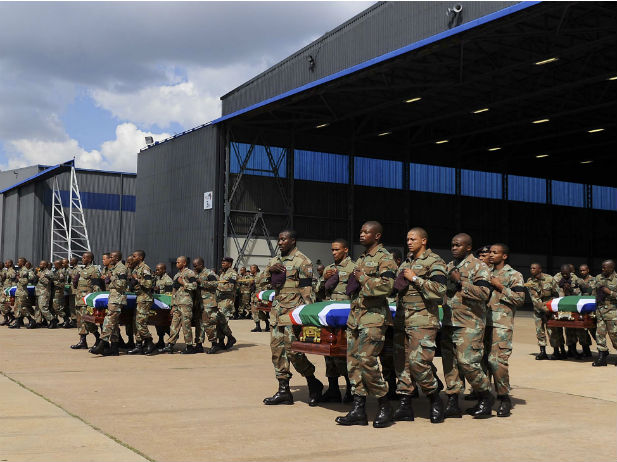
SADF funeral for CAR casualties

The AU will establish a new military force following a suggestion from South Africa, the international relations department has said.

“On Monday … the African Union summit [in Ethiopia] adopted a historic decision to establish the African Capacity for Immediate Response to Crises [ACIR], at the initiative of South Africa,” said spokesperson Clayson Monyela on Tuesday.

The proposal was made to tackle ongoing obstacles to peace and security which undermined democratically elected governments. The AU did not at the moment have an immediate response mechanism, as the process of implementing the African Peace and Security structure was ongoing, said Monyela.

The proposed ACIR was an interim measure, pending the African Standby Force’s commencement of operations and rapid deployment capability.

The ACIR was therefore not a new concept, but built on the principles of the African Standby Force. “This interim measure will further provide African countries with the flexibility to take concrete measures to address the challenges in the interim,” he said.

This would allow the process of getting the African Standby Force into operation to take place.

President Jacob Zuma told the summit that South Africa stood ready to provide support to deal with urgent matters of the continent.

Following South Africa’s pledge of assistance, other countries also pledged their support, and readiness, to contribute to the ACIR.Monyela said: “South Africa’s initiative has thus received broad consensus from member states of the African Union and has been adopted as a decision of the summit.”

Asked by Sapa whether any troop commitments had been made by South Africa at this stage, Monyela said that it was “running ahead of the process”. – Sapa