Anti-racism: an industry in decline

Brad Paisley and LL Cool J

Like coal mining in the Eighties, the anti-racism industry is in decline. Governments can no longer afford to subsidise “diversity workshops” for which there’s no demand. Especially from young people.

On both sides of the Atlantic, teenagers and students are giving the finger (as they might put it) to the hypersensitive race relations ideology drilled into them by their teachers. They laugh at jokes that, a decade ago, would have been regarded as racist. If, after a few drinks, one of their friends crosses the line into ethnic stereotyping, they’re more like to argue with them than to notify the campus police.

The disintegration of traditional anti-racism was brought home to Americans this week when Brad Paisley, a young country music star, and LL Cool J, a black rap artist, released a song entitled Accidental Racist. In it, Paisley clumsily tries to explain why he’s attracted to the Confederate flag. He sings: “I’m proud of where I’m from but not everything we’ve done/And it ain’t like you and me can rewrite history.”

Cool J replies: “Just because my pants are saggin’ doesn’t mean I’m up to no good /You should try to get to know me, I really wish you would… If you don’t judge my gold chains/ I’ll forget the iron chains.”

Cue melodramatic gasps of horror from progressive columnists. But what’s interesting is that most fans of Brad Paisley and LL Cool J (and there isn’t much overlap between the two groups) aren’t offended. A white singer takes grudging pride in the Confederate South? A black singer makes fun of his own sagging pants and refuses to harp on about slavery? Cool. Or at least, like, whatever.

This nonchalance confuses the elderly activists who, until recently, lumbered from one workshop to another, pocketing wads of cash in the process: “racial sensitivity” doesn’t come cheap.

I put those words in quotation marks because these bores did nothing to promote harmony. On the contrary, ethnic minorities were taught to be ultra-sensitive towards unintended slights (as opposed to real racism, which they didn’t need lessons in identifying).

As for white people, it was all about guilt-tripping. Chief executives booked themselves on reprogramming courses, patting themselves on the back. (One of the benefits of austerity, in my opinion, is that firms can no longer afford these feelgood exercises.) In schools, lessons focused relentlessly on race, with risible results. “Our English teacher would read poems by black authors in a Jamaican accent,” recalls a young colleague. “No one could keep a straight face.”

This readiness to mock pompous anti-racists isn’t evidence of hard prejudice. Old-style “racialism”, as it used to be called, is pretty much dead, in the sense that fewer and fewer of us are interested in the colour of people’s skin. The word “darkies” is antiquated as well as nasty. On the other hand, if young people of any background want to tease members of another group for its annoying or anti-social habits, then they go right ahead. And if they feel threatened by aggressive behaviour – for example by Islamists trying to segregate men and women at London University, as happened last month – then they won’t be silenced by right-on quangos.

I’m not denying that, in the heat of the moment, horrible things are said. This is what happens in a (mostly) colour-blind society that allows free speech, as opposed to one governed by the phoney etiquette of the grievance-mongers. But, in the words of the song, racism is increasingly accidental rather than intentional. Surely that’s progress. – Damian Thompson, From Saturday’s Daily Telegraph

Fear that DA ‘will bring apartheid back’

Helen Zille

Some South Africans fear that apartheid would return if the Democratic Alliance (DA) led the country, the party’s leader Helen Zille said on Saturday.

“When I travel around South Africa, it truly shocks me to hear that many

people think the DA would bring back apartheid if we won an election,” said Zille at a Democratic Alliance campaign in Alexandra, Johannesburg.

“There are a significant number of people who think the DA was responsible for apartheid, and that Helen Suzman (an apartheid activist who died in 2009) was a member of the ANC.”

Zille said DA members had to change the false perception people had about her party.

The campaign’s objective was to educate people about the history of the opposition party.

Zille gave a detailed background of how the party was formed and what its priorities were.

She said some DA members were also part of the struggle during apartheid, adding that the party had grown considerably in the last few years.

“The DA has grown so fast, because we have been able to convince people from many different backgrounds that racial nationalism is a dead-end, and that South Africa can only thrive as an open, opportunity society for all.” – SAPA

President Zuma’s comments regarding the impact of apartheid on South Africa’s present problems

FW de KlerkIn comments that he made to mark the 20th anniversary of Chris Hani’s assassination, President Zuma alluded to the recent debate regarding the impact of apartheid on the current problems confronting South Africa.

He said that “to suggest we cannot blame apartheid for what is happening in our country now, I think is a mistake, to say the least. We don’t need to indicate what it is apartheid did. The fact that the country is two in one – you go to any city, there is a beautiful part and squatters on the other side – this is not the making of democracy and we can’t stop blaming those who caused it.”

“While wanting to see change happening fast in every corner of the country, we are under no illusion that South Africa will automatically and comprehensively change in only 20 years. That is impossible. The legacy of apartheid runs too deep and too far back for the democratic administration to reverse it in so short a period.”

President Zuma’s remarks were a repetition of what has become a central refrain in ANC communication: that the legacy of the past – i.e. apartheid or “colonialism of a special kind” – is responsible for the triple crisis of inequality, unemployment and poverty. The remarks are usually accompanied by simplistic comparisons between whites who live in the “beautiful part” and blacks who live “on the other side.”

We are all the products of our past – and there can be no doubt that apartheid created serious distortions in the normal development process that black South Africans would otherwise have experienced. However, the roots of inequality and poverty are far more complex than that. They include, in particular, lack of access to decent education, employment and effective government services – all factors that have been within the sphere of government policy since 1994.

The inequality that characterised our society in 1994 may certainly be ascribed to the complex legacies of the past. However, the fact that, 19 years later, we are an even more unequal society is the consequence of the failure of government policy. Unacceptable levels of inequality have their roots – among other things – in:

  • the dismal performance of our education system caused overwhelmingly by government mismanagement and the depredations of SADTU;
  • the fact that almost 40% of black South Africans are unemployed – primarily as a result of rigid labour policies; policies and attitudes that discourage foreign and domestic investment and the refusal of COSATU to countenance competition in freer labour markets;
  • the inability of government to deliver decent services – which is attested to by service delivery protests throughout the country almost on a daily basis; and
  • the implementation of inappropriate policies to promote equality – which have greatly benefited the top 10% of the black population – but which have done nothing for the bottom 60%.

Attempts to blame these failures on “apartheid” will simply divert government and public attention from the urgent need to implement the kind of realistic solutions called for in the National Development Plan. They also serve intentionally or unintentionally to stir up racial animosities that we simply cannot afford. When President Zuma says that “we cannot  stop blaming those who caused it”, he is playing the very dangerous game of making whites the racial scapegoats for the manifest failures of his own government.

The reality is that many of the beautiful parts to which President Zuma refers are now increasingly inhabited by the emerging black elite and middle class. In 1995 whites accounted for 69% of those in the top earnings decile. By 2007 their share had diminished to 43%. By now it will be even smaller. The nature of the squatter camps is also changing: several are now inhabited by impoverished whites. The country may be “two in one” as President Zuma observes but they can no longer be simplistically characterised as ‘rich white’ and ‘poor black’.

Clearly we South Africans need to engage one another in frank discussions about the legacy of the past, the challenges of the present and  our vision for the future.

ISSUED BY THE FW DE KLERK FOUNDATION

CAPE TOWN, 12 APRIL 2013

Zuma, Manuel – ‘no quarrel over apartheid’

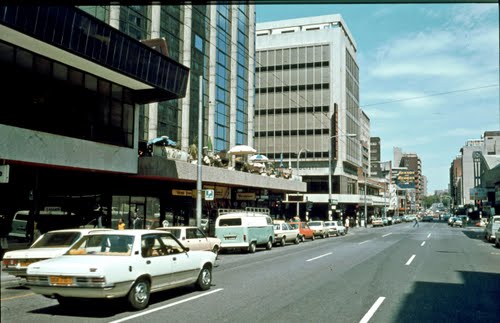
Legacy of apartheid... Johannesburg in the 1980s.

There is no contradiction between what President Jacob Zuma and Minister in the Presidency Trevor Manuel have said about the legacy of apartheid, the presidency said on Thursday.

“Stating that the apartheid legacy and impact still exists and will linger on for a long time does not mean that the president is saying that public servants should use it to excuse laziness and incompetence,” spokesman Mac Maharaj said in a statement.

“The point President Zuma made is that it is impossible to reverse the legacy of apartheid in only 20 years.”

During a wreath-laying ceremony to commemorate the 20 years since SA Communist Party leader Chris Hani was killed, Zuma commented on the statement that the government should stop blaming apartheid for its faults.

“To suggest we cannot blame apartheid for what is happening in our country now, I think is a mistake, to say the least,” he said, in an apparent reference to the comments made by Manuel.

“We don’t need to indicate what it is apartheid did. The fact that the country is two in one — you go to any city, there is a beautiful part and squatters on the other side — this is not the making of democracy and we can’t stop blaming those who caused it,” said Zuma.

Speaking to reporters on the sideline of a government leadership summit last week, Manuel said the government should take responsibility for its actions when it came to service delivery.

“We [the government] should no longer say it’s apartheid’s fault.

“We should get up every morning and recognise we have responsibility. There is no longer the Botha regime looking over our shoulder. We are responsible ourselves.”

Addressing public servants at the summit earlier, Manuel said the government had run out of excuses and had failed the people of South Africa repeatedly in terms of service delivery.

“We cannot continue to blame apartheid for our failings as a state,” he said in speech prepared for delivery.

“We cannot plead ignorance or inexperience. For almost two decades, the public has been patient in the face of mediocre services. The time for change, for ruthless focus on implementation has come.”

SACP deputy general secretary Jeremy Cronin reportedly said on Thursday that Manuel’s comments were taken out of context.

Cronin said Manuel’s remarks were intended to encourage civil servants to be proactive in delivering services.

During the wreath-laying, Zuma said: “While wanting to see change happening fast in every corner of the country, we are under no illusion that South Africa will automatically and comprehensively change in only 20 years. That is impossible.”

However, Zuma said as leaders of public servants, the government had to work harder, faster and more efficiently to ensure true freedom reached the poor and working class in a shorter time.

Maharaj said Manuel had also emphasised this.

“The impact of 300 years of apartheid and colonialism will be felt for many years to come, and since 1994 government has been working to reverse it. However, stating this fact, does not excuse laziness and inefficiency,” Maharaj said.

Opposition parties seemed to agree with Manuel’s comments that the government needed to take responsibility.

The Democratic Alliance said even though the material legacy of apartheid lived on, the slow rate of delivery could not be blamed on apartheid but on the government.

“The truth is that government has not delivered on these objectives fast enough,” DA national spokesman Mmusi Maimane said in a statement.

“Too many people still suffer from apartheid’s material legacy.”

He said Zuma should take responsibility for this and focus on improving service delivery so that the country could combat the evil legacy of apartheid.

United Democratic Movement leader Bantu Holomisa said although apartheid would be an important reminder of what not to do, the time was over for the ANC-led government to blame its failures on apartheid.

“Government has to take full responsibility for its failures and scandals such as the dysfunctional education system, the crumbling infrastructure, Sarafina II, the arms deal, the oilgate and Nkandlagate scandals, the [Andries] Tatane and Marikana incidents as well as the Central African Republic fiasco, among others,” he said. – Sapa

Bird flu or the American flu? Chinese allege ‘biological warfare attack’

A Chinese Air Force officer on Saturday accused the U.S. government of creating the new strain of bird flu now afflicting parts of China as a biological warfare attack.

People’s Liberation Army Sr. Col. Dai Xu said the United States released the H7N9 bird flu virus into China in an act of biological warfare, according to a posting on his blog on Saturday.

The charge was first reported in the state-run Guangzhou newspaper Southern Metropolis Daily and then picked up by several news outlets in Asia.

State Department spokesman Jason Rebholz dismissed the claim. “There is absolutely no truth to these allegations,” he told the Washington Free Beacon.

Seven deaths from the bird flu outbreak were reported as of Tuesday in state-run Chinese media. As many as 24 people reportedly were infected by the disease in Shanghai, Jiangsu, Zhejiang, and Anhui.

Chinese authorities are trying to calm public fears of a major epidemic, claiming there is no evidence the virus can be transmitted between humans.

The government also is claiming that the outbreak is not related to the recent discovery of thousands of dead pigs floating in a river in China.

The accusation of U.S. biological warfare against China comes as the Pentagon is seeking closer military relations with China. Army Gen. Martin Dempsey, chairman of the Joint Chiefs of Staff, is set to travel to China for talks with Chinese military leaders later this month.

Dai is a military strategist who in the past has been outspoken in seeking to foment conflict between China and the United States. He told the Global Times in August that China should go to war over U.S. support for Japan’s claims to the disputed Senkaku Islands.

Writing on Sina Weibo, a Chinese microblogging site akin to Twitter, Dai stated that the new bird flu strain was designed as a biological weapon similar to severe acute respiratory syndrome (SARS), which he also claimed was developed as a U.S. bio-weapon, that affected the country in 2003.

According to Dai’s posting, the new flu outbreak should not be a cause for concern. “The national leadership should not pay too much attention to it,” the PLA lecturer at the National Defense University wrote. “Or else, it’ll be like in 2003 with SARS!”

“At that time, America was fighting in Iraq and feared that China would take advantage of the opportunity to take other actions,” he said. “This is why they used bio-psychological weapons against China. All of China fell into turmoil and that was exactly what the United States wanted. Now, the United States is using the same old trick. China should have learned its lesson and should calmly deal with the problem.”

Dai said that even if “a few may die” from the flu outbreak, it will not equal one-thousandth of the deaths caused by vehicle accidents in China.

Dai in the past has called for China to punish the United States for U.S. arms sales to rival Taiwan, by selling arms to U.S. enemies. “China recognizes that a few perfunctory protests will not have any effect,” Dai said in 2010. “China can’t directly sanction American arms companies since they did not do business with China … but China can sanction companies that are doing business with China directly, like Boeing or General Electric.”

Dai also has said the United States has used crises with North Korea and offers of cooperation on the issue as a plot to drive a wedge between Beijing and its fraternal communist ally.

Dai also has said U.S. efforts to counter Chinese espionage and intelligence-gathering were part of a U.S. “plot theory” of “western countries threatening others by [releasing] information gained through spying in order to damage the reputations of other countries.”

A State Department official said China notified the World Health Organization (WHO) on March 31 about its first detected human cases of H7N9 infection. Fourteen cases were confirmed by the WHO by April 5, of which six were fatal. The organization said there is no evidence of human-to-human transmission.

“U.S. Embassy Beijing and U.S. Consulate Shanghai are monitoring the situation, working closely with counterparts at the U.S. Centers for Disease Control, and the Beijing and Shanghai municipal governments,” the official said.

The colonel’s accusation provoked a widespread response on Chinese websites. One post in reaction joked that Dai’s comment about auto deaths must mean that the United States and Germany are responsible for a conspiracy to produce cars, according to a report in Hong Kong’s South China Morning Post.

Luo Changping, deputy editor of Caijing, said most PLA soldiers would not support Dai’s comments and he urged the colonel to resign and apologize to those who have died from the current bird flu outbreak.

A defiant Dai then said in a new posting Sunday that “it is common knowledge that a group of people in China have been injected with mental toxin by the United States.”

“Now, a group of fake American devils are attacking me,” he wrote in another post. “I will not retreat even half a step.”

Analysts say the colonel’s remarks are a reflection of the growing xenophobic atmosphere within the Chinese military that views the United States as its main enemy.

Former State Department intelligence analyst John Tkacik said China’s military was largely to blame for mishandling the 2003 outbreak of SARS. Tkacik said there was speculation when the epidemic began that “the PLA suspects SARS had emanated from its own biological laboratories and was all the more eager to keep it secret.” China is known to have a covert biological arms program.

“Col. Dai Xu is a shameless liar when he accuses the United States of using bio weapons,” Tkacik told the Free Beacon. “He’s probably motivated by a desire to exculpate the PLA for their mishandling of the epidemic—no doubt most Chinese have happily forgotten the episode—as much as by a cynical xenophobia. But, that’s what passes for deep strategic thought at China’s National Defense University these days.”

The Pentagon has been trying with varying success to develop closer ties to the Chinese military as part of a strategy aimed at building trust. However, China’s military leaders believe the U.S. offers of closer ties are a ruse designed to contain China’s growing military buildup.

Defense Secretary Chuck Hagel spoke by phone with China’s Defense Minister Gen. Chang Wanquan on April 2. Chang is the No. 4 defense official after Chinese President Xi Jinping and two other generals who run the Central Military Commission, the Communist Party’s ultimate power organ.

“The leaders both expressed their intention to work together to continue to build a military-to-military relationship that serves the vision of both President Obama and President Xi,” Pentagon press secretary George Little said in a statement after the call.

“The secretary discussed the importance of focusing on areas of sustained dialogue, practical areas of cooperation, and risk reducing measures,” he said.

U.S. ties with China are strained due to China’s reluctance to rein in neighboring North Korea.

China provides North Korea with large amounts of fuel oil and other goods. However, Beijing has not taken steps to pressure Pyongyang using its economic leverage during the ongoing crisis.

The flu has lit up China’s thriving Internet, according to analysts. Over 945,600 microblog postings addressed the flu between April 8 and 9. Since the outbreak began some seven days ago, between 1.3 million and 3 million postings were put online on outlets including Sina Weibo and QQ Weibo.

Tens of thousands of users expressed doubts about the official Shanghai municipal government’s denial of any link between the dead pigs found floating last month in the region’s Huangpu River.

The proximity to the initial outbreak in Shanghai and the river has led to speculation that the pig deaths may have been linked to the flu virus jumping from animals to humans.

That speculation was fueled by reports that one of the victims of the flu was a pig butcher.

The avian flu strain is similar to an earlier outbreak with a significant difference: The current strain does not kill the birds it infects, making it more difficult to identify infected poultry.

The Shanghai government waited 20 days before announcing the first H7N9 infection on March 31. – The Washington Free Beacon

Merit must trump race

A war of words erupted at the Judicial Service Commission yesterday after a senior judge argued that merit should trump gender and race as considerations for appointment to the bench.

Eastern Cape High Court judge Clive Plasket, one of three candidates vying for two seats in the Supreme Court of Appeal, crossed swords with commissioners, including Justice Minister Jeff Radebe, who said his approach would set back efforts to transform the judiciary.

Plasket, a human rights lawyer since the 1980s who defended many political detainees, faced a barrage of questions from commissioner Dumisa Ntsebeza over the principle of appointing experienced white male judges over less experienced black women.

Plasket said gender considerations should not be used to sideline experienced white men.

“The fact that the one candidate is female, I would suggest, isn’t good enough to trump merit . It becomes a lot trickier when the merit gap is a lot closer.”

He said in instances in which a white male judge had 70 published judgments while a black female judge had six unpublished judgments, the appointment of the white male would be completely justified.

Plasket’s comments follow a report penned by commissioner Izak Smuts accusing the JSC of interviewing white men only as a formality, with no intention of recommending them as judges.

“If the majority view is that . white male candidates are to be considered for appointment in only exceptional circumstances, the JSC should, at the very least, come clean and say so, so that white male candidates are not put through the charade of an interview before being rejected,” he wrote.

His report was to be discussed by the commission behind closed doors.

[…]

“Once you find yourself with only white male candidates, I can’t see any basis upon which you can refuse to appoint a suitably qualified person,” said Plasket.

Chief Justice Mogoeng Mogoeng interjected, saying appointing only experienced white men to the bench would set back transformation: “When then are we ever going to transform the judiciary, if we are committed to it?”

Plasket retorted by saying failing to fill vacancies simply because “the wrong race” had applied would have a detrimental effect on the administration of justice.

“I can imagine that the imperative of the administration of justice also kicks in.”

[…]

Plasket is contesting Johannesburg High Court Judge Nigel Willis and Judge Halima Salduker, an acting judge in the appeal court.

[…]

The JSC will this week interview hopefuls for positions at the Electoral Court, the Competition Appeal Court and several high courts. – timeslive.co.za

Looters dancing on Thatcher’s grave

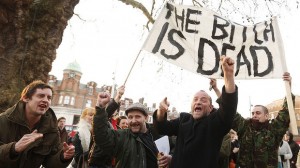
Revellers in Brixton staged a street party to celebrate Margaret Thatcher’s death, culminating in arrests and an attack on a local charity shop.

Around 100 hundred people were out on the streets to celebrate the death of former the former prime minister, whose death from a stroke was announced on Monday.

A board at the famous Ritzy cinema in Windrush Square was hijacked by partygoers who swapped the letters to read ‘Margaret Thatcher’s Dead.’

Smashed glass was strewn on the street after the window of charity shop Barnardos was kicked in during ugly scenes.

Police officers trying to keep order were attacked, with extra numbers drafted in to stop revellers spilling out on to the roads and causing traffic delays.

Two women were arrested on suspicion of burglary and spent the night in cells after Barnardos was targeted during celebrations.

Reporter Ewan Palmer was at the scene. He said: “There was the notion that this morbid celebration has been planned in thousands of people’s heads for more than 30 years.

“Police stood by and watched as more and more people arrived with their drink and banners mocking her death. Shouts of ‘Maggie, Maggie, Maggie! dead, dead, dead!” rang around gleefully.

“Chalk was handed out so people could graffiti their own message on the ground and surrounding walls.

“There were even two guys playing double bass and acoustic guitar in the crowd for a singalong. At the start of the evening, the whole thing resembled a middle-class music festival more than a raucous demo.

“Almost inevitably after a few hours of people drinking in the streets, this escalated into scenes of unrest between people and riot police, resulting in arrests and even serious injury.”

The revellers downed alcohol and brandished placards reading “The bitch is dead” and ‘Rejoice Thatcher is dead.’ Many revellers appeared younger than the 23 years which have passed since Thatcher left office.

A Scotland Yard spokesman said: “Police dealt with a group of approximately 100 people in Brixton who caused low-level disorder including throwing missiles at officers.

“In order to protect the community and to ensure the highways remained clear, extra officers were deployed.

“Two women were arrested after being found inside a shop in Brixton. They remain in custody.” – IBT

Thatcher’s death divides

Former British Prime Minister Margaret Thatcher was an “attractive” woman, who did more to help South Africa to “get rid of apartheid” than any other leader in her time, former foreign affairs minister Pik Botha said yesterday.

Thatcher died yesterday following a stroke. She was 87.

Botha, who served as the last foreign minister of the apartheid government, said while Thatcher was a staunch opponent of apartheid, she “listened”, and “understood” the issues that South Africa faced in abolishing it.

“She and [US President] Ronald Reagan did more to move South Africa to get rid of apartheid and towards a new constitution than any other leader outside the country,” said Botha, who served in the first post-apartheid government from 1994 to 1996 under President Nelson Mandela. He joined the ANC in 2000, but later criticised some of its policies.

The ANC’s tribute to Thatcher differed sharply from Botha’s in its assessment of her role in the dismantling of apartheid.

Though acknowledging that she was a major leader on the world stage, the ruling party said: “The ANC was on the receiving end of her policy in terms of refusing to recognise the ANC as the representatives of South Africans and her failure to isolate apartheid after it had been described as a crime against humanity.”

Botha met Thatcher in the early 1970s when he and other officials were invited to the UK. He later had several run-ins with her, when the two countries clashed on issues such as the Falklands war and the deportation of the “Coventry Four”, a group of South Africans arrested in London while attempting to smuggle arms to South Africa.

But, said Botha, “she helped me in so many ways to keep South Africa going internationally”.

He remembers a “historically critical moment”, on April 1 1989 – the day UN Resolution 435 was to have been implemented in then South West Africa (Namibia). The resolution was a UN-adopted proposal for a ceasefire between the South African Defence Force and the People’s Liberation Army of Namibia, and a UN-supervised election in the country.

“[Thatcher and I] met at Windhoek Airport and we heard that Swapo had come over the [Namibia/Angola] border in their thousands, heavily armed,” said Botha.

“Our troops were contained in their barracks, and she said [that] under no circumstances were we allowed to release them to fight the incursion. But she then helped me persuade UN Secretary-General Pérez de Cuéllar to allow the SADF troops to fight the incursion. If our troops weren’t freed to repel them then South West Africa would not have gone to elections peacefully,” said Botha. “Her death saddens me tremendously,” he added.

ANC spokesman Jackson Mthembu said: “Her tenure as prime minister redefined British politics and public administration and these impacted greatly on European politics and governance. Long after her passing on, her impact will still be felt and her views [will be] a subject of discussion.”

Former president FW de Klerk said Thatcher was a steadfast critic of apartheid. But, he added: “She consistently, and correctly, believed that much more could be achieved through constructive engagement with the South African government than through draconian sanctions and isolation.”

Social media was overflowing with people writing “Ding Dong!” in reference to the Wizard of Oz song, and posting pictures of themselves drinking in celebration of “Margaret Thatcher Death Day”.

Hundreds of people took to the streets in Brixton, an area of south London in Britain which suffered serious rioting in the 1980s, to celebrate Lady Thatcher’s death. Holding notices saying ‘‘Rejoice – Thatcher is dead’’, about 200 people gathered in the neighbourhood, a hotspot of alternative culture, and toasted her passing by drinking and dancing to hip-hop and reggae songs blaring from sound systems.

‘‘I’m very, very pleased. She did so much damage to this country,’’ said one man brandishing an original newspaper billboard from 1990 announcing Thatcher’s resignation. Others scrawled ‘‘Good Riddance’’ on the pavement.

‘‘We’ve got the bunting out at home,’’ said Clare Truscott, a woman in her 50s wearing a sparkly beret and holding a homemade sign reading ‘‘Ding dong, the witch is dead’’.

‘‘I’m from the north, where there were no jobs, where the industry was rapidly disappearing, and her policies ensured it went more quickly.’’

Brixton was the scene of fierce riots in 1981, two years after Lady Thatcher became prime minister. Carole Roper, a full-time carer in her 50s from north London, said: ‘‘We’re here to celebrate her death.’’

Sipping from a can of beer, she insisted: ‘‘I don’t think it’s vindictive. It’s not so much about the death of Thatcher but what she has done, the policies she introduced to this country.‘‘

Compare the coverage to that when Chavez died – she’s being eulogised. It’s been wall to wall coverage on the BBC, but she did nothing to help the poor people of this country.’’

In the Scottish city of Glasgow more than 300 people gathered to hold their own impromptu ‘‘party’’. Anti-capitalist campaigners shouted, ‘‘Maggie, Maggie, Maggie’’ while the crowd replied ‘‘dead, dead, dead’’.

Among her old foes many – at least temporarily – laid aside old grudges and paid public tribute to her achievements as Britain’s first female prime minister.

But others did not hesitate to express their continuing disgust and anger at Lady Thatcher’s policies and her (in their words) disastrous, divisive impact on Britain’s industry and people.

George Galloway, the Respect member of parliament for Bradford West and former Labour firebrand, led the charge with a simple Tweet: “Tramp the dirt down”.

It was a reference to a 1988 Elvis Costello song of the same name, a virulent attack on the then prime minister that contains the lines “when they finally put you in the ground / I’ll stand on your grave and tramp the dirt down.”

Mr Galloway added on Twitter: “Thatcher described Nelson Mandela as a ‘terrorist’. I was there. I saw her lips move. May she burn in the hellfires.”

His Twitter feed quickly became an echo chamber for criticism of Thatcherite policies, which one commenter said were “selling off public utilities, encouraging personal greed and befriending murderous dictators”.

On Facebook, a campaign was launched to take the Wizard of Oz song ‘Ding Dong! The Witch is Dead‘ to No. 1. – AFP, additional reporting by Sapa

IN HER OWN WORDS

“I don’t think there will be a woman prime minister in my lifetime.” – as Education Secretary in 1973. She became Britain’s first woman prime minister in 1979.

Where there is discord, may we bring harmony. Where there is error, may we bring truth. Where there is doubt, may we bring faith. And where there is despair, may we bring hope.” – Quoting St Francis of Assisi, on her 1979 election victory.

“I am not a consensus politician. I’m a conviction politician.” – 1979

“I don’t mind how much my ministers talk, as long as they do what I say.” – 1980

“We had to fight the enemy without in the Falklands. We always have to be aware of the enemy within, which is much more difficult to fight and more dangerous to liberty.” – On the 1984-85 miners’ strike, which provoked some of the fiercest union opposition to her policies.

“To those waiting with bated breath for that favourite media catch phrase, the U-turn, I have only one thing to say: You turn if you want to. The lady’s not for turning.” – At the 1980 Conservative Party conference to colleagues urging her to soften her economic policies which were raising unemployment.

“This is a day I was not meant to see.” – To reporters the day after surviving a deadly 1984 Irish Republican Army bomb attack on the Conservative Party conference.

“We have become a grandmother.” – On the birth of her first grandchild, 1989.

“No! No! No!” At the House of Commons in 1990, the climax of an anti-European outburst that moved Geoffrey Howe to quit as deputy prime minister and deliver a resignation speech which called for her to be challenged for her job.

“I fight on, I fight to win.” – In November 1990, after failing to win enough votes to avoid a second round in the Conservative leadership contest. She resigned the next day.

“It’s a funny old world.” – On her decision to quit in 1990. – Reuters

Frozen arm of murder victim waved about

Two men and a woman have been arrested for the alleged murder of a woman in Makhado in Limpopo, police said on Sunday.

“Shoppers at a… shop in Makhado [on Saturday] were shocked when a man stormed into a shop, reached for a freezer where he took out a human arm and started waving with it,” said Brigadier Hangwani Mulaudzi.

“The police were then notified and the man was arrested on the spot.”

The man told police he went to the shop to demand a share of R70,000 and a car he was promised for his role in the murder by the owner and his wife.

The 38-year-old man from Thengwe village then led the police to a nearby mountainous area where a mutilated body of a woman was found.

The woman’s arm, eyes and private parts were missing.

The man told police the Pakistani woman was allegedly killed on Wednesday after being made to believe she was going to a prayer meeting organised for her.

Police are also looking for the woman’s boyfriend who was allegedly implicated in the murder.

The man, the shop owner, 62, and his wife, 60, are expected to appear in the Makhado Magistrate’s Court on Monday. – SAPA

WikiLeaks exposes Kissinger era

The whistleblowing website WikiLeaks was on Monday to publish more than 1.7 million United States diplomatic and intelligence documents from the 1970s, founder Julian Assange revealed.

The website has collated a variety of records including cables, intelligence reports and congressional correspondence and is releasing them in a searchable form.

Assange has carried out much of the work from his refuge in Ecuador’s embassy in London and told the domestic Press Association that the records highlighted the “vast range and scope” of US influence around the world.

Assange has been holed up in the tiny diplomatic mission for nine months as he seeks to avoid extradition to Sweden over allegations of rape and sexual assault, which he denies.

WikiLeaks sent shockwaves around the diplomatic world in 2010 when it released a set of more than 250 000 leaked US cables.

The new records, dating from the beginning of 1973 to the end of 1976, have not been leaked and are available to view at the US national archives. They include many communications which were sent by – or to – then-secretary of state Henry Kissinger.

Many of the documents, which WikiLeaks has called the Public Library of US Diplomacy (PlusD), are marked NODIS (no distribution) or Eyes Only, while others were originally marked as secret.

Assange fled to the Ecuadorian embassy in June after losing his battle in the British courts against extradition to Sweden.

Ecuador granted him asylum in August, but Britain has refused to allow him safe passage out of the country, sparking a diplomatic stalemate.

Assange founded the WikiLeaks website that enraged Washington by releasing cables and war logs relating to the wars in Iraq and Afghanistan in one of the biggest security breach in US history. – Sapa-AFP

Why SA pays more for power

The reason why theSouth African consumer has to pay more for electricity, lies with the corrupt dealings between the Chamber of Mines and BHP Billiton.

About BHP Biliton’s power contracts with Eskom, Xolani Mkhwanazi warnes that BHP Biliton “expects  contracts to be honoured”. Mkhwanazi also happens to be chairman of BHP Biliton SA.

The same Mkhwanazi was CEO of the National Energy Regulator.

Mr Chris Yelland has pointed out that some of the BHP power contracts had to be approved by this National Energy Regulator as required by law. The NER was established in 1995. The NER was the legal predecessor of the 2004 NERSA.

Xolani Mkhwanazi was the CEO of NER from 1999 till 2004. During this time period the NER would have approved the extensions from 2020 to 2028 of the Hillside 1 and II power contracts. At the time 2020-2028 was so far into the future, that the extensions were irrational. Would Mkhwanazi in his honest mind claim that by 2020, South-Africa would still not be utilising Eskom’s surplus capacity of 2000?

Also during same time period Mozal I and Mozal II smelters in Mozambique were approved by the NER. By then there was already a huge surplus capacity of primary aluminium ingot smelting for off-take by the local industry. Thus the long term Mozal power contracts were irrational too.

Readers must not forget: all of BHP Biliton’s aluminium smelters at Southern African ports import all of their ore from BHP-bauxite mines in Australia on the other side of the globe. South-Africa has the bulk of the worlds chrome ore, none of its aluminium ore. South-Africa also produces its own reducdant for ferrochrome smelting. All reductant for all of BHP’s import aluminium ore is imported, mostly from the USA.

How come then Mkhwanazi, former CEO of the NER, approving unique power contracts between Eskom en BHP Biliton, later CEO of BHP Billiton Aluminium South-Africa, now chairman of BHP Billiton SA, is also chairman of the South-African Chamber of Mines? With the hundreds of thousands of tons of imported aluminum ore per annum, Mkhwanazi should have been chairman of Australia’s Chamber of Mines.

Eskom has asked NERSA to review the BHP Biliton power contracts. Within 2 months, NERSA will hold public hearings in this regard. The NER as legal predecessor of NERSA, who had approved these controversial contracts will come into the spotlight. So will the chairman of BHP Biliton SA, Xolani Mkhwanazi’s former position as CEO of the NER, during the time period when most of these controversial contracts and their irrational extensions were approved by the NER.

Jacob Mouw

How $700 million in Katrina relief money went missing

Where did all the money go?

“Your guess is as good as mine,” David Montoya, the inspector general of the Department of Housing and Urban Development, says of $700 million in missing taxpayer money that Louisiana homeowners were given in the wake of Hurricane Katrina to elevate and protect their homes from future storms.

A new report released from the inspector general’s office shows that more than 24,000 homeowners who received grants of up to $30,000 to elevate their homes either misspent or pocketed the money.

“The fact of the matter is that the money they received was for a specific purpose and the specific purpose was to elevate these homes to avoid future catastrophes,” Montoya tells Power Players.

He rates the home elevation program as little more than a complete failure.

“Considering there was just under $1 billion earmarked for this particular program and there’s $700 million that wasn’t used for that, I’d give it a very low D,” he says.

But the lessons learned from the failed home elevation project provides a useful roadmap as Congress moves to offer recovery funds to victims of Hurricane Sandy.

“Clearly, to give money out on the front end right after a disaster, when many of these people lost everything, with a promise to do something down the road, I think is counterproductive to what the program was designed to do,” says Montoya.

Montoya says his office will recommend that, for future disaster relief programs, funds are disbursed to individuals only after the project has been completed.

To hear more of the interview with the inspector general, including his explanation of why the government likely will never get the money back, check out this episode of Power Players. – YahooNews

Eurozone unemployment hits all-time high: 19 million out of work

European unemployed queuing up in front of employment office

Eurozone unemployment levels have hit 12 percent – the highest in the history of eurozone record-keeping, since the currency was launched in 1999.

The average unemployment rate across the eurozone’s 17 constituent European Union countries rose from January’s initial 11.9 percent high to 12 percent in February, meaning a further 33,000 people were put out of work. Overall, 19.071 million are jobless across Europe.

Some countries, including Spain and Greece suffered unemployment rates as high as 26 percent over the month of February.

Spain and Greece have both been shaken by violent protests, with Greece experiencing a massive increase in suicides and attempted suicides in 2010 and 2011.

Conversely, the lowest unemployment rates are still to be found in Luxembourg (5.5 percent), Germany (5.4 percent), Austria (4.8 percent) and the Netherlands (6.2 percent).

Youth unemployment (under-25s) has also soared, leaving 5.694 million out of work in the EU 27 (3.581 million of whom were in the euro area).

In Greece, the figure of unemployed under-25s borders on 60 percent, while in Spain, 55.7 percent of the nation’s youth are still out of work.

In January, unemployment in the eurozone had reached a previous record high of 11.8 percent, according to the original Eurostat report, meaning it is continuing to rise, fueling concerns over the region’s economic crisis.

Some economic experts had forecast the rise in unemployment, especially after the earlier January figure was later revised upwards, to verge on 12 percent.

As the statistics relate to February, they do not yet take the impact of Cyprus’ bailout into account.

A separate survey, also released on Tuesday, indicated that the eurozone recession continued in the first quarter.

Within the last two weeks, Markit’s chief economist Chris Williamson aired serious concerns to AFP.

“Instead of the eurozone economy stabilizing in the second quarter, as many – including the ECB – have been hoping to see, the downturn could therefore intensify in coming months,”  he said, expressing unease over the prospect.

The eurozone PMI shrank in March. Although not as bad as estimated a couple of weeks ago, the PMI stood at 46.8 points in the most recent survey. A figure below 50 is indicative of economic contraction. The overwhelming worry is that manufacturing activity has weakened across the region.

While there has been steady trade and good gains with non-EU countries, the drag on manufacturing order from within the eurozone is still significant.

Spanish manufacturing hit an especially steep slump in February, which follows news that the government plans to revise its economic forecasts for 2013, from an initially anticipated 0.5 per cent decline to a 1 per cent decline.

They Cyprus crisis in the last week of March seems to have had little overall impact so far. However, its effects could potentially strike later on in the year.

“While in some respects it is reassuring to see the events in Cyprus did not cause an immediate impact on business activity, the concern is that the latest chapter in the region’s crisis will have hit demand further in April,” Chris Williamson told Reuters on Tuesday.

Tutu wins $1.7 million prize

Anti-apartheid icon Desmond Tutu, the former archbishop of Cape Town, was awarded the $1.7-million Templeton Prize for his lifelong work to promote “love and forgiveness”.

The 81-year-old Nobel peace laureate, who rose to fame in the 1980s as a vocal opponent of South Africa’s white-minority apartheid regime, will be presented with the award at a ceremony in London on May 21.

The Templeton Prize, one of the world’s largest annual awards, is given each year to a living person who has made “an exceptional contribution to affirming life’s spiritual dimension”.

Last year’s winner was the Dalai Lama, Tibet’s spiritual leader, who gave the money to charity.

Tutu thanked “all the wonderful people who accepted me as their leader at home” for the prize, which is administered by the US-based Templeton Foundation.

“When you are in a crowd and you stand out from the crowd it’s usually because you are being carried on the shoulders of others,” he said.

The Templeton Foundation hailed Tutu’s “deep faith and commitment to prayer and worship”.

The prize was set up in 1972 by the late investor and philanthropist John Templeton. Its first winner, in 1973, was Mother Teresa.

Tutu spoke out vigorously against apartheid during the years when Nelson Mandela was in prison. He won the 1984 Nobel Peace Prize for his work, which he said has always been motivated by religion.

When Mandela became president he chose Tutu to chair South Africa’s Truth and Reconciliation Commission, which investigated crimes committed by all sides during apartheid.

Tutu has since given advice to communities elsewhere seeking reconciliation in the wake of conflict, including Northern Ireland and the Solomon Islands.

Cape Town’s St George’s Cathedral, where Tutu served as archbishop from 1986 to 1996, will host its own celebration of the prize on April 11. – France24