France has announced it will vote in favor of recognition of Palestine as a non-member observer state at the UN General Assembly later this week.
The French Foreign Minister Laurent Fabius told parliament that France “will respond ‘yes’” when the issue is put on a vote at the UN General Assembly.
France, a permanent UN Security Council member, is the first European country to speak in favor of elevating Palestinian status from an observer to a nonmember observer state.
The United States, which opposes the Palestinian bid for statehood, publicly disagreed with France’s move. State Department spokeswoman Victoria Nuland said Paris’s decision would not change the US assessment of the Palestinian action as a “mistake.”
“With regard to France and any other countries, we obviously disagree with our oldest ally on this issue,” she told reporters. “They know that we disagree with them. But it’s their sovereign decision.”
The Austrian foreign ministry also said Tuesday it would back the Palestinian bid and claimed that more than half of the European Union’s 27 member states would vote for the proposal, AFP reported.
Meanwhile, the UK says it is ready to support the PA in their current bid to become a non-member observer state if the Palestinians comply with three conditions, The Telegraph reports.
British Foreign Secretary William Hague allegedly requested Palestinian President Mahmoud Abbas, pledge not to join the International Criminal Court after its UN status is upgraded, not to apply for full membership at the UN and to resume peace negotiations with Israel without any preconditions.
At the moment the PA refuses to negotiate with Israel until it halts the expansion of Jewish settlements in the occupied West Bank and East Jerusalem territories.
On Thursday, the Palestinians will officially ask the assembly to upgrade their status. Earlier the Palestinian Authority said it expected the assembly to vote two-thirds in favor of granting the PA non-member status, seeing the move as an important step toward a two-state solution with Israel.
Israel strongly opposes the bid. Previously Tel Aviv said it objects to any wording the PA would bring for a vote at the assembly.
But as Israeli authorities were unable to block the bid they have changed their stance and now are trying to soften the wording, Haaretz reported on Tuesday citing a senior Israeli official.
The article states Tel Aviv and Washington are working together to change the document.
Last year, Washington used its veto power to block a Palestinian bid for statehood at the UN Security Council. A similar move is unlikely in this case as there are no vetoes in the General Assembly. – RT
While Obama carried the youth vote overall, his support declined from 2008 among all young voters and among key subgroups. In particular, Obama lost ground among young whites, men and independents.
Only 44% of white voters under 30 backed Obama, while 51% voted for Romney. This is a substantial change compared with 2008, when Obama carried the young white vote by 10 points (54% to 44%). Far more young blacks and Hispanics backed Obama than Romney, and there was little fall off in his support among these groups from 2008.
Obama also lost support among young men. Overall, 53% of men under 30 supported Obama, down from 62% in 2008. Fully 66% of young women voted for Obama, similar to the 69% who voted for him in 2008.
However, Obama lost support among both white men and women. Overall, 41% of white men supported Obama while 54% supported Romney. In 2008, Obama won the vote among white men, 52% to 46%. While white women voted for Obama over McCain by a 56% to 42% margin four years ago, they were divided this year (48% voted for Obama, 49% for Romney).
Surprisingly, Obama’s vote also declined among young black men, by 14 points, while holding steady among young black women. – Pew Reasearch
Researchers at King’s were investigating links between the likelihood of a heart attack or stroke and the state of the brain.
Data about the health and lifestyle of a group of over-50s was collected and brain tests, such as making participants learn new words or name as many animals as they could in a minute, were also performed.
They were all tested again after four and then eight years.
The results showed that the overall risk of a heart attack or stroke was “significantly associated with cognitive decline” with those at the highest risk showing the greatest decline.
It also said there was a “consistent association” between smoking and lower scores in the tests.
One of the researchers, Dr Alex Dregan, said: “Cognitive decline becomes more common with ageing and for an increasing number of people interferes with daily functioning and well-being.
“We have identified a number of risk factors which could be associated with accelerated cognitive decline, all of which, could be modifiable.”
Dr Simon Ridley, from Alzheimer’s Research UK, said: “Research has repeatedly linked smoking and high blood pressure to a greater risk of cognitive decline and dementia, and this study adds further weight to that evidence.
“Cognitive decline as we age can develop into dementia, and unravelling the factors that are linked to this decline could be crucial for finding ways to prevent the condition.
“These results underline the importance of looking after your cardiovascular health from mid-life.”
The Alzheimer’s Society said: “We all know smoking, a high blood pressure, high cholesterol levels and a high BMI [Body Mass Index] is bad for our heart. This research adds to the huge amount of evidence that also suggests they can be bad for our head too.
“One in three people over 65 will develop dementia but there are things people can do to reduce their risk. – BBC
Move over, “Everything is bigger in Texas.” The Lone Star state has a new favorite bumper sticker and it’s a simple one-worder: “Secede.” Yes, it appears that “secession fever,” as some columnists are calling it, has taken over the red-leaning state following the post-election petitions — and sales of the stickers are just one sign. Among others, a perennial GOP candidate named Larry Scott Kilgore has announced he’s running for governor and will legally change his name to Larry SECEDE Kilgore — yes, with “secede” in all-caps. His web page also declares, “Secession! All other issues can be dealt with later.”
Meanwhile former Florida governor Jeb Bush met Monday with a group of his former staffers at the J. W. Marriott hotel on Pennsylvania Avenue, just steps from the White House. Bush, a potential 2016 presidential contender, spent an hour in the hotel’s Cannon room, reminiscing and entertaining questions about his political future.
In an interview with NRO, Bush did not rule out a presidential run. “I am here to catch up with folks and promote education reform,” he said, smiling.
When asked again whether he will issue a Sherman-type statement about his future, Bush remained coy. “We have an alumni group that I like keeping in touch with,” he said. “I’m here to focus on educational reform, and that’s what I’m going to tell people.”
Neil Newhouse, Mitt Romney’s campaign pollster, was at the meeting, as were several veteran Florida operatives.
On Tuesday, Bush will host a national summit on education reform. Education secretary Arne Duncan, former secretary of state Condoleezza Rice, and Indiana governor Mitch Daniels will speak at the event.
Will Jeb be the man to stay in the Union? -msn.com/nationalreview
Over the next four years the U.S. will face a number of foreign policy problems, most of them regional, some of them global. Dispatches From The Edge will try to outline and analyze some of the key issues for Africa.
Africa is probably the single most complex region of the world and arguably its most troubled. While the world concerns itself with the Syrian civil war and the dangers it poses for the Middle East, little notice is taken of the war in the Congo, a tragedy that has taken five million lives and next to which the crisis in Syria pales.
Africa represents 15 percent of the world’s population, yet only 2.7 percent of its GDP, which is largely concentrated in only five of 49 sub-Saharan countries. Just two countries—South Africa and Nigeria—account for over 33 percent of the continent’s economic output. Life expectancy is 50 years, and considerably less in those countries ravaged by AIDS. Hunger and malnutrition are worse than they were a decade ago.
At the same time, Africa is wealthy in oil, gas, iron, aluminum and rare metals. By 2015, countries in the Gulf of Guinea will provide the US with 25 percent of its energy needs, and Africa has at least 10 percent of the world’s known oil reserves. South Africa alone has 40 percent of the earth’s gold supply. The continent contains over one-third of the earth’s cobalt and supplies China—the world’s second largest economy—with 50 percent of that country’s copper, aluminum and iron ore.
But history has stacked the deck against Africa. The slave trade and colonialism inflicted deep and lasting wounds on the region, wounds that continue to bleed out in today’s world. France, Britain, Germany, Italy, Spain and Portugal sliced up the continent without the slightest regard for its past or its people. Most of the wars that have—and are—ravaging Africa today are a direct outcome of maps drawn up in European foreign offices to delineate where and what to plunder.
But over the past decade, the world has turned upside down. Formerly the captive of the European colonial powers, China is now Africa’s largest economic partner, followed closely by India and Brazil. Consumer spending is up, and the World Bank predicts that by 2015 the number of new African consumers will match Brazil’s.
In short, the continent is filled with vibrant economies and enormous potential that is not going unnoticed in capitols throughout the world. “The question for executives at consumer packaged goods companies is no longer whether their firms should enter the region, but where and how” says a report by the management consultant agency A.T. Kearney. How Africa negotiates its new status in the world will not only have a profound impact on its people, but on the global community as well. For investors it is the last frontier.
The U.S. track record in Africa is a shameful one. Washington was a long-time supporter of the apartheid regime in South Africa and backed the most corrupt and reactionary leaders on the continent, including the despicable Mobutu Sese Seko in the Congo. As part its Cold War strategy, the U.S. aided and abetted civil wars in Mozambique, Angola, and Namibia. Americans have much to answer for in the region.
Militarization
If there is a single characterization of US policy vis-à-vis Africa, it is the increasingly militarization of American diplomacy on the continent. For the first time since WW II, Washington has significant military forces in Africa, overseen by a freshly minted organization, Africom.
The US has anywhere from 12,000 to 15,000 Marines and Special Forces in Djibouti, a former French colony bordering the Red Sea. It has 100 Special Forces soldiers deployed in Uganda, supposedly tracking down the Lord’s Resistance Army. It actively aided Ethiopia’s 2007 invasion of Somalia, including using its navy to shell a town in the country’s south. It is currently recruiting and training African forces to fight the extremist Islamic organization, the Shabab, in Somalia, and conducting “counter-terrorism” training in Mali, Chad, Niger, Benin, Cameroon, the Central African Republic, Ethiopia, Gabon, Zambia, Malawi, Burkina Faso, and Mauretania.
Since much of the US military activities involves Special Forces and the CIA, it is difficult to track how widespread the involvement is. “I think it is far larger than anyone imagines,” says John Pike of GlobalSecurity.org.
As a whole, US military adventures in Africa have turned out badly. The Ethiopian invasion overthrew the moderate Islamic Courts Union, elevating the Shabab from a minor player to a major headache. NATO’s war on Libya—Africom’s coming out party—is directly responsible for the current crisis in Mali, where Local Tuaregs and Islamic groups have seized the northern part of the country, armed with the plundered weapons’ caches of Muammar el-Qaddafi. Africom’s support of Uganda’s attack on the Lord’s Resistance Army in the Democratic Republic of the Congo resulted in the death of thousands of civilians.
While the Obama administration has put soldiers and weapons into Africa, it has largely dropped the ball on reducing poverty. In spite of the UN’s Millennium Development plan adopted in 2000, sub-Saharan Africa will not reach the program’s goals for reducing poverty and hunger, and improving child and maternal healthcare. Rather than increasing aid, as the plan requires, the US has either cut aid or used debt relief as a way of fulfilling its obligations.
At the same time, Washington has increased military aid, including arms sales. One thing Africa does not need is any more guns and soldiers.
There are a number of initiatives that the Obama administration could take that would make a material difference in the lives of hundreds of millions of Africans.
First, it could fulfill the UN’s Millennium goals by increasing its aid to 0.7 percent of its GDP, and not using debt forgiveness as part of that formula. Canceling debt is a very good idea, and allows countries to re-deploy the money they would use for debt payment to improve health and infrastructure, but as part of an overall aid package it is mixing apples and oranges.
Second, it must de-militarize its diplomacy in the region. Indeed, as Somalia and Libya illustrate, military solutions many times make bad situations worse. Behind the rubric of the “war on terror,” the US is training soldiers throughout the continent. History shows, however, that those soldiers are just as likely to overthrow their civilian governments as they are to battle “terrorists.” Amadou Sanogo, the captain who overthrew the Mali government this past March and initiated the current crisis, was trained in the U.S.
There is also the problem of who are the” terrorists.” Virtually all of the groups so designated are focused on local issues. Nigeria’s Boko Haram is certainly a lethal organization, but it is the brutality of the Nigerian Army and police that fuel its rage, not al-Qaeda. The continent’s bug-a-boo, al-Qaeda in the Islamic Meghreb, is small and scattered, and represents more a point of view than an organization. Getting involved in chasing “terrorists” in Africa could end up pitting the US against local insurgents in the Niger Delta, Berbers in the Western Sahara, and Tuaregs in Niger and Mali.
What Africa needs is aid and trade directed at creating infrastructure and jobs. Selling oil, cobalt, and gold brings in money, but not permanent jobs. That requires creating a consumption economy with an export dimension. But the US’s adherence to “free trade” torpedoes countries from constructing such modern economies.
Africans cannot currently compete with the huge—and many times subsidized industries—of the First World. Nor can they build up an agricultural infrastructure when their local farmers cannot match the subsidized prices of American corn and wheat. Because of those subsidies, US wheat sells for 40 percent below production cost, and corn for 20 percent below. In short, African needs to “protect” their industries—much as the US did in its early industrial stage—until they can establish themselves. This was the successful formula followed by Japan and South Korea.
The Carnegie Endowment and the European Commission found that “free trade” would end up destroying small scale agriculture in Africa, much as it did for corn farmers in Mexico. Since 50 percent of Africa’s GNP is in agriculture, the impact would be disastrous, driving small farmers off the land and into overcrowded cities where social services are already inadequate.
The Obama administration should also not make Africa a battleground in its competition with China. Last year US Secretary of State Hillary Clinton described China’s trading practices with Africa as a “new colonialism,” a sentiment that is not widely shared on the continent. A Pew Research Center study found that Africans were consistently more positive about China’s involvement in the region than they were about the US’s.
Jacob Zuma, president of South Africa, recently praised the continent’s “relationship with China,” but also said that the “current trade pattern” is unsustainable because it was not building up Africa’s industrial base. China recently pledged $20 billion in aid for infrastructure and agriculture.
One disturbing development is a “land rush” by countries ranging from the US to Saudi Arabia to acquire agricultural land in Africa. With climate change and population growth, food, as Der Spiegel puts it, “is the new oil.” Land is plentiful in Africa, and at about one-tenth the cost in the US. Most production by foreign investors would be on an industrial scale, with its consequent depletion of the soil and degradation of the environment from pesticides and fertilizers. The Obama administration should adopt the successful “contract farming” model, where investors supply capital and technology to small farmers, who keep ownership of their land and are guaranteed a set price for their products. This would not only elevate the efficiency of agriculture, it would provide employment for local people.
The Obama administration should also strengthen, not undermine, regional organizations. The African Union tried to find a peaceful resolution to the Libyan crisis because its members were worried that a war would spill over and destabilize countries surrounding the Sahara. The Obama administration and NATO pointedly ignored the AU’s efforts, and the organization’s predictions have proved prescient.
Lastly, the Obama administration should join with India and Brazil and lobby for permanent membership for an African country—either South Africa or Nigeria, or both— in the UN Security Council. India and Brazil should also be given permanent seats. Currently the permanent members of the Security Council are the victors of WW II: the US, Russia, China, France and Great Britain.
In 1619, a Dutch ship dropped anchor in Virginia and exchanged its cargo of Africans for food, thus initiating a trade that would rip the heart out of a continent. No one really knows how many Africans were forcibly transported to the New World, but it was certainly in the 10s of millions. To this day Africa mirrors the horror of the slave trade and the brutal colonial exploitation that followed in its wake. It is time to make amends. – http://dispatchesfromtheedgeblog.wordpress.com/
One of the largest toy chains in Sweden published a gender-neutral Christmas catalogue, which pictured boys playing with dolls and girls holding toy machine guns. The move has reignited a debate in Sweden over the proper place of gender roles.
Top Toy has produced children’s Christmas catalogues in Denmark and Sweden for both Toys R Us and BR. Though the catalogues’ page layouts are the same in both countries, the gender of the pictured kids is reversed in the Swedish edition.
“With the new gender thinking, there is nothing that is right or wrong. It’s not a boy or a girl thing, it’s a toy for children,” Top Toy director of sales Jan Nyberg told TT news agency.
The Danish catalogue showed a boy wielding a toy machine gun, which was replaced by a girl in the Swedish version. The “Hello Kitty” page of the Swedish catalogue also replaced a girl with a boy, and a one girl’s pink t-shirt was turned into light blue.
The move is a profound shift in strategy for Top Toy. In 2008, the company was criticized by Swedish advertising watchdog Reklamombudsmannen (RO) for encouraging outdated gender roles with catalogues that featured boys dressed as superheroes and girls as princesses.
Since then, Top Toy has modified its strategy based on RO’s advice.
“We have produced the catalogues in a completely different way this year,” Nyberg said. “For several years, we have found that the gender debate has grown so strong in the Swedish market that we… have had to adjust.”
Sweden is the frontline for the gender debate.
Since 2008, the government has spent 110 million Swedish crowns ($16.3 million) on promoting gender equality in schools, including the introduction of laws requiring teachers to actively work to reverse gender stereotypes.
The country also proposed a new single gender-neutral pronoun – ‘hen’ – to replace ‘he’ and ‘she’ in order to minimize gender stereotyping.
In January 2012, children’s author Jesper Lundqvist’s release ‘Kivi and Monster Dog,’ a book that uses ‘hen.’ The move sparked debate in Sweden and worldwide about the proper place of gender roles.
Elise Claeson, a columnist and a former equality expert at the Swedish Confederation of Professions, claimed that the use of the word hen is an example of notions of gender equality going too far.
Claeson argues that mixed messages about their gender can be harmful for kids: “It is important to have your gender confirmed to you as a child. This does not limit children; it makes them confident about their identity,” she told the Christian Science Monitor.
A bid to save nearly £3billion by slashing appointments with a doctor and treating patients via computer will put lives at risk, ministers were warned.
Health Secretary Jeremy Hunt is planning a technological revolution that could spell the end of the traditional doctor’s surgery.
A new system of “virtual clinics” is being planned in which GPs connect with patients via iPads and Skype, an idea that NHS bosses are importing from India.
The reforms would save £2.9billion “almost immediately” and improve the lives of most patients, for example by avoiding the need to find child care during appointments, Health Minister Dr Dan Poulter said last week.
However, critics are concerned the initiative would create a two-tier NHS in which the less technologically able, particularly the elderly, would be left behind.
Shadow Health Secretary Andy Burnham called the plan “dangerous”, while Age UK said cutting the number of personal appointments would erode the vital trust between doctor and patient.
The ideas, contained in a Health Department report called Digital First, include arming community nurses with iPads in rural areas and making more use of Skype video calling between GPs and patients. There will be more online assessments “augmented” with video calls.
Mobile phone “apps” will be used to access lab reports and health records and negative test results will be sent by text messages rather than delivered in person. Mr Hunt, who made a fortune by creating an internet company, believes that while mobile broadband technology is revolutionising most walks of life, there is a problem once people encounter the relatively antiquated systems of the NHS.
The Government is trying to fill a £20billion NHS funding gap and health chiefs want to reduce “needless” appointments that clog up staff time.
Patients would be encouraged not to attend GPs’ surgeries, firstly by telephone assessments and then by video links. NHS bosses have been examining practices in India where video-conferencing has proved successful with some patients.
In a Westminster debate last week, Dr Poulter said 15 million people with long-term conditions accounted for 70 per cent of all in-patient beds. “Many such hospital stays could be avoided through better management, including the better use of mobile technologies, to prevent people from becoming so unwell in the first place that they need to be admitted to hospital.
“We need to harness and better utilise more modern types of technology such as telehealth and mobile technology to support people better in their own homes and to drive down the cost of care.
“About one-third of patients do not necessarily need a face-to-face GP appointment.” In a statement to the Sunday Express, he stated: “It is important to stress that patients who are unwell and need to see their GP will still always have quality face-to-face time with them.
“The Government also recognises that not everyone, particularly frail older people, will have easy access to the internet.”
However, Age UK’s boss Michelle Mitchell warned: “Many people of all ages still prefer human contact.
“It also gives the medical professional the chance to recognise health issues that may not be obvious from a distance.”
Katherine Murphy, chief executive of the Patients Association, said: “The telehealth agenda must be driven by a desire to improve clinical outcomes and patient care, not the Government’s plans to save £20billion.”
Mr Burnham warned: “Older people who don’t have access to the internet will lose out.” – Express
Putin in 2009 outlined his strategy for economic success. Alas, poor Obama did the opposite but nevertheless was re-elected. Bye, bye Miss American Pie. The Communists have won in America with Obama but failed miserably in Russia with Zyuganov who only received 17% of the vote. Vladimir Putin was re-elected as President keeping the NWO order out of Russia while America continues to repeat the Soviet mistake.
After Obama was elected in his first term as president the then Prime Minister of Russia, Vladimir Putin gave a speech at the World Economic Forum in Davos, Switzerland in January of 2009. Ignored by the West as usual, Putin gave insightful and helpful advice to help the world economy and saying the world should avoid the Soviet mistake.
Recently, Obama has been re-elected for a 2nd term by an illiterate society and he is ready to continue his lies of less taxes while he raises them. He gives speeches of peace and love in the world while he promotes wars as he did in Egypt, Libya and Syria. He plans his next war is with Iran as he fires or demotes his generals who get in the way.
Putin said regarding the military,
“…instead of solving the problem, militarization pushes it to a deeper level. It draws away from the economy immense financial and material resources, which could have been used much more efficiently elsewhere.”
Well, any normal individual understands that as true but liberalism is a psychosis . O’bomber even keeps the war going along the Mexican border with projects like “fast and furious” and there is still no sign of ending it. He is a Communist without question promoting the Communist Manifesto without calling it so. How shrewd he is in America. His cult of personality mesmerizes those who cannot go beyond their ignorance. They will continue to follow him like those fools who still praise Lenin and Stalin in Russia. Obama’s fools and Stalin’s fools share the same drink of illusion.
Reading Putin’s speech without knowing the author, one would think it was written by Reagan or another conservative in America. The speech promotes smaller government and less taxes. It comes as no surprise to those who know Putin as a conservative. Vladimir Putin went on to say:
“…we are reducing taxes on production, investing money in the economy. We are optimizing state expenses.
The second possible mistake would be excessive interference into the economic life of the country and the absolute faith into the all-mightiness of the state.
There are no grounds to suggest that by putting the responsibility over to the state, one can achieve better results.
Unreasonable expansion of the budget deficit, accumulation of the national debt – are as destructive as an adventurous stock market game.
During the time of the Soviet Union the role of the state in economy was made absolute, which eventually lead to the total non-competitiveness of the economy. That lesson cost us very dearly. I am sure no one would want history to repeat itself.”
President Vladimir Putin could never have imagined anyone so ignorant or so willing to destroy their people like Obama much less seeing millions vote for someone like Obama. They read history in America don’t they? Alas, the schools in the U.S. were conquered by the Communists long ago and history was revised thus paving the way for their Communist presidents. Obama has bailed out those businesses that voted for him and increased the debt to over 16 trillion with an ever increasing unemployment rate especially among blacks and other minorities. All the while promoting his agenda.
“We must seek support in the moral values that have ensured the progress of our civilization. Honesty and hard work, responsibility and faith in our strength are bound to bring us success.”- Vladimir Putin
The red, white and blue still flies happily but only in Russia. Russia still has St George defeating the Dragon with the symbol of the cross on its’ flag. The ACLU and other atheist groups in America would never allow the US flag with such religious symbols. Lawsuits a plenty against religious freedom and expression in the land of the free. Christianity in the U.S. is under attack as it was during the early period of the Soviet Union when religious symbols were against the law.
Let’s give American voters the benefit of the doubt and say it was all voter fraud and not ignorance or stupidity in electing a man who does not even know what to do and refuses help from Russia when there was an oil spill in the Gulf of Mexico. Instead we’ll say it’s true that the Communists usage of electronic voting was just a plan to manipulate the vote. Soros and his ownership of the company that counts the US votes in Spain helped put their puppet in power in the White House. According to the Huffington Post, residents in all 50 states have filed petitions to secede from the Unites States. We’ll say that these Americans are hostages to the Communists in power. How long will their government reign tyranny upon them?
Russia lost its’ civil war with the Reds and millions suffered torture and death for almost 75 years under the tyranny of the United Soviet Socialist Republic. Russians survived with a new and stronger faith in God and ever growing Christian Church. The question is how long will the once “Land of the Free” remain the United Socialist States of America? Their suffering has only begun. Bye bye Miss American Pie! You know the song you hippies. Sing it! Don’t you remember? The 1971 hit song by American song writer Don McLean:
“And, as I watched him on the stage my hands were clenched in fists of rage.
No angel born in Hell could break that Satan’s spell
And, as the flames climbed high into the night to light the sacrificial rite, I saw…
Satan laughing with delight the day the music died
He was singing, bye bye Miss American Pie
Drove my Chevy to the levee, but the levee was dry
Them good ol’ boys were drinking whiskey and rye, singing…
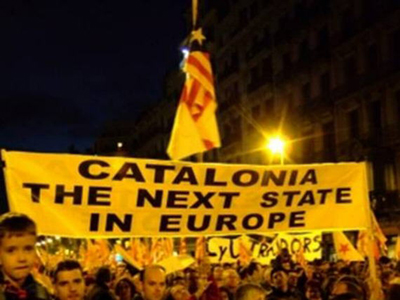
Four separatist parties in Spain’s Catalonia looked set to win a majority in regional elections on Sunday, partial results showed, but the main one was on course to lose some seats, possibly undermining its bid to call an independence referendum.
With half of votes counted, the ruling Convergence and Union alliance, or CiU, was winning 48 seats in the 135-seat local parliament, well down from its current 62 seats.
The separatist Republican Left, or ERC, was winning 20 seats, with two other smaller separatist parties taking a total of 16 seats, giving the four parties 60 percent between them.
Regional President Artur Mas, of CiU, had campaigned on a pledge to hold a referendum on independence, in response to a resurgent separatist movement among Catalans who are frustrated with Spain in a deep economic crisis.
Opinion polls had forecast that CiU would retain 62 or more seats in the local Parliament and that all four separatist parties would have more than two-thirds of the seats. Neither of those projections was met as the results began to come in.
Without the psychological backing of a two-thirds majority, analysts have said, it may be hard for Mas to defy the constitution and the central government in Madrid and try to hold a referendum.
Turnout was very high in the election, 68 percent, 10 percentage point higher than in the previous vote two years ago.
With more people than Denmark and an economy almost as big as Portugal’s, Catalonia has its own language. Like Basques, Catalans see themselves as distinct from the rest of Spain.
Growing Catalan separatism is a huge challenge for Prime Minister Mariano Rajoy, who is trying to bring down painfully high borrowing costs by persuading investors of Spain’s fiscal and political stability.
Mas converted to separatism after huge street demonstrations in September.
Up until recently Mas was a moderate nationalist who had pushed Spain to give Catalonia more self-governing powers. He has followed the popular mood in converting to a more radical separatism, but it is not clear he can hold a referendum legally.
Many Catalans are angry that Rajoy has refused to negotiate a new tax deal with their largely self-governing region. Annually, an estimated 16 billion euros ($21 billion) in taxes paid in Catalonia, about 8 percent of its economic output, is not returned to the region.
Home to car factories and banks that generate one fifth of Spain’s economic wealth, and birthplace of surrealist painter Salvador Dali and architect Antoni Gaudi, the region also has one of the world’s most successful football clubs, FC Barcelona. – Reuters
Singapore, where residents work the longest hours in the world, was also found to be the least emotional country.
Never mind its temperate 28C weather, low unemployment rate and high per-capita GDP – Singapore is the most emotionless society in the world, according to a new Gallup poll, beating the traditionally po-faced Georgia, Lithuania and Russia in a survey of more than 150 nations.
Asking respondents questions such as “Did you feel well-rested yesterday?”, “Were you treated with respect all day yesterday?” and “Did you smile or laugh a lot yesterday?”, the survey found that Singaporeans were the least likely to reveal experiencing any emotions at all.
Just 36% of Singaporeans reported feeling positive or negative emotions on a daily basis, while 60% of Filipinos recorded regularly feeling both – the highest response rate of any country worldwide.
The poll’s findings – released on Wednesday – soon went viral on the internet, where they became the butt of many jokes, not least among Singaporeans themselves. “Singapore ranked most emotionless country in the world – not sure how to feel about that,” ran a number of Singapore-based tweets. “That
Loading ...
is a lie,” commented one reader on the online news portal Today. “I use many emoticons to express how satisfied I am.”
Singapore’s 5.2 million residents work – at 46.6 hours a week – the longest hours in the world, according to the ILO. And only 2% of the country’s workforce describe themselves as engaged by their jobs, according to the Bloomberg report, despite the global average being 11%.
While many Singaporeans seem to agree that the nation does indeed work excessively long hours, its population is not necessarily “emotionless”, said the Singaporean native Adrianna Tan. “Every culture expresses everything differently. [The] European love of siesta, or quality of life, is seen in Asian eyes to be laziness,” said the 27-year-old IT consultant. “You can’t put one set of expectations that one group of people decides is ‘how one should live’ and apply it uniformly across the world.”
In the Philippines – which ranked as the world’s most emotional society, followed by El Salvador and Bahrain – analysts were quick to point out that being emotional doesn’t necessarily equate with being happy. One reporter at GMA News stressed that the nation ranked 103rd out of 155 countries in the 2012 World Happiness Report – and that its 95 million inhabitants are said to be the most depressed in all of south-east Asia. – The Guardian
Forget all that turkey, stuffing and pumpkin pie, today should be a day of fasting and atonement for American “sin.” That’s according to Robert Jensen, a journalism professor at the University of Texas at Austin. Jensen, known for his hard-left politics, also calls Thanksgiving a “white-supremacist holiday.”
Jensen’s opinion piece “No Thanks for Thanksgiving,” appeared on the far-left, Soros-connected website Alternet on Thanksgiving eve. In it, he wrote how Native Americans suffered because of the “European invasion of the Americas.” He went on to compare the Founding Fathers to Nazi Germany. “How does a country deal with the fact that some of its most revered historical figures had certain moral values and political views virtually identical to Nazis?” he asked.
According to Jensen, Thanksgiving is “at the heart of U.S. myth-building. “But in the United States, this reluctance to acknowledge our original sin — the genocide of indigenous people — is of special importance today,” he explained.
Jensen has a long career in both working journalism and academia, including work as a copy editor at The St. Paul Pioneer Press and the St. Petersburg Times, as well as “volunteer editing and writing for the Texas Triangle, Austin (weekly statewide lesbian/gay paper).”
This wasn’t the first time Jensen has bashed America. He does so on a regular basis. Other Alternet pieces include headlines like “The Painful Collapse of Empire: How the ‘American Dream’ and American Exceptionalism Wreck Havoc on the World” or “What White People Fear.”
Alternet is part of the George-Soros-supported Media Consortium. It is one of 58 left-wing media operations that aim to create a progressive “echo chamber.” – CNSNews
A spoof music video appealing to Africans to donate radiators for freezing children in Norway got almost 430 000 hits in five days on YouTube.
The video, a parody of the 1985 US charity song We are the World written by Michael Jackson and Lionel Richie, was the idea of a Norwegian group which said it aimed to challenge stereotypes about Africa.
“We need to change the simplistic explanations of problems in Africa,” the Norwegian Students’ and Academics’ International Assistance Fund said.
The United States used U.S.-Israeli spy software to hack into the French presidential office earlier this year, the French cyberwarfare agency has concluded, according to the newsmagazine l’Express.
The magazine reported late Tuesday that the computers of several close advisers to then-president Nicolas Sarkozy – including Chief of Staff Xavier Musca – were compromised in May by a computer virus that bears the hallmarks of Flame, which was allegedly created by a U.S.-Israeli team to target Iran’s nuclear program. Anonymous French officials pointed the finger at the United States.
“You can be on very good terms with a ‘friendly’ country and still want to guarantee their unwavering support – especially during a transition period,” an official told the magazine. The alleged spying attack took place a few days before the second round of the French presidential elections, which Sarkozy lost to Francois Hollande, a socialist.
Homeland Security Secretary Janet Napolitano reportedly did not deny the allegations when asked point-blank about them.
“We have no greater partner than France, we have no greater ally than France,” Napolitano reportedly answered, at the opening of an interview with l’Express. “We cooperate in many security-related areas. I am here to further reinforce those ties and create new ones.”
In the interview, Napolitano also said that the Flame and Stuxnet viruses had “never been linked to the U.S. government.”
The White House did not return a request for comment from The Hill.
Parts of this article have been translated from the French. Read the original here.
Hillary Clinton and Benjamin Netanyahu in Jerusalem
US Secretary of State Hillary Clinton vowed to support Israeli security on Tuesday while calling for a quick de-escalation of Gaza fighting that raged on unabated amid signs of an emerging truce deal.
The top US diplomat flew in for talks with Prime Minister Benjamin Netanyahu as efforts continued across the region to refine an elusive accord to end a week of violence that has cost 136 Palestinian and five Israeli lives.
The Israeli army confirmed its first fatality from rocket attacks on Tuesday, and a defence ministry official was also killed, while another missile landed harmlessly just south of Jerusalem on a day of continued strikes from Gaza.
The unrelenting violence also claimed the lives of 26 more Palestinians and witnessed an Israeli strike on a Gaza City building that houses foreign media organisations including AFP — the third such strike in three days.
Clinton told Netanyahu — a right-winger who has had strained relations with US President Barack Obama’s administration in the past year — that Washington’s commitment to Israeli security was “rock solid and unwavering.”
But she also stressed that this “is why we believe it is essential to de-escalate the situation” in the Palestinian territory.
Clinton further indicated that any truce announcement may not emerge until after she completes visits to the West Bank capital of Ramallah and Cairo for talks with Egyptian President Mohamed Morsi.
“In these days ahead, the United States will work with our partners here in Israel and across the region for an outcome that bolsters security for the peace of Israel, improves conditions for the people of Gaza and moves toward a comprehensive peace for all people of the region,” said Clinton.
Optimistic negotiators had initially said a deal could be announced in Cairo later Tuesday following days of negotiations brokered by Egypt’s new Islamist leadership.
“There will be a joint press conference between Hamas and Islamic Jihad and the Egyptian mediators tonight to announce the truce,” an Islamic Jihad source told AFP in Gaza City. A Hamas source separately backed up the report.
But Hamas later said in a statement that there was no truce accord, stressing that it could only be announced by Egypt and calling on Palestinian armed groups to “continue to riposte against Israel’s crimes.”
And an Egyptian official told AFP in Cairo that “the truce announcement is not expected tonight because we are still waiting for a response” from the Jewish state.
A meeting was held between Egypt’s intelligence chief Rafat Shehata and top-level delegations from Hamas and Islamic Jihad, but it wound up with no agreement being reached on a ceasefire, a source close to the discussions told AFP in Cairo.
“Hamas and Islamic Jihad told the Egyptians they weren’t in a hurry, and it was Israel that had asked Egypt for a truce,” the source said.
“Hamas says it has not yet received a reply from Israel and asks all the media not to rush. It is the Egyptian presidency that will announce a truce if an accord is reached. Any declaration before that, or different from that, is irresponsible.”
An Israeli diplomatic source told AFP that negotiations were ongoing.
“We are working very hard using our diplomatic channels. We are working continuously. But I cannot give you an estimated time of arrival (of a truce),” the source said.
The bloodshed meanwhile showed no signs of abating as the military pressed on with its bombardment of northern Gaza positions from which most of the militants’ rockets have been launched.
Netanyahu told Clinton he was ready to agree to a “long-term solution” as long as the rocket attacks from Gaza stopped.
“If there’s a possibility of achieving a long-term solution for this problem by diplomatic means, we prefer it. But if not, I’m sure you understand that Israel will have to take every action necessary to defend its people,” he said.
A senior Hamas official told AFP in Cairo that a key sticking point was whether Israel would begin easing its six-year-old blockade of Gaza coinciding with the truce or at a later date.
“A compromise solution is for there to be agreement on lifting the siege, and that it would be implemented later at a specified time,” he said.
Netanyahu and his key ministers decided in a closed-door meeting late Monday to place “a temporary hold on a ground incursion to give diplomacy a chance to succeed,” a senior Israeli official told AFP.
The move came as UN Secretary General Ban Ki-moon met Netanyahu and again urged all parties to end fire “immediately”.
A delegation of more than 10 Arab foreign ministers and other senior representatives also visited Gaza in a symbolic show of solidarity with the Palestinians — the latest in a string of regional leaders’ visits to the impoverished coastal enclave.
“The real problem is not a truce,” Arab League chief Nabil al-Arabi told reporters in Gaza City.
“The real problem that the Arab and Islamic countries and all friendly countries in the world must focus on is ending the occupation,” the organisation’s secretary general said.
Hamas is understood to be seeking guarantees that Israel will stop its targeted killings and end its blockade.
Israel for its part is believed to be looking for a 24- to 48-hour truce as a buffer to work out a more permanent arrangement.
The Security Council held talks late Tuesday to discuss a demand by Arab nations that it hold a public meeting on the crisis.
Western diplomats had expressed fears that comments made at an open meeting could harm efforts to reach a ceasefire, but they agreed to hold the meeting on Wednesday at 2000 GMT. – AFP
This website uses cookies to improve your experience. We'll assume you're ok with this, but you can opt-out if you wish. Cookie settingsACCEPT
Privacy & Cookies Policy
Privacy Overview
This website uses cookies to improve your experience while you navigate through the website. Out of these cookies, the cookies that are categorized as necessary are stored on your browser as they are essential for the working of basic functionalities of the website. We also use third-party cookies that help us analyze and understand how you use this website. These cookies will be stored in your browser only with your consent. You also have the option to opt-out of these cookies. But opting out of some of these cookies may have an effect on your browsing experience.
Necessary cookies are absolutely essential for the website to function properly. This category only includes cookies that ensures basic functionalities and security features of the website. These cookies do not store any personal information.
Any cookies that may not be particularly necessary for the website to function and is used specifically to collect user personal data via analytics, ads, other embedded contents are termed as non-necessary cookies. It is mandatory to procure user consent prior to running these cookies on your website.











 Loading ...


