Almost 280 dead after Egyptian police storm protestors

Egyptian protest
Egyptian protest

Egypt was under a tense state of emergency Thursday after security forces stormed the Cairo protest camps supporting ousted Islamist president Mohamed Morsi, in a bloody assault that sparked violence across the country which officials said claimed 278 lives.

The army-backed interim government imposed a month-long nationwide state of emergency, and curfews in Cairo and 13 other provinces after the violence on Wednesday.

Gory photographs and video images of the Cairo bloodbath dominated social media networks, as world powers called for restraint and condemned the show of force by security forces.

At least four churches were attacked, with Christian activists accusing Morsi loyalists of waging “a war of retaliation against Copts in Egypt”.

Hours after tear gas canisters first rained down on tents of protesters in the sprawling Rabaa al-Adawiya camp in eastern Cairo, an AFP correspondent counted at least 124 bodies in makeshift morgues there.

In a field hospital, its floors slippery with blood, doctors struggled to cope with the casualties, leaving the hopeless cases, even if still alive.

The health ministry said 235 civilians were killed in the Cairo crackdown and in subsequent clashes across Egypt. The interior ministry added that 43 security personnel had lost their lives.

Morsi’s Muslim Brotherhood spoke of 2,200 dead overall and more than 10,000 wounded.

Among those killed in Cairo was 17-year-old Asmaa al-Beltagui, daughter of wanted Muslim Brotherhood leader Mohammed al-Beltagui, a spokesman for Morsi’s movement said.

Britain’s Sky News said a veteran cameraman, Briton Mick Deane, was shot and killed while covering the assaults.

The violence prompted vice president and Nobel laureate Mohamed ElBaradei to resign, saying his conscience was troubled over the loss of life, “particularly as I believe it could have been avoided”.

“It has become too difficult to continue bearing responsibility for decisions I do not agree with and whose consequences I fear,” he said.

The state of emergency went into effect at 4:00 pm (1400 GMT) on Wednesday, with daily overnight curfews from 7:00 pm to 6:00 am.

The dramatic descent on the squares shortly after dawn came as a surprise to many. Security officials had originally spoken of gradually dispersing the sit-ins over several days.

Shortly after dawn on Wednesday, witnesses and an AFP correspondent said security forces fired tear gas before surging into Rabaa al-Adawiya, sparking pandemonium among the thousands of protesters who had set up the camp soon after Morsi was ousted in a military coup on July 3.

Men in gas masks rushed to grab each canister and dunk them in containers of water, as the main stage near the mosque of the camp blared Islamic anthems and protesters chanted “Allahu Akbar” (God is greatest).

Many Morsi supporters were given safe passage out of the camp, some flashing victory signs as they left through a security corridor.

A security official told AFP that hundreds of people were taking advantage of the safe passage offer, but that some diehards had stayed behind to fight on.

By Wednesday evening, a security official said Rabaa al-Adawiya was “totally under control”, adding: “There are no more clashes”.

In the smaller of the protest camps, at Al-Nahda square in central Cairo, police said they had control of the area after two hours.

Television footage showed flattened tents, as women and children flanked by police and army troops were led out of the square.

Dozens rounded up in the dispersal were shown sitting on the ground, handcuffed and surrounded by security forces.

Authorities later said calm had been restored across the country.

Use of force widely condemned

Europe’s leading powers, along with Iran, Qatar and Turkey, strongly denounced the use of force by the interim government.

The White House said Washington, which provides Egypt with $1.3 billion in annual military aid, “strongly condemns” the violence against the protesters and opposes the imposition of a state of emergency.

Interim prime minister Hazem al-Beblawi praised the police for their “self-restraint” and said the government remained committed to an army-drafted roadmap that calls for elections in 2014.

The Muslim Brotherhood urged Egyptians to take to the streets in their thousands to denounce the “massacre”.

“This is not an attempt to disperse, but a bloody attempt to crush all voices of opposition to the military coup,” Brotherhood spokesman Gehad al-Haddad said on Twitter.

Interior Minister Mohamed Ibrahim said no more protests would be tolerated.

The anger against the Islamist movement was evident as residents of several neighbourhoods clashed with Morsi loyalists.

Clashes also erupted between security forces and Morsi supporters in the northern provinces of Alexandria and Beheira, the canal provinces of Suez and Ismailiya, and the central provinces of Assiut and Menya.

In Alexandria, hundreds of angry Morsi supporters marched through the streets armed with wooden clubs chanting “Morsi is my president”.

An AFP reporter said they set fire to tyres and tore down pictures of army chief Abdel Fattah al-Sisi, who led the coup against Morsi.

It was a dramatic turn of events for the Muslim Brotherhood, who just over a year ago celebrated Morsi’s victory as Egypt’s first elected president.

His turbulent year in power, marred by political turmoil, deadly clashes and a crippling economic crisis, turned many against the Islamist movement, with millions taking to the streets on June 30 to call for his removal. – AFP

Egypt declares State of Emergency

egyptsoeEgypt declared a month-long state of emergency on Wednesday as violence raged across the country following a crackdown on supporters of ousted president Mohamed Morsi.

The nationwide state of emergency, announced by a presidency statement read out on state television, began at 4pm (2pm GMT).

The exceptional measures came as “the security and order of the nation face danger due to deliberate sabotage, and attacks on public and private buildings and the loss of life by extremist groups,” the presidency said.

Interim president Adly Mansour “has tasked the armed forces, in cooperation with the police, to take all necessary measures to maintain security and order and to protect public and private property and the lives of citizens.”

The emergency was imposed come as clashes raged around the country after police moved in to disperse two pro-Morsi camps in Cairo.

At least 124 were killed in the Rabaa al-Adawiya camp alone, according to an AFP count.

Black school protesters turn on media

smashPupils at New Eisleben Secondary School in Nyanga stoned a Cape Argus photographer’s vehicle on Wednesday morning during violent protests against the school’s principal.

Hundreds of pupils protested outside and inside the school premises this morning. Garbage was dumped in the school’s corridors.

Attempts at contacting the principal were unsuccessful – his office phone went unanswered.

Cindy Waxa a Cape Argus photographer, said the pupils originally welcomed her as a photographer.

However, a rumour that she was an informant for the Department of Education made the rounds and caused some of the pupils to turn on her.

As she drove away in a company car, the protesting pupils hurled stones, smashing the back windscreen of the car.

Police were on the scene mid-morning and fired a tear gas canister to disperse the pupils. The Cape Argus witnessed a number of teachers leaving the school premises, but it is understood that the principal was still in his office at the time of publication.

Bronagh Casey, spokesman for Education MEC Donald Grant, said department officials were on the scene to monitor the situation.

“We cannot confirm the reason for the protest,” she said.

“This is something that we will have to establish during the course of the day.

“The school has, however, been closed for today and we will continue to monitor the situation,” she said.

Cape Argus

Hundreds flee ‘bewitched’ Kimberley military base

Narysec recruits
Narysec recruits

Mass hysteria among hundreds of young students participating in the National Rural Youth Service Corps (Narysec) saw them fleeing the 3SAI Army Base and seeking refuge at the Roodepan police station.

Only days after they arrived for their four-month character-building programme at the military base, the students swopped their beds at the “spooky military base” for the open space outside the Roodepan police station where they slept on Monday night.

“Hundreds of us have seen and experienced supernatural events taking place at the military base. Some have seen a snake that keeps on terrorising us, while others have lost consciousness for unexplained reasons. We have told officials about the events but they have done nothing to allay our fears.

“Even the chaplain at the base has been called to pray for us but when we told him about these supernatural events he laughed,” the terrified students said.

When the DFA arrived at the police station on Tuesday morning, close to 200 students were gathered in the station premises. Some were also walking from the military base to the station.

“There is about 700 of us who are involved in this programme, but only a few want to remain at the base. We have been told that more students are coming from the base to join us,” some of the students said.

They also pointed out that they had boycotted the meals at the base on Sunday morning after one of the students, who apparently uses witchcraft, had told them that she and six other students she was working with had poisoned the food.

“This student told us that one of us would die if we ate breakfast on Sunday morning. As a result we have stopped eating at the base. This particular student confessed to senior officials that she and six other people were practising witchcraft but the officials did not believe her,” the students claimed.

Some of the students added that the student, who confessed to being a witch, had prophesied the death of a Narysec student at a facility in the Eastern Cape.

“We woke up today (on Tuesday) to reports that a Narysec student, who was supposed to travel from a facility in the Eastern Cape to 3SAI, had died. We know that people may not believe us or may think that we are not sane, but how can close to 700 of us be mad?

“There is something supernatural going on at that military base and the officials know about the ghosts there,” the students said.

They also raised complaints that, although they had gone to 3SAI Military Base for a character-building (non-military training) programme, they were in fact subjected to rigorous military training.

“Most of us have had to be transported to the sick bay to see a doctor after being taken through the stringent military training. We have a student who almost died at the hands of the instructors in charge of this training,” the students said.

Later on Tuesday, chaos erupted at the Roodepan police station when officials from the national Department of Rural Development and Land Reform, which is responsible for the Narysec programme, demanded that students who wanted to go home hand back the departmental clothing issued to them.

“This is madness… you (referring to the department officials) can go ahead and open cases against us but we will not leave the clothes that we are wearing,” the students said.

They said that the officials had instructed them to give back the department’s tracksuits, bags and toiletries if they wanted to drop out of the Narysec programme.

“These officials told us that if we leave the military base, we are effectively dropping out of the Narysec programme. But the officials have forced us out of the programme because we proposed that we be moved to a different venue or facility because of the supernatural things that are happening at the base.

“They refused to listen to us and, instead, have threatened to open cases of theft against us if we fail to return the items given to us,” the students said.

They pointed out that although they had not eaten for two days and had slept outside the police station, the officials of the department had not organised food for them or any alternative accommodation.

“We understand that the officials are forcing us out of the Narysec programme but they should have had the decency to organise food and alternative accommodation while we are waiting to be transported back to our homes. They know that we are not from around here and this attitude shows that they do not care,” the students added.

The students also complained about eating stale food at the military base.

They said that they came from across the country, including kwaZulu-Natal, the Western Cape, Eastern Cape, Mpumalanga and Limpopo, to attend the four-month programme.

“We arrived at the base on Friday. Some of the students from kwaZulu-Natal and Mpumalanga have already left Kimberley and are hitch-hiking back to their provinces,” they said.

The 2013 Narysec students added that the department had also not paid them their stipends.

By on Tuesday afternoon, students were still leaving the military base, some joining their counterparts at the police station while others were seen walking in groups along the Barkly West road, making their way to various hitch-hiking spots along the main roads out of the city.

Although the students said that the police had committed to arranging food and accommodation for them on Tuesday, Northern Cape police spokesman, Lieutenant Donald Mdlhuli, said that they could not comment on the matter and referred the DFA to the department and to the management of 3SAI military base.

Spokeswoman for the base, Melidie Tidbury, referred the media to the head of the base, Colonel Sipho Nziweni.

Nziweni denied claims of witchcraft at the military base.

“I do not know how the students, who believe in witchcraft, have experienced it but I have no knowledge of witchcraft at the base. But it is interesting that 105 of the 380 students who wanted to leave the base have come back,” Nziweni said.

He pointed out that only a fraction of the Narysec students wanted to leave the base.

“More than 500 students have remained and we now have this 105 that have came back,” he said.

He denied that the students were being given military training and that they were eating stale food.

“In fact this is not the first Narysec programme we have had at the base. The food they are eating is the food that our members are eating and it is not stale,” Nziweni added.

Although the Department of Rural Development and Land Reform promised to respond to media questions, it failed to do so at the time of going to press on Tuesday night.

Diamond Fields Advertiser

Why Putin is winning the War of Images

Abby Martin, a familiar face on RT

Russian President Vladimir Putin has created an anti-CNN for Western audiences with the international satellite news network Russia Today. With its recipe of smart propaganda, sex appeal and unlimited cash, it is outperforming its peers worldwide.

Russia Today uses the source material America supplies to its rivals untiringly and with relish. Even Washington’s relatively minor peccadilloes don’t escape notice. For instance, the show also includes a story about Gabonese dictator Ali Bongo Ondimba, whom US President Barack Obama supports.

Many in the West are also interested in seeing critical coverage of the self-proclaimed top world power. Russia Today is already more successful than all other foreign broadcast stations available in major US cities, such as San Francisco, Chicago and New York. In Washington, 13 times as many people watch the Russian program as those that tune into Deutsche Welle, Germany’s public international broadcaster.

Two million Britons watch the Kremlin channel regularly. Its online presence is also more successful than those of all its competitors. What’s more, in June, Russia Today broke a YouTube record by being the first TV station to get a billion views of its videos.

The station was even more triumphant when it signed Larry King, a legend of American radio and TV journalism who began working for Russia Today this summer. “America’s best known TV interviewer is defecting to the Russians,” wrote the London-based Times in May.

King and his new colleagues have a simple assignment: They are to “break the monopoly of the Anglo-Saxon mass media,” President Vladimir Putin said during a studio visit a few weeks ago. The Russians’ recipe for success has three ingredients: sex appeal, which has been atypical for most news channel; a rigidly anti-American stance; and a never-ending flow of money from the Kremlin.

The Ministry of Media Defense

Since 2005, the Russian government has increased the channel’s annual budget more than tenfold, from $30 million (€22.6 million) to over $300 million. Russia Today’s budget covers the salaries of 2,500 employees and contractors worldwide, 100 in Washington alone. And the channel has no budget cuts to fear now that Putin has issued a decree forbidding his finance minister from taking any such steps.

The Moscow leadership views the funds going to the channel as money “well invested,” says Natalya Timakova, the press attaché to Prime Minister Dmitry Medvedev. “In addition, Russia Today is — and I hope the Germans will forgive me for this remark — significantly more modern than Deutsche Welle, for example, and it also has more money.”

The government has also spent a lot of money on the new broadcasting center in northeast Moscow, which Russia Today moved into in May. The station, citing confidentiality requirements, isn’t willing to quote an exact price tag. On the grounds of a former Soviet tea factory, the broadcaster is now creating programming in Arabic, English and Spanish. In 2009, it rebranded its English- and Spanish speaking divisions as simply “RT.” The evening news is currently focused on the euro crisis, social protests in Portugal and the NSA surveillance scandal.

Margarita Simonyan
Margarita Simonyan

Margarita Simonyan is the woman who shaped Russia Today into Russia’s most effective weapon in the battle for influencing the opinions of the global public. In her office on the eighth floor of its headquarters in Moscow, the editor-in-chief has Orthodox icons on her desk and a dozen flickering screens around it. Putin made Simonyan the head of the new station in 2005. At the time, she was only 25 and derided as an unknown reporter from the crowd of journalists that accompany the president at meetings.

Simonyan’s mission is to prevent Russia from ever losing a war of images.

CNN showed images of destroyed buildings, allegedly taken after a Russian bomb strike on the Georgian provincial city of Gori. According to Russia Today, however, they were actually shots of the South Ossetian capital of Tskhinvali after a Georgian attack. “There is no objectivity,” Simonyan says today, “only approximations of the truth by as many different voices as possible.”

Mistrust of the domestic media is also greater than ever in the United States. CNN, for example, is struggling to cope with a massive loss of viewers. – Der Spiegel

Egypt: Security forces move in

Army moves in
Army moves in

Security forces backed by bulldozers moved in on Wednesday on two huge protest camps set up in Cairo by supporters of Egypt’s ousted president Mohamed Morsi, launching a long-threatened crackdown that left dozens dead and injured.

The operation began shortly after dawn when security forces surrounded the sprawling Rabaa al-Adawiya camp in east Cairo and a similar one at Al-Nahda square, in the centre of the capital.

Witnesses and an AFP correspondent said police rained canisters of tear gas down onto tents before entering Rabaa al-Adawiya, sparking pandemonium among the thousands of protesters who set up the camp soon after Morsi was ousted by the army on 3 July.

Men in gas masks rushed to grab each canister and dunk them in containers of water, as the main stage near the mosque of the camp blared Islamic anthems and protesters chanted “Allahu Akbar” (God is greatest).

Clashes quickly erupted between protesters and security forces on one side of the camp, as automatic fire could be heard. It was not immediately clear who was doing the shooting.

Television footage showed injured people being carried to a makeshift medical centre as well as police dragging away protesters, who have defied numerous ultimatums to end their demonstrations.

Protest leaders wearing gas masks stood defiantly on a stage while crowds of people wearing face masks stood amid the swirling tear gas as bulldozers began dismantling the camp.

Egypt’s interior ministry mid-morning said security forces have “total control” over Al-Nahda Square, the smaller of the two camps.

“Police forces have managed to remove most of the tents in the square,” the ministry said.

A security official told AFP that dozens of Morsi supporters had been arrested with the help of residents of the area.

Television footage showed protesters who had been rounded up sitting in the ground handcuffed and surrounded by security forces.

Families, with their children, carrying plastic bags were seen being escorted out of the square by police.

Railway authorities announced that all trains had been grounded to prevent protesters from moving outside of Cairo and reassembling.

Morsi’s Muslim Brotherhood urged Egyptians to take to the streets in their thousands to denounce the “massacre”.

“This is not an attempt to disperse, but a bloody attempt to crush all voices of opposition to the military coup,” Brotherhood spokesperson Gehad al-Haddad said on Twitter.

The Rabaa al-Adawiya protest camp, where several Brotherhood leaders are staying, “is calling on Egyptians to take to the streets to stop the massacre,” Haddad said.

In a separate tweet, Haddad said at least 250 people were killed and over 5000 injured in the crackdown. There was no immediate independent confirmation of the tolls.

An AFP correspondent counted 17 bodies at a makeshift morgue at Rabaa al-Adawiya, adding that many appeared to have died from gunshot wounds.

Egypt’s interior ministry said two members of the security forces were killed in the operation.

The crackdown came just hours after the United States urged the military-backed interim government to allow Morsi supporters to protest freely.

State Department deputy spokesperson Marie Harf said Washington regarded freedom to protest as a “key part” of the democratic process but would be concerned by reports of violence.

The United States, which provides $1.5-billion in mostly military aid to Egypt every year, maintains close ties to the Egyptian military but says it favours a rapid return to elected civilian rule.

Morsi, Egypt’s first elected president, was overthrown by the military on 3 July with popular backing.

His supporters had said nothing short of his reinstatement would persuade them to disperse.

Clashes between pro- and anti-Morsi demonstrators and security forces have killed more than 250 people since the end of June.

On Monday, the judiciary extended Morsi’s detention for a further 15 days pending an investigation into his collaboration with Palestinian group Hamas.

The Muslim Brotherhood, banned in 1954 and repressed by successive governments, won both parliamentary and presidential elections in 2011 after the ouster of veteran strongman Hosni Mubarak.

Prosecutors have set an 25 August date for the trial of the Brotherhood Supreme Guide Mohammed Badie and his two deputies. – AFP

Malema wants to emulate Mugabe

Malema and followers

Economic Freedom Fighters leader Julius Malema said on Tuesday that he wanted to emulate Robert Mugabe and congratulated the Zimbabwean leader on being re-elected president.

Speaking from Nigeria where he was visiting spiritual leader TB Joshua for “blessings” and “divine intervention”, Malema said that he — like Mugabe — was merely misunderstood, according to an eNCA report.

The former ANCYL leader said that Mugabe’s success at the polls should be celebrated.

“They have made their wishes very clear… and we want to congratulate President Mugabe because he has returned the land to the people and Zimbabwe will be one of the fewest African countries which is truly owned by Africans,” he said, according to the eNCA report.

Bob vows to intensify wealth transfer to blacks

bobZimbabwe’s President Robert Mugabe vowed Tuesday to intensify his controversial drive to transfer economic wealth to blacks and scoffed at calls to reform the security services following his disputed re-election.

“The indigenisation and empowerment drive will continue unabated in order to ensure that indigenous Zimbabweans enjoy a larger share of the country’s resources,” Mugabe told thousands of people at a rally in the capital to mark defence forces day.

“Now that the people of Zimbabwe have given us a resounding mandate in the governance of the country we will do everything in our power to ensure our objective of total indigenisation, empowerment, development and employment is realised.”

Mugabe was declared winner of the July 31 election with 61 percent of the vote against his main rival Morgan Tsvangirai’s 34 percent. Tsvangirai is challenging the victory, alleging vote rigging.

Zimbabwe passed an indigenisation law in 2007 forcing foreign-owned companies to cede 51 percent of shares to local investors in what Mugabe calls “the final phase of attaining total independence”.

Critics of the programme say it has benefitted Mugabe’s allies and frightened away potential investors.

In his second public speech after last month’s elections extended his 33-year rule, Africa’s oldest leader resisted opposition calls to rid the security forces of partisan officers.

Instead he praised the security forces for the peace that Zimbabwe has enjoyed over the past three decades.

He said the military has been “such a reliable pillar” of his government that he found it “surprising that some misguided fellow countrymen, at the behest of their Western allies, blatantly disregard the good work done by the (military) in maintaining peace and tranquility in the country.”

Mugabe said calls for reforms of the security sector were a disguise because “the enemy’s real ploy is to dilute the efficiency of the Zimbabwe Defence Forces”.

Some security chiefs have publicly declared their allegiance to Mugabe’s ZANU-PF party and vowed never to accept a leader who did not take part in the country’s 1970s liberation war. – AFP

Russia to give SA nuclear training input

rosatomRussia’s State Nuclear Power Corporation, Rosatom, which is busy positioning itself in case South Africa decides to build new nuclear power plants, has signed an agreement with North West University that will see it getting involved in training nuclear industry specialists for the country.

Rusatom Overseas, a Rosatom branch that specialises in the promotion of the corporation’s projects abroad, last week signed a memorandum of cooperation with North West University, the only institution in South Africa that offers postgraduate degrees in nuclear engineering.

The memorandum envisions the development of collaboration programmes in research, exchanges of experts, joint seminars and the writing of textbooks. A joint working group is to draw up a list of projects for collaboration.

“We are pleased to announce the signing of the MoU with our Russian colleagues,” said Professor Herman van Schalkwyk, rector of the Potchefstroom Campus of North West University. “We recognise that nuclear energy remains an important option for South Africa.

“The intention is to explore the potential for future collaboration, ranging from education to specific technical projects in nuclear engineering, hydrogen technologies, energy, etc.”

Jomart Aliyev, director-general of Rusatom Overseas, said the memorandum would promote the development of technical education in South Africa, while giving local researchers and scientists the opportunity to find out more about modern Russian technologies.

Joint research and scientific developments, he said, would “provide a solid foundation for the development of Rosatom’s business relations in South Africa”.

Russian President Vladimir Putin said after a meeting with South African President Jacob Zuma in Sochi in May that Russia was ready to assist South Africa in building up a comprehensive nuclear power engineering industry.

South Africa’s Koeberg nuclear plant is the only nuclear power-generating facility on the African continent.

South Africa’s Integrated Resources Plan (IRP) for 2010 to 2030, a 20-year projection on the country’s electricity supply and demand, envisages 9 600 MW of additional nuclear capacity by 2030. The plan is due to be reviewed soon.

Speaking at the Africa Energy Indaba in Johannesburg in February, Energy Minister Dipuo Peters said South Africa planned to expand its use of nuclear power in a safe and secure way as a key part of the country’s move towards a diversified, low-carbon energy mix.

“If we are serious about diversification towards a low carbon economy, we cannot belittle the role that natural gas and nuclear power can play in the realisation of that 2030 low-carbon energy vision,” Peters said.

Rosatom is ranked fourth in the world for nuclear electricity generation, accounting for 17% of the world nuclear fuel market. It conducts 45% of the world’s uranium enrichment services, and is ranked the second in the world for uranium reserves and fourth for uranium production.

The company last year opened a marketing office in Johannesburg, only its third such office after Ukraine and Singapore, and sent a high-level delegation to Durban to take part in the 5th BRICS (Brazil, Russia, India, China and South Africa) summit in March-April. – gov.za-Itar-Tass, with additional reporting by SAinfo


SA destined to go nuclear

electricitySouth Africa is destined to get more nuclear power stations as means of electricity generation as part of the Integrated Resources Plan.

It is envisaged that 9 600 megawatt of electricity will be generated in this manner by 2030 but nuclear power stations are not universally welcomed, especially after the Fukushima disaster in Japan.

These issues will be on the agenda of the Nuclear Industry Association’s (Niasa) annual convention starting in Port Elizabeth on Wednesday but even more significant is that Thyspunt, a 90-minute drive from Port Elizabeth is the preferred site for South Africa’s second nuclear-fuelled electricity plant.

Over the past six years, the proposed nuclear power station for Thyspunt has been opposed on several grounds. These include environmental, cultural and agricultural.

A third draft Environmental Impact Assessment is due to be released by Eskom in October which will then re-ignite the public participation progress.

Those opposing the building of a nuclear power station at Thyspunt are very concerned about the lack of transparency in the process.

“This site was selected by the previous regime by the apartheid Government. It would have been really great if we could start the selection process again in the new South Africa which would have been more inclusive and would look more at the situation that it is at the moment,” says the Thyspunt Alliance’s Trudi Malan.

She says that they are greatly concerned by the fact that it seems that Eskom is not really paying attention to what they are being told about this specific site at Thyspunt.

The Niasa convention will also be looking at the potential economic developments surrounding the implementation of the nuclear programme in South Africa.

The technologies used are foreign based but the potential for job creation is based in the construction phase creating cautious optimism for organised business.

“We have companies that are in the energy space and in the engineering and manufacturing space. We advocate for them to get an opportunity on such a big plant. It is complicated in one sense but it still works with bolts and nuts and pipes and valves. The point is also to demystify such a plant that it is not as complicated sometimes as it gets presented,” says Nelson Mandela Bay business Chamber’s Mandla Madwara.

A second nuclear power station for South Africa is not a done deal yet and indications are that the court will probably have the last say as those opposing nuclear power say they will take it all the way. – SABC

KwaDukuza protests calm after promises

Kwadukuza
KwaDukuza protest

KwaZulu-Natal Human Settlements MEC Ravi Pillay says he is confident that there will be no further service delivery protests and disruptions in KwaDukuza on the north coast.

Earlier this week residents barricaded the R102 with rocks and burning tyres and disrupted schooling.

One of the issues the residents raised was that of a lack of housing delivery. Pillay yesterday held a meeting with the community.

He says residents wanted reassurance that the housing project was on track. Pillay says, “The project is on track in the planning stages and I gave them a detailed report in the lay out plans that have been done.”

Pillay adds that they agreed to re configure the project steering committee to get better representation from the communities, to ensure that there is more effective communication with them.

He says he is confident that normality will resume. – SABC

DA strips ‘racist’ of party membership

Zuma surrounded by wives

The DA has stripped suspended Nelson Mandela Bay Metro DA councillor, Stanford Slabbert of his party membership after a disciplinary committee found him guilty of circulating an offensive and racist e-mail, criticising President Jacob Zuma.

In the e-mail Slabbert said Zuma had more wives than brain cells.

Eastern Cape DA leader, Athol Trollip says the party followed due processes.

“There were charges brought against Cllr Slabbert. He’s been guilty on three of the four charges. They are constitutional breaches due to him circulating racist and offensive email. The sanction has been, he’s found guilty and the finding is that membership is terminated meaning no longer member of DA. He has one more avenue to follow; an appeal through federal legal commission.”

Xenophobes in Limpopo ‘have criminal motive’

Foreigners pack up
Foreigners pack up

The South African National Civic Organisation (Sanco) in Tshisaulu outside Thohoyandou in Limpopo, where residents have been protesting for the past two days, says some protesters “have criminal motives”.

Foreign nationals started removing stocks from their shops on Monday night after a shop belonging to a foreign national was looted.

A shop owner who spoke to the SABC says the situation is no longer safe for them.

He says they will only return to their businesses when the protests end.

Sanco chairperson Aaron Netshifhefhe says residents have genuine grievances, however, the protests are being hijacked by people with criminal motives.

“Yesterday, they looted one foreigner’s shop, but what we have discovered, most of them were not Tshisaulu people. They have some people from outside, who haven’t got the interest with our people. Our people were only trying the pass the message to the police that, ‘please, come and arrest the people who are killing the people here’. We have only heard that there’s only one house burnt at Mapate. They say there are two others.”

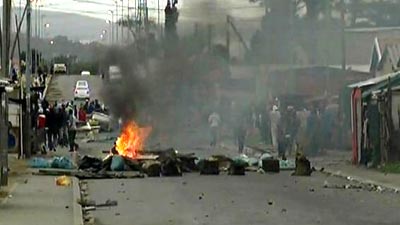
Residents earlier blockaded the Thohoyandou-Makhado road with stones and burning tyres in a protest over the murder of a woman. 21 residents have been arrested since the protest started in the area on Sunday.

Eleven of them have been granted bail.

The executive mayor of Vhembe district municipality in Limpopo, Tshitereke Matibe, was expected to meet with the residents of Tshisaulu outside Thohoyandou in a bid to end the public protest in the area. – SABC

Petrol hike increases taxi fares

taxifaresThe South African National Taxi Council (Santaco) has announced an increase in taxi fares which will be effective from the end of this month.

An increase of between 10% and 20% comes in the wake of the latest fuel price hike. Petrol rose by 32 cents a litre and diesel by 33 cents a litre. In June, the fuel price rose by 84 cents and diesel 78 cents a litre.

Santaco’s Bafana Magagula says local routes will be increasing by between R1 and R5 and long distance routes by R10 and R50.

In June, Sanatco introduced an index which will be used by associations to calculate taxi fares. The Taxi Fare Index is based on a computer programme that models the costs of taxi operations. The index will be released quarterly to the media and to Santaco members.

Consumers in general are under pressure as fuel hikes push up the cost of other consumer goods.

Industrial Development Corporation (IDC) Economist Lumkile Mondi, last Monday said that the volatile rand and relatively higher oil prices are to blame.

The expected e-tolls in Gauteng and possible interest rate hikes are other looming cost pressures for the consumer.