‘Life’ in the new South Africa: where people die at 49

Kevin_Kingby Kevin King

[followbutton username=’djkevking’ count=’true’ lang=’en’ theme=’light’]

Ever heard of the saying “life is short”? Actually, life is the longest thing that you or I will ever have. But that’s life on a personal level. If you’re South African, life is a whole lot shorter compared to the world average. When Madiba read out his “Better life for all” speech, I’m 100% sure that “better” did not imply shorter!

Life expectancy in the new South Africa has plummeted to a shocking 49 years. To put that in perspective, the life expectancy in Europe during the middle ages was around 30. And with the current downward trend, we could get even closer to that figure. We are currently ranked 210 out of 226 countries. The bottom 40 places consist mostly of African states of which we are in the lower half. Of the six countries which hold up the bottom of the list, four are neighbouring countries namely Swaziland, Zambia, Lesotho and Mozambique. In a war-ridden country such as Iraq, you can expect to live 20 years longer than in South Africa! Much further up the list are notables such as the USA (78 yrs), UK (79 yrs), New Zealand (80 yrs), Australia (81 yrs) and Japan (82 yrs).

So how on earth does our self-proclaimed “Capital of Africa” end up with a life expectancy of 49, 210th in the world and one of the worst fairing African states?

Pre-1994

At the start of the apartheid in 1948, the average life expectancy of African (black) South Africans was only 38. At the time there were close on eight million black South Africans. During the 46 years of apartheid, the average life expectancy rose significantly to 64 years. This increase was evident by the growth of the black population which was then estimated at just over 35 million.

Post-1994

Since the fall of apartheid, 17 years ago, the average life expectancy of a South African has dropped considerably from above 65 years to 49, a shameful number for a country that can afford billions to host world cups. There are a number of factors which contributed in our current state of shame but let’s have a look at the main ones:

1. HIV/Aids – The ruling party’s policies, under Mbeki, regarding Aids is said to have resulted in millions of deaths which have occurred and which are still to occur in the next decade. It has also contributed to the high rate of TB fatalities with are in most cases Aids-related.

2. Hospitals – Many of our hospitals have become places of dying instead of places of healing due to the lack of competent nursing staff and the lack of qualified doctors and nurses.

3. High crime rate – About 50 South Africans are murdered PER DAY which means about 20 000 people a year.

4. Lack of drinking water – Although water is plentiful, more than 80% of families do not have access to adequate drinking water. It is said that by 2015, more than 80% of our water resources will be undrinkable. This contributes to unhygienic conditions, sickness and disease.

5. Poverty – Unemployment is sitting at about 25%. Most of these people cannot afford food and do not have houses over their heads. Some who are employed don’t even get paid eg Aurora.

a) Any ideas on how to improve the life expectancy of our countrymen to an acceptable level, say above 75?

b) How long will this take?

[followbutton username=’djkevking’ count=’true’ lang=’en’ theme=’light’]

Russia: Syrian rebels behind chemical attack

Photo by Aleppo University Hospital

Samples taken at the Syrian town where chemical weapons were allegedly used indicate that it was rebels – not the Syrian army – behind the attack, Russia’s UN envoy Vitaly Churkin has said.

Russia has handed over the analyzed samples to the UN, he added.

“I have just passed the analysis of samples taken at the site of the chemical attack to the UN Secretary General (Ban Ki-moon),” Churkin said on Tuesday.

Evidence studied by Russian scientists indicates that a projectile carrying the deadly nerve agent sarin was most likely fired at Khan al-Assal by the rebels, Churkin pointed out.

“It was determined that on March 19 the rebels fired an unguided missile Bashair-3 at the town of Khan al-Assal, which has been under government control. The results of the analysis clearly show that the shell used in Khan al-Assal was not factory made and that it contained sarin,” he said.

Churkin added that the contents of the shell “didn’t contain chemical stabilizers in the toxic substance,” and therefore “is not a standard chemical charge.” The RDX – an explosive nitroamine commonly used for industrial and military applications – found in the warhead was not consistent with what the armed forces use.

According to Moscow, the manufacture of the ‘Bashair-3’ warheads started in February, and is the work of Bashair al-Nasr, a brigade with close ties to the Free Syrian Army.

Churkin stressed that unlike other reports which have been handed to the UN, the samples were taken by Russian experts at the scene, without any third party involvement.

More than 30 people died in the Khan al-Assal incident in the northern province of Aleppo in March. Damascus was the first to ask for the UN investigation, accusing opposition fighters of launching a chemical weapon attack. Syrian rebel groups denied the accusations, in turn blaming government forces.

However, the UN investigation has largely become stalled after a group of Western nations insisted on launching an inquiry into a separate case of alleged chemical weapons use in Homs in December 2012. The inquiry requires access to military objects, which Damascus has been unwilling to give.

The UN has also decided to exclude Russian and Chinese experts from the investigation team, with Syria protesting this decision.

So far, the UN commission of inquiry for Syria has not found any conclusive evidence proving that either side of the conflict used chemical weapons. This is despite several reports submitted by the US, UK and France, which claim to show that Syrian President Bashar Assad’s forces used such weapons.
Syria finds enough chemicals to ‘destroy the whole country’

The Syrian government invited chief UN chemical weapons investigator Ake Sellstrom and UN disarmament chief Angela Kane for talks in Damascus on Monday, announcing that a rebels-linked storage site containing piles of dangerous chemicals had been discovered.

“The Syrian authorities have discovered yesterday in the city of Banias 281 barrels filled with dangerous, hazardous chemical materials,” Syrian UN Ambassador Bashar Ja’afari said, adding that the chemicals were “capable of destroying a whole city, if not the whole country.”

The chemicals, which included monoethylene glycol and polyethylene glycol, were found in a storage site used by “armed terrorist groups,” Ja’afari explained. He said that Syria has started an investigation into the discovery.

The Syrian envoy expressed Damascus’ confidence that there will be “constructive negotiations with the Syrian officials in order to reach an agreement,” particularly in terms of “reference, mechanism, and time frame” of the UN mission.

Ja’afari added, however, that one should not “jump to the conclusion” that the Monday invitation means that Syria would consider allowing the UN team access to sites beyond Aleppo.

UN Secretary-General Ban Ki-moon’s spokesman, Martin Nesirky, reacted by calling the invitation “a move in the right direction,” but did not say whether UN investigators would accept it. The UN has been demanding that Sellstrom’s team be granted access across Syria “without further delay and without conditions,” ordering the Aleppo investigation not to begin until those demands were reached.Following Churkin’s announcement, both US and UK officials voiced their disbelief over any evidence suggesting that Syrian rebels used chemical weapons, stating they have yet been unable to see the whole report of Russia’s UN envoy.

The US has “yet to see any evidence that backs up the assertion that anybody besides the Syrian government has the ability to use chemical weapons, has used chemical weapons,” White House spokesman Jay Carney said.

When asked whether Washington had seen the Russian report, Carney replied that it had not.

The UK also voiced its skepticism regarding the report, stating that it didn’t believe the opposition could have obtained chemical weapons.

“We will examine whatever is presented to us, but to date we have seen no credible reporting of chemical weapons use by the Syrian opposition, or that the opposition have obtained chemical weapons,” BBC quoted a UK government spokesman as saying. – RT


CNN denies exclusive deal to broadcast Mandela’s funeral

CNNAmerican broadcaster CNN flatly denies any involvement with a rumored deal between Nelson Mandela’s relatives and the company over exclusive rights to broadcast possible future funeral of the first South African black president.

“There is absolutely no truth to the allegation that CNN has bought the rights to the Mandela funeral,” a company spokesperson said.

Earlier South Africa’s The Sunday Independent reported that Mandela’s family claimed CNN had “preferential” access to the funeral ceremony of the former South African leader.

Nelson Mandela, 94, remains in a critical but stable condition in hospital.

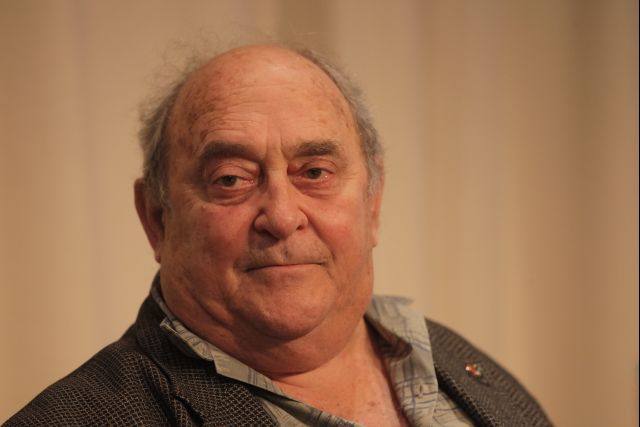
‘Our Rivonia trial lit the flame of revolution’: Denis Goldberg

Denis Goldberg
Denis Goldberg

Three silver-haired men sat together and recalled a court case 50 years ago that rocketed their friend and fellow freedom fighter to fame. To one man in the group that friend is simply “Nel.”

To the rest of the world he is Nelson Mandela, Nobel Peace Prize winner, South Africa’s former president, and a man who spent 27 years in jail for a cause he told a court in 1964 that he was prepared to die for.

Mandela, hospitalized since June 8, remains in critical condition. A grandson, Ndaba Mandela, said Tuesday that his grandfather is “very much alive” and responds when spoken to, though he is on life support in the form of mechanical ventilation. Mandela turns 95 on July 18.

Thursday marks the 50th anniversary of an event known in South African history as the Raid on Liliesleaf, a simple home in a Johannesburg suburb of Rivonia that served as the nerve center of activists seeking to overturn the white racist rule of South Africa’s apartheid era. Those arrested in the raid were charged with sabotage. Mandela had already been convicted of separate charges and was later tried and sentenced with those from Liliesleaf.

Denis Goldberg, 80, was one of the grey-haired men recalling the raid at a memorial for the event Monday evening. South Africa’s apartheid government, playing Cold War politics to win U.S. support, labeled those arrested as terrorists and communists. But Goldberg said the trial allowed those prosecuted in what became known as the Rivonia Trial to get their anti-apartheid views out to the public.

“It was a failed revolution at the time, but it was the spark that lit the flame,” said Bob Hepple, who was arrested at Liliesleaf but fled to England and did not face trial. “It’s great having a vision of freedom but you have to act to get freedom. It doesn’t fall from the trees.”

Mandela had previously traveled to Algeria to receive training for guerrilla warfare – violence that he never personally carried out but a strategy that he determined should be pursued by the African National Congress.

Writings discovered by the apartheid police in the Liliesleaf raid showed that Mandela had carefully pondered and endorsed the use of violence against apartheid.

“This was a thinking man. This was not a hot-headed leader,” Goldberg said.

Goldberg is one of the select few family members and friends who have visited Mandela since he was hospitalized June 8. Goldberg’s words last week that Mandela was conscious and responsive came in contradiction to papers filed in a Mandela family court case that described the former president as being in a vegetative state.

Goldberg and two contemporaries were invited to see Mandela by Graca Michel, Mandela’s wife. Goldberg said that Graca sat the three down and told them what she thought they should know about Mandela’s condition.

Goldberg retains the liberal feistiness that would have been required for a white man fighting for freedom for his black countrymen in the 1960s. He told Machel he would share the information about Mandela with the world. “I fought for democracy and I’m going to speak out,” he said.

“And Graca Machel said, ‘Yes, do that,'” Goldberg said.

Goldberg said it’s sad to see an old friend – once a strong physical presence – lying in bed “with a tube down his throat.” Mandela, he said, never addressed him by name. Goldberg is 15 years younger than the former president.

“For me he’s Nel and I’m boy,” Goldberg said. – AP

Obama orders fed workers to spy on each other

wethepeopleIn an initiative aimed at rooting out future leakers and other security violators, President Barack Obama has ordered federal employees to report suspicious actions of their colleagues based on behavioral profiling techniques that are not scientifically proven to work, according to experts and government documents.

The techniques are a key pillar of the Insider Threat Program, an unprecedented government-wide crackdown under which millions of federal bureaucrats and contractors must watch out for “high-risk persons or behaviors” among co-workers. Those who fail to report them could face penalties, including criminal charges.

Obama mandated the program in an October 2011 executive order after Army Pfc. Bradley Manning downloaded hundreds of thousands of documents from a classified computer network and gave them to WikiLeaks, the anti-government secrecy group. The order covers virtually every federal department and agency, including the Peace Corps, the Department of Education and others not directly involved in national security.

Under the program, which is being implemented with little public attention, security investigations can be launched when government employees showing “indicators of insider threat behavior” are reported by co-workers, according to previously undisclosed administration documents obtained by McClatchy. Investigations also can be triggered when “suspicious user behavior” is detected by computer network monitoring and reported to “insider threat personnel.”

Federal employees and contractors are asked to pay particular attention to the lifestyles, attitudes and behaviors – like financial troubles, odd working hours or unexplained travel – of co-workers as a way to predict whether they might do “harm to the United States.” Managers of special insider threat offices will have “regular, timely, and, if possible, electronic, access” to employees’ personnel, payroll, disciplinary and “personal contact” files, as well as records of their use of classified and unclassified computer networks, polygraph results, travel reports and financial disclosure forms.

Over the years, numerous studies of public and private workers who’ve been caught spying, leaking classified information, stealing corporate secrets or engaging in sabotage have identified psychological profiles that could offer clues to possible threats. Administration officials want government workers trained to look for such indicators and report them so the next violation can be stopped before it happens.

“In past espionage cases, we find people saw things that may have helped identify a spy, but never reported it,” said Gene Barlow, a spokesman for the Office of the National Counterintelligence Executive, which oversees government efforts to detect threats like spies and computer hackers and is helping implement the Insider Threat Program. “That is why the awareness effort of the program is to teach people not only what types of activity to report, but how to report it and why it is so important to report it.”

But even the government’s top scientific advisers have questioned these techniques. Those experts say that trying to predict future acts through behavioral monitoring is unproven and could result in illegal ethnic and racial profiling and privacy violations.

“There is no consensus in the relevant scientific community nor on the committee regarding whether any behavioral surveillance or physiological monitoring techniques are ready for use at all,” concluded a 2008 National Research Council report on detecting terrorists.

“Doing something similar about predicting future leakers seems even more speculative,” Stephen Fienberg, a professor of statistics and social science at Carnegie Mellon University in Pittsburgh and a member of the committee that wrote the report, told McClatchy.

The emphasis on individual lifestyles, attitudes and behaviors comes at a time when growing numbers of Americans must submit to extensive background checks, polygraph tests and security investigations to be hired or to keep government or federal contracting jobs. The U.S. government is one of the world’s largest employers, overseeing an ever-expanding ocean of information.

While the Insider Threat Program mandates that the nearly 5 million federal workers and contractors with clearances undergo training in recognizing suspicious behavior indicators, it allows individual departments and agencies to extend the requirement to their entire workforces, something the Army already has done.

Training should address “current and potential threats in the work and personal environment” and focus on “the importance of detecting potential insider threats by cleared employees and reporting suspected activity to insider threat personnel and other designated officials,” says one of the documents obtained by McClatchy.

The White House, the Justice Department, the Peace Corps and the departments of Health and Human Services, Homeland Security and Education refused to answer questions about the program’s implementation. Instead, they issued virtually identical email statements directing inquiries to the Office of the Director of National Intelligence, declined to comment or didn’t respond.

Caitlin Hayden, a spokeswoman for the White House National Security Council, said in her statement that the Insider Threat Program includes extra safeguards for “civil rights, civil liberties and privacy,” but she didn’t elaborate. Manning’s leaks to WikiLeaks, she added, showed that at the time protections of classified materials were “inadequate and put our nation’s security at risk.”

Reply from the National Security Council

Even so, the new effort failed to prevent former National Security Agency contractor Edward Snowden from taking top-secret documents detailing the agency’s domestic and international communications monitoring programs and leaking them to The Guardian and The Washington Post newspapers.

The initiative goes beyond classified information leaks. It includes as insider threats “damage to the United States through espionage, terrorism, unauthorized disclosure of national security information or through the loss or degradation of departmental resources or capabilities,” according to a document setting “Minimum Standards for Executive Branch Insider Threat Programs.”

McClatchy obtained a copy of the document, which was produced by an Insider Threat Task Force that was set up under Obama’s order and is headed by Director of National Intelligence James Clapper and Attorney General Eric Holder. McClatchy also obtained the group’s final policy guidance. The White House, the Justice Department and the Office of the Director of National Intelligence declined requests for both documents, neither of which is classified.

Although agencies and departments are still setting up their programs, some employees already are being urged to watch co-workers for “indicators” that include stress, divorce and financial problems.

When asked about the ineffectiveness of behavior profiling, Barlow said the policy “does not mandate” that employees report behavior indicators.

“It simply educates employees about basic activities or behavior that might suggest a person is up to improper activity,” he said.

“These do not require special talents. If you see someone reading classified documents they should not be reading, especially if this happens multiple times and the person appears nervous that you saw him, that is activity that is suspicious and should be reported,” Barlow said. “The insider threat team then looks at the surrounding facts and draws the conclusions about the activity.”

Departments and agencies, however, are given leeway to go beyond the White House’s basic requirements, prompting the Defense Department in its strategy to mandate that workers with clearances “must recognize the potential harm caused by unauthorized disclosures and be aware of the penalties they could face.” It equates unauthorized disclosures of classified information to “aiding the enemies of the United States.”

All departments and agencies involved in the program must closely track their employees’ online activities. The information gathered by monitoring, the administration documents say, “could be used against them in criminal, security, or administrative proceedings.” Experts who research such efforts say suspicious behaviors include accessing information that someone doesn’t need or isn’t authorized to see or downloading materials onto removable storage devices like thumb drives when such devices are restricted or prohibited.

“If you normally print 20 documents a week, well, what happens if the next week or the following week you have to print 50 documents or 100 documents? That could be at variance from your normal activity that could be identified and might be investigated,” said Randy Trzeciak, acting manager of the Computer Emergency Response Team Insider Threat Center at Carnegie Mellon University’s Software Engineering Institute.

“We’ve come up with patterns that we believe organizations might be able to consider when determining when someone might be progressing down the path to harm the organization,” said Trzeciak, whose organization has analyzed more than 800 cases and works with the government and private sector on cyber security.

But research and other programs that rely on profiling show it remains unproven, could make employees more resistant to reporting violations and might lead to spurious allegations.

The Pentagon, U.S. intelligence agencies and the Department of Homeland Security have spent tens of millions of dollars on an array of research projects. Yet after several decades, they still haven’t developed a list of behaviors they can use to definitively identify the tiny fraction of workers who might some day violate national security laws.

“We are back to the needle-in-a-haystack problem,” said Fienberg, the Carnegie Mellon professor.

“We have not found any silver bullets,” said Deana Caputo, the lead behavioral scientist at MITRE Corp., a nonprofit company working on insider threat efforts for U.S. defense, intelligence and law enforcement agencies. “We don’t have actually any really good profiles or pictures of a bad guy, a good guy gone bad or even the bad guy walking in to do bad things from the very beginning.”

Different agencies and departments have different lists of behavior indicators. Most have adopted the traditional red flags for espionage. They include financial stress, disregard for security practices, unexplained foreign travel, unusual work hours and unexplained or sudden wealth.

But agencies and their consultants have added their own indicators.

For instance, an FBI insider threat detection guide warns private security personnel and managers to watch for “a desire to help the ‘underdog’ or a particular cause,” a “James Bond Wannabe” and a “divided loyalty: allegiance to another person or company or to a country besides the United States.”

A report by the Deloitte consulting firm identifies “several key trends that are making all organizations particularly susceptible to insider threat today.” These trends include an increasingly disgruntled, post-Great Recession workforce and the entry of younger, “Gen Y” employees who were “raised on the Internet” and are “highly involved in social networking.”

Report from Deloitte

Some government programs that have embraced behavioral indicators have been condemned as failures. Perhaps the most heavily criticized is the Transportation Security Administration’s Screening of Passengers by Observation Techniques, or SPOT, program.

The program, which has cost $878 million and employs 2,800 people, uses “behavior detection officers” to identify potential terrorists by scrutinizing airline passengers for signs of “stress, fear or deception.”

DHS’ inspector general excoriated the program, saying in a May 2013 report, “TSA cannot ensure that passengers at United States airports are screened objectively, show that the program is cost-effective or reasonably justify the program’s expansion.”

Interviews and internal complaints obtained by The New York Times quoted TSA officers as saying SPOT has led to ethnic and racial profiling by emphasizing certain profiles. They include Middle Easterners, Hispanics traveling to Miami and African-Americans wearing baseball caps backward.

Another problem with having employees report co-workers’ suspicious behaviors: They aren’t sure which ones represent security threats.

“Employees in the field are not averse to reporting genuine security infractions. In fact, under appropriate conditions they are quite willing to act as eyes and ears for the government,” said a 2005 study by the Pentagon’s Defense Personnel Security Research Center. “They are simply confused about precisely what is important enough to report. Many government workers anguish over reporting gray-area behaviors.”

Even so, the Pentagon is forging ahead with training Defense Department and contractor managers and security officials to set up insider threat offices, with one company emphasizing how its course is designed for novices.

“The Establishing an Insider Threat Program for Your Organization Course will take no more than 90 minutes to complete,” says the proposal.

Officials with the Army, the only government department contacted by McClatchy that agreed to discuss the issue, acknowledged that identifying potential insider threats is more complicated than relying on a list of behaviors.

Response from the Army

“What we really point out is if you’re in doubt, report, because that’s what the investigative personnel are there to do, is to get the bottom of ‘is this just noise or is this something that is really going on?’” said Larry Gillis, a senior Army counterintelligence and security official.

The Army implemented a tough program a year before Obama’s executive order after Maj. Nidal Hasan, a U.S.-born Muslim, allegedly killed 13 people in a 2009 rampage at Fort Hood, Texas. Hasan, who has not gone on trial, has said he was defending the Afghan Taliban.

Gillis said the Army didn’t want a program that would “get people to snitch on each other,” nor did it want to encourage stereotyping.

“We don’t have the luxury to make up reasons to throw soldiers out,” Gillis said. “It’s a big deal to remove a soldier from service over some minor issue. We don’t want to ruin a career over some false accusation.”

But some current and former U.S. officials and experts worry that Obama’s Insider Threat Program could lead to false or retaliatory accusations across the entire government, in part because security officials are granted access to information outside their usual purview.

These current and former U.S. officials and experts also ridiculed as overly zealous and simplistic the idea of using reports of suspicious behavior to predict potential insider threats. It takes years for professional spy-hunters to learn their craft, and relying on the observations of inexperienced people could lead to baseless and discriminatory investigations, they said.

“Anyone is an amateur looking at behavior here,” said Thomas Fingar, a former State Department intelligence chief who chaired the National Intelligence Council, which prepares top-secret intelligence analyses for the president, from 2005 to 2008.

Co-workers, Fingar said, should “be attentive” to colleagues’ personal problems in order to refer them to counseling, not to report them as potential security violators. “It’s simply because they are colleagues, fellow human beings,” he said.

Eric Feldman, a former inspector general of the National Reconnaissance Office, the super-secret agency that oversees U.S. spy satellites, expressed concern that relying on workers to report colleagues’ suspicious behaviors to security officials could create “a repressive kind of culture.”

“The answer to it is not to have a Stasi-like response,” said Feldman, referring to the feared secret police of communist East Germany. “You’ve removed that firewall between employees seeking help and the threat that any employee who seeks help could be immediately retaliated against by this insider threat office.” – McClatchy Washington Bureau

Read more here: http://www.mcclatchydc.com/2013/07/09/196211/linchpin-for-obamas-plan-to-predict.html#storylink=cpy

Andile Mngxitama in talks with Malema

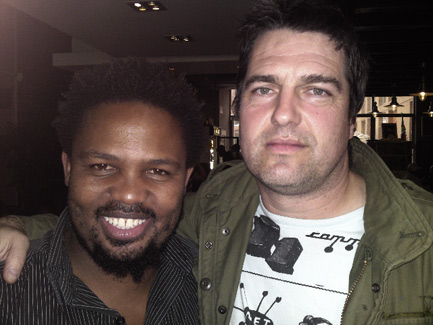
Andile with Aryan Kaganof [Ian Kerkhof]

Black consciousness proponent Andile Mngxitama is in talks with Julius Malema’s Economic Freedom Fighters (EFF) for a possible coalition ahead of next year’s general elections.

But he said it was not yet a done deal and he was not one of the leaders set to be announced by the EFF at its advertised press conference on Thursday.

Mngxitama is one of the national coordinators and founders of the September National Imbizo, a movement for young people with a strong emphasis on nationalisation, land redistribution without compensation and keeping politicians and civil servants accountable by forcing them to use public facilities like state schools and hospitals.

He said he would meet leaders of the EFF tomorrow to talk about outstanding issues.

Mngxitama said his movement had considerable support but was currently busy with an audit to determine exactly how many supporters it has.

He also invited other black consciousness movements and parties like the PAC to team up with them.

In an invitation to the press conference at Constitution Hill in Joburg, the EFF said they would announce the outcomes of a meeting by its “National Central Command Team”.

It will also announce and introduce its interim leadership in provinces.

The EFF will also announce plans for a “national assembly” on July 27 in Soweto, where it would invite young people to tell them “what is to be done”. – City Press

Snowden, the modern romantic hero

romanticby Rike Bosman

Snowden may have broken the law, but so did the Founding Fathers of America when they issued that famous declaration 237 years ago.

They did so in defiance of a powerful empire, just as Snowden has done. The world became a better place because they chose to defy the laws of their time, and Snowden’s idealistic act may leave us better off too.

One suspects that Thomas Jefferson, James Madison, and the rest of those revolutionaries would have been thrilled.

Five hundred years ago, Snowden would have sought cover in a church. In the middle ages, the romantic hero, seeking sanctuary from charges of treason, would have thrown himself on God’s mercy. Once across the holy threshold, he would have been untouchable by earthly justice.

God is a lot less powerful these days, sadly. If there is no higher law, Snowden needs a lawless zone instead, like an airport or an embassy. His best hope is not heaven, but the Grey Area.

Why are Snowden and Assange such fascinating figures? They are postmodern outlaws who have given up the comforts of an ordinarily life to save our freedoms. They are compelling because their predicament is both dreadful and very romantic.

Snowden has made the tenuous nature of our laws and nations and conventions explicit. Borders, and international laws have become arbitrary since he has blown the whistle. The political map is just a picture with lines drawn on it now, and it depends on the backing of a very powerful force.

How powerful? As we watch Snowden’s challenge, we also see the real grasp of that power unfolding.

Snowden flew into terminal F at Moscow’s Sheremetyevo airport from Hong Kong on 23 June, shortly after his passport was revoked by the US authorities.

Terminal F is described by a reviewer on airlinequality.com as an “awful prison”, but it is at least connected by a mile-long walkway to terminals D and E, which are said to be better appointed. Enterprising journalists who have flown into Sheremetyevo in the hope of finding Snowden have so far failed to do so. This may be because of a relatively unusual feature of the airport, the airside wing of the Novotel hotel, where passengers in transit without Russian visas are permitted to stay.

Some have speculated that the fugitive could be holed up in one of the hotel’s spartan rooms, awaiting the call from a friendly nation to leap on the next plane out of Moscow and return to a slightly more normal life. An AP reporter who spent a night there in search of Snowden called every room he could, to no avail; his efforts to seek him out in person were thwarted by the security guard stationed outside his door. He could be in the hotel, yes. But he could be in the airport’s detention quarters, so infamous that they once featured in the UNHCR’s guide to the problems facing the world’s refugees; he could be paying $20 an hour for a spot in a VIP lounge; he could be browsing the duty-free matryoshkas, somehow unseen by the world’s press; he could be somewhere else altogether. For the time being, at least, he is out of reach.

The uncertainty over Snowden’s whereabouts only makes the question of what his life might be like at the moment more tantalising. The airport is maybe the quintessential example of what have been called “non-places”, the grey places.

The modern airport is based on the assumption that everyone’s from somewhere else, and it becomes, therefore, an anthology of generic spaces – the shopping mall, the food court, the hotel lobby – which bear the same relationship to life.

The Iranian exile Mehran Karimi Nasseri, found himself in the no-man’s-land of the departure lounge at Paris’s Charles de Gaulle airport for fully 18 years. There was also Ram Charan, a successful business consultant who lived entirely on planes and in hotels until the age of 67, and whose only concession to normality was a weekly parcel of dirty laundry sent to an office in the US.

Uniquely modern fugitives, they are taking refuge in uniquely modern spaces. It’s not a coincidence that Snowden is a man of the internet, a space like the airport terminal or the embassy where the conventional rules don’t apply; a space of all nations, and of none; the beginning of a journey into the unknown.

Turkish defence conglomerate could become casualty of unrest

Erdogan with Koc holding chairman

The defense business of Turkey’s largest conglomerate could be a casualty of a row between the prime minister and one of its top executives over monthlong civil unrest that has battered the Turkish government, according to analysts and industry sources.

The prime minister has accused the Koc conglomerate of helping protesters, whom he referred to as “terrorists.” At stake, observers said, could be billions of dollars worth of government contracts in the portfolio of Koc’s two large defense companies — shipyard RMK Marine and armored vehicle manufacturer Otokar.

“It should come as no surprise if the government decided to thoroughly scrutinize all Koc-related contracts, including defense deals,” an analyst based here said.

An industry source said that some of the RMK and Otokar contracts may face revisions and some future deals may change course.

“It won’t be the first time a company becomes the victim of a political feud with the prime minister,” he said.

In 2009, Turkish tax authorities fined the country’s largest publishing group, Dogan Medya, US $3.2 billion over accounting irregularities, a fine that was larger than the company’s market value. The government denied any links between politics and the fine, although Prime Minister Recep Tayyip Erdogan had publicly called for a boycott of Dogan outlets and accused them of being politically hostile to his government.

What started May 31 as a demonstration by environmental activists in Istanbul has mushroomed into nationwide protests against Erdogan’s government in 80 cities. More than 2.5 million Turks have since protested Erdogan’s growing authoritarianism and Islamist governance. Four people have been killed in the demonstrations and more than 8,000 have been injured.

In one incident, protesters tried to escape police tear gas and pepper spray and took refuge in a posh Istanbul hotel, Divan, owned by Koc. Hotel management admitted the protesters to its lobby, which quickly turned into a makeshift first aid room.

The police fired more tear gas and pepper spray into the hotel lobby, although it is illegal to fire these chemicals into indoor spaces. It was reported that Ali Koc, a board member and third-generation family member, had ordered the hotel to help the protesters.

On June 16, an angry Erdogan said in a public rally: “We know which hotel owners helped terrorists [protesters]. It is a crime to abet terrorists. And those crimes will not remain unpunished.”

A senior government official close to Erdogan’s office said: “It is true that Erdogan got very upset by Koc’s open support for the protests. But I cannot tell how his anger would surface in this case.”

A procurement official familiar with Koc companies’ contracts denied any government intervention. “These are highly credible companies involved in most strategic programs. We have not yet received any political opinion regarding Koc-related contracts. And I cannot comment on how the prime minister will choose to behave in this matter.”

Erdogan chairs the Defense Industry Executive Committee (SSIK), the ultimate decision-maker on procurement. The procurement official admitted that Erdogan has a “powerful personal touch” when it comes to final decision-making at that panel.

Koc’s RMK Marine, based in Istanbul, is one of Turkey’s largest private shipyards. In January, the SSIK opened contract negotiations with RMK Marine to produce six corvettes under Turkey’s first national warship program, Milgem. The contract is worth $2.5 billion.

The corvettes are the smallest warships in the Turkish Navy. The largest ship is a frigate, and Turkey plans to use the experience gained in the Milgem project to design, develop and construct its first national frigate, the TF-2000, in the 2020s. Earlier, RMK Marine won a contract to build four search-and-rescue ships for the Coast Guard.

Otokar is the top supplier of armored vehicles to the Turkish Army. In 2008, Otokar signed a $500 million contract for Turkey’s first indigenous tank, the Altay. Under the deal, Otokar will build four prototypes that will undergo performance tests this year. The deal is for the prototypes only, and Otokar hopes to win the main production contract after performance tests.

Ironically, only 20 days before the unrest broke out, Koc announced that defense would be the fifth priority sector in the group’s strategic business planning, in addition to energy, finance, durable consumer goods and automotive production. – Defence News

Turkey unrest simmering

Ready for another round...
Ready for another round…

Turkish riot police have fired rubber bullets to block demonstrators from entering an Istanbul park, the birthplace of deadly unrest in June.

Riot police on Monday fired rubber bullets, tear gas and water cannons to block demonstrators from entering the small Istanbul park.

Police moved after Turkish authorities reopened Gezi Park to public use earlier in the day.

“Four people died for this park. This park will reopen!” a young demonstrator shouted, while others were trying to convince the police that their action was unfair and they should stop emptying the park.

But later in the day after police sealed off access to the central Taksim Square and the adjacent park, the cat-and-mouse game with protesters ensued in the nearby thoroughfares.

At least one demonstrator was seriously wounded, with his left eye abundantly bleeding, an Agence France-Presse journalist reported.

“You should be ashamed of yourself. Go on, shoot me too!” one of the protesters yelled at a police officer on top of an armoured vehicle.

Some angry shopkeepers at a fish market close to Taksim square lashed out at police and anti-government demonstrators, accusing them of ruining their business.

Earlier on Monday when Turkish authorities reopened the park they warned that no further protests would be tolerated.

‘Occupation zone’
“Gezi Park has been reopened to public but there are many calls for unauthorised protests aimed at turning the park into an occupation zone,” Istanbul Governor Huseyin Avni Mutlu wrote on Twitter.

A brutal police crackdown on May 31 against a peaceful sit-in to prevent 600 trees from being cut down in a park redevelopment scheme sparked June’s nationwide protests against Turkish Prime Minister Recep Tayyip Erdoğan and his Islamic-rooted government.

Protesters occupied the small park and put up tents to remain around the clock before being evicted by police on June 15. Erdogan has become unpopular as a result of his backing for Islamic Syrian rebels

Since then, the park has been closed. But in the face of public anger, authorities planted additional trees and a Turkish court annulled a government decision to redevelop the park, saying locals had not been sufficiently consulted about the project.

Residents feared the redevelopment plan would turn the area into a shopping district, while urban planners and ecologists said the proposals did not respect the environment.

Nearly three weeks of protests in Turkey have left four people dead and some 8 000 injured. – AFP

Egypt embassy in SA: Country safe for travel

egypttourismEgypt’s embassy in Pretoria says it is safe to travel to the North African nation, despite political upheaval after the ousting of its president.

“We would like to assure our travellers that Egypt is still safe to travel to and to visit,” spokesperson Amina Hatem said in a statement on Monday.

“All normal aspects of life including Egypt Air’s operations and international travel are safeguarded by the people and the authorities and remain perfectly functional as always.”

The South African government earlier warned its citizens to be careful when travelling to the country.

The Egyptian military toppled former president Mohamed Morsi on Wednesday, reportedly with the support of leaders from many sectors of Egyptian society.

The constitution was suspended.

South Africa encouraged citizens to register online with Registration of South African citizens Abroad when travelling to Egypt.

“The South African embassy in Egypt remains open and is available at all times to assist South African citizens, should circumstances require,” international relations spokesperson Clayson Monyela said. – SAPA

Bundesbank: China’s currency fast becoming global reserve currency

chinacurrencyFollowing the most recent shift ‘away’ from a USD-centric world (with the China-Australia direct currency convertibility), it seems the possibility of China’s Yuan as the next global reserve currency is getting closer. The Brits, Germans, and now the Swiss (who just signed a free-trade-agreement with China) are all actively vying to become Europe’s Yuan trading hub as it seems the long line of developments to internationalize the currency over the past two years. As Bundesbank board member Joachim Nagel noted in a speech entitled “Reniminbi as a potential reserve currency” this week, “the Chinese currency is well on its way to becoming one of the future global reserve currencies.” He noted that, although the USD is still the most commonly-used currency for settling trade with China; from virtually zero in 2010, the Yuan is used to settle over 12% of trading transactions now – and is likley to increase further.

Remember, nothing lasts forever:

This latest development in global currency relations should come as no surprise to those who have followed our series on China’s slow but certain  internationalization of its currency over the past two years. To wit: “World’s Second (China) And Third Largest (Japan) Economies To Bypass Dollar, Engage In Direct Currency Trade“, “China, Russia Drop Dollar In Bilateral Trade“, “China And Iran To Bypass Dollar, Plan Oil Barter System“, “India and Japan sign new $15bn currency swap agreement“, “Iran, Russia Replace Dollar With Rial, Ruble in Trade, Fars Says“, “India Joins Asian Dollar Exclusion Zone, Will Transact With Iran In Rupees“, “The USD Trap Is Closing: Dollar Exclusion Zone Crosses The Pacific As Brazil Signs China Currency Swap“, and “Thanks, World Reserve Currency, But No Thanks: Australia And China To Enable Direct Currency Convertibility.”

Via Deutsche Bundebank (Dr. Joachim Nagel),

Renminbi as a potential reserve currency

According to Bundesbank Executive Board member Joachim Nagel, the Chinese currency is well on its way to becoming one of the future global reserve currencies. This potential stems from the renminbi’s increasing convertibility, he said at a conference of the Chamber of Industry and Commerce in Frankfurt.

He emphasised that although the US dollar is currently the most commonly used currency for settling trade with China, the significance of the renminbi has increased greatly over the last few years. He underlined this by referring to figures published by SWIFT, which indicate that the percentage of trading transactions settled in renminbi jumped from virtually zero to around 12% between 2010 and 2012 – and is likely to increase further. In view of this, he pointed out that the renminbi has already achieved the status of a trading currency.

Drawing parallels to the Deutsche Mark

Mr Nagel compared China’s growing importance with the German economic miracle of the 1950s and drew parallels between the renminbi’s current growth and the development of the Deutsche Mark. Thanks to the recovery of the German economy, the country accumulated a large volume of foreign exchange reserves and the Deutsche Mark acquired the status of a global investment and reserve currency, he explained. He anticipates that “the renminbi is certain to have similar long-term prospects if market access is liberalised further”. Mr Nagel backed up his comments by citing a survey of reserve managers carried out by RBS. The survey revealed that 14% of reserve managers have already invested in renminbi, with 37% of respondents considering investing in the currency in the next five to ten years.

Mr Nagel sees the renminbi as currently transitioning from a being trading currency to an investment currency. While both inward and outward direct investment is now possible, portfolio investments will continue to be regulated, he remarked, adding that improvements are expected in this area. “The internationalisation process of the Chinese currency is taking place more gradually than was the case with the Deutsche Mark, which, at times, was subject to radical upheaval”, he added. Mr Nagel recalled, in this context, the collapse of the Bretton Woods system of fixed exchange rates and the crisis in the European Monetary System at the beginning of the 1990s.

Renminbi financial centre in Frankfurt

Mr Nagel noted that “given China’s growing economic importance, the internationalisation of the renminbi seems long overdue”. He explained the Chinese government’s decision to employ offshore trading centres, which would allow China to establish its currency internationally, while protecting its domestic financial system. Hong Kong, where around 80% of all renminbi trade is settled, is by far the most important trading centre for the currency, with London and Singapore each accounting for 4% of renminbi trade since mid-2012. He added that the expansion of the market has led to the growing significance of other financial centres for renminbi.

Mr Nagel welcomed Frankfurt’s endeavour to position itself as a trading hub for the Chinese currency, calling it a step in the right direction, towards the free movement of capital. “The high level of interaction between China’s and Germany’s real economies highlights the necessity for a more active renminbi trade”, Mr Nagel remarked, “perhaps even using Germany as a hub” – Zero Hedge

Snowden: Fresh allegations against the British, Germans

snowden2For weeks now, officials at intelligence services around the world have been in suspense as one leak after another from whistleblower Edward Snowden has been published. Be it America’s National Security Agency, Britain’s GCHQ or systems like Prism or Tempora, he has been leaking scandalous information about international spying agencies. In an interview published by SPIEGEL in its latest issue, Snowden provides additional details, describing the closeness between the US and German intelligence services as well as Britain’s acquisitiveness when it comes to collecting data.

In Germany, reports of the United States’ vast espionage activities have surprised and upset many, including politicians. But Snowden isn’t buying the innocence of leading German politicians and government figures, who say that they were entirely unaware of the spying programs. On the contrary, the NSA people are “in bed together with the Germans,” the whistleblower told American cryptography expert Jacob Appelbaum and documentary filmmaker Laura Poitras in an interview conducted with the help of encrypted emails shortly before Snowden became a globally recognized name.

Snowden describes the intelligence services partnerships in detail. The NSA even has a special department for such cooperation, the Foreign Affairs Directorate, he says. He also exposes a noteworthy detail about how government decision-makers are protected by these programs. The partnerships are organized in a way so that authorities in other countries can “insulate their political leaders from the backlash” in the event it becomes public “how grievously they’re violating global privacy,” the former NSA employee says.

SPIEGEL reporting also indicates that cooperation between the NSA and Germany’s foreign intelligence service, the BND, is more intensive than previously known. The NSA, for example, provides “analysis tools” for the BND to monitor signals from foreign data streams that travel through Germany. Among the BND’s focuses are the Middle East route through which data packets from crisis regions travel.

BND head Gerhard Schindler confirmed the partnership during a recent meeting with members of the German parliament’s control committee for intelligence issues.

But it’s not just the BND’s activities that are the focus of the interview with Snowden.

The 30-year-old also provides new details about Britain’s Government Communications Headquarters (GCHQ). He says that Britain’s Tempora system is the signal intelligence community’s first “full-take Internet buffer,” meaning that it saves all of the data passing through the country.

The scope of this “full take” system is vast. According to Snowden and Britain’s Guardian newspaper, Tempora stores communications data for up to 30 days and saves all content for up to three days in a so-called Internet buffer. “It snarfs everything in a rolling buffer to allow retroactive investigation without missing a single bit,” Snowden says.

Asked if it is possible to get around this total surveillance of all Internet communication, he says: “As a general rule, so long as you have any choice at all, you should never route through or peer with the UK under any circumstances.”

In other words, Snowden says, one can only prevent GCHQ from accessing their data if they do not send any information through British Internet lines or servers. However, German Internet experts believe this would be almost impossible in practice.

The attempt to conduct total data retention is noteworthy because most of the leaks so far in the spying scandal have pertained to so-called metadata. In the interview, Snowden reiterates just how important metadata — which can include telephone numbers, IP addresses and connection times, for example — really are. “In most cases, content isn’t as valuable as metadata,” Snowden says.

Those in possession of metadata can determine who has communicated with whom. And using the metadata, they can determine which data sets and communications content they would like to take a closer look at. “The metadata tells you what out of their data stream you actually want,” Snowden says.

It is becoming increasingly clear to recognize the way in which surveillance programs from the NSA and GCHQ — including Prism, Tempora and Boundless Informant — cooperate. The metadata provides analysts with tips on which communications and content might be interesting. Then, Snowden says, with the touch of a button they can then retrieve or permanently collect the full content of communications that have already been stored for a specific person or group, or they can collect future communications. But a person can also be “selected for targeting based on, for example, your Facebook or webmail content.” – Der Spiegel

Airport landing system off when plane crashed in San Francisco

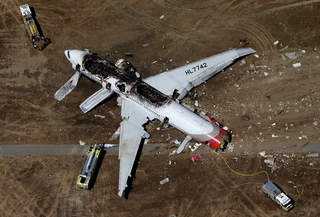
sanfranplanecrashA navigation system that helps pilots make safe descents was turned off at San Francisco airport on Saturday when a South Korean airliner crashed and burned after undershooting the runway, officials said.

The system, called Glide Path, is meant to help planes land in bad weather. It was clear and sunny, with light winds, when Asiana Flight 214 from Seoul, South Korea crashed just before noon, killing two passengers and injuring more than 100.

Aircraft safety experts said Glide Path was far from essential for routine landings, and it was not unusual for airports to take such landing systems off line for maintenance or other reasons.

But pilots have grown to rely on the decades-old technology, which is designed specifically to prevent runway misses, so investigators are likely to look closely at the issue.

“The pilots would have had to rely solely on visual cues to fly the proper glide path to the runway, and not have had available to them the electronic information that they typically have even in good weather at most major airports,” said Captain Chesley “Sully” Sullenberger, the former US Airways pilot who gained fame with a successful crash landing on the Hudson River in 2009.

“What that means is that then the automatic warnings that would occur in the cockpit when you deviate below the desired electronic path wouldn’t have been available either. So we don’t know yet if that’s a factor in this particular situation, but that’s certainly something they’ll be looking at,” he told the local CBS News affiliate.

Glide Path is a computerized system based at an airport that calculates a plane’s path of descent and sends it to pilots in real time.

San Francisco International has turned off the system for nearly the entire summer on the runway where the Asiana flight crashed, according to a notice from the airport on the Federal Aviation Administration’s Web site. It showed the system out of service June 1-August 22 on runway 28 Left.

Kevin Hiatt, chief executive of the Flight Safety Foundation and a former Delta pilot, said it was common for airports to take instrument landing systems offline for maintenance on clear days. Pilots use several other instruments and visual cues to land in clear conditions, Hiatt said.

Former Inspector General of the U.S. Department of Transportation Mary Schiavo said pilots had become increasingly dependent on instruments for flying. But she added that modern planes had plenty of systems for landing safely, down to a pilot watching the lights on the runway. – Reuters

Wife of top US diplomat falls critically ill

Teresa Heinz Kerry
Teresa Heinz Kerry

Teresa Heinz Kerry, a leading philanthropist and wife of US Secretary of State John F. Kerry, was in critical but stable condition Sunday after being flown to Massachusetts General Hospital from Nantucket, where she had been rushed to the hospital for an undisclosed ailment, according to aides to the secretary.

Heinz Kerry, 74, was stricken while at the family’s vacation home, according to State Department spokesman Glen Johnson.

“Late Sunday afternoon, Mrs. Teresa Heinz Kerry was taken by ambulance to Nantucket Cottage Hospital, accompanied by her husband,” Johnson said in a prepared statement. “Once doctors had stabilized her condition, she was transferred to Massachusetts General Hospital in Boston, again accompanied by the Secretary.”

Johnson did not provide further details of her condition, saying “the family is grateful for the outpouring of support it has received and aware of the interest in her condition, but they ask for privacy at this time.”

Shortly after 5:30 p.m., Noah Brown, public information officer for Nantucket Cottage Hospital, confirmed in a brief phone interview that Heinz Kerry had arrived at the hospital that afternoon.

“She was brought in, in critical but stable condition, and that is currently how . . . . her condition still remains,” Brown said. “At this point, we are determining the next phase of her care, be that either in our facility on the island, or on the mainland.”

Heinz Kerry has overcome serious health problems in recent years. She was diagnosed with breast cancer in September 2009 and underwent surgery and radiation treatments. She has publicly encouraged other women to get regular mammograms to help enable early detection of the disease.

The Kerry family’s holiday weekend on Nantucket was designed as a much-needed respite for the nation’s top diplomat following a frenetic pace of foreign travel, but it garnered unwanted headlines before Heinz Kerry’s hospitalization. On Friday, a State Department spokeswoman was forced to retract an earlier denial that Kerry had been on his yacht, Isabel, during the military coup in Egypt Wednesday. – The Boston Globe