‘Nightmare’ for US governor’s aide

Scott Walker
Scott Walker

Wisconsin Governor and potential 2016 GOP contender Scott Walker has many enemies on the left.

THE NIGHTMARE, reproduced in full below, was forwarded in 2010 by Thomas Nardelli, who was Walker’s chief-of-staff when he served as Milwaukee County Executive, to an undisclosed number of recipients, including Walker’s deputy chief-of-staff, Kelly Rindfleisch. Walker, who was elected governor later that year, went on to earn national notoriety for passing legislation aimed at dismantling the political power of Wisconsin’s public-sector unions. Nardelli became a full-time consultant.

Nardelli isn’t the only Walker official in trouble. The Republican fired his deputy finance director in December after the aide’s two-year-old tweets, one of which read, “I will choke that illegal mex cleaning in the library”, came to light.

Here’s the email:

THE NIGHTMARE

In the nightmare I found myself nude in bed, and I was looking at a mirror on the ceiling, and I discovered that I am a Negro, and I’m circumcised!

Quickly I sat up, found my pants and looked in the pockets to find my driver’s license photo and it was that same color, black.

I felt myself being very depressed, downcast, sitting in a chair.

But it’s a wheelchair! That means, of course, besides being black and Jewish, I’m also disabled! I said to myself, aloud “This is impossible! It’s impossible that I should be black and Jewish and disabled!” “It’s the pure and holy truth,” whispers someone from behind me. I turn around, and it’s my boyfriend.

Just what I needed!!! I am a homosexual, and on top of that, with a Mexican boyfriend.

Oh, my God …. Black, Jewish, disabled, gay with a Mexican boyfriend, drug addict, and HIV-positive!!!

Desperate, I begin to shout, cry, pull my hair, and Oh, nooooo…I’m bald!!!

The telephone rings. it’s my brother. He is saying, ‘Since mom and dad died, the only thing you do is hang out, take drugs, and laze around all day doing nothing. Get a job, you worthless piece of crap… Any job!’

Mom? Dad? Nooooo … Now I’m also an unemployed orphan! I try to explain to my brother how hard it is to find a job when you are black, Jewish, disabled, gay with a Mexican boyfriend, are a drug addict, HIV positive, bald, and an orphan, but he doesn’t get it.

Frustrated, I hang up. It’s then I realize I only have one hand!!! With tears in my eyes, I go to the window to look out. I see I live in a shanty-town full of cardboard and tin houses! There is trash everywhere.

Suddenly I feel a sharp pain near my pacemaker…. Pacemaker??

Besides being black, Jewish, disabled, a fairy with a Mexican boyfriend, a drug addict, HIV positive, bald, orphaned, unemployed, an invalid with one hand, and having a bad heart, I live in a crappy neighborhood.

At that very moment my boyfriend approaches and says to me, ‘Sweetie pie, my love, my little black heartthrob, have you decided what you are going to wear to Washington to see Obama?’

Say it isn’t so!!! I can handle being a black, disabled, one-armed, drug-addicted, Jewish homosexual on a pacemaker who is HIV positive, bald, orphaned, unemployed, lives in a slum, and has a Mexican boyfriend, but please, Oh dear God, please don’t tell me I’m a Democrat!

Young US adults living with parents at record high

parentlivingWhy are so many young adults in America living with their parents? According to a stunning Gallup survey that was recently released, nearly three out of every ten adults in the United States under the age of 35 are still living at home with Mom and Dad.

This closely lines up with a Pew Research Center analysis of Census data that looked at a younger sample of Americans which found that 36 percent of Americans 18 to 31 years old were still living with their parents.

That was the highest level that had ever been recorded. Overall, approximately 25 million U.S. adults are currently living at home with their parents according to Time Magazine. So what is causing all of this? Well, there are certainly a lot of factors.

Overwhelming student loan debt, a depressing lack of jobs and the high cost of living are all definitely playing a role. But many would argue that what we are witnessing goes far beyond temporary economic conditions. There are many that believe that we have fundamentally failed our young people and have neglected to equip them with the skills and values that they need to be successful in the real world.

More Americans than ever before seem to be living in a state of “perpetual adolescence”. As Gallup noted, one of the keys to adulthood is to be able to establish independence from your parents…

An important milestone in adulthood is establishing independence from one’s parents, including finding a job, a place to live and, for most, a spouse or partner, and starting one’s own family. However, there are potential roadblocks on the path to independence that may force young adults to live with their parents longer, including a weak job market, the high cost of living, significant college debt, and helping care for an elderly or disabled parent.

Unfortunately, it is becoming increasingly difficult for young people to become financially independent. While they are in high school, we endlessly pound into their heads the need to go to college. Then we urge them to take out whatever loans that they will need to pay for it, ensuring them that they will be able to get “good jobs” which will enable them to pay off those loans when they graduate.

Of course a very large percentage of them find that there aren’t any “good jobs” waiting for them when they graduate. But because of the crippling loans that they have accumulated, they quickly realize that they have decades of debt slavery ahead of them.

Just consider the following numbers about the growth of student loan debt in the United States…

-The total amount of student loan debt in the United States has risen to a brand new all-time record of 1.08 trillion dollars.

-Student loan debt accounted for 3.1 percent of all consumer debt in 2003. Today, it accounts for 9.4 percent of all consumer debt.

-In the third quarter of 2007, the student loan delinquency rate was 7.6 percent. Today, it is up to 11.5 percent.

This is a student loan debt bubble unlike anything that we have ever seen before, and it seems to get worse with each passing year.

So when is the bubble going to finally burst?

Meanwhile, our young adults are still really struggling to find jobs.

For those in the 18 to 29-year-old age bracket, it is getting even harder to find full-time employment. In June 2012, 47 percent of those in that entire age group had a full-time job. One year later, in June 2013, only43.6 percent of that entire age group had a full-time job.

And in many ways, things are far tougher for those that didn’t finish college than for those that did. In fact, the unemployment rate for 27-year-old college dropouts is nearly three times as high as the unemployment rate for those that finished college.

In addition, since Barack Obama has been president close to 40 percentof all 27-year-olds have spent at least some time unemployed.

So it should be no surprise that 27-year-olds are really struggling financially. Only about one out of every five 27-year-olds owns a home at this point, and an astounding 80 percent of all 27-year-olds are in debt.

Even if a young adult is able to find a job, that does not mean that it will be enough to survive on. The quality of jobs in America continues to go downhill and so do wages.

The ratio of what men in the 18 to 29-year-old age bracket are earning compared to what the general population is earning is at an all-time low, and American families that have a head of household that is under the age of 30 have a poverty rate of 37 percent.

Source: investmentwatchblog.com

Exporting water to China

caldroughtWhile historic winter storms have battered much of the US, California is suffering its worst drought on record. So why is America’s most valuable farming state using billions of gallons of water to grow hay – specifically alfalfa – which is then shipped to China?

The reservoirs of California are just a fraction of capacity amid the worst drought in the state’s history.

“This should be like Eden right now,” farmer John Dofflemyer says, looking out over a brutally dry, brown valley as his remaining cows feed on the hay he’s had to buy in to keep them healthy.

In the dried-up fields of California’s Central Valley, farmers like Dofflemyer are selling their cattle. Others have to choose which crops get the scarce irrigation water and which will wither.

“These dry times, this drought, has a far-reaching impact well beyond California,” he said as the cattle fell in line behind his small tractor following the single hay bale on the back.

“We have never seen anything like this before – it’s new ground for everybody.”

Farmers are calling for urgent help, people in cities are being told to conserve water and the governor is warning of record drought.

But at the other end of the state the water is flowing as the sprinklers are making it rain in at least one part of southern California.

The farmers are making hay while the year-round sun shines, and they are exporting cattle-feed to China.

The southern Imperial Valley, which borders Mexico, draws its water from the Colorado river along the blue liquid lifeline of the All American Canal.

It brings the desert alive with hundreds of hectares of lush green fields – much of it alfalfa hay, a water-hungry but nutritious animal feed which once propped up the dairy industry here, and is now doing a similar job in China.

“A hundred billion gallons of water per year is being exported in the form of alfalfa from California,” argues Professor Robert Glennon from Arizona College of Law.

“It’s a huge amount. It’s enough for a year’s supply for a million families – it’s a lot of water, particularly when you’re looking at the dreadful drought throughout the south-west.”

Manuel Ramirez from K&M Press is an exporter in the Imperial Valley, and his barns are full of hay to be compressed, plastic-wrapped, packed directly into containers and driven straight to port where they are shipped to Asia and the Middle East.

“It’s cost effective. We have abundance of water here which allows us to grow hay for the foreign market.”

Cheap water rights and America’s trade imbalance with China make this not just viable, but profitable.

“We have more imports than exports so a lot of the steamship lines are looking to take something back,” Glennon says. “And hay is one of the products which they take back.”

It’s now cheaper to send alfalfa from LA to Beijing than it is to send it from the Imperial Valley to the Central Valley.

“We need to treat the resource as finite, which it is,” he says. “Instead, most of us in the states, we think of water like the air, it’s infinite and inexhaustible, when for all practical purposes it’s finite and it’s exhaustible.”

Alfalfa farmer Ronnie Langrueber believes he’s doing his bit to help the American economy out of recession.

“In my opinion it’s part of the global economy,” he says, adding that only a fraction of the hay goes to China.

“We have to do something to balance that trade imbalance, and alfalfa is a small part we can do in the Imperial Valley to help that.”

He believes the whole “exporting water” argument is nonsense – that all agricultural exports contain water – and that there are few better uses for it.

“Is it more efficient to use water for a golf course for the movie stars?” Langrueber said.

“Or is it more efficient for farmers to use it to grow a crop and export it and create this mass economic engine that drives the country?”

Japan, Korea and the United Arab Emirates all buy Californian hay. The price is now so high that many local dairy farmers and cattle ranchers can’t afford the cost when the rains fail and their usual supplies are insufficient.

But they have to buy what they can.

Cattle rancher John Dofflemyer certainly sees it as exporting water abroad – he resents the fact hay is sent overseas.

Hay trucks are a common sight heading north up the road from the Imperial Valley – despite the high prices, the cattle farmers have to buy what they can.

Even with recent rains in northern California there’s still a critical shortage of water.

Drought is often an excuse for politicians to build dams or reduce environmental controls, but it’s no long-term fix.

In those places awash with water – where global trade distorts the local market – decisions need to be made by those without something to gain.

That’s where it gets even more complicated.

Source: BBC

American president kicking a door is ‘racist’

okicksdoorA student at McGill University in Montreal, Canada was forced to issue a formal apology for emailing a picture of President Obama kicking open a door–all because some students thought the image was somehow racist.

The image was actually an edited .gif, and was shown by Jay Leno on “The Tonight Show” last fall. It humorously suggests that the president may be fed up with press conferences. McGill student Brian Farnan, vice president of the university’s student government, sent out an email with the .gif and the harmless caption, “Honestly midterms get out of here,” according to Legal Insurrection.

What happened next is almost unbelievable: Another student issued a formal complaint against Farnan for committing a “micro-aggression.”For those not up-to-date on the PC lexicon, “micro-aggression” is the latest phrase of choice for leftist radicals seeking to blame racism for common annoyances suffered by people of all races. Minority activists at the University of Michigan, for example, have insisted that trivial slights, such as “Having your opinion second-guessed in a group assignment,” are micro-aggressions that betray the campus as a hostile place for students of color.

Source: The Daily Caller

Russia bans adoptions from same-sex marriage countries

Putin
Putin

Russia banned adoptions by single people from countries where same-sex marriage is legal.

The new measure comes into law in the middle of a Winter Olympics which gay activists have already tried to derail. The IOC has responded by emphasizing a separation between politics and sports.

The decree, signed by Prime Minister Dmitry Medvedev and posted on the government’s website Thursday, also reiterates a ban on adoptions by same-sex couples who are in unions “recognized as marriages and registered in accordance with the law of a country where such marriages are permitted.”

The measure came as an amendment to a law the Kremlin put in place in July banning same-sex couples from adopting children. That followed by days another law against exposing minors to gay propaganda, or any actions or statements that condone nontraditional relationships.

The latest decree doesn’t affect U.S. citizens because Russia already banned all Americans—regardless of their sexuality or marital status—from adopting Russian children in late 2012. It would apply to single people in other countries, mainly in Europe, where gay marriage has been legalized.

A spokesman for the European Union declined to comment.

Some countries don’t permit gay individuals or couples to adopt, according to the U.S. State Department. And more than a dozen countries don’t allow single people to adopt, according to a 2009 report by the U.N. Department of Economic and Social Affairs.

In an interview ahead of the Sochi Games last month, Russian President Vladimir Putin said gay people were welcome to attend the Olympics so long as they “leave the children in peace.”

So far, there haven’t been any prominent expressions of support for gay rights by athletes competing in Sochi, who have been told by Olympic officials to keep their political views out of the competitions.

Mr. Putin has increasingly crusaded against Western influence and “genderless and infertile” Western tolerance.

End of the road for affirmative action on US campuses?

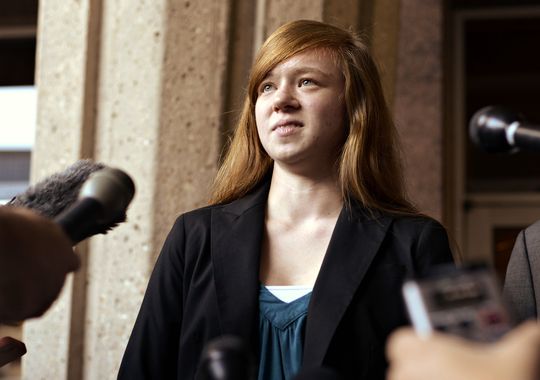
Abigail Fisher outside the Supreme Court

After more than 60 years, is the end of the road near for affirmative action in college admissions?

The idea of using race to help determine who gets a seat in public colleges has been under fire for decades. Eight states have essentially banned the practice, and a Michigan case pending before the U.S. Supreme Court could prompt others to do the same.

College officials nationwide got a wake-up call last June from the high court, which set a high bar for using race as part of a complex admissions program in Texas. Many observers say the combined weight of the two cases could finally push state universities to find another way to promote diversity.

“All the trends are pointing against the continued use of race in admissions,” says Richard Kahlenberg of the Washington, D.C.-based Century Foundation, a liberal think tank. Kahlenberg has for years advocated using family income,not race, as a way to ensure that public K-12 schools and colleges have a diverse student body.

A year after hearing Fisher, the justices last October heard arguments in a case from Michigan, where a 2006 state constitutional amendment banned racial preferences in public university admissions. Seven other states — California, Florida, Washington, Arizona, Nebraska, Oklahoma and New Hampshire — do the same, and about 29% of students live in states where affirmative action is banned, Kahlenberg estimates.

Michigan Attorney General Bill Schuette says the state’s position was summed up well by Chief Justice John Roberts, who said the best way to stop racial discrimination “is to stop discriminating on the basis of race.”

“Our constitution requires equal treatment in college admissions, which is an expression by 58% of Michigan voters in 2006 that says it is fundamentally wrong to treat people differently based on race or the color of their skin,” Schuette says. “It’s just wrong.”

A July 2013 study by Georgetown University scholars Anthony Carnevale and Jeff Strohl found that in 2009, white students were more “over-represented” among the USA’s 468 most selective colleges than they had been in 1995. From 1995 to 2009, the nationwide share of young people ages 18-24 who were white dropped 6 percentage points, from 68% to 62%. But whites’ share of freshman slots at the USA’s most elite colleges dropped just 2 points during that same period, from 77% to 75%.

Another study, by Orfield’s Civil Rights Project, found that 15 years after California’s ban on racial preferences went into effect, increased competition has dropped the share of black in-state high school graduates admitted to UCLA from 47.6% of applicants to 13.7%; the percentage of Latino students admitted dropped from 54.9% of applicants to 14.8%. The percentage of white students admitted also dropped, but not as sharply.

Kahlenberg says the string of affirmative action cases has pushed universities to find alternative ways to create diverse freshman classes. He notes that Texas’ 10% rule has resulted in higher levels of black and Latino representation. Other state systems have gotten similar results by eliminating preferences for children of alumni and bolstering financial aid, among other measures. These strategies have led to more racially and economically diverse classes “in a way the Supreme Court can’t touch,” he says. “I think that’s the future of affirmative action.”

Recent surveys have found that Americans don’t like using race in admissions, Kahlenberg says, “but on the other hand, Americans don’t want to see universities and American higher education re-segregated.”

A decision in the Michigan case, Schuette v. Coalition to Defend Affirmative Action, is expected this spring. If a majority of eight justices rule in Michigan’s favor (Elena Kagan, a former solicitor general, recused herself), it could prompt opponents of affirmative action in other states to push for similar bans.

But if the ban is overturned, states such as California again could weigh race in college admissions — and not a moment too soon, Orfield says. Admissions pressures there have become “very intense.” He notes that UCLA alone last year received nearly 100,000 applications. “It’s a big state, it’s growing … and we haven’t been growing the higher education system.” – USA Today

Contributing: Richard Wolf

Icy weather leads to record of flight cancellations

icycoldIcy weather in the US has led to the highest number of flight cancellations in more than 25 years, according to an analysis by The Associated Press.

U.S. airlines have canceled more than 75,000 domestic flights since Dec. 1, including roughly 14,000 this week. That’s 5.5 percent of the 1.35 million flights scheduled during that period, according to AP calculations based on information provided by flight tracking site FlightAware.

It’s the highest total number and highest percent of cancellations since at least the winter of 1987-1988, when the Department of Transportation first started collecting cancellation data.

On Thursday, more than 70 percent of flights were canceled in Baltimore, Philadelphia, Washington D.C. and Charlotte, N.C. thanks to a winter storm that paralyzed most air traffic along the East Coast. Ice storms this winter have caused major headaches in typically warm cities like Atlanta, Dallas and Houston.

“This year is off to a brutal start for airlines and travelers,” says FlightAware CEO Daniel Baker. “Not only is each storm causing tens of thousands of cancellations, but there’s been a lot of them.”

And February still has two weeks left.

Source: AP

The return of Trayvon Martin

Dunn and Davis
Dunn and Davis

A Florida man who shot and killed a black teenager in a dispute over loud music defended himself in court at a racially-charged trial which has revived memories of a notorious case that gripped the United States last year.

The murder trial of Michael Dunn has drawn comparisons to that of neighbourhood watch volunteer George Zimmerman, who was cleared of killing teenager Trayvon Martin after claiming self-defence under Florida’s controversial ‘stand your ground’ law.

Dunn, 47, who is white, insisted he was in fear for his life when he opened fire on a red sport utility vehicle after exchanging words with the black teenagers inside when he asked them to turn their music down.

“I was just going ‘oh my God, where is all this hostility coming from?’” Dunn told the court as he described seeing one of the teens pull out what looked to him like a shotgun.

Police did not find evidence of a gun in the vehicle and the three surviving teens testified that they never threatened Dunn.

Dunn insisted he was “in a panic” when he yanked his pistol out of his glove box as one of the teens started to get out of their car and come towards him.

“This is the point where he is coming to kill me, coming to beat me,” Dunn testified. “He made it quite clear what his intentions were.” Dunn said he kept firing as the sport utility drove away because he was afraid that he or his fiancé — who had rushed out of the gas station shop when she heard the shots — might get hit by returning fire.

On the night of the fatal gas station shooting, Dunn said the music from a red Dodge Durango parked next to him grew ‘really loud’ after his fiancée went into the store.

‘My review mirror was shaking, my eardrums were vibrating. It was ridiculously loud,’ Dunn said.

‘I said, ”Can you turn that down please?”’ he testified. ‘They turned it off. I said thank you.’

Dunn claimed that the music had not made him angry but described it as ‘rap c***’ and ‘obnoxiously loud’.

The young men in the Durango soon began using expletives, the word ‘cracker’ and then turned the volume back up, Dunn claimed.

‘I start hearing things like F-him and F-that,’ Dunn said. ‘It was mean-spirited.

‘When they turned the music on the second time i wasn’t going to ask them for any more favors again.

‘Now it got ugly. I had no reaction–I’m looking forward and hoping Rhonda comes out [of the store].

‘Now there’s thumping bass and he’s yelling over the bass. I hear ”I should kill that m***********.”’

‘I’m flabbergasted. Now I’m paying attention to what they are saying. Then I hear in a more elevated voice: ”I should f****** kill, that m**********.”’

Dunn added: ‘At this point, I think I should try and deescalate this.’

Dunn then claims that a young man, identified as Jordan Davis, who was seated in the rear of the car, bent down and appeared to pick up something by his feet.

The accused said that at this point, he did not reach for his pistol stored in the glove compartment of his car.

Dunn said Davis ‘came back up and slammed whatever it was against the door’.

He said: ‘I saw sticking above the windowsill about four inches of a barrel. It was a thump I heard against the door. It looked like a 12-gauge or maybe 20-gauge [shotgun].’

Dunn testified: ‘I was in fear for my life and I was stunned. I’ve never been threatened, let alone threatened with a firearm. I was incredulous–I couldn’t believe what I was hearing and seeing.’

The accused said that Davis began to get out of the car and yelled at him: ‘This s*** is going down now.’

Dunn said: ‘This is the point where my death is imminent, he made it very clear what his intentions were. I’ve never been in that position.’

Dunn testified that he had no idea that he had shot and killed Jordan Davis, 17, until he saw a news alert on his phone once he got back to his hotel.

He explained that he did not immediately contact local police because he wanted to get the advice of a neighbour who works in law enforcement and was convinced it was an open and shut case of self-defence.

Unlike Zimmerman — who did not face charges for weeks after claiming self-defence in the shooting of an unarmed teenager — Dunn was arrested and charged with murder the day after the shooting. He has been held in jail pending his trial.

Naspers attacks Google over international tax practices

google
Eric Schmidt

Google is once again under fire for its international tax practices. This time though, the flak isn’t coming from an international government, but South Africa’s largest online publisher.

In a statement issued to the press 24.com CEO Geoff Cohen said: “In the digital age, we accept that we compete with businesses from all over the world.

“However, it is clearly wrong that, as we invest in building a tax-paying business employing hundreds of South Africans, we are competitively disadvantaged through aggressive tax planning strategies of global businesses.”

The publisher, which is a division of emerging markets media and internet giant Naspers, says that Google’s use of various off-shore accounts for its transactions means that it’s not paying anywhere near as much tax in the country as it should be.

This it says, means that South African publishers are simply unable to operate on a level playing field with the internet giant.

As Memeburn pointed out in mid 2013, Google pulls in around R1 billion in advertising a year in South Africa.

That’s about as much as South Africa’s digital ad industry makes as a whole. Google makes this revenue with very little infrastructure development needed and with only a small satellite office of about 30 or so people.

24.com reckons that this puts lost tax revenue from Google at an estimated R140 million per annum in corporate taxes, and possibly a further R100 million in PAYE.

They resort to tax-avoidance strategies known as the ‘Double Irish’ or ‘Dutch Sandwich’.

Google however strongly denies that this is the case, especially when it comes to PAYE, noting that it pays that tax for every employee it has in South Africa.

When Memeburn approached Google for comment on Cohen’s statement, a Google spokesperson said the company “complies with tax laws in South Africa and every country where we operate.

Google has come under fire for its international tax policies in the UK after it emerged that it had paid just £6 million on £2.5 billion worth of sales in the country in 2012.

A number of countries have now instituted special Google taxes in a bid to curb that kind of behaviour.

The most recent country to institute a Google tax is Italy, which did so in December 2013.

Other countries, such as France, have issued Google with massive fines for tax non-compliance.

24.com is in favour of applying the former approach in South Africa. Significant legislative changes will be required before South African internet businesses will be able to compete with some of their global counterparts on a level tax playing field, it says.

The state appears to be heading in that direction, as it readies legislation that will force overseas companies selling digital goods to South Africans to pay VAT on those sales.

In a 2012 interview, Google Chairman Eric Schmidt said he was “proud” of the way Google had avoided paying taxes. “It’s called capitalism,” he said, “We are proudly capitalistic. I’m not confused about this.”

Source: Memeburn.com

Low-tech power grid attack baffles authorities

Moss Landing
Moss Landing

They came after midnight, two or more armed individuals so deft that they cut telecommunication cables in an underground vault and outsmarted security cameras and motion sensors at the power substation in a remote corner of Santa Clara County.

At daylight, FBI agents began poring over time-lapse photographs from the surveillance cameras. But the photos revealed only staccato muzzle flashes from a semiautomatic weapon and sparks as shots hit rows of transformers. There was not a face, not a shadow, of who was doing the firing.

The military-style raid on April 16 knocked out 17 giant transformers at the Metcalf Transmission Substation, which feeds power to Silicon Valley. The FBI is still working the case, and agents say they are confident it was not the work of terrorists.

What they do not have is a motive, fingerprints or suspects. But theories are piling up.

No one was injured. But it took utility crews nearly a month to repair the damage.

Four Democratic senators, including California’s Dianne Feinstein, chairwoman of the Senate Intelligence Committee, and Senate Majority Leader Harry Reid of Nevada, on Friday urged utility regulators to beef up security at power plants and substations around the nation. They said the “sophisticated attack” was a “wake-up call” about threats to crucial infrastructure.

Counter-terrorism officials have repeatedly warned of a potential cyberattack that could disable or crash electric grids, but the assault 15 miles southeast of San Jose was decidedly low-tech.

Law enforcement sources and others briefed on the investigation say the gunmen fired 120 rounds from a high-powered rifle and that nearly every shot hit the transformers 40 yards away in a 20-minute period.

The transformers began to leak tens of thousands of gallons of oil. They overheated and shut down, but did not explode.

Officials say the attackers brought night-vision scopes for their weapons, used heavy wire cutters to snip fiber-optic cables in a below-ground bunker and knew the specific manholes to open to reach the right cables.

The team briefly disabled the 911 emergency system and phone lines. They set off a motion detector by the fence before leaving, but the facility sits beside U.S. 101, a convenient escape route.

Source: LA Times

Western Maryland wants own State

secessionA tale of two Marylands: Western Maryland and the rest of the state. Fed up with high taxes and gun control, some people want to break away and go it alone.

Mary Bubala explains why they’re trying to form their own state.

There’s a storm brewing over the beautiful mountains and valleys of Western Maryland. More and more people in those five counties say Governor Martin O’Malley is out of touch and they want to break away from the rest of the state.

“I can’t imagine Maryland without Western Maryland,” said Governor Martin O’Malley.

“Do you actually care about your citizens?” questioned Rob Parr.

“I certainly don’t live in a bubble and I go around the state all the time,” O’Malley said.

“Why don’t you want to listen to people that you don’t agree with?” said Suzanne Olden.

“I spend my whole day listening,” O’Malley said.

Scott Strzelczyk, Suzanne Olden and Rob Parr are part of a growing group that wants to rip Maryland in two, creating the nation’s 51st state. They met recently at O’Lordan’s Irish Pub in Westminster to tell WJZ they’re fed up with politics as usual in Annapolis.

“If your vote doesn’t count, it’s the same as having no vote. We’re not free,” Strzelczyk said. “We’re doing exactly what they did in 1776. I just simply want to live as a free human being with limited government intrusion in my life and that’s really why I do this.”

They claim Maryland’s lawmakers don’t listen to their concerns so they want to form a state more in sync with their beliefs.

“I’ve gone down to Annapolis. I’ve complained; I’ve been in rallies,” said Parr. “It all falls on deaf ears.”

“The attitude is sit down, shut up, we don’t care what you think,” said Olden.

“We are enslaved to this government in Maryland that we want nothing to do with. All we simply want to do is peacefully leave,” Strzelczyk said.

“It’s a free country. People are allowed to express those opinions but we’re one Maryland and we’re stronger together,” O’Malley said.

Maryland isn’t the only state where frustrated citizens want to break away. It’s happening in Colorado, California, Arizona and Michigan.

“Republican counties are becoming more emphatically Republican; Democratic counties are becoming more emphatically Democratic, which means the divisions between Republican and Democratic counties are becoming all the more sharp,” said Johns Hopkins University professor Matthew Crenson.

Now the movement here is picking up steam. More than 8,000 people like the Facebook page for the Western Maryland Initiative and more than a thousand have signed petitions–but could they really form a new state?

“This is a peaceful way to resolve irreconcilable differences,” Strzelczyk said. “Lots of people out there feel like there is no recourse, there is no hope.”

But they know their chances of success are slim to none.

“Maryland’s my home. I was born here. It’s my home,” Olden said.

“If we leave and other people come in our place, buy our homes or whatever the case, these problems still exist,” Strzelczyk said.

“A diversity of perspectives and a diversity of people. That’s what makes us one Maryland,” O’Malley said.

“Why would anyone want to deny us our right of self-determination when that’s the basis of how all our governments are formed in this country? Why would anyone want to deny us that?” Strzelczyk said.

The Western Maryland Initiative is still working on a name for its proposed state. So far, the choices include Liberty, Antietam and Augusta.

More evidence that OBL’s death was faked

devgruMore evidence suggesting the entire story surrounding Osama bin Laden’s death is a fabricated lie.

A newly-released email shows that 11 days after the (alleged) killing of terror leader Osama bin Laden in 2011, the U.S. military’s top special operations officer ordered subordinates to destroy any photographs of the al-Qaida founder’s corpse or turn them over to the CIA.

The email was obtained under a freedom of information request by the conservative legal group Judicial Watch. The document, released Monday by the group, shows that Adm. William McRaven, who heads the U.S. Special Operations Command, told military officers on May 13, 2011 that photos of bin Laden’s remains should have been sent to the CIA or already destroyed. Bin Laden was killed by a special operations team in Pakistan on May 2, 2011.

McRaven’s order to purge the bin Laden material came 10 days after The Associated Press asked for the photos and other documents under the U.S. Freedom of Information Act. Typically, when a freedom of information request is filed to a government agency under the Federal Records Act, the agency is obliged to preserve the material sought — even if the agency later denies the request.

On May 3, 2011, the AP asked Special Operations Command’s Freedom of Information/Privacy Act Division office for “copies of all e-mails sent from and to the U.S. government account or accounts” of McRaven referencing bin Laden. McRaven was then vice admiral.

A May 4, 2011 response from the command’s FOIA office to the AP acknowledged the bin Laden document request and said it had been assigned for processing. AP did not receive a copy of the McRaven email obtained by Judicial Watch.

The Department of Defense FOIA office told the AP in a Feb. 29, 2012 letter that it could find no McRaven emails “responsive to your request” for communications about the bin Laden material.

Source: AP

‘F–k the EU’

nulandThe State Department’s top official for Europe apologized today after being caught making a crude and dismissive remark about the European Union, one of America’s top allies.

A leaked phone call posted on YouTube caught Assistant Secretary of State for European and Eurasian Affairs Victoria Nuland saying “f–k the EU” while speaking with U.S. ambassador to Ukraine Geoffrey Pyatt.

Nuland used the expletive while complaining that the European Union hasn’t done enough to get Ukraine to break an agreement with Russia and instead sign on to a trade agreement with Europe.

Dmitry Loskutov, an aid to Russian Deputy Prime Minister Dmitry Rogozin, tweeted, “Sort of controversial judgment from Assistant Secretary of State Victoria Nuland speaking about the EU.”

State Department spokeswoman Jen Psaki said today that Nuland has apologized for the remark.

Psaki would not say to whom Nuland apologized.

The four-minute conversation was about a Jan. 25 offer by Ukranian President Viktor Yanukovich to two opposition leaders, who want him to sign the EU deal, to become prime minister and deputy prime minister.

Nuland said she wanted one of the two leaders to join the government, but that another was too inexperienced and should stay outside officialdom.

Asked if Nuland’s expletives reflected a wider frustration within the State Department towards the EU, Psaki said she had a certain comfort level with expletives.

Goldman Sachs sued for selling worthless trades to Libya

goldman
Protest outside Goldman Sachs

Goldman Sachs, the Wall Street investment bank, is being sued in London for selling Libya worthless derivatives trades in 2008 that the country’s financial managers did not understand. Libya says it lost approximately $1.2 billion on the deals, while Goldman made $350 million.

At the time, the Libyan Investment Authority (LIA), which invests profits from the country’s oil and gas exports, had assets worth $60 billion under former dictator Muammar Gaddafi. Goldman Sachs convinced LIA to buy long-term call options on six companies: Allianz, a German insurance and investment company; Banco Santander, a Spanish bank; Citbank, a U.S. bank; Électricité de France, a French state utility; ENI, an Italian oil company; and UniCredit, an Italian bank.

What the Libyans did not understand was that if the stocks in these six companies did not rise, their investments would become worthless. Instead the LIA executives were taken in by a trip to Morocco as well as “small gifts, such as aftershaves and chocolates” and an offer of an internship for Mustafa Mohamed Zarti, the brother of the Libyan fund’s deputy executive director, in Dubai and London.

“The unique circumstances allowed Goldman Sachs to take advantage of the LIA’s extremely limited financial and legal experience to deliberately exploit its position of influence and to take advantage in a way that generated colossal losses for the LIA but substantial profits for Goldman Sachs,” said LIA Chairman AbdulMagid Breish in a statement.

For example, LIA paid $200 million to gamble on the value of 22.3 million Citigroup shares. At the time, these shares were worth $5.7 billion and so long as they rose in value by at least $200 million, LIA stood to get its money back and the full value of the shares. But since Citigroup’s shares did not rise by at least $200 million, LIA lost its wager.

The timing of the bets was particularly bad. Since the deals were struck in early 2008, just before the last financial crisis when most share prices tumbled, the Libyans lost their wagers.

“We think the claims are without merit, and will defend them,” Fiona Laffan, a Goldman Sachs spokeswoman in London, told Bloomberg news service.

However, the bank recently claimed that it had retrained its staff to ensure that customers are no longer blind sided by sales pitches for complex products. “For all of our employees, the experience of initiating, approving and executing a transaction for a client at Goldman Sachs is now fundamentally different,” Goldman claimed at its annual meeting last year.

Goldman Sachs is not the first Wall Street bank to be accused of taking advantage of naive foreign investors. Morgan Stanley was sued for selling bundled sub-prime mortgages to China Development Industrial Bank (CDIB) from Taiwan that they knew would fail. Even Standard & Poors (S&P), Wall Street’s top ratings agency, has been accused of helping banks to sell “collateralized debt obligations” that they knew were likely to go sour.

But this is not the first time that Goldman Sachs has been happy to help governments carry out dodgy deals. Back in 2001, Goldman reportedly charged Greece $300 million to engage on “‘blatant balance sheet cosmetics” to help the country join the European Monetary Union.

Members of the union were required to have government debt under 60 percent of gross domestic product and a budget deficit to gross domestic product ratio of under 3 percent. Unfortunately, Greece debt exceeded 100 percent and deficits were at 3.7 percent

Goldman Sachs took advantage of a loophole that allowed countries to enter the EMU if they could demonstrate that they were lowering their debt and their budget deficit. To do this, Goldman Sachs sold Greece a “cross-currency swap” that gave the government cash up front in return for a big payment at the end of the loan period. The beauty of the arrangement was that since such currency swaps were permitted by the European Statistical Agency (Eurostat), the debt and deficit appeared to shrink.

Source: Corpwatch