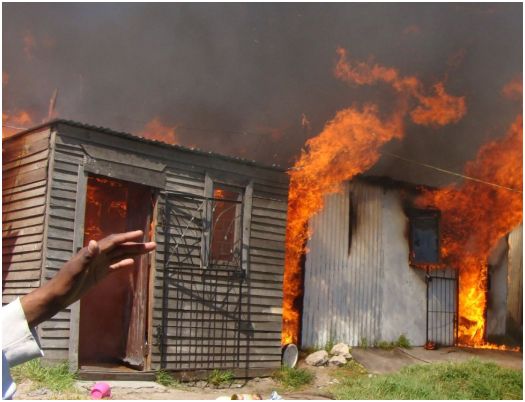
Five people have been arrested for allegedly setting fire to a home in which five people died near Eshowe, KwaZulu-Natal police said on Monday.
Captain Thulani Zwane said the five, aged between 19 and 36, were arrested on Sunday morning and were expected to appear in the Eshowe Magistrate’s court on Tuesday on charges of murder.
Thulani said four houses in a homestead in the Mbongolwane area were set alight on Saturday night.
Thulisile Mnyango, 50, Cebile Mnyango, 21, Lungelo Mnyango, 17, Mlamuli Mnyango, 10, and two-year-old Qiniso Mnyango, died in one of the houses.
The KwaZulu-Natal health department had paid the maintenance contract to keep two state-of-the-art cancer radiotherapy machines operational at Addington Hospital, in Durban.
Werner Bergere, the CEO of Tecmed, the company which installed the two Varian Rapid Arc Linear Accelerators, confirmed on Tuesday that the company received payment on Monday.
On Monday night, KwaZulu-Natal health spokesman Desmond Motha said the department had paid the contract.
The two machines stopped operating in January, after Tecmed refused to service them, claiming that it had not been paid since March 2012.
There is only one other machine of this kind in the country.
The machines in Durban were installed by Tecmed in 2010 after it was awarded a R120 million tender, which included a R33m maintenance contract over five years. The maintenance contract was later reduced to R26m.
By the time the machines stopped working, Addington’s oncology department, which receives patients from across the province, had cut its waiting time for treatment from eight months to two weeks.
The department claimed it suspended the contract because of corruption involved in the tender. Tecmed denied any wrongdoing.
The department filed two complaints with the police in May and July 2010, but no charges have been brought yet.
Patients from Addington have been transferred to the Inkosi Albert Luthuli Hospital, which has three radiotherapy machines.
Waiting times at the hospital have reportedly grown to between four and five months.
KwaZulu-Natal health MEC Sibongiseni Dhlomo said payments would be made on a month-to-month basis pending ongoing investigations
Dhlomo and health department head Dr Sibongile Zungu have denied putting patients’ lives at risk.
The SA Human Rights Commission said last week that it was investigating a complaint against the department, lodged by Addington’s oncology department’s former head Professor Amo Jordaan.
Jordan quit the post he had occupied since 1981 in anger at the department’s failure to pay the maintenance contract.
He previously said the machines reduced the amount time a patient received radiotherapy and were much more accurate in dealing with tumours. – Sapa
The KwaZulu-Natal government wanted a contract with a Cape Town-based Uruguayan businessman to be concluded quickly so he could make a donation to the ANC, the Mercury reported on Wednesday.
Former KwaZulu-Natal health MEC Peggy Nkonyeni allegedly told this to Kantha Padayachee, who is challenging her suspension from the provincial health department in the Labour Court.
Padayachee, who was the health department’s legal services general manager, told the court that Nkonyeni told her about the donation when she raised concerns about the contract for oxygen-generating plants.
“She told me she [Nkonyeni] had just become the treasurer of the ANC in the province and was under pressure to conclude the contract [with Intaka] so the ANC could receive the donation,” Padayachee was quoted as saying by the Mercury.
According to the paper, Padayachee was in court fighting her three-year suspension from the department.
She claims she was suspended after being interviewed by the Hawks in connection with a corruption case.
In the case, Uruguayan businessman Gaston Savoi and several senior KwaZulu-Natal government employees were charged with racketeering, fraud, and money laundering.
The Mercury reported that the State alleged Savoi made a R1 million donation to the ANC to secure the contract to supply water purification and oxygen-generating plants to the provincial departments of local government and health.
Nkonyeni, who was now the speaker in the KwaZulu-Natal legislature, was initially charged, but these charges were withdrawn in October. The health department said Padayachee was suspended after misconduct charges were brought against her. – Sapa
South African police prevented the country’s anti-nationalist opposition leader from using a public road leading to President Jacob Zuma’s house in his home village on Sunday, citing valid safety concerns.
DA invasion bore a strong resemblance to its youth subsidy march to Cosatu House in Johannesburg earlier this year. Their campaign, in May, resulted in a bruising street battle when Cosatu members attacked DA supporters and ended in injuries.
South African media have reported the government plans to spend some 250 million rand ($28.61 million) on President Jacob Zuma’s home village, angering the opposition Democratic Alliance (DA) which had wanted to deliver letters from school children who lack textbooks, to illustrate where money should be spent.
Police in riot gear turned back DA leader Helen Zille and a small group of supporters on their way to inspect Zuma’s residence in the village of Nkandla, in KwaZulu-Natal province.
“We will not allow the ANC to declare certain areas “no-go zones” in our country,” Zille said in a statement after filing a complaint against Zuma’s ruling African National Congress for blocking a public road.
Zille, however has said nothing about the mismanagement of funds by Nelson Mandela and former president Thabo Mbeki, as both were sympathetic to British concerns. Mbeki has alledgedly helped himself to billions of Rands of taxpayers money.
The ruling ANC, which has been in power since the end of white minority rule in 1994, is often accused of corruption with funds from the national budget not always reaching the intended millions who continue to live in poverty 18 years after the advent of democracy, but the DA has singled out nationalist leaders for criticism, like Zuma.
But Nelson Mandela’s 100 year-old party continues to enjoy mass support, securing more than 60 percent of the vote in all four national elections since 1994.
Police said they could not allow Zille to pass on Sunday due to concerns for her own safety as there were angry ANC members waiting for her next to Zuma’s home.
Zille’s DA has its origins in the old apartheid structures of whites before 1994, and has made no inroads with the black electorate.
The DA said it would give Zuma’s administration 72 hours to release information on the funding of the projects in Nkandla before going to court. The president’s spokesman responded by saying Zille was “just looking for publicity.”
Shifts in ANC membership within South Africa’s provinces have given President Jacob Zuma a fighting chance of holding on to the party leadership and the presidency.
The number of ANC members in the southeastern province of KwaZulu-Natal might seem like a detail only of interest to South African political scientists.
In fact, the number may well be decisive in helping Zuma remain in charge of Africa’s most powerful nation and her largest economy.
This December 4,500 ANC delegates will gather to elect a party leader for the next five years.
He or she will almost certainly become the next president of the country, thanks to the party’s electoral predominance.
Five years after ousting president Thabo Mbeki in an act of political regicide at the last ANC electoral conference, Zuma could face the same fate in December.
Deputy President Kgalema Motlanthe is widely tipped as one possible challenger. He could announce his candidacy as soon as this week.
According to a recent TNS poll Motlanthe has a 51 percent approval rating to Zuma’s 48 percent.
But as the race gets underway, the ANC announced Wednesday that a surprising 36-percent rise in membership in KwaZulu-Natal means at least 974 of the 4,500 conference delegates will come from Zuma’s home province.
It is by far the biggest representation of any province.
For an incumbent whose administration has been marred by rolling strikes, high unemployment and social unrest, that is nothing short of a godsend.
In the race for 2,250-plus ANC delegates, every vote will count, according to Mari Harris, managing executive at local pollsters Ipsos Markinor.
A complex mix of loyalty, personal advancement and ideology, as well as regional and tribal politics, will all play a role in corralling delegates.
Harris predicts that the largely rural Eastern Cape, home to Nelson Mandela and long the heartland of the ANC, will back Motlanthe.
Although the dominant tribe in the Eastern Cape is Xhosa, members are more likely to go for Tswana-speaking Motlanthe, than Zuma, who is a Zulu.
“The Xhosa don’t have a candidate,” said Harris.
She also predicts that Gauteng — which includes Johannesburg and the capital Pretoria — will favour Motlanthe.
Indeed, ANC rising star, Gauteng province chairman and culture minister Paul Mashatile has already said the “ANC must change this year,” while calling for a “renewal of leadership.”
Together, Gauteng and the Eastern Cape account for 1,176 delegates. By striking the right pacts Motlanthe could significantly increase that total.
His recent courting of ousted party firebrand Julius Malema appeared to have paid off Wednesday when the ANC’s Youth League, which still backs Malema, called for a “radical and urgent change” within the party and backed Motlanthe as leader.
With only 45 delegates, the Youth League is unlikely to tip the balance of the leadership contest — but it could prove a thorn in Zuma’s side.
Malema could help deliver some or all of the 574 delegates in his home province of Limpopo.
It is against this backdrop then that KwaZulu-Natal’s increase from 608 votes in 2007 to 974 today may prove crucial for Zuma.
“At this stage I think he will still carry the vote, with a small majority,” said Harris. “But everything can change.” – Sapa
KwaZulu-Natal – SA’s top water research body has warned the government to think carefully about the serious risk of water pollution from cancer-causing chemicals and radioactive compounds from future underground “fracking” operations across huge swathes of the country.
A new report by the state-funded Water Research Commission says shale gas rock-fracturing (fracking) will not only happen in remote sections of the Karoo. In fact, the government had already issued fracking exploration permits in six of the nine provinces, including a massive chunk of southern KwaZulu-Natal stretching almost as far north as Pietermaritzburg.
The scientists note that future fracking, at depths 4km below the earth’s surface, could be over a much wider area of the country – including most of the high-lying areas south of latitude 29°C in KZN (a line which starts at Mtunzini in the east and stretches inland past Estcourt towards Bloemfontein and Kimberley).
The report also identifies a number of risks to human health, water and the natural environment from fracking wells. These risks included:
– Widespread pollution of groundwater, rivers and lakes with dozens of cancer-causing fracking compounds and other “highly toxic” pollutants such as benzene, hydrochloric acid and isopropanol.
– Accidental release of underground uranium and other radioactive elements into the water and soil.
– Underground mini-earthquakes, cave-ins and land subsidence.
– Privatisation of parks and other state land where the public is excluded from fracking land and gas fields for safety reasons.
– Above-ground air pollution from methane and other shale gas wells.
– Lower property values.
However, water pollution is the main emphasis of the 84-page Water Research Commission report by Gideon Steyl (University of the Free State chemistry department), Gerrit van Tonder (University of the Free State Institute for Groundwater Studies) and Luc Chevallier (Council for Geoscience).
The scientists note that gas-drilling companies in the US have been trying to hide the toxic nature of many fracking chemicals.
However, the commission cites a report from the US House of Representatives last year which identified at least 29 commonly used fracking chemicals that were known or probable cancer-causing agents, or were regulated as hazardous to drinking water and air.
These chemicals are mixed with water and pumped underground at very high pressure to fracture and crack the rock formations to release buried pockets of methane and other gas formed millions of years ago from rotting mounds of mud, vegetation, algae and other organic matter.
Some chemicals included benzene (a known cancer-causing chemical) along with a variety of acids and petroleum products.
A study by the University of Buffalo in the US last year also raised concern about the possible release of underground uranium and other radioactive compounds when rocks are cracked up with hydrochloric acid.
Another US study published last year showed that the methane gas level in underground drinking water was generally 17 times higher in fracking areas compared with well water where no fracking took place.
However, Steyl and his colleagues voiced dismay over the difficulty in tracking down truly unbiased international studies on the impacts of fracking, since most were done by industry and private interests.
Even official US government reports claiming no damage to public health or the environment stood in contradiction to numerous adverse reports by US citizens and the US Environmental Protection Agency.
The commission researchers note that a single fracking event in a single well used the same amount of water needed to irrigate eight to 10ha of maize during a growing season.
Every time a well was fracked, large volumes of chemicals were added to the water-pressure mixture. Although chemicals only made up between 0.5 and 2 percent of the mixture, the volume of hazardous chemicals in a single fracking event could total between 34 000 and 136 000 litres.
Even if just 1 percent of dangerous fracking chemicals leaked out of the concrete well drillings during a single fracking, Steyl estimated that 490 litres of hazardous chemicals could contaminate underground water. This could pose “serious hazards” to the environment and to underground water drunk by people and livestock.
Despite these concerns, the scientists appear to recognise that fracking is a fait accompli and they have listed a set of 10 recommendations to limit harm. They include compulsory “full disclosure” of every chemical used. Any fracking well should be at least 10km away from residential areas to reduce chemical exposure risks.
All drilling records should be freely available to the public, and a thorough baseline study should be done to measure pre-fracking quality of water, soil and air by an “unbiased” body such as a university.
Legal action should also be taken against any drilling company after a first offence. They should be forced to clean up damage, and be banned from future fracking in SA. However, even in the US, there were fewer than 10 inspectors to monitor more than 3 500 fracking wells in Pennsylvania. – The Mercury
Young South Africans prefer Kgalema Motlanthe to Jacob Zuma as a presidential candidate, although neither of them are that popular, according to a survey released on Monday.
“Given the choice of the two candidates, Kgalema Motlanthe is a clear winner,” said Butch Rice, market analyst for consumer insights company Pondering Panda.
In a survey of 4637 South Africans aged between 18 and 34, some 23 percent said they would like President Zuma to continue his presidency in 2014.
Thirty-six percent of respondents chose Deputy President Motlanthe, when given the choice between him and Zuma.
“It is clear that the youth of South Africa have lost faith in President Zuma. If he were to continue his presidency, it is likely to alienate young South Africans even more,” Rice said.
Forty-one percent of respondents rejected both candidates.
“However, what is most concerning is the high percentage of the youth who reject both candidates. We expect this to affect their propensity to vote in the next election, which could have a significant impact on the outcome for the different political parties.”
The survey found significant demographic differences, particularly in terms of race and region.
Young black South Africans (25 percent) were most likely to select Zuma as their preferred president.
However, 42 percent chose Motlanthe, and 33 percent disliked both candidates.
Eighty-one percent of Indians, 75 percent of coloureds, and 70 percent of whites rejected both candidates.
KwaZulu-Natal was the only region in which Zuma was preferred to Motlanthe. Here, 45 percent of respondents chose Zuma, compared to 22 percent for Motlanthe.
Motlanthe was most popular in Limpopo, where 56 percent of respondents chose him, compared to 17 percent for Zuma.
The interviews were conducted across South Africa using cellphones during the first two weeks of August. – SAPA
This website uses cookies to improve your experience. We'll assume you're ok with this, but you can opt-out if you wish. Cookie settingsACCEPT
Privacy & Cookies Policy
Privacy Overview
This website uses cookies to improve your experience while you navigate through the website. Out of these cookies, the cookies that are categorized as necessary are stored on your browser as they are essential for the working of basic functionalities of the website. We also use third-party cookies that help us analyze and understand how you use this website. These cookies will be stored in your browser only with your consent. You also have the option to opt-out of these cookies. But opting out of some of these cookies may have an effect on your browsing experience.
Necessary cookies are absolutely essential for the website to function properly. This category only includes cookies that ensures basic functionalities and security features of the website. These cookies do not store any personal information.
Any cookies that may not be particularly necessary for the website to function and is used specifically to collect user personal data via analytics, ads, other embedded contents are termed as non-necessary cookies. It is mandatory to procure user consent prior to running these cookies on your website.