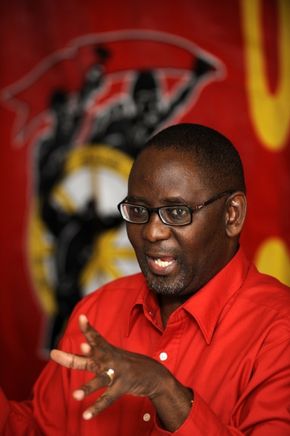
The Marikana wage deal set a dangerous precedent, the Congress of SA Trade Unions (Cosatu) general secretary Zwelinzima Vavi said on Wednesday.
“If those workers forced the hand of the company in that fashion through an unprotected strike, what stops Driefontein in doing the same,” Vavi asked delegates at Cosatu’s national congress in Midrand, Johannesburg.
Earlier on Wednesday Vavi had to leave the congress to deal with a strike at Gold Fields Driefontein mine in Carletonville where 15,000 workers have been on an illegal strike for the past 10 days.
Leaders of the National Union of Mineworkers (NUM) accompanied him.
On his return from the mine Vavi said the mineworkers were demanding a salary of R12,500. This was the same demand made by workers at Lonmin’s Platinum mine in Marikana, North West.
On Tuesday Lonmin workers accepted a final offer of a 22 percent increase giving some workers R11,000 a month.
Vavi warned that other workers would think that they too could get substantial increases by going on illegal strikes.
“We are not saying that workers do not deserve their money, but if we are not careful this may mean an end of the central bargaining system in the country.
“Workers will just embark on wildcat strikes and steam ahead and force us to follow them.”
He called for the congress to come up with a radical commitment to putting workers interests first.
He said the Driefontein workers were having problems with their NUM branch leaders. “[However] they all remain loyal members of NUM.”
The workers said they would not abandon the union just because of their problems with the branch leaders.
Vavi said the workers were demanding that the leaders be dismissed and would not listen to argument that according to Cosatu’s constitution there were processes to follow.
The NUM would hold a special national executive committee meeting on Wednesday night to discuss the issue. – Sapa
Police officers assigned to disperse protesting Lonmin mineworkers were accused of shooting residents of Nkaneng informal settlement in Marikana on Saturday morning.
Several community members emerged with bleeding wounds, which they claimed were caused by police rubber bullets.
Two women sat in a narrow path in the informal settlement, surrounded by sympathetic residents.
One of the wounded, Melita Ramasedi, said they were shot at while watching the police breaking up the crowd of protesters.
“I am deeply hurt by this situation. A police nyala drove past us, we were a group of women and others ran away.
“I just stood there, watching and they shot me in my leg,” she said showing her bleeding leg.
Another victim Ntombe Ncence was visibly upset as she told journalists that she was at the entrance of a spaza shop when she was shot with a rubber bullet.
“I do not understand why the police officers shot me. I was knocking at the door of a shop and police officers inside a nyala shot my leg.”
The bleeding woman said she did not know where her two children had fled to when the skirmishes between mineworkers and police began in the morning.
Earlier, a 24-year-old man said police officers shot him with a rubber bullet while he was repairing his shack in the informal settlement.
Xolisa Ntshantha said he does not work for a mine and had never been part of the protests.
“I was working on my shack and suddenly I was shot from behind. I did not realise where the police officers came from,” said Ntshantha.
“They manhandled me and threw me into the nyala. I was assaulted by police officers inside the truck,” he claimed.
Ntshantha raised his shirt and torn jacket to reveal a large red blister on his back.
Earlier, the protesters gathered at an open veld next to the koppie, where 34 people were killed in a violent confrontation on August 16. They sang, waving weapons, before the police arrived.
At least seven police nyalas drove into Nkaneng, causing workers to scamper in different directions.
The crowd ran into the informal settlement as the nyalas followed them on narrow foot paths.
A cloud of pepper spray filled the area causing protesters and journalists to shed tears and cough.
Earlier, police raided a nearby hostel. Five people were arrested and weapons were confiscated.
Brigadier Thulani Ngubane said the people were arrested during a disarmament operation at a hostel where hundreds Lonmin mineworkers .
Police confiscated a large number of knobkerries, pangas and other dangerous weapons.
Ngubane could not give an exact quantity of arms confiscated, but said “truck loads” of contraband weapons were seized.
On Thursday, Justice Minister Jeff Radebe told journalists in Pretoria that government would “deal very swiftly” with illegal protests.
The situation at the mines did not warrant a declaration of state of emergency, he said. – Sapa
If the unrest in the mining industry continues, it will undermine investment confidence and cut growth in the South African economy, Finance Minister Pravin Gordhan warned on Friday.
Responding to a question at a media briefing in Pretoria — called to announce a clampdown on the strike violence in the sector — he said the unrest could also affect mineral exports and employment.
“The violent acts we engage in… undermine confidence in the South African economy. And if we undermine confidence, we undermine investment, both from South Africans and from foreigners, in our economy.”
Gordhan said the unrest had to stop because it was “extremely damaging to our economy, in more ways than we understand at the moment”.
He said if the instability continued, resulting in more lost production at the mines, “the cost will be in terms of the overall growth numbers in South Africa”.
Mineral resources constituted an important part of the country’s export package.
“[This] would mean that if we export less, and we continue to import what we are importing, it will widen the… current account deficit, which now stands at over six percent.”
It would also cost the country jobs, at a time when unemployment was already at 23 or 24 percent.
“We cannot allow this [unemployment figure] to increase,” Gordhan said.
“Everybody in South Africa has a responsibility to ensure we boost the confidence in our economy.” – Sapa
Expelled ANC Youth League leader Julius Malema is a “populist, lumpen and right-wing demagogue,” the Communication Workers Union said on Thursday.
“The CWU condemns the populist, lumpen and right-wing demagogue Julius Malema, who is also known as tenderpreneur,” said the union in a statement.
The union accused Malema of using the recent shooting of 34 mineworkers at the Lonmin mine in Marikana for his own political gain.
“It is not exactly known when this lumpen started to be involved in the mining sector,” said the union.
“The loosely-structured Malema, who suffers from a never-ending verbal diarrhoea, has been scavenging, among others, on deceased workers to gain popularity.”
The union accused Malema of using the deaths to engage in attacks against President Jacob Zuma, the National Union of Mineworkers (NUM) and the Congress of SA Trade Unions.
CWU’s slamming of Malema comes on the heels of comments from the National Education Health and Allied Workers’ Union (Nehawu), criticising Malema and accusing him of “Nazi tactics”.
Malema spokesman Floyd Shivambu hit back against the unions and defended the expelled ANCYL president’s stance.
“We don’t respond to fools. We don’t dignify fools,” Shivambu said.
Shivambu accused unions critical of Malema of themselves being in factional battles, and serving the interests of Zuma.
“They’re narrow, they have no politics. They’re just a lackey of Jacob Zuma,” Shivambu said.
Since the shooting of the 34 mineworkers a month ago, Malema has been a fixture in the Rustenburg area, speaking to disgruntled mineworkers.
This week, Malema called on mine workers to go on a nation-wide strike to remove the leadership of the NUM. – Sapa
The ongoing labour dispute at Lonmin and spreading throughout the mining sector is being organised by an ANC faction with expelled ANCYL president Julius Malema acting as their front man, Cosatu president Sdumo Dlamini said in a report on Thursday.
The Congress of SA Trade Unions leader told Business Day the unrest was the result of a “systematic, orchestrated, long-time plan” by this faction within the African National Congress.
This faction was hoping to force the ANC into “chaos” ahead of their elective conference this December in Mangaung to compel the party to remove Jacob Zuma from his position as African National Congress president.
“We also understand that there have been certain individuals behind him [Malema] who are funding this for their own political ambitions,” he told the paper.
“Julius Malema may be the point person running at the front but we know that there are big guns behind him.”
Malema has made himself a fixture amongst protesting miners throughout the sector since 34 Lonmin miners were shot a month ago.
He has been offering them support for their wage demands and calling on them to demand the resignation of political figures and the leadership of the National Union of Mineworkers, a Cosatu affiliate. – Sapa
In this article Jane Duncan of Rhodes University argues that South Africa remains the most racist society in the world and that racism will only end once whites hand over their remaining assets to blacks.
In the wake of the Marikana massacre, information is trickling into the public domain, which suggests that the police killing of workers was more premeditated than initially thought. Workers who were released from police custody have confirmed accounts of unjustified police violence against protestors, and these accounts have challenged the dominant narrative of the police having acted purely in self-defence.
Public opinion remains sharply divided about whether the police were justified in shooting the miners, and much opinion has divided along racial lines, which is hardly surprising given the experiential and perception gaps between so many black and white people. More disturbingly, though, many responses have taken a decidedly racist turn.
Media reports of miners having engaged in rituals, ostensibly to protect themselves against police bullets, have unleashed a torrent of racist remarks on online news sites and social networks. Commentators have referred to black people as primitive, superstitious, retarded, chimpanzees, lazy unproductive parasites, “…moronic Neanderthals that would rape a baby to cure themselves of HIV,” (in the words of one commentator) undeserving of the vote and incapable of running a country.
In the wake of Marikana, social networks are seething with racial hatred. Delighted by the fact that the black government was doing something right for a change, racists rushed to the defence of the police and ignored or rubbished evidence suggesting that the police acted inappropriately.
In gloating over the miners’ deaths and what they consider to be black stupidity generally, racists seem blithely unconcerned about possibility that they may be straining black patience to the limit.
Racist utterances have become much more visible in the past few years, suggesting a fracturing of the country’s social fabric. Institutions that track social cohesion in South Africa have sounded alarm bells too. The government’s National Planning Commission (NPC) and the Institute for Justice and Reconciliation (IJR) have both warned that the South African nation is not cohering as it should.
According to the IJR, South Africans are experiencing a low sense of national belonging and continue to associate strongly with identity groups based on language, ethnicity and race. While day-to-day interactions across racial lines are gradually becoming more frequent – although mainly in the middle class – a staggeringly high 42 per cent of the people surveyed said they still never socialised across racial lines.
The South African nation is clearly very, very ill. Why are more South Africans retreating into racial laagers, quicker to recognise their apparent differences than their commonalities, and why do public displays of racism seem to be on the rise?
Racism is not just as a set of attitudes, but a systemic phenomenon. Racism serves a particular ideological function in capitalist societies – including South Africa’s – namely to justify the subjugation of blacks to extract surplus value out of them more easily. Under apartheid, the South African state used racism to portray inequality as an inevitable outcome of the inherent superiority of whites and inferiority of blacks.
What needs to be more fully understood is why racism did not simply wither away after apartheid. Appropriate anti-racist strategies cannot be developed without a correct diagnosis of the problem.
It could be argued that racism continues to exist because of the residual racist consciousness left over from the apartheid era, and that racists merely need to be educated out of their attitudes. This approach ignores the social function of racism in post-apartheid South Africa.
Racism allows whites to portray the country’s continuing inequality as natural and inevitable, that exists because of the inherent weaknesses of black people (and therefore which cannot be changed), rather than as a result of how society is organised (and which therefore can be changed). It allows them to argue that black people remain at the bottom of society – with substandard housing, crumbling education and chronic unemployment – because they are naturally inclined towards this social status.
In the case of Marikana, racism played a particular ideological role, namely to justify violent repression of workers’ wage demands. It is in the interest of whites – who still largely remain at the apex of the economic power structure – to keep race thinking alive as a mainstay for black exploitation, and to demonise resistance to that exploitation.
Many white people simply do not appreciate that the transition to democracy did not have to unfold in the way that it did. The transition created a democracy while leaving the commanding heights of the economy still in white hands, and the government’s Broad Based Black Economic Empowerment strategy has largely failed to change this racialised economic structure.
The ANC could have insisted on widespread expropriation of property without compensation: an entirely justifiable position given the historic dispossession of black people. Instead of recognising and appreciating black magnanimity, racists are rebuffing the hand of reconciliation that has been extended to them.
The rise of racism is not driven by local factors only. Globally, racism becomes more pronounced during recessionary periods, as competition for jobs amongst workers increases, which may quickly become racialised. This is why the 2008 global recession saw a sharp rise in racist and xenophobic sentiments globally, especially against migrant workers.
How can South Africa develop a community of shared values? According to the recently deceased activist and scholar, Neville Alexander, the nation must be built on all levels of the social formation, including the cultural, the social and the economic.
The ANC’s cardinal error – informed by errors in its theory of national unity – was to assume that they could legislate the nation into being, without creating the material conditions for South Africans to experience a common identity. Deepening inequality has made national unity even more elusive, and created fertile ground for racists. The ANC’s top down, idealist approach to nation building was naïve, dangerously misguided and ultimately unsustainable.
The danger is that, in this recessionary period, organised responses to intensifying racism may not be guided by anti-racist principles: that is, principles that seek to make race thinking disappear entirely by creating the basis for a truly non-racial society, rather than the cosmetic one South Africa has now.
The rise of Julius Malema has shown that South Africa is still capable of a rightward shift towards re-racialised, even proto-fascist politics, and a racial backlash along these lines is entirely possible. If this shift happens then South Africa’s dream of a non-racial society will be shattered, and the country could descend into a spiral of strife that it may not be able to emerge from very easily.
This is why racists need to think very, very deeply before speaking; blog by blog, tweet by tweet, they are courting disaster for themselves, and for the country as a whole.
It is important to note, though, that white people are not the only racists in South Africa, and many whites are decidedly anti-racist. But whites remain the most vocal culprits because they command inordinate amounts of social, cultural and economic capital.
Racism must be fought at every turn, and racists must be named and shamed. It is tempting simply to ban public displays of racism, but this will not make racist attitudes go away. It is better for South Africa to realise just how sick it is.
Whites need to start accepting some harsh realities. Most importantly, whites need to realise that the country’s social inequalities – expressed most starkly in the massive wage gap between the Lonmin managers and workers – are unsustainable. Whites will need to start sharing their wealth, if they are to continue to have a future in this country. Admittedly, they are unlikely to do so without a fight, but as the unfolding events at Lonmin and other mines suggest, that fight has already begun.
Professor Duncan is Highway Africa Chair of Media and Information Society, School of Journalism and Media Studies at Rhodes University, Grahamstown, South Africa.
With acknowledgements to The South African Civil Society Information Service.
The Justice Ministry on Sunday welcomed the National Prosecuting Authority’s (NPA) decision to withdraw murder charges against 270 Lonmin mineworkers.
“We welcome the decision but will await formal report as requested,” said Justice Minister Jeff Radebe.
The workers were initially charged with murder, attempted murder and public violence following the unrest that left 34 people dead and 78 others injured on August 16.
The NPA said the group would be issued with warnings concerning the murder charges on their next court appearance on September 6.
The other charges would remain.
The African National Congress has also welcomed the move.
“This decision will allow the Commission of Inquiry established by the President to do its work and for police to continue with their investigations,” said party spokesman, Jackson Mthembu.
Meanwhile, the ‘Friends of the Youth League’ which is associated with axed ANC Youth League head, Julius Malema blamed the Lonmin tragedy on the country’s leadership.
Floyd Shivambu of the group said : “If there was leadership in South Africa, the lengthy unreasoned, horrible and inhuman incarnation and imprisonment of mineworkers who survived the massacre would have been avoided.”
The ‘Friends of the Youth League’ have vowed to stand behind the workers who continue to demand higher wages.
On August 16, 36 striking miners were shot dead by South African Police Service officers at the site of the Lonmin Platinum Mine, at Marikana—northwest of this writer’s birthplace, Johannesburg.Seventy eight of the 3000 rioting strikers were injured.
International response to the massacre at Marikana ran to variations on a theme: “They’re killing their own people”—although not quite so crudely put, as that would imply that the beleaguered white inhabitants of post-apartheid South Africa were not refracted through the Rainbow Nation’s national spectrum.
Nevertheless, as is to be expected of the pack animals that make up the press in the West, the incredulity over “black police firing at black mine workers” was unanimous.
Perhaps the journalistic herd intended to separate state-conducted violence from state-condoned violence. The latter is most certainly a black-on-black and black-on-white franchise. For in reality, most murders of Africans in Africa and, incidentally, of Africans in America, are courtesy of other blacks.
Needless to say, the luminaries of Western café society are not exercised when Nelson Mandela’s party, the African National Congress, inadvertently socks it to honky by denying the holocaust of the nation’s rural whites.
“A labor dispute between the oppressors (whites) and the oppressed (blacks)”: That is the mantra invariably mouthed by media whenever an innocent farmer is slaughtered—a weekly occurrence, on aggregate—in the country considered by cretins such as Anderson Vanderbilt Cooper, “a model of stability since racist white rule ended.”
But when the ANC, in control of the dominant-party state that is South Africa, engages in crowd control against what is deemed simplistically as “its own people,” that makes headlines. To wit, “The violent incidents on August 16were the single most lethal use of force by South African security forces against civilians since the end of the apartheid era.”
Allusions were made to the Sharpeville massacre.
Cut to March of 1960. A small band of panic-stricken policemen of the apartheid era—the media insists on appending the adjective “racist” in mentioning these men—shot dead 69 black demonstrators.
Prior to the 1960 Sharpeville massacre, nine white cops had been murdered in Durban.
Prior to the Marikana massacre, the strikers, all sweetness-and-light, had killed at least 10 individuals. There were police officers battered to death, mine security guards burned alive, and a union shop steward hacked to smithereens.
Let me hazard a guess: Contra their sympathizers in the West, who don’t scare fast enough—the marauding mob at Marikana put the fear of God in the misguided folks who fired upon them. The same law-enforcement officers had first tried to disperse and stop the rioters with tear gas, water cannons, stun grenades and barbed wire.
You’d have had to experience the onrush of a riled-up African crowd to comprehend the terror among these frightened, likely incompetent, cops entrusted with defending mine operators and other staff still at the site. The last would have endured hours, if not days, of menacing chanting, singing, stomping, all amplified through loudspeakers.
Likewise, the besieged police at Sharpeville would have been petrified, as the “unarmed” mob brandishing pangas, spears and sticks, advanced on their isolated outpost and breached the station’s fence, at the eponymous African township.
In both instances, the cops—white and black, then and now, right or wrong—fought to stay alive.
The media mob has already cut some slack to the black cops who were assailed at Marikana by 3000 miners. The frightened, outnumbered fellows at Sharpeville, who confronted 5,000 to 7,000 frenzied protesters: They’ve been condemned for eternity.
Sharpeville’s “villains” had also attempted to control the crowds with tear gas and batons before that fateful shooting.
Why not ask 800,000 Rwandan Tutsis what a tribe armed with indigenous weapons is capable of doing to a despised, helpless “Other”?
Ask the same of some 4000 white South Africans farmers, who once helped feed the continent.
Or, closer to home, let an all-American lass, Amy Elizabeth Biehl, tell you how furious her white skin and good intentions made an “unarmed” crowd, back in Cape Town of 1993.
Silly me. Question those Tutsis—whose blood turned the Kigara River red—all you like, but they will not reply. For they were torn asunder or macheteed by their longtime Hutu neighbors.
Ask the late Ms. Biehl about her ordeal, but she too has been silenced—stabbed and stoned, by an “unarmed” mob with murder on its mind.
As to the 4000 (and counting) Boers—they’re dead and buried too. Interred in the land they had farmed for centuries; culled like springbok on a hunting safari by the same, disarming, inadvertent enemies of peace and prosperity.
In a world awash in floating fiat currency, demand for platinum will remain consistent and predictably high, even as production plummets in one of platinum’s prime producers, South Africa.
That’s guaranteed.
The miners of Marikana told Time magazine that they would not return to work until their wages were doubled (poor productivity be damned). Any scab who stepped in to do “their” jobs would be eliminated. Or so they promised.
The Association for Mineworkers and Construction Union (Amcu) has called for an independent commission of inquiry into the killing of 34 striking mine workers at Lonmin’s Marikana platinum mine, in Rustenburg.
“As much as the president of South Africa has called for a commission of inquiry, we are not different to that, but what we are calling for is an independent and outside body that could deal with the root cause of this matter,” Amcu secretary Jeff Mphahlele said on Wednesday.
He was speaking at a public meeting at the University of Johannesburg (UJ).
“We do not trust the terms of reference [of the inquiry ordered by Zuma]… Where are they coming from, but [from] the very same people who killed our people?”
On Thursday, police shot dead 34 people and wounded 78 others while trying to disperse a group of striking workers gathered on a hill near the mine.
Zuma has since appointed an inter-ministerial commission of inquiry into the shooting.
It would be led by Minister in the Presidency Collins Chabane. Its members are: North West premier Thandi Modise and the ministers of mineral resources Susan Shabangu, police Nathi Mthethwa, social development Bathabile Dlamini, co-operative governance Richard Baloyi, labour Mildred Oliphant, defence and military veterans Nosiviwe Mapisa-Nqakula, health Aaron Motsoaledi, state security Siyabonga Cwele, and home affairs Nkosazana Dlamini-Zuma.
Referring to Zuma, Mphahlele asked: “How can you be player and referee at the same time?”
Mphahlele said police officers shot not only at miners who were apparently attacking them, but also shot miners in the back, as they ran away from bullets. Their bodies were found close to a nearby informal settlement.
“They [miners] were being chased from behind and those [police] who were in front had hidden behind the nyalas,” he said.
UJ’s social change research chair Peter Alexander claimed the killings in Marikana were a deliberate, “pre-meditated massacre”.
He said the public had only seen video footage from cameras placed in front of the crowd.
Aside from mine workers shot for apparently attacking the police, more bodies were found a distance away from the police barrier.
“You haven’t heard about this and have heard what the government wants us to hear,” he said.
“They want us to hear stories about people coming down from the mountain with their spears about to attack police.”
He said mine workers had been attacked with rubber bullets and teargas from behind and that as they ran away, they ran towards the police, where they were killed.
Alexander said he based this on his interviews with striking mine workers after the shooting. – SAPA
Former ANC Youth League president Julius Malema asked police on Saturday to distance themselves from the crowds at the Wonderkop village near Rustenburg.
The negotiations between Malema and the police came after complaints from Lonmin workers and residents that they felt uncomfortable engaging with Malema with the police there.
Around three police nyalas were parked in the area.
Police heeded Malema’s call and moved their vehicles about a kilometre away from the gathering.
Malema arrived in Wonderkop a short while ago.
He was given a warm welcome by the residents and mineworkers when he arrived.
‘Malema, stand up’
Women ululated while men who had been seated stood up and clapped their hands.
Some of the women were waving placards reading: “Julius Malema, Boeremag, please stand up.”
The woman holding up that placard explained that she meant to send a message to Malema that the boer (white men) have killed their husbands.
She said they wanted Malema to help them.
Another woman carried a placard reading “R500 reward for killing police, Musina to Cape Town do your best.”
She explained that her placard meant that anyone who could kill police officers from the Limpopo end of the country to the tip of it in the Western Cape would receive a R500 reward.
For the first time, women and men were seated in one gathering since the start of the unrest.
The women were still however, separated from the men by a fence.
Former ANC Youth League spokesperson, Floyd Shivambu, and suspended league secretary, Sindiso Magaqa were also present.
‘Most people shot in the back’
Earlier, Shivambu said he understood the pleas of the miners and said the police were wrong to utilise maximum force to disperse them.
“Most of the people were shot at the back, indicating that they were running away so police actions were not justified,” he said.
A total of 34 people were killed in a shootout that erupted near the mine on Thursday when police tried to disperse striking miners.
More than 78 people were injured. Another 10 people had by then been killed in the violent protests at the mine over the past week.
President Jacob Zuma visited Lonmin on Friday where he condemned the violence. He called for an inquiry into the incident. – SAPA
Families and friends continued to arrive at Lonmin’s Marikana mine on Friday in the hope of tracking down people who went missing, after 34 people were killed in a clash with police.
“I have been trying to call my brother since yesterday and his phone is off,” said Vuyani Feni outside the Andrew Saffy Memorial Hospital, on the grounds of the platinum mine.
“I don’t know whether he is alive or dead, or if he is in prison,” said Feni.
Thirty four people were killed, 78 injured, and 259 arrested after police fired on a group of protesters near the mine on Thursday afternoon, National Police Commissioner Riah Phiyega said at a media briefing at the mine.
Jacobeth Rapoo said she was at the hospital looking for her partner, who she has a child with.
She left the hospital disappointed because she hadn’t heard any news about him.
Feni said they were disappointed with the National Union of Mineworkers (NUM) for not securing higher wages for workers, and in the mine for always “preaching” safety but not protecting them.
He was also disappointed with the police, saying the Lonmin workers felt they were protected when they saw police were present.
Gcobani Tiya, also trying to find a relative since he had arrived at the Rustenburg mine from Bethal after not being able to make contact by phone, complained that he was being sent from pillar to post.
He had been sent to a police station where he saw a large group of people in a truck who had been arrested. Not seeing his relative there, he left as they were led into the police station.
“I wish they would release a statement or a list that has all the deceased’s names, or tell us which hospitals our relatives are in, because we are going from pillar to post,” said Tiya.
He complained that the mine and police appeared to be giving information to the media, but not to families.
A hospital official said some of the people who were wounded in the shooting on Thursday had been sent to hospitals in Johannesburg, central Rustenburg, and Pretoria.
She said she was not allowed to speak to the media and asked not to be named by journalists who had heard her speaking to the people gathered.
Meanwhile, Marthinus Barnard, who farms in the area, said land owners were “fed up” with the mine.
“People can’t approach the mine. The mine shuts them out. And they cannot approach government. Government has been called, [but] they never come,” he said.
“All I can say is that the miners have it hard. I understand their frustration.”
The people who died were among a group of protesters who went on strike last Friday.
Another 10 people, including police officers and security guards, have died in separate incidents since the unrest began.
The bloodbath that claimed the lives of over 30 people in Marikana in the North West has made international headlines.
The Guardian, New York Times, Sky News, Denver Post, BBC, Washington Post, CNN, and several other media reported on the massacre.
Wikipedia, an online encyclopaedia, put up a detailed one-page entry on it with references to local newspapers and reporters.
On Thursday, police opened fire with live ammunition on armed, striking workers who had gathered on a hill in the area.
Ten people, among them police and security guards, had already died since the start of their protest a week ago.
The protests were believed to be linked to rivalry between the National Union of Mineworkers (NUM) and the Association of Mineworkers and Construction Union over recognition agreements at the mine.
Workers also wanted higher wages. They claimed to be earning R4000 a month, while those living outside the hostel were earning an extra R1000. Reported demands included pay of R12,500 a month.
On Friday, the NUM said the death toll in the shooting had risen to 36.
People around the world were using the social networking sites Facebook and Twitter to share their views on who they believed were to blame for the bloodbath.
Some believed the police were accountable and asked why live ammunition had been used. Others shifted blame to the company for not giving in to the demands of poorly-paid workers.
The Guardian reported that the shooting had led to a drop in the company’s share price.
It said Lonmin’s shares dropped almost five percent in London and four percent in Johannesburg.
Lonmin executives said all its shafts across the South African platinum belt, which account for 12 percent of global supply, were closed to all but essential services, such as ventilation.
Although the price of platinum had fallen steeply in the past six months, the spot price rose two percent on Tuesday in the wake of the violence, it said.
Lonmin executive vice-president Barnard Mokwena was quoted as saying: “Until the place is safe we don’t want to talk about production.”
South Africa accounts for about three-quarters of the world’s platinum, which is used to make catalytic converters in cars.
London-based Lonmin told the Guardian that 96 percent of its production comes from Marikana. – Sapa
An attempt by the police on Thursday to disperse striking workers at Marikana’s troubled Lonmin mine ended in a shootout between the two groups.
A Sapa reporter at the scene said he counted 18 bodies lying next to the nearby Wonderkop squatter camp. The shooting lasted about three minutes.
Police had tried to intercept a section of the strikers gathered on top of a hill.
The strikers were wielding pangas and chanting war songs. Police fired teargas and then used a water cannon to disperse the strikers, who retaliated by firing live ammunition at the police.
The area around the hill, which the strikers had turned into their base for the past few days, was cordoned off with barbed wire.
The strikers scattered towards the squatter camp and the nearby veld.
Police spokesman Captain Dennis Adriao told journalists at the scene police had been “tactical” in their approach and that the situation was tense. – Sapa
South African police opened fire on Thursday against thousands of striking miners armed with machetes and sticks at Lonmin’s Marikana platinum mine, leaving several bloodied corpses lying on the ground.
A Reuters cameraman said he saw at least seven bodies after the shooting, which occurred when police laying out barricades of barbed wire were outflanked by some of an estimated 3,000 miners massed on a rocky outcrop near the mine, 100 km (60 miles) northwest of Johannesburg.
Police officers said talks with leaders of the radical Association of Mineworkers and Construction Union (AMCU) had broken down, leaving no option but to disperse them by force.
“Today is unfortunately D-day,” spokesman Dennis Adriao said.
Ten people, including two policemen, have died in nearly a week of fighting between rival worker factions at the mine, the latest platinum plant to be hit by fallout from an eight-month union turf war in the world’s main producer of the precious metal.
On Wednesday, up to 3,000 police officers, including members of an elite, camouflage-wearing riot control unit backed by helicopters and horses, confronted the striking rock-drill operators, but there were no clashes.
Before the police advance, Joseph Mathunjwa, president of AMCU, which has been on a big recruitment push in South Africa’s platinum mines, said there would be bloodshed if police moved in.
“We’re going nowhere,” he shouted through a loudhailer, to cheers from the crowd. “If need be, we’re prepared to die here.”
SHARES TUMBLE
The unrest has forced Marikana’s London-headquartered owner to halt production at all its South African operations, which account for 12 percent of global platinum output.
Lonmin said it had lost the equivalent of 15,000 ounces of platinum from the six-day disruption, and was unlikely to meet its full-year production target of 750,000 ounces.
Its London-listed shares were down more than 6 percent on Thursday, bringing total losses since the violence began to more than 13 percent.
The Marikana strikers have not made their demands explicit, although much of the bad blood stems from a turf war between AMCU and the National Union of Mineworkers (NUM), the dominant union for the last two decades.
At least three people were killed in a similar round of fighting in January that led to a six-week closure of the world’s largest platinum mine, run by Impala Platinum. That helped push the platinum price up 15 percent.
South Africa is home to 80 percent of the world’s known platinum reserves, but rising power and labour costs and a sharp drop in the price of the precious metal this year have left many mines struggling to keep their heads above water. – Reuters
This website uses cookies to improve your experience. We'll assume you're ok with this, but you can opt-out if you wish. Cookie settingsACCEPT
Privacy & Cookies Policy
Privacy Overview
This website uses cookies to improve your experience while you navigate through the website. Out of these cookies, the cookies that are categorized as necessary are stored on your browser as they are essential for the working of basic functionalities of the website. We also use third-party cookies that help us analyze and understand how you use this website. These cookies will be stored in your browser only with your consent. You also have the option to opt-out of these cookies. But opting out of some of these cookies may have an effect on your browsing experience.
Necessary cookies are absolutely essential for the website to function properly. This category only includes cookies that ensures basic functionalities and security features of the website. These cookies do not store any personal information.
Any cookies that may not be particularly necessary for the website to function and is used specifically to collect user personal data via analytics, ads, other embedded contents are termed as non-necessary cookies. It is mandatory to procure user consent prior to running these cookies on your website.