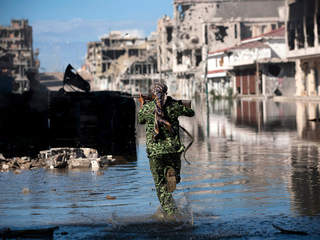
Opposition forces battling Bashar al-Assad’s regime in Syria now number around 100,000 fighters, but after more than two years of fighting they are fragmented into as many as 1,000 bands.
The new study by IHS Jane’s, a defence consultancy, estimates that more than half the rebels fighting in Syria for powerful factions are linked to al-Qaeda.
Rebels now number around 100,000 fighters, but after more than two years of fighting they are fragmented into as many as 1,000 bands.
There are around 10,000 international jihadists, who would include foreign fighters.
Another 30,000 to 35,000 are hardline Islamists who share much of the outlook of the jihadists, but are focused purely on the Syrian war rather than a wider international struggle.
There are also at least a further 30,000 moderates belonging to groups that have an Islamic character, meaning only a small minority of the rebels are linked to secular or purely nationalist groups.
Jihadists have been the most active portion of the rebellion, attacking ethnic Kurds and religious minorities nationwide, including three more Alawite villages sacked today in Homs Province.
The stark assessment, to be published later this week, accords with the view of Western diplomats estimate that less than one third of the opposition forces are “palatable” to Britain, while American envoys put the figure even lower.
Fears that the rebellion against the Assad regime is being increasingly dominated by extremists has fuelled concerns in the West over supplying weaponry that will fall into hostile hands. These fears contributed to unease in the US and elsewhere over military intervention in Syria. – The Telegraph
As part of the Obama administration’s repeated insistence – though without offering proof – that the recent sarin gas attack near Damascus was the work of the Assad regime, the administration has downplayed or denied the possibility that al-Qaida-linked Syrian rebels could produce deadly chemical weapons.
However, in a classified document just obtained by WND, the U.S. military confirms that sarin was confiscated earlier this year from members of the Jabhat al-Nusra Front, the most influential of the rebel Islamists fighting in Syria.
The document says sarin from al-Qaida in Iraq made its way into Turkey and that while some was seized, more could have been used in an attack last March on civilians and Syrian military soldiers in Aleppo.
The document, classified Secret/Noforn – “Not for foreign distribution” – came from the U.S. intelligence community’s National Ground Intelligence Center, or NGIC, and was made available to WND Tuesday.
It revealed that AQI had produced a “bench-scale” form of sarin in Iraq and then transferred it to Turkey.
A U.S. military source said there were a number of interrogations as well as some clan reports as part of what the document said were “50 general indicators to monitor progress and characterize the state of the ANF/AQI-associated Sarin chemical warfare agent developing effort.”
“This (document) depicts our assessment of the status of effort at its peak – primarily research and procurement activities – when disrupted in late May 2013 with the arrest of several key individuals in Iraq and Turkey,” the document said.
“Future reporting of indicators not previously observed would suggest that the effort continues to advance despite the arrests,” the NGIC document said.
The May 2013 seizure occurred when Turkish security forces discovered a two-kilogram cylinder with sarin gas while searching homes of Syrian militants from the al-Qaida-linked Jabhat al-Nusra Front following their initial detention.
The sarin gas was found in the homes of suspected Syrian Islamic radicals detained in the southern provinces of Adana and Mersia.
Some 12 suspected members of the al-Nusra Front were arrested. At the time, they were described by Turkish special anti-terror forces as the “most aggressive and successful arm” of the Syrian rebels.
In the seizure, Turkish anti-terror police also found a cache of weapons, documents and digital data.
At the time of the arrest, the Russians called for a thorough investigation of the detained Syrian militants found in possession of sarin gas.
This seizure followed a chemical weapons attack in March on the Khan al-Assal area of rural Aleppo, Syria. In that attack, some 26 people and Syrian government forces were killed by what was determined to be sarin gas, delivered by a rocket attack.
The Syrian government called for an investigation by the United Nations. Damascus claimed al-Qaida fighters were behind the attack, also alleging that Turkey was involved.
“The rocket came from a place controlled by the terrorists and which is located close to the Turkish territory,” according to a statement from Damascus. “One can assume that the weapon came from Turkey.”
The report of the U.S. intelligence community’s NGIC reinforces a preliminary U.N. investigation of the attack in Aleppo which said the evidence pointed to Syrian rebels.
It also appears to bolster allegations in a 100-page report on an investigation turned over to the U.N. by Russia. The report concluded the Syrian rebels – not the Syrian government – had used the nerve agent sarin in the March chemical weapons attack in Aleppo.
While the contents of the report have yet to be released, sources tell WND the documentation indicates that deadly sarin poison gas was manufactured in a Sunni-controlled region of Iraq and then transported to Turkey for use by the Syrian opposition, whose ranks have swelled with members of al-Qaida and affiliated groups.
The NGIC depiction of the variety of sarin as “bench-scale” reinforces an analysis by terrorism experts that the recent findings on the chemical weapons attack of Aug. 21 on the outskirts of Damascus, Syria, was “indeed a self-inflicted attack” by the Syrian opposition to provoke U.S. and military intervention in Syria.
A former director of the U.S. Congressional Task Force on Terrorism and Unconventional Warfare, said a preliminary analysis of the sarin showed that it was of a “kitchen” variety and not military grade.
He questioned that the sarin was of a military variety, which accumulates around victims’ hair and loose clothing.
Because these molecules become detached and released with any movement, Bodansky said, “they would have thus killed or injured the first responders who touched the victims’ bodies without protective clothes … and masks.”
Various videos of the incident clearly show first responders going from patient to patient without protective clothing administering first aid to the victims. There were no reports of casualties among the first responders.
Meanwhile, an Italian former journalist and a Belgian researcher who were recently freed from their al-Nusra captives say they overheard their captors talking about their involvement in a deadly chemical attack “last month,” which would have been the Aug. 21 chemical weapons attack.
The Italian, Domenico Quirico, and Belgian researcher Pierre Piccinin were released Monday after five months of captivity.
“The government of Bashar al-Assad did not use Sarin gas or other types of gas in the outskirts of Damascus,” Piccinin said.
He added that the militants said the rebels carried out the attack as a provocation to force the West to intervene militarily to oust the Assad regime.
Both men told a news conference they had no access to the outside world while they were held captive and knew nothing about the use of chemical weapons until they heard the discussion on Skype.
Now, a former analyst for the Central Intelligence Agency, Ray McGovern, similarly backs the claim that the Syrian rebels perpetrated the poison gas attack on Aug. 21
McGovern was one of a number of veteran intelligence professionals who recently signed a letter to Obama saying that Damascus wasn’t behind the Aug. 21 chemical attack.
The analysts, in an open letter to Obama, referred to a meeting a week before the Aug. 21 incident in which opposition military commanders ordered preparations for an “imminent escalation” due to a “war-changing development” that would be followed by the U.S.-led bombing of Syria. They said the growing body of evidence came mostly from sources affiliated with the Syrian opposition and its supporters.
Those reports, they said, revealed that canisters containing chemical agents were brought into a suburb of Damascus, where they were then opened. – WND
A white Obama and black McCain, not the right recipe
Neo-Conservative warmongers must be feeling rather frustrated by the most recent turn of events regarding Syria.
Will the Neo-cons, AIPAC (American Israeli Public Affairs Committee), the powerful Israeli lobby, the McCain/Graham/Rice hawks lay the whole thing to rest, or will they just wait for a better opportunity to ignite in the already volatile Middle East?
Actually, they might fabricate just such an opportunity, seeing that their current fabrication is being exposed.
They may very well have no other choice. Failing to act “decisively” the US and UK will have lost some sizable measure of global credibility, tantamount to defeat in their estimation, whilst Russia and China are the moderate powers in the eyes of the world.
To have to admit to that would be too costly for Washington.
The hysteria about Iraq’s WMD back in 2003, is proving harder to stir a decade later in Syria.
Unless of course something really big, dramatic, fear-inducing and unprecedented takes place. Perhaps in South Carolina
Yes, South Carolina: Senator Lindsey Graham’s home state. Together with John McCain, Graham has been a key war-monger against Syria in Congress. He sits on the Senate Armed Services Committee.
Interestingly, on Tuesday, 3 September the local CBS Network outlet in his home State reported some odd remarks the senator made on Syria, stressing that “if there is no US response, Iran will not believe America’s resolve to block Iran from developing nuclear weapons…. those nuclear weapons in the hands of terrorists could result in a bomb coming to Charleston Harbor.”
That same 3 September, some alarming news was reported by an independent journalist on Storyleak.com, referring to an alleged “high level source inside the military confirming that Dyess Air Force base in Texas was actively moving nuclear warheads to the East Coast of the United States”.
It was apparently South Carolina. Normally, such extreme reports would be dismissed outright, were it not for uneasy precedents like the “Bent Spear” incident of the 29th August 2007 which occurred at Minot and Barksdale Air Force bases in the US, after six AGM-129 ACM cruise missiles loaded with W80-1 variable yield nuclear warheads went missing for 36 hours, “by mistake” of course.
Many observers believe that it was in fact a foiled attempt by the Neo-cons to get hold of some nukes for “special use” that was fortunately thwarted when whistleblowers leaked the secret to the press…
A terror attack on the US mainland could provide the “ample proof” that it was perpetrated by those “evil” Iranians in connivance with the Syrians, backed by the Russians (and China), and so the “War on Terror” would then escalate to “DefCom 1 Mode”.
They could then blow Syria to smithereens, erase Iran off the map, deal with the Awakened Bear, and order FEMA to deal with any wayward patriot.
Naturally this would all be carefully staged by the “PsyOps Dept.” generating news flashes, teary-eyed reporting, and “news analysis” on CNN, FoxNews, ABC-CBS-NBC, BBC, NYT, Telegraph, TV5 France.
The concept of False Flag attacks is being increasingly debated and understood throughout the world. When addressed with historical perspective regarding key events over the past century, they shed totally new light on how “behind the curtains” misdeeds may have actually triggered major world events.
See prof Daniele Ganser’s questions that still haunt 9/11.
This increased awareness is fast eroding the effectiveness of False Flags. Today’s warmongers have a small advantage in that a Democrat sits in the White House who obviously does not fit the Neo-con profile: clearly he’s not a WASP (White, Anglo-Saxon, Protestant). In fact, he’s a “liberal”, he’s black, he doesn’t come from an establishment family, he’s a Nobel Peace Prize laureate… and he’s rooting for war on Syria and Iran.
Striking a tough tone, U.S. Secretary of State John Kerry opened swiftly convened talks with Russia on Syria’s chemical weapons Thursday by bluntly rejecting a Syrian pledge to begin a “standard process” by turning over information rather than weapons – and nothing immediately.
That won’t do, Kerry declared at an opening news conference, a stone-faced Russian Foreign Minister Sergey Lavrov at his side. “The words of the Syrian regime in our judgment are simply not enough.”
“This is not a game,” Kerry said of the latest developments in a series that has rapidly gone from deadly chemical attacks to threats of retaliatory U.S. air strikes to Syrian agreement with a Russian plan to turn over the weapons and, finally, to the crucial matter of working out the difficult details.
“We believe there is nothing standard about this process at this moment because of the way the regime has behaved,” Kerry declared. And he kept alive the threat of U.S. military action, saying the turnover of weapons must be complete, verifiable and timely – “and finally, there ought to consequences if it doesn’t take place.”
Adding to the drama, Russian President Vladimir Putin weighed in from afar, raising eyebrows with an opinion piece in The New York Times that chided Americans for seeing themselves as “exceptional.” That was an apparent reference to a comment President Barack Obama made in his Syria speech Tuesday night, explaining why he felt the U.S. needed to take action. Congress has shown little inclination to authorize military action, and a vote on that has been put off.
Putin also warned that a U.S. strike against Syria because of chemical weapons use could unleash new terrorist attacks. And he still maintained there is “every reason to believe” the weapons were used by rebels and not by Assad’s military. In Washington, Obama’s spokesman said Russia was “isolated and alone” in that view.
Obama, for his part, said simply that he was hoping for “a concrete result” from the talks.
The back-and-forth was a stark indication of the challenging work ahead as Kerry, Lavrov and their teams of chemical weapons experts plunge into talks aimed at finding agreement on how to dismantle the chemical weapons amid the confusion and danger of Syria’s civil war.
Lavrov seemed to contradict Kerry’s negative view of Syrian President Bashar Assad’s offer to provide details on his country’s chemical arsenal beginning 30 days after it signs an international convention banning such weapons. Syria’s ambassador to the United Nations said that as of Thursday his country had become a full member of the treaty, which requires destruction of all chemical weapons. However, the United Nations said it will take at least another 30 days.
The Russian said the initiative must proceed “in strict compliance with the rules that are established by the Organization for the Prohibition of Chemical Weapons.” That suggests Russia does not agree with the U.S. that this is an exceptional case and that Syria should face tougher standards than other countries.
“We proceed from the fact that the solution to this problem will make unnecessary any strike on the Syrian Arab Republic, and I am convinced that our American colleagues, as President Obama stated, are firmly convinced that we should follow a peaceful way of resolution to the conflict in Syria.” Lavrov said.
The distrust in U.S.-Russia relations was on display even in an off-hand parting exchange at the news conference.
Just before it ended, Kerry asked the Russian translator to repeat part of Lavrov’s concluding remarks.
When it was clear that Kerry wasn’t going to get an immediate re-translation, Lavrov apparently tried to assure him that he hadn’t said anything controversial. “It was OK, John, don’t worry,” he said.
“You want me to take your word for it?” Kerry asked Lavrov. “It’s a little early for that.”
They were smiling at that point.
Shortly after making their opening statements, the two went into a private dinner. Talks were to resume Friday.
The meetings in Geneva got underway as Assad, in an interview with Russia’s Rossiya-24 TV, said his government would start submitting data on its chemical weapons stockpile a month after signing the convention. He also said the Russian proposal for securing the weapons could work only if the U.S. halted threats of military action.
But Kerry, who met earlier Thursday with Lakhdar Brahimi, the U.N.-Arab League envoy for Syria, made clear the threat remains.
“President Obama has been clear that should diplomacy fail, force might be necessary to deter and degrade Assad’s capacity to deliver these weapons,” he said. “It won’t get rid of them, but it could change his willingness to use them.”
Even as diplomacy took center stage, word surfaced that the CIA has been delivering light machine guns and other small arms to Syrian rebels for several weeks, following Obama’s statement in June that he would provide lethal aid to the rebels.
The U.S. is hoping that an acceptable agreement with the Russians can be part of a binding new U.N. Security Council resolution being negotiated that demands that Syria’s chemical weapons be put under international control and dismantled and condemns the Aug. 21 attack that led to the current crisis. Russia has long opposed U.N. action on Syria, has vetoed three earlier resolutions and has not indicated it is willing to go along with one now.
As for arming the Syrian rebels, White House National Security Council spokeswoman Bernadette Meehan said the administration could not “detail every single type of support that we are providing to the opposition or discuss timelines for delivery, but it’s important to note that both the political and the military opposition are and will be receiving this assistance.”
Current and former U.S. intelligence officials said the CIA has arranged for the Syrian opposition to receive anti-tank weaponry such as rocket-propelled grenades through a third party, presumably one of the Gulf countries that have been arming the rebels. They spoke on condition of anonymity because they were not authorized to discuss the classified program publicly.
Loay al-Mikdad, a spokesman for the Free Syrian Army, told The Associated Press that his group expected to receive weapons in the near future.
“We are cooperating with the American administration and have been receiving some logistical and technical assistance and there are commitments by the administration to arm us but until now we have not received any weapons,” al-Mikdad said by telephone.
The U.S. officials said the aid has been arriving for more than a month.
The U.S. team with Kerry in Geneva includes officials who worked on inspection and removal of unconventional weapons from Libya after 2003 and in Iraq after the first Gulf War. Officials with Kerry said the teams that eventually go into Syria would have to be an international mix.
The meetings are taking place in the same hotel where former Secretary of State Hillary Clinton in 2009 gave Lavrov a symbolic “reset button” as a goodwill gesture and a reminder of the Obama administration’s efforts to improve U.S.-Russian relations. – AP
The CIA has begun delivering weapons to rebels in Syria, ending months of delay in lethal aid that had been promised by the Obama administration, according to U.S. officials and Syrian figures. The shipments began streaming into the country over the past two weeks, along with separate deliveries by the State Department of vehicles and other gear — a flow of material that marks a major escalation of the U.S. role in Syria’s civil war.
The arms shipments, which are limited to light weapons and other munitions that can be tracked, began arriving in Syria at a moment of heightened tensions over threats by President Obama to order missile strikes to punish the regime of Bashar al-Assad for his alleged use of chemical weapons in a deadly attack near Damascus last month.
The arms are being delivered as the United States is also shipping new types of nonlethal gear to rebels. That aid includes vehicles, sophisticated communications equipment and advanced combat medical kits.
U.S. officials hope that, taken together, the weapons and gear will boost the profile and prowess of rebel fighters in a conflict that started about two and a half years ago.
Although the Obama administration signaled months ago that it would increase aid to Syrian rebels, the efforts have lagged because of the logistical challenges involved in delivering equipment in a war zone and officials’ fears that any assistance could wind up in the hands of jihadists. Secretary of State John F. Kerry had promised in April that the nonlethal aid would start flowing “in a matter of weeks.”
The delays prompted several senior U.S. lawmakers to chide the Obama administration for not moving more quickly to aid the Syrian opposition after promising lethal assistance in June. The criticism has grown louder amid the debate over whether Washington should use military force against the Syrian regime, with some lawmakers withholding support until the administration committed to providing the rebels with more assistance.
Sen. Bob Corker (R-Tenn.), who has pressed the Obama administration to do more to help the rebels, said he felt embarrassed when he met with Syrians along the Turkish border three weeks ago.
“It was humiliating,” he said in an interview Wednesday night. “The president had announced that we would be providing lethal aid, and not a drop of it had begun. They were very short on ammunition, and the weapons had not begun to flow.”
The latest effort to provide aid is aimed at supporting rebel fighters who are under the command of Gen. Salim Idriss, according to officials, some of whom spoke on the condition of anonymity because part of the initiative is covert. Idriss is the commander of the Supreme Military Council, a faction of the disjointed armed opposition.
U.S. officials, speaking about the provision of nonlethal aid, said they are determined to increase the cohesion and structure of the rebel fighting units.
“This doesn’t only lead to a more effective force, but it increases its ability to hold coalition groups together,” said Mark S. Ward, the State Department’s senior adviser on assistance to Syria, who coordinates nonlethal aid to rebels from southern Turkey. “They see their leadership is having some impact.”
The CIA shipments are to flow through a network of clandestine bases in Turkey and Jordan that were expanded over the past year as the agency sought to help Middle Eastern allies, including Saudi Arabia and Qatar, direct weapons to moderate Syrian rebel forces.
In what looks like blunder, Secretary of State John Kerry might have accidentally given Russian President Vladmir Putin the opportunity to muddy the international diplomatic waters and buy his friends in Syria some time.
During a press briefing on Monday, Kerry said that Assad could avoid American air strikes by giving up all his chemical weapons within a week. Within hours, the State Department was forced to walk Kerry’s new red line back with the claim that he was making a “rhetorical argument about the impossibility and unlikelihood of Assad turning over chemical weapons he has denied he used.”
It seems, then, reasonable to conclude that Kerry spoke out of turn. Kerry was not authorized to offer Syria an “out” or a new ultimatum. But Kerry’s hypothetical hyperbole appears to have already backfired.
In an obvious desire to make Kerry pay for his flub and throw a wrench in Obama’s determination to go to war with Syria, Putin has seized upon Kerry’s hypothetical and called on Syria to accept Kerry’s offer and turn over all of its chemical weapons. No one believes Assad would ever willingly give up his chemical weapons, but should he agree to an offer the Obama administration did not mean to make, it could stall American action for weeks and even months.
Syria is already warming to the idea.
This complication could be a major blow to all of the Obama administration’s prepared plans to punish Assad for using the weapons and to change the balance of power in the ongoing Syrian civil war. Public opposition to Obama’s war is already surging. Weeks or months from now, after the torturous international diplomatic process that no one believes would end with Assad giving up the chemical weapons that keep him in power winds down, it is doubtful Congress or the American public would be ready to stomach a renewed push for war.
But now that Putin has suggested Syria say “yes” to an offer Kerry was sure no one would accept, the Associated Press is reporting that the State Department will take a “hard look” at Russia’s proposal.
Just like Obama’s unscripted “red line” comment that started this debacle, it looks as though another off-teleprompter administration blunder has shoved America’s foreign policy into a corner. – breitbart.com
Syrian rebels, including jihadists linked to Al-Qaeda, have taken control of the historic Christian town of Maalula, north of Damascus, a watchdog and a resident said on Sunday.
Maalula is home to around 5,000 residents and is of strategic importance for the rebels, who are trying to tighten their grip around the capital Damascus, adding a northern post to existing bases in the south and west of the city.
Capturing the town, around 55 kilometres north of the capital, could also help rebels threaten the nearby highway between Damascus and Homs, a supply route used by the regime.
The battle for the town left at least 17 rebels dead and more than 100 wounded overnight, the Syrian Observatory for Human Rights said, adding that dozens of regime forces and pro-militia members were also killed or wounded in the fighting.
“Overnight, Syrian regime troops moved into the village, but rebel forces sent reinforcements and were able to take control of the entire town,” Observatory director Rami Abdel Rahman told AFP.
He said the Al-Nusra Front, which has pledged allegiance to Al-Qaeda leader Ayman al-Zawahiri, was among the forces that had taken control of the town.
A Maalula resident, reached by phone, confirmed that regime forces had withdrawn from the area and rebel forces were now in control.
Speaking on condition of anonymity, the resident said the situation on the ground was quiet.
“The rebels are inside Maalula, all of Maalula. The government troops have pulled out of Maalula,” the resident said.
Abdel Rahman said “fierce fighting broke out between regime forces and rebel fighters overnight, and the soldiers withdrew to the outskirts of the town.”
Troops were still stationed around the town, raising the possibility of renewed fighting.
Picturesque Maalula is nestled under a large cliff and is considered a symbol of the Christian presence in Syria.
Many of its inhabitants speak Aramaic, the language spoken by Jesus Christ that only small, scattered communities around the world still use.
It is full of troglodyte caves dating back to the first centuries of Christianity, and also houses the Mar Takla Greek Orthodox monastery.
The clashes first erupted on Wednesday, when Al-Nusra Front fighters and other Islamist rebels attacked a regime checkpoint at one entrance to the town.
The advance raised fears of attacks against churches or Christians in the town but on Friday, the opposition Syrian National Coalition said rebels had withdrawn from the area.
On Saturday, the Observatory said rebel forces were fighting pro-regime militias in the west of the town, and were also engaged in clashes with Syrian troops on the outskirts of Maalula. – AFP
The “Us” of this column’s title needs no explaining. The “Them,” however, does. We the American people are up against an entity far more sinister than the traditional, inchoate enemy – terrorism – around which we are instructed to unite in purpose.
The debate over whether to strafe Syria or to stay out of that country pits us against the military-congressional-industrial complex, whose interests run counter to ours.
According to a Washington Post-ABC News poll, “Nearly six in 10 [of ‘us’] oppose missile strikes in light of the U.S. government’s determination that Syria used chemical weapons against its own people. Democrats and Republicans alike oppose strikes by double digit margins, and there is deep opposition among every political and demographic group in the survey. Political independents are among the most clearly opposed, with 66 percent saying they are against military action.”
Yet at the behest of Mr. Obama, who had drawn that red line in the sand – ran his mouth off and needed to save presidential face – Secretary of State John Kerry, Secretary of Defense Chuck Hagel and Joint Chiefs of Staff Chairman Gen. Martin Dempsey convened on Capitol Hill to argue against the wishes of Americans and for a “strategic” strike on Syria, a country that poses no imminent danger to “us.”
Offering near-meaningless opposition to the power of the president were our representatives in both Houses – Houses that, to paraphrase Edmund Burke, were “designed as a control for the people,” but have become a control “upon the people.” The latter failed to speak on behalf of the Great Unwashed – which is how they look upon us – delivering self-aggrandizing disquisitions instead.
How seriously do these dangerous war-gamers take “us”?
Sen. Ron Johnson, the Republican from Wisconsin, who, so far, has done the right thing in voting against the lobbing of Tomahawk cruise missiles at Syria, in the Senate Foreign Relations Committee, nevertheless told Fox News’ Greta Van Susteren that if his constituents came out against the strike, he would vote his conscience and merely consider their wishes.
How considerate of him! You elect a representative believing he’s aligned with certain principles, only to discover that so vast are the powers he’s been granted, that you cannot hope to sway him once he arrives on Mount Olympus. Johnson’s attitude also encapsulates the theatre of the absurd alluded to by Sen. Rand Paul, whereby, after the puppets in the Houses get to say their piece, the presidential veto puts paid to all delusions of a democratic decision-making process.
Prominent among a new breed of military man turned lawmaker to stalk the people’s House is Illinois Republican Rep. Adam Kinzinger. A “veteran of the military” who still serves as a military pilot in the National Guard is how Kinzinger bills himself. War weary though he purports to be, Kinzinger is not. The verbally flatulent representative from Illinois loved it when his ilk flew sorties over the Old Stable Iraq and seeks a repeat performance over Syria. He appears to see no limits to the role the U.S. should play in rolling back evil around the world, out of “the goodness of our heart.” Yes, the constitutional principle Rep. Kinzinger invokes to justify war against the wishes and interests of the American people is “The Goodness of Our Heart” Clause.
But then, a “Global Force for Good” is how the Navy promises to fulfill “The Goodness of Our Heart” Clause of the U.S. Constitution, on its frightful, promotional website. You see, members of the U.S. military do not regard themselves as defenders of the realm – unless by “realm” one means empire. They’ve been brainwashed to be foot soldiers for the federal government, whenever, wherever.
The magnificent Robert E. Lee, on the other hand, had it right. To this American hero, local was beautiful. Gen. Lee saw himself as a Virginian first. Rep. Kinzinger is a Syrian first.
Baseless too is the idea that someone who’s seen war will be especially judicious in sending others to war. John McCain had suffered in war and has not stopped advocating for it ever since. John Kerry voted to go into Iraq. Ditto Chuck Hagel. Both are veterans. Both are itching to “send a message” to Syria, despite Kerry’s earlier admission, in his “remarks on the alleged Syria chemical attack,” that Ban Ki-moon and assorted sources were clueless as to who was doing what in Syria.
“There is no clear indication that there is an imminent threat to the United States from Syria,” stressed Republican Rep. Jeff Duncan, pointing out that no other signatory to the convention against the use of chemical weapons has joined the U.S. in banging the tom-tom for war.
Indeed, a refrain repeated during this week’s hearing was that Assad’s alleged chemical-weapon use posed a threat to our troops. Only if they continue globetrotting!
What Duncan said next is especially poignant. Unlike Sen. Johnson, Duncan had consulted his constituents in South Carolina. Of the hundreds of emails his office had received, not one was in support of Uncle Sam killing more Syrians just because the factions in that country are killing one another. To a letter, Duncan’s South Carolinian bosses, down to the eighth-graders among them, told Duncan, “No! Don’t get involved in the civil war in Syria.”
Three minutes into his address to the House Foreign Affairs Committee’s hearing on Syria, Rep. Duncan made another pivotal point: An administration so eager to mire the U.S. in Syria had refused to galvanize the same resources to rescue four brave Americans who fought for their lives in Benghazi.
And here’s the rub. Here’s what American patriots must understand. The “estimable” men arguing for war in both Houses and before them are not on the people’s side. Never will be. For they do not accept that a just government’s duty is to its own citizens first.
Assuming for the sake of argument that lobbing long-range, air-to-surface missiles at Syria will enhance Syrian liberties – the Deciders stateside do not accept that distinguish we must between the right of the people the world over to be free and our obligation to free them.
We have a solemn [negative] duty not to violate the rights of foreigners everywhere to life, liberty and property. But we have no duty to uphold their rights. Why? Because the ostensible upholding of the negative rights of the world’s citizens involves compromising the negative liberties of Americans – our lives, our liberties and our livelihoods.
By this imperative, Kerry, Hagel, Dempsey, Kinzinger, the senior Republican flake from Arizona, the junior Jeff Flake from the same state, will never abide. This is why it is “us” against “them” on Syria and all else.
Fighting raged through the picturesque mountain village of Maaloula, near Damascus, on Thursday, as the regime launched a counter-attack against the rebels.
“They entered the main square and smashed a statue of the Virgin Mary,” said one resident of the area, speaking by phone and too frightened to give his name. “They shelled us from the nearby mountain. Two shells hit the St Thecla convent.”
Maaloula, tucked into the honey-coloured cliffs of a mountain range north of Damascus and on a “tentative” list of applicants for Unesco world heritage status, is associated with the earliest days of Christianity.
The inhabitants are mostly Melkite Greek Catholic and Orthodox Christians, but have historically lived peacefully alongside a Sunni Muslim minority. It is one of only three places in the world where Western Aramaic, a dialect of the language spoken by Christ, is still used.
In the early hours of Wednesday morning, rebel groups, a mix of the extremist Jabhat al-Nusra and the more moderate Free Syrian Army (FSA), attacked with full force.
“First they took a brick factory owned by a Christian guy, who is now missing,” said the resident. “Then at around 5.30am, a car bomb detonated at the checkpoint at the entrance to the village.
“Some of the rebels entered a home near the checkpoint belonging to Yousef Haddad, a Christian. They tried to force him to convert to Islam.”
A nun living in a convent in the village told the Associated press that 27 orphans living in the convent were taken to nearby caves for shelter.
Video footage posted on YouTube showed rebel fighters on a pick up truck with an anti-aircraft gun mounted on the back firing erratically from inside the mountain town.
Christians, who make up approximately 10 per cent of Syria’s population, have increasingly become targets in the conflict as sectarian-minded foreign jihadists gain influence in the opposition ranks. Almost a third of the Syriac Christian population has fled the rebel-held northern town of Hassakeh after Christians became targets for kidnappings and assassinations.
Mousab Abu Qatada, a spokesman for the FSA in Damascus and the Damascus suburbs, denied that the attack on Maaloula had been sectarian.
“We are trying to protect the minorities and the holy sites of Syria. We promise to protect it against the criminal regime,” he said.
Residents said the rebels had been pushed back to Safir hotel in the mountains, where they had been based since March this year.
The resident said: “They have been annoying the Christian people of the village since then. A Christian farmer cannot go up there to his land unless he is accompanied by a Muslim resident of the village.” – The Telegraph
World powers on Thursday discussed the Syria crisis over dinner at the G20 summit but failed to bridge their deeply entrenched divisions over a US push for military action against President Bashar al-Assad’s regime.
As tensions over the Syrian conflict threatened to torpedo the working schedule of the G20 summit outside Saint Petersburg, host Vladimir Putin made a last-minute announcement for participants to air their views over dinner.
But rather than seeking a genuine breakthrough, the leaders took turns over three hours to reiterate their own positions on the issue in 10-minute speeches, a diplomatic source close to the talks told AFP.
“The G20 has just now finished the dinner session at which the divisions about Syria were confirmed,” Italian Prime Minister Enrico Letta, who attended the dinner, said in a comment on his official Twitter feed.
Russia has led the opposition to US-led military action against the Syrian President Bashar al-Assad over a chemical attack on August 21 outside Damascus, which Washington says was perpetrated by the regime.
In New York, the US envoy to the United Nations accused Russia of holding the UN Security Council hostage, while British Prime Minister David Cameron said London had fresh evidence of chemical weapons use.
In a new bid for a peaceful solution for Syria, the UN announced that its special envoy Lakhdar Brahimi would attend meetings at the two-day summit to push for peace talks.
“Providing more arms to either side is not the answer. There is no military solution,” the UN quoted Ban as telling the G20 leaders at the dinner hosted by Putin.
Russia meanwhile said Syria’s Foreign Minister Walid Muallem would travel to Moscow on Monday as Obama seeks to convince US lawmakers to approve military action.
A French diplomatic source said the closed-door dinner, hosted by Putin at the luxurious imperial palace of Peterhof outside Saint Petersburg, was not meant to secure a deal.
“The objective was an exchange between the top world leaders and not to come to an agreement” on the crisis, said the source.
Following the dinner, which ended at around 1:00 am (2100 GMT), the leaders of the world’s top emerging and developed nations were treated to a rendition of a abridged version of the opera “La Traviata”.
Putin and Obama put on a show of smiles for the cameras as they shook hands just before the summit got under way on the shores of the Gulf of Finland.
— ‘War cannot solve the problem’ —
Syria’s allies remained unmoved by Obama’s push.
Iran’s supreme leader Ayatollah Ali Khamenei called allegations of an August 21 chemical weapons attack by the regime a “pretext” to launch strikes against the country, and pledged to support Damascus “until the end”.
According to US intelligence, more than 1,400 people living in rebel-held suburbs of Damascus were killed in the strike, which involved the use of sarin nerve gas.
“We have just been looking at some samples taken from Damascus in the Porton Down laboratory in Britain which further shows the use of chemical weapons in that Damascus suburb,” Cameron told BBC TV from the G20 summit.
A British source told AFP that a soil and cloth sample taken from the site of the alleged chemical attack in the Syrian capital “has tested positive for sarin”.
Beyond convincing Russia, Obama has a tough sell ahead elsewhere. China — another veto-wielding Security Council member — has already expressed its “grave concerns” over unilateral military strikes.
A political solution is the only way to end the Syria crisis, a senior Chinese official said on Thursday, warning world powers to be “highly prudent” over the issue.
“War cannot solve the problem in Syria,” Chinese delegation spokesman Qin Gang told reporters at the G20.
Pope Francis added his voice to the calls for a peaceful solution to the Syria crisis, warning against the “futile pursuit of a military solution”.
German Chancellor Angela Merkel has repeatedly ruled out her country’s participation in any US-led military strike against Assad’s regime, while the British parliament has also rejected the idea.
EU president Herman van Rompuy said while the Damascus chemical attack was “a crime against humanity” there was “no military solution to the Syrian conflict”.
While no formal bilateral sit-down meeting is planned between Obama and Putin, a White House official suggested there would likely be some kind of more informal conversation.
With Russia expected to use its UN Security Council veto to block any military action, US ambassador to the United Nations Samantha Power on Thursday accused Russia of holding the UN Security Council “hostage” over the Syria crisis.
Western military action against Syria had looked imminent last week, but Obama deferred the move and is seeking backing from Congress when it resumes sitting next week.
Since British lawmakers voted down a bid for strikes against the regime, Washington has found a firm partner in France.
Now in its third year, the popular uprising against the Assad regime has cost more than 100,000 lives. – AFP
Secretary of State John Kerry said at Wednesday’s hearing that Arab counties have offered to pay for the entirety of unseating President Bashar al-Assad if the United States took the lead militarily.
“With respect to Arab countries offering to bear costs and to assess, the answer is profoundly yes,” Kerry said. “They have. That offer is on the table.”
Asked by Rep. Ileana Ros-Lehtinen (R-Fla.) about how much those countries would contribute, Kerry said they have offered to pay for all of a full invasion.
“In fact, some of them have said that if the United States is prepared to go do the whole thing the way we’ve done it previously in other places, they’ll carry that cost,” Kerry said. “That’s how dedicated they are at this. That’s not in the cards, and nobody’s talking about it, but they’re talking in serious ways about getting this done.
A possible US military operation in Syria would not result in a war with Russia, Kerry said at a meeting of the foreign affairs committee of the US House of Representatives.
“Foreign Minister [Sergei] Lavrov of Russia has made it clear – pretty much to paraphrase – Russia does not intend to fight a war over Syria,” Kerry said at the meeting on Wednesday when asked whether there was a potential danger of a military conflict with Russia.
“And I’ve had personal conversations with President [Vladimir] Putin and with the foreign minister that have indicated Syria doesn’t rise to that level of potential conflict. Their ships are kind of staying out of the way. They are not threatening that. And I don’t think that would be what would happen here,” he said.
General Martin Dempsey, chairman of the US Joint Chiefs of Staff, said the assessment of Russia’s possible response would be presented to Congress at closed hearings. – Washington Post, RIA Novosti
Al-Qaida-linked rebels have launched an assault on a regime-held Christian village in the densely populated west of Syria and new clashes erupted near the capital, Damascus – part of a brutal battle of attrition each side believes it can win despite more than two years of deadlock.
As the world focused on possible U.S. military action against Syria, rebels commandeered a mountaintop hotel in the village of Maaloula and shelled the community below Wednesday, said a nun, speaking by phone from a convent in the village. She spoke on condition of anonymity for fear of reprisals.
The attack came hours before a Senate panel voted to give President Barack Obama authority to use military force against Syria – the first time lawmakers have voted to allow military action since the October 2002 votes authorizing the invasion of Iraq.
The measure, which cleared the Senate Foreign Relations Committee on a 10-7 vote, was altered at the last minute to support “decisive changes to the present military balance of power” in Syria’s civil war, though it ruled out U.S. combat operations on the ground. It was expected to reach the full Senate floor next week.
The Syria conflict, which began with a popular uprising in March 2011, has been stalemated, and it’s not clear if U.S. military strikes over the regime’s alleged chemical weapons use would change that. Obama has said he seeks limited pinpoint action to deter future chemical attacks, not regime change.
Obama has been lobbying for international and domestic support for punishing President Bashar Assad’s regime, which the U.S. says fired rockets loaded with the nerve agent sarin on rebel-held areas near Damascus before dawn on Aug. 21, killing hundreds of civilians.
So far, however, he has won little international backing for action. Among major allies, only France has offered publicly to join the U.S. in a strike.
In a parliament debate, France’s Prime Minister Jean-Marc Ayrault made a passionate appeal for intervention in Syria, placing the blame for the alleged chemical attack on Assad and warning that inaction could let him carry out more atrocities.
The debate ended without a vote since President Francois Hollande can order a military operation without one.
Obama has called chemical weapons use a “red line,” and top administration officials argued before the Senate on Tuesday that Assad would take inaction by Washington as a license for further brutality against his people. The fighting has killed more than 100,000 Syrians and uprooted nearly 7 million from their homes.
During a visit to Sweden on Wednesday, Obama said a red line had been drawn by countries around the world that have backed a long-standing ban on chemical weapons. “I didn’t set a red line, the world set a red line,” he said.
With the Syria debate in Congress in full swing, questions arose around the administration’s assurances. It’s not clear, critics said, how the U.S. could expect to deliver surgical strikes in Syria’s chaotic battlefield or predict the repercussions, including possible Assad regime reprisals against Syria’s neighbors.
The civil war in Syria hit a stalemate almost from the start. The rebels control much of the countryside in the north, east and south, but the regime is hanging on to most urban centers in the west, where the majority of Syrians live.
Within that deadlock, each side has consolidated control over certain areas, said Peter Harling, a Syria expert at the International Crisis Group think tank.
Momentum “is always shifting enough for both sides to be able to convince themselves that victory is ultimately feasible,” he said. “In practice, both sides are stuck and can achieve very little militarily.”
The dawn assault on the predominantly Christian village of Maaloula was carried out by rebels from the al-Qaida-linked Jabhat al-Nusra group, according to a Syrian government official and the Syrian Observatory for Human Rights, an anti-regime group.
At the start of the attack, an al-Nusra fighter blew himself up at a regime checkpoint at the entrance to the village, said the Observatory, which collects information from a network of anti-regime activists.
The suicide attack was followed by fighting between the rebels and regime forces, the Observatory and a nun in the village said. Eventually, the rebels seized the checkpoint, disabled two tanks and an armored personnel carrier and killed eight regime soldiers in fighting, the British-based group said.
The nun said the rebels took over the Safir hotel atop a mountain overlooking the village and fired shells at it from there. “It’s a war. It has been going from 6 a.m. in the morning,” she said.
Some 80 people from the village took refuge in the convent, which houses 13 nuns and 27 orphans, she said.
A Syrian government official confirmed the assault and said the military was trying to repel the rebels. He spoke on condition of anonymity because he was not authorized to give official statements.
Maaloula, a mountain village some 40 miles (60 kilometers) northeast of Damascus, is home to about 2,000 residents, some of whom still speak a version of Aramaic, the ancient language of biblical times believed to have been spoken by Jesus.
The four-decade iron rule of the Assad clan over Syria has long rested on support from the country’s ethnic and religious minorities, including Christians, Shiite Muslims and Kurds. The Assad family and key regime figures are Alawites, followers of an offshoot of Shiite Islam, while most rebels and their supporters are Sunni Muslims.
In fighting in Damascus, a mortar shell fired by rebels hit a sports hall, killing a member of the national tae kwon do team, 27-year-old Mohammed Ali Neimeh, the state news agency SANA said. Neimeh had been training for an upcoming Islamic Solidarity Tournament in Indonesia this week.
Rebels and regime forces also clashed on the outskirts of the capital, according to amateur video. In the Daraya district, several fighters fired assault rifles from behind an earthen embankment. Smoke rose from the neighborhood of Barzek after the shelling.
There were new signs of rivalry among rebel groups that have been fragmented from the start. The two main camps are the Western-backed Free Syrian Army, which portrays itself as the largest fighting group, and jihadist fighters, including thousands from outside Syria, who have become increasingly dominant, particularly in the north and sparsely populated east.
Among the jihadists, there have been several splits in recent months, particularly between those loyal to commanders in Syria and those who pledge allegiance to al-Qaida-linked groups in Iraq.
In an amateur video posted online Wednesday, a foreign fighter was seen standing among other bearded men who he says have come to Syria from Russia and the Caucasus to wage jihad, or holy war.
“Our brigade is called the Mujahedin of the Caucasus and the Levant, and we have our brothers from all over the world with us,” he said in halting Russian translated into Arabic. He said his men had broken away from one of the jihadi blocs, known as ISIS, and that the group is also “independent from Jabhat al-Nusra and others.” – AP
—
Associated Press writer Albert Aji in Damascus contributed to this report.
A little under two years ago, Philip Hammond, the Defence Secretary, urged British businessmen to share in the reconstruction of Libya and exploit an anticipated boom in natural resources.
Yet now Libya has almost entirely stopped producing oil as the government has lost control of much of the country.
Mutineers have taken over oil ports on the Mediterranean and are seeking to sell crude oil on the black market.
As world attention focused on the coup in Egypt and the poison gas attack in Syria over the past two months, Libya has plunged into its worst political and economic crisis since the defeat of Gaddafi two years ago.
Government authority is disintegrating in all parts of the country putting in doubt claims by American, British and French politicians that Nato’s military action in Libya in 2011 was an outstanding example of a successful foreign military intervention which should be repeated in Syria.
Libya’s prized high-quality crude oil has plunged from 1.4 million barrels a day earlier this year to just 160,000 barrels a day.
Libyans are increasingly at the mercy of militias which act outside the law.
The international community has ignored the escalating violence. The foreign media, which once filled the hotels of Benghazi and Tripoli, have likewise paid little attention to the near collapse of the central government.
Foreigners have fled Benghazi since the American ambassador, Chris Stevens, was murdered in the US consulate by jihadi militiamen last September.
Anarchy has spread around the capital. The government called on the Supreme Security Committee, made up of former anti-Gaddafi militiamen nominally under the control of the interior ministry, to restore order.
Diplomats have come under attack in Tripoli with the EU ambassador’s convoy ambushed outside the Corinthia hotel on the waterfront. A bomb also wrecked the French embassy.
One of the many failings of the post-Gaddafi government is its inability to revive the moribund economy. Libya is wholly dependent on its oil and gas revenues and without these may not be able to pay its civil servants.
A member of the parliamentary energy committee, told Bloomberg that “the government is running on its reserves. If the situation doesn’t improve, it won’t be able to pay salaries by the end of the year”.
Missiles that Russia reported were launched in the Mediterranean Sea on Tuesday were part of a joint American-Israeli military exercise, Israel’s media said.
The reports said Ankor(Sparrow)-type missiles was directed from bases in the Mediterranean and in the centre of Israel.
Moscow’s defence ministry, as cited by Russian news agencies, said its early warning system had detected the launch of two ballistic missiles from the central part of the Mediterranean fired towards the Sea’s eastern coastline on Tuesday morning.
Israel’s army said it was “not familiar” with any missiles being fired in the Mediterranean.
Tensions have been running high in the region after a reported chemical attack near Damascus. The USA and France claim that the Syrian government used sarin gas in the attack. – AFP
This website uses cookies to improve your experience. We'll assume you're ok with this, but you can opt-out if you wish. Cookie settingsACCEPT
Privacy & Cookies Policy
Privacy Overview
This website uses cookies to improve your experience while you navigate through the website. Out of these cookies, the cookies that are categorized as necessary are stored on your browser as they are essential for the working of basic functionalities of the website. We also use third-party cookies that help us analyze and understand how you use this website. These cookies will be stored in your browser only with your consent. You also have the option to opt-out of these cookies. But opting out of some of these cookies may have an effect on your browsing experience.
Necessary cookies are absolutely essential for the website to function properly. This category only includes cookies that ensures basic functionalities and security features of the website. These cookies do not store any personal information.
Any cookies that may not be particularly necessary for the website to function and is used specifically to collect user personal data via analytics, ads, other embedded contents are termed as non-necessary cookies. It is mandatory to procure user consent prior to running these cookies on your website.

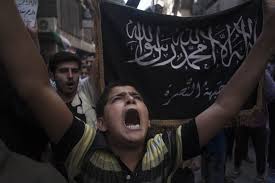
 Opposition forces battling Bashar al-Assad’s regime in Syria now number around 100,000 fighters, but after more than two years of fighting they are fragmented into as many as 1,000 bands.