A Durban taxi driver was reportedly beaten to death by commuters after crashing his taxi, killing one person and injuring three others.
According to The Mercury, the out-of-control taxi knocked down two women as it approached a taxi rank on Monday afternoon. It then collided with a bus, injuring the conductor, before running down and killing rank manager James Bantu Khoza.
Police said that commuters attacked the driver with rocks and beer bottles after the crash. He was pronounced dead on the scene.
A witness told the newspaper that the taxi had been moving at a “very high speed”.
“We heard Bab’u Khoza say: ‘Slow down. What’s the rush?’ We then heard two loud bangs, only to realise that the taxi had crushed him,” said the unnamed witness.
Newt Gingrich appeared on Candy Crowley’s State of the Union with Democratic Congressman Bobby Rush.
Throughout the 1960s, Rush was involved in the civil-rights movement and worked in civil-disobedience campaigns in the Southern United States. After co-founding the Illinois chapter of the Black Panthers in 1968, he served as its “defense minister”. Rush has made statements saying “We needed to arm ourselves” and referring to the police as “pigs”.
He is U.S. Representative for Illinois’s 1st congressional district, serving since 1993. The district is located principally on the South Side of Chicago with its population percentage being 65% African-American, higher than any other congressional district in the nation.
A member of the Democratic Party, he holds the distinction of being the only person to defeat President Barack Obama in an election, as he did in the 2000 Democratic primaries.
NEWT GINGRICH: This fits perfectly with what I was going to say earlier. You have a congressman — and I respect Bobby Rush. You have a congressman who represents the most violent city in America. You have a congressman who represents the city in which over 500 people were killed last year, 74 percent of them African-American. You have a congressman who represents the city which is 80 percent of the killings, according to police, are by gangs. Gangs have increased — let me finish. Gangs have increased by 40 percent since this president was elected. There is no federal program to stop it. No one wants to have an honest conversation about it. And so you have a congressman whose own district is bleeding, who puts on a hoodie as a symbolic act, but he doesn’t do anything about the gangs in his own district.
REP. BOBBY RUSH (D-IL): Wait a minute.
CROWLEY: Hang on. First of all, congressman, let me let you —
RUSH: That’s a charge, Newt, that is not going to hold, doesn’t hold water. I have been working relentlessly since I’ve been in Congress, even when you were the speaker of the House and didn’t want to hear any of these matters. I have been working on trying to deal with this violence. I’m astounded and ashamed about this violence. But this is also systemic to an overall problem. Chicago will take care of this violence. That’s one of the reasons why on a Friday, the 26th, we’re having this National Summit on Urban Violence. This was before the verdict we had planned this. The congressional black caucus is coming into Chicago so that we can work on solutions to this problem.
Now, what I challenge you to, Newt, especially today, I want to challenge you and your Republican cohorts. Today is a Sunday. Today is a day of worship. We serve and worship the same God. In Michael 6:3 and 8, the words tell us that we should love justice, do mercy, and walk humbly with our God. Now, for those folks who are cheering the George Zimmerman verdict, I would challenge you and the rest of the, let us honor, and let us lift up the spirit of the words of Micah 6:8 to work together to have the conversation, but not just have the conversation. Let us deal with the disenfranchisement, and let us deal with the distortions as it relates to our nation.- Real Clear Politics
The surge in violence continues in Baltimore as the police report more shootings, the last of which happened late Saturday in Northeast Baltimore.
Clergy and lawmakers are trying to calm anxious residents.
There have been three shootings in the last 24 hours in Baltimore. At least 40 shootings have happened in the last 10 days and 16 of them were deadly.
City clergy are now asking residents to step up and end this violent trend.
At Lafayette Avenue, a man is shot in the leg and at South Haven street, a woman is shot and killed.
“We’ve never had anything like this happen on Haven Street. I’ve been here for 15 years and never seen anything like that,” said concerned resident John Wrencher.
His block becomes the latest home to Baltimore’s nearly 40 shootings in two weeks. More than a dozen people are dead.
City clergy and members of 120 churches are rallying and praying this weekend for peace.
Even a 21-car motorcade drives through the city showing just how deadly this violent trend is becoming.
“If you put a police officer in every block, you still could not solve the program when the problem is inside of the individual, ” said Bishop Angel L. Nunez of Bilingual Christian Church.
This recent surge in shootings highlights the city’s problem with gun violence and homicide rate. So far this year, there have been around 117 homicides, the highest in six years.
But for Stephanie Rawlings Blake, it’s personal.
Her cousin, was gunned down last month near his home.
“Whether our homicide rate is 200 or 300 or one, we can never get that life back,” said Rawlings-Blake.
With the violence spotlighting Baltimore, the mayor said the solution starts with us.
“When we have a spike, we have cameras from all over the city, outside of the city, national reporters. I welcome them back for the miracle. I know that as you are standing here, you are not going to tolerate it,” said Rawlings-Blake.
City leaders say that call to action, may stop the next shot from being fired in your neighborhood.
In the latest shooting, an adult male was shot in the back on a basketball court. He is being treated for non life-threatening injuries at a local hospital.
Police plan to step up enforcement through Fourth of July weekend. – CBS
Much research and media attention has been devoted to exploring rapidly emerging African countries in recent years. In addition to extraordinarily high GDP growth rates, many African countries have seen their middle classes grow substantially and demand goods and services that were formerly available only to individuals in more developed countries. Cell phone use in Africa has increased substantially in recent years; its nearly 649 million mobile users in 2011 made it the second-largest market for mobile phones in the world after Asia.
Furthermore, the continent has the fastest-growing cell phone market in the world, maintaining an annual growth rate of almost 20% since 2007. This has substantially contributed to economic development within the continent as a result of various innovations and improvements, from mobile banking to faster communications between merchants and customers, as the World Bank notes. In Kenya, the success of the mobile banking system M-pesa has opened the door for a multitude of mobile phone tech startups, prompting some to refer to the country as the “Silicon Savannah.” (It should be noted, however, that mobile phone technology in Africa frequently does not afford robust Internet access, with all its innovation potential.)
The benefits of mobile technology in other regions are widely hailed. The availability of cell phones and use of social media is often credited with playing a key role in the Arab Spring, which toppled dictatorships in Egypt and Tunisia, and sparked protest movements throughout the Middle East and North Africa. In Mozambique, cell phones have been shown to improve voter education and political participation, while in Namibia cell phone usage has allowed citizens to hold their government officials more accountable and reduce corruption. Although much research has been done on the rise of technology in the developing world and its positive dimensions for politics, very little research has been done regarding possible negative externalities of increased communications capacity, such as improving the organizational abilities of violent groups to incite more conflict.
A 2013 paper from Duke University and the German Institute of Global and Area Studies published in the American Political Science Review, “Technology and Collective Action: The Effect of Cell Phone Coverage and Political Violence in Africa,” examines the impact that cell phones have had on violent conflict on the continent. The authors, Jan H. Pierskalla and Florian M. Hollenbach, utilize conflict data from the UCDP Georeferenced Event Data Set, which includes data on organized violence from 1989 to 2010, and data on cell phone coverage from the GSM Association, a global association of mobile phone service providers. The authors use various statistical techniques to account for economic, social and geographical factors related to conflict and to determine whether there is indeed an association between cell phone coverage and violent conflict in the context of Africa.
Key findings include:
– Even when confounding variables such as income, inequality, ethnic fractionalization, geography are accounted for, increases in cell phone coverage are associated with higher levels of violence throughout Africa.
– When evaluated on an individual country level, the impact of cell phone coverage on conflict is also significant within each country.
– Greater cell phone coverage leads to more conflict in “areas with structural conditions that favor violence” than those where the conditions do not favor violence; it “enables groups to overcome their collective action and coordination problems more easily, which translates to more organized conflict events.”
– The authors conclude that “cell phones lead to a boost in the capacity of rebels to communicate and monitor in-group behavior, thus increasing in-group cooperation. Furthermore, cell phones allow for coordination of insurgent activity across geographically distant locations.”
“We do not believe,” the researchers caution, “that the spread of cell phone technology has an overall negative effect on the African continent. The increase in violence induced by better communication might represent a short-term technological shock, while the positive effects of better communication networks on growth and political behavior may mitigate root causes of conflict in the long run.” The authors suggest that more research must be done to determine how communication technology, such as cell phones, impacts various forms of collective action, whether violent or non-violent, in Africa. They also note that prior research on the connection between cell phone capacity and violence — namely, the 2012 working paper “Is the Phone Mightier than the Sword? Cell Phones and Insurgent Violence in Iraq” — observed the opposite effect: Mobile technology was associated with decreased insurgent violence in Iraq.
Related research: The World Bank’s 2012 report “eTransform Africa: The Transformational Use of Information and Communication Technologies in Africa” examines a wide variety of areas, including agriculture, health, education and governance. The report discusses the implications of Africa’s so-called “mobile decade.” – journalistresource.org
Government has acknowledged that high levels of violent crime in South Africa are having a significant negative impact on the country’s economy, Beeld reported on Tuesday.
According to government’s green paper on policing, drawn up by the police civil secretariat and which had just been released, violent crime was preventing South Africans from participating socially and economically in the country.
In addition to the about R68 billion in tax money spent annually on the South African Police Service (SAPS), violent crime was costing the country dearly due to loss of productivity and foreign investment, the document stated.
Dr Johan Burger, senior researcher at the Institute for Security Studies (ISS), said he was pleased to hear government recognise the facts.
“Crime in South Africa is a blanket of fear that has an inhibitory effect on everything.”
Democratic Alliance spokeswoman Dianne Kohler-Barnard, said government’s acknowledgement of the problem was a watershed moment.
However, acting parliamentary portfolio committee on police chairwoman Annelize van Wyk, said government had been aware of the impact of crime on the economy for a long time.
“Just look at our budget. It’s important to lay a solid foundation and the green paper is merely the starting point for legislation,” she said. – Sapa
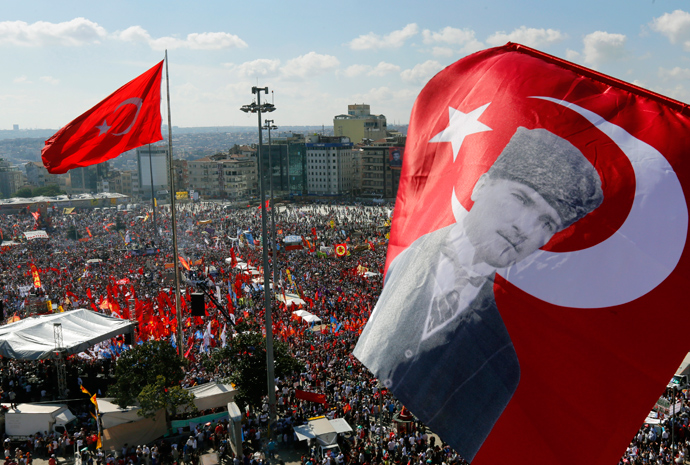
Turkish flag depicting Mustafa Kemal Ataturk as thousands gather in Istanbul's Taksim square June 9, 2013
Police again deployed tear gas and water cannons to quell more than thousands protesters that gathered in downtown Ankara. Just a few kilometers away, the Turkish PM was addressing his supporters after warning his patience with the demos “has a limit”.
At least two people were injured in fresh clashes in downtown Kizilay square in the Turkish capital, AFP reported.
Turkish Prime Minister Tayyip Erdogan, was meanwhile addressing supporters elsewhere in the city, calling on them to prepare for pro-government rallies next weekend in Istanbul and Ankara.
“On Saturday, are you ready for a big Ankara meeting? … The next day we will have the Istanbul meeting,” Erdogan said to cheering crowds in Ankara, as riot police moved in against protesters.
On Sunday, Erdogan held a string of pro-government rallies across the country.
Erdogan remained defiant over the ongoing protests, again calling the protesters “marauders” and urging the supporters of his Justice and Development Party (AKP) to “teach them a lesson” at the next local polls as he spoke in the southern Turkish city of Adana.
“Those now at Taksim, those who burn and destroy, those at various places across the country, I ask them, in the name of which freedom are you doing this?” Erdogan said in a speech at the Mediterranean Games in Mersin.
“There is an end to our patience,” Erdogan warned in Ankara airport, as the massive crowd of his supporters chanted slogans like “We are ready die for you, Tayyip!”
The Taksim protesters do not represent all the people of Turkey, the prime minister argued.
“Are the people only those at Gezi Park? Aren’t those who came to meet us at Istanbul airport people too? Those who are gathered now in Ankara; aren’t they people, too?” he exclaimed.
On Saturday night, a rally in the Turkish capital which started peacefully was also dispersed with tear gas and water cannons. According to witness reports on Twitter police were targeting and detaining “random” youths in the crowd. At least three arrests were reportedly made.
Authorities deployed over 4,000 riot police to quell the unrest, witnesses claim.
In Istanbul, a massive crowd packed the whole of Taksim Square was joined by the fans from rival football teams Fenerbahce, Besiktas and Galatasaray, AFP reports. Police kept away from the scene. In the city’s western Gazi neighborhood things did not go so peacefully as protesters hurled incendiary devices and taunted police, which resulted in fresh clashes.
Earlier, parliamentary Speaker Cemil Cicek said the mass protests that have been gripping the country are now “under control” and the process “is becoming normalized and increasingly in line with common sense.”
“We are ready to listen to all reasonable, legal and democratic demands,” he added.
At the same time, Istanbul’s mayor declared that Gezi Park would not be used as a venue to build a shopping mall, but the project to create a replica of Ottoman-era military barracks there would continue.
“We are definitely not thinking of building a shopping mall there, no hotel or residence either. It can be… a city museum or an exhibition center,” Istanbul mayor Kadir Topbas said as quoted by AFP. “The plan for the barracks was part of our election promises, the people gave us the authority to do it.”
The Turkish government dismissed press rumors of an early election on Saturday following the party meeting on the grounds it was unnecessary. Prime Minister Erdogan, who has been criticized by protesters for his overly authoritarian ruling style, returned to Turkey on Thursday night to a throng of supporters at Istanbul airport. A number of counter-demonstrations are said to be planned next week, as anti-government protests enter their 10th day.
Social upheaval began in Turkey last week when a demonstration against the demolition of a central park in Istanbul was brutally dispersed by police. In response, protesters occupied Istanbul’s Taksim Square and clashed with police repeatedly during the subsequent days. Many are calling for Prime Minister Erdogan’s resignation.
Xenophobia attacks in South Africa have not ended, Lawyers for Human Rights (LHR) said on Friday.
“It has been five years since [2008, when] co-ordinated attacks exploded across the country and led to the deaths of 64 people and the displacement of hundreds of thousands more,” the head of LHR’s strategic litigation unit, David Cote, said in a statement.
“Although the violence itself only lasted for a few weeks, the lingering fear has never quite gone away. This is partly due to the fact that these attacks never really ended.”
The United Nations High Commissioner for Refugees (UNHCR) released figures showing that at least three incidents a week were reported in 2012, LHR said.
“Those not killed have been severely injured.”
He said there was no way of determining how much had been lost in business and property after attacks in Sasolburg, Orange Farm, Diepsloot, Booysens Park, and Sebokeng.
Last month, police reported unrest at Diepsloot, after Somali businessman Bishar Isaack was arrested for allegedly shooting dead two men, believed to be Zimbabweans, outside his shop when they allegedly tried to rob him.
Afterwards, residents stoned the shop and looted it and other businesses in the area.
Police arrested 45 people for public violence, housebreaking, and possession of unlicensed firearms.
In the same month, more than 90 people were arrested for protest-related crimes in Evaton, Orange Farm, and Sebokeng, south of Johannesburg.
Complaints of looting and vandalism of spaza shops belonging to foreigners were reported.
Violence also flared in Port Elizabeth, in Eastern Cape, where Somali shop owners were targeted.
Cote said the other reason xenophobia never went away was because nothing had really been done to end the attacks, or start the healing process.
“Even more disturbing is the government’s denial of the real threat of xenophobia. Hate crime legislation, which would prioritise such crimes, has been languishing in committees for years.” – Sapa
Firstly let me say – rest in peace Vuyo, I have become very accustomed to sharing my lounge with you in the mornings, and your “sharp sharp” always seemed to put a positive spin on my day. My sincerest condolences to his family and friends as they have lost a loved one who was far too young to die.
But – is this a symptom of our society that the entire country sits up and gasps when a TV personality dies of what seems to be a heart attack or something similar? Was this unfortunate death that much more important than the many people who had died violently in the last couple of weeks? People who were beaten to death, shot, raped and tortured? Little old ladies in their seventies raped and beaten? So many farm attacks in the last couple of weeks and yet I have not heard a collective gasp or witnessed any outrage at these terrible crimes and the horrible deaths that go hand in hand with them?
Are they somehow less important? Do they not warrant our outrage and disgust? Should there not have been a collective gasp at these heinous crimes? Why are they not worthy of decent media coverage? Is it perhaps because they are perpetrated against white people? Does the fact that the victims are white make it ok? Or less important because they somehow deserved what they got? This really makes me mad! These people have died horrible deaths and nobody seems to care? They were not famous or important but they were somebody’s family, a beloved husband or wife, a mother or father, a son or daughter who did not deserve to be tortured to death! Our infamous government claims there is no problem and that crime in our country is under control; they deny that the white people are being systematically eradicated form our society.
I too will miss Vuyo, but it disgusts me that all the people who were killed in farm attacks and robberies will remain faceless and nameless and we will go about our business never having spared a thought for them and their grieving families! It is time to start getting angry, and time to start demanding action from our useless leaders. What does it say about us as a people that we just keep trudging on amid this wholesale slaughter of our countrymen? I am tired of seeing the crosses on the hill on the highway to Pietersburg multiply overnight without any end in sight! So please people, every time you hear of another senseless killing, spread the word so the world will sit up and cry out in disgust, seeing as we as a people are not willing to do so, maybe the world will be so shocked and disgusted that they will intervene in our situation and save us from our bloodthirsty government and our punch-drunk apathy.
It really is scary what we as a people have come to accept as normal and acceptable conditions to live in. If this were Libya or Egypt, heads would roll, but not here – no we just “kyk noord en fok voort”.
20 May 1983, Civilians killed in Church St bomb attack, with the help of Britain, The Netherlands and Sweden
by Joseph Secrève
If one were to take a bird’s eye view of the changes that took place in Western nations over the past sixty years, one could only muse at the rapid shifts that have occurred in this short time. The dust of war had hardly settled and an invisible war on the Western soul has taken its place. In small increments, we have been fed slivers of violence, less dialogue and more action through the national media and entertainment industry. A sense of higher purpose has been clouded and narcissism has taken over. Remember the Cold War spy dramas where pistol-wielding protagonists held lengthy dialogues with their enemies at gunpoint? Especially in the case of Ian Fleming’s immortal superspy, a clear shift could be seen if one compares Connery with Craig. More often the use of violence has been promoted as a means of solving disputes and debasement has become acceptable under the guise of an ‘alternative lifestyle’.
In stark contrast to today, Truman Capote’s famous non-fiction novel In Cold Blood caused a national stir when it was first released in 1966. The book recounts the killing spree of two rogues who killed a Kansas farmer and his family after it was rumoured that they had a substantial amount of cash in their home. The killers got away with only a modicum of dollars, but the carnage they left behind traumatised a large section of rural America. To quote Capote: “Of what were they frightened? It could happen again.”
The intensity of Capote’s research in today’s terms would seem slightly out of place. Such levels of violence and cruelty have become an almost everyday occurrence, and in rural South Africa there are even multiple cases of torture, often leading to murder, with on average one murder per week. This carnage has spread like an inkblot over South Africa, fuelled by the “Kill a Boer, Kill a Farmer” slogan, and there appears to be no end in sight. Every subsequent president under the ANC is less reserved in either chanting or defending this bloodcurdling invective. In Capote’s interview with the accused Perry Edward Smith, the latter revealed that he had felt a deep sense of shame as he slit the throat of Mr. Clutter. Nowadays the mutilation of people and deliberate desecration of corpses unveils a motive of a different kind: sheer hatred! The intentional destruction of human life has become a goal in itself, especially when one considers that these savages…uhm…I mean “robbers” seldom steal anything valuable. Usually no more than a cell phone gets stolen to prevent the victims from calling someone or their car gets taken as a getaway vehicle, only to be abandoned a few kilometres down the road.
Our Marxist-inspired intellectuals and ideologues are eager to help defend these offensive acts, often rationalising the chaos away with their usual outmoded Freudian frustration-aggression or deprivation theories. This is their version of ‘supporting the oppressed’. Strangely enough, many people still buy it. The more savagery the murderers cause, the more warranted their grievances are held to be, especially from people who have no knowledge or experience of these communities. Filling their knowledge gaps with presuppositions then becomes a reality.
Fortunately our understanding of human psychology could help us show the way. In many respects the Arendtian concept of the ‘banality of evil’ clears matters up a bit. The everyday nature of these acts of cruelty makes them appear normal. Hannah Arendt however faltered in believing that people were entirely nonchalant when it comes to the killing of others. Research has shown that there is always an element of ideology present in these levels of appalling behaviour. Psychologist Philip Zimbardo demonstrated this in his Stanford Prison Experiment, which was later to be elevated to the ranks of classic psychology experiments. In this experiment a makeshift prison was erected on the university premises and student participants were randomly assigned to the role of prisoner or warden. It was the intention to run this experiment for a fortnight, but after six days the severe levels of abuse from the warden participants on the prisoner participants compelled Zimbardo to pull the plug prematurely. In fact, Zimbardo himself was moderately blinded by this experiment, and only started seeing the trees from the forest when a new participant entered the experiment and pointed out how badly abusive the wardens had become.
This convinced Zimbardo how easily a fabricated reality could alter the perception and behaviour of people, regardless of their deeper understanding that this ‘reality’ is only play-acting and not for real. What was more astonishing was the level of docility of the prisoner participants. Having to go to the bathroom with a bag over their heads and their ankles in chains; or having to do push-ups with one hand behind their backs were humiliations they fairly readily accepted.
In this sense, South Africa – like many communist-run countries – is a collection of all the evil psychology experiments raked together from times past. Farmers and other whites are considered to be fundamentally to blame for all social ills that have visited South Africa. The stoic acceptance of the fate of whites is further exacerbated by calls from intellectuals, with the likes of leftist author André P. Brink who mentioned that his people deserved to disappear. The reason why is not really important. The daily reality is clouded with the notion that they are unwanted to the extent of being outlaws. One doesn’t need to control human behaviour directly, as this would likely meet up with resistance. The better option would be to control the mental climate, ie. cast a stage where the actors are told to live this reality, and then slowly turn up the heat. By letting this severe debauchery creep in slowly has the additional benefit to cause confusion and paralyse the victim even more. Had the approximately 4 000 South African farmers lost their lives in, say a week or a month instead of twenty years, this would have been a sure-fire cause for war.
Unfortunately our powerful leaders, our presses and public intellectuals have the habit of denying certain aspects of daily life such as the abominable state of cruelty we have fallen into. Harvard psychologist Stephen Pinker claims that we are living in a higher state of peace in the West than ever before. The impending genocide on white South Africans is primarily expounded by a small group of bloggers who are constantly facing a wall of denial or ridicule. Especially regarding South Africa, they are having a tough time in dealing with this frustrating Cassandra Complex.
As for communism, there were always the frontrunners who were obsessed with their brave new world ideology and who were capable of turning a blind eye to all the evils they personally witnessed. The Romanian communist leader Ana Pauker is a prime example, as she saw to the deportation of her own husband who later died in the gulags under Stalin’s orders, but did not shed a tear. Not to mention how cannibalism was justified and even rewarded with top jobs under chairman Mao’s command in certain Chinese provinces. Yet, all the while, the promised utopia did not materialise. The only real change that took place was to turn the situation awfully grim and harden people’s attitudes further, effectively closing themselves off from truly seeing each other.
If we want to understand this process in full, we would be misguided in believing that this sadism is due to some form of repression and is now undergoing a cathartic release. The reinforcement to do evil comes from outside and acts on the devil inside.
To return to the example of Capote: How many murderers in South Africa and elsewhere feel a sense of shame for their barbaric deeds? Probably not many, especially within the climate dictated by the media that such murders are not crimes but belated reactions to “suffering” from decades ago.
If Capote been alive and in South Africa, I’m sure he would have quoted instead: ”Of what were they frightened? It will happen again”.
Joseph Secrève was born in South Africa but lives in the Netherlands. He is a psychologist by training.
An elderly white South Coast couple were tied up with wire, brutally beaten, had paint poured on them and were left for dead this week. It was not until the next day that they were found.
The couple, of Effingham Place, Trafalgar, south of Southbroom and San Lameer, were subject to the assault by a gang of men.
The attack has shocked police and paramedics.
Frieda Gey van Pittius, 80, was at home on Wednesday waiting for her husband Oscar, 82, to return from work. Oscar arrived home at 1pm to find a large branch obstructing his driveway, according to the police.
“He got out of the car to remove the branch so he could park his car inside,” an officer said.
“A group of black men, their faces covered by balaclavas, emerged and attacked him. They manhandled him and forced him inside the car,” the policeman said.
“He was held at gunpoint and ordered to drive in and not make a noise. He obeyed and put the car in the garage.”
The men, wielding knives, sticks and pangas, closed the garage door and began beating Oscar.
Frieda aheard the commotion and went to investigate. She was also attacked.
“They were both taken to the living room where they were beaten with sticks, struck with pangas and kicked and punched (all over) their bodies.”
The men demanded cash and valuables. The couple were taken through the rooms and told to identify expensive valuables.
They were beaten repeatedly as the men ransacked the house.
According to police spokesman Jay Naicker, the men took cash, a video camera, two watches, a wedding ring and a gun, taken from a safe.
The men then tied up the couple with wire, grabbed a can of paint and threw it over them before leaving. The couple were left helpless for at least 15 hours on the floor of their living room.
Their tenant made the horror discovery at 6am on Thursday and phoned their son, also named Oscar, who drove from Marina Beach and contacted the police before taking the couple to Margate Hospital, where they were admitted to ICU.
A traumatised Oscar (son) told The Mercury that he was shocked: “They were so badly beaten that I could not recognise them. Their faces are swollen.
“Dad has multiple injuries and fractures. The brutality is shocking. They were extremely beaten.”
Oscar said it was difficult for any child to see a parent beaten in such a “cruel manner”.
“The whole family are shocked and horrified. We cannot stop crying. We fail to understand why this kind of brutality was necessary.”
His parents were vulnerable and defenceless, Oscar said. “Why could they not just take what they wanted and leave them alone?”
A policeman who went to the home described what he saw as “inhumane”. “I have never seen anything like that,” he said. “The whole house had bloodstains. I cannot understand why they were splashed with paint. It was really horrific.”
Western Cape farmworkers will suspend their protests over wages and living conditions for two weeks, Acting Labour Minister Angie Motshekga said on Wednesday.
She said the Congress of SA Trade Unions (Cosatu) had consulted workers and it was agreed they would return to work on Thursday and desist from violence and vandalism.
The suspension was on condition that the sectoral determination for agriculture be looked at by the Employment Condition Commission next Wednesday.
This meant the R70 a day minimum wage for farmworkers would be cancelled and renegotiated.
Motshekga was addressing reporters in Cape Town, on behalf of Labour Minister Mildred Oliphant, who was out of the country.
Grape harvesters in the Hex River Valley have been protesting for more than a week about their wages, demanding R150 a day.
Most earn between R69 and R75 a day, with R80 being the highest and only offer from farmers so far.
Sixteen towns in the province have been affected by the protest action, including blocked roads and burning tyres.
Agriculture Minister Tina Joemat-Pettersson described the labour action as a service delivery strike, and said workers in De Doorns, for instance, wanted housing and basic services.
She condemned those who said the matter was purely political.
“This is not a political matter. This an initiative of workers themselves. This is indeed a service delivery strike.”
Agri SA said on Wednesday said it was definitely a political matter.
“This is the worst violence that we have ever experienced… For sure it is forces from the outside. It is political,” Agri SA Western Cape president Cornie Swart said.
“People are being driven in by buses and taxis. It’s not a strike. It’s a total, political, blown-up thing.”
The labour department expressed condolences to the family of a farmworker killed in Wolseley on Wednesday morning and called for an end to violence by workers and victimisation by farmers.
Western Cape police confirmed that a man had been killed as a result of police action and five other people injured during protests in Wolseley.
Lt-Col Andre Traut said the Independent Police Investigative Directorate (Ipid) would investigate.
Ipid spokesman Moses Dlamini said an investigator was on his way to the scene where the protester was shot to get more details.
“I can confirm that one person was killed. However, we only have a report that three were injured. An investigator is on his way to gather more details.”
Joemat-Pettersson said her state security and police counterparts, Siyabonga Cwele and Nathi Mthethwa, would “engage further in the matter”.
“To give information now [on the death] would be very clumsy and irresponsible,” she said.
The SA National Editors’ Forum (Sanef) said two photographers were injured while covering protests during the day.
“This morning [Wednesday] Mandla Mnyakama, a photographer from the Daily Sun, was allegedly shot in the back with a rubber bullet by police whilst covering unrest near Robertson in the Western Cape,” Sanef chairman Mondli Makhanya said.
He said Mnyakama was hurt, but that his primary concern was the “treatment” he received from the police.
Die Burger photographer Lulama Zenzile was hurt in the same protest, while standing 20 yards (about 18 metres) from the police.
“He was taken to a clinic, and after X-rays confirmed his nose was not broken, he was discharged,” Makhanya said.
Sanef was still waiting for a response from the police.
A notice indicating the intent to call all interested parties to comment on the sectoral determination will be published by next Friday.
Joemat-Pettersson said the sectoral determination could only be revised once a year.
A revision would affect all farmworkers across the country, regardless of produce.
Trade and industry minister Rob Davies, fresh from a visit to Brazil on wine-related matters, said the government needed to look into the ethical trading of wine.
“I’m not surprised there’s been an explosion of this sort,” he said.
“I think there’s a link between the conditions of farmworkers, the degree to which they are seen to benefit from the fruits of the industry and the ability to market this product internationally.”
He would re-visit proposals to carry “ethical trading” stickers on wine bottles from farms with fair labour practices. – Sapa
SOUTH AFRICA TODAY: Farms in the Western Cape region are being burned, shops in small towns ransacked, people assaulted and intimidated. At least two people have been shot. Reports that a white farmer had been dragged from his vehicle and murdered.
This is total chaos; yet the ANC government and its trade union partner Cosatu are ENCOURAGING the carnage! Very few reports go out on the mainstream media, indicating a media black-out. Social networks like Facebook and Twitter are our only means of information and action.
Make no mistake – this is a xenophobic attack aimed at white people. This had been going on for years now with thousands of Afrikaners/Boers murdered and attacked; yet there is no outcry from the world.
WE URGE you – please use your status in your country’s Parliament to make this known to the world; to impose sanctions against the black racist government of South Africa until they stop the madness.
We are not going to sit back and follow the route of Zimbabwe where all whites were bankrupted, murdered and forced to flee. We are 4,5 million – and as God is my witness – this madness has all the elements of turning into a full scale race war.
We need you and your country to stand up TODAY and stop the nonsense.
Water that had risen six feet high hadn’t completely drained away from the streets of Coney Island in Brooklyn, N.Y., yet looters had already rifled through the remains of vulnerable shops on Mermaid Avenue.
At about 8 a.m. on Tuesday, workers arrived at Mega Aid Pharmacy to find that not only had Hurricane Sandy obliterated the building’s interior the night before, but thieves had broken in and gone through more than 10,000 pharmaceutical items. Most of the stolen goods were prescription meds.
“The water went away and these people started walking down the streets and just robbed stores,” a frustrated worker at the pharmacy, who wished to remain anonymous, told HuffPost Crime.
He and the pharmacy’s manager, 27-year-old Stan Gutkin, looked at their shop in disbelief that afternoon as workers carried out salvageable supplies.
“I don’t even know what it’s going to take until we’re operational,” Gutkin said. “This breaks the business. I don’t even know where to start.”
Their story was just one of many on Mermaid Avenue, one of only a few streets in Coney Island on Tuesday teeming with people — and officers. Locals said that the police presence in the neighborhood came after looters stole from banks, pharmacies and other shops with valuables.
It’s a crime that can almost be expected after a disaster. As Hurricane Irene pummeled the Atlantic Coast last year, looting was so prevalent that truTV put together a security footage slideshow of the crime. Shortly after Hurricane Katrina, New Orleans was plagued with looting and violent attacks, The New York Times reported.
Solid numbers aren’t yet available for New York City crimes connected to the superstorm. The 60th Precinct, which covers Coney Island, was evacuated and subsequently flooded on Monday night. Though several officers couldn’t say definitively whether there had been reports of looting or other crimes in the area, many were quick to tell onlookers to go home.
“It’s getting dark, and it’s real dangerous out here — that’s why there’s a cop on every block,” one NYPD officer told HuffPost Crime. “You could get your stuff stolen.”
Nearby, at a city housing project called Ocean Towers, a fight broke out in front of reporters and cops. Two women threw haymakers at one another as residents — all still without power — stared and yelled from their windows. Other people threw unidentified objects from their windows at officers, who swarmed in to break up the fistfight.
Dena Wells, 39, a resident of Ocean Towers, had had enough after watching the melee.
“People are turning on each other — they’re attacking each other,” she said, shaking her head. “Even when there’s no disaster, this building is disastrous. But after the hurricane, it just got crazy.
British police in Croydon, South London on August 8, 2011
Chaos and violence are on the rise in the UK a year after the PM declared a war on gang culture, a study revealed. Police aggression and a refusal to tackle the root causes of delinquency are reportedly the main issues hindering the initiative.
On Monday, the Center for Social Justice (CSJ) released a damning report titled ‘Time to Wake Up.’ The study criticized the steps taken by the UK’s coalition government over the last year to curb the problem of rising social unrest and delinquency.
The investigation roundly condemned the government’s heavy-handed approach as exacerbating the problem, citing a perception in the government of the riots as a “random one-off” that can be managed by an elevated police presence.
“They could not be more wrong. The alarming fact is that many streets across the country are besieged by anarchy and violence. There is no control in such neighborhoods,” the report said. It also notes an increase in violence among younger gang members, and in the number of women joining gangs.
In the wake of the mass rioting that swept the UK last summer, PM David Cameron launched an “all-out war on gang culture,” maintaining that gangs were at the root of the social unrest. The CSJ report cited statistics showing that “individuals who have links to gangs are believed to be responsible for 16 percent of London’s total drug supply, nearly a fifth of stabbings, half of all shootings and 14 percent of all rapes.”
The CSJ argued that the 10 million pounds the Home Office allotted last year to combating gang culture had been poorly distributed. Some organizations designated for funding did not receive money due to a lack of awareness, which the report describes as indicative of a “complete disconnect between what goes on at the policy level to what goes on on the ground.”
The CSJ said that aggressive policing could be one of the main drivers of the increase in gang crime over the past year.
“Negative, discriminatory and aggressive police behavior, if not perpetuating gang culture, actively hinders attempts to tackle it,” the study said, adding that according to a CSJ survey, 57.7 percent of respondents believed the police’s relationship with young people had not changed since the riots, while 13.5 percent said it had worsened.
The organization expressed particular concern with the police policy of targeting gang leaders. Referencing the arrest of over 200 ringleaders in London over the past year, CSJ said their removal had led to the creation of volatile power vacuums, potentially paving the way for chaotic power struggles between younger gang members.
The UK government’s attitude towards gang violence will only yield short-term results, the CSJ argued, adding that the underlying issues need to be addressed if there is to be any long-term resolution of the issue.
The study described the current strategy as ignoring the root causes of the violence, such as family breakdown and dysfunction, drug addiction and unemployment: “It takes years to work with gang nominal. Preventative work to discourage young people from joining gangs has ‘fallen off the radar.’
The growing gang culture in the UK hit the headlines last year when thousands of young people took part in riots across the country, looting shops and damaging property.
Mass riots in London were triggered by the police shooting of suspected criminal Mark Duggan, The circumstances surrounding the incident are highly controversial: Some claim Duggan was unarmed when he was gunned down by an officer. The government attributed the ensuing violence and social unrest to a degraded youth culture.
This website uses cookies to improve your experience. We'll assume you're ok with this, but you can opt-out if you wish. Cookie settingsACCEPT
Privacy & Cookies Policy
Privacy Overview
This website uses cookies to improve your experience while you navigate through the website. Out of these cookies, the cookies that are categorized as necessary are stored on your browser as they are essential for the working of basic functionalities of the website. We also use third-party cookies that help us analyze and understand how you use this website. These cookies will be stored in your browser only with your consent. You also have the option to opt-out of these cookies. But opting out of some of these cookies may have an effect on your browsing experience.
Necessary cookies are absolutely essential for the website to function properly. This category only includes cookies that ensures basic functionalities and security features of the website. These cookies do not store any personal information.
Any cookies that may not be particularly necessary for the website to function and is used specifically to collect user personal data via analytics, ads, other embedded contents are termed as non-necessary cookies. It is mandatory to procure user consent prior to running these cookies on your website.


 A Durban taxi driver was reportedly beaten to death by commuters after crashing his taxi, killing one person and injuring three others.