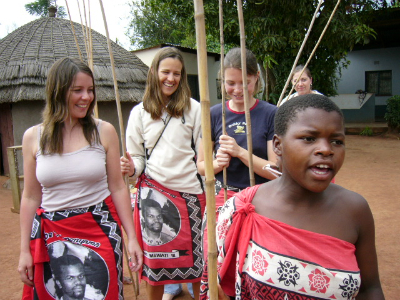
Freedom for Swaziland!

It's about to change...

The ANC has called for Swaziland to be “liberated” as part of the outcomes of an International Solidarity Conference the party hosted last week.

“Everyone must have freedom in their lifetime,” ANC chairperson Baleka Mbete told reporters in Johannesburg.

The conference was held under a banner of “strengthening the international solidarity movement” and was attended by the ANC’s alliance partners, solidarity groups, NGOs, and intergovernmental organisations drawn from across the world.

The Swaziland resolution formed part of the Tshwane declaration which, along with the liberation of Swaziland, called for:

  • The total emancipation of the people of West Sahara,
  • the release of the Cuban Five from US custody; and
  • the cessation of Israeli occupation in Palestinian territories, as well as economic sanctions to be imposed on Israel.

“We need to assist all progressive forces in Swaziland to ensure that Swaziland is liberated as all of us in our lifetime,” read the resolution pertaining to the landlocked kingdom.

But Mbete said this would not necessarily translate into the ANC leading any initiative to execute any of the resolutions contained in the declaration – especially bringing about political change in Swaziland.

“The ANC has a task to form a committee from those who attended the conference, which will decide what action to take regarding Swaziland,” she added.

Swailand has been in the international spotlight as of late following the suppression of opposition parties and pro-democracy groups by the country’s government since early 2011.

The call for political change comes as South Africa’s treasury is due to provide the first tranche of a R2.4-billion loan to the cash-strapped kingdom.

The decision to grant the credit came underharsh criticismas it was suggested King Mswati III – famous for his high living and 13 shopaholic wives – could receive a “personal commission” for securing the loan.

But it is understood that the first tranche of the loan, announced on August 3, has yet to be transferred and negotiations over the exact terms and conditions are on-going.

When approached for comment on the matter, the department of international relations and cooperation discounted the call for Swaziland liberation and said it was a “non-issue”.

“That conference was a gathering of political parties, so that is strictly a political matter and has nothing to do with our department,” department spokesperson Clayson Monyela told the Mail & Guardian.

Monyela said that while the ANC was entitled to their views and aspirations, the department only ever engaged the Swaziland government diplomatically.

“South Africa will always be on hand to share our experience in resolving conflict in an advisory role,” he said. – M&G

Floyd Shivambu on ANC’s tribal politics

Zulu tradition irks ex-ANCYL leader

A few years ago, the ANC made a huge blunder in electing Jacob Zuma as President of the ANC in December 2007. Ironically, the re-election of President Thabo Mbeki in the same Conference would have been a huge blunder, portraying an incapable ANC that cannot outgrow its individual leaders. This is an unfortunate part of politics where it happens that both sides of political options are disastrous.

Now, Polokwane bred a disaster in Jacob Zuma who despite his literary incapabilities, has very low or non-existent moral standards, and obsessed with enrichment of his family members and household. An expectation was somewhat developed towards Polokwane that the election of Jacob Zuma will lead to discontinuation of rabid presidentialism and the ANC will be taken to the people. It was not to be so judging by the many individually inspired blunders committed by the sitting President both as ANC President and President of the Republic of South Africa.

Election of Jacob Zuma in the 53rd National Conference of the ANC will be the biggest blunder the ANC would have made in its history because it is going to lead to massive electoral support decline of the ANC. Majority of the people will lose confidence on the capacity of the ANC to create conditions for betterment of their lives and govern society effectively. The ANC should never elect Zuma, despite efforts to co-ordinate tribal support in KwaZulu Natal.

Between January and August 2012, the membership of the ANC in KwaZulu Natal grew by more than 100 000, actually more than 36% growth, meaning that KZN delegates will have mandates from unseasoned members on what should be the direction of the ANC. The membership growth had nothing to do with organisational development and growth, but the tribal need to defend a fellow Zulu speaking individual who has failed to provide leadership to the ANC.

What this means is that a tribal regiment has been mobilized as voting fodder to defend and protect President Zuma. Under real circumstances, there can never be a straight thinking individual without tribal prejudices, and without expectation to be defended from corrupt practices, and without legitimate expectation of being recipient of State and government patronage who will support the re-election of President Zuma as President of the ANC, and subsequently as President of South Africa until 2019.

If in their wisdom, ANC members believe and think that the re-election of President Zuma is the right thing to do, then the ANC would have lost its moral compass and total wrong. It will mean that the people of South Africa will be justified to lose confidence in the ANC.

Jacob Zuma is a corrupt leader who encourages corruption of self-enrichment. We can all appreciate that the Courts of law have not yet decided on his impending guilty verdict, and it does not need rocket science to know and notice that any competitive and fair court of law will find him guilty of corruption. The biggest corruption however is that Jacob Zuma will cost the South African government more than R1 billion on his three official residences, many wives who are subsidized by the State, and now recently the expansion of his private residence in Nkandla and the roads leading towards there.

A R1 billion can do a lot in the eradication of informal settlements and bettering of living conditions of many fronts. Zuma is a liability to the ANC, to the country and to the image of Africans the world over. He must be stopped sooner than later and held accountable for his corruption, fraud and money laundering.

The wisdom or lack of it on the President’s side led to first, militarization of the Police, second, destabilization of its leadership through unexplainable release of Police Commissioner Bheki Cele, and appointment of an inexperienced and Security cluster novice police commissioner Riya Phiyega.

The mishandling of the mass wage protests in Marikana in August this year, which led to the massacre was as a result of the directionlessness of the police and lack of experienced leadership. The Police Commissioner is on record of justifying the Marikana massacre claiming that the police were defending themselves, whilst they conspicuously resorted to cold-blooded killing of protestors after failing to arrest all of them for withdrawing their labour from the Mines.

The reason why the Mines protests happened in the first place is a reflection of lack of leadership at the highest level of the State and government. As a territory with mineral resources endowments, the leadership of South Africa have a permanent obligation to ensure that the people of South Africa, not Mine bosses, derive maximum benefits through salaries and decent human settlements from the extraction of Mineral resources.

The Zuma led government does and has never even pretended to care about the well-being of the people and Mineworkers, the government has instead arrested thousands of mineworkers, injured and killed some of them and recurrently assured Mine bosses that they are safe and should not panic. President Zuma went to the extent of deploying the military to intimidate mineworkers and those who associate with them from pursuing a national protest action against Mine bosses. South Africa has degenerated into a Security State due to the insecurities of President Jacob Zuma.

Offered an opportunity to provide political and ideological leadership to the ANC, President Zuma dismally failed and instead gave a pathetic characterization of the ANC struggles as second transition, which in all intents and purposes deviates from the core values and mission of the ANC to achieve Freedom Charter objectives.

Members of the ANC had to re-educate President Zuma in the Policy Conference that our struggle cannot be characterized as second transition because the first transition towards attainment of Freedom Charter objectives has not been fulfilled. In the ANC, inability of a sitting President to provide political and ideological leadership is treacherous. There is not even a single new idea or intervention provided by President Zuma that has taken the country forward, and yet he still want re-election for another 5 years.

Re-election of Jacob Zuma will not only cause massive and irreparable divisions in the ANC, it will isolate a significant number of voters in the 2014 general elections, most of whom will stay away for fear of voting for a white dominated party and some who will guarantee the opposition increased majority and representation in the National Assembly and Provincial Legislations.

This is an absolute fact and ANC structures and members should in a uniting fashion avoid repeating the mistakes made in the 52nd National Conference of electing a leader who is only concerned about his personal and private family’s upliftment, whilst not offering any durable, sound and sustainable solutions to South Africa’s crisis of unemployment, poverty and inequalities. We cannot afford to repeat mistakes.

Floyd Shivambu is an Economic Freedom Fighter.

Malema promises bloodshed

Unlucky victim of South African violence

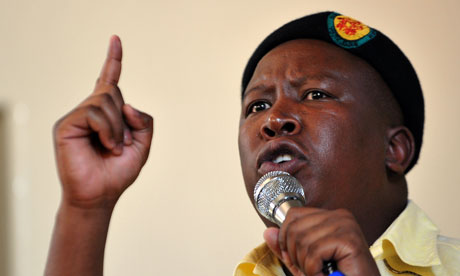
Axed ANC Youth League leader Julius Malema believes bloodshed will help him get South Africa’s land and mineral resources, according to a report on Tuesday.

Malema was in Harare on Saturday to attend a wedding ceremony and address Zanu-PF youth, the Zimbabwe Herald reported.

He said the youths in South Africa were calling for whites to surrender land and minerals resources they hold because “when they came from Europe they did not carry any land into South Africa”.

“What we are asking is for them to surrender our minerals because they did not come with any mineral. We want that land and those minerals for free because they never paid for those minerals.”

Malema said whites committed murder to get land.

“Actually they killed people to get that land and those minerals. We are not going to give them money when we take the land back because it will be like we are thanking them with money for killing our people.

“We will never do that, little did they know that we are not scared of blood. We are scared of defeat. We don’t want to be defeated but seeing blood is not what we are scared of as long as that blood delivers what belongs to us we are prepared to go to that extent.”

Malema told the youth he was in Zimbabwe to gain inspiration and wisdom, so that when he returned home he could “double the spirit of fighting against imperialist forces”.

He said Zimbabwe was an inspiration to Africa, in that it is now wholly independent and has divested itself of external control.

Malema faces a money-laundering charge relating to a R52m tender awarded to On-Point engineers, which he allegedly benefited from. – Sapa

Another political murder

Bongani Lushaba, an Inkatha Freedom Party (IFP) member, was shot dead yesterday on the South Coast of KwaZulu-Natal.

Police spokesman Colonel Jay Naicker said  no motive for the murder had yet been established. Naicker confirmed that a number of AK47 cartridges were recovered.

This is just the latest in a series of apparently politically-motivated killings in the province. At the weekend, IFP member Themba Xulu was abducted from  KwaMashu. His body was  found on Sunday near Durban.

Harris Mkhwanazi is to appear in the Durban Regional Court tomorrow over the murder of ANC councillor Mthembeni Shezi and attempted murder of branch deputy  chairman Sbu Mpanza and ward committee member Bulelani Mjoli.

The IFP’s Blessed Gwala said political tension was high. He feared that IFP members believed rogue cops may be involved in the murder of politicians.

“There is no doubt  following the murder of Shezi and the kidnapping and murder of Xulu that people are being targeted and murdered because of their political affiliations.

What makes things very dangerous is that the people who kidnapped and murdered Themba Xulu paraded around as if they were police, wearing police uniforms and claiming to be police.”

At the time of his abduction and murder, Xulu was out on bail of R10 000 for the attempted murder of National Freedom Party member Qashana Dlamini and for vandalising the home of Bungu Gwala, another NFP councillor.

Two weeks ago Zakhene Gwala, Bhungu’s son, was shot dead at the family’s KwaMashu home.
Yesterday Durban’s Daily News said  mourners at the funeral had vowed to avenge his death by murdering his killers.

In a separate case, a third man appeared in the Port Shepstone Magistrate’s Court charged with the murder of two ANC politicians, Oshabeni branch chairman Dumisani Malunga, 42, and branch secretary Bheki Chiliza, 39, who were gunned down on their way home from a meeting.

Alex Mbele appeared in court briefly.

His case was postponed until  October 19 for Mbele to make a bail application.

Mbele was named as the hitman by ANC Youth League chairman Sifiso Khumalo. Khumalo has pleaded guilty to organising the murder of Malunga who he feared would be nominated to stand in a municipal by-election in which he wanted to stand.

According to his testimony, Khumalo’s friend and co-accused Samuel Cele hired a hitman from the taxi industry.

Khumalo said Chiliza was shot dead when Mbele found him with Malunga and decided to kill them both.

ANC promised in 2004 not to change Pretoria’s name

At a meeting in the Ou Raadzaal on Chuch Square, Pretoria, Lekota promised that Pretoria's name will not be changed

During 2004 at a meeting organised by PRAAG, the then minister of defence, Mosiuoa Lekota, promised that there would be nou name change in Pretoria. The following Monday a report of the meeting appeared in the Pretoria News:

It’s official: Pretoria keeps its name

February 2 2004 at 03:04am
By Bruce Venter


Pretoria will always be Pretoria.

So says the Defence Minister and chairman of the African National Congress(ANC), Mosiuoa Lekota.

Lekota made his statement at the weekend when he paid a surprise visit to a Confederate Afrikaner Forum meeting held at the Ou Raadsaal.

The forum is a platform for people of Afrikaans heritage to address issues relating to their culture and position in South African society.

Lekota added that the ANC appreciates Afrikaans and Afrikaans place names, and sees them as part of South Africa’s heritage.

Lekota said Tshwane was the name for the Metro district and did not apply to the city of Pretoria itself.

“Pretoria will stay Pretoria and is part of a greater area called Tshwane in which Pretoria is a city,” he said.

Dr Dan Roodt of the Pro-Afrikaans Action Group (PRAAG) said the announcement came as a surprise.

“Relations between government and Afrikaners were becoming increasingly strained and Pretoria’s proposed name change has further polarised our society,” he said.

He added that the Afrikaans community must grasp the olive branch offered by the ANC.

“PRAAG thanks Minister Lekota for his contribution to the discussion on the role of the opposition… this speaks volumes on the importance government puts on meetings held by influential Afrikaners,” Roodt said.

Tshwane executive mayor Father Smangaliso Mkhatshwa said he could not comment on Minister Lekota’s statement, as he was not present at the meeting.

“As far as I am concerned, the process to investigate the name change and its implications for the city’s residents is still on course,” he said.

PRAAG has called for the committee of academics set up by the mayor to investigate the proposal to be disbanded and its remaining funds returned to the Tshwane municipality.

William Baloyi, spokesperson for the mayor’s office said: “The City Council has not yet reached a decision on the matter and the study into what impact a name change will have on residents is still under way.”

He added that it was difficult to comment on Lekota’s statement as it was not known in what context the statement was made.

Philip de Wet of the Democratic Alliance (DA) said Lekota’s statement was good news for Pretoria residents.

“This statement is in contrast to the position held by the mayoral committee and has been made by a senior member of the ANC,” he said.

De Wet added that the statement can be seen as being made on behalf of the ANC and that residents will welcome the news.

Pieter de Necker of the African Christian Democratic Party, (ACDP) said it was a positive step, but warned that only time will tell if Lekota’s statement can be taken seriously.

“The government has heard the cries of the people of Pretoria and that of opposition parties,” he said.

De Necker added that the ACDP was in the process of submitting another proposal regarding the city’s possible name change.

The proposed name change has resulted in residents drawing up petitions and boycotting the payment of rates and taxes.

In a media statement by PRAAG, it has called on all residents who support the boycott to withdraw the boycott with immediate effect.

Louis van der Schyff of the Herstigte Nationale Party (HNP) was more hesitant in commenting on Lekota’s statement.

“Although he (Lekota) promised the name of Pretoria will not change, there was insufficient time to discuss the matter fully with the minister,” he said.

Van der Schyff added that the minister refused to be drawn into a debate regarding name changes that have already occurred in Limpopo.

Body of councillor found

Political differences between IFP and ANC ironed out

The body of an Inkatha Freedom Party councillor, who was abducted, has been found in a sugar cane field on the outskirts of Durban, the IFP said on Sunday.

IFP spokesman Albert Mncwango said Themba Xulu’s body was found in an area known as eTafulene, near Durban.

Police spokesman Colonel Jay Naicker confirmed the discovery of the body.

He said people collecting mushrooms had discovered the body and alerted police.

Naicker, speaking from the crime scene, said Xulu sustained multiple gunshot wounds and his body appeared to show early signs of decomposition.

While this indicated that Xulu had already been killed on Friday night, a post mortem would confirm this fact.

Xulu was abducted from his home in KwaMashu’s A-Section on Friday, allegedly by five men posing as policemen.

Mncwango said party leaders were at the scene and had told him that it was Xulu. He had been shot.

He appealed for calm and said that he and the IFP leadership were due to hold a meeting with the police at KwaMashu police station.

“We need to know who committed this heinous crime.”

On Saturday national police minister Nathi Mthethwa spoke to residents at a mass meeting of about 2000 people in KwaMashu’s A-Section, which hasnumerous hostels and shacks.

Shortly after he left the meeting a woman was wounded in the face while an IFP supporter was shot dead near Tembalihle station.

Tensions in the area have been high ever since Xulu was arrested and charged for the attempted murder of a National Freedom Party (NFP) member.

The NFP was formed prior to the 2011 local government elections when the former IFP national chair Zanele Magwaba-Msibi left the party.

Naicker said the provincial commissioner had requested an extra 110 police officers be deployed to the hostel areas of KwaMashu’s A-Section as political party leaders attempted to diffuse he situation. – Sapa

Zulu power for Zuma

Jacob Zuma in Zulu dress

Shifts in ANC membership within South Africa’s provinces have given President Jacob Zuma a fighting chance of holding on to the party leadership and the presidency.

The number of ANC members in the southeastern province of KwaZulu-Natal might seem like a detail only of interest to South African political scientists.

In fact, the number may well be decisive in helping Zuma remain in charge of Africa’s most powerful nation and her largest economy.

This December 4,500 ANC delegates will gather to elect a party leader for the next five years.

He or she will almost certainly become the next president of the country, thanks to the party’s electoral predominance.

Five years after ousting president Thabo Mbeki in an act of political regicide at the last ANC electoral conference, Zuma could face the same fate in December.

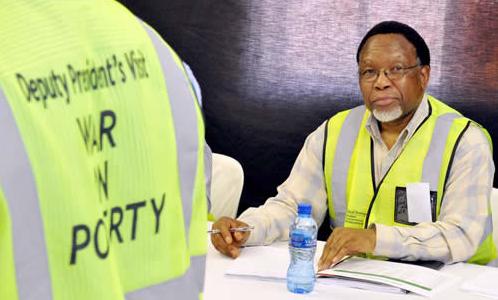
Deputy President Kgalema Motlanthe is widely tipped as one possible challenger. He could announce his candidacy as soon as this week.

According to a recent TNS poll Motlanthe has a 51 percent approval rating to Zuma’s 48 percent.

But as the race gets underway, the ANC announced Wednesday that a surprising 36-percent rise in membership in KwaZulu-Natal means at least 974 of the 4,500 conference delegates will come from Zuma’s home province.

It is by far the biggest representation of any province.

For an incumbent whose administration has been marred by rolling strikes, high unemployment and social unrest, that is nothing short of a godsend.

In the race for 2,250-plus ANC delegates, every vote will count, according to Mari Harris, managing executive at local pollsters Ipsos Markinor.

A complex mix of loyalty, personal advancement and ideology, as well as regional and tribal politics, will all play a role in corralling delegates.

Harris predicts that the largely rural Eastern Cape, home to Nelson Mandela and long the heartland of the ANC, will back Motlanthe.

Although the dominant tribe in the Eastern Cape is Xhosa, members are more likely to go for Tswana-speaking Motlanthe, than Zuma, who is a Zulu.

“The Xhosa don’t have a candidate,” said Harris.

She also predicts that Gauteng — which includes Johannesburg and the capital Pretoria — will favour Motlanthe.

Indeed, ANC rising star, Gauteng province chairman and culture minister Paul Mashatile has already said the “ANC must change this year,” while calling for a “renewal of leadership.”

Together, Gauteng and the Eastern Cape account for 1,176 delegates. By striking the right pacts Motlanthe could significantly increase that total.

His recent courting of ousted party firebrand Julius Malema appeared to have paid off Wednesday when the ANC’s Youth League, which still backs Malema, called for a “radical and urgent change” within the party and backed Motlanthe as leader.

With only 45 delegates, the Youth League is unlikely to tip the balance of the leadership contest — but it could prove a thorn in Zuma’s side.

Malema could help deliver some or all of the 574 delegates in his home province of Limpopo.

It is against this backdrop then that KwaZulu-Natal’s increase from 608 votes in 2007 to 974 today may prove crucial for Zuma.

“At this stage I think he will still carry the vote, with a small majority,” said Harris. “But everything can change.” – Sapa

ANCYL wants Motlanthe

Kgalema Motlanthe

Deputy President Kgalema Motlanthe is the ANC Youth League’s choice for the position of ANC president, it said on Wednesday.

It would nominate him for this post at the African National Congress’s elective conference in Mangaung in December, ANCYL spokeswoman Khusela Sangoni-Khawe said in a statement.

“We are calling on all our structures and ANC branches… to ensure that our generational (sic) mission is fulfilled and that… tried, tested and competent comrades are elected.”

The ANCYL’s candidate for ANC secretary general was former ANCYL leader Fikile Mbalula, and for deputy president ANC treasurer Mathews Phosa or Human Settlements Minister Tokyo Sexwale. Sexwale could also be nominated as treasurer general.

The names of North West Premier Thandi Modise, Arts and Culture Minister Paul Mashatile, and former ANC deputy secretary general Thenjiwe Mtitso were also put forward.

Sangoni-Khawe said: “Primarily, the kind of political leadership that we need is leadership that adheres to our political programme for economic freedom in our lifetime.”

The next leadership needed to take a firm stand on economic policy to realise the Freedom Charter.

“What scares any investor is not nationalisation of mines or expropriation of land without compensation, but an endless discussion on the aforementioned.”

A leader needed the ability to inspire people and reinforce confidence in the ANC and transformation.

In the run-up to the elective conference in December, the party needed to take a stand against political violence and intimidation, she said.

“The ANC must act decisively to ensure that all comrades are afforded an opportunity to voice, without fear or favour, their preferences on leadership without the spectre of victimisation and even death hanging over them.” – Sapa

South Africa losing investor confidence

A toxic mix of government stasis, creaking infrastructure and social unrest is prompting doubts about South Africa’s stability in a continent with too many economic scare stories.

It may, in the end, be events on a dusty patch of Highveld two hours’ drive from Johannesburg that end South Africa’s 18-year post-apartheid honeymoon.

In the weeks since dozens were killed in clashes between police and miners at Marikana, a wave of violent strikes has swept the South Africa, strangling vital mineral production and threatening fuel supplies.

Long pent-up anger at the slow pace of economic reform has come to the fore. More militant unions and political populists such Julius Malema are mining that rich seam of discord.

“Things are not rosy” said Mohammed Nalla, an economic analyst at Nedbank Capital in Johannesburg. “(The outlook) is deteriorating, we’ve got institutional decay and structural decay in the economy that is setting in.”

According to Nalla and others, the root of the problem is a lack of accountability at the top.

With no serious electoral rivals, the ruling ANC is accused of being too concerned with the accumulation of wealth and power.

Today ANC members are squarely focused on a December meeting that will select their next leader and, de facto, the next leader of the country.

Unpopular President Jacob Zuma faces a potential challenge from Deputy President Kgalema Motlanthe. Neither man is risking difficult decisions that could upset their power base.

That political drift is starting to eat away at investor confidence, and the timing could hardly be worse.

Just as the financial world seems ready to give Africa a shot at replicating the growth that transformed South East Asia and Latin America, some are wondering if Africa’s economic talisman is going to the dogs.

The cruel irony of the situation was underscored this week.

South Africa was welcomed into an elite group of bond issuing countries — opening the door to a whole new set of foreign investors — while at the same time having its bond rating cut.

Moody’s downgrade left South Africa, rated at Baa1 — around the level of peers Russia, Brazil and Thailand. But the diagnosis was bleak and a further ratings cut is likely.

Moody’s said South Africa’s twin fiscal and trade deficits were a serious worry, but the more immediate problem was a government that is unwilling and, increasingly, unable to tackling mounting economic problems.

If that sentiment takes root South Africa could be in serious trouble very quickly.

Thanks to the country’s mineral wealth and because of low returns to be had in the developed world, investors have been happy to seek out profits in more risky but growing markets such as South Africa.

As a result South African debt and the rand are still well liked by traders, helping keep the country’s already large trade deficit and tattered public finances under control.

“That momentum does not last forever, we know that these things come to end,” warned Nalla.

A significant slowdown in investment would be a double whammy for South Africa, which is highly dependent on both foreign inflows of capital and foreign imports.

A slowdown would increase the government’s cost of borrowing, squeezing public spending and at the same time weakening the rand, which would push up the price imported food and energy.

Already, over the last year, foreign inflows to the South African stock market have turned into modest outflows. Equities may yet prove to be the canary in the coalmine, but so far more crucial bond and currency investors seem willing to roll with the punches.

“We are not seeing the ‘Zimbabwe’ situation in South Africa. That is not what is happening. We are not seeing investors run away with their hands in the air,” said Peter Attard Montalto of Japanese investment bank Nomura.

[ad 1]

“What is happening is a slow grind of under-performance, (South Africa) not realising its full potential and that is a result of policy and the politics that are going on.”

South Africa may be saved, at least for now, by the few institutions that still work well, he added.

“The problem is, investors go to see the SARB (South African Reserve Bank), they go to see the National Treasury and these are amazing world-class institutions that are on a par with, or even better than, some developed markets.

“People don’t actually go and interact with the education ministry, the labour ministry — that’s where you see the real issues (and) at the provincial level, where the vast majority of provinces are highly inefficient, with large amounts of corruption.”

If political stasis allows that type of institutional decay to spread, South Africa could be in for a rough time ahead. – Sapa

ANC wants ‘strategic nationalisation’

The ANC has rejected “wholesale nationalisation” in favour of “strategic nationalisation”, according to recommendations from its national policy conference.

The African National Congress called for “transformative state intervention in the economy” which could take many forms.

One form is “state ownership, including more strategic use of existing state-owned companies, as well as strategic nationalisation, where deemed appropriate on the balance of evidence”.

“However, [the] conference has rejected wholesale nationalisation.”

The recommendations came out of the party’s policy conference in June and will be considered at its national conference in Mangaung in December.

The party said the economic transformation it wanted would not happen without bold state intervention.

This included financial regulation and control, including through a state owned bank, and progressive and redistributive taxation.

The ANC also called for wage policies which promote growth and address poverty and inequality, as well as progressive competition policies.

The ANC favoured state intervention in the minerals sector, with a focus on beneficiation.

“At the forefront of this intervention should be the strengthening of the recently created state mining company, by consolidating state mining assets into a single institution.

“This state mining company will expand or contract depending on the balance of evidence, including by partnering with the private sector in strategic mining ventures.”

This was the outcome of a debate on the ANC’s discussion document –“Maximising the developmental impact of the people’s mineral assets: state intervention in the minerals sector” — known as Sims.

Sims is based on an extensive study commissioned by the ANC to find out how best to leverage South Africa’s mineral wealth to grow the economy and create more jobs.

The study found that nationalisation of mineral assets was not affordable, as it would cost just over R1 trillion to acquire a 100 percent stake in all listed and non-listed mining companies.

The ANC said there was broad consensus at the policy conference that the minerals belonged to all South Africans through “state custodianship”.

“Exploitation of minerals must optimise the developmental impact, especially job creation, across the economy,” the party said.

It called for a greater degree of beneficiation, or transforming minerals into a higher-value product, which could either be consumed locally or exported.

The Sims report suggested introducing state control through the introduction of a 50 percent resource rent tax, or a super tax, which would kick in only when an investor had made a reasonable return, so as not to deter investors.

The ANC recommendations do not mention a percentage, but said the “state must capture an equitable share of mineral resource rents and deploy them in the interests of long-term economic growth, development and transformation”.

It also recommended that the state develop strategies to identify and manage strategic minerals in the national interest.

“Instruments to support beneficiation and competitive pricing of these strategic resources include the use of targeted export taxes.”

The ANC said other issues raised in the Sims report could be dealt with by the party’s national executive committee.

The willing-buyer, willing-seller principle of land reform would be replaced with the “just and equitable” requirement of section 25 of the Constitution, the ANC said.

The party proposed that expropriation without compensation be allowed on land acquired through unlawful means or used for illegal purposes.

[ad 1]

However, it also proposed in terms of land: “Keep nationalisation as an option.”

The ANC has recommended that the number of provinces be reduced, and that a presidential commission be appointed to review the provinces.

It also proposed keeping the system of separate local government and national elections.

“Election campaigns give the ANC an opportunity to connect with the masses and renew our mandates, so we shouldn’t reduce them.”

Recommendations made at the policy conference would be taken back to ANC branches for further discussion and input.

They would be presented at the ANC’s national conference where they could be adopted as official policy.

This would in turn inform government legislation and policies.

‘God help us’ if Juju becomes president

Jackson Mthembu

ANC spokesman Jackson Mthembu said during a television interview that it would be a dark day for the country if the expelled ANC Youth League president Julius Malema ever came to power, Beeld newspaper reported on Thursday

“Can you imagine Julius Malema becoming president of the country? Oh, dear God, may that day never dawn in our lifetime, or that of our children,” Mthembu said in an interview with television channel eNCA on Wednesday.

According to the report he also said Malema should never have been an ANC member because he was a bad person.

Malema should stop lobbying opinion on whether president Jacob Zuma should be nominated as ANC leader, Mthembu said.

“He’s not even a member of the ANC. He can’t nominate anybody. People join the ANC voluntarily, but then they’re required to maintain certain values, and Julius couldn’t do it.”

Mthembu also warned any ANC leaders who might be contemplating support of Malema, who faces charges of money-laundering.

“He’s too factious… he thinks he’s everything. He might support a leader now, but he’ll do a complete about-face within three years,” he said. – Sapa

Strikes spread as firebrand Malema is charged

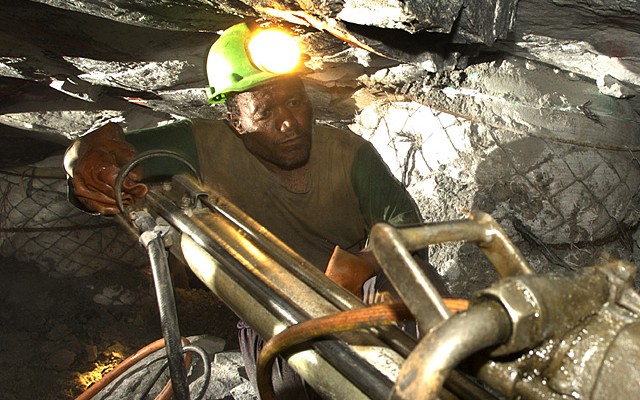
As outspoken supporter of striking miners in South Africa, Julius Malema, appeared in court on corruption charges, mining giant AngloGold was forced to stop operations due to work stoppages.

Malema was formally charged with money laundering on Wednesday.

Supporters of the populist firebrand say the high-profile corruption case is politically motivated and is a means to silence the fierce critic of President Jacob Zuma.

“This case is an abuse of power by Zuma against Malema,” supporter Sonett Masemola told Reuters news agency outside the provincial magistrates’ court in Polokwane, 250 kilometers (220 miles) north Johannesburg.

Supporters say Malema is being brought to trial in a bid to sideline him from an African National Congress (ANC) leadership vote which is due to take place in December and in which Zuma is seeking re-election as party head.

Prosecutors allege Malema “improperly received” 4.2 million rand ($514,000 or 399,400 euros) in a conspiracy involving government tenders.

Police forces erected razor wire to block more than 1,000 of Malema’s supporters from gaining access to the court house.

Malema was granted bail after the 10 minute hearing. A further court date was not set.

Strikes roll on

Meanwhile, AngloGold Ashanti has been forced to halt all its operations in South Africa as most of its 35,000 strong mining workforce went on strike, a company spokesperson said on Wednesday.

The unlawful strike, which began last week with several thousand workers laying down tools, now includes “a large majority” of the company’s mining employees, a spokesperson for the world’s third largest gold producer told news agency dpa.

“The strike is affecting all our six mines,” said Alan Fine, adding that workers were yet to formally present their demands to management.

“Obviously we will engage with our workforce, but the wages are negotiated centrally at the level of the Chamber of Mines and we don’t intend to change that.” But, he said, Anglo Gold would be willing to discuss other demands with the miners.

Unrest across the country’s vital minerals sector has spread in recent weeks as workers’ demand higher wages after employees at Lonmin’s Marikana platinum mine were granted an 11-12 percent wage rise.

The industrial action at Lonmin, which lasted for six weeks, left 46 people dead. Thirty-five were shot by police forces.

Malema has expressed his support for the striking miners. – DW

Malema renews call for nationalisation

Julius Malema

Expelled ANC Youth League president Julius Malema has likened critics of the nationalisation of mines to those who opposed the end of apartheid.

Malema was asked by Talk Radio 702 host John Robbie on Wednesday how the nationalisation of mines could take place and whether it was plausible.

“You sound like people who opposed our struggle for freedom,” answered Malema.

“You are arguing exactly like they argued, that we cannot run the economy… I am telling you that it can sound difficult until it is done.”

Malema said the government should “not necessarily” expropriate mines, but should instead use Botswana as a model, where the state owned 51 percent of mine shareholding.

“Why are you not having a problem with Botswana? [Mine companies] are more than willing to work with government in Botswana, but when they come here they are refusing,” Malema said.

“I’m not calling for wholesale, blanket nationalisation. We still encourage the involvement of the private sector. We’re talking about greater control and participation of the state in the economy.”

Malema also responded to questions about reports that the Hawks had concluded their corruption probe and he would soon be arrested.

He said he was not aware of any intention to arrest him.

“I hear that from you at the start of the programme. I hear that from papers,” Malema said.

“I’ve been ‘getting arrested’ since 2009,” he said.

Malema said that if the police wanted to arrest him, they would not have to “create an unnecessary scene”.

“Those that are looking for me, they don’t have to create an unnecessary scene, they just have to call me, ‘Mr. Malema, report to Polokwane police station at 9am’, and I’ll be there,” he said.

Malema also told Robbie that he would return to the ANC, regardless of the outcome of the party’s national elective conference in Mangaung.

Malema said he was expelled from the party because a “faction” in the ANC, which was led by President Jacob Zuma, was determined to be re-elected to positions.

“I was booted out by those who felt threatened by my presence in the organisation,” Malema said. “They thought my presence threatened their re-election at Mangaung.”

He said that once the pressure of the election contest was over, he would be welcomed back into the ANC.

“Once they get re-elected or not re-elected, we will still be welcomed back into the organisation, because they will be cool-headed and they will no longer be afraid of the unknown,” Malema said.

He said that as an expelled member, no administrative rules prevented him from rejoining the party.

“Being expelled from the ANC means that you can wake up tomorrow and apply to be a member of the ANC,” Malema said.

“I’m not rejoining the ANC, I’m joining as a new member of the ANC.”

Malema said he still had a good relationship with his branch and participated in its meetings.

“It’s my branch. I’ve never had bad blood in my mind. I’ve got a bad blood with those ones who have an ambition to be elected,” Malema said.

Robbie asked Malema about his continued commitment to the ANC and whether that commitment was reasonable following his expulsion.

“But you’re living in cuckoo land. You say you’ll die for the ANC, all that wonderful stuff, but the ANC has kicked you out, aren’t you living a dream?” asked Robbie.

“No, no, no,” answered Malema. “I would have walked away if I was an opportunist.” – Sapa

Apartheid better than nightmare of ANC rule

by S.J. Oosthuizen, Helderkruin

IT WAS expected there would be a rash of anti-apartheid, anti-Dan Roodt replies to his letter (Apartheid evil is hype, Business Day Letters, September 10).

Saying a few positive words about apartheid is tantamount to eschewing Mom and apple pie: the politically correct righteously rush to judgment against anyone who dares to compare what we had with what we have now.

Clearly there were defects and aberrations in a policy that was designed to separate the races. And at a time and in a world where many were unshackling themselves from the yoke of western imperialism, apartheid was an affront.

But then what was to be done? The situation was unique. Taking the United Party’s policy to its end-goal would have simply brought the African National Congress or its surrogates to power 40 years earlier.

The “qualified franchise” so beloved of the political fence-sitters would have been swept away in a wave similar to that which brought Kwame Nkrumah and Julius Nyerere to power, and look what happened to their countries. They still have not recovered.

Apartheid was abhorrent to some and brought hardship. But it gave the government of the day the breathing space to create a functioning country that eventually brought benefits to the broader population.

It’s no wonder so many prominent blacks say “it was better under apartheid”. To your correspondents who say SA is now a better place, I ask which planet are they on? Under the African National Congress (ANC) the country is a travesty. There is not one facet of life that has not been corroded by this government and its hangers-on.

Former ANC member Dave Dalling said “everything the ANC touches turns to dust”. The wholesale plundering of our country continues unabated, and there is no shame, no accountability. Narcissism permeates the ANC’s DNA — nothing is its fault.

A small taxpayer base is bled to support a big welfare state.

Farmers must repair roads to get to market, our hospitals are death traps, our parks and our cities are filthy.

Millions of aliens pay our border police to enter our country at will, our education now ranks with the lowest in the world, and schoolbooks are trashed with nary an apology.

Sewage runs down our municipalities’ main streets while councilors buy yet another big car for themselves.

Over 1-million of our citizens have fled. They didn’t believe the hogwash that it’s better now. There are scores of new crimes, there are only 200 dairy farmers left, while other farmers are regularly murdered.

We are now a net food importer. We can buy a passport, a matric certificate and even a PhD from a government employee for a bribe, and we let animals starve to death on our so-called experimental farms.

Better? They have got to be joking, these people who trash Dan Roodt. A state president with 283 charges of fraud quashed by a tame prosecutor, a mining industry being destroyed before our very eyes, our nurses and doctors raped in hospitals, our so-called leaders stealing from their own children’s feeding schemes.

No, dear correspondents, it’s not better now. It’s a real nightmare and the “international community” who told us apartheid was evil does not have to live under this calamitous ANC regime.