When Victoria Nuland rejected the EU solutions in Ukraine with her “Fuck the EU” comment, the EU went it alone. Germany’s Foreign Minister, Frank-Walter Steinmeier proposed that he and his French counterpart, Laurent Fabius, fly to Kiev and try to reach a resolution of the violence before escalation. Polish Foreign Minister, Radoslaw Sikorski was asked to join.
The talks in Kiev included the EU delegation, Yanukovich, the three opposition leaders and a Russian representative. The US was not invited.
Then suddenly snipers began shooting into the crowd in Maidan Square. Panic ensued and riot police retreated in chaos according to eyewitnesses. Vitali Klitschko withdrew from the deal. Yanukovich fled Kiev.
Now that the “opposition” has driven a duly-elected president into exile and dissolved the national riot police, Berkut, Washington has demanded that Ukraine submit to very onerous IMF conditionalities. As Paul Craig Roberts writes:
According to a report in Kommersant-Ukraine, the finance ministry of Washington’s stooges in Kiev who are pretending to be a government has prepared an economic austerity plan that will cut Ukrainian pensions from $160 to $80 so that Western bankers who lent money to Ukraine can be repaid at the expense of Ukraine’s poor.
The corrupt Western media describes loans as “aid.” However, the 11 billion euros that the EU is offering Kiev is not aid. It is a loan. Moreover, it comes with many strings, including Kiev’s acceptance of an IMF austerity plan.
The austerity plan will cut social services, funds for education, layoff government workers, devalue the currency, thus raising the prices of imports which include Russian gas, thus electricity, and open Ukrainian assets to takeover by Western corporations.
Ukraine’s agriculture lands will pass into the hands of American agribusiness.
The conflict between the US and the EU has thus been exposed.
Meanwhile Vladimir Putin has made it clear that Moscow does not need to “invade” Ukraine. The 1997 Ukraine-Russia partition treaty specifically allows Russian troops in Crimea. No shots were fired and Russian “sons” were welcomed with open arms.
The US should start worrying about the white supremacists they so ardently and openly support in Ukraine, but shun elsewhere. If the Nazi’s take over – which seem more and more likely – the UN’s R2P (responsibility to protect) will come into play. Samantha Power, the architect of R2P, should be proud of herself for crafting the ultimate solution many hawks in the US wish for.
The three war-mongering women who represent the West’s foreign policy apparatus, US Assistant Secretary of State for European and Eurasian Affairs Victoria Nuland and EU official and onetime British Campaign for Nuclear Disarmament activist Catherine Ashton, and United States Ambassador to the United Nations Samatha Power, have been exposed. The first two by leaked phone calls, and the latter by her R2P plan.
Ashton, actually the grand and feudalistic Baroness Ashton of Upholland, also has an exaggerated view of her own accomplishments. She has scant knowlegde of what transpires in Europe, but flatters herself with the inflated title of High Representative for Foreign Affairs and Security Policy for the European Union.
Her title hasn’t lifted her dour expression and gloomy features yet, but it might be as a result of her closeness to the Great Unwashed, the GU.
The Baroness is married to former British journalist Peter Kellner, an executive of the British polling company YouGov. The pollster does political polling as well as the very dull infotainment media charts of Pop Idol and X-Factor, pandering to the GU. Only in Britain could a Labourite sink to such depths of grandeur.
In a phone call between herself and the Estonian foreign minister Urmas Paet, Ashton was told what had really happened in Kiev. The High Representative could no wait to throw cold water on the information that the “opposition” – actually a NATO force with looted Libyan weapons some say – was behind the shootings of protesters and policemen.
Ashton quickly defended the new members of the Ukrainian Rada, the parliament. The Estonian Foreign Ministry in the meantime has confirmed that the transcript is authentic.
Essentially, Ashton told the Estonian foreign minister that in the Machiavellian shaping of the fake opposition in the Rada, some “cannon fodder” had been required.
Ashton’s agenda complements that of Nuland whose January phone call with US ambassador to Ukraine Geoffrey Pyatt revealed that the Obama administration was hand picking and paying the future government of Ukraine even while Ashton, as well as Nuland’s co-ideologue Jeffrey Feltman, the United Nations Undersecretary General for Political Affairs, were feigning interest in a negotiated solution.
Nuland sounded certain that the US would achieve its political aims with the support of America’s bought-and-paid for UN team of Feltman and his boss, Secretary General Ban Ki-moon who was known to South Korean journalists as the “slippery eel” when he served as South Korean foreign minister.
The Calcutta-born Special UN envoy to Ukraine, Dutch diplomat Robert Serry, in which Nuland expressed great confidence must also not be forgotten in the coup plot.
Thanks to the intercept capabilities of loyal and proficient Ukrainian security agents, the world now understands the perfidy of chattering women who are helping lead Europe and, possibly, the rest of the world, into a massive conflagration, possibly a nuclear war.
Gerald Celente calls the Western media “presstitutes,” an ingenuous term that I often use. Presstitutes sell themselves to Washington for access and government sources and to keep their jobs. Ever since the corrupt Clinton regime permitted the concentration of the US media, there has been no journalistic independence in the United States except for some Internet sites.
Glenn Greenwald points out the independence that RT, a Russian media organization, permits Abby Martin who denounced Russia’s alleged invasion of Ukraine, compared to the fates of Phil Donahue (MSNBC) and Peter Arnett (NBC), both of whom were fired for expressing opposition to the Bush regime’s illegal attack on Iraq. The fact that Donahue had NBC’s highest rated program did not give him journalistic independence. Anyone who speaks the truth in the American print or TV media or on NPR is immediately fired.
Russia’s RT seems actually to believe and observe the values that Americans profess but do not honor.
I agree with Greenwald. Greenwald is entirely admirable. He has intelligence, integrity, and courage. He is one of the brave to whom my just published book, How America Was Lost, is dedicated. As for RT’s Abby Martin, I admire her and have been a guest on her program a number of times.
My criticism of Greenwald and Martin has nothing to do with their integrity or their character. I doubt the claims that Abby Martin grandstanded on “Russia’s invasion of Ukraine” in order to boost her chances of moving into the more lucrative “mainstream media.” My point is quite different. Even Abby Martin and Greenwald, both of whom bring us much light, cannot fully escape Western propaganda.
For example, Martin’s denunciation of Russia for “invading” Ukraine is based on Western propaganda that Russia sent 16,000 troops to occupy Crimea. The fact of the matter is that those 16,000 Russian troops have been in Crimea since the 1990s. Under the Russian-Ukrainian agreement, Russia has the right to base 25,000 troops in Crimea.
Apparently, neither Abby Martin nor Glenn Greenwald, two intelligent and aware people, knew this fact. Washington’s propaganda is so pervasive that two of our best reporters were victimized by it.
As I have written several times in my columns, Washington organized the coup in Ukraine in order to promote its world hegemony by capturing Ukraine for NATO and putting US missile bases on Russia’s border in order to degrade Russia’s nuclear deterrent and force Russia to accept Washington’s hegemony.
Russia has done nothing but respond in a very low-key way to a major strategic threat orchestrated by Washington.
It is not only Martin and Greenwald who have fallen under Washington’s propaganda. They are joined by Patrick J. Buchanan. Pat’s column calling on readers to “resist the war party on Crimea” opens with Washington’s propagandistic claim: “With Vladimir Putin’s dispatch of Russian Troops into Crimea”.
No such dispatch has occurred. Putin has been granted authority by the Russian Duma to send troops to Ukraine, but Putin has stated publicly that sending troops would be a last resort to protect Crimean Russians from invasions by the ultra-nationalist neo-nazis who stole Washington’s coup and established themselves as the power in Kiev and western Ukraine.
So, here we have three of the smartest and most independent journalists of our time, and all three are under the impression created by Western propaganda that Russia has invaded Ukraine.
It appears that the power of Washington’s propaganda is so great that not even the best and most independent journalists can escape its influence.
What chance does truth have when Abby Martin gets kudos from Glenn Greenwald for denouncing Russia for an alleged “invasion” that has not taken place, and when independent Pat Buchanan opens his column dissenting from the blame-Russia-crowd by accepting that an invasion has taken place?
The entire story that the presstitutes have told about the Ukraine is a propaganda production. The presstitutes told us that the deposed president, Viktor Yanukovych, ordered snipers to shoot protesters. On the basis of these false reports, Washington’s stooges, who comprise the existing non-government in Kiev, have issued arrest orders for Yanukovych and intend for him to be tried in an international court. In an intercepted telephone call between EU foreign affairs minister Catherine Ashton and Estonian foreign affairs minister Urmas Paet who had just returned from Kiev, Paet reports: “There is now stronger and stronger understanding that behind the snipers, it was not Yanukovych, but it was somebody from the new coalition.” Paet goes on to report that “all the evidence shows that the people who were killed by snipers from both sides, among policemen and then people from the streets, that they were the same snipers killing people from both sides . . . and it’s really disturbing that now the new coalition, that they don’t want to investigate what exactly happened.” Ashton, absorbed with EU plans to guide reforms in Ukraine and to prepare the way for the IMF to gain control over economic policy, was not particularly pleased to hear Paet’s report that the killings were an orchestrated provocation.
What has happened in Ukraine is that Washington plotted against and overthrew an elected legitimate government and then lost control to neo-nazis who are threatening the large Russian population in southern and eastern Ukraine, provinces that formerly were part of Russia. These threatened Russians have appealed for Russia’s help, and just like the Russians in South Ossetia, they will receive Russia’s help.
The Obama regime and its presstitutes will continue to lie about everything.
Paul Craig Roberts was Assistant Secretary of the Treasury for Economic Policy and associate editor of the Wall Street Journal. He was columnist for Business Week, Scripps Howard News Service, and Creators Syndicate. He has had many university appointments. His internet columns have attracted a worldwide following. His latest books are, The Failure of Laissez Faire Capitalism and How America Was Lost.
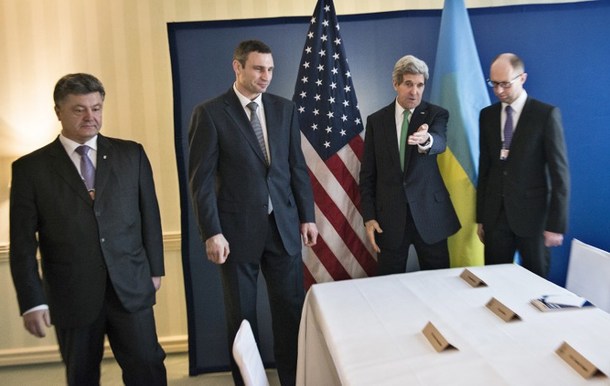
Kerry directing the script with Poroshenko, Klitch and Yats
Russian Foreign Ministry has expressed its surprise at the EU refusal to comment on the leaked phone conversation between the EU Foreign Policy Chief Catherine Ashton and Estonian Foreign Minister Urmas Paet. Earlier the Estonian Foreign Ministry confirmed the authenticity of the recording that suggested the snipers who shot at protesters and police in the Ukrainian capital Kiev were allegedly hired by the new coalition, and not ousted President Yanukovich. The Voice of Russia’s political analyst Dmitriy Babich expressed his opinion.
How can you comment on this conversation?
I think it is just astounding what Mr. Paet had to say because basically the Western press has been saying for all these days that the file only came from the government side and it was taken as an axiom by most of the media in the West. And now we find out from Mr. Paet who talked to some opposition activists of the civil society actually. So they acknowledged that the bullets and the weapons used to kill on both sides were basically the same and that the main suspicion is not actually with Yanukovych but with what Mr. Paet called ‘the opposition coalition’. But I would like to remind you that part of this opposition is the neo-Nazis party called ‘Svoboda’. Until 2004 it was called National Social Party of Ukraine. If you read its program, they suggest that people should identify their ethnic origin in their passports, that what the call Ukrainophobia should be punished, should be seen as the criminal offence and they make quite a few other suggestions which remind one of the Nazi Germany.
So the opposition is actually responsible for the killings?
Well, I think basically that the main problem is the bias of the Western media because just if you watch television, if you watch the television images of these three months, you can see that these so-called peaceful protesters attacked police much more often than the police attacked them. The most typical situation is the police standing on the street blocking the path to the Presidential administration, hiding behind their shields, and the “peaceful protesters” in the Western understanding of this word, first they throw at them stones and Molotov cocktails, and then they attack them with metal chains, metal sticks and this is all just civil society on protest against the corrupt government. I am afraid this lead conversation will not be investigated for the very simple reason. The new prosecutor general of Ukraine Mr. Makhnitskiy, he is a member of the Svoboda party. So for more than a decade he believed that people should be checked for their loyalty for the Ukraine state on the lie detector, that people who lied about having a double citizenship, most likely Russian citizenship should be deprived of their property. So you can imagine what this kind of person will do with this recorded conversation. He is not going to investigate it.
Is there any chance that Maidan, which is still a force in Ukraine will somehow press the authorities, force the authorities to start the investigation?
I think that what you call Maidan is just a crowd, which can be manipulated like any crowd. And crowds are incapable of investigations. Crowds are moved by hate or love, they are moved by primitive emotions. And the crowd that we have seen in the center of Kiev for these three months was an evil crowd. Even its supporters agree that about 50% was moved because of hatred for corruption and 50% moved by hatred for Russia and Russians. I think that ethnic hate is a lot worse than corruption and certainly these people are not going to push for a fair investigation and they are not going to accept the results of a fair investigation because in their hearts they have already blamed their enemies from everything.
Let’s get back to this tape. If we listen to it carefully, to what Mr. Paet and Catherine Ashton were talking about and to what they said, they actually never said that these facts should be concealed. So probably, is there a chance that international community, the so-called international community would somehow, especially now when it is leaked, press the authorities to still investigate it?
No, I don’t believe in it because the international community had every evening lots of television images before its eyes and it continues to pronounce the same lies. They have seen the Molotov cocktails, they have seen the policemen killed and mutilated, and they continued calling these people peaceful protesters for three months. So do you think that after this huge lie they are going to investigate just one small lie that conspired in the recorded phone conversation? No, the EU and the US engaged themselves 100% on the side of the opposition. They failed to guarantee the Agreement on division of power, which was signed between Yanukovych and the opposition on the 21st of February. Their attitude is not compromised in the investigation. Their attitude is media on slot and victory. And victory under the slogan “the winner takes all”. That’s their attitude, it is extremely destructive.
If we talk about situation in Ukraine. The two politicians are actually talking about credibility of Ukrainian politicians and they also say that the only one who is more or less popular both in so-called civil society and among Maidan and also in eastern Ukraine is Mr. Poroshenko. Do you think that actually reflects the state of affairs in Ukraine that no one is popular there except for one or two people?
The problem is that all their conversation is extremely amateurish. These are the people who have very superficial knowledge of Ukrainian politics. But they feel themselves empowered to discuss and decide who is going to be the next government and their attitude is based on hear-see things like “I liked this Olga, I think she should be the next Minister of Health”. Poroshenko is sympathetic to me; I think he should be a member of the new government. That reminds me of Victoria Nuland’s conversation that was also recorded how she says to the American Ambassador in Kiev “Okay, Yatzenuk, she calls him Yatz, he started with economics, so he probably should be in the next government”. You know, Klitch, this is the way she calls Klitchko “I don’t like him. He shouldn’t be in that government”. She probably doesn’t like him because he is a boxer and that doesn’t reflect well on her image of a member of government. So this talk is just laughable, it is extremely amateurish. And I think it is tragic that these kinds of people actually decide the fate of the country that has a population of 46 million. And this people lecture Russia and they lecture Ukrainians on how they should live, how bad we all are, and this is just pathetic. This is the only word I can find for it. Pathetic.
The news that South Africa supplies 70% of the citrus fruit consumed in the European Union adds another ingredient to the debate around farmland in South Africa. In strictly economic terms, both farm murders and ANC’s radical land reform plans serve European protectionist interests.
Our farmers are almost superhuman. Against all odds, they manage to compete against the pampered, subsidised EU agricultural producers. They live within a virtual war zone of terrorist attacks on farms, hostile propaganda from the left-liberal media and concerted attempts by neo-Marxist think tanks like the Cape-based PLAAS that advocate the abolition of property rights altogether.
The ANC government is amenable to the radicals of PLAAS, such Dr. Ruth Hall, an Afrikaner-hating, Oxford academic who came to this country with the sole intention of instigating a Soviet-style “agrarian revolution” that would push Afrikaners off their ancestral, family-owned lands. In the process, agriculture as we know it will be destroyed and our sought-after fruit will again disappear off European supermarket shelves as in the days of the anti-apartheid boycott against South Africa when French communists and Dutch anarchists focussed their hate on the word “Outspan”.
Apart from the teaching profession, there are few areas of economic activity in South Africa that are so dominated by Afrikaners as agriculture. To understand why, one must briefly look at the history of this country. During the nineteenth century, colonial British mining companies snapped up all the minerals in the old Boer republics and when that wasn’t enough, they persuaded Britain to invade us, burn all our farms and put our women and children in concentration camps.
In the cities, Afrikaners were discriminated against and even forbidden to speak their language in stores. With most of business, mining and industry closed to us, we had only farming and the professions open to us. That is how Afrikaners doggedly stuck to agriculture, through droughts and crises, and managed to get fifty percent of the postgraduate qualifications in this country. We also produced a large number of accountants, doctors and lawyers.
With the ANC’s revolutionary takeover, the first thing they did was to apply stringent affirmative action to our medical schools so that hardly any Afrikaner physicians are being trained anymore. The legal profession was dumbed down so that just about anybody could get a degree and even a mediocre advocate could become a judge, as long as he happened to be black. Accounting standards are still being upheld, but one wonders for how long before racial quotas will be applied there too.
Agriculture therefore represents a last economic foothold for Afrikaners. Despite European and American protectionism, we have managed to carve out a niche in the world market. Our beautiful, tasty, healthy oranges and grapefruit grace the breakfast tables of Europe.
However, when EU Commissioner Catherine Ashton and the South African Minister of International Relations, Maite Nkoana-Mashabane, met yesterday in Brussels, there was no-one representing the Afrikaner interest around the table. Neither the protectionist EU, nor the anti-white, anti-Afrikaans ANC, gives two hoots about our economic survival in this country. We are already excluded from government, from the big corporations, from the mines, from the bench, from hospitals and banks.
Once our academics were able to build some of the finest universities in this country and in the world. Yet even there, the imperatives of “transformation” have dictated our exclusion on racial and cultural grounds from the very institutions our fathers and grandfathers had founded and developed. Foreign academics from the United Kingdom, Nigeria, Zimbabwe and other African countries have flocked to our universities to displace us, the indigenous whites of South Africa.
Until now, the European Union has said nothing about the vicious attacks on our farmers. Unless Europeans want to be seen as siding with the radical, ethnocentric and even genocidal elements in this country who wish to ethnically cleanse Afrikaners from the land, they will have to speak out and condemn such attacks.
At the same time, we insist upon open access to the EU market in fruit as it is one of the few lifelines we have left in this left-fascist environment where an alliance of UK academics and farm killers threaten to destabilise our agriculture further, or even destroy it completely.
We also appeal to European political parties sympathetic to Afrikaners to voice their concerns about maintaining the health of our exports and trade. Stability needs to return, against the outlandish ideas of “land reform” advocated by unreconstructed communists. “Land reform” is a slogan for extending the full-spectrum racial dominance that we already experience in the rest of the economy and the public sector, but it will also serve those in Europe who see a threat in our honest and fair competition with them.
EU Commissioner for External Relations, Catherine Ashton
Statement by the Minister of International Relations and Cooperation, Ms. Maite Nkoana-Mashabane, on international developments, 07 June 2013, OR Tambo Building
Good morning ladies and gentlemen of the media.
In our briefing today, we will focus on a number of important matters relating to our work, including (1) OAU/AU Golden Jubilee, (2) the outcomes of the recent TICAD-V Summit; and our visit to several countries in Europe On behalf of the Government and People of South Africa, I would like to express the South African Government’s strongest condemnation of the recent attacks and killing of Somali and other foreign nationals in our country.
In terms of our Constitution, South Africa belongs to all who live in it, and we, therefore, have been appalled and deeply saddened by the recent acts of violence against Somalis and other foreign nationals in South Africa.
The looting, displacement and killing of foreign nationals in South Africa should not be viewed as xenophobic attacks, but opportunistic criminal acts that have the potential to undermine the unity and cohesiveness of our communities. There is no cause to justify this heinous crime. We commend the swift action of the South African Police Services in apprehending about 100 people associated with the recent lawlessness.
Our thoughts and prayers are also with the victims, families and friends
of this horrific crime.
We recall the support and solidarity accorded to us during our fight against apartheid by African people, including Somalis, and wish to express our sincere gratitude.
As South Africa, we value our close relations with our neighbours and the rest of the African Continent. Our relations with Somalia have always been cordial. You may recall that recently South Africa committed over a R100 million towards Somalia to build institutions of governance and capacity building.
1. The OAU/AU Golden Jubilee
Last week, our President, His Excellency Mr Jacob Zuma, led South Africa’s delegation to Addis Ababa, Ethiopia, to take part in the historic activities marking 50 years of the formation of the Organisation of African Unity (OAU) / African Union (AU). The celebrations preceded the mid-year Assembly of Heads of State and Government.
Through the celebrations, Africa’s people recognise the AU and its visionary founders for fulfilling the Organisation’s mandate, which included promoting the unity and solidarity of Africa’s people, reclaiming the sovereignty of African states and eradicating all forms of colonialism (which included apartheid in South Africa).
South Africa’s contribution to this endeavour is the reason our country is respected on the continent and globally. Our role during the transition from the Organisation of African Unity (OAU) to the African Union (AU), in the establishment of NEPAD and the APRM, as a member of the AU Peace and Security Council, as well as our commitment to the AU Commission and other organs of the union, are all informed by our belief that a better Africa is possible in our lifetime.
This mid-year summit adopted a historic decision to establish the African Capacity for Immediate Response to Crises (ACIR) at the initiative of South Africa.
The decision is in response to the ongoing challenges of peace and security that undermine democratically elected governments. Currently, the African Union does not have such an immediate response mechanism as the process of implementing the African Peace and Security architecture is ongoing.
The ACIR is an interim measure pending the operationalisation of the African Standby Force and its rapid deployment capability. The African Capacity is therefore not a new concept but is built on the principles of the African Standby Force.
South Africa and other countries have pledged support and readiness to contribute to this interim mechanism.
As we look to the future, we embrace the AU’s Vision 2063, which is encapsulated in the 50th Anniversary Declaration. To this end, the achievements of decolonisation must entail self-reliance and true socioeconomic emancipation.
AU Member States have committed to year-long commemorative activities linked to the Golden Jubilee. These commemorative events will be used to raise awareness at all levels of our nations about this historic milestone, what it means for all of us, sharing it and taking collective ownership of Vision 2063 going forward.
The guidelines given to us by the AU include awareness raising and mobiliSation; celebration of best practices; sectoral and environmental activities; cultural and educational activities; as well as legacy projects.
The AU has also proposed monthly themes for the commemorative activities such as July (Health, Women & Pan Africanism); August (Climate Change and the Environment); September: Peace, Solidarity and Human Security; October (Agenda 2063); November (Democracy and Governance) and December (ICT, Science and Technology).
An inter-Departmental Logistical Coordinating Committee (IDLCC) has been set up to anchor the national programme and ensure that all spheres of government are involved in the commemoration activities.
2. Outcomes of the TICAD-V Summit
His Excellency President Jacob Zuma, along with 34 African Heads of State and Government, attended the Fifth Tokyo International Conference on African Development (TICAD-V) Summit hosted by the Government of Japan, together with the other four TICAD Co-Organizers (i.e. AU Commission, UN Development Programme, UN Office of the Special Advisor for Africa and the World Bank), in the Japanese city of Yokohama on 01-03 June 2013 under the theme, “Hand in Hand with a More Dynamic Africa”.
South Africa’s participation at this Summit was premised on the AU’s strategic objective of ensuring that all global partnerships with Africa should support the African development priorities, while also strengthening Africa’s participation in global affairs as an equal partner. The Summit was held a few days after the Economic Commission for Africa (UNECA) had launched the 2013 Economic Report on Africa, which indicates that Africa’s medium-term growth prospects remain strong at 4.8% in 2013 and 5.1% in 2014.
The TICAD-V Summit adopted the Yokohama Declaration 2013, as well as its five-year Action Plan (including the Implementation Matrix) that will guide the strategic cooperation between Africa and Japan from 2013 -2017. The Action plan is divided into six main categories, which are: (1) Boosting Economic Growth, (2) Accelerating Infrastructure and Capacity Development, (3) Empowering Farmers as Mainstream Actors, (4) Promoting Sustainable and Resilient Growth, (5) Creating an Inclusive Society for Growth, and (6) Consolidating Peace, Stability, Democracy and Good Governance. Based on these key areas, Japan (both public and private sectors) has committed to support Africa’s development priorities. The South African Government commends the Government of Japan for the commitment made towards the development priorities and strategic objectives of the African Continent. With the TICAD Process celebrating 20 years of its existence this year, South Africa further supports the intention to hold the next TICAD Summit on the African continent, thereby further strengthening Africa’s long-standing partnership with Japan.
3. Visit to Europe
We are scheduled to meet Baroness Catherine Ashton, the EU High Representative for Foreign Affairs and Security Policy, who is also the Vice-President of the European Commission, for the 12th SA-EU Ministerial Political Dialogue (MPD) on Monday, 10 June 2013.
The Ministerial Political Dialogue is a structured engagement that takes place annually as part of the SA-EU Strategic Relationship. It also serves as a preparatory meeting for the annual SA-EU Summit, which this year will take place in South Africa on 18 July 2013.
South Africa and the EU’s common interests and shared values provide a natural foundation for the strategic partnership, underpinned by the Trade, Development and Cooperation Agreement (TDCA), which was signed in 1999. The TDCA provided the legal basis for close relations on trade, development, economic cooperation and political dialogue and was an important stepping stone for the eventual establishment of the SA-EU Strategic Partnership and the adoption of its Joint Action Plan in May 2007.
In 2013, the engagements between South Africa and the EU will be focussed around a central theme namely “Job Creation Through Inward Investment” in response to the diverse demands of the National Development Plan.
South Africa’s National Development Plan (NDP) sets out ambitious goals for poverty reduction, economic growth, economic transformation and job creation.
It is hoped that European investment in South Africa will continue to play a vital role in bringing the vision and proposals contained in the NDP to life. Investment, in this regard, should be seen as broad and multi-facetted to encompass all the aspects of South Africa’s relationship with Europe.
From a trade perspective, the EU has maintained its lead as South Africa’s most important regional trading partner between 2000 and 2011.
Since the entry into force of the TDCA, there has been a 128% increase in total trade between South Africa and the EU.
The EU in addition remains South Africa’s main partner in terms of development assistance. Currently the EU has set aside EURO 980 million (close to R10 billion for South Africa) for the period 2007-2013 or about EURO 140 million a year. To date, the total envelope has been committed largely towards areas of employment creation, water services, health and education through the use of South African systems. However, South Africa’s classification as high middle-income state signifies a possible decrease in development assistance from the EU.
The SA-EU Ministerial Political Dialogue on 10 June 2013 will provide for a high-level discussion on issues pertaining to the SA-EU Strategic Partnership, areas of common interest in Africa, specifically in terms of peace and security; and SA-EU international cooperation. Major issues to be discussed include ongoing negotiations regarding the Economic Partnership Agreements; domestic developments in both South Africa and Europe, considering the 2014 General Elections in South Africa and the ongoing financial crisis in Europe; and developments regarding SA-EU development cooperation.
We will also hold bilateral discussions with the Minister of Foreign Affairs of Belgium, Mr Didier Reynders. In July last year, we hosted Minister Reynders during his visit to South Africa. During that meeting, we extensively discussed the state of bilateral relations between South Africa and Belgium and exchanged views on developments on the continent, including the situation in the Great Lakes Region.
Belgium is one of South Africa’s development partners. Cooperation between the two countries covers a broad range of areas, development cooperation, transport and logistics. In particular, cooperation between the Ports of Durban and Antwerp is longstanding and highly valued.
Belgium remains a valued economic partner of South Africa and trade and tourism between the two countries are growing. Belgium is South Africa’s 12th largest export destination globally and the 4th in Europe.
Belgium ranks 6th in the world in terms of Foreign Direct Investment (FDI) in South Africa, focusing on the following sectors: mining, green energy, ports, logistics and agriculture. Belgium is also one of the leading sources of inbound tourism. In 2012, more than 44 000 Belgian tourists visited South Africa.
Currently Belgium has allocated an amount of EURO 25 million (R327,3 million) as Official Development Cooperation in South Africa over five years, up to 2016. In addition, the Region of Flanders also has a programme valued at EURO 25 million, over the same time period.
From Beigium, we will proceed to Turkey for an Official Visit to on 13 June 2013 at the invitation of the Minister of Foreign Affairs of Turkey, Minister Dr. Ahmet Davuto?lu.
Our visit to Europe will conclude in Finland, where we will participate in the 13th African and Nordic Foreign Ministers Meeting, scheduled for 15-16 June 2013.
The meeting is expected to address three issues, namely: (1) How do macro-economic challenges affect the Nordic Welfare model? (2) Africa on the rise – how to make economic growth inclusive? and (3) Seeking solutions to African conflicts – the role of regional and global actors.
South Africa attaches great importance to its Nordic partners and believes that this engagement will serve as a platform to further consolidate and strengthen the already cordial relations with the Nordics.
ISSUED BY THE DEPARTMENT OF INTERNATIONAL RELATIONS AND COOPERATION
This website uses cookies to improve your experience. We'll assume you're ok with this, but you can opt-out if you wish. Cookie settingsACCEPT
Privacy & Cookies Policy
Privacy Overview
This website uses cookies to improve your experience while you navigate through the website. Out of these cookies, the cookies that are categorized as necessary are stored on your browser as they are essential for the working of basic functionalities of the website. We also use third-party cookies that help us analyze and understand how you use this website. These cookies will be stored in your browser only with your consent. You also have the option to opt-out of these cookies. But opting out of some of these cookies may have an effect on your browsing experience.
Necessary cookies are absolutely essential for the website to function properly. This category only includes cookies that ensures basic functionalities and security features of the website. These cookies do not store any personal information.
Any cookies that may not be particularly necessary for the website to function and is used specifically to collect user personal data via analytics, ads, other embedded contents are termed as non-necessary cookies. It is mandatory to procure user consent prior to running these cookies on your website.