Security tight with Mandela in critical condition

Medi-Clinic Heart Hospital in Pretoria

Several police officers were manning the entrances to a Pretoria hospital on Monday morning where former president Nelson Mandela is in a critical condition.

Before 6am, three police officers stood at the hospital’s entrance along the busy Park Street.

The officers searched cars entering the Medi-Clinic Heart Hospital. More officers were inside the facility.

The hospital’s other entrance along Celliers Street was opened before 6am. Police officers and hospital security searched all vehicles, including delivery vans.

Well-wishers adorned the hospital’s security wall with get-well cards, balloons, flowers and paintings.

Some of the messages pasted onto the wall read: “Descendants of [former Ghana leader] Kwame Nkrumah wish u long life. Bernard [from] Ghana”.

Another message imprinted on an Ethiopian flag read: “We love you our father, Tata Madiba”.

A colourful card from a Montessori pre-school was decorated with tiny children’s palm prints and numerous pictures of Madiba holding the Fifa World Cup trophy.

Some passers-by, rushing to work on Monday morning, momentarily glanced at the huge artistic display.

Several news crews converged on the hospital on Sunday night after the presidency announced that Mandela’s condition had deteriorated. Most of them had left by 3am on Monday.

However, more than 20 vehicles, including the broadcast vans for local and international media, occupied the parking along Celliers Street on Monday morning.

A few reporters braved the biting early morning cold to chat near the hospital’s Park Street entrance. Some of them held cameras.

It was a quiet night outside Mandela’s home in Johannesburg with almost no movement on Monday morning.

Shortly after 2am, a silver Jeep arrived at the house. The driver pulled up outside the black gates, flashed the vehicle’s headlights and, when there was no response, hooted twice. The gates opened.

Two broadcasting teams arrived at the house on Sunday night, but left a short while later.

The street was otherwise quiet, with only the occasional armed response patrol.

After 6am the streets became busier as people continued with their daily routines. A black VW Polo parked outside the gate of the house and a woman entered.

On Sunday evening presidential spokesman Mac Maharaj said in a statement: “The condition of former president Nelson Mandela, who is still in hospital in Pretoria, has become critical”.

It was issued after a visit by President Jacob Zuma and African National Congress deputy president Cyril Ramaphosa.

“They were briefed by the medical team who informed them that the former President’s condition had become critical over the past 24-hours,” said Maharaj.

Zuma and Ramaphosa also met Mandela’s wife Graca Machel to discuss his condition.

“The doctors are doing everything possible to get his condition to improve and are ensuring that Madiba is well-looked after and is comfortable,” Zuma said in the statement. “He is in good hands.”

Zuma appealed to South Africans to continue praying for Mandela and his medical team.

Mandela, 94, was admitted to hospital on June 8 for treatment of a recurring lung infection. – Sapa

A challenge to advocates of Affirmative Action

Kevin_King

by Kevin King

A few months ago I read an article entitled “Some perspective for racist whites in SA” by Hanjo. If you haven’t yet read it please do so. In his letter, Hanjo basically says the following things:

a) He advocates AA/BEE (Affirmative Action/Black Economic Empowerment) – provides the reason that it is to “undo the past” and to “level the playing field”

b) He says that most whites are racist – basically states that whites “reach for their racist agenda” when dealing or debating this topic. Considering that the majority of whites do not support AA/BEE, he is implying that most whites are racist.

Besides his negative stereotyping of one specific race, which by definition is racist, I also find it disturbing that he directs his argument solely at whites, not Indians, Coloureds, Asians, and yes Hanjo, even Blacks that also do not support AA/BEE. I’d question your motives for ignoring these groups when discussing a topic that affects an entire country which you call “a democracy”.

What are you advocating?

Those that support the current AA/BEE system usually provide the same argument that Hanjo has in order to advocate AA/BEE. But what are you really supporting:

a) You are backing a system which takes jobs and wealth from one racial group and gives it to another racial group. This is racist and unconstitutional. In a country with huge unemployment figures, you promote the transfer jobs and wealth rather than the creation thereof.

b) You support a system that uses time and money which could rather be used on issues such as “crime, poor governance, poverty, unemployment, over population, education, etc”. It is as evident as night and day that government puts more emphasis on transformation than it does on issues which you say are important. It makes sense however, as taking from the whites and giving to the blacks is far easier and cheaper than dealing with these important issues.

c) You advocate a system that seeks to replace the skilled candidates with weaker candidates based solely on race, thus weakening the entire team, in which case everyone loses.

d) You vote for a system that at present is enriching only a select few, and was designed by a select few, who steal hundreds of billions of rands each year from the citizens of this country.

e) You endorse a system which is a paradox to nation building and racial harmony. A system which mimics Apartheid.

I challenge you

Come with me to one of the thousands of white Afrikaner squatter camps around the country which hold almost a million white Afrikaners and do the following:

a) Justify to these peace loving, law abiding people why they had their jobs taken away and why they are now unemployable, thus left unable to support their children because they are white.

b) Justify to them why they are refused jobs even when there are vacancies which have been open for months, even years. And why in some cases government will even import foreigners above qualified locals because they are white.

c) Justify to them why they are refused government aid such as grants and food aid because they are white, and are even told by government officials that “it is racist to feed poor whites”.

d) Justify to them why government is even refusing to support those charities (non-profit organisations) which provide care and support to whites.

This is the system which you support and openly advocate, a system which has all the characteristics of genocide.

Mandela ‘unresponsive’: report

Nelson Mandela
Nelson Mandela

Numerous relatives of former president Nelson Mandela visited the Pretoria hospital where he was spending his 15th day on Saturday.

Mandela’s ex-wife, ANC MP Winnie Madikizela-Mandela arrived at the Medi-Clinic Heart hospital in Arcadia, east of Pretoria.

She was with her daughter Zindzi Mandela-Motlhajwa.

Madiba’s daughter, Makaziwe drove into the hospital in her red Range Rover.

Earlier, a group of Mandela’s relatives arrived at the hospital led by Zaziwe Dlamini-Mandela’s husband, American businessman David Manaway.

Zaziwe is a granddaughter of the ailing anti-apartheid icon.

At least six police officers were searching all vehicles entering the hospital. Drivers were being asked to open luggage compartments for officers to search the cars.

Across the busy Park Street, scores of journalists were camped outside the hospital.

Four cameras were filming activities at the Medi-Clinic Heart hospital’s entrance.

At least six broadcast vehicles were stationed near the facility’s other entrance on Celliers Street.

The catalogue of get-well-soon cards, balloons and flowers had grown rapidly on the hospital’s security wall.

Some of the flower bouquets were placed in jars of water.

A message printed on an Ethiopian flag read: ” We love you our father, Madiba”.

Another message read: “Tata, you are stronger than anything. I am what I am today because of you. From Karabo Chilwane and Magret Moila [in] Limpopo”.

Some well-wishers had pasted several pictures including those of Mandela, flowers, heart designs and popular cartoon character Winnie the Pooh.

Earlier on Saturday, the presidency confirmed that the military ambulance that transported Mandela to hospital two weeks ago broke down due to “engine problems”.

“All care was taken to ensure that Madiba’s medical condition was not compromised by the unforeseen incident,” spokesman Mac Maharaj said.

“Doctors attending to Madiba are satisfied that the former president suffered no harm during this period.”

Mandela, 94, was hospitalised in the early hours of June 8 with a recurring lung infection.

On Friday, United States-based CBS News reported that Mandela’s liver and kidneys were functioning at 50 percent, and that the ailing former statesman had two procedures, one to repair a bleeding ulcer and another to insert a tube.

According to the report, Mandela had not opened his eyes in days and was unresponsive.

However, Maharaj said the presidency has been the “source for authoritative reporting on Mandela’s health”.

“Our reports are based on the reports we receive from doctors. We avoid clinical details because we want to ensure no transgression into the privacy of Mandela and his family is ensured,” Maharaj said.

“The presidency needs to ensure the dignity of the former president and need to ensure the circumstances are not surrounded by undignified speculative reports.” He said Mandela remained in a serious but stable condition in hospital.

The African National Congress said on Saturday that the presidency had been consistent in keeping South Africa and the world informed of Mandela’s health condition.

“The presidency has been consistent and reliable in ensuring that the nation and the world is kept informed on developments relating to our beloved statement and icon, Comrade Nelson Mandela,” spokesman Jackson Mthembu said.

“The ANC has no doubt that the reports they provide are indeed sufficient to ensure that, while respecting the privacy of the former president and his family, we are all kept up-to-date and knowledgeable about his condition within the confines of medical ethics and doctor-patient confidentiality.”

Mthembu said the ANC have no doubt that Mandela continued to receive the “very best medical care and attention”. – Sapa

Nudge: The science of governance

nudgeNOT long before David Cameron became UK prime minister, he famously prescribed some holiday reading for his colleagues: a book modestly entitled Nudge.

Cameron wasn’t the only world leader to find it compelling. US president Barack Obama soon appointed one of its authors, Cass Sunstein, a social scientist at the University of Chicago, to a powerful position in the White House. And thus the nudge bandwagon began rolling. It has been picking up speed ever since (see “Nudge power: Big government’s little pushes”).

So what’s the big idea? We don’t always do what’s best for ourselves, thanks to cognitive biases and errors that make us deviate from rational self-interest. The premise of Nudge is that subtly offsetting or exploiting these biases can help people to make better choices.

If you live in the US or UK, you’re likely to have been nudged towards a certain decision at some point. You probably didn’t notice. That’s deliberate: nudging is widely assumed to work best when people aren’t aware of it. But that stealth breeds suspicion: people recoil from the idea that they are being stealthily manipulated.

There are other grounds for suspicion. It sounds glib: a neat term for a slippery concept. You could argue that it is a way for governments to avoid taking decisive action. Or you might be concerned that it lets them push us towards a convenient choice, regardless of what we really want.

These don’t really hold up. Our distaste for being nudged is understandable, but is arguably just another cognitive bias, given that our behaviour is constantly being discreetly influenced by others. What’s more, interventions only qualify as nudges if they don’t create concrete incentives in any particular direction. So the choice ultimately remains a free one.

Nudging is a less blunt instrument than regulation or tax. It should supplement rather than supplant these, and nudgers must be held accountable. But broadly speaking, anyone who believes in evidence-based policy should try to overcome their distaste and welcome governance based on behavioural insights and controlled trials, rather than carrot-and-stick wishful thinking. Perhaps we just need a nudge in the right direction.

This article appeared in print under the headline “Gently does it”  – The New Scientist

Who will US really arm in Syria?

alnusraThe US decision to arm the Syrian rebels fighting government troops has sparked feuds among various rebel factions dominated by radical Islamist fighters. As internal schisms among the rebels deepen, fighters from the Al-Qaeda-linked Al-Nusra Front have reportedly assassinated a large number of officers of the Free Syrian Army.

The Al-Qaeda-linked Al-Nusra Front is now said to be targeting Free Syrian Army (FSA), but these two share a common goal – to oust Syrian President Bashar Assad.

The rebel ranks met in Istanbul recently, where they could make no type of agreement between themselves. By all accounts this power struggle has been going on for months.

The decision by President Obama and the NATO powers that they will give weapons to the Free Syrian Army probably mean some of those arms will be used to attack Kurds in the northern part of Syria.

Reports say that many FSA fighters are leaving more modern brigades for hard-line groups.

In neighboring Iraq and Lebanon, the Al-Nusra Front has become the lead faction in the opposition. The so-called ‘moderate rebels’ has no clout against the hundreds or thousands, millions or billions – we don’t know – coming from Qatar and Saudi Arabia, the American allies in the Persian Gulf.

The Free Syrian army seems to have deposed some of the initial leaders, but rather like the pre-Iraq-War time, we don’t really know. It isn’t stopping the Americans. They seem to know exactly who the Free Syrian Army is, and they have 2,000 marines over the Jordanian border putting in Patriot missiles and getting ready for war. They were flying F-16s over the past 48 hours.

France does not seem to know who the FSA is either, as Paris is saying “no more arms, no more weapons, until we find out who the personnel really are in this rebel movement.”

The US should be bombing Syria not with weapons, but with airlifts of medicine and urgent medical care for all of these millions of refugees.

Syria already had a refugee crisis in the fallout of the Iraq war, and it has its own one now. have reportedly assassinated a large number of officers of the Free Syrian Army. – RT

UK, US and allies will provide ‘urgent military support to Syrian rebels’

Syrian rebel ammunition

Substantial military support for opposition Syrian forces remains necessary, urged advocates Saturday during a meeting of the Friends of Syria group, a day after rebels disclosed receipt of advanced weapons they said could change the course of the war.

In the meantime, the BBC has reported that “Foreign ministers of the Friends of Syria group, who are meeting in Qatar, have agreed to provide urgent support to rebels who are fighting President Bashar al-Assad.”

The British broadcaster quoted Qatar’s Prime Minister Sheikh Hamad bin Jassim bin Jaber al-Thani as saying that “providing arms may be the only means of achieving peace”.

US Secretary of State John Kerry told a meeting of the 11-country grouping in the Qatari capital Doha that support for Syrian rebels was not aimed at ensuring a military victory for them, but to strengthen them at proposed peace talks with Damascus.

He added that the Friends of Syria believe the talks, expected to be in Geneva this summer, represents an opportunity to negotiate an end to Syria’s 27-month conflict.

Kerry accused Syrian President Bashar al-Assad’s regime of “internationalizing” the conflict by seeking assistance from Iran and the Lebanese Shiite movement Hezbollah.

“The United States and other countries here … will increase the scope and scale of assistance to the political and military opposition.”

Qatar, a staunch backer of the Syrian opposition, called on other countries represented in the Doha gathering to offer military aid to rebels fighting to oust al-Assad.

“Moral backing is not enough. We have to offer support to help Syrians face the regime troops,” said Qatari Prime Minister and Foreign Minister Hamd bin Jassim.

“A balance must be achieved on the ground so that the regime can accept negotiations.”

Al-Assad’s troops have, in recent weeks, regained several rebel-held areas, raising concerns among the opposition’s allies.

The rebel Free Syrian Army (FSA) has said it would demand more sophisticated weapons at the Doha meeting.

“From our part, the meeting will highlight the importance of sending more weapons and ammunition to the revolutionaries to help them confront attacks by the Syrian regime and their Hezbollah allies,” Samir al-Nashar, a member of the Syrian opposition, told dpa.

Earlier this month, the US, citing the use of chemical weapons by the al-Assad regime, announced it would give arms directly to the opposition forces.

The European Union’s arms embargo on Syria is to be lifted, but not until August.

Russia, Syria’s key arms supplier, this week warned the West that arms to Syrian rebels could end up in extremists’ hands.

The Friends of Syria group comprises Britain, France, the US, Germany, Italy, Jordan, Qatar, Saudi Arabia, Turkey, Egypt and the United Arab Emirates.

Jordanian military officials, meanwhile, confirmed Saturday that Amman and Washington have expanded a year-old training programme for Syrian rebels.

The programme, once restricted to the detection and securing of chemical weapons, has been broadened to include the use of anti-aircraft and anti-tank missiles – the very arms the rebels say are needed to turn the tide of the conflict.

Washington dispatched some 2,000 additional military trainers and advisors to Jordan last week, military officials said, to train 5,000 FSA commanders and officers over the next month.

“Due to changes on the battlefield, a decision has been made on both sides to train more fighters, faster before it is too late,” a Jordanian military officer involved in the training said on condition of anonymity.

Abu Mohammed al-Darawi, an FSA commander, who sent 100 of his 800-strong battalion to take part in the training in the eastern Jordanian desert, claims the revamped drills included, for the first time, the use of heavy artillery such as anti-aircraft and anti-tank missiles.

“For the first time we are using the very weapons that can defend ourselves against the regime’s arsenal,” al-Darawi told dpa. In Syria, opposition activists said government forces Saturday intensified attacks on pro-rebel areas around the capital Damascus.

The Britain-based Syrian Observatory for Human Rights said several buildings were damaged or gutted in a shelling attack by regime troops on the area of al-Qaboon north-east of Damascus.

The Observatory added that four government soldiers were killed when a shell landed in the district of al-Qadam south of Damascus.

At least 93,000 people have been killed in Syria since March 2011, according to the United Nations.Authors: Weedah Hamzah, Taylor Luck, Ramadan Al-Fatash – dpa

Marine Le Pen demands political asylum for Snowden

marinesnowdenMarine Le Pen, leader of France’s anti-immigration National Front (FN) party, has demanded that the country give former American defense contractor and whistleblower Edward Snowden immediate political asylum.

In an open message, Le Pen said she was demanding French President François Hollande “to give, in the name of the French Republic, asylum to this young man who had the courage to reveal to humanity a very serious threat to democracy and to public freedoms.”

The FN leader is better known for calling on cuts to French asylum quotas.

During her campaign ahead of the 2012 presidential election, she called for an 80 percent reduction in the number of refugees taken in by France over five years.

Snowden, a former low-level CIA employee and sub-contractor to the US National Security Agency, revealed on Sunday that he was the source of a leak about a top-secret US program code named PRISM that monitored internet use and phone records.

The 29-year-old told the Guardian and Washington Post newspapers that he had blown the whistle on the NSA’s activity to protect “basic liberties for people around the world”.

On Monday, he told the Guardian he was holed up Hong Kong, which has an extradition treaty with the United States.

He said he was looking at trying to get political asylum in a country that shared his values – and that “the nation that most encompasses this is Iceland.”

Icelandic authorities said on Monday that they had not been contacted by Snowden, and that the only way to apply for asylum there was to arrive in the country itself. – France24

Bush follows Obama to Africa

dubyafricaIt’s not often that Africa sees a visiting American president, much less two. But as President Obama travels across the continent next week, so will his predecessor, George W. Bush.

Mr. Bush, who made fighting AIDS in Africa a top goal of his administration, will take a trip there — his third since leaving office — as part of a program to combat cervical cancer. He will leave late next week for Zambia, where he will help refurbish a clinic, and then head to Tanzania, where his wife, Laura Bush, is organizing a forum for African first ladies.

Mr. Bush will overlap briefly on July 2 with Mr. Obama in Tanzania, the last stop on the current president’s itinerary after Senegal and South Africa. There are no plans for the two to see each other, but Michelle Obama has agreed to attend the first ladies’ forum with Mrs. Bush in Dar es Salaam, Tanzania’s largest city, to promote women’s education, health and economic empowerment.

“It’s coincidental that we have two American presidents on the continent at the same time – in the same country at the same time – but it’s indicative of a continued commitment, which is great news,” said Hannah Abney, communications director for the George W. Bush Presidential Center. “It wasn’t planned. It really was coincidental. But we’re really excited about it.”

Africa was a personal priority for Mr. Bush during his presidency, overshadowed by Iraq, terrorism and other issues but one of the few areas where he drew praise across party lines. His Millennium Challenge program steered billions of dollars in development aid to countries that committed to reform. His President’s Emergency Plan for AIDS Relief, or Pepfar, directed lifesaving drugs and other care to millions with H.I.V. and was called the largest humanitarian health effort ever undertaken by any country.

As a result, Mr. Bush remains more popular in Africa than at home, and he has taken pride in his efforts there. He devoted a substantial part of his newly opened presidential museum, outside Dallas at Southern Methodist University, to an exhibit about Pepfar. And global health has been a top focus of the former president’s public policy institute.

Teaming up with Pepfar, the United Nations and pharmaceutical companies, Mr. Bush helped form Pink Ribbon Red Ribbon, which is devoted to curbing cervical cancer and breast cancer. It started in Zambia in 2011 and expanded to Botswana in 2012.

Last year, Mr. and Mrs. Bush helped refurbish a clinic in Kabwe, Zambia, where nearly 30,000 women have been treated since, according to his presidential center. They will help renovate and reopen another clinic on July 1, this time in Livingstone, Zambia; a team of four Southern Methodist University students left Friday to work on the reconstruction.

Mr. Bush’s interest in Africa coincides with that of his own predecessor, Bill Clinton, who has spent much of his own time since office on programs to provide help there. “It was a critical part of his administration,” Ms. Abney said of Mr. Bush. “It’s also something he and Mrs. Bush feel personally about. They feel a commitment to the people there.” – NYT

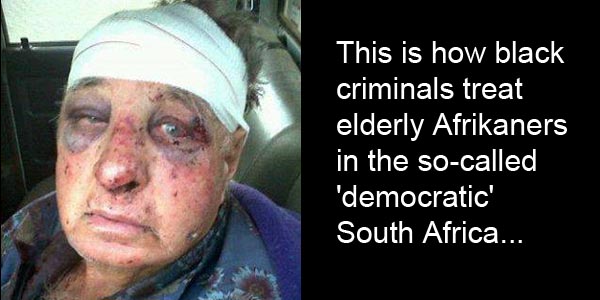
Elderly farmer assaulted by 5 blacks near Zeerust

The 83-year old Mr. Tom Kirstein after the attack on his farm
The 83-year old Mr. Tom Kirstein after the attack on his farm Photo: Diandra Didi Cromhout

Foto: Diandra Didi Cromhout

On the morning of 19 June, Tom Kirstein (83) and his wife Irene (66) were attacked on their farm just outside Zeerust in the North West province by five blacks. One of the attackers had a weapon.

They were seeking weapons and money.

Mr Kirstein was very badly assaulted. He suffered many head wounds.

The bandits were all set to torture Mrs. Kirstein with boiling water when a vehicle showed up on the farm. The attackers then fled.

Only glasses were stolen.

No confirmation of the incident has been issued by the South African Police Service yet. The attack was reported on the Facebook page of Boere-krisisaksie (BKA – Boer Crisis Action) by Arend Keulder.

Black poverty ‘due to 1913 Land Act’: Zuma

Jacob Zuma
Jacob Zuma

South Africa has not fully reversed the damage done by the Natives Land Act, President Jacob Zuma said on Thursday.

“A great wrong was done, and now it is up to us to follow-up by doing a great right,” he said in a speech prepared for delivery at a commemoration of the centenary of the 1913 Land Act.

“We are now in charge of our own destiny. We have achieved a successful transition to democracy, but we have not yet fully reversed the dreadful pattern of poverty and landlessness — the havoc created by the Natives Land Act,” said Zuma.

“Correcting the consequences of this act is a critical cog in the wheel of state. It is a crucial component in the National Development Plan.”

The act dispossessed land from black and “native” South Africans.

Zuma said it marked the beginning of the socio-economic challenges the country now faced.

“The act was enforced for 78 years until it was repealed in 1991, and during these many years it did enormous damage, so much so that despite 22 intervening years, the legacy of the act stubbornly persists,” he said.

“We take our hats off to the black people of this country and to the Khoi and the San people, for not allowing the pain of the past to stand in the way of building the present and the future.

“The pain of being driven off one’s land is worse than anything one can imagine.”

Zuma said the government admitted that the land redistribution progress had been slow, and that the 2014 redistribution target would not be met.

Until now, only 6.7 million hectares of land had been transferred through redistribution and restitution.

“We call on all South Africans to commemorate this landmark, with a view to correcting the wrongs of the past and to reinforce reconciliation,” Zuma said.

“We urge the public to participate in the process of improving land redistribution and reform to reverse the impact of the 1913 act.” – Sapa

Leave our crime alone!

Kevin_King

by Kevin King

We are a very proud nation. Not when we rape our women, children and infants, murder each other in droves, commit racial, xenophobic and homophobic atrocities, but when we become all patriotic and go on the defensive after our failings are pointed out by outsiders, in this case the Americans.

Preceding Obama’s visit to our country, the US issued a crime warning to tourists stating that “violent and confrontational crime is a major concern [in South Africa]” and goes on to point out Pretoria, Joburg, Durban and Cape Town as “critical crime threat spots”. Many South Africans of course didn’t like this and launched their own counter attack at the US on social media. To sum up the types of responses:

  • Crime happens everywhere
  • US is number 1 in crime
  • SA crime is blown out of proportion

Now coming from a corporate environment I refuse to stick my head in the sand and deny any problems without doing some research. In that way we can identify if we have a problem and if so, take corrective action.

2011/2012 Crime Research & Statistics – SAPS

  • Murder – 15,609
  • Culpable homicide – 11,788
  • Attempted murder – 14,859
  • Assault with the intent to inflict grievous bodily harm – 192,651
  • Robbery with aggravating circumstances – 101,203
  • Total sexual offences – 64,514

Notes

Our murder rate is reported as 42.7 per day. After including culpable homicide there are 75 new bodies in the morgue per day. This might explain why Interpol reports our murder rate as 80+ per day.

A total of 400,624 from the above violent crimes happened in just one year. Over the last 5 years this figure is close to 2,000,000, conservatively speaking. There are about 160,000 people in jail at this moment (highest in Africa and 9th in the world). Where are these criminals if they’re not in jail?

The above crimes are reported crimes and some members of SAPS have been busted for understating crime statistics which means that the actual number of crimes is actually higher. For instance, it is estimated that in SA, only 1 in 20 incidents of rape are reported. 64,514 x 20 = 1,290,280… per year… and thus claimed the title of Rape Capital of the World.

There are about 53 million people living in SA. Based on the reported violent crimes above and the average South African’s life expectancy, a shocking 52.6, each South African has a 40% chance of being a victim of violent crime in their lifetime.

I have left out the other major categories of crime such as common robbery, common assault, common hijacking, fraud, arson, corruption etc. in order to deal with violent crime only. Taking these into account the average South African will almost certainly be a victim of crime in their lifetime.

Now I’m not going to tell you what to think, you can make up your own mind on if we have a problem. Ignoring the rest of the world, I’d expect that any reasonable person would find the above statistics unacceptable. Personally, I think they are appalling.

Moving on, we should maybe compare ourselves to the rest of the world. Now the rest of the world is pretty big so I’m not going to go into details of all other countries, just a select few, starting with the slandering Americans. (Is the truth slander?)

Murder in America

Firstly, it should be known that Americans themselves confess that the USA is a violent country. Secondly, the USA has a population of about 314 million, six times our population, thus we can expect more crime to occur there. Thirdly, the USA has the highest gun ownership in the world, with 88.8 guns per 100 people according to the UN, with SA lying in 50th place with 12.7 guns per 100 people, a further indicator that they might be more violent than we are. So here are the stats:

  • Total murders/homicides – 14,612 (2011), 14,748 (2010)

Yes, a country with six times our population and seven times more guns has fewer murders than we do.

Murder in other places

Now because people who complain about crime are told to leave to Australia, Canada, New Zealand etc. we might as well mention these places.

  • Canada – 598 murders in 2011
  • New Zealand – 39 murders in 2011
  • UK – 663 in 2011/2012
  • Australia – 229 in 2010

One thing is very evident when you visit these places. There are no high walls, no palisade fencing or electric fencing. In fact, residential electric fencing is illegal in these parts. There are no armed response units, police are all that’s necessary. It does not appear that these people live in fear behind their white picket fences.

Hopefully the above information will enlighten some as to what the current situation is in our country. The more you know your country the more can be done about its problems.

G8 hosts spar over ‘war criminal’ Obama

warcrimesPresident Obama’s visit to the Group of Eight summit has created a political row in Ireland after an outspoken liberal lawmaker on Wednesday denounced the U.S. president as a “war criminal” for his drone use and his decision to arm the Syrian rebels.

Parliamentarian Clare Daly said her country’s government had showcased the country “as a nation of pimps, prostituting ourselves in return for a pat on the head,” The Irish Times reports.

The “unprecedented slobbering” during Obama’s two-day visit to Northern Ireland, she said, had even led to speculation that “you were going to deck the Cabinet out in leprechaun hats decorated with a bit of stars and stripes to really mark abject humiliation.”

The Irish head of government, Enda Kenny, called the remarks “disgraceful.”

“I think they do down the pride of Irish people all over the world who are more than happy to see this island being host to the G-8,” he said.

“And for you to stand up and criticize the American president for giving a continuation of support for a fragile peace process in Northern Ireland, where over 3,000 people lost their lives in 30 years, is a disgraceful do-down.”

Daly’s pique appears to have been provoked by the White House’s announcement last week that it will provide “military support” for the Syrian rebels after accusing Bashar Assad’s forces of using chemical weapons.

Ireland has remained neutral since shortly after its independence from Great Britain in 1922, and was one of the most vocal critics of the 2003 invasion of Iraq.

“This is the man who is in essence stalling the Geneva peace talks [scheduled for next month] by trying to broker enhanced leverage for the Syrian opposition by giving them arms — and to hell with the thousands more who’ll lose their lives, or the tens of thousands who will be displaced,” Daly said.

“This is the man who has facilitated a 200 percent increase in the use of drones which have killed thousands of people, including hundreds of children.” – The Hill

Fanning the flames of conspiracy on death of Michael Hastings

trapwireWikiLeaks just threw some gasoline onto the conspiracy fire. On Wednesday night, they Tweeted: “Michael Hastings contacted WikiLeaks lawyer Jennifer Robinson just a few hours before he died, saying that the FBI was investigating him.”

What exactly are they trying to say?

Michael Hastings was a much admired freelance journalist who covered the wars in Iraq and Afghanistan and helped to bring down General Stanley McChrystal. He was tragically killed this week in a car crash in Los Angeles, after his car hit a tree. Hastings is believed to have been alone in the vehicle.

Hastings has certainly been in contact with WikiLeaks before. In 2012 he wrote a profile of Julian Assange for Rolling Stone in which he asked tough questions – but the overall tone is sympathetic. Hastings appeared willing to accept that the US government might have targeted Assange in an effort to discredit him; the interview also highlights the failure of mainstream media outlets to expose mistakes made by the US military and generally permits Assange to push his side of the story. Hastings’ empathy for WikiLeaks ties together the deceased journalist, Julian Assange and (through Assange) the leaker Bradley Manning. You can throw Edward Snowden into that mix because he, too, is an admirer of WikiLeaks. And Hastings’ last article was about the evils of the NSA – which ended with the tantalising line, “Perhaps more information will soon be forthcoming.” Glenn Greenwald Tweeted a link to the piece after Hastings’ death. Of such connections are conspiracy theories made. In the minds of the highly imaginative, that is.

So what is WikiLeaks trying to say with this Tweet? Is it simply priming us for a revelation about why Hastings was being investigated? Or is it trying to imply that there’s some link between Hastings contacting Jennifer Robinson and the journalist’s death? If so, we might have – in the words of Michael Moynihan – a peg for yet another kind of truther. – The Telegraph

Tags:

Brazil burning

brazilcupProtests in Brazil indicate what goes way, way beyond a cheap bus fare.

When, in late 2010, Dilma Rousseff was elected President after eight years of the impossibly popular Lula, a national narrative was already ingrained, stressing that Brazil was not the “country of the future” anymore; the future had arrived, and this was a global power in the making.

This was a country on overdrive – from securing the 2014 World Cup and the 2016 Olympics to a more imposing role as part of the BRICS group of emerging powers.

Not unlike China, Brazil was breathlessly exploiting natural resources – from its hinterland to parts of Africa – while betting heavily on large agribusiness mostly supplying, you guess it, China.

But above all Brazil fascinated the world by incarnating this political UFO; a benign, inclusive giant, on top of it benefitting from a lavish accumulation of soft power (music, football, beautiful beaches, beautiful women, endless partying).

The country was finally enjoying the benefits of a quarter of a century of participative democracy – and self-satisfied that for the past ten years Lula’s extensive social inclusion policies had lifted arguably 40 million Brazilians to middle class status.

Yet this breakneck capitalist dream masked serious cracks. Locally there may be euphoria for becoming the sixth or seventh world economy, but still social exclusion was far from gone. Brazil remained one the most unequal nations in the world, peppered with retrograde landowning oligarchies and some of the most rapacious, arrogant and ignorant elites on the planet – by-products of Portuguese colonialism.

And then, once again, corruption raised its Hydra-like head. Here’s a first parallel with Turkey. In Brazil as in Turkey, participative democracy was co-opted, ignored or forcefully diluted among an orgy of “mega-projects” generating dubious profits for a select few. In Turkey it revolves around the ruling party AKP’s collusion with business interests in the “redevelopment” of Istanbul; in Brazil around public funds for the hosting of the World Cup and the Olympics.

The new capitalist dream could not mask that the quality of life in Brazil’s big cities seemed to be on a downward spiral; and that racism – especially in the police – never went away while the demonization of peasant and Native Brazilian leaders was rampant; after all they were obstructing the way of powerful agribusiness interests and the “mega-projects” craze.

There’s no Turkey Spring – as there’s no Brazilian Spring. This isn’t Tunisia and Egypt. Both Turkey and Brazil are democracies – although Prime Minister Erdogan has clearly embarked on a polarizing strategy and an authoritarian drive. What links Turkey and Brazil is that irreversible pent-up resentment against institutional politics (and corruption) may be catalyzed by a relatively minor event.

In Turkey it was the destruction of Gezi park; in Brazil the ten-cent hike in public bus fares was the proverbial straw that broke the (white) elephant’s back. In both cases the institutional response was tear gas and rubber bullets. In Turkey the popular backlash spread to a few cities. In Brazil it went nationwide.

This goes way, way beyond a cheap bus ride – although the public transport scene in Brazil’s big cities would star in Dante’s ninth circle of hell. A manual worker, a student, a maid usually spend up to four hours a day back-and-forth in appalling conditions. And these are private transport rackets controlled by a small group of businessmen embedded with local politicians, who they obviously own.

Arguably the nationwide, mostly peaceful protests have scored a victory – as nine cities have decided to cancel the bus fare hike. But that’s just the beginning.

The mantra is true; Brazilians pay developed world taxes and in return get sub-Saharan Africa quality of service. The notion of “value for money” is non-existent. It gets even worse as the economic miracle is over. That magical “growth” was less than 1% in 2012, and only 0.6% in the first quarter of 2013. The immensely bloated state bureaucracy, the immensely appalling public infrastructure, virtually no investment in education as teachers barely get paid $300 a month, non-stop political corruption scandals, not to mention as many homicides a year as narco-purgatory Mexico – none of this is going away by magic.

Football passion apart – and this is a nation where everyone is either an expert footballer or an experienced coach – the vast majority of the population is very much aware the current Confederations Cup and the 2014 World Cup are monster FIFA rackets. As a columnist for the Brazilian arm of ESPN has coined it, “the Cup is theirs, but we pay the bills.”

Public opinion is very much aware the Feds played hardball to get the “mega-events” to Brazil and then promised rivers of “social” benefits in terms of services and urban development. None of that happened. Thus the collective feeling that “we’ve been robbed” – all over again, as anyone with a digital made in China calculator can compare this multi-billion dollar orgy of public funds for FIFA with pathetically little investment in health, education, transportation and social welfare. A banner in the Sao Paulo protests said it all; “Your son is ill? Take him to the arena.” – RT