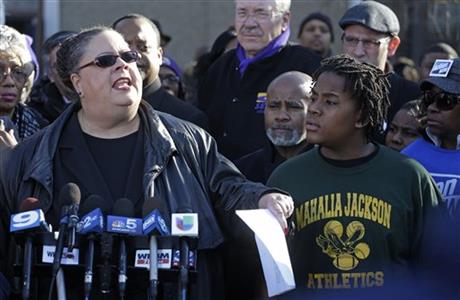
Chicago to close 54, mainly black schools

Karen Lewis
Karen Lewis of the Chicago Teacher's Union during a protest against the closure

CHICAGO (AP) — Tens of thousands of Chicago students, parents and teachers learned Thursday their schools were on a long-feared list of 54 the city plans to close in an effort to stabilize an educational system facing a huge budget shortfall.

Mayor Rahm Emanuel says the closures are necessary because too many Chicago Public School buildings are half-empty, with 403,000 students in a system that has seats for more than 500,000. But opponents say the closures will further erode troubled neighborhoods and endanger students who may have to cross gang boundaries to attend school. The schools slated for closure are all elementary schools and are overwhelmingly black and in low-income neighborhoods.

CPS officials say money being spent to keep underutilized schools open could be better used to educate students elsewhere as the district deals with a $1 billion budget deficit. About 30,000 students will be affected by the plan, with about half that number moving into new schools.

“Every child in every neighborhood in Chicago deserves access to a high quality education that prepares them to succeed in life, but for too long children in certain parts of Chicago have been cheated out of the resources they need to succeed because they are in underutilized, under-resourced schools,” said district CEO Barbara Byrd-Bennett. “As a former teacher and a principal, I’ve lived through school closings and I know that this will not be easy, but I also know that in the end this will benefit our children.”

As word of the closures trickled out, parents and teachers reacted with anger and shock, some even crying. Sandra Leon said she got a tearful call from her grandchildren’s kindergarten teacher saying the school was on the list to be closed. Her two grown children also attended the school, and Leon wiped her eyes as she waited outside for her grandchildren.

“It’s been so good for our kids,” Leon said. “This school is everything.”

Chicago officials have moved to close schools in the past, but never anywhere near the number designated at one time by the Emanuel administration. Former Mayor Richard M. Daley’s administration spread school closings over a number of years. CPS, the nation’s third-largest school district, now has 681 schools.

Chicago is among several major U.S. cities, including Philadelphia, Washington and Detroit to use mass school closures to reduce costs and offset declining enrollment. Detroit has closed more than 130 schools since 2005, including more than 40 in 2010 alone.

The issue has again pitted Emanuel against the Chicago Teachers Union, whose 26,000 members went on strike early in the school year, idling students for seven days. It has also put Emanuel and Byrd-Bennett at odds with parents, civic leaders and lawmakers, who have blasted the pair during highly charged community meetings throughout the city and at a legislative hearing earlier this week.

Union President Karen Lewis criticized Emanuel, who is out of town with his family, for being on vacation on the day of the announcement. She called the closings “an abomination.”

“This is cowardly and it is the ultimate bullying job,” Lewis said. “Our mayor should be ashamed of himself.”

The vast majority of the 54 schools are in overwhelmingly black neighborhoods that have lost residents in recent years. Chicago’s black population dropped 17 percent in the last census as African-Americans moved out to the suburbs and elsewhere. The other few schools are majority Hispanic or mixed black and Hispanic. Overall, 91 percent of Chicago public school students are minorities.

Many of the schools identified for closure are in high-crime areas where gang violence contributed to a marked increase in Chicago’s homicide rate last year. The district plans to have community groups help students get to their new locations safely.

Among the critics is Eular Hatchett, who lives in the violence-plagued neighborhood of North Lawndale and walks her 13-year-old nephew DaVontay Horace to school.

“Our parents know about this area,” she said. “They don’t know about those other areas. If they send him way north or way south, I’m not going to do that. It’s too dangerous.”

Because some schools have more than one building, a total of 61 structures will be closed. In addition to the closures, students at 11 other schools will be “co-located” with existing schools. Six schools have been targeted for academic interventions known as “turnaround.”

CPS says the plan will save the district $560 million over 10 years in capital costs and an additional $43 million per year in operating costs.

The district plans to invest $233 million into what it calls the “welcoming” schools, or the buildings that students in closed schools will be moving to. Those funds will be used for air conditioning, upgraded technology and security and to ensure every school has a library.

District officials said they couldn’t calculate how many teachers will be laid off as a result of the cuts because school leaders will make decisions about their own budgets.

Many teachers and parents expressed anger and frustration at how the news of the closures trickled out, leaving some to agonize over rumor and conjecture.

“In a word, the approach was brutal. It’s certainly not deserved by these parents and these kids,” said Mary Visconti, the director of the Better Boys Foundation, a youth organization in the Lawndale neighborhood.

At Lafayette Elementary, where 95 percent of its 483 students come from low-income families, teacher Rosemary Maurello said the principal read teachers a letter from the district Thursday morning saying the school is among those it plans to close. The letter said a final decision would be made in May after more community meetings are held and budget plans are reviewed.

But Maurello said letters and information packets were already being sent to parents and the district’s message to teachers included a mention of specific plans to move the Lafayette students to another school about 10 blocks away.

“It sounds like a done deal to me,” Maurello said.

Gated communities or fated communities?

From the air, it’s easier to spot wealth than poverty. Climbing out of Cape Town International Airport the informal settlements soon become a blur but the private developments remain in crisp focus, their pristine loops of asphalt standing out like Nazca lines, the bulk of their road-straddling gatehouses unmissable and their clustered tricolours of lawn, pool and villa conspicuous against the dun landscape.

Later, descending into Johannesburg in darkness, the city lights reveal the same pattern: random, dull and fuzzy in the shack districts but bright and purposeful in the secure enclaves.  The British euphemistically call these developments “gated communities” but South African developers use the more straightforward “security estate”.

In one such as these, near Pretoria to the north, Oscar Pistorius felt safe enough behind high walls, razor wire, attack dogs and armed guards to sleep with the patio doors open (albeit with a gun under his bed and a cricket bat behind the bathroom door).

Pistorius lived on the Silver Woods Country Estate (shown in the aerial image above) – a “pres­ti­gious secu­rity estate” of 290 homes and still-vacant building plots set amid similar districts with names like Willow Acres and Faerie Glen. This still-growing Securicor suburb will eventually house 25,000 people.

The sleeping and bathing quarters at Casa Pistorius are now among the most familiar interior layouts of all time thanks to numerous media reconstructions of the night he shot and killed his girlfriend Reeva Steenkamp.

Yet the urban design of Silver Woods has hardly been discussed, even though its paranoia-driven features might provide the only mitigating circumstances in Pistorius’ favour: people who live in these places clearly fear for their lives.

Like most security estates, Silver Woods has a single point of entry and departure: a covered, manned and barriered gateway, bristling with CCTV and biometric scanners and resembling a sub-tropical Checkpoint Charlie. It is connected to the public domain but not of it.

The estate is “enclosed with a solid, elec­tri­fied secu­rity wall” and is planned “in such a way that it has the feel of a vil­lage.” All build­ing work is sub­ject to “a strict archi­tec­tural and aes­thet­ics spec­i­fi­ca­tion”.

Yet this is a village with no facilities on offer beyond raw security: no stores, playgrounds, bars or cafes. Residents have to journey by car for all their daily needs, or get them delivered. Hinting perhaps at the fearful priorities of its residents, the estate’s website boasts of its proximity to hospitals and medical clinics first of all, before listing the distance to local schools and shops. The location of the nearest police station is not regarded as a benefit worth mentioning.

While security estates respond to violent crime they do not solve it. Despite its precautions Silver Woods has suffered “incidents” in the past. Beneath a brief statement on its website from the Silver Woods management commiserating on the Valentine’s Day tragedy a woman called Colleen has commented: “We moved to the UK to avoid the crime. While liv­ing in a ‘secure’ sub­urb in Johan­nes­burg we expe­ri­enced many an inci­dent with regards safety, bur­glary etc. Our chil­dren were vic­tims of hijack­ing attempts as well.”

Developments like Silver Woods attract universal disdain from architectural writers and urbanists. They are seen as a betrayal of civilised values and an abandonment of design’s potential to benignly regulate behaviour in the urban environment. Former Guardian architecture critic Jonathan Glancey called gated communities a “social ill” and wrote: “It’s time we opened our gates, and to shoo the fear away as we do.”

But they are becoming the default setting in towns and cities around the world – and not only for the wealthy. In the USA, the number of homes in developments secured by walls or fences grew 53 percent between 2001 and 2009 and now account for ten percent of all occupied homes.

Anna Minton’s 2009 book Ground Control documented the creeping privatisation of urban space in the UK and the USA but the book predates news of entire private cities being built in Guatemala and Honduras.

She updated the book in 2012 to include a new chapter on the London Olympic Park, which she described as “a divided landscape of privately owned, disconnected, high security gated enclaves side by side with enclaves of poverty which remain untouched by the wealth around them”. This, she writes, creates “a climate of fear and growing mistrust between people, which together with the undemocratic nature of these new private places, erodes civil society.” This paragraph makes Stratford sound like Johannesburg, which it most definitely is not.

I once found myself accidentally living in a gated community in London and the experience taught me of its benefits. Between signing the contract and moving into the flat the developer erected a high, spike-topped fence, electronic gates and unmissable CCTV arrays.

I was furious, until I found out that the other residents had demanded the improvements after numerous muggings in the dark cul-de-sac between the converted warehouses of our development. The over-conspicuous security measures caused mild resentment among neighbours on the other side of the fence but opportunistic crime ended immediately. We came to appreciate our ugly guardians. They were needed to overcome a fundamental design flaw – the spatially indefensible arrangement of the converted industrial buildings.

But even where there is no razor wire or guard, much of life takes place in monitored environments that require entry credentials. Concierged apartment blocks are types of security estates, arranged vertically rather than horizontally. Office buildings with swipe-card entrance systems are security estates.

The Tube and rail networks are security estates, as is a ticketed festival or conference (entry to the Design Indaba conference I was attending in Cape Town was via fingerprint scanner). Large private developments like Canary Wharf are gateless, city district-sized security estates.

What we think of as the public realm has in many places shrunk to a leaf skeleton of arteries that connect non-public realms. But does it really matter whether the land beneath your feet is owned by the state or by a corporation? And if the former is unable to guarantee the safety of its citizens, is it not understandable that they turn to the latter? – Marcus Fairs www.dezeen.com

Lesotho witch doctor found cooking the remains of white Afrikaner farmer

A witch doctor from Lesotho was busy cooking body parts of a white farmer when he was arrested, the Free State High Court heard this week.

The trial of Moeketsi Hopolong Mokoena (34) on Monday before Judge A. Kruger was postponed until April 22, the Beeld reported.

According to the charge sheet, he was busy cooking parts of Jan van Wyk (82) of the farm Jakkalsfontein.

The black man allegedly killed Basie Venter (65) of the farm Biesiesvlei in the evening of March 30, 2009. His wife witnessed the murder outside their home.

The state argues that Mary Venter saw how Mokoena killed her husband with an iron pipe. Mokoena then fled, presumably to Van Wyk’s farm. It is about 5 km away.

The state said when security officers arrived at Van Wyk’s farm, they found Mokoena, bloodied, seated on the front porch of the homestead.

Van Wyk’s badly mutilated body was found in the living room. He died as a result of a deep wound to the neck.

His body parts were found in a pan where Mokoena was busy cooking them.

Lesotho is often called a British Bantustan. Prince Seeiso of the royal house of Lesotho, is also high commissioner to the Court of St James in Britain.

The extent to which the British exerted direct control over Basutoland waxed and waned until Basutoland’s independence in 1966, when it became the Kingdom of Lesotho, but Britain has remained a strong influence.

A third of the population goes hungry. It has one of the highest rates of HIV/Aids in the world and life expectancy now is only 41 with some sources claiming it is as low as 34. It is so poor that it is sometimes classified as Fourth World.

Yet the mountainous African kingdom of Lesotho is the place where the British Royal, Prince Harry says he can truly be himself. He runs a charity in the country and regulary visists the place.


Are Babies Bigoted?

In one of the fastest-growing areas in psychology, researchers are gaining insight into the mental processes of subjects that are barely able to communicate: babies. In recent years, innovative and playful experimental setups have suggested that infants as young as six months old have a sense of morality and fairness, and that 18-month-olds are capable of altruistically helping others.

Some of this research, though, has also shed light on racial preferences. A new study published in Psychological Science suggests that 9- to 14-month-olds exhibit a preference for their own — in watching a puppet show, at least, they seem to prefer their own kind, and support puppets that pick on those who are different from them.

Because babies can’t communicate verbally, J. Kiley Hamlin of the University of British Columbia has pioneered the use of puppet shows to probe their psychology and better understand how they see the world. In this study, her research team put on an show in which 52 infant participants were led to identify themselves as similar to one of the characters in the show and different from the other.

To accomplish this, the researchers started off by asking the infants to pick a food, either graham crackers or green beans (a little surprisingly, a full 42 percent chose the vegetables). Then, the infants were shown a pair of rabbit puppets, one who liked graham crackers and one who liked green beans:

Once they’d solidly demonstrated each rabbit’s choice, one of them — either the one with the same preference as the infant observer, or the one with an opposite preference — would be randomly chosen to encounter a pair of new characters: one dog, termed a “helper,” and another, called a “harmer.” As the rabbit played with a ball and dropped it, the nice “helper” dog threw it back, but the mean “harmer” dog (below) held onto the ball:

After both of the scenes were over, both dogs were presented to the infant, and the particular dog that the baby first reached for was interpreted as the character it preferred.

The results were a bit startling: When the infants had watched a play involving a rabbit with a food choice that matched theirs, 83 percent preferred the “helper” dog. When they’d watched a play with a rabbit who liked a different food, 88 percent chose the “harmer” dog. This held true regardless of the  babies’ original food choices — the only thing that mattered was whether the rabbit’s identity, it terms of food choice, matched their own.

To further parse the motivations underlying the infants’ choices, the  researchers conducted a similar experiment that involved a neutral dog that neither help nor harmed the rabbit.

In this part of the study, the older infants’ preferences revealed that when watching rabbits who had different favorite foods than them, they not only liked “harmer” dogs more than neutral dogs, but strongly preferred even neutral dogs when compared to “helpers” (this was true among the 14-month-olds, but not the  9-month-olds). In other words, it seemed that they not only wanted to see the rabbit treated poorly, but also would rather see it treated neutrally than get some help.

Of course, when designing experiments for subjects that can’t use words to communicate, the simplest of variables could potentially throw off the results. It’s unclear, for example, if the researchers alternated which side the “helper” and “harmer” puppets appeared on, so the babies could have been influenced by their emerging sense of handedness.

In the past, critics of such puppet show experiments have also charged that a baby merely reaching for one puppet or another might be an impulsive reflex, rather than reflecting an underlying moral judgment.

What’s clear, though, is that this experiment demonstrated a consistent reflex across the babies tested. While extrapolating this to mean that the babies are racist or bigoted is probably a step too far — for one, they were  merely considering individual puppets, not groups of puppets with similar  characteristics — it does raise interesting questions about the origins of xenophobia in an individual’s lifetime. – Smithsonian.com

Students to wear ‘White Privilege’ wristbands

The Wisconsin Department of Public Instruction runs several programs that emphasize racial issues.

One of those programs – an Americorps operation called VISTA (Volunteers in Service to America) –   encourages white students to wear white wristbands that serve “as a reminder about your (white) privilege?”
The program for high school students “seeks to build capacity in schools and districts serving low-income families to develop an effective, sustainable, research-based program of family-school-community partnerships,”according to its Facebook page.
That sounds reasonable enough. However, the program becomes a bit suspect when one notices the Gloria Steinem quote on the top of their webpage: “The first problem for all of us, men and women, is not to learn, but to unlearn.”
The webpage list a series of suggestions for high schools students to become more racially sensitive. The suggestions include:
• Wear a white wristband as a reminder about your privilege, and as a personal commitment to explain why you wear the wristband.
• Set aside sections of the day to critically examine how privilege is working.
• Put a note on your mirror or computer screen as a reminder to think about privilege.
The Wisconsin DPI also sponsors  CREATE Wisconsin, an on-going “cultural sensitivity” teacher-training program that focuses largely on “whiteness” and “white privilege.” – WTMJ

No asylum for white family in US

A white South African family has lost their court bid for asylum in the US, the Sunday Times reports.

The family, a couple with two children originally from Durban, claimed they were in danger in South Africa because another family member had been racist and his victims wanted revenge.

“This is not about black versus white. It’s about them being specific targets of retribution from victims of another person’s racism,” the family’s lawyer Errol Horwitz told the newspaper.

He said the family’s paternal grandfather had allegedly abused his employees at a construction company in South Africa.

His daughter-in-law testified in US courts that, as a result of his alleged racism, her dog was poisoned, human faeces thrown at their home, she was threatened, and her daughter was the victim of an attempted kidnapping.

However, this week, a request for a new appeal hearing was turned down by three judges of the US Ninth Circuit Court of Appeals.

Previously the court had ruled that since the grandfather had retired, there would be no credible threat against the family.

The family has spent 15 years involved in various court actions to try and gain asylum.

Horwitz said the children were likely to gain US residency through other legal avenues.

However the parents were now “effectively undocumented migrants. The family is devastated by this decision.” – SAPA

Young black man gets 22 years for raping 85-year old disabled woman

A man was sentenced to 22 years’ imprisonment by the Pietermaritzburg High Court on Friday for rape, KwaZulu-Natal police said.

Sibusiso Didis Nkosi, 26, was found guilty of raping an 85-year-old disabled women in her room at an old age home in Paulpietersburg shortly after midnight on March 12, 2011, Captain Thulani Zwane said.

“He entered the room through a door that was not locked and raped the victim. The accused fled the scene on foot,” Zwane said.

Nkosi was arrested shortly after the attack and charged with the rape.

“The case was transferred to Vryheid family violence, child and sexual offences unit members, who collected all required evidence by the court for the purpose of good conviction.”

Zwane said Nkosi was denied bail and appeared in court on various occasions until he was convicted and sentenced in the High Court on Friday.

KwaZulu-Natal commissioner Lt-Gen Mmamonye Ngobeni said: “We as [the] South African Police Service condemn such brutal attacks on vulnerable elderly women by these heartless criminals who do not respect the rights of women and children.

“Sibusiso Nkosi, like any other criminals already convicted by our courts, do not deserve to be in our community and this sentence will send a strong message to others who might think of committing such crimes.” – Sapa

Tony Blair, Ignoramus Supreme

Taking himself seriously…

Every time I write about Tony Blair, I tell myself that it will be the last time.  But then I find myself coming back, time and again, like a dog to its vomit.   It isn’t because Blair is so interesting in himself.

On the contrary, the more he appears in the media and utters his banal and narcissistic pronouncements, the more he reminds me of a cross between the gardener Chance in Being There and Bismarck’s depiction of Napoleon III as a ‘sphinx without a riddle.’

For me Blair’s interest, such as it is, derives from his political role, and particularly his role in the Iraq war and a dangerous and fervid promoter of the new 21st century militarism.

Last week, there was a sharp and disturbing article by Chris Doyle , the director of the Council for Arab-British Understanding (CAABU), which drew attention to an aspect of the Blair phenomenon that I have always found striking and inexplicable; the often breathtaking shallowness that underpins so many of his judgements and positions – particularly when they have anything to do with the Middle East.

Doyle’s piece contains the following anecdote:

‘Shortly after Tony Blair set up shop as the Quartet Representative in the luxurious American Colony Hotel in Jerusalem he met a group of former Parliamentary colleagues. To the jangle of jaws dropping on the floor, he confessed that before he had come out there, he had not realised just how little he really understood about the Israel-Palestine conflict as Prime Minister. The reality on the ground was so much worse then he had ever imagined.’

This is the man who the ‘Quartet’ sent to bring peace to the Middle East, who once told the Labour Party Conference in 2001 of his determination to ‘re-order’ the post-9/11 world ‘from the deserts of northern Africa to the slums of Gaza, to the mountain ranges of Afghanistan’.

This is not the first time Blair has made grandiose pronouncements on subjects he knows nothing about.  In his book on the Iraq war, the Guardian journalist Jonathan Steele once described how Blair met three academic experts on Iraq at 10 Downing Street during the build-up to the Iraq war to discuss what might happen after the invasion.

You might think that consulting established experts such as Toby Dodge, Charles Tripp and George Joffe when you are about to go to war was  the mark of a wise politician, willing to recognize the gaps in his own knowledge and keen to remedy them through consultation.

According to Steele,  the three academics each made short presentations in an attempt to give Blair some insight into the complexities of Iraqi society and politics and the possible consequences of military action, but the would-be liberator was not interested in such trivia.

Charles Tripp told Steele that Blair ‘wasn’t focussed. I felt he wanted us to reinforce his gut instinct that Saddam was a monster. It was a weird mixture of total cynicism and moral fervour.’

Tripp later recalled how

‘At one point, Blair said something like: “Isn’t Saddam Hussein uniquely evil?”There was a muttering from this group of 21st-century academics as if to say: “What’s this man on about?” I thought, no, Saddam’s not unique, and as for evil, well, that’s his statecraft!’

George Joffe told Steele that he came away with the impression of  ‘someone with a very shallow mind, who’s not interested in issues other than the personalities of the top people, no interest in social forces, political trends, etc’.

Once again,  the most disturbing aspect of Blair’s ignorance is not just what it says about Blair himself.   Since 2008 Blair has been giving a course at Yale University on ‘faith and globalisation’; governments pay millions for his advice; he picks up vast fees for speaking engagements to elite gatherings across the world continues to be regarded by the British and American media as the go-to man on anything to do with the Middle East; banks pay him huge salaries as a consultant.

Despite his disastrous record in Iraq, he continues to be taken seriously when he calls for new ‘interventions’ in Syria and Iran; when Newsnight commemorated the Iraq anniversary, he was given a twenty-minute respectful interview by Kirsty Walk; both Cameron and Miliband treat him like some wise elder statesman; according to Doyle ‘One politician visiting the US State department last year came away stunned at the high regard Blair was held in.’

All this for a man who again and again has demonstrated that he has no idea what he is talking about, whose record in Iraq – leaving aside the question of the criminality of the war – is one of gross negligence and recklessness.   Yet the political and media elites continue to consider him an expert and an authority, as though nothing ever happened.

All of which suggests that Blair’s cliches and ill-informed assumptions and delusions about terrorism, Islam, the Middle East and the Israeli-Palestinian conflict  are actually useful in some way – at least to some people and institutions, and that the reputation that he has acquired in certain circles was not achieved in spite of his shallowness and ignorance – but because of it. – Matt Carr

China’s drone fleets

China is building one of the world’s largest drone fleets aimed at expanding its military reach in the Pacific and swarming U.S. Navy carriers in the unlikely event of a war, according to a new report.

The Chinese military — known as the People’s Liberation Army (PLA) — envisions its drone swarms scouting out battlefields, guiding missile strikes and overwhelming opponents through sheer numbers. China’s military-industrial complex has created a wide array of homegrown drones to accomplish those goals over the past decade, according to the report released by the Project 2049 Institute on March 11.

“The PLA now fields one of the world’s most expansive UAV [unmanned aerial vehicle] fleets,” said Ian Easton and L.C. Russell Hsiao, researchers at the Project 2049 Institute and authors of the new report.

U.S. military forces still operate the largest drone fleet, with at least 679 drones in 2012, according to data from the International Institute for Strategic Studies reported by the Guardian. But the new Project 2049 Institute report estimates that China had 280 military drones as of mid-2011 — a number that has likely grown since then.

Chinese military drones have already entered the frontlines of China’s territorial disputes with neighboring countries such as Japan by flying maritime patrols over disputed areas. The Project 2049 Institute report warned that China could be tempted to use drones more aggressively without risking human lives, or even consider “plausibly deniable” drone attacks blamed upon mechanical failure or cyberhackers.

Chinese strategists have also discussed using swarms of drones to overwhelm the U.S. Navy’s carrier groups in the unlikely possibility of a shooting war. The drones could act as decoys, use electronic warfare to jam communications and radar, guide missile strikes on carriers, fire missiles at U.S. Navy ships or dive into ships like kamikaze robots.

“In particular, numerous authoritative studies indicate a strong emphasis on developing UAVs for locating, tracking and targeting U.S. aircraft carriers in support of long range anti-ship cruise and ballistic missile strikes,” the Project 2049 Institute report says.

All the main branches of the Chinese military field operational drone units. The new report identifies those military units along with major academic, industry and military organizations involved in building Chinese drones.

The report goes on to examine the state of Chinese drone technology. China is developing drones such as the rumored “Dark Sword” stealth drone that have low radar profiles to escape radar detection. It also wants to build “space” drones that could loiter at heights of 31 miles (50 kilometers) above the Earth to provide constant surveillance. (Scientists typically consider 62 miles (100 km) to mark the boundary for the edge of space.)

Chinese engineers have even begun working on drones that have the software brains to fly in formation, do aerial refueling and takeoff and land autonomously — capabilities that the U.S. military has also developed or begun testing for its own drones.

The risk of war between the U.S. and China remains low. But the report cautions that the U.S. military could prepare for the worst-case scenario by hardening its existing air bases in Asia and developing energy weapons (such as lasers) for better air and missile defense. – TechNewsDaily

Obama shuns diversity

Marcia L. FudgeCongressional Black Caucus Chairwoman Marcia L. Fudge is escalating her campaign to urge President Barack Obama to pick African Americans for his cabinet, publicly releasing a letter that slams the first black president for a lack of diversity among his closest advisers.

“The people you have chosen to appoint in this new term have hardly been reflective of this country’s diversity,” the Ohio Democrat said in the March 11 letter.

Fudge adds that CBC members’ offices have received phone calls from angry constituents questioning why Obama hasn’t nominated anyone with the ability “to speak to the unique needs of African Americans. Their ire is compounded by the overwhelming support you’ve received from the African American community.”

By releasing the letter, Fudge is escalating a campaign by the CBC to push Obama on his cabinet diversity and continuing to demonstrate her willingness to push Obama aggressively to embrace her group’s priorities.

The Ohio Democrat previously moved to promote three CBC members for open Cabinet positions, highlighting a long-standing sore spot in the relationship between the CBC and the president, who was a member of the group during his one Senate term.

Obama, in turn, dispatched top aide Valerie Jarrett for her first Capitol Hill meeting of the second term to meet with the CBC for a State of the Union preview and listening session with members.

White House officials have assured CBC leaders that they will be pleased with future decisions. But Fudge apparently has lost patience, hence the letter Monday.

In the letter to Obama, Fudge said the CBC “looks forward to meeting with you to discuss this and other pressing issues.” CBC spokeswoman Ayofemi Kirby said a meeting with Obama has been requested, but no answer has yet come back from the White House.

Privately, the relationship between Obama and the CBC has been complicated for a long time, with members complaining about social snubs and Obama’s reluctance to address the high black unemployment rate head on.

The rift over Obama’s Cabinet is a case in point. For example, there was some jealousy in Obama’s first term that a member of the Congressional Hispanic Caucus, then-Rep. Hilda L. Solis, D-Calif., was chosen to lead the Labor Department but that no member of the CBC was even vetted for a Cabinet slot. Rep. Sanford D. Bishop Jr. of Georgia was discussed for Agriculture secretary but not formally vetted. – Roll Call Staff

Mandela’s memory ‘fading’

Nelson Mandela is doing well but has memory lapses, a close friend said on Monday.

Mandela spent a night in hospital at the weekend for a medical checkup, AFP reported.

The 94-year-old is aware of current political events, but he forgets at times that his fellow anti-apartheid activists are dead, said human rights lawyer George Bizos, who defended Mandela during his 1960s treason trial.

Bizos paid a visit to the Nobel Peace Prize-winner at his Johannesburg home 10 days ago and said Mandela “looked OK.”

Dutch stores to label products from Israeli settlements

The Netherlands has asked its retail chains to label Israeli products made in areas beyond the 1949 ceasefire line, including Judea, Samaria, eastern Jerusalem and the Golan Heights.

The Netherlands is the second European country, after the UK, to introduce this kind of labeling system.

However, there will be no punitive measures for those retailers who choose not to comply. Also, it will not be illegal to import products from these areas and only labeling of fresh fruit, vegetables, wine, honey, olive oil, fish, meat, chicken, eggs and cosmetics will be affected.

The decision comes following the EU recommendation for its member states to implement an economic boycott of Jewish communities in those areas.

Europeans must leave South Africa

Brad Cibane

For ages, the country today known as South Africa was no more than a loose band of separate communities. The Nguni tribes, which settled on the Southern tip of Africa around the 10th century, neither considered themselves a single nation, nor did they consider the Khoisan people already inhibiting the area part of their collective, writes Brad Cibane in the Mail&Guardian.

The Dutch settlers, who committed to transforming the Cape from a refreshment station to a settlement in the 1670s, also did not envision forming a nation with the Khoisan or the Nguni tribes. The same is apparent for the English colonists who settled in the 1820s.

The settlers and the colonists divided the country among themselves into four separate states: the Colony of Natal, the Cape Colony and the Boer Republic (Orange Free State and Transvaal). The situation persisted until the early 1900s when, after a bloody war, the Volksraad and the British embarked on negotiations, which culminated in the South African Union Act of 1909. On May 31 1910 the Union of South Africa was formed as a British dominion.

The new Union of South Africa excluded non-Europeans from its constitutional structures. The exclusion awoke the natives to the reality of their status, and drew them closer together. The loose band of tribes united to speak in unison when the South African Natives Congress was transformed into the African National Congress in 1912.

The unjust marginalisation of natives (Ngunis and Khoisan) was codified in 1913 when the government enacted a law reserving more than 87% of land for the exclusive use of whites. The government coveted ultimately to dispel all non-Europeans, and to create a “Little Europe” in Africa.

The vision started to take shape in 1948 when the National Party came into power. The National Party’s policy of “separate developments” (or “apartheid”) anaesthetised the distinction between the English and the Afrikaners. Government rhetoric opted instead for the more generic term “Europeans”. It sought to unite all whites under the “European” banner. South Africa was for (white) Europeans.

The biggest hurdle that faced the new united nation was that European South Africa and black South Africa were very different. Thabo Mbeki characterised the differences vividly in his “two nations” speech. Thus, the task of building a single nation was prodigious and it befell not just the new “black government” but all South Africans.

The characteristic terms “black” and “European” were discarded, leaving a single South Africa occupied by Africans of all races. White South Africans who had been beneficiaries of a system that pillaged and oppressed on their behalf relinquished their “European” status and citizenship. Those aggrieved by the demolition of “Little Europe” packed their bags and headed elsewhere.

It appears, however, that there are citizens of “Little Europe” (or European-South Africans) remaining in South Africa today. The problem with these people is that they do not consider themselves South African (other than “Little Europeans”). They harbour the most regressive elements.

The corollary of a South African citizenship is that it entails not just the right to co-exist with other South Africans, but also the concomitant obligations of contributing to the betterment of the nation. Citizenship in the new South Africa entails discarding racial and cultural prejudices. For the citizens of former “Little Europe”, a citizenship in the new South African also entails giving up a privilege built on many years of domination.

The nuisance with citizens of “Little Europe” currently inhibiting South Africa is that they sit elevated on a platform of perceived betterness. They harp and lash harshly at government without rolling up their own sleeves to fight the good fight. They speak with nostalgia about the good old days when their citizenship did not entail obligations towards black folk. They speak of the black inclination towards crime but make no recognition of the root causes (poverty, illiteracy and inequality).

An apt example of a citizen of “Little Europe” is a (white) man who tells foreign media that the (“black”) government is responsible for his (white) son shooting his (white) girlfriend. He makes no mention of the gun culture in which he raised his son.

South Africa faces Herculean challenges and all South Africans must battle together. The first step toward winning the battle is taking ownership of all problems by all South Africans, black or white, rich or poor. Poverty, crime and and iliteracy should concern all residents the country with similar urgency.

South Africa belongs to South Africans, citizens of “Little Europe” must leave. “Little Europe” no longer exists.

Cibane, however, likes Afrikaans. He says it’s is a beautiful language, even though it’s rather heavy. People are often curious about the difference between Afrikaans and Dutch. Except for the semantic difference, Afrikaans is much lighter, although the accent is rather heavy. Unfortunately, Afrikaans is burdened by the Soweto uprising, Skhothens, Captonian thugs and, well, the National Party.

Many young South Africans refuse to speak the language. But, if you’ve seen 7de Laan, you’ll know that it is not impossible to make love to the South African variant of Dutch.

For a non-speaker, Afrikaans gets a plus because it is exotic. Many none speaker, who at least understand the language, will appreciate hearing, “jy is pragtig” instead of “you are beautiful.”

Cibane thinks Afrikaans does not handle vulgarity well, however.

Bipartisan drone wars errupt

Rand Paul

After years in the shadows, the administration’s secret drone program burst into very public view Wednesday with lawmakers grilling the attorney general over legal justification for targeted killings and Sen. Rand Paul launching an old-style one-man filibuster to demand answers from President Obama.

The Kentucky Republican held the floor for hours, effectively blocking a vote on the nomination of John O. Brennan, whom Mr. Obama has tapped to be CIA director. He said he would relent only if the administration publicly vowed not to target Americans on U.S. soil.

“This is a long, drawn-out day, but it’s to try to get some answers,” Mr. Paul said after he crossed the eight-hour mark late Wednesday evening. “It’s to try to shame the president into doing the right thing.”

Democrats, who control the chamber, were forced to delay a vote on the Brennan nomination until at least Thursday, and it could go into the weekend, depending on what other blockades Republicans erect.

At issue is the administration’s argument that it can kill those it suspects have ties to terrorism, including U.S. citizens, without having to put them on trial.

The fulcrum of the debate is the drone program, started under President George W. Bush and expanded by Mr. Obama, which many lawmakers said gives too much power to the executive branch — and raises tricky questions about whether drones could be used to execute Americans in the United States.

The administration has only recently acknowledged the drone program and says it is seeking a public debate in order to find common ground on what Americans are ready to accept.

“I think there is going to be a greater effort at the transparency. A number of steps are going to be taken. I expect you will hear the president speaking about this,” Attorney General Eric H. Holder Jr. told the Senate Judiciary Committee on Wednesday morning.

But he faced bipartisan demands for more information and more clarity on what is and what isn’t allowed.

“You can hear almost unanimous concern about transparency and wrestling with how to move forward here in a way that protects both our constitutional liberties and our security as a nation,” Sen. Christopher A. Coons, Delaware Democrat, told Mr. Holder.

Under close questioning by Sen. Ted Cruz, Mr. Holder repeatedly said American citizens on U.S. soil were not “appropriate” targets for extrajudicial executions.

Mr. Cruz said that wasn’t good enough.

“You keep saying ‘appropriate.’ My question isn’t about propriety. My question is about whether something is constitutional or not,” the Texas Republican said.

“Let me be clear: Translate my ‘appropriate’ to ‘no.’ I thought I was saying no, all right? No,” Mr. Holder said.

Mr. Holder also said he is not sure Congress could ban the president from using drones to kill Americans on U.S. soil. – Washington Times