Body of councillor found

Political differences between IFP and ANC ironed out

The body of an Inkatha Freedom Party councillor, who was abducted, has been found in a sugar cane field on the outskirts of Durban, the IFP said on Sunday.

IFP spokesman Albert Mncwango said Themba Xulu’s body was found in an area known as eTafulene, near Durban.

Police spokesman Colonel Jay Naicker confirmed the discovery of the body.

He said people collecting mushrooms had discovered the body and alerted police.

Naicker, speaking from the crime scene, said Xulu sustained multiple gunshot wounds and his body appeared to show early signs of decomposition.

While this indicated that Xulu had already been killed on Friday night, a post mortem would confirm this fact.

Xulu was abducted from his home in KwaMashu’s A-Section on Friday, allegedly by five men posing as policemen.

Mncwango said party leaders were at the scene and had told him that it was Xulu. He had been shot.

He appealed for calm and said that he and the IFP leadership were due to hold a meeting with the police at KwaMashu police station.

“We need to know who committed this heinous crime.”

On Saturday national police minister Nathi Mthethwa spoke to residents at a mass meeting of about 2000 people in KwaMashu’s A-Section, which hasnumerous hostels and shacks.

Shortly after he left the meeting a woman was wounded in the face while an IFP supporter was shot dead near Tembalihle station.

Tensions in the area have been high ever since Xulu was arrested and charged for the attempted murder of a National Freedom Party (NFP) member.

The NFP was formed prior to the 2011 local government elections when the former IFP national chair Zanele Magwaba-Msibi left the party.

Naicker said the provincial commissioner had requested an extra 110 police officers be deployed to the hostel areas of KwaMashu’s A-Section as political party leaders attempted to diffuse he situation. – Sapa

Dlamini-Zuma has no power at AU

Dlamini-Zuma

Newly elected African Union (AU) chairwoman Nkosazana Dlamini-Zuma has been set up to fail in her new position, former President Thabo Mbeki said in a media report on Sunday.

“I think part of this feeling that she is going to change [things] is the failure to understand how the AU operates. People might put a big burden on her shoulders expecting her to do this and that and when it doesn’t happen, they will blame her when actually she has no capacity to do these things,” Mbeki told the Sunday Independent.

The former president said AU policies did not originate from the AU Commission, which Dlamini-Zuma heads.

Mbeki said the AU depended on policy made by individual nations, with the commission only able to try and persuade them.

“You have to be able to intervene with the governments in a manner that encourages them,” Mbeki said.

He said the AU had appointed a former head-of-state, Malian President Alpha Konare, for this reason.

“The reasoning was that once you have a former head of state sitting in this position of chair; he will have sufficient influence over his former peers,” Mbeki said. “It didn’t work.”

Mbeki said Konare asked not to be re-appointed to the position at the end of his term.

“The people should not raise expectation with regard to the appointment of Nkosazana, which expectations will be disappointed,” Mbeki said. – Sapa

Hackers block Swedish govt. and CB websites

Fictional Swedish hacker Lisbeth Salander has some real-life imitators

Websites operated by Sweden’s central bank, parliament as well the security service were Friday offline or reported disturbances, the day after hackers had threatened to target them.

Hackers believed to be linked to the group Anonymous on Thursday urged supporters to conduct the so-called denial of service (DDoS) attack after an internet company was searched by Swedish police.

In a video posted on YouTube, an anonymous spokesman had warned of new attacks on Friday, citing that “the raid on PRQ disabled many of our torrent sites. We see this as a crime against freedom-to-information.”

A denial of service attack involves web addresses being hit by a flood of traffic, making the website unaccessible.

The Swedish Prosecution Authority’s website was also offline as was that of the Anti-Piracy Agency formed by Swedish film and computer game producers and distributors that challenge illegal file-sharing.

The search of the internet company, which the prosecution authority named as PeriQ Networks AB, ended Wednesday and several servers were seized. The suspicions centred on suspected copyright infringements.

Similar attacks have hit other sites earlier this week.

Some news reports suggested that PRQ had links with the file-sharing website The Pirate Bay. Four members of the website have in the past been sentenced for copyright infringement. One of its members, Gottfrid Svartholm Warg, was last month extradited from Cambodia on suspicion of another case of cyber crime.

Pirate Bay, which allows users to share music and video files, was started in 2003, according to its website. It says it does not store copyrighted or illegal material. – DPA

Black doctor writes fake death certificate

Six people, including a doctor, will appear in a Durban court next week after allegedly faking a death to collect life insurance, police said on Saturday.

Spokesman captain Thulani Zwane said they used a stolen identity document, belonging to Mandisa Mkhwebula, without her knowledge, to take out death cover.

“After nine months of paying monthly premiums, they declared her dead and prepared the necessary documents with home affairs, a funeral parlour and a doctor to enable them to claim,” Zwane said.

Three sisters, Zodwa Ngcobo, Thulile Madondo and Zandile Linda, and their two accomplices, Sibongiseni Thabethe and Brian Khumalo, were out on R2500 bail each.

Thabethe, arrested in a pub in central Durban, and Khumalo, who was arrested in Pinetown, apparently provided most of the documentation used to commit the fraud.

The 47-year-old Isipingo doctor was alleged to have supplied the blank BI 1663 death notification form to the sisters.

“It is alleged that he sold blank BI 1663 to people who wanted to lodge fraudulent claims,” Zwane said.

The five people would appear before the Durban Commercial Crime Court on Tuesday, while the doctor would appear separately. – Sapa

Conservatives and the diversity dross

The next news item is unremarkable. “The U.S. government,” reports Fox News, “paid a Chicago consultant hundreds of thousands of dollars to put on diversity training workshops that, according to one watchdog, included an exercise in which employees were told to chant ‘our forefathers were illegal immigrants.’”

What do you expect from “the U.S. government”? It’s a criminal gang out to erase every vestige of a history that might rekindle in a pliant people the quest for freedom. The government, and its excrescences, do these things reflexively rather than as a matter of collusion and conspiracy. Like a big amorphous amoeba—a simple, single-celled organism—government will instinctively act to preserve its own integrity.

The people to condemn in his story are the “Conservative group Judicial Watch.” While we are grateful to JW for uncovering the bestialities of bureaucrats—in the substance of their complaint, they are almost as complicit as government. They complain that,

“Instead of being diversity-oriented or tolerance-oriented, it’s more about adopting a mindset,” said Lisette Garcia, a senior investigator with the group.

Garcia of Judicial Watch is quite fine with the government conducting mind-control workshops on taxpayers’ dime, so long as these indoctrination sessions transmit true “diversity and tolerance,” as promised.

What kind of a conservatism is this? The watchdogs are worse than the dogs in power (my apologies to dogs). At least the people who dreamed up the “diversity intelligence advantage course” know what they are after. What do Garcia and her friends want?

A truly conservative watch dog would, first, object to the unconstitutional appropriation of taxpayer funds. Second, they would reject the diversity doxology. Americans should not relinquish their birthright for a mess of pottage.

Were Lisette Garcia of Judicial Watch a true conservative she’d take the opportunity to mention that “Thomas Jefferson never entertained the folly that he was of immigrant stock. He considered the English settlers of America courageous conquerors, much like his Saxon forebears, to whom he compared them. To Jefferson, early Americans were the contemporary carriers of the Anglo-Saxon project.”

The settlers spilt their own blood “in acquiring lands for their settlement,” he wrote with pride in A Summary View of the Rights of British America. “For themselves they fought, for themselves they conquered, and for themselves alone they have right to hold.” Thus they were “entitled to govern those lands and themselves.”

Read Ilana’s blog.

Jared Taylor makes plea for White Student Union in Towson

Member of Youth for Western Civilization

by Kyle Rogers of examiner.com

Pro-American activist Jared Taylor spoke at Towson University near Baltimore to argue for the need for a White Student Union on campus.

Taylor is the author of Paved With Good Intentions, and the president of New Century Foundation. Local Charleston residents may recognize his name as he has been a repeat guest on the Rocky D radio show.

Several groups at Towson, most notably the Black Student Union, are advocating racial discrimination against whites. They say the University should not allow a White Student Union, even though it provides lavish funding for every other racial group to organize. The University tried to keep Taylor from coming by charging him $1,600 for “security.” The University lets all manner of radical left-wing and black power activists use campus facilities and provides them with security free of charge.

The Black Student Union organized against the speech. That group packed the conference room early, causing many supporters of Jared Taylor to be shut out. Only two hundred people were allowed in the room. A large number of supporters of Jared Taylor who came from out of town were denied entry.

The Towson Black Student Union takes a militant stance on campus. The official facebook page for the group shows two of its leaders giving black power salutes. They also have a black panther painted on the wall of their University-funded Black Student Union facility. Their official website displays the black power flag emblem used by the New Black Panther Party.

The speech was organized by a student named Matthew Heimbach. He has run an official campus group in the past. It was called “Youth For Western Civilization.” Heimbach, and other members of the group were viciously harassed on campus. They were bombarded with death threats and threats of being gang raped. Campus police turned a blind eye. Their faculty sponsor was harassed into withdrawing his sponsorship.

Jared Taylor made an eloquent half-hour presentation and then answered questions for an hour. The entire event was recorded. Click the video in this article to watch it.

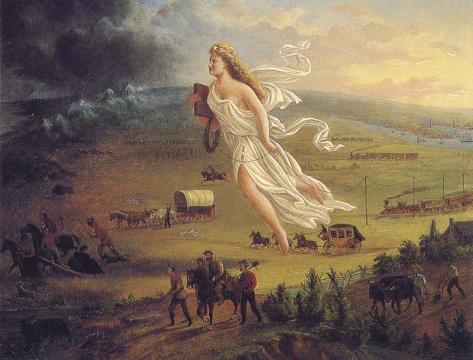
It’s not ‘Manifest Destiny’ any longer

Manifest Destinyby Ned Kowalski

The US is engaged in wars with no end in sight. Unlike the Indians Wars on the North American Continent prior to and after the founding of the American nation, these wars in Iraq and Afghanistan will not be won by “Manifest Destiny”.

Manifest Destiny was the belief widely held by Americans in the 19th century that the United States was destined to expand across the continent. The concept, born out of “a sense of mission to redeem the Old World”, was enabled by “the potentialities of a new earth for building a new heaven”. The phrase itself meant many different things to many different people. The unity of the definitions ended at “expansion, prearranged by Heaven”. Mid‑19th century Democrats would use it to explain the need for expansion past the Louisiana Territory.

Manifest destiny provided the dogma and tone for the largest acquisition of U.S. territory. It was used by Democrats in the 1840s to justify the war with Mexico and it was also used to acquire portions of Oregon from the British Empire. But Manifest Destiny always limped along because of its internal limitations and the issue of slavery, says Merk, and never became a national priority. By 1843 John Quincy Adams, a major supporter, had changed his mind and repudiated Manifest Destiny because it meant the expansion of slavery in Texas.

The legacy is a complex one. The belief in an American mission to promote and defend democracy throughout the world, as expounded by Abraham Lincoln and later by Woodrow Wilson and George W. Bush, continues to have an influence on American political ideology

It is one thing to occupy a continent with settlers who outpopulate the indigenous peoples. These Native Americans were placed on reservations. The March of Tears during Andrew Jackson’s presidency demonstrates the cruelty necessary to defeat and neutralize entire indigenous populations who have vastly different cultures and religions.

Is it possible to kill enough Afghanistanis and Pakistanis, Africans, Muslims, Chinese, Russians, etc., to accomplish what the US wants in the world? To eliminate terrorism is to eliminate the weak, and if you believe the Pentagon, everyone outside the US is “weak” . Could the British invade and kill enough Irish in Northern Ireland to eliminate terrorism? By changing their tactics, The British finally eliminated terrorism in Northern Ireland, only to have it re-instituted in London by jihadists. It just never goes away.

With the possibility that banks may continue to fail and the deterioration of the economic situation in the US, contingency plans need to be made to deal with this domestic economic crisis. Global warming, food shortages and rising populations are here already. To virtually ignore these crises while chasing the golden ring of oil in the Middle East, is foolhardy at best. The economic collapse of the US is a real risk. Americans have fallen into the trap of hubris, by believing the world is an extension of home.

Both Democrats and Republicans are pursuing, and have been pursuing, the far-right’s foreign policy for decades. Especially plans for “regional diplomacy”. And these thoughts on regional diplomacy are alarmingly thin, on closer inspection. It has become like fighting needles by burning haystacks.

To launch a comprehensive regional and international diplomatic initiative, that includes key nations in the region, to help achieve a new political settlement among different peoples, start a civil war, and initiate a humanitarian catastrophe and regional conflict. But it comes at an enourmous cost to American soft power.

Americans need to pressure their candidates to stop talking in vague general terms, and demand that Washington’s long-practiced foreign policies that have real American people on the front lines, become more realistic.

Those being exploited around the globe for their nations’ resources are not winning Americans any friends. Can they all be either killed or put in reserves?

Fear of fracking

Fuel is usually found in unattractive places. Geologists discovered the biggest oil and natural gas reserves in the deserts of the Middle East and beneath the permafrost of Siberia. Countries in temperate Central Europe, on the other hand, have only modest reserves. One of them lies some 5,000 meters (16,000 feet) beneath the surface in Rotenburg/Wümme, an administrative district in the northwestern German state of Lower Saxony.

Using a method known as “fracking,” Germany could exploit domestic sources to meet its natural gas needs for 20 years. But safety worries have prompted government authorities to refrain from granting the permits that companies need to use the controversial technique.

ExxonMobil, which operates a well called “Bötersen Z11” uses “induced hydraulic fracturing,” or “fracking” for short.

ExxonMobil plans to inject about 350,000 liters (92,500 gallons) of water, mixed with a cocktail of chemicals, into the well under high pressure. The liquid is supposed to penetrate into the rock at the bottom of the pipe and trigger a long-term loosening effect. Hair-line fractures will create a network of tiny channels from which natural gas can escape for at least 15 years, according to ExxonMobil estimates.

But what ExxonMobil still lacks is official permission to do this. The state mining agency has been sitting on the company’s application for the last year, hesitant to move forward with its approval.

“Unfortunately, fracking has become a scary word,” says Dieter Sieber, a mining engineer and fracking expert at ExxonMobil. A cart decorated with pamphlets from a local citizens’ initiative is parked at the entrance to the drilling site. The group aims to “protect God’s creation,” and one of its signs proclaims: “Stop Fracking!”

The public reservations and protests are coming at a surprisingly late point. As a method to increase the yields of hydrocarbon deposits, fracking has been in use for almost 50 years. In Germany, it has been instrumental in preventing domestic natural gas production from drying up altogether. Very few Germans are aware that, until the 1980s, almost a quarter of the natural gas being burned in Germany came from domestic sources. Although it’s still about 12 percent today, that number is declining by about 1 percent a year.

The deposits that have already been discovered are almost exhausted. About 300 wells have been fracked in Germany since the 1960s. Without imports, more than three-quarters of which come from Russia, Norway and the Netherlands, Germany would soon find itself without natural gas — if there weren’t another alternative, that is.

In May, Germany’s Federal Institute for Geosciences and Natural Resources (BGR) published a study concluding that there are up to 2.3 trillion cubic meters (81 trillion cubic feet) of technically recoverable natural gas under German soil, primarily in the northern state of Lower Saxony and the western state of North Rhine-Westphalia. This would amount to more than 20 times Germany’s annual consumption of natural gas.

The reserves are in deposits that are described as “unconventional,” consisting of shale and coal formations, which are the primary “source rocks” of hydrocarbons. They were long considered unexploitable because they are substantially denser than “conventional” deposits found in more porous sandstone. The coveted fuel simply doesn’t flow out of shale formations — which is where fracking comes in.

Fracking is now proving to be a key technology for extracting oil and gas from shale formations. In Germany, the natural gas reserves that could be exploited in this manner would have “the potential to make up for declines in production in recent years,” explains geophysicist Dieter Franke, a geophysicist who heads the BGR’s oil and gas geology department. In light of the sheer magnitude of proven reserves, this could be seen as a conservative estimate.

Since the mid-1990s, Americans have been far more aggressive and active when it comes to fracking. Geologists estimate that — after China and, presumably, Russia — the United States has the third-largest shale natural gas reserves on Earth, or about 20 times as much as Germany. The United States is exploiting these reserves on a large scale and even hopes to use fracking to end its dependence on gas imports.

Now the United States is also taking a similar approach with shale oil. Thanks to fracking, the Midwestern state of North Dakota already produces more than half a million barrels of oil from the Bakken shale formation. As a result, this year, the state surpassed Alaska in oil production for the first time. According to a forecast by the Organization of Petroleum Exporting Countries (OPEC), oil-tanker traffic to North America could very well be eliminated by 2035.

In contrast to the United States, which once met its own oil requirements and is now enthusiastic about returning to this status, government agencies in Europe are tentative. France, which is assumed to have the largest unconventional gas reserves in Western Europe, has yet to issue a single fracking permit. German authorities have only permitted isolated test fracking. The last fracking operation in German bedrock was conducted in late July 2011 — also by ExxonMobil — at the “Buchhorst T12” site, a conventional gas deposit in Bundsandstein, a type of colored sandstone that lies below large parts of Western and Central Europe.

Horror stories from the United States, an El Dorado for companies engaged in fracking, have discredited the technology. A documentary film about the practice showed a fireball emerging from a faucet, a result of the presence of methane in drinking water. People are starting to realize that pumping 13 million liters of chemical-laced water into a hole can have unpleasant consequences.

Ex-defense Chief Says Attack On Iran Would Be Disastrous

Robert Gates

Painting a picture of internal political dysfunction in a dangerous world, former Defense Secretary Robert Gates warned Wednesday night that a U.S. or Israeli attack on Iran would have disastrous consequences.

Neither the United States nor Israel is capable of wiping out Iran’s nuclear capability, he said, and “such an attack would make a nuclear-armed Iran inevitable. They would just bury the program deeper and make it more covert.”

Iran could respond by disrupting world oil traffic and launching a wave of terrorism across the region, Gates said.

“The results of an American or Israeli military strike on Iran could, in my view, prove catastrophic, haunting us for generations in that part of the world.”

First in this season’s Norfolk Forum speaker series, Gates spoke to an audience of nearly 2,000 in Chrysler Hall.

United Nations sanctions aimed at discouraging Iran’s nuclear ambitions are starting to have an impact on the Iranian economy, he said, and “that’s our best chance going forward, to ratchet up the economic pressure and diplomatic isolation to the point where the Iranian leadership concludes that it actually hurts Iranian security and, above all, the security of the regime itself, to continue to pursue nuclear weapons.”

And while Israeli anxiety over Iran’s intentions is understandable, he added, America should make it clear to Israel’s leaders that “they do not have a blank check to take action that could do grave harm to American vital interests.”

Meanwhile, Gates warned, the United States is paralyzed by partisan gridlock that threatens the nation with financial insolvency.

The combination of across-the-board spending cuts and tax increases set to take effect in January, put in motion by Congress’ inability to agree on how to reduce the ballooning national debt, would do grave damage to the military and virtually every other essential government operation and could throw the country into a new recession, he said.

The central problem, Gates said, is that both major parties have been captured by their ideological extremes.

“The moderate center, the foundation of our political system, is not holding.

“Too many of our politicians seem more concerned with winning elections and scoring ideological points than saving the country.”

Gates ran the Pentagon from 2006 to 2011 under Presidents George W. Bush and Barack Obama. He was the first defense secretary to serve under presidents of both parties.

He was also the only career CIA officer in history to rise from entry-level employee to director of the agency. He was director from 1991 to 1993.

The Kansas native now holds the honorary post of chancellor at the College of William and Mary. A 1965 graduate of the college, he is the first alumnus in the modern era to become chancellor.

Britain to appeal colonial torture judgement

Colonial times

Britain’s Foreign Office said it would appeal a High Court judgement on Friday that three elderly Kenyans who were tortured under British rule in the 1950s could pursue their claim for damages from London.

“The judgement has potentially significant and far reaching legal implications,” it said in a statement.

“The normal time limit for bringing a civil action is 3 to 6 years. In this case, that period has been extended to over 50 years despite the fact that the key decision makers are dead and unable to give their account of what happened.”

The Foreign Office added that it did not dispute that each of the three claimants in the case suffered torture and other ill treatment at the hands of the colonial administration.

Lawyers for the claimants said Friday’s judgement would be carefully studied by victims of alleged colonial torture from Malaya to the Yemen from Cyprus to Palestine, as well as South Africa.

The claimants, Jane Muthoni Mara, Wambuga Wa Nyingi and Paulo Muoka Nzili celebrated the news in Nairobi, Kenya. They were represented by a white lawyer, Martyn Day.

London’s High Court ruled the case, relating to the 1950s Mau Mau uprising, could proceed despite the time elapsed.

The ruling means the case will now go to a full trial. Lawyers for the three hailed it as a “historic” judgement.

While the government accepts UK forces tortured detainees it denies liability and will appeal against the decision.

After the 2011 ruling, the case went back to the High Court in July to consider a claim by the UK Foreign and Commonwealth Office (FCO) that the actions had been brought outside the legal time limit. The FCO said it faced “irredeemable difficulties” in relation to the availability of witnesses and documents.

As the news filtered through, several dozen elderly Kenyans erupted into cheers. They linked arms and danced through the grounds of the Kenyan Human Rights Commission, which has been supporting the claimants.

For them, and other veterans of the Mau Mau struggle, today’s judgement was a significant victory.

But elsewhere in Kenya the case has received little attention. Only a handful of reporters from the Kenyan media turned up to cover the reaction from the veterans themselves.

There are historical reasons for this. Many of those who found themselves in power following independence in 1963 had previously been associated with the Home Guard: those who fought with the British colonial authorities against the Mau Mau rebels.

When independence came, many believed this chapter in Kenya’s recent history would sow division rather than foster unity. The elderly veterans of that struggle are still fighting for recognition, both at home and abroad.

In his ruling, the judge said: “A fair trial for the Kenyans on this part of the case does remain possible and the evidence on both sides does remain significantly cogent for the court to complete its task satisfactorily.”

A lawyer for the three said the claimants had not been in court because they were in the Kenyan capital Nairobi, but they were “absolutely delighted” when they learned of the result.

Martyn Day said lawyers would be pressing for a trial “as quickly as possible” but they would also be pushing for the government to reach an out-of-court settlement.

“This is a historic judgement which will reverberate around the world and will have repercussions for years to come,” he said in a separate statement.

“The British government has admitted that these three Kenyans were brutally tortured by the British colony and yet they have been hiding behind technical legal defences for three years in order to avoid any legal responsibility. This was always morally repugnant and today the judge has also rejected these arguments.”

He added: “Following this judgement we can but hope that our government will at last do the honourable thing and sit down and resolve these claims. There will undoubtedly be victims of colonial torture from Malaya to the Yemen, from Cyprus to Palestine, who will be reading this judgement with great care.”

Written evidence from the three Kenyans sheds light on their treatment at the hands of colonial forces:

  • Mr Nyingi, 84, a father of 16, said he was arrested in 1952 and detained for about nine years. In one incident in 1959 he said he was beaten unconscious and still bears marks from leg manacles, whipping and caning. “I have brought this case because I want the world to know about the years I have lost and what was taken from a generation of Kenyans, he said
  • Mr Nzili, 85, said he was stripped, chained and castrated shortly after being arrested in 1957. “I felt completely destroyed and without hope,” he said
  • Ms Mara, 73, said she was 15 when she was raped at a detention camp. “I want the British citizens of today to know what their forefathers did to me and to so many others. These crimes cannot go unpunished and forgotten,” she said

A spokesman for the FCO said the judgement had “potentially significant and far-reaching legal implications”.

“The normal time limit for bringing a civil action is three to six years. In this case that period has been extended to over 50 years despite the fact that the key decision-makers are dead and unable to give their account of what happened,” the spokesman said.

“Since this is an important legal issue, we have taken the decision to appeal. In light of the legal proceedings it would not be appropriate for the government to comment any further on the detail of the case.”

The spokesman reiterated that the government did not dispute that each of the claimants suffered torture at the hands of colonial forces.

“We have always said that we understand the pain and grievance felt by those, on all sides, who were involved in the divisive and bloody events of the emergency period in Kenya, and it is right that those who feel they have a case are free to take it to the courts,” he said.

It’s a boy!

Some couples want a baby boy badly. So badly they’re willing to fly halfway around the world to get one. Destination? The United States.

Dr. Jeffrey Steinberg, director of The Fertility Institutes in Los Angeles and New York City, has for several years offered a fertility procedure allowing affluent couples to choose their baby’s gender. Sex selection, outlawed in many countries, is legal in the United States: Steinberg’s clinics have treated “thousands” of couples from India, China, Canada, Australia, the United Kingdom, and 142 other nations.

Steinberg recently told the London Evening Standard that he’s helped around 400 British couples conceive their choice of a boy or girl. They sometimes pay $45,000 or more for one of Steinberg’s package deals that includes treatment, plane tickets, and a hotel. The doctor opened his New York clinic in 2008 to cater to British and European patients, who are perhaps less than an eight-hour flight away. Sex selection is illegal within the United Kingdom, but Steinberg boasted that “leading British politicians” fly to his New York office for that very purpose.

Steinberg admitted his clinics have recently seen a “huge growth” of Chinese clients. Almost all of them—98 percent—ask for a boy. So do most Indian couples. Both countries ban sex selection, but it’s practiced illegally because of cultural preferences for boys.

Several U.S. clinics perform sex selection using preimplantation genetic diagnosis (PGD): Doctors obtain the couple’s sperm and eggs, mix them in a dish, and implant only a few embryos of the desired gender. Steinberg typically performs PGD by fertilizing eight or nine eggs and implanting just one embryo, discarding or freezing the others.

In 2009 Steinberg considered allowing parents to choose their child’s eye and hair color, too (see “Eugenics,” March 28, 2009). He nixed the idea after a pro-life outcry.

Israeli forces kill American gunman

Israeli forces shot dead an American man who opened fire in a seaside hotel packed with tourists on Friday, killing one person.

The Friday incident at the lobby of Leonardo Club Hotel took place after an Israeli armed guard tried to intervene in an intense argument between the American and a hotel employee.

The US tourist then grabbed the guard’s gun and fired several shots, killing the hotel staffer.

The shooter has been described as “in his twenties” and part of an Israeli-American exchange program that is regularly sponsored by various pro-Israeli organizations across the US.

No other deaths or injuries have yet been reported, although some hotel guests and employees were reported to be suffering from psychological distress, requiring hospitalization.

Reports indicate that the shooter barricaded himself in the hotel’s kitchen after killing the employee and was shot dead by the police forces following what has been described as failed negotiations for his surrender.

The man barricaded himself in the hotel kitchen, shooting back at law enforcement officers. He was shot dead by members of a military counter-terrorism squad, a military source said.

An Israeli hotel guest, Aviram Sela, said he tried to wrestle the gunman to the ground before he started shooting, as terrified tourists dived for cover behind a sofa in the hotel lobby.

“We saw him beating the guard and grab his weapon and the magazine,” Sela told Israeli television, adding that the gunman then took aim at a member of his family.

Israeli Defense Minister Ehud Barak told Army Radio the incident “appears to be an internal dispute”.

Eilat, on the border with Egypt and Jordan, has been a target of militant attacks in the past, and has come under rocket fire from Egypt’s Sinai in the past several months. The city is currently crowded with both foreign tourists and Israelis on a seven-day Jewish religious holiday.

Britain likes anarchy, especially in South Africa

by Dan Roodt

Over the past week or two, I have been embroiled in a polemic in Business Day and elsewhere about South African and Afrikaner history. First of all, I challenged the ubiquitous assumption that apartheid visited some form of genocide upon South African blacks. Neither did apartheid “withhold education from blacks” as historian Hermann Giliomee has so amply demonstrated in a few recent articles.

I got some irate replies from Mrs. Louise Asmal, wife of the destructive former minister of education Kader Asmal. Mrs. Asmal is Irish, therefore a foreigner enthralled by the stereotyped views of our history proliferating abroad. Dr. Wilmot James of the Democratic Alliance also responded to my “apartheid revisionism” by regaling us on the apparent injustices suffered by his family under the previous South African government.

However, any injustices from 1948 to 1994 must pale into insignificance next to the injustices, nay, atrocities suffered by Afrikaners since 1994, not to mention much of the nineteenth century and especially the Anglo-Boer. One letter writer to Business Day had the temerity to suggest that 34 000 Boer women in the British concentration camps had died as a result of “cultural factors” such as a lack of hygiene.

If only the Germans had thought of that one: the Jews died at Auschwitz and Dachau “because they were dirty”. Take that, you dirty Jew! There you have it, you vile Afrikaner miscreant!

I have often wondered at the source of British arrogance. When I worked in Johannesburg dealing rooms, we were often visited by high-flying financiers out of the City of London with dirty collars and cuffs. In the Johannesburg heat you also became aware that these people, although living in five-star hotels, did not make the morning shower one of their regular habits.

More often than not they were nothing short of uncouth, lacked any form of culture and were given to getting drunk ever so often. Yet these British yobs in dirty shirts with double cuffs sporting flashy cuff links radiated a sense of know-it-all superiority that was a wonder to behold.

The presenter of Top Gear, Jeremy Clarkson, recently fulminated against his own countrymen, saying about Britain: “We are the country that invented the concentration camp.” Notwithstanding Tony Blair’s lies about Iraq’s weapons of mass destruction, the British sense of moral superiority has never been stirred, let alone shaken.

Talking of James Bond, that great hero of fiction and film, it reminds me of something else: Britons are, like African warlords, “licensed to kill”. That is why it is almost futile to mention any past or present British war crimes and human-rights violations. It will only elicit boredom or the impression that one has broken some rule of etiquette merely by mentioning it.

Currently I am reading a book by one Willem Steenkamp, who is apparently the former military correspondent of the Cape Times. Entitled, Assegais, drums and dragoons: a military and social history of the Cape, it is irritating in parts, because one senses that the author is trying to offer a politically correct re-reading of early Cape history. For example, he spends a whole chapter arguing that the seventeenth and eighteenth centuries were marvels of racial integration and intermarriage so that we are all in fact “Coloureds”. If so, then it must be a genetic miracle that Afrikaners from the oldest families still manage to produce offspring that appear even more European in features and in skin colour than the children of many European nations. Every time I drive past an Afrikaans high school, I am simply amazed at the incongruous sight of all these beautiful, gamboling white children in the African sun. On my mother’s side I have a lot of Botha blood, Botha being one of the oldest and most common Afrikaner surnames, going back to the early Cape. Yet a Dutch TV team, with an American geneticist in tow, replete with Harvard Ph.D., gave me a DNA test. To their utter disappointment, I was found to be of 100% European ancestry, or if you prefer, white, that dreaded concept.

However, if one disregards Steenkamp’s attempts at political correctness, the book contains some interesting material on the building of the Castle at the Cape of Good Hope in the seventeenth century. He quotes an author, Mentzel, who described life at the Castle thus:

“…for a man who loves method it is a veritable joy to observe the excellent order maintained in the Castle. The whole work of the day is mapped out by the clock and is performed with the utmost punctuality.”

To some extent, those two sentences describe much of the Afrikaner ideal for South Africa, one we had lived up to for most of the time when he had any say in government. On a recent visit to the Pretoria archives, I was astonished to see the meticulous way in which the early pioneers had immediately set about recording the meting out of the first farms in the Transvaal in the 1840s. I twice saw another of South Africa’s surfeit of Bothas, PW, at his home in the Wilderness near George, and on both occasions he repeated the words to me:  “I believe in orderly government.”

The Castle at the Cape of Good Hope is something of a symbol of that order which we have vainly tried to maintain in South Africa, and not only because the Castle was used as an emblem for the old South African Defence Force, prior to the ANC’s takeover.

Whence the need for such a fortress in the seventeenth century? From the very moment that Jan van Riebeeck and his fellow pioneers set foot in the Cape on 6 April 1652, they had to protect themselves from two constant enemies: the cantankerous, often violent Khoikhoi or “Koina” as Steenkamp calls them,  as well as, of course, belligerent Britain or England as it was known then.

During the seventeenth and eighteenth centuries, England was nothing less than a pirate nation, attacking merchant ships from other nations at will, much like Somalian pirates do today in the Indian ocean off the horn of Africa. Again and again the Netherlands had to fend off the English pirates and troublemakers, until the courageous Dutch Admiral Michiel de Ruyter sailed up the Thames and all but destroyed the English fleet. That gave us a few decades of respite.

Unfortunately, the treacherous British who changed alliances as it suited them, eventually got the upper hand and since then our misery here in South Africa has not ceased. Instead of “privateers” holding a commission from Queen Elizabeth I or some other monarch, a licence to rob and kill like James Bond, we are now faced with a motley collection of NGOs, churches, propagandists and rapacious mining magnates who would gladly see South Africa reduced to rubble if only they could make a quick buck in the process.

In the City of London the current anarchy and mining strikes must be a boon to traders who would be long gold and platinum, but short the rand and South African government bonds. They also propagate “land reform” in the hope of destroying our agriculture so that we would ultimately be completely at the mercy of British NGOs like Oxfam or Save the Children. Except, it is not our children that they will be saving.

In this way, there is a strange synergy between the British privateer, his profit motive that does not balk at bribery of the odious ANC officials, and the strange breed of histrionic, publicity-seeking “do-gooder” that also abounds in the British Isles. The latter have wrought almost more evil than the looting privateer or “businessman”. One such individual was Father Trevor Huddleston of the Anglican Church. Without Huddleston and his various public and private stratagems, the ANC terrorist regime would never have come to power in South Africa and we would have been spared the current descent into anarchy.

From my reading of the facts since Huddleston’s fateful arrival in South Africa in 1945, the ANC would long have fallen by the wayside as just another failed, penniless black organisation with megalomaniac dreams. Huddleston more or less “created” – trained, indoctrinated and groomed – subsequently world-famous black heroes such as Nelson Mandela and Desmond Tutu.

The culture of licence, criminality, violence, prostitution and gangsterish “glamour” that characterised Huddleston’s Sophiatown, would eventually overwhelm the entire country. Of course, Sophiatown has been lionised by English authors such as Nadine Gordimer and Anthony Sampson, the first editor of the black Drum magazine. Gordimer even wrote a roman à clef, A world of strangers, with an ill-disguised Anthony Sampson as the main character, boozing in shebeens and chasing after township whores.

After 1948, Britain or at least Labourite Britain, launched a total propaganda onslaught against South Africa, aided and abetted by much of the local English media who have never shaken off their colonial, jingoist origins during nineteenth-century British rule. They have maintained their fawning, sycophantic dependence upon English so-called “liberal” ideas, together with their often irrational and pathetic sense of “being superior” to Afrikaners.

Recently , the ideal of Sophiatown during the 1940s and 1950s, that “multiracial” demi-monde, has triumphed over that of the Castle. Thanks to the English menace, we have come full circle since 1652. The “excellent order” that we have created by being disciplined and law-abiding, together with the prosperity resulting from that order, have been swept away.

Those periods of South African history when Britain and its callous officials dominated us, notwithstanding its hysterical clergy, inciting blacks or Khoikhoi against the indigenous white population, have always been characterised by the kind of lawlessness and mayhem that we are currently experiencing.

But we must also blame ourselves, in having allowed – despite the historical evidence – this catastrophe. Our forefathers could withstand Britain, for decades and even centuries. They fortified themselves against all those English ships out there and formed commandos of citizens to defend themselves and to maintain order. In fact, the commando system that the ANC abolished had been more than three centuries old!

Why have we been found wanting?

Turkish parliament votes for cross-border military operations in Syria

Turkey’s parliament has authorized cross-border military operations into Syria. The move follows a cross-border mortar-shelling into Turkey which Damascus has apologized for.

The Turkish parliament voted 320-129 in favor of the bill, though the government was quick to eliminate the perception they country preparing for a unilateral military assault.

Turkish Prime Minister Recep Tayyip Erdogan said Turkey “does not want to “start a war”  with Syria while speaking at a press conference on Thursday evening .

“All we want in this region is peace and security. We have no intention of starting war. We are aware of the outcome, consequences, of war in Iraq and Afghanistan…we see the same in Syria,” Al Jazeera cites him as saying. But Errdogan warned the country was capable of defending itself against threats after he claimed that new shells coming from Syria had landed on Turkish soil on Thursday.

“An accident can be called ‘an accident’ once, twice, three times, but four, five six times,” Errdogan continued.

His statements regarding the bills follow those made by Deputy Prime Minister Besir Atalay following the vote on Thursday.

“The bill is not for war… It has deterrent qualities,” he said.

Atlay stressed that Turkey’s priority was to act in conjunction with “international institutions” on Syria. He further said the Syrian government “has admitted what it did and apologized. The deputy premier added that Syria had given its assurances “such an incident would not be repeated.”

Following an exchange of fire at the Syrian-Turkish border, the US and NATO have condemned Syria and pledged to support Turkey. The White House has called for more pressure to be exerted on Damascus.

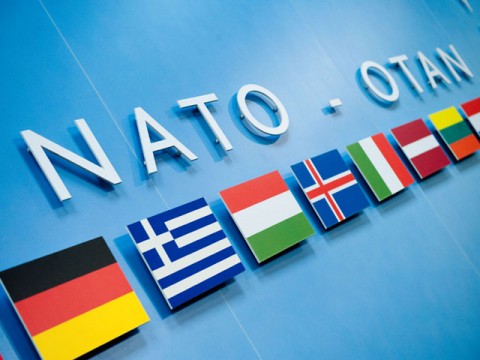
NATO’s North Atlantic Council has convened tonight for an urgent meeting upon the request of Turkey, to discuss the shelling of the town of Akcakale.

“The most recent shelling on 3 October 2012, which caused the death of five Turkish citizens and injured many, constitutes a cause of greatest concern for, and is strongly condemned by, all Allies,” NATO said in a statement.

“In the spirit of indivisibility of security and solidarity deriving from the Washington Treaty, the Alliance continues to stand by Turkey and demands the immediate cessation of such aggressive acts against an Ally, and urges the Syrian regime to put an end to flagrant violations of international law.”

According to officials the meeting has been held under article 4 of NATO’s code, concerning consultations when a member state feels territorial integrity is under threat.

Syria’s UN envoy said on Thursday that “Syrian authorities confirmed that they are seriously investigating the source of the [attack] that lead to the death of Turkish citizens.”

Ambassador Bashar Ja’afari read out a letter which had been delivered to the UN Security Council expressing Syria’s “deepest condolences” to the families of the victims which killed five civilians in southeast Turkey.

He called for both sides to act “wisely” and “rationally”, saying that “undisciplined, armed terrorists” operating on the countries’ shared border posed a threat not only to Syria, but the greater region. He further claimed the long Turkish-Syrian border had been used as a conduit for terrorists to smuggle arms into Syria.

Ja’afari insinuated the Turkish response to the incident had been disproportionate, however, saying that Turkey had shelled southern Syria for nearly 12 hours straight following Wednesday’s attack.

A document posted online by an al-Qaeda affiliated group called the al-Nusra Front claimed responsibilty for the multiple bombings.

US Secretary of State Hillary Clinton in contrast was quick to condemn Syria for Wedensday’s mortar attack in Turkey. “We are outraged that the Syrians have been shooting across the border. We are very regretful about the loss of life that has occurred on the Turkish side. We are working with our Turkish friends.”

­After the Turkish parliament approved military operations against Syria, thousands of anti-war protesters took to the streets of the biggest Turkish city, Istanbul. About 5,000 people joined an anti-war rally that finally turned into an anti-government demonstration against Turkey’s ruling Justice and Development Party, headed by Prime Minister Recep Tayyip Erdogan.

Anti-war protests near the parliament in the capital, Ankara, turned violent, with protesters clashing with police who tried to prevent demonstrators from moving around the capital.

­After a heated debate an urgent parliamentary session has opted to apply the new law.

Originally the bill targeted militants of the Kurdistan Workers Party (PKK) fighting for independent Kurd state for the last three decades. The Kurds have bases in northern Iraq, de-facto not controlled by the government in Baghdad. The Turkish military has conducted a number of air and ground assaults on Kurdish positions in Iraq, most of them considered successful.