South African whites, by definition, cannot be ‘racist’

This is a very amusing story that was published recently in South Africa. A local black comedian who calls himself  TolA$$Mo (Mongezi Ngcobondwane) claimed that an Afro-American called him a “kaffir” and there is a court case on which you could read about here.

The usually anti-white columunist on the Daily Maverick, Sisonke Msimang, writes:

The wrinkle in the story is that the man Ngcobondwane allegedly shot his weapon at, and whom he claims called him kaffir – is black. And while it is theoretically plausible in an abstract sense, that a black person (even one from America where the South African term kaffir is not in use) might call another black person by a racial epithet, the reality is that the particular person in question seems unlikely to have done that. I happen to know French (although he is a relatively new acquaintance) so I may be biased – but I would be surprised if someone who was raised by civil rights activists would use a word like kaffir against another Black person.”

Ngcobondwane then goes on to suggest, “If one more white man calls me a kaffir, I’m going to moer him.”

This is a sentiment with which many black people in South Africa can identify. There is nothing quite like being called a kaffir. It takes the air out of your lungs, hits you in the solar plexus; stings your eyes and dries your mouth. You are at once ashamed and enraged – understanding that the word should have no power and yet feeling its force and weight in your pelvis and your knees and in the soles of your feet. Kaffir has the density of centuries; it is the color of blood and tastes like metal.

roodt_fbfotoThe argument elsewhere in the same column seems to be that the “race card” should not be played among blacks or “brothers” in American parlance. The race card should be reserved for whites only, i.e. you should only call whites racist, not your fellow blacks or “people of colour”. Although somewhere in this story lurks the somewhat politically incorrect fact that the American, James Albert French, might have been light-skinned, a kind of inverse reaction to the normal one whereby South African blacks kill their darker skinned “brothers” from other African countries, also calling them makwerekwere or “Kiwi’s” after the shoe-polish brand.

The other problem for cultural-Marxist race theory in SA is that whites and especially Afrikaners, are politically powerless and may therefore by definition not be racist, even if they use the word “kaffir”. Race being a social construct, or so the theory goes, “racism” is but the expression of power relations between a majority with political power and a minority without it. As we do not even rule a single municipality in South Africa and are both culturally and politically dominated by Afro-Saxon blacks, we cannot be racist, unlike Mr. French here who hails from the American Empire.

“Kaffir” is also an Arab word, originally, so one should think that it should be acceptable, not being of European or “eurocentric” origin. It means “heathen” and given the many belief systems proliferating today, including anti-racism which has all the hallmarks of a religion, like blasphemy, excommunication, etc., we are perhaps all “kaffirs” to someone somewhere. Or as the Koos Kombuis song goes in Afrikaans: “Ons is almal kaffers in ons harte.” Or maybe Koos Kombuis should be banned? Placed on the index, censored? Read my latest essay, Raiders of the lost Empire, if only because I also quote Karl Marx in there somewhere: “Hegel remarks somewhere that all great world-historic facts and personages appear, so to speak, twice. He forgot to add: the first time as tragedy, the second time as farce.”

‘Afrikaans books, movies, folk music – they’re abysmal’ NOT!

It is quite amusing, but up to now there has not been much of a reaction to my recently published essay, Raiders of the lost Empire, now going into its third week. So far, the most extensive response has been from the USA where that thoughtful Hegel and Kojève enthusiast, Roger Devlin, wrote a review on American Renaissance. I get the impression that much of cultural-Marxist Johannesburg and Cape Town is just trying to ignore some of the points raised in my essay, as they do not want their own ethnic presuppositions challenged.

roodt_fbfotoGiven the many issues dividing white South Africans, not least Afrikaners themselves, I was a bit loath to stir up more internecine squabbling by focussing on South Africa’s new (and old) “English” identity. Yet I felt this issue had to be raised, if we are to understand the current identity problems afflicting South Africa and that are leading to so much violence, sadism and social decay.

Not surprisingly, someone calling himself AnalogMan responded on the American Renaissance commentary section by expressing his “disappointment” as “an English-speaking South African (with an Afrikaner mother)”. He also went on to say that “Afrikaans books, movies, folk music – they’re abysmal”.

Well, there you have it, despite his Afrikaner mother, he feels that the totality of Afrikaans cultural production is “abysmal”! But probably cultural-Marxist Johannesburg and Cape Town would agree with him, without ever having read a word or listened to a note of what they so peremptorily denounce.

Perhaps I should quote his full comment, before posting my reply, to put the reader fully in the picture.

As one of those English-speaking South Africans (with an Afrikaner mother), I’m a little disappointed in Dr Roodt. He’s welcome to his opinions, and I understand the bitterness of Afrikaners toward the British Empire, but he goes overboard with his hyperbole.

Yes, South Africa supported Britain and America through several wars, and was shamefully betrayed, but those were largely English-speaking volunteers, not Afrikaners. Back home, many Afrikaners supported Germany. They had an organization called the Ossewa Brandwag (Ox-wagon Vanguard). Turned out they were right after all, but they can’t simultaneously claim to have been deceived.

Yes, it’s true that Britain supported terrorism (the Church of England boasted that it gave more money to the ANC than anybody else), but so did the Netherlands, France and Germany, ancestral homelands of the Afrikaners. I am no more responsible for British sins than Afrikaners are for the sins of those countries.

The poofter Barry Ronge is no more representative of English South Africans than Andre Brink is of Afrikaners.

It’s not “post-revolutionary, anglicised South Africa” that is to blame for the abominable standard of education, or even for the silly new flag, described by the other poofter Afrikaner comedian Pieter-Dirk Uys as “a beach towel with a Y-front” (as these poor people are wont to do; geddit? Y-front – that’s underpants – snicker). It’s post-revolutionary negrified South Africa.

“.. the booming South African economy allowed their children to fully participate in the decadent Anglo-American hippie culture of the 1960s and 1970s” … well, not quite. I was there. Afrikaners were firmly in control of the government. Censorship was strict. South Africa never even got television until 1976. It was only on my wedding night that I discovered that women did not have stars on their chests. OK, bit of an exaggeration, there. But the government was afraid that TV would destroy the Afrikaans language, since most programming would be imported from America (by that time Britain was boycotting us and we couldn’t get their TV programs anyway). A lot of it was dubbed into Afrikaans, but SA could not produce enough material locally to compete. Decadent hippie culture? Must have missed it, somehow.

Look, when I was a kid, there was a lot of rivalry between the English- and Afrikaans-speakers. They called us rooinek (redneck) or soutpiel (salt- er… member) and we called them rock-spider or hairy-back. We grew out of it. It’s sad that Dr Roodt is still hanging on to the old attitudes.

To say that no one in South Africa speaks or writes English very well is just silly. A billion dollars on an election – come off it. Afrikaans books, movies, folk music – they’re abysmal. Google “youtube boeremusiek” or watch this video (with a Confederate connection) if you’re interested and have the stomach for it. We’re not just envious.

Question Diversity is at least somewhat correct when he compares Afrikaners to Southrons. They are despised for being unsophisticated, some of them are real jerks, but they have a natural courtesy that I admire (when they want to). I have many times stood in a group of Afrikaners, where I was the only English-speaker present, and they all spoke English, even among themselves, even though they struggled, out of consideration for me. It’s quite embarrassing.

But they sound… quite different. Here’s a sample. Obviously, it’s a caricature, but you get the picture.

Perhaps AnalogMan should read my whole essay and not just this review, however good it is in giving an overview. Ultimately, it is about more than just petty chauvinistic feelings and name-calling. Twice I was asked to leave shops in Cape Town because I spoke Afrikaans to my children, but I do not hold that against all English-speaking South Africans. In the 1950’s still there were signs in Durban: “Flat (apartment) to let: Indians and Dutchmen need not apply.”

Today, of course, Durban is black and such niceties belong to a bygone age. All South African whites have to some extent been brainwashed, but the zeal for multiculturalism is strongest among English-speakers by far. During the fateful 1992 referendum by which FW de Klerk tricked the electorate into voting for the coming ANC takeover by calling it “the pursuit of negotiations”, 85% of English-speakers voted “yes” while the Afrikaner vote was split 50-50. But just the other day I noticed something on Twitter which I might share with you.

In my essay I quote the PhD thesis by Sarah Britten who is apparently also an advertising executive in Johannesburg, in which she examined the role of SABMiller in “shaping the new multicultural South African (English) identity”. Britten and I had some exchange of views last year on our respective websites so I sometimes look at her usually politically correct opinions on Twitter. The other day I noticed two things: She had changed her profile pic, showing herself in an Indian sari with a red dot on her forehead. At first I thought she had been to some fancy-dress party dressed as a married Indian woman. Having spent a year down in Durban, I more or less know that a dot on the forehead denotes married status. She also tweets quite a bit about her recent marriage to a “hot guy” ten years her senior. (She is about 40; all of this is public information on her Twitter.)

I suppose I am a bit slow to understand these things, but the ultimate revelation came in two of her latest tweets. On Saturday 6 September, the day Verwoerd was assassinated in 1966, she tweeted:

What could those things have been, I wondered? And then further down, also on 6 September, I read:

So there we have it. That explains why she now wears a sari and a red dot on her forehead. This is another example supporting my argument: that the identity crisis of the pseudo-British elite in South Africa has caused most of our problems. The very same people who would not let their apartments to Afrikaners whom they considered to be on the same level as Indians, are now marrying the Indians!

I could write another book about the Verwoerd obsession of English South Africa. Verwoerd went to English schools in Rhodesia where he was the best student in his final year and won a Rhodes scholarship to go to Oxford, which he declined. Apart from his aversion to the British royal family (in his newspaper he ignored the visit of the then Princess Elizabeth to Johannesburg and drily referred to “traffic congestion caused by foreign visitors” on page two), he demonstrated only goodwill to English-speakers and was something of a white nationalist, avant la lettre. He famously said to the British Foreign Secretary, Harold McMillan, “that there should not only be justice for the black man in Africa, but also for the white man”. Yet, no other public figure has so consistently been vilified as Verwoerd, to this day, by English academics, journalists, politicians, authors, the clergy, etc. Almost every day there is some negative reference to Verwoerd in our media. The worst insult is comparing anyone to Verwoerd!

Note also how Sarah Britten puts it: “Verwoerd died on this day in 1966.” As if he died of natural causes. I suppose you could say that JF Kennedy also “just died”. She omits any reference to the fact that Verwoerd was stabbed to death by a white-looking Greek mulatto and former member of the Communist Party, Tsafendas, right inside parliament where he was on the verge of giving a speech!

If you think that “Afrikaans books, movies, folk music – they’re abysmal”, you are just acting out the stereotype we have of the aloof Englishman who prefers to ignore Afrikaans. Actually, let me tell you a Russian joke. Despite our very different histories, there is currently a growing affinity between Russians and Afrikaners as we have in common our language nationalism and being hated by the British. The Russian joke goes like this:

An Englishman was shipwrecked and stranded on a desert island. Months later a ship arrived to rescue him, but his rescuers noticed three primitive structures built on the island, spread widely apart. One he lived in, but what were the other two for? his rescuers wondered.

“The second one is my club,” the Englishman replied.

“But what about the other one, what is that?”

“That is another club and I am ignoring it,” he said.

Maybe this not funny, but Russians whose culture dictates that they never smile at strangers because it would show insincerity, can be seen shaking with mirth when they recount this joke and I think it contains a kernel of truth.

For most of our history, Afrikaners have been that “other club” in South Africa, the one to be ignored, except where we could be called racists, fascists, and so on. Verwoerd was a highly cultured man who once dipped into the state budget when opera singer Mimi Coertse came to him, begging for money for some production. He also saw Stravinsky once who was at that time considered an avant garde composer. Mimi Coertse was studying in Vienna as a 20-year old when the lead soprano of the Viennese State Opera suddenly fell ill. Mimi was her understudy and then got the role of the Queen of the Night in Mozart’s Magic Flute thrust upon her. For twenty years afterwards, Mimi was something of a goddess in one of Europe’s former aristocratic capitals, singing one role after the other. She sang most of our Afrikaans folk songs too, turning them into the equivalent of German lieder. You may listen to her singing “Heimwee” (longing) on YouTube here:

Afrikaans music represents 20 percent of the market in South Africa, competing against black music and imported American music. Steve Hofmeyr, who has now been banned from singing Die Stem in certain places, has sold 2 million CD’s. Our politicians may have betrayed us, but we still have singers who can get 50 000 people together to sing our national anthem with tears in their eyes. And, as ever, the liberal journalists are vilifying and attacking our beloved Steve who joked the other day that the only riot he had ever caused at a concert was at the autograph stand, yet he is being banned for “public safety reasons” from certain towns and also because he “promotes racism”. Singing your own national anthem that speaks of South Africa’s cliffs and skies, “promotes racism”, apparently.

On my book shelf I have an Encyclopaedia of South African music in four volumes (ed. Jacques P. Malan), written by Afrikaner academics and at one time every small town had its own circle of musicians. Afrikaans music today is so varied, going from modern classical symphonies to folk, country, Boeremusiek, pop, rock, heavy metal and even rap that it does not fit into any single category. On Saturday night my daughter went to listen to Jack Parow, an Afrikaner rapper, with the difference that his “raps” are quite poetic and in pure Afrikaans, unlike American rap with its ghetto slang and glorification of the hood culture.

Regarding literature, it is of course ironic that South African English authors should have received the Nobel Prize twice, once for Nadine Gordimer whose parents were Jews from Latvia and once for J.M. Coetzee, an anglicised Afrikaner. Yet despite the vast state subsidies and cushy jobs for leftist English authors, Afrikaans literature still dwarfs English writing in this country. A single Afrikaner author, Karel Schoeman, has written more books and of greater quality than Gordimer and Coetzee combined. But his themes are not overtly political and he shuns publicity, at one time living in a small Free State town called Trompsburg with a sign on the door stating, “Interviews by appointment only.” Some of his books have been translated into English and into French, but he will never be fêted as an anti-apartheid or “anti-racist” author, so I daresay the Swedish Academy is not going to give him the Nobel prize anytime soon. All over South Africa, there are clubs of readers we call leeskringe (literally reading circles) where usually middle-aged ladies read and discuss serious Afrikaans books.

Afrikaans literature is not recognised because it is ignored and we have had to contend with cultural boycotts, exclusion, affirmative action, derision, etc. Even now there is something of a cultural boycott against us by most of the EU embassies in Pretoria. The US and UK governments would rather die than welcome even one Afrikaner classical pianist into their countries by sponsoring a plane ticket, for example, let alone a cultural exchange with people writing in the so-called “language of apartheid”, Afrikaans. Blacks writing in English in South Africa are showered with prizes, money and international acclaim, whereas most of the time, we do not exist, except for a few politically correct authors like André Brink who have been translated or write bilingually and are thought to be the sum total of Afrikaans writing. I have stopped reading Brink because I cannot stand his anti-white diatribes anymore. His last novel, Philida, was a South African equivalent of the movie Twelve years a slave. Sickening.

But then Brink has spent most of his life as a tenured radical at South African English universities, such as Rhodes and Cape Town. So he understands by now what is expected of him in the international literary stakes: trashing whitey.

Of English moral hysteria and student pranks

South Africa is apparently experiencing another tedious outburst of moral outrage about an innocuous case of “blackface” put on by two women students at the University of Pretoria for a 21st-birthday party.

I try to keep the mass media at a safe distance and therefore do not listen to radio, watch TV or buy any newspapers. The internet is a more clinical way of accessing information without background shrieks, unless it is YouTube.  Yet, judging from responses on Twitter, there is some hullabaloo going on and the two students have now been “charged” by the university and will be subjected to a disciplinary hearing. They could face expulsion or some other form of punishment.

roodt_fbfotoSouth Africa has slid so far down into an abyss of sadism, crime, murder and rape that it seems entirely risible that anyone should care about how white students make up their faces at a fancy-dress party. Yet, as one of the zealous anti-racists in Johannesburg, Gillian Schutte, once intoned in desperation: “Where is the outrage?”

Indeed. We need outrage to distract us from our abject failure as a society and even the increasing signs of a failed state in what used to be called the “Republic of South Africa”. Hardened and jaded by armed robberies, shootings in broad daylight, car hijackings, murder and torture of farmers, endemic corruption and the highest incidence of rape on the planet, the average South African – black or white – could hardly care about the latest student prank in Pretoria.

Yet the media and academic elite, in their slavish imitation of American political correctness, have to have their outrage and moral hysteria. There is something particularly British about moral hysteria which I suppose one could trace back to the time of Cromwell’s puritanical rule and which Fleet Street still has on tap whenever the United Kingdom has to rally public opinion behind another BP or Shell oil war somewhere.

It is certainly ironic that these days British moral hysteria is often projected towards Russia where once the rigours of communist zeal held sway. I was surprised to learn that anti-Semitism in the USSR carried the death penalty. As I do not know any Russian, I could not tell you which words merited a bullet in the head. Were it not for the fact that the death penalty had been abolished in 1994, one could well imagine how “racism” or politically incorrect utterances might soon become a capital offence in South Africa.

Thus South Africa gets its propensity for anti-racist outbursts from both Britain and the ex-USSR where many of the post-1994 leadership spent their formative years. Also, the Marxist-Leninism of the USSR has migrated to the USA in the form of so-called “cultural Marxism” which is the staple at most American universities, slavishly imitated by our local campuses. As Paul Craig Roberts put it recently in one of his sharply-worded commentaries on US-UK war-mongering:

If we are honest and have the strength to face reality, we will realize that the Soviet Union did not collapse. It simply moved, along with Mao and Pol Pot, to Washington and London.

In 1934 or so, shortly before the University of Pretoria completely abolished tuition in English in favour of Afrikaans, a Union Jack was burnt in front of the Old Arts Building by a young poet, WJP Erlank, who wrote under the pen name Eitemal. The English press was outraged, leading to his expulsion as a student but he instantly became an Afrikaner hero.

How the tables have been turned! It is certainly indicative of Afrikaner powerlessness that an English-speaking student, Thorne Godinho of the liberal DA’s youth movement DASO on the campus, was able to engineer the current outburst by publishing the photograph of the two Afrikaans girls dressed up as black servants on Facebook and get the university to punish them. If you want to know the meaning of “kowtow”, just watch today’s Afrikaans university administrators in action.

In more senses than one, Afrikaners find themselves completely at the mercy of latter-day zealots who are endlessly beating their quasi-religious precepts about race and racism into them. The slightest semantic or symbolic deviation is immediately punished and the guilty ones pilloried or subjected to a witch-hunt that will ruin their careers or “shame” them for years to come. It was the case during the so-called “Reitz 4” incident, as well as earlier this year during the photographing of a women’s residence initiation ceremony in Potchefstroom where for one split second and from a certain angle it could resemble a Nazi salute. Now the University of Pretoria is experiencing the same spate of orchestrated “outrage”.

Mr. Ponty Thuynsma, 76, in hospital. Photo: Lisa Hnatowicz, Beeld
Mr Ponty Thuynsma, 76, in hospital. Photo: Lisa Hnatowicz, Beeld

Over the past few days an elderly Afrikaner, Koos Jonker, was literally beaten to death by blacks near Ellisras. In a separate incident, Mr. Ponty Thuynsma was tortured with a hot iron and made to drink petrol in his home east of Pretoria. Thuynsma had to be admitted to the intensive care unit of the Wilgers hospital (see picture). However, these murderous, sadistic incidents pale into insignificance next to purely linguistic or symbolic transgressions of the dominant anti-racist theology committed by Afrikaans students.

In the USA, African Americans have been endowed with a special “minority” status akin to a sacerdotal class with special privileges protecting them against public criticism. As a special caste they also need to be treated with above-average respect. All of this dogma has been imported wholesale into South Africa, where blacks form a majority. Declaring the majority, who already has a monopoly on political power, in need of special protection and beyond criticism or occasional mocking quickly leads to a Soviet-style totalitarian society.

There is increasing censorship and after this latest “blackface” incident, some people think that the movies of comedian Leon Schuster should be banned as he often dons blackface and imitates black slang and speech patterns.

It is also beyond my comprehension how the South African “nation” as it has been defined, can be so criminal and morally depraved, yet at the same time given to an acute sensitivity or what we call in Afrikaans kleinserigheid, touchiness. Logically, the same rapist or murderer who finds torture acceptable conduct, would object to a white girl in “blackface” or someone using a term that is ethnically off-colour.

Of course, in the media and the universities there is an entire language and thought police force waiting to denounce anyone who deviates from their increasingly puritanical norms. By force of “outrage” and moral hysteria, they impose their contradictory values on us. Everyone who does not agree with them is vilified as a “Nazi”, “fascist”, “racist”, “white supremacist”, “sexist”, “homophobe” or other label within their impoverished catechism.

I almost wrote “secular catechism”. But there is nothing secular about it and its acolytes certainly do not subscribe to the values of the European Enlightenment. Tolerance and freedom of speech are not part of their belief system. It is a real religion with a fairly simple dogma and enough zealots to patrol the boundaries of our words and our actions. They do not countenance any form of heresy and at best will allow “sinners” to repent and submit to a programme of re-education.

Or “discipline”, that Leninist word for those deviating from the party line.

However, the strategic thrust of the current campaign around the Afrikaans universities is to oust the last remaining Afrikaners from those institutions so that they may be entirely controlled by English cultural Marxists. In its wisdom, the ANC government has decided that “South Africa needs more PhDs” and is throwing money at the problem. So apart from serving the “Red Church” as Albert Camus called it, one may also eject some hapless Afrikaner academic from his post amid rising incomes in the tertiary-education sector. Hence the witch-hunts against dissident students and lecturers at all the Afrikaans universities.

In the nineteenth century, anglicisation in South Africa was justified by British imperialism; now it is based on race and political correctness. Signs of “racism”, as defined, detract from the language and cultural rights of Afrikaners and even their access to tertiary education.

Until the final victory of Sovietised English over Afrikaans is trumpeted in South Africa, the semantic war is bound to intensify. We might as well all put on “war paint”; if that can still be said without causing offence to native Americans.

Rooinek angst, a reply to Shaun de Waal

In response to Shaun de Waal’s review of Afrikaans popular movie Platteland in the Mail & Guardian, Paint your oxwagon a few years ago, I offered a response which seems all the more relevant, given the current and growing animosity of English liberal whites against Afrikaans and Afrikaners in South Africa.

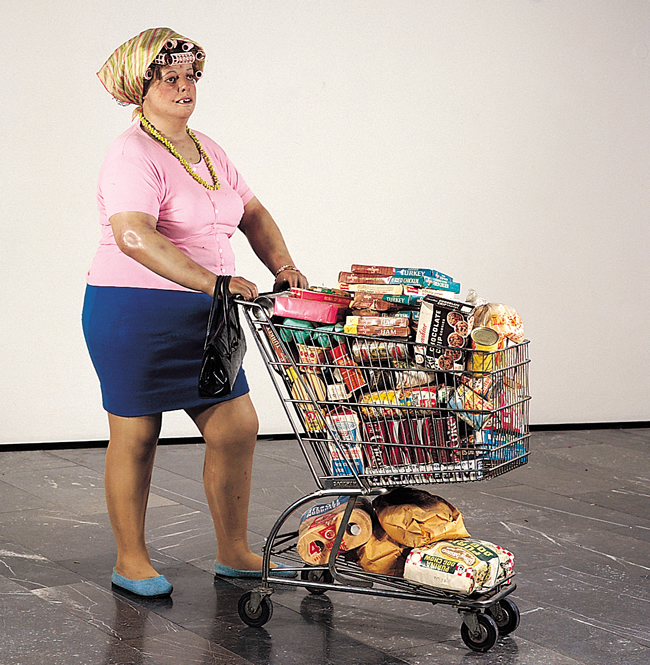
Duane Hanson sculpture

Every time I notice the local sout bevolking crawling out of their cramped Italian pseudo-villas in their ill-fitting T-shirts and jeans I get vaguely curious, thinking: Who are these people anyway? Missus, thrice divorced, still believes that she’s really sexy in tight jeans at 55 and balding Mister sports a manly tattoo on his forearm, a kind of psychological prop for the physique that is falling apart due to too much beer, TV and cigarettes. Living Duane Hanson sculptures pushing the shopping trolleys of their “global culture” along the existential void of their lives.

Then along comes Shaun de Waal and demonstrates to us that “something has survived” from the Jurassic Park of Empire and that deep inside the suburban would-be American or Australian’s mind lurks some sort of identity, a negative identity. Like, we still hate dem dumb Dutchmen. Congratulations! You actually made it to 2011, without being killed by some roving liberated black man with a stolen SADF assault rifle.

Immediate question, however: Why does Shaun de Waal not change his surname? After all, it hardly carries any chic with the rest of the Anglo crowd desperately trying to cling onto a British accent. Uncomfortable genealogical questions might surface around après-ski or après-British-soccer-on-TV drinks, one imagines. Why not Shaun Smith or even Shaun Mountbatten? Apparently name changes are dirt cheap to do through Home Affairs and if you pay a bribe it could be delivered shockingly pronto.

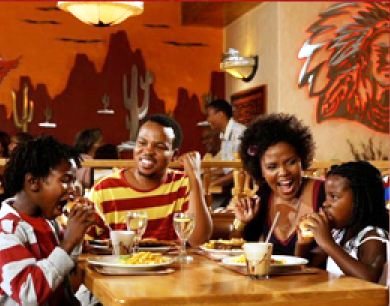
The aesthetics of the Spur. English multicultural food.

Unfortunately, brain transplants or improving your genes – that’s something different to jeans, look it up if you missed school biology in the old SA – do not come that easily or cheaply. Coping with your congenital physical and mental inferiority and going through convulsive episodes of megalomania brought on by examples of Afrikaner popular culture no doubt make for a sorry existence. And then, rooinek ethnic angst is sooo boring and predictable. I sometimes wonder how these low-life jingoes survive at all in South Africa. After all, how can one eat vegetables knowing that they emanate from some odious Boereplaas? Or perhaps at the Spur, which Shaunie will appreciate as a temple of his universal culture, enjoying the semiological intricacies of the Indian or “native-American” motifs on the wall or on the menu, he will ask for imported Argentinian or Brazilian steak, lest he inadvertently contributes to the Afrikaner economy.

On the other hand, the culinary tastes of the species do not extend much beyond junk food or TV dinners from Woolworths, so the Spur would count as something of a gourmet experience. Quoting JM Coetzee is not exactly kosher either… Didn’t he include some Afrikaans dialogue in In the heart of the country? But at least he is an Aussie now and may be certified biltong or melktert-free. Not that I have anything against Australia, that cultured nation. I just hope Down Under will finally vacuum all these Shauns from our country. Paul Kruger should never have allowed them in here. Afrikaner tolerance has always been our great weakness.

Le Pen a growing threat to mainstream politicians

The growing threat to France’s mainstream political leaders posed by Marine Le Pen, head of France’s National Front, has been underscored by an opinion poll putting her in the lead for the first time in the race for the next presidential election.

The charismatic Ms Le Pen has overtaken former centre-right president Nicolas Sarkozy in voting intentions if the first round of the election were held today, with socialist incumbent François Hollande trailing in third, according to the Ifop poll.

Ms Le Pen scored 26 per cent in the poll, up from 24 per cent in the last sounding taken in April, while Mr Sarkozy, widely expected to announce a political comeback in September, slipped six points to 25 per cent following court accusations of corruption levelled against him in early July.

The FN has been on the rise since Ms Le Pen took over leadership of the party from her father Jean-Marie Le Pen in 2011. She came third behind Mr Hollande and Mr Sarkozy in the 2012 presidential election with 18 per cent of the vote and the party has since grown as Mr Hollande’s popularity has slumped in the face of recession and rising unemployment.

In May’s European parliamentary elections, the FN won a nationwide vote for the first time, easily defeating both Mr Sarkozy’s UMP party and the socialists with a score of 25 per cent.

The latest poll, for the magazine Marianne, appeared to confirm the damage caused to Mr Sarkozy and the UMP by financial scandals and internal leadership wrangling that have sapped its ability to present a coherent opposition to Mr Hollande’s government, despite the president’s record-low personal approval ratings.

Mr Sarkozy was questioned under arrest and then placed under formal investigation on July 2 on suspicion of corruption, influence peddling and a breach of professional secrecy linked to a separate probe into his election campaign financing in 2007.

The UMP is also under investigation over allegations of covering up millions of euros in spending above legal limits in Mr Sarkozy’s 2012 campaign.

The Ifop poll underlined growing fears on both the mainstream left and right that Ms Le Pen is set to repeat the feat of her father in 2002 when he reached the second round of the presidential election by coming second, knocking out the then socialist candidate Lionel Jospin.

Most analysts continue to believe she would then be defeated in the run-off by whichever candidate she faced, as mainstream voters rallied to defeat her. The Ifop poll did not test second round voting intentions, but earlier polls have shown a narrower margin of defeat than the 82-18 per cent loss suffered by her father against Jacques Chirac in 2002, especially if her opponent were Mr Hollande.

Concerns that Mr Hollande is already heading for defeat have prompted speculation that the Socialist party might opt for another candidate. But the Ifop poll showed neither of the two likeliest alternatives, Manuel Valls, the reformist prime minister, nor Arnaud Montebourg, the leftwing economy minister, doing any better.

Source: FT

South African Communist Party should not prevent Clive Derby-Lewis’s release

Jeremy Cronin’s opinions on the release of Clive Derby-Lewis as reported in Business Day not so long ago reflect the extraodinary powers of the South African Communist Party that endure almost 25 years after the collapse of the Berlin Wall.

roodt_dan4Comrade Cronin alludes to “intelligence, military and arms dealer networks” that may have been behind Chris Hani’s assassination, seeing Derby-Lewis as simply a puppet and “dad’s army white supremacist”. Logically, then, there should be no harm in granting him parole as he is probably himself ignorant of these wider, counter-revolutionary forces against which the Party and the State are valiantly resisting, from the safety of their black luxury cars.

Ridiculous and anachronistic as South African communism might be, it must be worrying to the few thinking people left in our country that prominent communists may override state departments, the courts and even the minister concerned, when it comes to the release of a prisoner on parole. We know that Schabir Shaik and Jackie Selebi found it extremely easy to be released on medical parole, yet Cronin scoffs at the notion that Derby-Lewis should even be allowed to die in dignity, at home and surrounded by his family.

Since the 1970s, French intellectuals have shown how totalitarianism was hard-wired into the thinking of Marx, Engels and Lenin. However, underlying the egalitarian fanaticism of communists, were also the ethnic prejudices of a Stalin, a Beria, a Pol Pot or a Mengistu that meted out mass murder to Ukrainians, Poles, Chinese or the ethnic minorities of Ethiopia.

Communism is a secular religion that precludes political pluralism or tolerance. In our country, Joe Slovo, Chris Hani and others practised urban terrorism, as they saw themselves as above the law, including the Geneva Conventions that prohibited attacks on civilians and non-combatants.

While Cronin polishes his own conspiracy theories, he forgets how the SACP used to be in cahoots with the murderous East European regimes and their intelligence agencies, including the Stasi.

Not only is the SACP caught in an ideological time warp, but it has always demonstrated equally dated Boerehaat tendencies. The fact that Derby-Lewis had sided with Afrikaners in the historical conflict that has always plagued South Africa, makes him that much more hated.

All decent people should insist that Derby-Lewis – a former MP and no common criminal – be released, regardless of ideology. At the same time, we may ask: Why should communists be treated with kid gloves for their past crimes against our civilians? Like the Americans, we should claim civil damages from communist terrorists in local and international courts. Many of them are still alive and culpable.

French municipal candidate gets prison sentence for ‘monkey’ racism

A former candidate in France’s recent municipal elections who likened the nation’s justice minister, who identifies as black, to a monkey was sentenced to nine months in jail for hate speech.

The National Front, a party that has often come under fire for its leaders’ comments about the nation’s immigrant populations, was fined almost $68,000 and the candidate, Anne-Sophie Leclere, was fined more than $40,000 on top of her prison sentence.

In October 2013, Leclere, the National Front’s candidate for the northern municipality of Rethel in March’s elections, posted a photo of Socialist Justice Minister Christiane Taubira — originally from French Guiana, a French overseas department in northern South America — next to a photo of a monkey. Laws in France bar communication intended to incite hatred, harm or discrimination against anyone because of ethnic, national or sexual identity or handicap.

“I prefer to see her swinging in a tree than to see her in government,” Leclere told TV channel France-2 in an interview, echoed across French media.

In a more recent, similarly explosive remark, the party’s founder, Jean-Marie Le Pen, father of the party’s current leader, Marine Le Pen, said in May the Ebola virus could solve the world’s “demographic explosion” and Europe’s “immigration problem.” Many of France’s immigrants are from its former colonies in Africa, the only continent where Ebola has been reported.

National Front spokeswoman Huguette Fatna, originally from Martinique and the party’s former political consultant on its few remaining colonial-era territories, called the ruling an attack on free expression.

“We have no freedom of speech here. We call ourselves democratic — we should have freedom of speech,” Fatna said.

She added that the National Front will appeal the ruling. The party ousted Leclere immediately after a scandal erupted over her comments, apologizing on her behalf, but Fatna said Leclere’s prison sentence was “excessive.”

The case has in recent months sparked debate over France’s laws against racist speech. Despite Leclere’s comments, in April the National Front received its largest share of municipal votes ever.

Gabe Rottman, legislative counsel at the American Civil Liberties Union, said that when racist views are silenced by law, they sometimes grow in strength.

“There is a concern that unless the speech is legitimately incitement [to violence], when the government shuts them down, it gives them more credence to what they are saying. And it forces that stuff underground, where it can turn violent,” Rottman said.

Houria Bouteldja, spokeswoman for the anti-racist political movement Les Indigenes de la Republique — The Indigenous of the Republic — and a leading voice on the rights of France’s people of color, also said the law does not work to effectively combat racism in a country where, for some, it has become a political platform.

“There are people that are against the expression of the extreme right,” Bouteldja said. “But we also have the racism of the left.”

Charlie Hebdo, a weekly leftist publication, has on numerous occasions printed cartoons that French Muslims like Bouteldja have decried as Islamophobic. No formal legal battle was launched against the publication, though, and the nation’s Foreign Affairs Minister Laurent Fabius, although he decried the publication as imprudent for stirring unrest in the Muslim world, qualified the cartoons as being protected by “freedom of speech.”

“I say, allow free speech or censor racism on both sides,” Bouteldja said.

Rottman said the United States does not have laws against racist speech precisely because they are often arbitrarily enforced.

“One of the reasons we don’t have inciting-hatred laws like we see in other countries is these laws leave it up to government as to what constitutes hate speech — they are subject to arbitrary use and potential misuse.”

Although Bouteldja’s organization applauds the ruling that punishes Leclere’s racist remarks, she emphasized that Taubira’s government has upheld laws barring women from wearing Muslim head coverings in schools and women from wearing facial veils in public venues.

“This xenophobia — it’s a production of the French state, not just the extreme right. This Islamophobia — the laws against Islamic dress, they are upheld by the government of Ms. Taubira.”

Bouteldja said that combating racism will take more than laws, that it will take a “mobilization of society against the racism of the state.”

“There needs to be a political consciousness of identifying the victims of racism and forbidding it. In the ’30s, it was the Jews. Now it’s the blacks, the Muslims and the Roma.” – Al Jazeera

Black murderer gets 5 life terms in KZN, South Africa

The Provincial Commissioner of KwaZulu-Natal Lieutenant General Mmamonnye Ngobeni has welcomed a hefty sentence handed down to Ntokozo Mthimkhulu (32) by the Mthunzini High Court yesterday, 17 July 2014. He was sentenced to five life terms plus 42 years imprisonment for five counts of rape, five for robbery and five for murder. “This is a clear indication that members of the SAPS work hard to tackle crimes against women and children, as this remains one of our priorities. This conviction enhances the community’s trust and confidence in the police. I thank the Empangeni detectives for this praiseworthy success”, said the KwaZulu-Natal Provincial Commissioner, Lieutenant General Mmamonnye Ngobeni.

During 2010 from June to September five bodies of women were found in sugarcane field around Empangeni area. Cases of murder were opened at Empangeni police station and it was suspected that a serial killer was involved. It was further suspected that the victims were raped and robbed before they were killed. Richards Bay Organised Crime Unit took over investigation that led to the arrest of the accused at Esikhawini area in September 2010. He was linked to all crimes by means of DNA. – SA Police Media Service

Nadine Gordimer and kronor for our Red Terror

For a while now, I have been interested in the “Swedish connection”. The intriguing question for me is: What role did Nadine Gordimer play in securing the Swedish funding for the ANC and South African Communist Party? Without the Swedish millions or hundreds of millions, there would never have been a campaign of Red Terror with bombs and gruesome necklace murders, and South Africa might never have had a change of government.

roodt_dan4I have even taken to learning some Swedish, sensing that somewhere in Stockholm must lie the secret to the calamity that has befallen my country, descending into violence, corruption, anarchy. Nadine Gordimer received the Nobel Prize for Literature from the Swedish Academy and one of the current members of that academy, Per Wästberg, played a singular role in making South Africa a political cause in Sweden. He was also a friend of the radically socialist prime minister, Olof Palme. Gordimer-Wästberg-Palme… that is how I suspect it went, and there exist both fact and fiction to back it up.

In the 1960s the South African Communist Party received only £30 000 per year from the Soviet embassy in London, which was obviously too little to fund the military takeover of South Africa about which the party fantasized. If any of the communists had prayed, one could say that their prayers were answered by Sweden.

In a country as violent as contemporary South Africa, I have often thought that someone should write a kind of satire based on Boccacio’s Decameron, where people escape to some remote farm somewhere to tell one another stories while the rest of the country endures the daily dose of rapes, murders and armed robberies.

This morning there was a news report about a four-year old girl who was shot near Cape Town. In a sense, then, someone like Nadine Gordimer dying at the ripe old age of 90 is almost a cause for celebration. She was attacked once in her Parktown home, and somehow managed to ascribe it to “unemployment”, not to the singular nihilism of our roving sadists who terrorise us all.

I suppose many people would find it inappropriate for me to speculate about her possible role in securing the huge amounts of Swedish crowns that financed the Red Terror campaign of the 1980s when car bombs went off in the street, as well as other explosive devices in shopping centres and restaurants. But in a country where the Grim Reaper lurks on every street corner and in every suburb, we have already bidden farewell to etiquette or quaint customs requiring us to offer only eulogies to the recently deceased.

Although most people call Nadine Gordimer a South African author, I daresay that few people bought her books in this country. I often heard bookshop managers complain that her works “don’t sell”. Of course, overseas, especially in the US and Great Britain, she was much more popular and decidedly more appreciated. In all the obituaries she is described as an “anti-apartheid author”, whatever that might mean in literary terms.

In a way, Gordimer took pride in her contempt for us, the born-and-bred South Africans, especially whites and Afrikaners. She belonged to the radical-chic set who took it upon themselves to vilify us from the safety of their homes in Johannesburg’s northern suburbs, where opulence and leftism have often vied with one another.

I first met Nadine Gordimer as an undergraduate student at the University of the Witwatersrand. At the time I remember I wrote some “cultural” pieces for Wits Student, the campus newspaper. Two of us made an appointment to see her. She was quite aloof in her treatment of us and as far as I recall, she did not offer us anything to drink. Or maybe that was just my Afrikaans upbringing and our famous sense of hospitality that made me notice that. And then we were students, hardly New York celebrities who could further her career or her international renown.

I recall something else from that visit: while she pretended to be some kind of intellectual, most of her opinions and remarks were quite shallow. One of us tried to draw her into a discussion on literary theory, but she shied away from that and just got more haughty, with an ill-disguised irritation filtering through to the conversation.

We were eventually shown the door and I can hardly even remember the article that was published afterwards.

The second time I more or less “bumped into her”, to put it colloquially, was chez les Goldblatt, meaning the house of Mr. and Mrs. David Goldblatt, the photographer. I was more or less friends with the Goldblatts’ son, with whom I studied political science. In those days, especially at Wits, political science meant Karl Marx. OK, so we also dipped into Hegel and a bit of Jean-Jacques Rousseau, but that was about it in the second year.

The Goldblatts had quite an old-fashioned kitchen and may even have had one of those ancient coal stoves that became fashionable for their art deco extravagance at one point in the seventies. There was also a kitchen table and they were making coffee in an Italian espresso pot, real coffee, not the instant stuff that most people drank in those days. I was a sucker for real coffee, especially people who ground their own beans. I remember when my wife and I moved into a flat in Hillbrow a few years later, the first thing we bought was an extravagant designer coffee maker and coffee grinder. The Brazilian in Loveday Street sold us that, together with the beans for which we made regular pilgrimages into downtown Johannesburg. Yes, in those days it was still white, believe it or not.

Imagine my surprise then when Nadine Gordimer came casually strolling into the kitchen, clutching a copy of the afternoon’s Star, the terrible Johannesburg newspaper. You might retort that all Johannesburg newspapers have always been terrible and I would have to agree.

She did not recognise me from the time of the interview or if she did, she did not let on. I think we students excused ourselves, with or without coffee, and that was the end of that little vignette from my youth.

Or should I call it a piece of the puzzle? For, unlike most white South Africans who were not privy to the inner circles of Johannesburg radical chic – especially not Afrikaners who still have no clue about Marx and Hegel – I collected all these souvenirs in both senses of the word, from books and real-life encounters.

Not so long ago, I wrote a review in Afrikaans of Joe Slovo’s biography, Ruth First and Joe Slovo in the war against apartheid (Monthly Review Press). For those who do not know, Monthly Review Press is just about the most famous Marxist publisher in the United States, so it is only natural that they should publish Slovo’s biography.

That is another piece of the puzzle. Somewhere in another interview with a British newspaper, Gordimer referred to Joe Slovo and his wife Ruth as “those wonderful Slovos”. I gather that they were friends at some point.

Slovo was the mastermind behind the so-called “armed struggle” or urban terrorism campaign against South African in the 1970s and 1980s, assisted by the Soviets and East Germans, but financed by Sweden! Eventually the poor old National Party, which by that time was run by utter morons, capitulated to Slovo and the rest of the radicals, old and new, and today we are on our way to emulating the former Soviet Union, with extremist policies just round the corner, such as “land reform”. Even the oafish journalist, Max du Preez, wrote a few days ago that a real, Soviet- or Cuban-style revolution is looming ahead for us. In his parlance, Uhuru is weer op die tafel (Uhuru is on the table again).

On 27 April 2004, the then Swedish ambassador to South Africa announced on the Afrikaans radio station RSG that “without Sweden, the ANC would never have come to power in South Africa”. For all their other faults, Swedes are usually honest.

How did the “wonderful Slovos” get to the Swedish money? is the intriguing question. For that, one must read one of Nadine Gordimer’s early novels, A world of strangers. Here and there, the narrator breaks into a kind of political soliloquy, fulminating against the newly elected National Party government that was busy banning communism and threatening to move the multiracial slum area, Sophiatown, to a new place called Soweto. A world of strangers represents an ode to Sophiatown and its main character, a British journalist who comes to work on the mythical black magazine, Drum.

The novel is something of a roman à clef, because in real life the protagonist was Anthony Sampson, who also played a major role in making Mandela famous in the pages of The Observer, a London newspaper. I read his autobiography in which he paradoxically expresses his suprise that Mandela ever became a leading figure as he had found him dull and narcissistic, back in the nineteen-fifties.

Per Wästberg definitely publicised Nadine Gordimer’s writings in Sweden too. I suppose he must have had some hand in her nomination for the Nobel prize.

However, as my knowledge of “svenska” grows, I am increasingly able to piece together the role played by Per Wästberg in securing the funding bonanza for the radical movement that made possible the Red Terror that in turn brought the National Party to its knees.

Wästberg is himself an author and a journalist. All through the 1950s and the 1960s he had written many articles on South Africa in Sweden’s most influential newspaper, the Dagens Nyheter, owned by the Bonnier family. In 1960 he was apparently banned from both Rhodesia and South Africa, no doubt because he was writing very negative material on both countries. From what I can see, he published a book on his experiences in Southern Africa, På svarta listan (On the black list). During the crucial period from 1976 to 1983 when the international propaganda campaign against South Africa really got going, Wästberg was the editor of Dagens Nyheter. I can just imagine what kind of coverage he gave to South Africa at the time, with his intimate knowledge of what was going on behind the scenes, with the distribution of Swedish funds to the ANC and SACP, as well as the “New Radicals” within South Africa. A recent book by that title, written by one Glen Moss, claims that the ANC did not so much overthrow the old government, as a small group of radicalized Marxist or neo-Marxist students on the campus of the University of the Witwatersrand. Well at least I had the honour of rubbing shoulders with Moss, Barbara Hogan and other illustrious revolutionaries.

Did Gordimer also channel some Swedish government funds into South Africa to publish her own books here? I strongly suspect so, because the local edition of her dystopian short novel, July’s People, was brought out by an Afrikaner liberal imprint Taurus, with whom I had some contact at the time. Even calling Taurus “liberal” sounds wrong. They were more like sycophants, enthralled to Gordimer and her views. No-one would have told me at the time about the underground Swedish money fuelling the revolution in South Africa, so I have no direct evidence of such a transaction. But during the 1980s while my wife and I lived near the place de la République in Paris, I received a visit from Taurus’s bearded Afrikaner lay-out artist who had just been to, guess which country? Sweden. Now, at that time the degree of interest in Sweden among Afrikaner layout artists was at about the same level as Swedish winter temperatures, in the negatives.

In fact, the poor man could not stop telling us how Sweden and its “overly civilized people” had horrified him. He was something of a nature freak and therefore felt much more at home in the African bush, studying vultures through binoculars, than dealing with taciturn, politically correct Swedes whose social codes he probably understood as little as they did his. He had no reason to travel to Sweden, except as a minor part of the grand plan to overthrow the South African government, financed by Sweden and other Nordic states.

The Swedish connection was there alright. Without the friendship between Gordimer, the “wonderful Slovos” and Wästberg, as well as their shared leftist politics, the South African revolution might never have happened.

If only Afrikaners today could have had some Nordic sugar daddy, we could still have saved this country. Alas, and partly thanks to Per Wästberg’s propaganda in the Dagens Nyheter, that will never be the case.

We will have to find it in ourselves to not only survive in Africa but also to break down all the stereotypes and half-truths so copiously distributed through Nadine Gordimer’s novels and short stories.

Shortly before I went to Paris in 1985, there was a conference of the Afrikaanse Skrywersgilde in Johannesburg, in the sports centre of the University of the Witwatersrand. My intellectual irritation with Nadine Gordimer finally reached a critical point when she confounded structuralism and post-structuralism and did not understand that great Nietzschean strand of post-humanism running through so-called “French theory” at the time. The other day a caller reminded me of the minor philosophical clash I had with Gordimer that day.

In a sense, South Africa and not even Afrikaans have any real literature. There is some good Afrikaans poetry, and one or two novels from the first half of the twentieth century, but it more or less stops there. I do not know too much about Russian, but apparently 70 years of communist rule in Russia also produced a few good satires, such as Bulgakov’s The master and Margarita, but not much else. The greatest Russian novelist of the twentieth century, Vladimir Nabokov, was fiercely anticommunist and also claimed by the Americans as he wrote his later works in English.

Without the Afrikaans word apartheid, neither Gordimer nor JM Coetzee would ever have received the Nobel prize for literature. Being the antipodes of the world, a strange formerly Western country in Africa, South Africa lends itself to being violently misunderstood. These days, of course, the confident foreign equations between South African and American race problems are making way for a kind of muted horror that no-one will ever admit to. We have run out of master copies, a bit like Nadine Gordimer in her so-called “post-apartheid period”.

As I tried to intimate in my much-maligned novel set in the 1980s, we have been semantically carpet-bombed, a bit like Iraq’s entire infrastructure was destroyed by the USA during the second Gulf War. There is no meaning left in South Africa. We are even going to kill the last religion left, Democracy. As a country, South Africa has no beliefs, no principles left, apart from sadism, perhaps. The Marquis de Sade, not Nelson Mandela, is our patron saint.

In one of her rare moments of introspection, Nadine Gordimer spoke about the “Manichean poisons” she had to “imbibe” in order to make her prose “relevant”. It was more or less an admission that she practised a genre that would please the foreigners and her friends in the communist underground, but that would not speak to us, Afrikaners de souche. How I love that newly politically incorrect expression that has lately become popular in France!

Gordimer’s parting shot to me was a letter to International PEN in which she tried to oppose any form of Afrikaans literary society coming into being on South African soil. She partially succeeded in that the whole of Cape Town and Stellenbosch at one point banished me to a kind of Siberia. In making me persona non grata among the pen-pushers in my own language, Gordimer had a kind of last laugh on me.

Not that being persona non grata in Afrikaans literary circles is anything to regret. That was the way it was thirty years ago, and it will continue that way. If “Marx turned Hegel on his head”, our southern peninsula lives permanently upside down, blood running into our heads all the time, sometimes spurting in the streets or in restaurants where our Red Terror has hardly abated.

And if my comments should be seen as amiss, as a bit of an overly politicised obituary, I simply claim that political licence that Gordimer did in so many of her books, to launch into a proletkult tirade against the social conditions or government policies around her.


Red Terror and the killing in South Africa

I came across this interesting quote from the Mengistu era in Ethiopia yesterday, whose communist-style party, the Derg, said the following in 1976:

“We are ready to unleash red terror on the EPRP fascists. Their blood shall serve as the water with which we (will) put out the fire of counter revolution.” Asked by Amnesty International, the Voice of Masses radio, a mouthpiece for the Derg regime, responded that “if they [human rights groups] say we don’t have to kill people, aren’t they saying that we can quit the Revolution? The cry to stop the killing is a bourgeois cry.”

Unfortunately, South Africa is also living through some kind of Red Terror with Afrikaner farmers being tortured and hacked to death. Yet, because they have been so vilified by the British media and the generally left-wing, quasi-communist universities in South Africa, no-one is paying any attention.

As they say, one man’s terrorist is another man’s freedom fighter. Aboobaker Ismail, who masterminded the Church Street bomb that killed 19 and injured more than 200 people on 20 May 1983 is fêted as a hero in South Africa and he received a top job at the South African Reserve Bank. Many of his victims are still alive, blinded and maimed for life and they will never receive compensation from the revolutionary South African state either which prefers to squander public money to uphold the lifestyles of its heroic ex-terrorist “cadres”.

Austrian Freedom Party tops the polls with 28%

Vienna – the conservative Freedom Party (Freiheitlichen Partei Österreichs – FPÖ) is now the strongest political party in Austria, according to the latest polls. If an election had to be held in the country today, 28 percent of Austrians would vote for the FPÖ, showing an increase from March this year. The Freedom Party is extending its lead over the leftist Social Democratic Party of Austria (SPÖ) that is currently showing 23 percent support.

The recent poll published by the magazine News prompted analysts to predict further gains ahead for the Freedom Party.

Christina Matzka of meinungsraum.at commented on the poll: “This is not a passing fad. The Freedom Party seems to be establishing itself in first place and rising without stopping. The cause is the unhappiness with government and government inaction. A quick agreement on tax reform gave them some buyoncy, for example. So they have not assuaged the dissatisfaction of the people.”

The Freedom Party has cemented itself around the 20 percent mark and 19 percent of the 800 people polled (margin of error +/- 3,5 percent) said they would vote for the party. The Greens are at 14 percent (plus 2), while the Neos are weakening, declining with four percentage points to 10 percent. The Stronach Team, currently at 2 percent, seems without any hope.

Also in a direct vote for the Chancellorship has the weakness of the top policitians become evident: the leader of the Freedom Party, Heinz-Christian Strache, has overtaken the current chancellor and chairman of the Social Democrats, Werner Faymann, with 15 percent against 14 percent. Only nine percent of voters support the vice-chancellor and leader of the Austrian People’s Party, Michael Spindelegger.

‘Negro slaves giving America a blowjob’

A Polish news magazine has obtained a secret recording of Foreign Minister Radoslaw Sikorski saying that Poland’s relationship with the United States was worthless.

The Wprost news magazine said the recording was of a private conversation between Sikorski and Jacek Rostowski, finance minister.

Headlines appeared, blaring: “You know that the Polish-US alliance isn’t worth anything”, also describing Warsaw’s attitude towards the United States using the Polish word “murzynskosc”.

This roughly translates as “Negro slave”.

The leak went on: “It is downright harmful, because it creates a false sense of security … Complete bullshit. We’ll get in conflict with the Germans, Russians and we’ll think that everything is super, because we gave the Americans a b***j** Losers. Complete losers.”

As The Guardian reports:

The word “murzyn,” denotes a dark-skinned person and someone who does the work for somebody else, according to the PWN Polish language dictionary.

Asked by Reuters to comment on the transcript of Sikorski’s conversation with Rostowski, foreign ministry spokesman Marcin Wojciechowski said: “We do not comment on media speculation”.

Judge who sentenced Saddam murdered by ISIS

After the second invasion of Iraq in 2006 found no WMD’s – the pretext for the invasion in the first place – the Americans settled for the kangaroo court trial of Saddam Hussein.

Quick to announce “mission accomplished” then, recent events however have made a mockery of that claim.

As part of its blitz-campaign to take over northern Iraq, ISIS found and then promptly executed Rauf Rashid Abd al-Rahman, the judge who sentenced Saddam to death – a death which was crowning moment of the second US invasion of Iraq, and the confirmation of successful US foreign policy.

It goes without saying that if local reports are true, the man who indirectly did the US bidding in slamming the book shut on the Saddam regime and Iraqi “liberation”, has met with poetic justice.

As LiveLeak first reported, Rauf Rashid Abd al-Rahman was the replacement chief judge of the Supreme Iraqi Criminal Tribunal’s Al-Dujail trial of Saddam Hussein in 2006. His background, from Wikipedia:

Abd al-Rahman was an ethnic Kurd from Halabja. He replaced Rizgar Mohammed Amin as chief judge on 23 January 2006. Amin had resigned after being criticised in the Iraqi media for appearing “too soft” on the defendants by allowing them to speak aloud in court without being recognized. After Amin’s resignation, Abd al-Rahman headed the Supreme Iraqi Criminal Tribunal during the rest of the trial of Saddam Hussein and when it sentenced him to death. He also sentenced to death some of his top aides. In December 2006, Abd al-Rahman took his family to Britain on a travel visa, and three months later applied for asylum. He later cancelled his application. In 16 June 2014, Abd al-Rahman was arrested by ISIS rebels during 2014 Northern Iraq offensive. Two days later, it was reported that ISIS captured and executed him.

Gold rises sharply on Fed interest-rate outlook

Gold futures jumped the most in 14 weeks as the Federal Reserve said U.S. interest rates will remain low, driving the dollar lower and boosting demand for the precious metal as an alternative investment.

According to Bloomberg, the greenback fell to a four-week low against a basket of 10 major currencies. Yesterday, Fed Chair Janet Yellen said rates will probably remain low for a considerable time after debt purchases by the central bank end. In 2013, gold ended a 12-year rally on expectations that the Feb would taper monetary stimulus following gains in the labor market.

“Some people are buying gold since Yellen made it clear that the low-interest rate regime is here to stay,” Tommy Capalbo, a broker at Newedge Group in New York, said in a telephone interview. “The dollar’s weakness is also supportive.”

Gold futures for August delivery rose 1.7 percent to $1,294.60 an ounce at 10:05 a.m. on the Comex in New York, A close at that price would mark the biggest gain for a most-active contract since March 12. Earlier, the metal reached $1,295.90, the highest since May 23.