Afrikaans author and academic Daan Wybenga tortured to death in Clarens

The well-loved Afrikaans author and academic Prof. Daan Wybenga, 69, has just been tortured to death in his house in Clarens, in the Free State. His body was found on Monday night in his home.

Wybenga is the latest casualty in South Africa’s spate of sadistic black-on-white murders, fueled by racial animosity and years of communist propaganda. His body was so badly mutilated that his son, Mr. Wim Wybenga, 37, could only recognise him by his hands.

According to him, the killers threw boiling water over his dad, hit him over the hand, tied up his hands and feet, and taped a plastic bag around his head to suffocate him.

“At the autopsy, my dad still had the plastic bag around his head and his hands and feet were tied up. His skin was burnt off and full of blisters. His face was also swollen,” said Mr. Wybenga.

His corpse was found in the bathroom, presumably because the hot water there was used to torture him. Making their victims drink hot water, or making them stand under hot showers is a favourite form of torture used by South Africa’s marauding black bandits. In the case of the massacre of the Viana family, in Walkerville, near Johannesburg, 12-year old Amaro Viana was drowned in a tub of hot water.

According to Mr. Wim Wybenga, his father was a loving man who deeply cared for others, even strangers.

“My father was well-liked man and gentle. Hy helped poor people. Every month he gave a large amount to charity. Everyone here knows one another and cares for each other. When something like this happens, it disturbs the harmony of the community.”

People in Clarens described him as a caring and respected man who was very fond of his vegetable garden. He took a special interest in an informal settlement inhabited by black people in Clarens and donated food and money to them.

His gold-coloured Toyota Corolla, cellphone, and music system were missing from the house.

Police were still searching for the murderers and appealed to the community to come forward with information. Charges of murder, house robbery, and vehicle theft were being investigated.

Prof. Wybenga was a linguist, author and also had a passion for theology.

From 1984 t0 1992 he lectured in Afrikaans and Dutch at the Northwest University’s Vaal Triangle campus and afterwards at the Sebokeng campus of Vista University.

He retired in 2003.

He published various academic books on the Afrikaans language.

Wybenga is survived by four children, Fernande, Christabe, Gea, Wim and two grandchildren.

The funeral will take place next Thursday at 12:00 at the Reformed Church in the nearby town of Bethlehem.

‘African’ is not Bantu

roodt_dan_wiki

by Dan Roodt

[followbutton username=’danroodt’ count=’true’ lang=’en’ theme=’light’]

Like Dan Roodt’s Facebook page

Sam Ditshego’s response entitled Ancient ‘Af-rui-ka’, Business Day 7 October, to my previous piece merely serves to confirm what I am saying: that neither the word nor the concept “African” is of Bantu origin.

Linguists differ on this, but three Mediterranean nations first used it: the Egyptians, the Carthaginians and the Romans. Via Latin, it spread all over Europe and eventually came to be used in sub-Saharan Africa too.

Frederik van Zyl Slabbert, a failed liberal politician, wrote a little book in Afrikaans in which he too played upon the ambiguity of the terms Afrikaner/African.

If there is any documentary evidence of other inhabitants of SA calling themselves “Africans” before 1707, I challenge Mr Ditshego to produce it.

Afrikaners are not “Europeans of Dutch extraction” either. Many of our people also came from Germany, France and Scotland.

Our relationship towards the Netherlands is complex, despite speaking mutually intelligible languages. In the recent past, Dutch Calvinists collected funds for terrorist bombings against Afrikaners in their very churches. They have a monarchy and we are republicans.

Most whites today would reject the notion that “white supremacy is a global power system”. According to Ditshego,

I have no truck with affirmative action and BEE and don’t give a hoot where they originated. Who affirms whom here? In the US, where African-Americans are a minority, they need to be affirmed and in South Africa, where Africans are in the majority, they still need to be affirmed. This confirms that white supremacy is a global power system.

In the US, the term used by George Bush — “New World Order” — has become popular for describing the global power system. It represents a kind of global, multicultural police state practising drone killings by remote control that is mostly inimical to white interests.

Unfortunately, South African Bantu have been defined by others, mostly by Marxist historians and anthropologists, but further back by missionaries who had documented and standardised their languages.

This process is still going on, with Prof Jonathan Jansen of the University of the Free State recently suggesting that the Bantu languages should be abandoned in favour of English.

Political correctness relies on stereotypes and shallow thinking, which is why Mr Ditshego cavalierly dismisses all German and French anthropologists from the first half of the 20th century as “racist”.

The German-born father of cultural relativism and a cult hero of the left, Franz Boas, lived and wrote precisely at that time. Claude Lévi-Strauss, too, was born in 1908 and did much to undermine any sense of European cultural superiority.

In a certain sense, there is no place for the rooted African in South Africa.

The European capitalist and the nomadic Bantu herdsman are united in viewing our land as simply a resource to be temporarily exploited until moving on.

That is the great tragedy of the Afrikaner people, in having developed a sentimental attachment to a land and a continent where the New World Order sees simply a province of the globalised US, exporting its own ethnic categories and concepts, such as “affirmative action” and “diversity”.

Also published as a letter in Business Day. on October 10, 2013

[followbutton username=’danroodt’ count=’true’ lang=’en’ theme=’light’]

Like Dan Roodt’s Facebook page

Raping Cape teacher may have sexually assaulted other pupils

childrape3A Cape Town teacher accused of raping a 12-year-old pupil appeared in the Blue Downs Magistrate’s Court on Wednesday, said Western Cape police.

The matter was postponed to October 24. He remained in custody, said Captain Frederick van Wyk.

The 39-year-old primary school teacher was arrested earlier this week after the girl’s father approached the police.

“According to preliminary investigation, the victim was picked up by the suspect on six different occasions, over a period of several months, while the victim was on her way home from school,” he said.

“The suspect allegedly took her to his house where he raped her…. At this stage it is not clear why the victim did not come forward earlier.”

Van Wyk said police were investigating the possibility that other pupils were sexually assaulted. – Sapa

Three blacks arrested in Zeerust for murder and house robbery

arrest_handcuffsThree men have been arrested in Zeerust in connection with murder and house robbery, North West police said on Wednesday.

Two men were arrested last month and one took the police to where the stolen items were, said Colonel Sabata Mokgwabone.

“The men took the police to a bush at Ikageng township and police dug out a plastic which contained three pistols, three rifles and rifle ammunition,” said Mokgwabone.

Police also found a silencer, a set of binoculars and an empty magazine.

Mokgwabone said the discovery of the firearms led police to arrest the third suspect on Tuesday.

“The third suspect took the police to the bushes where five firearms and four rifles were recovered.”

Mokgwabone said it was discovered that three firearms belonged to a farmer who was attacked in April.

“Police were further taken to Dinokana village in Lehurutshe where they found a hunting rifle with empty magazine dumped in the bush.” – Sapa

Q&A: The trial of ousted Egyptian president Morsi

Mohammed Morsi
Mohammed Morsi

Another former president of Egypt is going on trial. Mohammed Morsi, the Islamist leader who became the country’s first freely elected president only to be ousted by the military after a year in office, faces charges he incited his followers to kill protesters.

The trial is a new landmark in Egypt’s 2 ½ years of turmoil since autocrat Hosni Mubarak was toppled. Morsi’s supporters have been protesting since he was removed on July 3. Hundreds have been killed in clashes, and authorities have arrested more than 2,000 members from his Muslim Brotherhood. Officials, the media and a broad swath of the public contend the Brotherhood have proven themselves a threat to the country, while the group says the military is crushing democracy.

Here is a look at the case against Morsi and 14 Brotherhood members on trial with him – and the politics around the case.

Q: What are the charges based on?

A: The charges are rooted in violence that erupted during one of the first major protests against Morsi during his year in office. On Dec. 4, some 100,000 people protested outside the presidential palace against Morsi’s decree granting himself sweeping immunity from judicial oversight. The decree allowed his Islamist allies to push a disputed draft of the constitution toward adoption without court challenge.

The protesters demanded he call off a referendum on the draft scheduled days later. Some scuffled with police outside the palace gates. Morsi left the palace from a backdoor, and his convoy was heckled. He later said one of his drivers was injured. A few thousand protesters set up a camp outside the palace while the Muslim Brotherhood called for a “general mobilization” of members.

The next day, Islamists attacked the camp, tearing up tents and beating protesters. Videos at the time showed them marching in military-style lines and chanting, “God is great” and “Morsi’s men are everywhere.”

More anti-Morsi protesters streamed to the scene, and street battles lasted into the early hours of the next day, each side throwing stones and firebombs.

Amid the melee, Brotherhood members abducted protesters and held them in a makeshift room at the palace gates, beating them to confess they were paid thugs, according to later statements by those who were held. The next day, they handed the detainees to the police. A prosecutor later freed them, saying there was no evidence against them but that his Morsi-appointed boss had pressured him to implicate them.

At least 10 people were killed in the battle. One was a journalist who wrote articles critical of Morsi. The Brotherhood claimed all the dead were its members, but the families later said the group pressured them to say their slain relatives belonged to the Brotherhood.

A: Isn’t this just a political show trial?

Q: That’s complicated. Human rights lawyers say on the face of it, this is possibly the strongest case against Morsi. Laywers tried to raise a case against Morsi over the Dec. 5 violence soon after it happened, giving some credibility to arguments it is not purely based on post-coup vengeance. (Under the Morsi-appointed chief prosecutor and justice minister at the time, the attempt went nowhere.)

However, this trial comes as part of the wide crackdown against the Muslim Brotherhood aimed at crushing it as a political force as the new military-backed government moves ahead with its own transition plan.

The Brotherhood says the charges are baseless and the planned trial a sham, aimed at giving legal cover to the coup.

There are concerns over how fair the trial will be. Morsi has been held in secret military detention undergoing questioning since his ouster, virtually incommunicado except for two calls with his family and visits by the EU foreign policy chief and an African Union delegation. He has not spoken to his legal team, which says it hasn’t been given documentation on the prosecution’s case.

Another issue reflecting the politics: Trials are selective. No one is prosecuting the military or police over deaths of protesters. Human rights lawyers say officials in office are almost never held to account.

Q: What is the evidence against Morsi?

A: The prosecution’s case has not been made public. Morsi at the time accused the protesters of starting the violence.

In parts of the investigation leaked to the Egyptian press, the head of the police force at the time said he refused to use force to break up the unarmed protesters outside the palace, so Morsi called out his supporters to do so. According to the press reports, the head of the Republican Guards – which protect the palace – said Morsi gave him a one-hour ultimatum to forcefully break up the sit-in. The Guards chief said he asked for more time to disperse it peacefully, and one of Morsi’s aides told him “our men” will take care of it.

At the height of the fighting, leading Brotherhood member Essam el-Erian went on the group’s TV station and called for Morsi supporters to go to the scene “in the tens of thousands to besiege those thugs because now is the moment to arrest them.” El-Erian is now a co-defendant in Morsi’s trial, though he is currently on the run and in hiding, so would be tried in absentia unless caught.

At the time, the organized nature of the attack on the camp fueled accusations by opponents that the Brotherhood runs “militias” to crack down on opponents, a claim the group denies.

Q: Any other trials coming up?

A: The Brotherhood’s top leader, Mohammed Badie, and several other members are already on trial on incitement charges over a separate incident of violence. Prosecutors are preparing cases against some 2,000 Brotherhood members currently in prison, including on allegations of including inciting violence in clashes outside the Brotherhood headquarters in Cairo and holding and torturing policemen during a pro-Morsi sit-in.

Morsi could also face more trials. He is being investigated on charges of insulting judges when, during a presidential speech, he accused specific judges of helping rig elections under Mubarak. Another case concerns allegations he colluded with Hamas to carry out attacks on prisons that broke free Morsi and other Brotherhood leaders during the 2011 anti-Mubarak uprising.

Q: Speaking of Mubarak, he’s still on trial?

A: Yes. In June 2012, he was convicted and sentenced to life in prison for failing to stop the killings of the around 900 protesters who died in 2011 uprising But an appeals court overturned the conviction, saying the prosecution failed to provide concrete evidence. Mubarak’s retrial began last spring. – AP

Soweto man, 35, rapes 10-year old

rape_girls_feetA Johannesburg man has been arrested for the rape of a 10-year-old girl in Zondi, Soweto, police said on Tuesday.

The 10-year-old girl was playing with other children in the street at around 6pm when the man allegedly approached her and took her back to his shack, Warrant Officer Kay Makhubela said.

One of the children alerted their aunt, who went to the man’s shack with other people accompanying her.

The girl had been raped and the 35-year-old man was reported to the police.

He was arrested and was expected to appear in the Protea Magistrate’s Court soon, Makhubela said. – Sapa

Black man from Soweto rapes, stabs 17-year old girl in Rietvallei

rape3A 22-year-old man was arrested in connection with the rape and attempted murder of a teenager in Soweto on Tuesday, Gauteng police said.

Kagiso police caught him in Meadowlands extension 10 after a tip-off, Lt-Col Katlego Mogale said.
He allegedly raped the 17-year-old girl and stabbed her in the neck with a pair of scissors after breaking into her house in Rietvallei, on the West Rand, around 9am.

She was rushed to hospital in a serious but stable condition. The man would appear in the Kagiso Magistrate’s Court soon. – Sapa

Rape of mentally ill woman shocks community safety MEC

baby_rapeGauteng community safety MEC Faith Mazibuko expressed shock on Tuesday at the rape of a mentally ill Soweto woman.

“No stone will be left unturned in the criminal justice system to bring the perpetrator to book,” she said in a statement.

The 47-year-old woman was raped, allegedly by her nephew’s friend, in Zola on Saturday night.

Police said the alleged rapist and the nephew were at a shebeen on Saturday night. The man left.

The nephew, knowing his friend was going to his aunt’s house in Zola, left the shebeen shortly afterwards, Warrant Officer Kay Makhubela said.

“He found his friend on top of his aunt and had a fight with him.”

The man ran away and was still at large.

“We need to stand together as communities and continue to fight against this scourge of people who prey on the vulnerable,” Mazibuko said.

She said her department was providing medical and legal assistance and counselling for the victim through Ikhaya Lethemba, a centre for abused women and children. – Sapa

Gang warfare outside Western Cape court

crime-gunA man was shot and wounded outside the Western Cape High Court in Cape Town on Wednesday, police said.

Lt-Col Andre Traut said the 31-year-old man, from Table View, was shot in the face and shoulder around 1pm. A 21-year-old man from Delft was arrested and a revolver was seized.

Traut said the motive for the shooting was unclear. – Sapa

Cape Town teacher charged with raping 12-year old pupil

rape7A Cape Town teacher is set to appear in the Blue Downs Magistrate’s Court on Wednesday in connection with the multiple rape of a 12-year-old pupil, Western Cape police said.

Captain Frederick van Wyk said the 39-year-old primary school teacher, from Kraaifontein, was arrested earlier this week after the girl’s father approached the police.

“According to preliminary investigation, the victim was picked up by the suspect on six different occasions, over a period of several months, while the victim was on her way home from school,” he said.

“The suspect allegedly took her to his house where he raped her… at this stage it is not clear why the victim did not come forward earlier.”

Van Wyk said they were investigating the possibility of other pupils being sexually assaulted. – Sapa

On the prejudices of ‘progressives’

roodt_dan_wiki

by Dan Roodt

[followbutton username=’danroodt’ count=’true’ lang=’en’ theme=’light’]

Like Dan Roodt’s Facebook page

My first question upon reading this sorry little ego trip from a Daily Maverick columnist who obviously thinks she deserves the Nobel prize for literature in a few days, is: Why don’t you go back to the UK where you spent 14 halcyon years? Why return to this backward country where English is mostly a second language to everyone – even to people like you who are hardly on the English peerage list – and therefore in various states of creolisation, pidginisation, etc.?

Many sub-editors and journalists at English-language newspapers in this country are actually Afrikaners. Maybe you should go on a campaign and get them fired and replaced by born-and-bred Englishmen?

Recently the Coloured champion of English and anglicisation in South Africa, Jonathan Jansen, claimed that “English will unite us”, where Afrikaans divided us, or some such lunatic fallacy. The truth is that English, like any language, unites as well as divides. In the UK, the British class system has created almost two worlds, an upper class gossiped about in the tabloid press and an anomic, drug-ridden white underclass whose children pass out in public places as reported here.

In the USA, which until recently used to be an English-speaking country, there is the Mason-Dixon line which no longer exists politically, but which still defines two cultures. The New York Times regards Southern identity with the same suspicion as a Soviet commissar would look upon stirrings of nationalism in any satellite state. We Afrikaners have a lot in common with Southern Americans, having lost an important war in the nineteenth century but also being puritans and Calvinists. The other day I read a comment by the Austrian intellectual Erik von Kuehnelt-Leddihn describing American folk music, especially country, as Calvinist and I must admit, he is right! The contemptuous American-liberal view of “red-state fascism” corresponds very much to the Johannesburg leftist’s supercilious “interest in the oddities of post-Apartheid whiteness”, as Nicky Falkof puts it.

To me English is also a foreign language, like French. But I really love reading books in French and even sometimes, more rarely, in English. When a black taxi knocked me over on my bicycle in DF Malan Drive a few years ago, I lost a lot of what Falkof would call my white skin, and spent a week immobile on my side. To ease the pain and discomfort, I read three Jean Echenoz novels and I think his quirky, ironic prose anaesthetised me a little and took my mind away from my immediate inability to even get up and go to the toilet without help.

I have never come across a Frenchman or -woman who held me in contempt because I was not a mother-tongue writer of French. Yet, Nicky Falkof, this is what you seem to be doing: you despise people who do not happen to be “to the manner born”, to quote J.P. Donleavy. I gather you were raised in some deep corner of Houghton where anglophilia was part of your noble upbringing.

By implication you are also saying that Afrikaners like Sunette Bridges and others are foreigners because they do not speak or write British English properly. The theme of alienation, becoming-foreign in the land of one’s birth – my forebears only came here in 1701 so I have not been properly naturalised as a “South African” – is one that really interests me. We named most of the country’s towns and cities, yet we are now seen as strangers. Farm murders are also an expression of xenophobia because, at least since the revolution, Afrikaners are considered foreigners or settlers, as Thabo Mbeki, Ruth First and many others have assured us.

That said, and being a foreigner/stranger, an “étranger” – if you know the famous novella by Albert Camus bearing that title, you will understand the existential alienation concomitant with being “not of this place”, the RSA, which is now oh so English – I cannot say that I know too much about your exalted language.

Yet the one thing I do know about South African English is that it is really horrible, lacking in aesthetic sense and coherence. Even mother-tongue speakers – although that might be a contradiction in terms – make lots of mistakes all the time and of course spelling and grammar have fallen by the wayside since the revolution and Kader Asmal importing something called “outcomes-based education”. Have you heard how blacks speak English? Have you seen how some of them write it, even ones with university degrees? Because it is not their own language, but also because since 1994 they have had sub-Bantu education. Maybe you should apply some of your heart-felt linguistic snobbery there?

Or is it not politically correct to put blacks down on account of their English style, but in relation to those local whites who object to being killed, tortured and raped, it is almost de rigueur?

Your other concern, that these hapless non-English are not amenable to being manhandled and executed by Foucauldian freedom fighters, and are actually usurping the register of genteel leftist diction, might be more problematic than you think. You describe it as “a ham-fisted attempt at adopting progressive discourse”.

First of all, I regard as ham-fisted the attempts by English people such as yourself to adopt some kind of local identity. Why does Woolworths sell boerewors and koeksisters? Why are you not proud to say that you are English, hoist the Union Jack or preferably the St. George’s Cross, and leave us in our benighted enjoyment of sosaties and pap, dubious Afrikaans poetry and popular songs, including Steve Hofmeyr, much like British peers on a visit to Africa would gaze from a distance at the dancing natives in colonial times?

At its simplest level: why do you want to correct our grammar? Lately, you or your underlings have even taken to correcting Afrikaans grammar, something about which you know absolutely nothing.

At a more theoretical level – and this might be another primitive display of non-English mores, as we are straying from “common sense” now – what you call “progressive discourse” probably means some variation of Marxism. To the extent that Karl Marx used Hegel and German indealism to construct his little dogma of the class struggle, we “naive people of the veld” could level exactly the same accusation at you “progressives”: Why did you pollute Hegel with your quasi-religious social eschatology? Progressivism in itself stands revealed as a perverted – more precisely perverse, even in a sexual sense – form of idealism.

By the way, the expression “naive people of the veld” is derived from a statement made by Gillian Slovo, the daughter of South African Communist Party leader Joe Slovo who characterised all of Afrikaans culture, everything from Eugène Marais to Mimi Coertse or Arnold van Wyk, I suppose, as “the naive culture of the veld”. Gillian Slovo is English enough to remain in London and I sometimes wonder when all you “progressives” will follow her example.

Being “naive people of the veld”, we find some things difficult to understand. The cognitive limitations of the proverbial “dumb Dutchman”… One is the depths of sadism that the freedom fighters stoop to in their orgies of killing in rural areas, but sometimes in the cities too. The mutilation of the victim’s body is supposed to be a sign of clinical sadism, so we are not being semantically naive in referring to it as sadism.

The second conundrum is the depths of “progressive” contempt for our “naive culture of the veld”, our language, music, architecture, cuisine, art, literature, place names, and so on. How do we explain that contempt, even apart from the “progressive” penchant for everything British and colonial?

Is there some innate or structural connection between the sadism of the “natural born killers” stalking the countryside and the “progressive” need for humiliating, putting down and ultimately affirming a cultural and perhaps even racial superiority on the part of the cultural-Marxist nobility that rules the roost in South Africa, particularly in the media and the universities?

A phenomenon of which, needless to say, Nicky Falkof has just given us an exemplary demonstration.

[followbutton username=’danroodt’ count=’true’ lang=’en’ theme=’light’]

Like Dan Roodt’s Facebook page

Black mob threatens school over its Afrikaans language medium

Heidelberg_ANCA mob chanting that they will burn the headmaster of an old and prestigious high school east of Johannesburg yesterday marched on the school, led by local politicians from the South African Communist Party and the ANC.

One of the ANC-Communist apparatchiks who participated in yesterday’s march in Heidelberg, Recato Eberwein, had previously written on a blog:

I personally hope genocide happens. Then we get rid of amabhunu’s that life (sic) in cuckoo land. Kill a Boer, Kill a Farmer. Until Jesus comes we the ANC will rule

The ANC-Communist Party provincial government in Gauteng is currently on an offensive to stamp out Afrikaans in schools under its radical MEC, Ms. Barbara Creecy, a self-confessed Marxist revolutionary.

After an incident during which a black pupil at Volkskool Heidelberg had tried to kill a white classmate, the school suspended the pupil concerned, pending a disciplinary hearing. Due to the race of the suspended pupil, it was immediately denounced as racism by local ANC-Communist Party officials.

After a previous protest had been prohibited by court order, a march was held yesterday to protest against the suspension of the murderous pupil, as well as 10 others who had been investigated for drug possession and abuse. This too, was denounced as “racism”.

Mr. Johan Bester, the school governing body’s representative for safety and security, said the suspended pupils were suspected of taking drugs.

“We have a drug monitoring system and we regularly test pupils for drugs,” said Bester.

“If they test positive they are suspended and we put them on a programme to help them.”

Anglo-black genocide pact

A retired historian in Nigel, a nearby town, told praag.org: “What we are seeing are old rancours coming to the fore. During the Anglo-Boer War the British military in these parts had encouraged armed Bantu men to kill and rape the Boer women. Boer civilians were also put into concentration camps where they were starved to death or left without water.

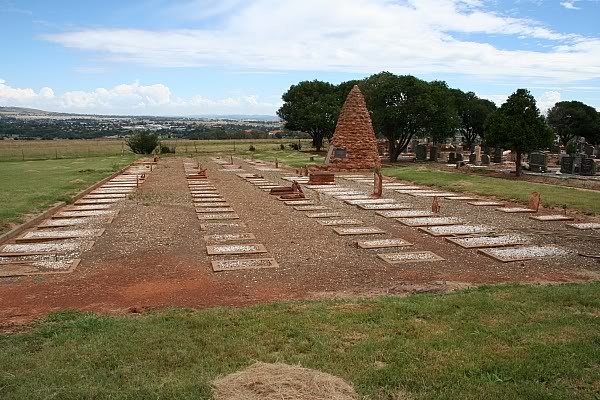
Children's graves at the British concentration camp site in Heidelberg
Children’s graves at the British concentration camp site in Heidelberg Photo: Boerevryheid

“This particular high school was founded just after the war, in a desperate attempt to save the Afrikaans language from being extirpated by the British administration. The fact that the school is today highly successful, displined and one of the top-performing schools in the province, is just too much to bear for Mrs. Creecy and pro-British genocidaires who are still nursing the Afrikaner hatred from hundred years ago.”

The mob was demanding that the century-old patriotic name of the school be changed to that of a local communist, Robert Nkosi. Another member of the South African Communist Party, Archie Mokonane of the South African Communist Party (SACP) told the crowd that the school was racist because it taught in Afrikaans.

“English is the language of proletarian internationalism, therefore all other languages are racist. Those people in Europe who teach in Dutch or German or French are racists too!”

Sipho Nhlengethwa, a local ANC councillor, said they would campaign for the school to be named after Obed Nkosi, a terrorist from Ratanda, the black township in the area. “This is our public school now, we have conquered the Boers,” said Nhlengethwa.

Regional leaders from the ANC, SA Communist Party, Cosatu and the Young Communist League handed over a memorandum of demands.

They want the school’s civilian governing body to be dissolved and replaced with a revolutionary communist council of “education workers”.

‘We will necklace them, we will burn them’

Young Red Guards chanting “we will necklace them, we will burn them”, referring to the Afrikaner pupils at Heidelberg Volkskool, disrupted and brought to a halt all education in the black township of Ratanda. School children were forced to participate in the protest, with both primary and high schools being deserted for the rest of the day. Bystanders put the number of marchers at 8 000. Teachers had told children that there would be no classes on Monday as “everybody had to march against the Afrikaner cockroaches”.

Volkskool was also accused of being racist because there were white players in the rugby team, with some members of the mob claiming that governmental race quotas for rugby only allowed one or two white players per team. “We want no whites in the team, it hurts our eyes to see whites,” said one.

A spokesman for the school blamed the inflamed racial tensions in the town on the provincial government’s failure to build an extra English-language high school, as promised in 1998. Cornelius Human, a member of the school’s governing body responsible for its legal affairs, said:

“What we found ourselves in was just a situation with wild allegations, with no substance – and we’re expected to act on them. It’s exactly the same situation that we have now.”

In hundred years, not much has changed in Heidelberg. The British concentration camp has gone, leaving a children’s graveyard like so many others in South Africa, but the hatred of Afrikaner children has stayed.

Japanese author Murakami leading race for Nobel literary prize

Haruki Murakami
Haruki Murakami

In a year with no clear favourites, Japanese novelist Haruki Murakami appears to be the front-runner to win the Nobel Prize for Literature this week.

Murakami, known across the globe for works such as “Norwegian Wood” and “1Q84”, heads the list at bookmaker Ladbrokes with 5/2 odds.

Also near the top of the Ladbrokes list is Canadian Alice Munro with odds of 4/1, and American Joyce Carol Oates with 8/1 odds.

Murakami has impressed the critics and won a mass readership with his intricately crafted tales of the absurdity and loneliness of modern life. His works, which are peppered with references to pop culture, have been translated to around 40 languages.

Munro is a writer of short stories, a genre that has only rarely been recognised by the Nobel committee, while Oates can look back at a prolific career spanning five decades during which she has produced more than 40 novels as well as plays and poems.

Overall, however, there is little consensus about who will win the prize, worth eight million Swedish kronor ($1,25 million, 925,000 euros). Observers also point to Belarussian writer Svetlana Alexievich and Algerian Assia Djebar as possible laureates.

The winner’s identity will be revealed at 11 GMT Thursday, when the Swedish Academy, picking as its venue the historic Bourse building in downtown Stockholm, will announce the winner of the world’s top prize for literary excellence.

A total of 195 authors have been nominated, including 48 first timers, and that is pretty much all that is known beforehand.

The deliberations of the Swedish Academy are secret and will remain closed to the public for the next 50 years, but outsiders still have some inkling of the factors that guide them — and literary fame is not among the top concerns.

“For the past 15 years, the Academy has… explored questions of literary quality, the evolution of literature, and its place in a historical context. It’s fascinating work,” said Gunilla Kindstrand, editor-in-chief at Swedish newspaper Haelsingetidningar.

“For them, it’s less important if the laureate is well-known or not.”

Or, as prominent Swedish publisher and journalist Svante Weyler put it: “The Academy takes a certain pleasure in surprising people, and acts in a slightly irrational manner.”

After last year’s prize to Chinese writer Mo Yan, whose close ties to authorities in Beijing made him controversial, the Academy has two choices this year, he said.

Either it can pick a writer who is completely apolitical, or it can choose one who is politically engaged, but not in a way that upsets the West.

“Svetlana Alexievich fits that description perfectly,” he said.

This opinion is shared by Bjoern Wiman, culture pages editor for Swedish daily Dagens Nyheter.

“The Academy ought to have recognised literary reporters in the Ryszard Kapuscinski class a long time ago,” he said, referring to the celebrated Polish foreign correspondent and writer, who died in 2007.

“Alexievich is a documentary author who writes polyphonic reportage at a very high level of accomplishment.”

He added that he believed very firmly this year’s prize would go to a female writer, something that has only happened 12 times since the award was first handed out in 1901.

Among other names that keep popping up: Poets Ko Un of South Korea and Syria’s Adonis, as well as novelists including American Philip Roth and Albanian Ismail Kadare.

It’s not essential that the winner has “written a lot of books”, argued students at Rinkebyskolan, a school in a disadvantaged neighbourhood of Stockholm which traditionally receives a visit from the literature laureate every year.

“The books have to be good, that is to say interesting and a source of inspiration, and they should motivate people to do something good for mankind,” a group of students from the school told AFP in an email.

Whether the 2013 winner fits that bill will remain a mystery for a few more days. For Weyler, the publisher, the only thing that is beyond doubt is the likely age of the laureate.

“In literature, you are rarely very good until you get old,” he said jokingly. “It’s not like mathematics where you make all the discoveries before the age of 25.”

Swedish poet Tomas Transtroemer, who won the prize in 2011 at age 80, argued that “for most writers, the Nobel Prize is a very distant phenomenon. Even though literary prizes can spur on writers, there are other forces that motivate a work.”

The winner will receive the prize in Stockholm on December 10, the anniversary of the death of Swedish industrialist and philanthropist Alfred Nobel, who established the award. – AFP

Head of community safety arrested for drunken driving

drunk-drivingMpumalanga’s head of community safety appeared in the Kempton Park Magistrate’s Court on Monday on charges of drunk driving and impersonating a police officer, Gauteng police said.

Thulani Sibuyi was granted R1000 bail after appearing in court, said Lt-Col Katlego Mogale.

“He allegedly crashed into another vehicle, and when the police came he allegedly put on his siren and told them he was a police officer, said Mogale.

Democratic Alliance spokesman Anthony Benadie has called on Mpumalanga MEC Vusi Shongwe to act against Sibuyi.

“As the head of the provincial task team implemented to fight drunk driving in the province, the DA believes Sibuyi must lead by example,” said Benadie.

The Mpumalanga department of community safety could not be reached for comment on Monday. – Sapa