US baker must make gay cakes

An appeals court ruled on Thursday that a Colorado baker cannot refuse to sell wedding cakes to same-sex couples because it goes against his religious beliefs.

The decision comes nearly two months after a landmark Supreme Court decision legalised gay marriage across the United States.

Masterpiece Cakeshop has joined a growing number of businesses successfully sued for discriminating against gay couples.

However, businesses in more than half of the United Sates are still legally allowed to refuse gay customers because 29 states don’t prohibit discrimination based on sexual orientation.

Charlie Craig and David Mullins filed a complaint under Colorado’s anti-discrimination laws when baker Jack Phillips told them in 2012 he wouldn’t make them a cake due to his religious beliefs.

The state did not recognise gay marriage at the time, but did prohibit discrimination based on sexual orientation.

Phillips argued that being required to make wedding cakes for gay couples violated his right to freedom of religion and free speech.

The state’s appeals court disagreed, arguing in a 66-page ruling that requiring someone to comply with the law is not the same as compelling someone to “endorse” something they don’t agree with.

Source: AFP

Jimmy Carter has cancer

Former US president Jimmy Carter said on Wednesday that recent liver surgery revealed he had cancer that had spread to other parts of his body.

“I will be rearranging my schedule as necessary so I can undergo treatment by physicians at Emory Healthcare,” Carter, 90, said in a statement.

“A more complete public statement will be made when facts are known, possibly next week.”

Carter, a Democrat, served as the 39th president from 1977 to 1981 after defeating Republican incumbent Gerald Ford.

He was defeated for re-election in 1980 by Republican Ronald Reagan.

The Carter family has a history of pancreatic cancer, including his parents, two sisters and younger brother Billy Carter who all died from the disease.

Carter told the New York Times in 2007 that he and other relatives had given blood for genetic studies seeking to help doctors diagnose the disease.

Asked why he has escaped the disease for so long while it devastated the rest of his family he blamed smoking.

“The only difference between me and my father and my siblings was that I never smoked a cigarette,” said Carter, former governor of Georgia and a state senator.

Carter is a virulent critic of Israel. He maintains that Israeli policy in the West Bank represented instances of apartheid worse that those that once held sway in South Africa.

Carter’s comments were broadcast on Israel Radio, which played a tape of an interview with the ex-president. He made similar remarks in interviews, such as one to CBC television.

“When Israel does occupy this territory deep within the West Bank, and connects the 200-or-so settlements with each other, with a road, and then prohibits the Palestinians from using that road, or in many cases even crossing the road, this perpetrates even worse instances of apartness, or apartheid, than we witnessed even in South Africa.”

Carter has rejected the criticism of use of the word apartheid.

“I feel completely at ease,” said Carter, while accusing Israel of oppressing Palestinians. “I am not running for office. And I have Secret Service protection.”

Ferguson teen shot by police had a gun

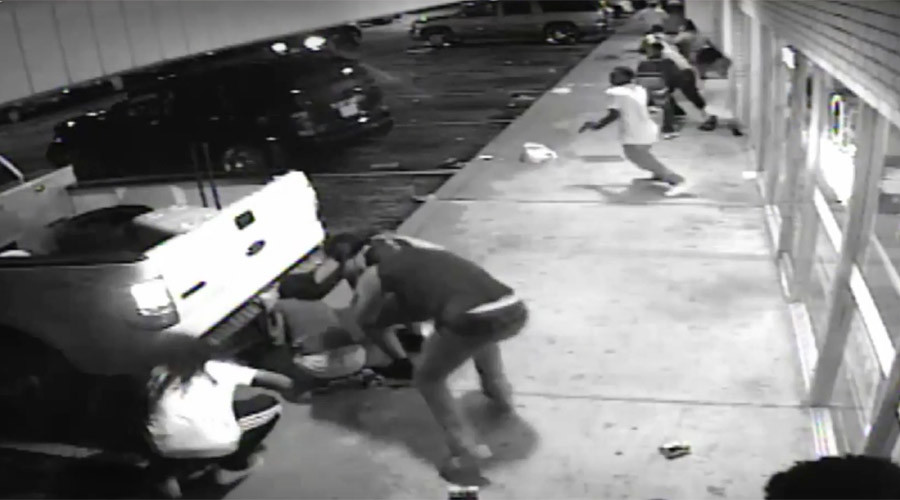
St. Louis County police have released surveillance footage allegedly showing Tyrone Harris, a black teen, with a gun. Police said Harris fired the weapon at plainclothes officers before they shot back, leaving him critically wounded in Ferguson on Sunday.

The 13-second video comes from a surveillance camera owned by Solo Insurance Services. It opens with people casually walking past a row of shops and parked cars.

Then, some sort of disturbance off camera causes people to start running away, with some ducking behind vehicles, as a group of about 10 people comes into view, running and separating.

One person wearing a white t-shirt and darker trousers is seen separating from those fleeing. He then pulls what appears to be a pistol from his waistband with his left hand, holding it out in front of him before moving off camera.

The St. Louis County police department said detectives have identified the person in the video as Tyrone Harris, who they said was responding to shots fired by another group at the scene. The incident took place during a commemoration protest marking the one-year anniversary of Michael Brown’s killing by police.

Police claim Harris allegedly opened fire on an unmarked police van before four police officers answered in kind. He was hit eight to twelve times, according to his father, Tyrone Sr., who disputed the police account on Monday, but declined to discuss his son’s shooting on Tuesday after the video was released, according to the Associated Press.

Harris, 18, is still in critical condition in a St. Louis hospital. There were no updates on his condition on Tuesday.

Source: RT

Pressure builds on Hillary to explain emails

As pressure builds on Hillary Clinton to explain her official use of personal email while serving as secretary of state, she faced new complications Tuesday. It was disclosed her top aides are being drawn into a burgeoning federal inquiry and that two emails on her private account have been classified as “Top Secret.”

The inspector general for the Intelligence Community notified senior members of Congress that two of four classified emails discovered on the server Clinton maintained at her New York home contained material deemed to be in one of the highest security classifications – more sensitive than previously known.

The notice came as the State Department inspector general’s office acknowledged that it is reviewing the use of “personal communications hardware and software” by Clinton’s former top aides after requests from Congress.

“We will follow the facts wherever they lead, to include former aides and associates, as appropriate,” said Douglas Welty, a spokesman for the State Department’s inspector general.

The expanding inquiry threatens to further erode Clinton’s standing as the front-runner for the Democratic presidential nomination. Since her reliance on private email was revealed in March, polls in crucial swing states show that increasing numbers of voters say Clinton is not honest and trustworthy, in part, because of her use of private emails.

Revelations that dozens of Clinton’s emails now include classified information has prompted an FBI inquiry into whether classified information was improperly stored on her private server and a thumb drive held by her attorney. The news has sparked fear among national security experts that the federal government’s secrets may have been exposed or even hacked.

Source: McClatchy

Saudi king blames Mossad for 9/11

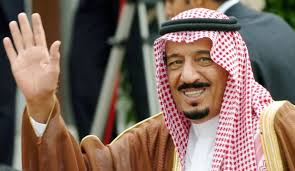
The former ambassador to Saudi Arabia said in an interview this week that following 9/11, Saudi King Salman had insisted to him that the Mossad was responsible for the attacks.

“One of my first calls was with then-governor of Riyadh… Prince Salman, who is now the king. His response was very emphatic [that] this could not have been Saudis, we couldn’t possibly have done this,” former envoy Robert Jordan said on CNN’s Fareed Zakaria GPS.

“This had to have been an Israeli plot. The Mossad must have done this,” he cited Salman as saying at the time.

“I got the same thing from the minister of interior, Prince [Mohammed bin] Nayef,” Jordan continued. “I finally had to bring a CIA briefer out and show some of these princes some compelling evidence that it, indeed, was Saudis who were the hijackers.”

Jordan went on to say that he saw the Saudis as being in denial about the fact that 15 of the 19 hijackers were from their country.

The Saudis eventually altered their position, he said, after al-Qaida bombed three Western housing compounds in May 2003.

“At that point, Crown Prince Abdullah said to me that he understood that they had a problem, that they would take immediate action to capture or kill the attackers and to treat just as harshly anyone who gave them comfort or aid or even tried to justify what they did,” said the former ambassador.

In his new book, Desert Diplomat: Inside Saudi Arabia Following 9/11, Jordan writes that the Palestinian issue was often a “source of Saudi anger directed at me.”

“America should be able to resolve this, they told me.

After all, the United States was omnipotent. All Washington had to do was snap its fingers and Israel would come to heel, do whatever we commanded it to do,” he says in the book.

Source: Jerusalem Post

No outrage after white teen’s killing

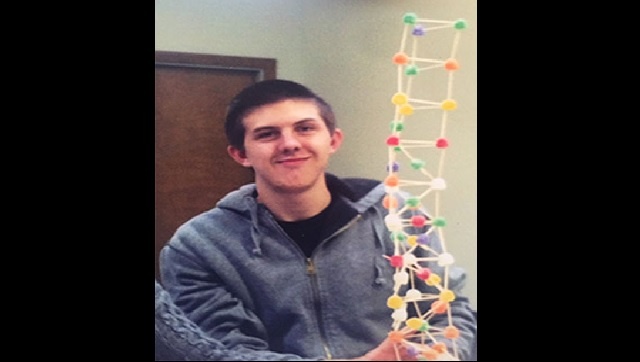
After an independent autopsy showed that Zachary Hammond was shot by police from behind, the family of the unarmed South Carolina teen is wondering at the lack of national outrage in this case. Hammond was white.

According to the police in Seneca, South Carolina, an officer shot Hammond “in self-defense” when the teen allegedly tried to run him over with a car during a drug arrest. An officer approached Hammond’s car in the parking lot of a Hardee’s restaurant on July 26, after an undercover officer arranged a marijuana buy with the teen’s date, 23-year-old Tori Morton. The initial police report mentions finding a bag of marijuana on Morton – who was charged with simple possession – but makes no note of the lethal shooting.

The official autopsy confirmed Hammond was shot twice, but did not say from what angle. Hammond’s family arranged for an independent autopsy, which showed the 19-year-old had been shot from above and behind, suggesting that the official police story was inaccurate.

Speaking to reporters on Tuesday, attorney for Hammond’s family Eric Bland said that Hammond had been shot in the left rear shoulder, and through the back of his chest, indicating the officer fired from the side of a stopped car, through the open window. Bland says Hammond was on a first date with Morton, who was eating ice cream at the time, and that the police should have never used deadly force.

Seneca is a city of 8,200 in the northwestern corner of South Carolina, near the university town of Clemson, and about 30 miles west of Greenville.

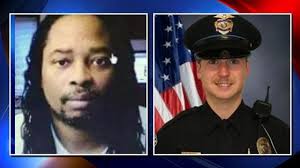
Hammond’s death came a week after Samuel Dubose was killed in Cincinnati, Ohio under very similar circumstances. University of Cincinnati police officer Raymond Tensing said Dubose was trying to run him over with his car, and that he fired in self-defense. Once Tensing’s body camera footage was released, showing otherwise, the officer was indicted for murder. Tensing is white; Dubose was black.

Dubose’s killing has attracted national attention, but Hammond’s was barely noticed. According to the Los Angeles Times, while Dubose’s name was mentioned in over 43,000 tweets between July 26 and August 4, Hammond’s appeared in 289 tweets in the same time period.

Bland, the attorney for Hammond’s family, finds the discrepancy “very disturbing.”

“An unarmed white teenager whose life is wrongfully taken at the hands of overzealous police is the same and equal to an unarmed black teenager whose life is wrongfully taken at the hands of overzealous police,” he told the LA Times.

Police in Seneca are standing by their officer, though. Speaking to the Greenville News last week, Chief John Covington said the officer “actually had his hand on or very close to the car, possibly pushed off from the car,” and the teen “was not shot from behind.”

“The attorney wasn’t there either,” Covington said. “He’s got to put his spin on things. His clients are the parents and they’re grieving. I understand that. My heart goes out to them.”

Seneca police’s refusal to publish the official autopsy results or name the officer involved in the fatal shooting has raised eyebrows. The Charleston Post and Courier filed an open records request for the officer’s name, and the copy of the official incident report, neither of which have been released by the police. – RT.COM

Russians hack US Joint Chiefs of Staff

Investigators say they believe the same Russian hackers that carried out attacks on the White House and State Department last year and the attempted penetration of the Pentagon last month were responsible for a major cyberattack that shut down the Joint Chiefs of Staff email for the past 11 days, The Daily Beast has learned.

In all of the attacks, hackers broke into unclassified email networks by sending legitimate-looking emails than turned out to be malware or “spear phishing” attempts. In April, President Obama’s unclassified emails were among those compromised, along with the State Department.

Ten days before the July 27 hacking of the Joint Staff system, the Pentagon sent an email warning “at least five” DOD computer users had been targeted, which was first reported by The Daily Beast. The notice linked those attacks to penetrations of unclassified networks at the White House and State Department that began last year.

The Joint Chiefs then suffered what one defense official called the “most sophisticated” attack on its unclassified network, one that has shut down communications ever since for the 4,000 employees on the Joint Staff unclassified server.

Source: Daily Beast

US Report warns of backlash against whites

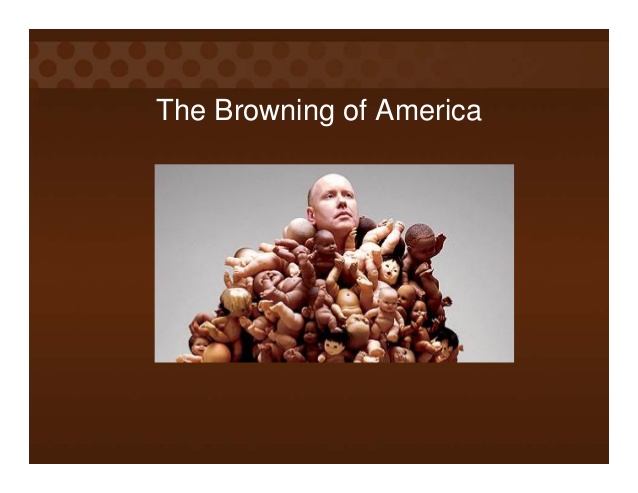
A study of the growing Hispanic immigrant population declares that the country is on the verge of the “Latinization of the United States,” a “browning of America” that by 2050 will be 29 percent Latino — and politically influential.

Published in the authoritative journal “Ethnicities,” the immigration analysis by two California experts noted that while big states such as California and Florida are home to most Hispanics, there has been a recent growth surge exceeding 300 percent of mostly Mexicans to Georgia, Kentucky, South Carolina, North Carolina and Arkansas.

The analysis is focused on how to economically handle the surge so that Latinos do not get left behind — or out of the middle class. The numbers and characterization of the new immigrants spells out the influence of the Hispanics.

In “Latina/o Formations in the United States,” Loyola Marymount University’s Antonia Darder and University of California’s Rodolfo D. Torres write that already 20 percent of the 30 million youths aged 18-24 in America are Latino and are poised to influence American politics and policy.

“By the sheer force of numbers, the kinds of adults that Latino students become will dramatically shape the future history of this country, as the former white majority becomes a minority population, at least in terms of number,” said the study provided to Secrets. It sits behind a paywall.

“Latinos have become more than an electoral voting bloc, emerging as strategic actors in major processes of democratic social transformation,” they added.

And they warned that there could be a backlash as whites try to hang on to power.

“In fact, the current struggle that persists in Arizona may well be a bellwether for the potential backlash that is bound to ensue in others parts of the nation, as the White Anglo-Saxon Protestant population no longer enjoys the political security associated with their past majority status,” said the authors.

“Over the past four decades, Latinos in the United States have emerged as strategic actors in this process of socio economic transformation. This so-called Latinization of the United States comes at a time of increasing social polarization and class inequalities. These forces assert themselves economically, demographically, culturally and politically in the workplaces and in Latino everyday life,” added their analysis.

Source: Washington Examiner

US ambassador to Vietnam promotes gay marriage

Since their December arrival in Vietnam, U.S. Ambassador Ted Osius and his mulatto husband have become the most prominent gay couple in the Southeast Asian country.

Osius and Clayton Bond landed with their toddler son shortly before the government abolished its ban on same-sex marriage. Now the couple, who recently adopted an infant girl, find themselves promoting the LGBT rights movement across the country.

“A lot of young people have reached out to me on Facebook, to say: ‘We are happy to see somebody who is gay and is happy in his personal life but also has had professional success’,” Osius said in an interview. “I don’t think of it as advocating as much as supporting Vietnamese civil society in doing what it is already doing.”

The Communist government’s revised marriage law, and while not officially recognizing same-sex marriage, potentially opened up opportunities to attract the tourist “pink dollar”.

Yet young gay Vietnamese say they can be ostracized in a patriarchal society in which heterosexual marriage and parenthood are seen as the path to happiness. The legal changes also sit oddly in a country that more broadly curbs political dissent, Phil Robertson, deputy Asia director at Human Rights Watch, said in an e-mail.

Osius, 53, and Bond frequently appear together at official government gatherings and media events. Osius — who is on his first posting as ambassador and has also worked in Indonesia and India — always introduces his husband and often talks about their children, who are 19 months and five months.

“This is a core interest of ours with regard to human rights,” said Bond, 39. “People see us as an openly gay couple with kids serving our country. I hope people find that inspiring.”

While a small number of celebrities have held same-sex weddings, Osius and Bond are the most prominent gay couple in Vietnam, said Tung Tran, director of ICS, a Ho Chi Minh City-based group that advocates for lesbian, gay, bisexual and transgender rights. They are also embraced by the larger population, reflecting the closer relationship being forged by Hanoi and Washington.

Osius and Bond plan to renew their vows before U.S. Supreme Court Associate Justice Ruth Bader Ginsburg during her visit to Hanoi later this month.

“They are the full package,” Tran said by phone. “They are married. They have a family. They are successful. They are our role models.”

Osius, a career diplomat, co-founded GLIFAA, a U.S. association for LGBT employees and families in foreign affairs agencies, in 1992. There are now six openly gay U.S. ambassadors, including Osius, Ambassador to Australia John Berry and Ambassador to Denmark Rufus Gifford, said Regina Jun, president of the group.

Osius’ posting to Vietnam comes amid improved relations between Vietnam and the U.S., former enemies that have shared economic goals and strategic concerns about an increasingly assertive China in the region. Vietnam’s civil society is relatively robust, Osius said, even as its human rights record in other areas remains a hindrance to even warmer ties.

In most parts of Southeast Asia including Thailand, the push for gay rights has stalled. Countries such as Brunei and Malaysia punish those who engage in gay behavior.

In Singapore, sex between men is illegal. The city-state banned a song and video by Taiwanese singer Jolin Tsai’s about same-sex relationships, the Straits Times reported May 26.

Source: Bloomberg

‘What lion?’ Zimbabweans ask as Cecil circus goes global

As social media exploded with outrage this week at the killing of Cecil the lion, the untimely passing of the celebrated predator at the hands of an American dentist went largely unnoticed in the animal’s native Zimbabwe.

“What lion?” acting information minister Prisca Mupfumira asked in response to a request for comment about Cecil, who was at that moment topping global news bulletins and generating reams of abuse for his killer on websites in the United States and Europe.

The government has still given no formal response, and on Thursday the papers that chose to run the latest twist in the Cecil saga tucked it away on inside pages.

One title had to rely on foreign news agency copy because it failed to send a reporter to the court appearance of two locals involved.

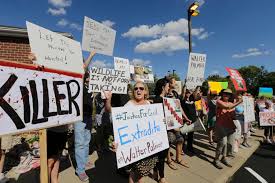
In contrast, the previous evening 200 people stood in protest outside the suburban Minneapolis dental practice of 55-year-old Walter Palmer, calling for him to be extradited to Zimbabwe to face charges of taking part in an illegal hunt.

Local police are also investigating death threats against Palmer, whose location is not known. Because many of the threats were online, police are having difficulty determining their origins and credibility.

Palmer, a lifelong big game hunter, has admitted killing Cecil with a bow and arrow on July 1 near Zimbabwe’s Hwange national park, but said he had hired professional local guides with the required hunting permits and believed the hunt was legal.

For most people in the southern African nation, where unemployment tops 80 percent and the economy continues to feel the after-effects of billion percent hyperinflation a decade ago, the uproar had all the hallmarks of a ‘First World Problem’.

“Are you saying that all this noise is about a dead lion? Lions are killed all the time in this country,” said Tryphina Kaseke, a used-clothes hawker on the streets of Harare. “What is so special about this one?”

As with many countries in Africa, in Zimbabwe big wild animals such as lions, elephants or hippos are seen either as a potential meal, or a threat to people and property that needs to be controlled or killed.

The world of Palmer, who paid $50,000 to kill 13-year-old Cecil, is a very different one from that inhabited by millions of rural Africans who are more than occasionally victims of wild animal attacks.

According to CrocBITE, a database, from January 2008 to October 2013, there were more than 460 recorded attacks by Nile crocodiles, most of them fatal. That tally is almost certainly a massive underrepresentation.

“Why are the Americans more concerned than us?” said Joseph Mabuwa, a 33-year-old father-of-two cleaning his car in the center of the capital. “We never hear them speak out when villagers are killed by lions and elephants in Hwange.”

Source: Reuters

Cincinnati braces for black violence after police shooting

An Ohio police officer who shot a black man during a routine traffic stop was charged with murder Wednesday in what prosecutors called a “senseless” act motivated by anger.

“He wasn’t dealing with someone who was wanted for murder — he was dealing with someone with a missing license plate,” Hamilton County Prosecutor Joseph Deters told reporters.

The case comes as the United States grapples with heightened racial tensions in the wake of a series of high-profile incidents of African Americans being killed by police in disputed circumstances.

Deters said he hopes the swift action by his office will show that justice is being done in this case.

University of Cincinnati campus police officer Ray Tensing initially told investigators that he shot Sam DuBose in the head after DuBose tried to drive away and dragged the officer along with him.

“You will not believe how quickly he pulls his gun and shoots him in the head. It’s maybe a second. It’s incredible. And so senseless,” Deters said as he prepared to release the video.

A lawyer for Officer Tensing, Stew Mathews, disputed Deters’s comments during an interview with an Ohio television station and said that other video of the shooting would tell a completely different story.

The university shut down its campus and placed barricades at entrances out of concern that the news could lead to protest or even violence.

City officials pressed for peace and said they were prepared “for any scenarios that present themselves.”

A series of sometimes violent protests have broken out across the United States in response to other high-profile police shootings over the past year.

Cincinnati was struck by days of violent unrest following the police shooting of an unarmed black man in 2001.

Tensing, 25, had been a police officer for four years, the Cincinnati Enquirer reported.

Drug overdoses now leading cause of death in US

American lawmakers are grappling with ways to respond to a worsening heroin epidemic. Drug overdoses are now the leading cause of death in the US, surpassing car accidents and gunshot wounds, according to the Centers for Disease Control and Prevention.

Lawmakers attending a House of Representatives judicial committee hearing on Tuesday learned that the number of people overdosing on opioids has quadrupled in the past decade, with many deaths occurring in the upper class, particularly among women and in suburban areas.

“There were over 43,000 deaths in 2013, or approximately 120 per day, over half of which involved either a prescription painkiller or heroin. These are our family members, friends, neighbors, and colleagues,” Jack Riley, acting deputy administrator of the Drug Enforcement Agency, told the committee.

Drug deaths now outnumber deaths from gunshot wounds (over 33,600) and motor vehicle crashes (over 32,700) in the United States, according to the CDC.

Riley said there are more than 600,000 heroin users in the US today, and agency officials say the figure is likely to be undercounted, as it is based on a household survey and wouldn’t account for all heroin users among homeless populations.

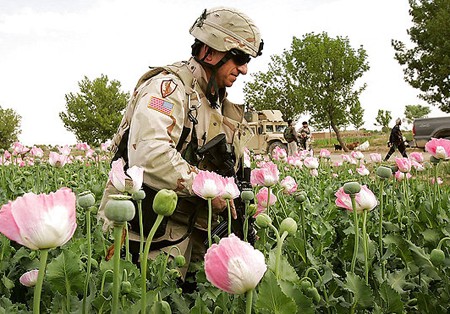
The sheer volume of heroin that is coming into the country and the number of people turning to it has been driving the levels of drug abuse up, according to analysts. Between 2008 and 2012, the DEA saw a 232 percent increase in drug busts along the Mexican border. Last year alone, agents seized 281 kilograms of heroin.

The biggest gateway to heroin is an addiction to prescription drugs. Increases in overdoses seen among women and the wealthy may be accounted for by previous addiction to prescribed pills, according to the CDC. When pills become too expensive or difficult to obtain, people may have turn to a cheaper alternative – heroin at $10 a bag.

What is also unique about the opioid epidemic is that it is no longer just a border or urban problem, but a suburban problem as well. Local law enforcement has largely been left to handle the epidemic on their own, but they are increasingly looking for answers from the federal level. The DEA and other experts see a connection between drug cartels and small street gangs in local towns like Chesapeake, Virginia.

McDonald’s losing the fast food fight

In the fast food fight for customer spending, one restaurant giant is struggling while rivals scoop up diners’ dollars.

Last week, McDonald’s reported its global comparable sales fell again, dropping 0.7 percent in the second quarter.

Meanwhile, comps at Burger King rose 6.7 percent in constant currency while Arby’s comps rose 7.6 percent during the second quarter. Several other large restaurants are also showing positive growth.

“It seems like the only big player doing negative numbers, period. They’re in a healthy market but they’re not participating in that market,” said David Palmer, analyst at RBC Capital Markets, in a phone interview.

This comes after several blockbuster years at the chain where it delivered a string of mid-single digit comp increases in the 2000s after a successful previous turnaround plan called “Plan to Win.”

In its domestic unit, McDonald’s comps have lagged its fast-food sandwich peers (a group that includes Arby’s, Burger King, Carl’s Jr., Jack in the Box, Wendy’s, Sonic and Subway) each month since October 2013, according to data that its investor-relations team provides to analysts using data from The NPD Group.

Source: CNBC

Fewer black US reporters than in 1968

America’s newspapers, including many that for years decried the lack of black representation in Congress, on Wall Street and in corporate boardrooms, have not increased the percentage of African-Americans in newsrooms above 1968 levels — and may have even cut the numbers.

According to a report on the Columbia Journalism Review and census data from the American Society of News Editors, blacks in newsrooms represent 4.78 percent of the staff. In 1968, the year of race riots following the assassination of Rev. Martin Luther King Jr., LBJ’s National Advisory Commission on Civil Disorders put the number of blacks in newsrooms at “less than 5 percent.”

CJR’s Alex T. Williams said the numbers are higher when all minorities are included, according the ASNE survey, but still a tiny 13.34 percent.

“The percentage of minorities employed in daily newspapers (the ASNE looks at black, Hispanic, Asian American, Native American, and multiracial populations) has increased from 3.95 percent in 1978, when the ASNE began conducting the census, to 13.34 percent in 2014. The Radio Television Digital News Association estimates that in 2014, minorities made up 13 percent of journalists in radio and 22.4 percent of journalists in television,” wrote Williams.

“Still, these figures are a far cry from the 37.4 percent of Americans that are minorities,” Williams added.

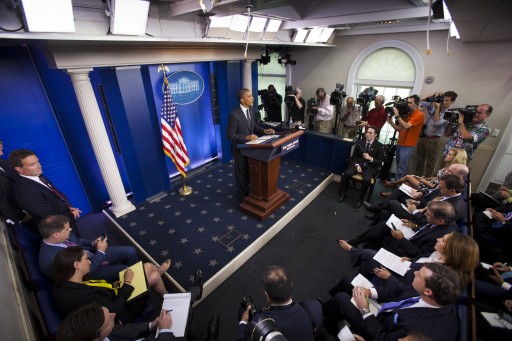
The figures for Washington reporters aren’t much different. Secrets recently interviewed American Urban Radio Networks White House correspondent April Ryan who determined that just 10 percent of White House regulars are black.

The author of The Presidency in Black and White said, “I’ve come out of that lower press room door, past the podium, or walked by and looked into that crowd. It shocks me sometimes. I’m like, ‘Wow!'”

It’s not an education thing. Other figures in the report said that minorities account for 24.2 percent of journalism or communications majors at colleges and universities. And they accounted for 21 percent of graduates from those programs.

The problem seems to be that minorities don’t get the job offers.

Overall, 49 percent of minority graduates found jobs versus 66 percent of white graduates.

Source: The Examiner