Scotts airline passengers in major Ebola scare

Airline passengers in Scotland were at the centre of an Ebola scare after their plane was quarantined at Aberdeen airport

Passengers on a British Airways flight from London were kept on the aircraft for over two hours after a young African girl complained of feeling unwell on the flight.

Medics in chemical suits boarded the plane while anxious passengers watched on in horror.

Passengers on a British Airways flight from London were kept on the aircraft for over two hours after a 10-year-old girl, believed to be of Nigerian descent, was “violently sick” onboard the BA1314 service.

Environmental Health and trained infectious diseases medics immediately quarantined the aircraft until the sick passenger could be safely removed. It’s understood the girl travelled from infected regions in Africa.

One man, whose pregnant daughter was on the flight, said: “We tried to get information but nobody was returning our calls.

“The passengers weren’t being told anything other than the girl was sick and quarantine measures were put in place.”

It is understood the woman has now been transferred to the infectious diseases unit at Aberdeen Royal Infirmary where further tests will be carried out.

Source: Daily Record

Ebola czar has disastrous biosecurity record

Newly appointed UN Ebola Czar, David Nabarro, has warned of an explosion of Ebola cases.

Nabarro, a UKIP politician, was the senior UN system Co-ordinator for Avian and Human Influenza when WHO supplied the bird flu virus which contaminated 72 kilos of seasonal flu in Baxter’s biosecurity 3 facilities in Austria in 2009.

Biologist Richard Ebright recommended civil and criminal proceedings be instituted over another comparatively tiny breach with thebird flu virus when he testified before Congress last month on CDC lapses, Reuters reports.

A U.S. government scientist working with bird flu rushed through lab procedures in order to get to a staff meeting, setting off what could have been a fatal mishap, health officials said.

They said the U.S. Centers for Disease Control and Prevention (CDC) lab worker, who was not identified, allotted only about half the time necessary to carry out the procedures safely, and as a result samples of mild avian flu were tainted with a highly deadly strain and sent from CDC to researchers at the U.S. Department of Agriculture.

CDC released the report of its investigation of the avian flu incident and said disciplinary action is under consideration. The agency is under congressional scrutiny over repeated safety lapses, including the potential exposure of scores of its workers to live anthrax bacteria in June.

As serious as the sample mix-up, which occurred in January, was the failure to report it as required by federal law when the contamination became clear in May, according to biosafety experts. CDC did not report the incident until July.

“The matter needs to be referred for civil and/or criminal investigation,” said biologist Richard Ebright of Rutgers University, an expert in biosafety who testified before Congress last month on the CDC lapses.

According to the report, CDC shipped the avian flu sample from its Atlanta campus to a USDA poultry lab in Athens, Georgia, in March, and scientists there began using it in research in May.

When the supposedly non-lethal viruses killed an entire flock of chickens, a USDA scientist sequenced the genome of the virus. That revealed it was not low-pathogenicity H9N2, as CDC said, but highly pathogenic H5N1, which has killed hundreds of people since 2013.

USDA scientists, out of an abundance of caution, handled the sample under stringent biosafety conditions, including with gloves, suits, and respirators, and no one was infected.

On May 23, USDA scientists told the CDC flu lab about the mix-up. CDC scientists did not report it to managers, or file a form required when dangerous pathogens are mishandled, until July 9, just as CDC officials were completing a report on the anthrax breach that occurred in June.

LACK OF JUDGMENT

Failure to report reflected “a lack of sound professional judgment by those aware of the contamination,” the CDC investigators wrote. Among those aware of the release were the head of the flu lab and the Virology Surveillance and Diagnostics Branch Chief, the report said.

The CDC investigators concluded that the failure to report the breach was not deliberate, which Rutgers’ Ebright said in an interview “strains credulity.”

How the original mix-up of flu strains occurred is unclear, the report said, because the CDC scientists said they could not recall everything they did and did not keep a lab notebook or other written documentation.

As best the investigators could tell, however, a flu lab scientist transferred H9N2 virus received from Hong Kong, and H5N1 from Vietnam, into cell cultures on the same morning.

Based on card-key readers that record entries and exits, the investigators concluded that the scientist rushed through a procedure that required 90 minutes to ensure safety – basically, putting enough time between working with H9N2 and then with H5N1 – in just 51 minutes in order to make a noon meeting. That included time to shower and change.

In addition, the report found, there was no approved procedure for what the scientist was doing, colleagues who might have noticed a breach were frantically rushing to finish experiments ahead of a February scientific meeting, and the lab director had a “heavy work load”.

The flu lab scientists told CDC investigators they did not realize they were required to file a ‘Form 3’ about the accidental release of a dangerous pathogen. A USDA spokeswoman did not respond to a question about whether the poultry lab scientists were required to file the form.

CDC said it is reviewing existing laboratory protocols, taking steps to improve record-keeping and compliance, testing for cross-contamination before samples are transferred within or outside CDC, and “providing additional extensive training” of lab staff, including reporting requirements.

Israeli strike levels 12-story Gaza building

The targeting of large buildings appears to be part of a new military tactic by Israel. Over the weekend, the army began warning Gaza residents in automated phone calls that it would target buildings harboring “terrorist infrastructure” and that they should stay away.

A senior military official confirmed that Israel has a policy of striking at buildings containing Hamas operational centers or those from which military activities are launched. The official said each strike required prior approval from military lawyers and is carried out only after the local population is warned.

However, he said, there was now a widening of locations that the military can target. The official spoke on condition of anonymity because he was not permitted to discuss the matter with reporters.

In the 12-story apartment tower, the target was a fourth-floor apartment where Hamas ran an operations center, according to Israeli media. In the past, Israel has carried out pinpoint strikes, targeting apartments in high-rises with missiles, while leaving the buildings standing. However, this time a decision was made to bring down the entire tower, according to Channel 10, an Israeli TV station.

The military declined immediate comment when asked why it collapsed the entire building instead of striking a specific apartment.

Source: AP

Hedge funds gave Mugabe millions for genocide in return for platinum mines

Zimbabwe’s dictator Robert Mugabe unleashed a storm of brutal, genocidal violence after losing the 2008 elections — and now we know that it was funded by western hedge-funds and banks, led by Och-Ziff Capital Management, the largest publicly traded fund, with assistance from Blackrock, GLG Partners, and Credit Suisse, who raised $100M for Mugabe’s weapons and torture-chambers in exchange for a sweetheart deal on the country’s platinum mines.

Daniel Och’s Och-Ziff manages $45.7B, including funds from the California Public Employees’ Retirement System. Och’s protege, Michael Cohen, led the charge to fund Mugabe’s pogrom; while an Israeli diamond trader called Dan Gertler helped broker a joint deal with OCH to invest in mining in the Democratic Republic of Congo, another nation whose state is complicit in horrific terror-campaigns that include child soldiery and rape camps.

Och-Ziff is under investigation for its deals in Zimbabwe and DRC, including allegations that it deliberately and illegally disguised its involvmeent. Cohen left Och-Ziff in 2013, shortly after buying a $22M country estate outside London: “Ewhurst Park, the more than 900-acre spread includes a sprawling main house, cottages, a church, a large lake with ducks, a boathouse, bridges, wooded areas, fountains, and formal gardens.” Cohen wouldn’t provide a comment to Businessweek on the deals.

Four days later, Camec announced it was using the money it raised to purchase a joint venture with the Zimbabwe Mining Development Corp., or ZMDC, Mugabe’s state-owned mining company. The joint venture owned the platinum stakes on the Great Dyke that had been taken back just a few weeks earlier from Anglo American. The price included $5 million in cash; Camec issued shares to partners whose identities were shielded by a shell company based in the British Virgin Islands; and $100 million to Mugabe’s government. Camec said the $100 million was a cash loan “to comply with its contractual obligations to the government of Zimbabwe” for the platinum claims. It said the money would be repaid out of ZMDC’s share of future platinum earnings. Camec’s balance sheets for the period make clear that funding for the platinum rights came from the private transactions involving Och-Ziff.

On the day Camec announced the deal with Mugabe’s government, two of McGee’s embassy employees were in the countryside gathering intelligence on Mugabe’s efforts to ensure his win. A lieutenant colonel in the president’s army told embassy staffers that soldiers, militia members, and ruling party backers loyal to Mugabe were training to conduct what he called a “reorientation campaign,” according to McGee and embassy cables. The lieutenant colonel also said 400 vehicles were being deployed to facilitate the operation.

Violence intensified throughout May. Soldiers drove opposition supporters out of their rural villages or urban neighborhoods. According to the United Nations Office for the Coordination of Humanitarian Affairs, more than 33,000 people were driven from their homes by month’s end. Hundreds turned up at the gates of the American Embassy. “These people were literally running for their lives,” McGee says.

Source: boingboing.net

ISIS video a fake say experts

We have been fed so much fake government war propaganda in recent decades

Video experts observed that the video showing the actual beheading of US journalist James Foley was so professionally produced and well-scripted, to the extent that portions of it appeared to be just being acted out.
Two video experts were one in observing that portions of the purported video were give-aways that the beheading video was intended primarily for propaganda purposes.

One security expert, who had credible experience of scrutinizing videos of beheading, noted a very strange thing about Foley’s video – in the seconds before the executioner jab the knife into Foley’s neck, there was no single sign that he was terrified.

“My experience of these things is when the knife gets close the knees buckle and you become like a rag doll, whereas this guy seemed to sit upright. It could be that that particular knife wasn’t the one that killed him, that that was a play-acting thing,” the expert told The Times.

After the part where the executioner was shown cutting Foley’s head, the video fades.

The next part of the video already showed Foley’s decapitated head while he was upturned back. His hands were handcuffed. But his right ankle already had bruises hinting that he had been kneeling on the ground longer than what was shown in the video. And most importantly, a different looking knife lies on the ground, next to Foley’s corpse.

“The guy is obviously dead but it may be that particular scene was acted and that was why he is staying stiff,” the security expert noted.

Joe Fields, of Breakthru Productions, a recording studio in London, on the other hand noted that the video was well-produced as both Foley and the masked man appeared to be speaking following well-scripted lines.

What was noticeable for Fields was the battery-powered microphone clipped to the front of Foley’s robe. He said that the microphone looks like a professional one used in television studios so as the audio can be recorded without the need of editing or sound dubbing.

With all these elements present, it could be considered that the man masked in black, speaking with a British accent, was not the one who killed Foley. Rather, the man was just acting out the part.

Source: ibitimes.com

India, Pakistan ties sour as cross-border fire heats up

Indian and Pakistani troops intensified firing across the border over the weekend killing at least four, an Indian official said on Sunday, straining ties between the arch rivals who recently called off top-level diplomatic talks.

Last week India said its foreign secretary would not meet with her Pakistani counterpart as scheduled on Monday because of plans by Pakistan to consult separatists from the border state of Jammu and Kashmir ahead of the meeting.

The cancellation dashed any hopes of near-term peace deliberations, chances of which had risen after Pakistani Prime Minister Nawaz Sharif attended the inauguration of Indian Prime Minister Narendra Modi about three months ago.

The Himalayan region of Kashmir has been a bone of contention between India and Pakistan since both countries became independent in 1947. They have fought three wars and came close to a fourth in 2001 and there have been regular clashes on the Line of Control that divides Indian- and Pakistan-controlled Kashmir.

Giving ammunition to hawks on both the sides against resuming talks, firing across the border has picked up.

Source: Reuters

WHO pandemic business plan states goal is to vaccinate world’s population

A WHO business plan to increase the supply of pandemic vaccines says the goal is to produce enough pandemic vaccine to inject 6.7 billion people – or the world’s entire population.

The WHO documents says the capacity to produce pandemic vaccines with adjuvants would reach 6.2 billion doses in 2010.

“This business plan evaluates the short to medium-term (2007–2017) options available to pursue the Global pandemic influenza action plan to increase vaccine supply (GAP) goal of developing enough pandemic vaccine to immunize the world’s population (6.7 billion people).”

Meanwhile a video showing the bodies of ebola victims dumped in the source of a river by the Liberian government, currently partnering with WHO, has fueled fears that Ebola is being spread through rivers.

Locals describe how the wetlands where the bodies of at least 45 ebola victims were dumped is the source of a major river located northwest of a city. Householders close by express fears that their well could be contaminated with Ebola.

The government of Sierra Leone said in a press release on August 6th, that it had overturned a WHO plan to build Ebola treatment centers in built up areas. Treatment centers are to be relocated to communities away from where people dwell or reside,” says the press release. An Ebola center already under construction is to be moved.

Beijing arrests member of sect for brainwashing members

Over the past three months China has arrested nearly 1,000 members of a sect referred to as a cult by Beijing, state media said on Tuesday.

The group told members that a “female Jesus” had arrived and called on members to overthrow the Communist party, which the group referred to as “the big red dragon”, the state-run Global Times reported.

The crackdown, since June, has focused on members of the Church of Almighty God, a group that has attracted followers in rural areas of China for more than 10 years.

The people arrested include “high-level organisers and backbone members” of the group, the official Xinhua news agency said, citing officials. The agency did not give details of the crimes linked to the suspects, who are said to come from more than six provinces.

Beijing has for years struggled to suppress the Almighty God group, with state media reporting the arrest of nearly 1,000 followers in 2012 when the organisation was under the spotlight for predicting an apocalypse.

State media said the group brainwashed its members and encouraged them to isolate themselves from family and friends.

This year’s crackdown follows the murder in May of a woman at a McDonald’s restaurant in the eastern province of Shandong, which police blamed on members of Almighty God. The movement’s founder is reported to have fled to the US.

On Thursday five people will go on trial in connection with the murder, Xinhua said.

China tightly controls religious expression, permitting worship only at government-controlled Buddhist, Daoist, Muslim, Protestant and Catholic establishments but banning other religious organisations.

Source: The Guardian

Violence errupts in Ebola quarantine zone as deaths surge

Violence erupted in an Ebola quarantine zone in Liberia’s capital Wednesday when soldiers opened fire and used tear gas on protesting crowds as they evacuated a state official and her family.

Four residents were injured in the clashes that flared in Monrovia’s West Point slum which has been sealed off as part of new security measures aimed at containing the deadly virus.

The death toll from the Ebola oubreak in West Africa has risen to 1,350, the World Health Organization said on Wednesday, with 106 new deaths reported between August 17-18 in three countries.

The U.N. health agency said that 221 new suspected, probable and confirmed cases of the deadly fever were reported across Guinea, Liberia and Sierra Leone over the two-day period.

The crackdown in Liberia comes as authorities around the world scramble to stem the worst-ever outbreak of Ebola, which has killed at least 1,350 people across west Africa this year.

Liberian President Ellen Johnson Sirleaf quarantined West Point and Dolo Town, to the east of the capital, and imposed a night-time curfew as part of new drastic measures to fight the disease.

Residents of West Point, where club-wielding youths stormed an Ebola medical facility on Saturday, reacted with fury to the crackdown, hurling stones and shouting at the security forces.

“It is inhumane,” resident Patrick Wesseh told AFP. “They can’t suddenly lock us up without any warning, how are our children going to eat?”

Deaths from the epidemic that has swept through west Africa since March now stand at 1,350 after a surge of 106 victims in just two days, according to the World Health Organization.

Fears that the virus could spread to other continents have seen flights to the region cancelled, and authorities around the world adopting measures to screen travellers arriving from affected nations.

Classified information on missing MH370 stolen

Classified information from the computers of officials involved in the investigation into the disappearance of Malaysia Airlines MH370 has been stolen, The Star Online reported Wednesday.

The computers of the high-ranking officials are said to have been hacked and the stolen information was allegedly being sent to a computer in China before the Malaysian Science, Technology and Innovation Ministry blocked the transmissions, the website reported.

The national cyber security specialist agency CyberSecurity Malaysia said that the malware that led to the information leak was sent to the officials via email on March 9, one day after the aircraft disappeared en route from Kuala Lumpur to Beijing, according to The Star Online.

According to the security agency’s estimates, about 30 computers were infected by the malware. The agency is said to be working with Interpol on the incident at the moment. CyberSecurity Malaysia suspects that the motivation for the attack was the accusations of the Malaysian government made by some people of concealing crucial information about the investigation.

The Malaysia Airlines Boeing 777-200 flight MH370 traveling from Kuala Lumpur to Beijing vanished on March 8 with 239 people on board, of which there were 227 passengers and 12 crew members. On March 24, Malaysian Prime Minister Najib Razak said that, according to the satellite data, MH370 crashed in the southern part of the Indian Ocean.

Russia to request UN report on MH17 air disaster

Russia is planning to request an official report on the progress of the investigation into the crash of a Malaysian passenger plane in eastern Ukraine, Russia’s UN envoy Vitaly Churkin said Monday.

“We will ask for a briefing by the UN Secretariat on the progress of the implementation of Resolution 2166,” Churkin told reporters at the United Nations headquarters in New York.

Churkin said it had been a month since the start of the probe and paragraph 13 of the resolution envisions periodical reports by the UN secretary general on the progress of the investigation.

On August 14, the Dutch Safety Board, which is in charge of victim identification and probing the cause of the disaster, said it had finished its work in Ukraine, and that an initial report on the flight MH17 crash will be released during the first week of September.

A total of 298 people, including 193 Dutch citizens and 27 Australians, died on July 17 as a Malaysia Airlines Boeing 777 en route from Amsterdam to Kuala Lumpur crashed in Donetsk Region of Ukraine.

The investigation into the circumstances of the crash is seriously obstructed by continuing clashes between independence supporters and Kiev forces in eastern regions of Ukraine.

Ukrainian authorities claim the plane was shot down by independence supporters, whereas the latter say they do not have necessary equipment to hit a target flying this high.

Source: RIA Novosti

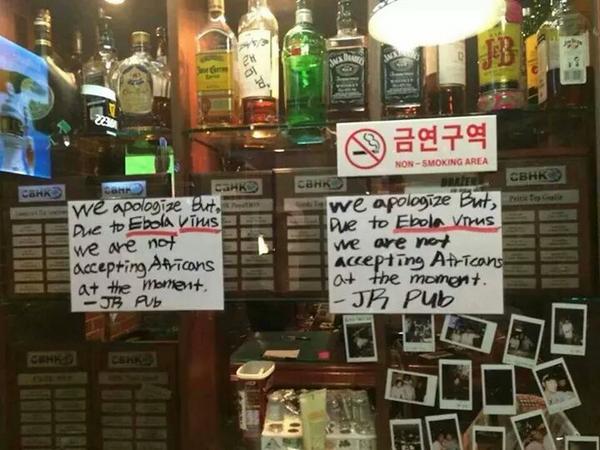
Africans unwelcome as Ebola threat

Ebola gives pub excuse to bar black people

With ethnic relations once again making headlines in America, racism elsewhere can sometimes make discrimination appear relatively minor by comparison. Consider what those of African origin face when living or traveling in Asia, for example.

Today’s illustration comes from Twitter, where one restaurant in South Korea is refusing to serve black people due to fears over Ebola!

Imagine the outrage were this sign to appear anywhere in the United States:ebolakorea

Given that many American soldiers stationed in Korea are African-American, it’s hard to believe this isn’t generating more attention.

Shoot-on-sight order against Ebola

Liberia’s armed forces have reportedly been given orders to shoot people trying to illegally cross the border from neighbouring Sierra Leone, which was closed to stem the spread of Ebola.

Soldiers stationed in Bomi and Grand Cape Mount counties, which border Sierra Leone, were to ‘shoot on sight’ any person trying to cross the border, said deputy chief of staff, Colonel Eric Dennis, according to local newspaper the Daily Observer.

The order comes after border officials reported people continued to cross the porous border illegally.

Grand Cape Mount county had 35 known ‘illegal entry points,’ according to immigration commander Colonel Samuel Mulbah.

Illegal crossings were a major health threat, said Mulbah, ‘because we don’t know the health status of those who cross at night’.

Liberia closed its borders with Sierra Leone weeks ago in an attempt to contain the Ebola outbreak, which killed more than 1100 people in west Africa.

The announcement came after residents of a slum near the capital broke into an isolation centre and freed up to 30 Ebola patients, local newspaper Front Page Africa reported.

‘As I speak the police station is deserted. There is no security now in West Point,’ resident Moses Teah was quoted as saying.

The break-in to protest poor conditions at Ebola quarantine centres has raised fears that the deadly virus will spread in the slum.

Source: Skynews

Nigeria will treat Ebola with Nano Silver

Eight Ebola patients in Nigeria will be treated with an experimental drug called Nano Silver, the Nigerian minister of health said, according to news reports.

The drug was reportedly developed by a Nigerian doctor living overseas, and is being shipped to Nigeria’s biggest city, Lagos. But the health minister did not disclose the name of the doctor who developed the treatment, and little else is known about it, the Wall Street Journal reported.

One possibility is that the drug is made from nanoparticles of silver, but it may also be made from other components, experts say. In any case, it’s highly unlikely the medicine has ever been tested against Ebola in nonhuman animals, experts say.

“I am suspicious of the claim … of this being a viable treatment for Ebola virus, and I am worried that this will cause more harm than good,” said Dr. Amesh Adalja, an infectious-disease specialist and a senior associate at the University of Pittsburgh Medical Center’s Center for Health Security. [5 Things You Should Know About Ebola]

Experimental drugs

The current Ebola outbreak — the largest in history — has killed more than 1,000 people in West Africa. Because there is no approved vaccine or treatment for Ebola, and the virus has a high fatality rate, the World Health Organization decided this week that it was ethical to use unproven drugs in the current outbreak.

Two American health care workers and a Spanish priest received doses of an experimental, antibody-based drug called ZMapp. (The Americans are reported to be improving; the priest has died.) A Canadian company is donating 1,000 doses of its experimental drug to Liberia, and the U.S. Food and Drug Administration lifted a hold on using another drug, developed by Tekmira Pharmaceuticals. All of those drugs have been tested in nonhuman primates, and the Tekmira drug is going through initial safety trials in humans.

But the drug that Nigerian health officials plan to use is much less well known — and likely less tested — than any of these experimental compounds, experts say.

Nano silver

No one has reported on what Nano Silver is made of, or how it works.

One possibility is that the drug uses tiny — or “nano” — particles of silver. There is some evidence that silver has antimicrobial properties, said Dr. William Schaffner, a professor of preventive medicine and infectious diseases at Vanderbilt University Medical Center in Nashville, Tennessee.

But as far as taking it orally as medicine, “silver has been tried in various other circumstances against several different infections with very limited effect,” Schaffner told Live Science.

Adalja noted that silver coatings on bed railings, catheters and endotracheal tubes can inhibit bacteria from colonizing those surfaces. Silver is also added to certain topical antibacterial creams, such burn creams, to prevent infection, he said.

But there’s no peer-reviewed evidence that silver could help a person infected with the Ebola virus, Adalja said. And if the drug were actually made of tiny silver nanoparticles, then the particles could potentially penetrate cells and “wreak some havoc there,” Adalja added.

In the U.S. and elsewhere, the diet supplement colloidal silver is popular, although drinking too much of the liquid silver suspension can have an ugly side effect: Colloidal silver can turn people blue.

But it’s possible that the phrase “nano silver” is just a catchy name for a totally different compound, Adalja said.

No animal testing

It’s unlikely that Nano Silver has been tested in animals infected with Ebola, Adalja said. In the United States, Ebola is incredibly hard to gain access to: Anyone who handles live Ebola virus must work in one of a handful of biosafety level 4 (BSL-4) laboratories, and must be cleared by both the FBI and the Centers for Disease Control and Prevention (CDC) to work with such a dangerous agent, Adalja said.

Another reason to doubt the treatment’s validity is that any success in Ebola research tends to be big news, he said. In other words, if Nano Silver were showing promise, it would likely not have just been noticed now.

“Most of the things that are going on with Ebola are very well publicized,” Adalja told Live Science.

Giving untested treatments to Ebola patients is a risky proposition, Schaffner said.

People may think to themselves, “‘These are desperate circumstances. What’s to lose?'” Schaffner said. “There’s a terrific amount to lose.”

If the drugs harm people, or are just useless, “the already shaky confidence in the health care system could be threatened,” Schaffner said.

Even focusing on more tested drugs could undermine the public health effort. Quantities of all the experimental drugs are scarce, and are no substitute for “tried and true” methods for stopping Ebola, Adalja said.

“That involves basic public health and hygiene, finding cases, reporting them and tracking them,” Adalja said.

Source: livescience.com