‘Racist HP Lovecraft’s name should be dropped’ from World Fantasy awards

The board of the World Fantasy awards has said that it is “in discussion” about its winners’ statuette, modelled on the late HP Lovecraft, after calls for the trophy to be changed due to Lovecraft’s “fundamental racism”.

Over the past four decades, the prestigious fantasy prize has been won by writers including Michael Moorcock, Gene Wolfe and Haruki Murakami. It comes in the shape of a bust of Lovecraft, the creator of the Cthulhu mythos and prolific writer of weird fiction, who – 2011’s best novel winner Nnedi Okorafor was stunned to discover – was also the author of a poem that gives an unflattering description of black people:

When, long ago, the gods created Earth
In Jove’s fair image Man was shaped at birth.
The beasts for lesser parts were next designed;
Yet were they too remote from humankind.
To fill the gap, and join the rest to Man,
Th’Olympian host conceiv’d a clever plan.
A beast they wrought, in semi-human figure,
Filled it with vice, and called the thing a Nigger.

– H.P. Lovecraft, On the Creation of Niggers (1912)

At the time, the Nigerian-American author wrote of her conflicted feelings over the fact that “a statuette of this racist man’s head is one of my greatest honours as a writer”. Now her fellow author Daniel José Older has launched a petition calling for the organisers of the prize to make the late African-American science fiction writer Octavia Butler the inspiration for the statue rather than Lovecraft.

Older has almost 2,500 signatories to date, including Okorafor and other authors; he writes that while Lovecraft “did leave a lasting mark on speculative fiction, he was also an avowed racist and a terrible wordsmith”, and “it’s time to stop co-signing his bigotry and move sci-fi/fantasy out of the past”.

The novelist told the Guardian that while he reads Lovecraft himself, and appreciates “aspects” of his work, “there’s no reason, in 2014, to have a man who enthusiastically advocated for genocide be the face of fantasy’s greatest honour”.

“People have been debating whether Lovecraft being a racist matters or whether it’s his writing that should be at issue. I’m saying: both matter. After decades and decades of deeply embedded racism being prevalent in the fantasy genre, it’s time to make courageous moves against racism, and that includes not championing a vile racist,” said Older.

Okorafor, who was not involved with setting up the petition, said she loved the idea of Butler replacing Lovecraft, also suggesting the late Diana Wynne Jones as a possible option, “or some sort of mystical creature or plant”.

She also welcomed the controversy as an occasion for opening an important discussion. “I think seeing all aspects of authors like this (especially when it manifests clearly in the author’s work) will help us be better able to deal with issues of race. Instead of pretending it’s not there or feigning colour-blindness, it’s better to DEAL with it. Talk it out. See it. Accept it,” she said. “It’s not comfortable to question someone you idolise. It raises emotions. The practice of cognitive dissonance abounds. There are uncomfortable arguments. Snarky rebuttals and retorts are written. These are growing pains.”

Older said there had been “thoughtful and brilliant points made on all sides and some ridiculous, nonsensical trolling” in response to his suggestion, adding that he “wasn’t surprised that some folks took personal offence to the petition. Lovecraft has long been fandom’s favourite racist and it’s always fascinating to watch people tie themselves in all sorts of rhetorical knots trying to justify appalling hatred on the one hand and sloppy prose on the other.”

One lengthy defence has been offered by Lovecraft expert ST Joshi, who writes of “the significant question as to whether racism should be regarded as so much more significant a moral, intellectual, and personal flaw than many other stances one could name”, and of “the further absurdity of thinking that Lovecraft’s undeniable racism somehow negates his immense talents as a writer and also negates the many virtues – intellectual, aesthetic, and personal – that he displayed over his life”.

A Salon article by the writer Laura Miller saw the self-avowed Lovecraft fan write that “we need to be able to accept the truth that even great artists – greater ones than Lovecraft, certainly – have their ugly sides, and that ugliness can be inextricable from their greatness. Art, being human, is an expression of the whole self. This isn’t the same as accepting Lovecraft’s racism. You can acknowledge, contemplate and discuss that racism without feeling obliged to reject the work as a whole.”

She adds: “When Joshi writes, ‘If Nnedi Okorafor and China Miéville [another WFA winner who objects to the trophy] are so offended at owning the WFA, they should simply return it and be done with the matter,’ he is essentially telling writers like Okorafor that they must accept an honour from that community in the form of a man who considered [black people] to be ‘semi-human’ and filled ‘with vice’. Suck it up, or get out. I’m pretty sure this is not the message the World Fantasy Convention meant to send when they gave Okorafor the prize in the first place.”

The board of the World Fantasy awards, which will be held in November in Washington, DC, said it “has been and continues to be in discussion about the future of the award statuette”. – The Guardian

Nadine Gordimer dies at 90

Nobel laureate and writer Nadine Gordimer has died at the age of 90, reports said on Monday.

She died peacefully in her sleep at her Johannesburg home on Sunday, law firm Edward Nathan Sonnenbergs said in a statement on behalf of the Gordimer family.

This was according to EyeWitnessNews and Channel24.co.za.

Gordimer was born near Springs in 1923. She was a stauchly left-wing author and friend of Joe Slovo and Ruth First, two leading South African communists.

She wrote novels and short stories in which the narrator often launched into political tirades against white South Africans. She was awarded the Nobel prize in Literature in 1991.

Her novels did not sell well in her native country, but were appreciated in New York and London where critics lauded them for their political themes.

In one of her novels, July’s People, she predicted a dystopian future in which whites would be mercilessly slaughtered by blacks, including passenger planes that would be shot down with missiles. In the book a white family is protected and looked after by their former black servant, named July.

PRAAG supports EFF call to scrap Die Stem

PRAAG, the Pro-Afrikaans Action Group, has come out in favour of the EFF plan to scrap the bits of Die Stem still sung as part of the South African national anthem.

“Although, like all Afrikaners, we love Die Stem,” said Dan Roodt, leader of PRAAG, “we have to face the fact that it represents a kind of patriotism and national identity that do not fit in with South Africa’s open-border, internationalist, pan-African policies.”

According to PRAAG, there is vast popular and institutional support for doing away with Die Stem, which is being astutely exploited by the Economic Freedom Fighters. “Just like the Business Day, the country’s main business newspaper, supports the confiscation of Afrikaner-owned farms, the English universities, media, and even religious bodies like the South African Council of Churches or the Jewish Board of Deputies would also support doing away with any Afrikaans or Afrikaner snippets still included in the national anthem. There is a rising tide of Boerehaat in South Africa, which it would be unwise to further exacerbate by insisting on any retention of Afrikaner elements within South Africa’s post-1994 British and pan-African identity.”

At the same time PRAAG supports the singing of Die Stem at Afrikaans art festivals, such as Innibos in Nelspruit where singer Steve Hofmeyr recently got 45 000 people to sing the 1928 anthem written by poet CJ Langenhoven, as well as other Afrikaner patriotic songs. “Steve did the right thing,” said Roodt. “We have to face the fact that mainstream South Africa has rejected our language, culture, literature and traditions and as a non-colonial people we would never force it upon others, unlike the British, French and other colonial powers. Let us sing Die Stem henceforth among ourselves, as a souvenir of our lost sovereignty and a song of hope for the future when sometime we will again be free of cultural, linguistic, political and military domination.”

Roodt also rejected neo-marxist criticism of Hofmeyr’s act in Nelspruit, with left-wing radicals characterising it as “fascist” and “authoritarian”. “These days in our country, everything is ‘fascist’,” Roodt said. “The family, heterosexuality, spelling correctly, giving marks for a maths test, rugby, aesthetic standards, stopping immigrants at the border, are all derided as manifestations of right-wing extremism. The EFF does not wear red overalls for nothing. In fact, Julius Malema is the spiritual and intellectual leader of the South African revolution and we predict that the universities will soon fall over themselves to award him honorary doctorates in political science, economics and philosophy.”

“Let us not stand in the way of transformation and revolution,” Roodt concluded. “But at the same time, let us uphold our quaint habits, such as good Afrikaans spelling, giving marks for maths tests in our schools and singing Die Stem.”

Gabriel Garcia Marquez dies at age 87

Gabriel Garcia Marquez

MEXICO CITY — Gabriel Garcia Marquez, the Colombian author whose beguiling stories of love and longing brought Latin America to life for millions of readers and put magical realism on the literary map, died on Thursday. He was 87.

A prolific writer who started out as a newspaper reporter, Garcia Marquez’s masterpiece was One Hundred Years of Solitude, a dream-like, dynastic epic that helped him win the Nobel Prize for Literature in 1982.

Garcia Marquez died at his home in Mexico City, where he had returned from hospital last week after a bout of pneumonia.

Known affectionately to friends and fans as “Gabo”, Garcia Marquez was Latin America’s best-known and most beloved author and his books have sold in the tens of millions.

Although he produced stories, essays and several short novels such as Leaf Storm and No One Writes to the Colonel early in his career, he struggled for years to find his voice as a novelist.

100yearsofsolitudeHe then found it in dramatic fashion with One Hundred Years of Solitude, an instant success on publication in 1967. Mexican author Carlos Fuentes dubbed it “Latin America’s Don Quixote” and Chilean poet Pablo Neruda also compared it to Miguel de Cervantes’ 17th century tour de force.

Garcia Marquez’s novel tells the story of seven generations of the Buendia family in the fictional village of Macondo, based on the languid town of Aracataca close to Colombia’s Caribbean coast where he was born on March 6 1927, and raised by his maternal grandparents.

In it, Garcia Marquez combines miraculous and supernatural events with the details of everyday life and the political realities of Latin America. The characters are visited by ghosts, a plague of insomnia envelops Macondo, swarms of yellow butterflies mark the arrival of a woman’s lover, a child is born with a pig’s tail and a priest levitates above the ground.

At times comical and bawdy, and at others tragic, it sold over 30-million copies, was published in dozens of languages and helped fuel a boom in Latin American fiction.

A stocky man with a quick smile, thick mustache and curly hair, Garcia Marquez said he found inspiration for the novel by drawing on childhood memories of his grandmother’s stories — laced with folklore and superstition but delivered with the straightest of faces.

“She told things that sounded supernatural and fantastic, but she told them with complete naturalness,” he said in a 1981 interview. “I discovered that what I had to do was believe in them myself, and write them with the same expression with which my grandmother told them: with a brick face.” Although One Hundred Years of Solitude was his most popular creation, other classics from Garcia Marquez included Autumn of the Patriarch, Love in the Time of Cholera and Chronicle of a Death Foretold.

Tributes poured in following his death.

“The world has lost one of its greatest visionary writers — and one of my favourites from the time I was young,” said US President Barack Obama.

“Your life, dear Gabo, will be remembered by all of us as a unique and singular gift, and as the most original story of all,” Colombian pop star Shakira wrote on her website alongside a photograph of her hugging Garcia Marquez.

In Aracataca, a lone trumpet played on Thursday night as residents held a candlelight vigil for the man who made the town famous.

Magic and reality

Garcia Marquez was one of the prime exponents of magical realism, a genre he described as embodying “myth, magic and other extraordinary phenomena”. His most prolific years coincided with a turbulent period in much of Latin America, where right-wing dictators and Marxist revolutionaries fought for power.

Chaos was often the norm, political violence ripped some countries to shreds and life verged on the surreal. Magical realism struck a chord.

“In his novels and short stories we are led into this peculiar place where the miraculous and the real converge. The extravagant flight of his own fantasy combines with traditional folk tales and facts, literary allusions and tangible — at times obtrusively graphic — descriptions approaching the matter-of-factness of reportage,” the Swedish Academy said when it awarded Garcia Marquez the Nobel Prize in 1982.

Garcia Marquez admired Franz Kafka’s Metamorphosis and was also influenced by esteemed Latin American writers Juan Rulfo of Mexico and Argentina’s Jorge Luis Borges.

US author William Faulkner inspired Garcia Marquez to create “the atmosphere, the decadence, the heat” of Macondo, named after a banana plantation on the outskirts of Aracataca.

“This word had attracted my attention ever since the first trips I had made with my grandfather, but I discovered only as an adult that I liked its poetic resonance,” he wrote in his memoirs, Living to Tell the Tale. Fans will pay their last respects to him in the Palace of Fine Arts in Mexico City on Monday and he will be cremated in a private ceremony.

Politics, literary feud

Like many of his Latin American literary contemporaries, Garcia Marquez became increasingly involved in politics and flirted with communism.

He spent time in post-revolution Cuba and developed a close friendship with communist leader Fidel Castro, to whom he sent drafts of his books.

“A man of cosmic talent with the generosity of a child, a man for tomorrow,” Mr Castro once wrote of his friend. “His literature is authentic proof of his sensibility and the fact that he will never give up his origins, his Latin American inspiration and loyalty to the truth.” The US banned Garcia Marquez from visiting for years after he set up the New York branch of communist Cuba’s official news agency and was accused of funding leftist guerrillas at home.

He once condemned the US war on drugs as “nothing more than an instrument of intervention in Latin America” but he became friends with former US president Bill Clinton.

“He captured the pain and joy of our common humanity in settings both real and magical. I was honoured to be his friend and to know his great heart and brilliant mind for more than 20 years,” Mr Clinton said on Thursday.

Despite his reputation as a left-leaning intellectual, critics say Garcia Marquez didn’t do as much as he could have done to help negotiate an end to Colombia’s long conflict, which has killed tens of thousands of people.

Instead, he left his homeland and went to live in Mexico.

The damning criticism he leveled at his homeland still rings heavily in the ears of some Colombians.

He was also a protagonist in one of literature’s most talked-about feuds with fellow Nobel laureate Mario Vargas Llosa of Peru.

The writers, who were once friends, stopped speaking to each other after a day in 1976 when Mr Vargas Llosa gave Garcia Marquez a black eye in a dispute — depending on who one believes — over politics or Mr Vargas Llosa’s wife.

But Mr Vargas Llosa paid tribute to Garcia Marquez on Thursday, calling him a “great writer” whose novels would live on.

Politics and literary spats aside, Garcia Marquez’s writing pace slowed down in the late 1990s.

A heavy smoker for most of his life, he was diagnosed with lymphatic cancer in 1999, although the disease went into remission after chemotherapy treatment.

None of his latest works achieved the success of his earlier novels.

One of those, Love in the Time of Cholera, told the story of a 50-year love affair inspired by his parents’ courtship.

It was made into a movie starring Spanish actor Javier Bardem in 2007, but many critics were disappointed and said capturing the sensuous romance of Garcia Marquez’s novel had proved too tough a challenge.

Garcia Marquez’s most recent work of fiction, Memories of My Melancholy Whores, got mixed reviews when it was released in 2004. The short novel is about a 90-year-old man’s obsession with a 14-year-old virgin, a theme some readers found disturbing.

Garcia Marquez is survived by Mercedes Barcha, his wife of more than 55 years, and by two sons, Rodrigo and Gonzalo.

When he was working, Garcia Marquez would wake up before dawn every day, read a book, skim through the newspapers and then write for four hours. His wife would put a yellow rose on his desk.

His last public appearance was on his 87th birthday in March when he came out from his Mexico City home to smile and wave at well-wishers, a yellow rose in the lapel of his gray suit. – Reuters

Language discrimination fuels Ukrainian conflict

Language map of Ukraine

The deepening crisis in Ukraine involves not only issues of political sovereignty, European integration and Russian hegemony, but also language and its relationship to nationalism and ethnic identity. Immediately after the removal of President Viktor Yanukovych from power on Feb. 22, the Ukrainian Parliament repealed a controversial law passed in 2012 that allowed the use of “regional languages” – including Russian, Hungarian, Romanian and Tatar — in courts and certain government functions in areas of the country where such speakers constituted at least 10 percent of the population. (In 1991, in the wake of the collapse of the Soviet Union, the newly independent state of Ukraine established Ukrainian as its sole official language.)

Interim President Oleksandr Turchynov has since vetoed that repeal, but the episode has alarmed many of Ukraine’s Russian speakers and others. “Just as the law itself was meant to validate the continued use of Russian in Ukraine for a wide range of activities, the move to cancel that law was perceived as taking away rights enjoyed by the Russian-speaking population, and potentially a sign that there might be growing discrimination against them,” explained Olga Oliker, a security and defense analyst at the RAND Corp.

Indeed, after the 2012 law was passed, 13 of Ukraine’s 27 regions, mostly in the industrial eastern parts of the country, quickly adopted Russian as a second official language. (But even then, the passage of the law triggered demonstrations in the streets and even fistfights in Parliament.) Dr. Vitaly Chernetsky, associate professor in the department of Slavic languages and literatures at the University of Kansas, commented that the 2012 language law was poorly written and roundly criticized by many experts at the time. “Additionally, no budgetary allocations were made at the time, so passing this law was, in effect, a purely symbolic measure intended to divert the attention of the Ukrainian electorate from corruption and economic problems,” Chernetsky said in an interview.

According to the CIA/World Factbook, the Russian language is spoken by about one-fourth (24 percent) of the Ukrainian population, while about one-sixth (17.3 percent) of the Ukrainian population are ethnic Russians. RT, a Russian television network, claims that 40 percent of Ukrainians speak Russian, (presumably including non-Russians). Russian speakers are concentrated in the southern and eastern parts of Ukraine – while in the southern autonomous region of Crimea (where the Russians have had a naval base on the Black Sea for more than 200 years), an estimated 60 percent of the population are ethnic Russians.

Related

Oleksandr Turchynov: The Baptist Currently Running Ukraine
Ukraine Girls Really Knock Me Out: Women Playing Crucial Roles In Euro-Maidan Protests
The Ukraine Parliament reportedly will consider yet another language law in the coming weeks or months – it is unclear if it will again allow a multi-language framework for the country’s social and political life.

Svitlana Melnyk, a lecturer in Slavic languages and literatures at Indiana University-Bloomington, argued that the establishment of monolingualism formed a key part of solidifying Ukraine’s national identity. “For post-Soviet independent countries and Ukraine in particular, the state language has symbolic meaning and a great symbolic value in the process of nation-building,” she said. “This is a national symbol along with the flag and anthem. The language issue is highly politicized in Ukraine, and its future management heavily depends on the evolving political situation.”

Melnyk added that she thinks that Ukrainian should be “the only state language” in the country. “At the same time, the [new language] law should consider the current socio-linguistic situation and protect the languages of national and ethnic minorities in the country,” she said.

But the temporary repeal of the 2012 law sparked outrage from Ukraine to Moscow and even in the European Union. Russian Prime Minister Dmitry Medvedev condemned the law’s abolition. “We do not understand what is going on there. There is a real threat to our [Russian] interests and to the lives and health of our citizens,” he said at a press conference, adding that the new interim government in Kiev lacks legitimacy. Similarly, Konstantin Dolgov, the Russian Foreign Ministry’s commissioner for human rights, characterized the law’s repeal as an “attack on the Russian language in Ukraine” and a “brutal violation of ethnic minority rights.”

Outside of Russia, the European Parliament even passed a resolution calling on the new Ukraine regime to respect the rights (and languages) of its minority population. “The Parliament of Ukraine has made what I believe to be a mistake… canceling a law on regional languages,” Poland’s Foreign Minister Radoslaw Sikorski told CNN. “The new Ukrainian government should signal very eloquently to the ethnic minorities in Ukraine that they are welcome in Ukraine; that they are going to be part of the new Ukraine. And also Ukraine is a member of the Council of Europe, [with] its laws on protecting minorities.”

Separately, in response to the gathering storm in Ukraine, some nationalist lawmakers in Moscow, led by the far-right Liberal Democratic Party of Russia, have called for the fast-tracking of Russian citizenship to ethnic Russians in Ukraine. LPDR MP Ilya Drozdov has already tabled a bill that would grant Russian citizenship to Ukrainian-Russians within six months of proving their ethnicity. “The adoption of this amendment would allow [us] to lawfully use the migration potential of Ukrainian citizens of Russian ethnicity who desire to get Russian citizenship,” Drozdov explained. RT reported that more than 2 million residents of the former Soviet republics have received fast-tracked Russian citizenship since the fall of the Soviet Union – even including people not of ethnic Russian origin, like the South Ossetians of Georgia, who speak an Iranian-related language.

Meanwhile Ukrainian nationalists, particularly members of the ultra-right Svoboda (Freedom) party led by Oleg Tyahnibok, have even threatened to ban the Russian language completely and even strip the Ukrainian citizenship of the nation’s Russian speakers. Jean Asselborn, the foreign minister of Luxembourg, in a meeting with his Russian counterpart Sergei Lavrov in Moscow, expressed their grave concerns about another Svoboda-proposed bill that would essentially ban all Russian language media in Ukraine (which Svoboda has defended by citing that Russian reports of the turmoil in Ukraine have been tarred with bias). That bill would prohibit from Ukraine any media from nations that have not ratified the European Convention on Transfrontier Television — Russia has signed the convention, but has not ratified it yet.

“Russia is not a party to the convention, but it does not prevent us from broadcasting all across Europe. No EU member makes any problems for our broadcasts. If such a decision is taken in Ukraine, it would be a serious violation of the freedom of speech,” Lavrov said at a media conference.

With respect to the prevalence of Russian language, Chernetsky also noted if one looks at an average Ukrainian newsstand, one will find that about 90 percent of the publications are in Russian, even in the areas where the majority of the population speaks Ukrainian. “The Russian language also dominates the radio,” he said. “The only segment of the media where the Ukrainian language predominates is the national-level television channels.”

Oliker noted that while Ukraine has some strident far-right groups, including Svoboda and Pravyi Sektor (Right Sector), there are also more measured voices that recognize that Ukraine is a multi-ethnic country and which have absolutely no interest in denying anyone their citizenship on ethnic grounds. “Emotions are of course running very high right now, but I think most Ukrainian leaders, including the leadership of Svoboda, know they stand to lose far more than they stand to gain by taking action against the ethnic Russian minority,” she noted. “That said, the situation bears watching, because people are very angry and frightened, because one cannot ignore the ethnic undertones to the anger or the fear, and because elements of Svoboda, and certainly Pravyi Sektor, do hold ultra-nationalist views.”

Russian and Ukrainian are closely related Slavic tongues, but they are also distinct languages with separate ethnic and national identities. The Christian Science Monitor reports that Russian-language activists in Ukraine have long wanted to make Russian a second official state language, citing such scenarios in multi-lingual countries like Canada and India. “There is this pervasive suggestion that if you speak Russian, you’re not a loyal or true Ukrainian. This makes Russian-speakers feel like second-class citizens,” Ruslan Bortnik, vice chairman of Russian-Speaking Ukraine, an advocacy group, told the Monitor.

Of course, Ukrainian nationalists fear the further encroachment of Russian into its national fabric. “If Russian were an official language, the main fear is that it would be a wide-open door for Russian influence in Ukraine,” said Oleksiy Kolomiyets, president of the Center for European and Transatlantic Studies in Kiev. – International Business Times

Black student ‘lynches’ 2 whites for art project

lynch1An African-American student at Sacramento State University is under fire for her recent work of art – which consisted of “lynching” two white men from a tree on the northern California campus.

The men were reportedly actors and were in no real danger during the project, which took place during the day in early December while students were on campus. The men were hung from a tree with a thick rope.

The senior responsible for the performance art, Christina Edwards, defended her project to Fox 40 News.

“The purpose of this performance was to bring to light social injustices and the issue of inequality that impacts me and my community as a whole,” Edwards said.

Edwards says she chose to illustrate this time in history by using race reversal, in an effort to shine new light on an old but standing matter. And says she followed all campus procedures.

The university doesn’t see it that way, however. University President Alexander Gonzalez released this statement saying, in part: “The university did not approve the display, and I want to assure everyone that I am working to address the multiple issues raised by this incident.” – thecollegefix.com

Oscar-entered movie hints at Brazil’s underlying racism

A poster advertising the movie

by Peter Debruge

Tucked among the 76 submissions competing for this year’s Oscar foreign-language prize is a film quite unlike any that has previously represented Brazil, whose cinematic output has been more directly associated with flashy, slum-set pics like “City of God” and the high-energy “Elite Squad” series.

Kleber Mendonca Filho’s “Neighboring Sounds,” by contrast, unfolds almost entirely on a residential block in the city of Recife — the same street where the filmmaker lives. Taking place in a world that everyday Brazilians might recognize, “Sounds” reveals the unspoken fear wealthier locals feel toward their neighbors, which drives them into private apartments high above the streets, and the ambiguous threat posed by the lower classes.
According to Mendonca (in Portuguese, “filho” means “son,” similar to “junior”), Brazilians live by a form of nonconfrontational racism — always present, but seldom acknowledged.

What makes “Sounds” so potent is the way it dares to examine these prejudices without identifying them outright, relying on audiences to recognize the phenomenon.

“I actually made it a point with the actors and my colleagues never to use the word ‘racism’ in the film, so we would be on the same realistic ground as Brazilian society, which doesn’t see itself as racist but practices racism every day,” explains Mendonca, who was heavily influenced by such American films as “Poltergeist,” “E.T.” and “Halloween,” in which fantastic things unfold within seemingly normal suburban environments.

“I thought it would be interesting to make a film that takes place in kitchens and living rooms, but to shoot it with the feel of 1970s Panavision, knowing that would create this tension between what you see and the situations being depicted,” explains Mendonca, who explored many of the same themes in previous short films. “If you watch all of them, you end up with ‘Neighboring Sounds,’ which is kind of embarrassing,” the director says, though he has hardly exhausted all he has to say in his first narrative feature.

In addition to two Brazil-based scripts he is developing, Mendonca stumbled across a project called “The Crew” after meeting screenwriter Mark Peploe on a jury at Locarno.

Highly impressed with “Neighboring Sounds,” Peploe (who penned Michelangelo Antonioni’s “The Passenger” and won an adapted screenplay Oscar for co-writing “The Last Emperor” with Bernardo Bertolucci) asked Mendonca if he would consider reading a script Peploe himself had written. “It’s adapted from something that Michelangelo and I worked on together for a number of years,” Peploe related. – variety.com

More than 500 world-famous authors sign anti-surveillance petition

jmcoetzee
JM Coetzee

More than 500 renowned authors – including five Nobel laureates – from across the globe have signed a petition demanding to end ‘mass surveillance’. It follows the revelations over the last few months of US’ and other countries’ spying.

Their open appeal is called ‘A Stand for Democracy in the Digital Age’. Among the signatories are Nobel laureates Orhan Pamuk, JM Coetzee, Elfriede Jelinek, Günter Grass and Tomas Tranströmer.

Others who signed the letter include Bjork, Umberto Eco, Yann Martel, Ian McEwan and many others.

“WE DEMAND THE RIGHT for all people, as democratic citizens, to determine to what extent their personal data may be collected, stored and processed, and by whom; to obtain information on where their data is stored and how it is being used; to obtain the deletion of their data if it has been illegally collected and stored. WE CALL ON ALL STATES AND CORPORATIONS to respect these rights,” the open appeal read.

It adds that “a person under surveillance is no longer free; a society under surveillance is no longer a democracy. To maintain any validity, our democratic rights must apply in virtual as in real space.”

The letter also calls for the creation by the UN an International Bill of Digital Rights.

Everyone is invited to sign the open appeal at www.change.org/surveillance

The petition comes in the wake of massive revelations by Edward Snowden that disclosed surveillance all over the globe carried out by NSA.

In the latest incident, it has been revealed that the NSA and the UK’s GCHQ spying agencies collected players’ charts and deployed real-life agents into online games World of Warcraft and Second Life.

The move was organized by group of independent authors who made it possible through personal contacts and private networks.

Danish writer Janne Teller, one of the organizers, told the Daily Mail that the authors’ community is “really very worried about mass surveillance” which is “undermining democracy totally.”

“I think it’s quite significant when you have 560 or so of the greatest contemporary writers, from all across the world, expressing a very serious concern, because these are people who always work on the big philosophical questions of life. Hopefully their concern matters to politicians,” Teller added.

The concern listed by the appeal’s organizers is reflected in statistics.

A recent survey by the writers’ rights group PEN discovered that 85 percent of its US members are worried about government surveillance, according to the organization’s report.

Twenty-eight percent had also curbed their social media use, while 24 percent are avoiding certain topics in phone and email conversations. – RT

Mandela daughters at movie premiere: ‘The show must go on’

The actor Idris Elba on a poster advertising the movie

People attending the London premiere of a new film about Nelson Mandela were told of his death as the closing credits rolled, reported Associated Press.

Stopping the screening of “Mandela: Long Walk to Freedom” was discussed, but Mandela’s daughters asked that the premiere continue, a film spokesman said Thursday night.

Producer Anant Singh announced Mandela’s death once the film was over, and he called for a moment of silence.

The audience included the film’s stars and Prince William and his wife, Kate.

“It was extremely sad and tragic news,” William said upon leaving the film.

Zindzi Mandela, Mandela’s daughter, also was there. When asked on the red carpet on her way into the premiere about her father, she had said, “My father is fine.”

Nelson Mandela was 95.

Harvey Weinstein and his wife Georgina Chapman (25 years his junior)

The North American rights for the film were acquired by the Weinstein brothers’ The Weinstein Company (TWC). Apart from Long walk to freedom, the Weinstein brotherrs and prroducer Anant Singh have also colaborated on Sarafina, Cry the beloved country and other films.

“I am extremely passionate about Mandela: Long walk to freedom,” said TWC Co-Chairman Harvey Weinstein. “Anant Singh first gave the book to me in 1994, when the first edition came out. We have been talking about making this film since 1999. There have been a number of stop and goes, but sometimes things work out for a reason, and Anant Singh has done a masterful job in producing this epic story of our times. Through Anant and Bob De Niro, I met Nelson Mandela, and it was one of the best experiences of my life.”

BBC host arrested on sex offenses

Paul Gambaccini
Paul Gambaccini

Veteran BBC TV and radio presenter Paul Gambaccini was arrested on suspicion of sexual offenses, the broadcaster said Friday.

Gambaccini, 64, has worked at the BBC for four decades and is one of Britain’s best-known music presenters. The BBC said he was held at his home and was questioned in police custody Tuesday. He was released on bail later that day.

Gambaccini’s spokesman said the presenter denies the allegations.

Police didn’t confirm the report, saying only that two men, aged 64 and 74, were arrested Tuesday as part of an operation probing historical sexual abuse. The investigation was triggered by the abuse scandal surrounding late BBC broadcaster Jimmy Savile, and has so far arrested more than a dozen people.

Police in Britain don’t name suspects until they are charged.

The BBC said Gambaccini wouldn’t be presenting his weekly radio show Saturday and would stay off-air in the next few weeks.

“Paul Gambaccini has decided that, in light of today’s media attention, he would rather not be on air at present and we respect that decision,” a BBC statement said. – AP

Czech artist gives Communists and Leftists the Finger

thefingerThe Czech artist David Cerny’s sculpture floats in the Vltava River and is aimed at the presidential residence, Prague Castle, in the background.

Mr. Cerny is not known for understatement or diplomacy after displaying a caricature of a former Czech president inside an enormous fiberglass rear end.

But on Monday, Mr. Cerny, 45, took his political satire to new heights when, on the eve of Czech general elections this weekend, he installed on the Vltava River a 10m plastic purple hand with a raised middle finger. It is a symbol, he said, that points directly at the Prague Castle, the seat of the current Czech president, Milos Zeman.

Mr. Cerny said the monumental hand with its outstretched middle finger, placed on a float facing the castle, was a “scream of alarm” against the state of politics in the Czech Republic, endemic corruption and Mr. Zeman, a former leftist prime minister, whom he accused of becoming intoxicated with power.

He said the sculpture, which he gave an unprintable title, was also aimed at the country’s Communist Party, which could gain a share of power in the coming elections for the first time since the revolution that overthrew communism more than two decades ago.

“This finger is aimed straight at the castle politics,” Mr. Cerny said by phone from Prague, the Czech capital. “After 23 years, I am horrified at the prospect of the Communists returning to power and of Mr. Zeman helping them to do so.”

Mr. Zeman, who was visiting Ukraine on Monday, declined to comment through a spokeswoman, who told the Czech news media that he had not yet seen the sculpture.

The sculpture is part of a Czech tradition of cultural rebellion dating to Communist times, when artists, writers and musicians like the Plastic People of the Universe used subversive lyrics or gestures to revolt against authority.

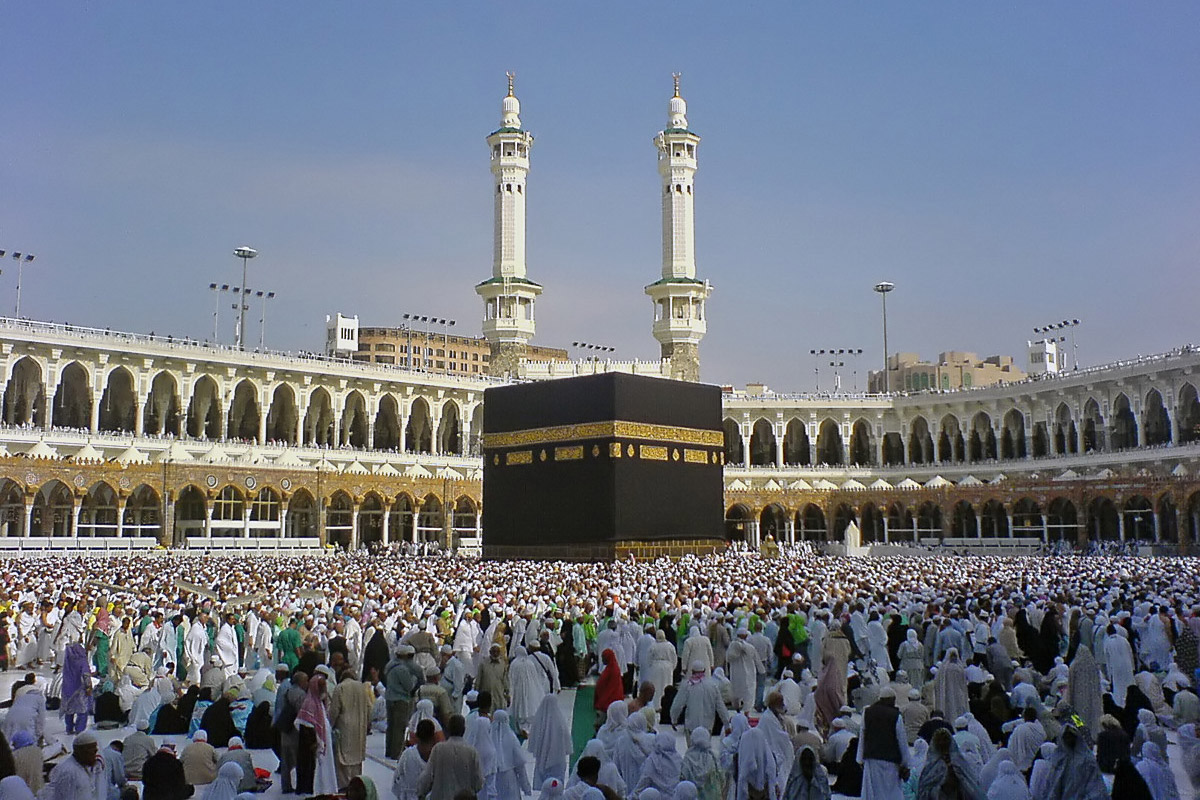
3 million Muslim pilgrims in Saudi Arabia for climax of Haj

The Kabba in Mecca
The Kabba in Mecca

Some 3 million Muslim pilgrims ascended Mount Arafat near Mecca in Saudi Arabia at the climax of the annual haj.

Authorities deployed around 100,000 security personnel to secure the pilgrims, the state-run Saudi Press Agency reported.

The granite hill is the place where the Muslim prophet Mohammed is said to have delivered his last sermon around 14 centuries ago.

The pilgrims wear seamless white robes to symbolize equality during the haj, one of the five pillars of Islam. It culminates in the feast of Eid al-Adha on Tuesday.

Saudi officials on Sunday said 1.3 million pilgrims arrived from abroad – 21 per cent less than last year. No reason was given for the decline.

The pilgrimage comes as the Middle East Respiratory Syndrome -Coronavirus (MERS-CoV) has been slowly spreading in parts of the region.

At least 136 cases, including 58 deaths, have been reported since last month. Sporadic outbreaks have been limited to Jordan, Saudi Arabia, Qatar and the United Arab Emirates.

The risk of the spread of illness or stampedes in Saudi Arabia is present during the haj.

In 2006, nearly 350 pilgrims were killed in a stampede.

In 1987, more than 400 people were killed when police attempted to break up a political rally. Saudi authorities have since warned pilgrims to avoid political activities during the pilgrimage. – dpa

Canadian wins Nobel Prize in literature

Alice Munro
Alice Munro

Canadian writer Alice Munro has won this year’s Nobel Prize in literature.

More than a hundred reporters from around the world thronged and bustled in the Stock Exchange Building in Stockholm’s Old Town for about an hour before the doors to the Swedish Academy swung open.

Notably, there were many Japanese reporters present, hoping to break the news that Haruki Murakami had won the prize. Finally, the Swedish Academy’s Permanent Secretary Peter Englund stepped out from the doors and said Canadian short story writer won the prize.

The Swedish Academy, which selects Nobel literature winners, called her a “master of the contemporary short story”.

This may have to do with the frank intimacy of her tone, which is stripped of ornament and fuss, yet also, in its plainness, contains huge amounts of terrible, sublime, and contradictory feeling.

It may have to do with the fact that she writes mostly about women who want to escape some kind of confinement, who are hungry for experience above all else, and who attain it at a dear price.

They are elegant, wry, determined women. They are also subversives, and because they allow us into their lives.

It may have to do with her work being politically very safe.

Munro is the first Canadian writer to receive the prestigious $1.2m award since Saul Bellow, who won in 1976 and left for the US as a boy.

Munro’s writing has brought her numerous awards including a National Book Critics Circle prize for “Hateship, Friendship, Courtship, Loveship, Marriage”. She is also a three-time winner of the Governor General’s Prize, Canada’s highest literary honour.

Last year’s Nobel literature award went to Mo Yan of China.

The 2013 Nobel announcements continue on Friday with the Nobel Peace Prize, followed by the economics prize on Monday.

Black rappers embrace twerking Miley Cyrus

Miley Cyrus in a typical pose

by Mesfin Fekadu

While Miley Cyrus has a batch of critics, there is a group rallying behind her and praising her as a vital talent: rappers.

Pharrell produced several songs on Cyrus’ new album. She has been featured on the latest albums from Snoop Lion and will.i.am. Big Sean requested her as the star of his “Fire” music video. And to top it off, Kanye West invited her to appear on the remix to “Black Skinhead,” his anti-racism rant from his eerie and dark “Yeezus” album.

Cyrus’ album “Bangerz,” out Tuesday, features guest spots from Big Sean, Nelly, Future and French Montana. In an interview, Juicy J called the 20-year-old “a genius.” 50 Cent, who hasn’t yet worked with her, added that Cyrus “can be on anything hip-hop orientated because (she’s) rebellious.”

The idea of the former “Hannah Montana” star becoming a muse for rap stars seems odd to some, but Mike WiLL Made-It, who executive produced “Bangerz,” said the singer has struck a chord with rappers because she isn’t following in the footsteps of pop stars like Katy Perry but creating her own bold path.

“People like Kanye are fans of music, people like Pharrell are fans of all types of music. … It all boils down to her being very talented and not scared to do new things,” said the producer, whose new single, “23,” features Cyrus, Wiz Khalifa and Juicy J.

“Her voice is incredible. It’s one of a kind … no limitations,” added Mike WiLL Made-It, who is behind hits like Juicy J’s “Bandz a Make Her Dance” and Rihanna’s “Pour It Up.”

Others aren’t sure if talent is the reason behind it.

“Whether you’re a Miley fan or not, she is the girl of the moment,” said Cori Murray, entertainment director at Essence magazine. “Business is business. They’re in the music business; she’s the girl of the moment, so why not get on record with the girl of the moment? That’s as basic as it’s going to get.”

Cyrus, who will host and perform on NBC’s “Saturday Night Live” this week, has been the girl of the moment for months now. It started with her transformation from teen queen to twerk queen, rising with her edgy “We Can’t Stop” party-style music video. Of course, she hit new heights (or to some, new depths) with her eye-popping, sexually charged MTV Video Music Awards performance in August. It featured the scantily dressed singer twerking, gyrating on Robin Thicke and what’s become her signature move – sticking out her tongue.

The wild child antics – from being nude in the music video for her first No. 1 hit, “Wrecking Ball,” to her embrace of drug culture in a recent Rolling Stone interview – have made headlines. But her VMA performance and twerking with black female dancers caused another stir, with many questioning if Cyrus is wrongfully appropriating black culture as a path to success.

“That’s a very ignorant statement to say like, ‘Oh, she’s misrepresenting the black culture ’cause she’s twerking.’ If that’s the only thing that represents the black culture, that’s sad,” Mike WiLL Made-It said. “We got a whole bunch of (stuff) that represents the black culture.”

Murray, who said she and other editors at Essence discussed Cyrus after her VMA performance, echoed the producer’s thoughts.

“I think the black culture that she is influenced by, I think it’s black culture that has become popular culture. There is so much to (black culture) and we’re so complicated and she is just what mainstream America thinks about black culture,” she said.

But while the star is a product of hip-hop culture, “Bangerz” is far from a hip-hop album. The 13-track set has moments that are downbeat, others are up-tempo dance numbers and electronic. It also features Britney Spears and production and songwriting work from pop master Dr. Luke.

“Once they get over all the twerking … once they get past all of that and listen to the music, the music is actually great,” said Mike WiLL Made-It.

While Cyrus has her rap cheerleaders, not everyone has embraced her. When asked about Cyrus’ high profile rap collaborations, Ahmir “Questlove” Thompson jumped in with: “Or the idea of Miley using us as accessories? I don’t know.”

“I kind of felt same sort of way when Gwen Stefani went through her Asian phase as accessories. At the end of the day, it’s like, is that objectifying us? Hip-hop is already a one-dimensional view as far as us looking like caricatures,” the Roots leader said.

“Yeah, I’m all for collaborating, my life is based on collaborations, but I’m more concerned about what it’s based in. Is it genuine interest or is it like a benign curiosity about a culture? I don’t want her to just take that we’re just good for twerking and having big (butts).”