The Catholic media is up in arms over comments President Obama made during a speech while in Northern Ireland for the G8 summit. Obama made what is described as “an alarming call for an end to Catholic education,” in spite of the fact that it is considered “a critical component of the Church.”
In front of an audience of about 2,000 young people, including many Catholics, Obama claimed that Catholic education divides people and blocks peace, according to the Scottish Catholic Observer
“If towns remain divided—if Catholics have their schools and buildings and Protestants have theirs, if we can’t see ourselves in one another and fear or resentment are allowed to harden—that too encourages division and discourages cooperation,” Obama said.
Catholic World News noted:
Ironically, President Obama made his comments just as Archbishop Gerhard Müller, the prefect of the Congregation for the Doctrine of the Faith, told a crowd in Scotland that religious education upholds the dignity of the human person. Archbishop Müller said that Catholic schools should promote “all that is good in the philosophies of societies and human culture.”
Fr. John Zuhlsdorf quoted the Observer’s article on Fr. Z’s blog and added:
Another example of what this man wants: total isolation of any religious values in the private sphere alone. Pres. Obama is working either to intimidate or legislate or even TAX religious freedom out of the public square.
Off the top of my head, I can’t think of a foreign visit to a Islamic nation where he told people on his arrival that they shouldn’t have madrasas. Can you?
Did he when visiting, say, Israel, say “You Jews shouldn’t have synagogue schools and you muslims shouldn’t have mosque schools.” I can’t remember. Did he?
Each of the articles drew numerous public comments, most suggesting that Obama be more concerned about the public schools in the United States than their parochial schools, which are working just fine. – bizpacreview.com
What a difference 5 years make: Obama braves blistering Berlin heat to make speech before invite-only crowd of 4,500 (that’s 195,500 FEWER than last time he was in Germany)
It was a more muted affair for President Obama in Berlin today as he spoke at Berlin’s iconic Brandenburg Gate before an invite-only crowd of 4,500 guests – a remarkable difference from the rock-star welcome he received five years ago in front of 195,500 cheering supporters.
Then, Obama had it all to play for – the glowing presidential candidate symbolizing America’s revived hope for the future. This time, he arrived back in Berlin under the cloud of NSA surveillance programs which have outraged many Europeans and the ever-growing crisis in Syria.
The President removed his jacket and rolled up his sleeves as he battled the 86F temperature on Wednesday, quipping: ‘People of Berlin, your welcome is so warm I’m going to take off my jacket.’
What a difference five years makes: 200,000 people came out to see then presidential candidate Barack Obama speak in 2008 at the Victory Column, around a mile from his speech today
At times wiping away beads of sweat, the President read from paper because the teleprompter wasn’t working.
He used the bulk of his speech to call for a reduction in the world’s nuclear stockpiles – as he stood behind high walls of bullet-proof glass in the public square. The two-inch thick sheets are routinely used when the President appears before large crowds in public spaces.
Appealing for a new citizen activism, Obama renewed his call for the world to confront climate change, a danger he called ‘the global threat of our time’.
In a wide-ranging speech that enumerated a litany of challenges facing the world, Obama said he wanted to reignite the spirit that Berlin displayed when it fought to reunite itself during the Cold War.
Obama’s Kenyan half-sister made a rare public appearance as she joined Michelle and her daughters for emotional visit to Berlin’s Holocaust memorial
‘Today’s threats are not as stark as they were half a century ago, but the struggle for freedom and security and human dignity, that struggle goes on,’ Obama said at the city’s historic Brandenburg Gate under a bright, hot sun.
‘”And I come here to this city of hope because the test of our time demands the same fighting spirit that defined Berlin a half-century ago.’
The German press had mixed reviews for Obama on Wednesday, a marked difference from five years ago when ‘Obama-mania’ greeted him in the streets.
National newspaper Die Zeit published an article online on the Berlin speech, saying that Obama appeared to be the ‘young, fresh, uninhibited’ political force he was five years ago – but that the time between his speeches has been marked by ‘bitter disappointment’.
The article said Obama’s battles over gun control and equality for same-sex marriage must be remembered, otherwise his speech in Berlin could be seen as just ‘nice words’ in light of his decisions on Guantanamo and the NSA surveillance.
Other than his landmark speech, the President spent Wednesday in talks with German chancellor Angela Merkel and other top politicians including president Joachim Gauck.
He touched down with his family in the German capital on Tuesday night, waving to the crowds gathered at Tegel Airport.
His wife Michelle and daughters Malia and Sasha visited the city’s Holocaust memorial on Wednesday, accompanied by the President’s half-sister Auma, who studied in Germany.
Five years ago, when he was still seeking election as President, Obama received a rapturous reception on a brief tour of Europe where he was greeted as a leader who could give the world a fresh start after the controversial presidency of George W. Bush.
Now he is a much more divisive figure – although his re-election last year was welcomed by most Europeans, recent revelations about his administration’s spying on internet communications have tarnished his record in the eyes of many.
Mr Obama’s speech tomorrow will inevitably be compared with JFK’s, which took place on June 26, 1963 at the Rathaus Schöneberg, a few miles away from the Berlin Wall which had been under construction over the previous two years.
Kennedy’s speech, considered one of his best, held up West Germany as a symbol of freedom on the front line of the battle against communism.
It featured the famous line: ‘All free men, wherever they may live, are citizens of Berlin, and therefore, as a free man, I take pride in the words, “Ich bin ein Berliner!”‘ – Daily Mail
Survivors of a dinghy tragedy that left 63 migrants dead have accused the Nato member states of failing to come to the aid of people in danger.
The harrowing case known as the boat “left-to-die” was first revealed by the Guardian in 2011 and raised serious questions about the role of Nato naval vessels and military aircraft after a tiny dinghy crammed with 72 migrants from sub-Saharan Africa ran out of fuel and drifted for two weeks along one of the busiest shipping lanes in the world. The passengers died one by one, despite numerous distress calls, while Nato allies engaged in the operation against Muammar Gaddafi were in the waters nearby but did not help.
An initial legal complaint was shelved by the Paris prosecutor’s office last year after the French military claimed it had no responsibility.
Last year, an investigation by the Council of Europe, the continent’s human rights watchdog, found that a catalogue of institutional and legal failures led to the avoidable deaths of the migrants. It called on Nato and its member states to launch separate inquiries into why so many military units – including a Spanish frigate under Nato command that was sailing in the immediate vicinity of the boat – failed to respond to the migrants’ desperate pleas for help.
The new Paris legal complaint – with the International Federation of Human Rights Leagues and three other rights groups as civil parties – is designed to force a judicial inquiry by a French investigating judge. Another complaint is to be lodged in Belgium and official demands for information have been made in Canada and the UK.
Human rights groups denounced the lack of information from defence ministries whose forces were present.
Father Mussie Zerai, an Eritrean priest in Rome, one of the last people to communicate with the migrant boat before its satellite phone battery ran out, warned against the omertà, or code of silence, among Nato states.
Survivor’s account
Launching the legal case, Abu Kurke , a survivor, described what happened after the dinghy left Libya on March 27 2011 before washing up in Libya two weeks later with only 11 people alive, two of whom died shortly after.
Abu Kurke (25) had fled his native region of Oromia in Ethiopia as a result of political violence, trekking across the Sahara to reach the north African coast. He and a friend paid for their passage on the dinghy but boarded without food or water after the Libyan military intercepted them and took their bags. Abu Kurke found the boat “very small, very dangerous”. He considered swimming back but his friend warned that Libyan forces might open fire.
He now lives in the Netherlands with his wife and child, and needs ear surgery after injuries from sun exposure. “I have constant nightmares,” he said. “To see 63 people die is something that you can’t easily forget.”
Gonzalo Boye, the lawyer heading the Spanish case, said that naval ships on a military operation that did not assist civilians in danger was equivalent to a “war crime”. – Guardian News and Media 2013
Italy’s first black Cabinet minister is facing Internet death threats before a visit to a region known for its anti-immigrant political base.
But Cecile Kyenge says she’s not afraid and challenged Italians to respond to such intimidation themselves to prove that Italy isn’t racist.
Kyenge, a Congolese-born doctor who has lived in Italy since 1983, has been the target of racist diatribes ever since she was named integration minister in April. She has been called “Congolese monkey,” and a member of a “bonga bonga government.”
Last week, a local politician from the xenophobic Northern League party was expelled from the party after she suggested on Facebook: “Why doesn’t someone rape her (Kyenge), so she can understand what victims of atrocious crimes feel?” The official, Dolores Valandro, was implying that immigrants were responsible for violent crime in Italy.
Kyenge on Wednesday acknowledged “racist episodes,” but declined to brand the country as a whole racist. She has offered a muted response to the attacks against her, saying it’s more for Italy as a nation to respond.
“These actions are directed against all of us, not just me,” Kyenge told reporters. “Surely it hasn’t left me indifferent. But I think the response that the country gives is important.”
Unlike France, Germany or Britain, where second and third generations of immigrants have settled, albeit uneasily, Italy is a relative newcomer to the phenomenon, with the first waves of immigrants coming to Italy’s shores only in the 1980s. The country’s race problem was then largely seen at soccer stadiums, where even today black stars like Mario Balotelli are routinely subjected to racists taunts.
But Kyenge’s emergence onto the political stage has brought the issue to the fore, spurred on in part by her call for Italy to change its citizenship law to allow children born in Italy of legal immigrants to obtain citizenship more easily.
Currently, such children can only apply once they turn 18, and can be denied citizenship for a host of bureaucratic mistakes or omissions. Kyenge says changing the law is a key part of changing Italians’ very concept of citizenship, to take into account the country’s changing demographics.
Foreigners made up about 2 percent of Italy’s population in 1990; currently the figure stands at 7.5 percent.
“It’s a new citizenship that comes about by the meeting of different cultures,” she said.
Her call, however, has been met with stiff resistance by the anti-immigrant Northern League, which isn’t taking part in a parliamentary committee drafting the new citizenship law. Kyenge’s spokesman, Cosimo Torlo, said it’s unclear at what age citizenship could be obtained under the proposed legislation – at age 3, 5 or 10 – but that “Whatever it is, it will be better than the current law.”
The threats against Kyenge are real. She arrived at the Foreign Press Association with a phalanx of bodyguards, two of whom flanked the dais where Kyenge spoke, talking into their shirt cuffs and sending signals to two other colleagues at the back of the room.
Asked about the unusually high security detail, Kyenge noted that all ministers have bodyguards. “But it’s clear that for me, because of the threats I have received, there’s a greater attention on protection.”
This weekend, Kyenge will give the opening address to a multicultural festival in the northern region of Veneto, the political home base of the Northern League. Far-right groups are planning a protest. Isabella Zuliani, vice mayor of the town hosting the event, told newspaper Il Gazzettino that police have already been informed about a new round of Internet death threats directed at Kyenge, including one that exhorted simply: “Kill her.”
“Racist episodes exist, but you can’t say that a country is racist because there are certain episodes in the territory,” Kyenge said.
That said, Kyenge appeared more ready to acknowledge such “racist episodes” than in her first meeting with the media, soon after she was nominated. Then, she said Italy’s problem wasn’t so much racism as ignorance of “the other.”
After two months of taunts directed against her, Kyenge said, “Maybe what is missing in Italy is a culture of immigration: We have to try to know, understand the ‘other,’ and that diversity is a richness.
“As soon as we understand that, we can evaluate whether Italy is racist,” she added. – AP
Thousands of demonstrators gather outside the Greek public television and radio broadcaster ERT headquarters in Athens, June 11, 2013.
Greece’s governing coalition parties are to meet for a second time in three days to try and end a political crisis triggered by the closure of state broadcaster ERT.
Conservative Prime Minister Antonis Samaras will hold talks later Wednesday with coalition partners — the Socialist Pasok and Democratic Left parties — who have opposed his decision to switch of ERT’s signal and fire all its 2,700 employees.
The dispute has raised the threat of a snap general election in crisis-hit Greece, just one year after the last general election. But most analysts have argued that politicians are unlikely to gamble on the country’s vital bailout program given that opinion polls suggest no party would emerge the outright winner.
Shares on the Athens Stock Exchange were broadly unchanged Wednesday, as markets in Europe drifted.
Pasok spokeswoman Fofi Gennimata demanded that the government switch ERT’s signal back on, in compliance with a high court decision this week.
But conservatives insist the public broadcaster will remain off the air until a more efficient state TV and radio network is set up.
“It’s fairly simple. A mistake has been made and it must be corrected,” Gennimata told private Vima FM radio. “It requires bravery to correct a mistake. But that is necessary. It’s not acceptable for an elected government to fail to comply with a high court order.”
Gennimata denied reports that senior members of her party were seeking Samaras’ replacement as prime minister.
Fired ERT employees have continued unauthorized broadcasts since the broadcaster’s June 11 closure, streamed mostly online and on disused analog frequencies, and have even expanded regional TV and radio programming this week.
Journalist and other media unions on Wednesday filed a law suit against Greece’s finance and media ministers, accusing them of violating the high court ruling.
ERT was axed as international pressure is growing on the bailed out country to fire public servants and speed up long-term cost cutting reforms aimed at making the country’s budget and national debt sustainable.
Samaras has described ERT as an organization under excessive union control that could not be reformed without closure. Opponents counter that ERT’s problems stem from decades of political interference in programming and hiring decisions.
Greece’s two largest labor unions are planning to stage a protest rally outside ERT headquarters, a building 10 kilometers (6 miles) north of central Athens that remains occupied by laid off broadcast workers for a ninth day. Protests in other Greek cities and towns are also planned to start at 6:00 p.m. (1500GMT), to coincide with Samaras’ coalition talks. – AP
Trying to tamp down concerns about government over-reach, President Barack Obama on Wednesday defended U.S. Internet and phone surveillance programs as narrowly targeted efforts that have saved lives and thwarted at least 50 terror threats.
“This is not a situation in which we are rifling through ordinary emails” of huge numbers of citizens in the United States or elsewhere, the president declared during a news conference with German Chancellor Angela Merkel. He called it as a “circumscribed, narrow” surveillance program.
“Lives have been saved,” Obama said, adding that the program has been closely supervised by the courts to ensure that any encroachment of privacy is strictly limited.
Merkel, for her part, said it was important to continue debate about how to strike “an equitable balance” between providing security and protecting personal freedoms.
“There has to be proportionality,” she said. She added that their discussion on the matter Wednesday was “an important first step” over striking a balance.
Merkel appeared to be looking to avoid a public rift with Washington over the surveillance program, particularly since Germans benefit from U.S. intelligence. Much of the German criticism of the program has come from her junior coalition partners, facing the prospect of losses in the September election and looking for an issue.
The two leaders spoke to the media after meeting privately on a range of issues confronting U.S. and European leaders, including the fragile effort to bring peace in Afghanistan, where peace talks with the Taliban are in the offing to find ways to end the nearly 12-year war. Earlier Wednesday, Afghan President Hamid Karzai suspended talks with the United States on a new security deal to protest the way his government was being left out of the initial peace negotiations with the Taliban.
Obama said the U.S. had anticipated “there were going to be some areas of friction, to put it mildly, in getting this thing off the ground. That’s not surprising. They’ve been fighting there for a long time” and mistrust is rampant.
Karzai said Wednesday that peace talks cannot begin amid “fighting and bloodshed.” But Obama said it was important to pursue a parallel track toward reconciliation even as the fighting continues, and it would up to the Afghan people whether that effort ultimately bears fruit.
On another world trouble spot, the 2-year-old Syrian civil war, the president declined to provide details on the type of military support the U.S. will provide to opposition forces. But he said the administration had been consistent in working toward the over-riding goal of a Syria that is “peaceful, non-sectarian, democratic, legitimate, tolerant.”
“I cannot and will not comment on specifics around our programs related to the Syrian opposition,” he said.
The president said while world leaders at the just-completed Group of 8 summit in Northern Ireland could not agree on whether Syrian President Bashar Assad must go, he believes Assad cannot regain legitimacy.
And the president offered reassurances on another issue of particular concern in Germany. In response to a question from a German reporter, Obama said the United States doesn’t use Germany as a launching point for unmanned drones to strike terrorist targets. He said he knows there have been some reports in Germany speculating that was the case, but it’s not so.
Later Wednesday, Obama planned to draw attention to his plan for a one-third reduction in U.S. and Russian arsenals, rekindling a goal that was a centerpiece of his early first-term national security agenda.
His 26-hour whirlwind visit to the German capital caps three days of international summitry for the president and marks his return to a place where he once summoned a throng of 200,000 to share his ambitious vision for American leadership.
Obama will make the case for his nuclear plan during a speech at Berlin’s iconic Brandenburg Gate. His address comes nearly 50 years after John F. Kennedy’s famous Cold War speech in this once-divided city, and five years after Obama spoke in the city during his 2008 run for president.
The president has previously called for reductions to the stockpiles and is not expected to outline a timeline for this renewed push. But by addressing the issue in a major foreign policy speech, Obama is signaling a desire to rekindle an issue that was a centerpiece of his early first-term national security agenda.
Five years later, Obama comes to deliver a highly anticipated speech to a country that’s a bit more sober about his aspirations and the extent of his successes, yet still eager to receive his attention at a time that many here feel that Europe, and Germany in particular, are no longer U.S. priorities. A Pew Research Center poll of Germans found that while their views of the U.S. have slipped since Obama’s first year in office, he has managed to retain his popularity, with 88 percent of those surveyed approving of his foreign policies.
Obama also has an arc of history to fulfill.
Fifty years ago next week, President Kennedy addressed a crowd of 450,000 in that then-divided city to repudiate communism and famously declare “Ich bin ein Berliner,” German for “I am a Berliner.” Since then, presidents from Ronald Reagan to Bill Clinton have used Berlin speeches to articulate broad themes about freedom and international alliances.
Obama, fresh from a two-day summit of the Group of Eight industrial economies, placed his hand over his heart outside the sunny presidential palace as a German military band played “The Star-Spangled Banner,” the American national anthem. He and German President Joachim Gauck inspected a lineup of German military troops before entering the palace, stopping to greet children who waved American and German flags.
The visit was attracting widespread attention in Germany. People waved and snapped photos as Obama sped by after his arrival and a thick cluster awaited the motorcade as it passed the Brandenburg Gate. An evening news show in Berlin devoted itself to the president’s visit, highlighting “Das Biest,” or “The Beast,” as the president’s armored limousine is called.
There have been a few small protests, including one directed against the National Security Agency’s surveillance of foreign communications, where about 50 people waved placards taunting, “Yes, we scan.”
Merkel has said she was surprised at the scope of the spying that was revealed and said the U.S. must clarify what information is monitored. But she also said U.S. intelligence was key to foiling a large-scale terror plot and acknowledged her country is “dependent” on cooperating with American spy services.
For Merkel, the visit presents an opportunity to bolster her domestic standing ahead of a general election in September.
The U.S. and the Germans have clashed on economic issues, with Obama pressing for Europe to prime the economy with government stimulus measures, while Merkel has insisted on pressing debt-ridden countries to stabilize their fiscal situations first.
But the two sides have found common ground on a trans-Atlantic trade pact between the European Union and the U.S. At the just-completed G-8 summit, the leaders agreed to hold the first talks next month in the U.S. – AP
Top Nazi war crimes suspect Laszlo Csatary, accused of overseeing thousands of Jewish deportations during World War II, was charged with war crimes on Tuesday in Hungary, prosectors said.
The 98-year-old, under house arrest since last year after apparently living for years undisturbed in Hungary, is listed by the Wiesenthal Center as its most-wanted alleged Nazi war criminal. – Sapa
Sweden will next year introduce a total ban on bestiality, which until now has only been illegal if cruelty to the animal could be proven, the government said Thursday.
“The government is now tightening the rules surrounding bestiality so there will be no doubt about the fact that it is prohibited to inflict suffering on animals,” Minister for Rural Affairs Eskil Erlandsson said in a statement.
“The should be no doubt that bestiality is unacceptable.”
Until now, bestiality was illegal in Sweden only if it could be proven that the animal had subjected to suffering.
From January 1, any sexual act with an animal will be punishable by a fine, a maximum prison sentence of two years, or both, even if the animal shows no sign of injury or suffering.
“It’s very good that the law will be changed,” a spokesman for the Swedish Federation of Veterinarians, Johan Beck-Friis, told AFP.
“It’s very important that society makes a clear statement that it is unacceptable to use animals that way,” he said.
The ban will bring Sweden in line with a European Union directive.
Germany introduced a ban in December, following in the footsteps of Britain, France, and Switzerland among others.
The Swedish parliament is expected to pass the bill into law soon, as there is broad political consensus on the issue.
According to Beck-Friis, under the current law veterinarians may suspect that an animal has been sexually abused but they are generally unable to prove it.
As a result, there are no statistics available on how common bestiality is in the country.
In 2006, the latest year for which statistics are available, about 100 cases of animals suffering injuries suspected of being related to bestiality were brought to the authorities’ attention, Beck-Friis said. – AFP
Turkey on Monday said it had contacted British authorities to inquire about “unacceptable” newspaper allegations that Britain spied on Finance Minister Mehmet Simsek’s emails and phone calls when he was in London in 2009.
Documents leaked by US former spy Edward Snowden appear to show that Britain spied on foreign delegates including fellow NATO member Turkey at G20 meetings at the time, British newspaper The Guardian reported Monday.
“It is clear that if the report is true, such an action by an ally country is unacceptable,” the foreign ministry said in a statement, stressing that it was waiting for “an official and satisfying statement from British authorities” on the matter.
“This will constitute a scandal in terms of relations between the two countries if any truth is found in the allegations,” it added.
As with the other G20 participants who were reportedly spied on, including South Africa, there is no suggestion that Simsek and his party were involved in any kind of criminal offence, according to the newspaper.
The newspaper said it had seen a document showing that Britain’s Government Communications Headquarters (GCHQ), its electronic eavesdropping agency, put Simsek under surveillance while in London, and possibly up to 15 members of his delegation as well.
The document stated that the objective was “to establish Turkey’s position on agreements from the April London summit” and their “willingness (or not) to co-operate with the rest of the G20 nations”.
According to the leaked files seen by the Guardian, British spies tricked delegates into using specially prepared Internet cafes. Those cafes allowed the spies to intercept communications and monitor email messages and phone calls through delegates’ BlackBerry devices. – AFP
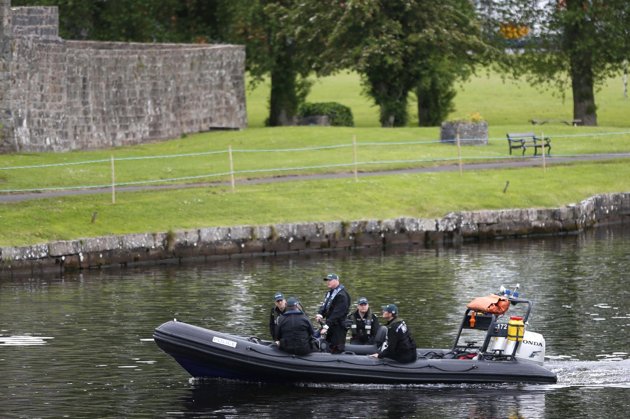
Police patrol the water around Enniskillen in Northern Ireland where the G8 summit is being held
British Prime Minister David Cameron says leaders gathering Monday for the G-8 summit in Northern Ireland should reach speedy agreement on trade and tax reforms, and draw inspiration from the host country’s ability to resolve its own stubborn conflict.
Speaking hours ahead of the summit’s official opening at a lakeside golf resort, Cameron said he expects formal agreement to launch negotiations on a European-American free trade agreement. He said a pact to slash tariffs on exports would boost employment and growth on both sides of the Atlantic.
“This will be a summit that will drive growth and prosperity all over the world,” Cameron declared as he arrived at the summit venue ahead of leaders from the United States, Canada, Russia, Germany, France, Italy and Japan as well as the 27-nation European Union.
Referring to Northern Ireland’s ability to leave behind a four-decade conflict that claimed 3,700 lives, he said leaders of the Group of Eight wealthy nations should be inspired by the setting – the lush lakelands of County Fermanagh – to deliver their own economic breakthrough.
“Ten or 20 years ago, a G-8 in Fermanagh would have been unimaginable. But today Northern Ireland is a very different place … a symbol of hope to the world,” Cameron said.
Obama, seizing on that theme, was beginning his trip in the Northern Ireland capital of Belfast, where he’s delivering a speech on sustaining Catholic-Protestant reconciliation 15 years on from the U.S.-brokered Good Friday peace accord.
The U.S. leader was scheduled to speak inside Belfast’s Waterfront Hall, a glass-fronted building that would never have been built during the city’s long era of car bombs that ended with a 1997 Irish Republican Army cease-fire.
But with IRA splinter groups still active today, Northern Ireland’s police appear to be leaving little to chance in ensuring security around the Lough Erne resort west of Enniskillen.
More than 3,500 officers from Britain have been imported to double the security detail, and British Army engineers have helped to erect a daunting perimeter of steel fences and coiled razor wire for miles (kilometers) around the resort’s lone road entrance.
Air space over much of Northern Ireland is being restricted to summit traffic for the duration of the summit, which concludes Tuesday. And the water around the resort’s peninsula has been similarly closed to civilians, with police patrolling by boat, although the public is still free to fish from shore.
And Northern Ireland’s riot-savvy police have been deployed in armored vehicles and flame-retardant suits. They’re keeping massive mobile water-cannon vehicles in reserve, lest hard-left protesters make any serious bid to breach the security fence.
However the police commander of G-8 security, Assistant Chief Constable Alistair Finlay, says he expects peace to reign when socialist and anti-globalization protesters march Monday night from central Enniskillen to the fence.
Finlay said while officers had trained to manage crowds of more than 10,000 protesters, this was unlikely to materialize Monday, with just 2,000 expected and few anti-G-8 activists traveling from continental Europe for the occasion.
As the protesters march, G-8 leaders are due to hold a working dinner where foreign policy issues – especially the increasingly opposed positions of the United States and Russia over Syria’s civil war – will be on the menu.
Obama was expected to hold a bilateral meeting with Russian President Vladimir Putin before that dinner. Obama last week announced that the United States would begin arming rebel groups trying to oust the Russian-backed government of Bashar al-Assad.
Cameron said he also hoped to achieve agreement that no G-8 member should pay ransoms to secure the release of hostages in North Africa, where western and Asian workers are top targets for kidnappers. – AP
Clandestine immigrants on their way to Italy in a rubber dinghy
Seven immigrants drowned on Sunday during an attempted crossing to Italy by gripping on to a large tuna fishing cage towed by a trawler, according to witnesses from among the 95 people rescued by the coast guard.
Italy’s coast guard rescued the migrants off the shores of Sicily after reports came in of dozens of people clinging desperately to the tuna cage out at sea.
Survivors later told rescue workers that seven people with them had drowned after they had tried to scramble on board the trawler when the crew cut the line linking the boat with the cage.
Witnesses said the victims had been pushed back into the sea, Italian media said.
Rescuers pulled more than 250 people in several boats to safety on Sunday, as the number of people who landed in Italy over the weekend rose to over 900.
More than 100 men from Eritrea were taken to Lampedusa island off the Sicilian coast on Sunday, along with a further 55 people from a different boat, some of whom had jumped into the water at the sight of the coast guard.
On Saturday, some 690 immigrants were rescued from boats with engine trouble or dinghies that had begun taking on water, including a baby girl born during the crossing from Turkey.
Good weather has raised fears of increased numbers of migrants trying to reach Italy by sea. – AFP
France’s socialist government suffered the indignity of a first-round exit in a parliamentary by-election to replace a disgrace minister forced out over a tax-dodging scandal.
Former budget minister Jerome Cahuzac, who is facing charges of tax fraud, stepped down from his parliamentary seat in April.
In Sunday’s by-election for his seat in Lot-et-Garonne, southwest France, the socialist candidate was pushed into third place — and thus eliminated.
The second-round run-off on June 23 will be fought between a candidate from the centre-right UMP party of former president Nicolas Sarkozy; and a member of the far-right National Front (FN).
The vote was marked by a turn-out significantly lower than in the 2012 general election: only 46 percent of the 75,000 voters eligible to have their say bothered to do so.
President Francois Hollande acknowledged that the result was fall-out from the scandal around Cahuzac, whose ministerial portfolio had included the fight against tax evasion.
For UMP president Jean-Francois Cope, the result was another “scathing repudiation of Francois Hollande and his policies”.
Socialist party leader Harlem Desir called on voters to ensure the FN candidate did not win the second-round run-off vote.
Sunday’s result was another slap in the face for the ruling Socialists after defeats last weekend in two other by-elections.
The party now has 292 deputies in the National Assembly: just three seats more than the 289 seats that ensures an absolute majority.
Through to the second round are the UMP’s Jean-Louis Costes, who came first with 28.7 percent of the vote; and the FN candidate, 23-year-old Etienne Bousquet-Cassagne, who polled 26 percent.
Socialist candidate Bernard Barral came third with 23.7 percent. – AFP
Germans are expressing outrage as details of a US internet spy program – revealed by a former CIA employee-turned-whistleblower – are prompting comparisons with that of former communist East Germany’s Ministry for State Security.
Unfortunately for Obama’s upcoming trip to Berlin, it was revealed that Germany ranks as the most-spied-on EU country by the US, a map of secret surveillance activities by the National Security Agency (NSA) shows.
German ministers are expressing their outrage over America’s sweeping intelligence-gathering leviathan, with one parliamentarian comparing US spying methods to that of the communist East Germany’s much-dreaded Ministry for State Security (Stasi).
Washington is using “American-style Stasi methods,” said Markus Ferber, a member of Chancellor Angela Merkel’s Bavarian sister party and member of the European Parliament.
“I thought this era had ended when the DDR fell,” he said, using the German acronym for the disposed German Democratic Republic.
Clearly, enthusiasm for the American leader’s upcoming visit will be much more tempered than it was in 2008 when 200,000 people packed around the Victory Column in central Berlin to hear Obama speak of a world that would be dramatically different from that of his hawkish Republican predecessor, George W. Bush.
Merkel will question Obama about the NSA program when he visits in Berlin on June 18, government spokesman Steffen Seibert told reporters on Monday. Some political analysts fear the issue will dampen a visit that was intended to commemorate US-German relations on the 50th anniversary of John F. Kennedy’s famous “Ich bin ein Berliner” speech.
One year into his second term, Barack Obama seems powerless to roll back the military and security apparatus bolted down by the Bush administration in the ‘War on Terror.’
One consequence of this failure of the Obama administration to reign in Bush-era excesses emerged last week when former National Security Agency employee Edward Snowden, 29, blew the whistle on a top-secret intelligence system named Prism, which collects data on individuals directly from the servers of the largest US telecommunications companies.
According to documents leaked to the Washington Post and Guardian newspapers, PRISM gave US intelligence agencies access to emails, internet chats and photographs from companies like Google, Facebook, Twitter, Verizon and Skype.
Justice Minister Sabine Leutheusser-Schnarrenberger said leaked reports that US intelligence services are able to track virtually all forms of Internet communication demanded an explanation.
“The more a society monitors, controls and observes its citizens, the less free it is,” she wrote in a guest editorial for Spiegel Online on Tuesday. “The suspicion of excessive surveillance of communication is so alarming that it cannot be ignored. For that reason, openness and clarification by the US administration itself is paramount at this point.”
She has sent a letter to her “US counterpart Eric Holder” seeking clarification on the legal foundation of the PRISM program.
“I’ve observed with great concern reports about a possible program,” Leutheusser-Schnarrenberger said in a statement emailed by her ministry in Berlin. “This may constitute massive access to telecommunications data without permission on a huge scale.”
All of the facts must be put on the table, the minister added.
Obama has defended the intelligence-gathering system as a “modest encroachment” that Americans should be willing to accept on behalf of security.
“You can’t have 100 per cent security and also then have 100 per cent privacy and zero inconvenience,” he said. “We’re going to have to make some choices as a society. There are trade-offs involved.”
The United States, however, is not legally restricted from eavesdropping on the communications of foreigners, meaning in theory that Washington could be listening to and collecting the private communications of individuals anywhere in the world.
Peter Schaar, Germany’s federal data protection commissioner, said the leaked intelligence was grounds for “massive concern” in Europe.
“The problem is that we Europeans are not protected from what appears to be a very comprehensive surveillance program,” he told the Handelsblatt newspaper. “Neither European nor German rules apply here, and American laws only protect Americans.”
Meanwhile, German opposition parties hope to gain from the scandal, especially with parliamentary elections approaching in September, and Merkel looking to win a third term.
“This looks to me like it could become one of the biggest data privacy scandals ever,” Greens leader Renate Kuenast told Reuters.
Obama is scheduled to hold talks and a news conference with Merkel on Wednesday followed by a speech in front of the Brandenburg Gate, the 18th triumphal arch that is one of Germany’s most recognizable landmarks. – RT
For some Finnish women, adoption is the new pregnancy
The adoption of South African children by Finnish couples is steadily growing, South Africa’s ambassador to Finland Sello Moloto said on Friday.
In 2011, Finland’s statistics showed that most children adopted from abroad were born in South Africa, he said in Helsinki.
“It’s great. They are given a new life in Finland,” said Moloto.
“And you know, these adopted children are living much better here [in Finland] than some middle class families in South Africa, even better than my kids. They have guitars and ipads and lots of other things…”
Most of the adopted South African children in Finland had been abandoned.
In the past five years around 400 South African children were adopted in Finland, most of them aged between two and four.
“These kids, when you see them, they are already speaking Finnish,” said Moloto.
Many women in Finland chose not to have children as they concentrated on careers.
“Many of them decide not to have kids, as they don’t think they have the time for conceiving… but the main thing is the choice,” he said.
Finnish couples preferred South African children to those from other African states.
“I don’t know what are their reasons but South African laws are much tighter.
“They believe that if they pass through all the processes and screening, the child would not be reclaimed at a later stage.”
He said Finnish people also trusted the South African legal system more than other African countries.
The adopted children generally kept their South African-born names, like Bongani, Thando, and Bheko.
The children could at any time visit their homeland, as many of them retained dual citizenship for Finland and South Africa.
Moloto recently visited a couple who had adopted two South African boys.
The wife was a doctor and the husband a businessman.
“Everything in their home is South African. There are South African flags, emblems, music, food….” said Moloto.
They even celebrated South African holidays so that the boys would not forget their heritage and where they came from.
“I went there on the occasion of Freedom Day and they were having a braai. I was quite surprised.”
They also celebrated Mandela Day.
The boys were born to different mothers and were now brothers.
Finland worked mostly with the Johannesburg Welfare Society, but also other adoption agencies.
Women not wanting their babies were urged to take them to the society or other adoption agencies instead of abandoning them in public places.
“It’s better to leave the kid at the society… than dropping them on the sidewalk,” said Moloto.
According to Statistics Finland, adoptions in 2012 of children born abroad numbered 208.
“The largest groups in the adoptions from abroad to Finland were children born in China and South Africa,” it said on its website.
“In 2011, the largest groups in adoptions from abroad were children born in South Africa.” -Sapa
This website uses cookies to improve your experience. We'll assume you're ok with this, but you can opt-out if you wish. Cookie settingsACCEPT
Privacy & Cookies Policy
Privacy Overview
This website uses cookies to improve your experience while you navigate through the website. Out of these cookies, the cookies that are categorized as necessary are stored on your browser as they are essential for the working of basic functionalities of the website. We also use third-party cookies that help us analyze and understand how you use this website. These cookies will be stored in your browser only with your consent. You also have the option to opt-out of these cookies. But opting out of some of these cookies may have an effect on your browsing experience.
Necessary cookies are absolutely essential for the website to function properly. This category only includes cookies that ensures basic functionalities and security features of the website. These cookies do not store any personal information.
Any cookies that may not be particularly necessary for the website to function and is used specifically to collect user personal data via analytics, ads, other embedded contents are termed as non-necessary cookies. It is mandatory to procure user consent prior to running these cookies on your website.


 The Catholic media is up in arms over comments President Obama made during a speech while in Northern Ireland for the G8 summit. Obama made what is described as “an alarming call for an end to Catholic education,” in spite of the fact that it is considered “a critical component of the Church.”