The dollar soared Thursday as global markets reeled from the US Federal Reserve’s signal it may start to taper its massive stimulus this year.
News of a cash crunch in China also sent jitters through the market, driving investors into the safe-have dollar.
The euro fell to $1.3223 around 2200 GMT from $1.3297 late Wednesday.
The dollar jumped against the Japanese currency, to 97.27 yen from 96.39 yen, while the euro rose to 128.62 yen from 128.24.
“The price action in the US dollar today confirms that yesterday’s Federal Reserve meeting marked a major turning point for the greenback,” said Kathy Lien of BK Asset Management.
Stock markets across the globe and commodity prices swooned after Federal Reserve Chairman Ben Bernanke said Wednesday that the central bank could begin to wind down its $85 billion-a-month stimulus program as early as this year if the US economy continues to improve.
Analysts said the markets focused on the timetable for the tapering instead of the Fed’s statement that any move is conditional on the economic outlook.
The world’s reserve currency also benefited from renewed concerns about slowing growth in China, the world’s second largest economy, after weak manufacturing data.
Lien noted that interbank overnight lending rates in China had spiked to a record high in a rise that began two weeks ago, but the central bank has refrained from injecting money into the system.
The situation was made worse by weakening economic data, she said.
“Now China finds itself in a liquidity crunch begging for the central bank to step in,” Lien said.
“The central bank however refuses to do because they want to punish speculators and are in the midst of reforming the economy but the longer they hold off, the more disruption it will have on China’s economy and the global financial markets.”
The dollar rose to 0.9275 Swiss franc from 0.9277 late Wednesday.
The pound, however, was stronger against the greenback, fetching $1.5501, up from $1.5483. – AFP
The Star, once South Africa’s biggest daily, now also belongs to Sekunjalo
Sapa reports that Cosatu and its some of its affiliates make up a large portion of Sekunjalo Independent Media’s (SIM) shareholding, the company said on Thursday. But a mysterious Chinese investor is providing some of the funding and could end up with a 20% stake in one of South Africa’s most influential newspaper groups.
Employees of Independent News and Media (INM) would get 10 percent of the shares in company, SIM chairman Iqbal Surve said in a statement.
“We know we can continue to gro
w and run this media group profitably,” he said.
Independent News and Media in Ireland confirmed on June 17 that its shareholders had voted in favour of the sale of the media group to the Sekunjalo Group. The two shareholders of Independent News and Media SA (INMSA) would be SIM, with 75 percent, and the Government Employees’ Pension Fund (GEPF) acting through the Public Investment Corporation (PIC), with 25 percent. This would ensure that INMSA was “firmly in South African hands”, said Surve.
He said 63 percent of SIM’s shares would be held by Sekunjalo Investment Holdings; the Congress of SA Trade Unions’ (Cosatu) investment company Kopano Ke Matlaka, represented by Collins Matjila; the SA Clothing and Textile Workers’ Union Investments Group, represented by Andre Kriel; the Food and Allied Workers’ Union, represented by Basebenzi Investments and Katishi Masemola; and employees, via a special purpose vehicle.
The other 37 percent would be held by a number of “broad-based value adding partners”, he said.
These included the Black Business Chamber (Western Cape) and various independent South African Women’s business community organisations, represented by Lindiwe Barbara Ngcobo, and Manemele Maria.
Sekunjalo Digital Media would help drive a digital and mobile growth strategy; and the Mvezo Development Trust, represented by Mandla Mandela, would provide for the development of the communities of the Eastern Cape.
They were joined by the Umkhonto we Sizwe Military Association (through the Military Veterans’ Trust); and the Western Cape Development Trust, which would focus on the provision of bursaries for journalists from black communities.
Other shareholders were prominent entrepreneurs and business people such as Sandile Zungu, and media and advertising personalities Tim Modise and Groovin Nchabeleng, from the Blue Print Group.
“The Sekunjalo Consortium will at all times have control of INMSA, with a number of funding partners sharing in the equity of the company,” said Surve Funding would come from SIM itself, from banks, the trade union investment companies, the GEPF, and a Chinese consortium.
“To ensure that the business has sufficient capital resources to reinvest in vernacular titles, digital strategy, reinvigorating existing titles and an African growth strategy, additional funding has been arranged which may see a further shareholding/investment of 20 percent placed with the Chinese consortium,” he said.
INMSA owns the Cape Times, the Cape Argus, the Weekend Argus, the Daily Voice, The Star, Pretoria News, Saturday Star, Sunday Independent, Diamond Fields Advertiser, Weekend Pretoria News, Daily News, The Mercury, Post, Independent on Saturday, the Sunday Tribune, the Zulu daily newspaper, Isolezwe, and its Saturday and Sunday editions.
It also owns a number of weekly community newspapers in the Western Cape, and has investments in the community newspaper markets in KwaZulu-Natal and Gauteng.
It also owns and runs Independent Online (IOL) and publishes three Conde Nast international magazine brands: House & Garden, GQ and Glamour.
Surve said he strongly believed in the future of print media in South Africa.
“This is the beginning of a strategy to invest in newspapers across Africa, and to focus on developing digital and other cross-media opportunities.”
The Media Workers’ Association of SA (Mwasa) welcomed the announcement and said it believed the staff share would revolutionise labour relations in the media sector.
“Mwasa welcomes this offer to empower all staff and looks forward to further formal engagements to determine logistical and operational arrangements for the participation of staff in the direction of the new company,” it said.
It looked forward to meeting the challenges and opportunities the announcement presented, and congratulated Surve and the SIM consortium on a “watershed achievement”.
South African manufacturers of truck and bus tyres are the latest target of a Brazilian antidumping investigation against South Africa, following an application by the Brazilian body representing tyre manufacturers, ANIP.
This comes in the wake of another trade probe of South Africa, over allegations of Sasol dumping polypropylene products, launched in March this year. Meanwhile, the tiff between the two Brics (Brazil, Russia, India, China and South Africa) members about cheap chicken imports to South Africa has been continuing.
Brazil threatened legal action at the World Trade Organisation (WTO) last year when South Africa’s International Trade Administration Commission investigated the dumping of frozen Brazilian poultry in South Africa and introduced a provisional antidumping duty.
Brazil initiated an antidumping probe on June 10 into imports of new truck and bus tyres from South Africa, Russia and Asian countries, giving importers 40 days to respond. It alleged South Africa’s manufacturers were dumping at a 51.98% discount.
South African Tyre Manufacturers Conference CEO Etienne Human said the claim only recently came to its attention. “The (conference’s) members are in the process of obtaining technical advice on how to deal with the Brazil antidumping application.”
An industry expert on Wednesday said Brazil had been “quite aggressive” in protecting its manufacturing industry, and implied that the authorities did not always follow WTO rules diligently on the introduction of trade remedies.
International trade law firm Felsberg & Associates said Brazil had introduced five antidumping investigations within two months at the end of last year, ranging from seamless carbon steel pipe imports from China to tyres from South Korea, Thailand, Taiwan and the Ukraine.
Apparently requests by the South African Tyre Manufacturers Conference for discussions with the Brazilian authorities had been unsuccessful.
The tyre antidumping initiation document says that due to the lack of pricing data for the products probed, the normal value for all investigated countries was based on “estimates of production costs, operational expenses and profit margins”. – BDLive
In line with Steinhoff’s policy to review its funding structure, facilities, liquidity and capital structure regularly, Steinhoff Europe today announced that the syndicated revolving credit facility has been successfully refinanced, effectively extending the maturity dates by two years from June 2014 and 2016, to June 2016 and 2018 respectively. In addition Steinhoff Europe took advantage of the current strong European corporate loan environment and increased the facility from €720.5 million to €860 million. The refinancing closed at similar interest rates as those previously negotiated, ranging from Euribor plus 1.25% to Euribor plus 2%.
Director of treasury and financing activities, Stehan Grobler commented “The transaction provides significant benefits to Steinhoff, including sustained borrowing costs, increased financial liquidity and extended maturities. We are pleased to maintain our relationship with 35 international and European participating lenders on continued favourable loan terms and in addition the syndicated loan now includes two new lenders. We are particularly pleased by the extended terms agreed, confirming the vote of confidence in the quality of the European operations’ earnings and assets.”
Africa subsidiaries further diversify and extend debt maturities
Steinhoff also confirmed that various refinancing initiatives have been successfully concluded to extend maturities and commit liquidity on behalf of the African operations. Steinhoff Africa already refinanced R350 million of debt, effectively extending the maturity dates to April/May 2016 at a rate of Jibar+1.6%. Steinhoff’s independently listed subsidiary, JD Group (JDG) refinanced approximately R1.5 billion of debt at terms ranging from Jibar plus 0.76% to Jibar plus 2.03%.
“The JD debt refinancing consists of various trances of listed and unlisted paper. The most noteworthy of these being the listed tranches of R450 million repayable in April 2016 at a rate of Jibar plus 1.65%, and R300 million repayable by April 2018 at a rate of Jibar plus 2.03%” said Grobler.
About Steinhoff International
Steinhoff International Holdings Limited was listed in 1998 on the Johannesburg Stock Exchange (the JSE Limited) and forms part of the JSE Top 40 index, the JSE Industrial 25 index and is included on the JSE Socially Responsible Investment (SRI) Index.
Steinhoff is an active investment holding company. Since inception, its investment strategy has been focused on investing in complementary assets that could provide benefits to, or derive benefits from, the existing businesses within its portfolio. Steinhoff is primarily invested in listed or listable operating subsidiaries and associates.
These businesses operate independently, each with its own investment and growth focus, namely:
· Steinhoff Europe, an integrated mass market retailer of furniture and household goods, predominately serving the discount segment.
· 62% investment in listed entity KAP Industrial Holdings Limited, a diversified southern Africa industrial company operating in the logistics (Unitrans), integrated timber (PG Bison) and manufacturing sectors.
· 56% investment in listed entity JD Group Limited, an emerging market retailer of furniture and household goods, motor vehicles and DIY products, supported by a consumer finance business.
· 20% Associate investment in PSG Group, an investment holding company invested in a variety of complementary assets at various stages of development and maturity.
· A property portfolio comprising commercial, industrial and retail real estate assets throughout the jurisdictions where we operate.
President Jacob Zuma has rejected the notion of South Africa lacking policy certainty and investor confidence.
“I think there is leadership in this country, very clear leadership. There is certainty on policy, there is certainty on economic policy. I would not accept the fact that there is no certainty,” he told the National Assembly on Wednesday.
Zuma was responding to a question by Democratic Alliance parliamentary leader Lindiwe Mazibuko.
She said labour unrest had contributed to a “break-down in investor confidence”, triggering warnings that South Africa’s platinum could decline by 60 percent in coming years.
She asked where Zuma stood on the issue of strike balloting, and argued that ANC MPs had undermined government’s efforts to improve the economy by removing a provision requiring a pre-strike vote from the Labour Relations Amendment Bill.
The president said labour strife at mines was a complex issue because of the emergence of rival trade unions, and it was vital that all roleplayers co-operate to resolve it.
“The difficulty has come in the manner in which the recent problems have emerged,” he said.
He praised Deputy President Kgalema Motlanthe for his mediation efforts between unions and mining companies.
“I think they are working very closely to agree on the matters that have to be addressed in terms of addressing the problems at the mining level,” he said.
Zuma said negative headlines were largely to blame on negative views expressed by the political opposition.
“Generally, people are saying we are doing very well. I have just come back from Japan. They are full of praises of South Africa… key investors. So it is not like a perception that is thrown around that investors are worried, not at all.”
He said the economy was well-balanced and aimed at dealing with the country’s specific challenges, including imbalances created by its apartheid past.
“Therefore, I confirm, the policies of the ruling party are absolutely correct, no-one could argue against them. Whoever argues against them does not understand the South African sentiment.” – Sapa
The revenue outlook could dim even more if markets react adversely to an awaited announcement by the US Federal Reserve, Finance Minister Pravin Gordhan warned on Tuesday.
“In respect of the revenue outlook in relation to the current economic growth that we are experiencing,… we are today facing more difficulties than anticipated.
“[This is] partly because of the very uncertain and volatile environment that we are experiencing globally, which could become worse when the chairman of the Federal Reserve of the US addresses us,” Gordhan told the National Assembly during debate on the 2013 Appropriation Bill.
Federal Reserve chairman Ben Bernanke is expected to indicate on Wednesday whether the US central bank will taper off its massive quantitative easing programme, which was designed to boost the recovery of the US economy.
“It is likely that if the markets don’t like what he is saying, or interpret what he is saying in a particular way, that could introduce shockwaves very similar to what we experienced about two weeks ago in the financial markets around the world, so prepare ourselves for that.
“All these uncertainties actually introduce uncertainty around the revenue picture,” Gordhan said.
Two weeks ago, the rand fell to a four-year low against the dollar. The US currency has strengthened in recent weeks, raising expectations that the Federal Reserve might start retreating from its bond-buying stimulus programme.
The bill putting into effect Gordhan’s R1.1 trillion 2013 budget was passed after often acrimonious debate, with opposition parties criticising the performance of one department after another and refusing to support the budget allocations for many.
Rising on the finance ministry’s budget, Democratic Alliance finance spokesman Tim Harris said it was not legitimate to blame the volatility of the rand and South Africa’s bleak growth outlook on quantitative easing.
Harris said the DA would vote for the department’s budget this year, but threatened not to do so in future if Gordhan were to bow to pressure from the ANC’s left-wing allies on fiscal policy.
Gordhan dismissed the criticism on finance policy as electioneering.
“As we get closer to elections, the temptation for fabrication becomes quite strong,” he said.
“The ANC, for the past 19 years, has led this country extremely well in terms of the fiscal management of this country…. There is no piece of fact that anybody can produce anywhere in South Africa that can accuse the ANC of being profligate, of being irresponsible, of not responding timeously to the events around us.
“We can’t be subjecting our public to the DA model of neo-liberalism and laissez-faire, which they want to cast upon South Africa.”
All opposition parties refused to support the presidency budget, in effect turning this vote into one of no confidence in President Jacob Zuma, with DA parliamentary leader Lindiwe Mazibuko saying South Africa could not afford another term of “leadership failure”.
Congress of the People leader Mosiuoa Lekota said he would not vote for the state security budget in protest against the Protection of State Information Bill which is awaiting the president’s signature.
Lekota said former president Nelson Mandela would never have signed the bill because it was a setback for freedom of speech. – Sapa
BANKSERVAFRICA’s Economic Transaction Index (Beti) showed encouraging signs of the economy clawing back in May after three quarters of stagnation, the electronic payment transaction company said on Thursday.
While the Beti figures for May were not as strong as those for April, they still revealed growth of 2.9% year on year.
BankservAfrica’s regulated products CEO Brad Gillis said the negative sentiment in the South African economy “may not be completely justified”.
Although the actual index number for the May Beti was a little down from April, it was the second highest on record.
“This confirms that economic activity may have turned the corner after about three quarters of stagnation,” he said.
Between April and May, the Beti decreased 0.2%.
Economists.co.za chief economist Mike Schussler said April was the strongest month in a long time, as the shift in public holidays had made it a stronger-than-normal month.
“On the other hand, the May Beti seems more subdued, but it is clear that April was an exceptionally strong month, which, together with February transaction data, indicated a return to stronger growth in the economy,” he said.
However, the May Beti did not confirm that South Africa was very likely to have higher economic growth in the second quarter of 2013, than the first quarter.
“We saw no major strikes in May, and that has definitely played a role in relatively strong figures. The economy is still on its feet, but the pace is closer to a stroll than that of a 100m race”, Mr Schussler said.
He expected growth of about three percent in the second quarter of 2013.
“The South African economy has climbed back from stagnation levels that many still think the economy is in. Stagnation was last year’s battle … we are convinced that economic activity is picking up”, Mr Schussler said.
The actual number of economic transactions in the May Beti was 81.7-million, which was 3.5% higher than during May 2012.
The actual total monetary value of the transactions that the Beti reflects was more than R634.2bn just for May 2013.
The total value of transactions in May 2013 was therefore up 11.8% in nominal terms over May 2012. – Sapa
President Jacob Zuma denied on Thursday being responsible for the sharp decline in the value of the rand.
Responding to the Presidency Budget Vote debate, Zuma roasted opposition parties for linking his news briefing more than two weeks ago on the state of the economy to the depreciation of the rand, hours after he spoke.
“The fact is that markets were very volatile on the day of the media briefing on the economy,” Zuma said.
“Traders responded to news from the United States on quantitative easing, a form of very lax monetary policy in the United States. This led to the strengthening of the dollar,” said Zuma.
The rand plummeting was as a result of a stronger dollar and lower commodity prices.
Zuma conceded that labour unrest and the weak GDP would have added to the situation.
“There had been an expectation that growth would be between one and two percent. When the 0.9 percent growth figures were released, there was a sell-off of the rand,” he said.
Zuma warned opposition parties to steer clear of statements which could make matters worse.
Instead, parties should “put the country first” and work with the government to help build confidence in the economy.
The president said concerns in the mining sector, which has been hard hit by labour unrest, were being dealt with.
Deputy President Kgalema Motlanthe would meet players in the sector on Friday to discuss disputes in an attempt to bring an end to the instability.
While there appeared to be some recovery in the mining sector this year, following a tumultuous 2012, it was far from out of the woods.
“It is for this reason that we place a high premium on restoring stability in the mining sector.”
Zuma asked opposition parties to support the government’s efforts to broker a peace deal between unions in the sector.
“The bottom line is that we should exercise caution when dealing with such matters, and avoid uninformed or loose talk that may exacerbate the situation.”
The US dollar was beaten by major currencies in a week that saw extreme volatility, especially around the yen. Rate decisions in Japan and NZ, and US Federal Budget Balance, Retail Sales and inflation figures are the top events this week. Will this kind of market action continue? Here is an outlook on the main market-movers awaiting us.
The US economy gained 175K jobs in May, exceeding Analysts’ Forecast of a 167,000 job addition , following a series of weak readings.
Furthermore, this was the third straight month that payrolls increased less than 200,000, indicating the US job market is not strong enough to be turning the corner, especially in light of the government’s austerity measures, weighing in the economy.
This enabled only a partial recovery of the US dollar after a major crash, following the mediocre US data and the ECB decision: Draghi practically put the negative deposit rate on the backburner.
Standing out from the crowd were the New Zealand and Australian dollars. The Aussie dollar is getting close to critical support. – SAPA
Billionaire entrepreneur Mark Shuttleworth’s bid to have South Africa’s exchange control system declared unconstitutional could have a devastating effect on the country, the SA Reserve Bank (SARB) said on Tuesday.
Jeremy Gauntlett SC, for the SARB, argued that the order sought by Shuttleworth in the High Court in Pretoria was “the most radical court order imaginable”.
“He quite deliberately decided to attack the heart of the scheme and seeks to bring down the pillars of the temple,” said Gauntlett.
“If the applicant succeeds in striking down Section Nine of the Currency Act and declaring all orders and rules unconstitutional, there would be no inhibition on removing capital from this country at all.
“Section Nine is the heart of the exchange control system and he wants to knock [it] down.”
Gauntlett said Shuttleworth claimed it was in the interest of all South Africans to destroy the entirety of the exchange control system in the country.
“He couldn’t get his money out of the country. Now he wants to pull the whole system down. Why should this financial refugee, living on the Isle of Man, speak on behalf of the entirety of South African society?”
Apart from his constitutional challenge to the exchange control system, Shuttleworth wants the court to set aside the levy of more than R250 million he had to pay to get some of his assets out of the country in 2009, and to order the SARB to return the money.
He further seeks an order declaring that the SARB’s so-called “closed door policy” of insisting that members of the public communicate with it through the intermediation of authorised banks is unconstitutional and invalid.
Shuttleworth has blamed the existing system of exchange control in South Africa for “forcing” him to emigrate in 2001.
He had assets worth over R4.27 billion in South Africa when he emigrated, but he transferred the assets out of the country in 2008 and 2009, each time subject to the payment of a 10 percent “exit charge”.
The government abandoned the levy a year after Shuttleworth moved the remainder of his assets out of the country.
Gauntlett argued that Shuttleworth’s application on the levy should be dismissed because he had attacked the wrong decision-maker, as the SARB was only carrying out a decision announced by the finance minister during a speech in Parliament in 2003.
He said the minister’s decision was authorised by statute, and the primary reason for the levy was to dissuade capital flight out of the country and not to raise revenue.
He said the context was that foreign exchange reserves were vulnerable, and that few countries were able to look at a flight of capital comfortably. If a crisis developed overnight there would be the need for swift action.
“There are sophisticated economic forces at work, and there’s a need for fast action for the purpose of protecting the currency. There’s nothing wrong with such a legislative scheme.”
If you have to engage the public before you make a regulation, all regulations in the country could be struck, Gauntlett said.
“When you control foreign exchange, you cannot conceivably say: ‘Let’s put up a billboard somewhere and consult the public.’ You cannot do things that day because people will take their money and go.”
He said these were the realities of how legislatures worked.
“This argument is nonsense on stilts. It was decided it [the 10 percent exit levy] was no longer needed, but that may change,” Gauntlett said.
A month ago we pointed out that as a result of Australia’s unprecedented reliance on China as a target export market, accounting for nearly 30% of all Australian exports (with the flipside being just as true, as Australia now is the fifth-biggest source of Chinese imports), the two countries may as well be joined at the hip.
Over the weekend, Australia appears to have come to the same conclusion, with the Australian reporting that the land down under is set to say goodbye to the world’s “reserve currency” in its trade dealings with the world’s biggest marginal economic power, China, and will enable the direct convertibility of the Australian dollar into Chinese yuan, without US Dollar intermediation, in the process “slashing costs for thousands of business” and also confirming speculation that China is fully intent on, little by little, chipping away at the dollar’s reserve currency status until one day it no longer is.
That said, this latest development in global currency relations should come as no surprise to those who have followed our series on China’s slow but certain internationalization of its currency over the past two years. To wit: “World’s Second (China) And Third Largest (Japan) Economies To Bypass Dollar, Engage In Direct Currency Trade”, “China, Russia Drop Dollar In Bilateral Trade”, “China And Iran To Bypass Dollar, Plan Oil Barter System”, “India and Japan sign new $15bn currency swap agreement”, “Iran, Russia Replace Dollar With Rial, Ruble in Trade, Fars Says”, “India Joins Asian Dollar Exclusion Zone, Will Transact With Iran In Rupees”, and “The USD Trap Is Closing: Dollar Exclusion Zone Crosses The Pacific As Brazil Signs China Currency Swap.”
And while previously the focus was on Chinese currency swap arrangements, the uniqueness of this weekend’s news is that it promotes outright convertibility of the Yuan: something China has long said would happen but many were skeptical it ever would. That is no longer the case, and with Australia setting the precedent, expect many more Asian countries (at first) to follow in Australia’s footsteps, because while the developed world is far more engaged in diluting its currency as a means to spur “growth”, Asian and developing world nations are still engage in real, actual trade, where China is rapidly and aggressively becoming the world’s hub.
More from The Australian:
Former ambassador to China Geoff Raby, now a Beijing-based business figure, told The Weekend Australian: “The value of such a deal would be substantial for exporters to China, especially those that import a lot from China like mining companies, as it would remove business constraints including exchange-rate risks and transaction costs.”
Businesses, like individuals when travelling, have to pay extra to convert currency since there are different rates for buying and selling.
So removing one step also cuts out the cost of paying for such a “spread”.
Australia has undertaken significant lobbying for the deal and the direct conversion of the yuan, also referred to as the renminbi (RMB), is identified as a priority in the government’s Asian century white paper.
“We have held preliminary discussions with the Chinese government to explore how soon direct convertibility can be practicably achieved,” the white paper says.
“We are continuing these discussions, and also exploring other opportunities to work with China to support the internationalisation of the RMB.”
Australia’s banks increasingly arrange trade finance through Hong Kong, which has developed a special role as China’s chief international finance centre.
Needless to say, China is eagerly looking forward to taking yet another bite out of the USD’s reserve status.
New President Xi Jinping, a former Communist Party secretary of Shanghai, is a champion of that city’s development as China’s finance hub, and it is believed that the Prime Minister may fly there to sign the currency conversion deal.
Ms Gillard is expected to go on from Shanghai to Beijing, where she will open the third Australia China Economic and Trade Forum organised primarily by the Australia China Business Council, which will be bringing about 100 people from Australia for the event. Participants are likely to include Andrew Harding, Rio Tinto’s new chief executive for iron ore; Warwick Smith, ANZ Bank’s chairman for NSW and the ACT; Australian Trade Minister Craig Emerson and Financial Services Minister Bill Shorten; Gao Hucheng, China’s Commerce Minister; and Gao Xiqing, the acting head of China Investment Corporation, the country’s vast sovereign wealth fund.
The ANZ Bank has been a strong advocate of direct convertibility between the dollar and the yuan. Gilles Plante, the bank’s chief executive in Asia, said in a recent report that in the last financial year, China accounted for 29 per cent of all exports and 18 per cent of imports, but the value of that trade denominated in yuan was less than 0.3 per cent.
He forecast that cross-border flows of funds would be liberalised “to support Shanghai’s plan to build itself as a global financial centre. At the time the whole world is digging out opportunities from the rise of the yuan, Australia should not lag behind.”
It was significant the liberalising governor of the People’s Bank, Zhou Xiaochuan, kept his job during the reshuffle of China’s leadership. He said last year at a conference: “The next movement related to the yuan is going to be reform of convertibility. We are moving in this direction; we need to go further, we will have some deregulation.”
Most importantly, to China, Australia will serve as the Guniea Pig – should this experiment in FX liberalization work out to China’s satisfaction, expect Beijing to engage many more trade partners in direct currency conversion.
Beijing appears to have chosen Canberra as its partner in this next movement for straightforward economic reasons, as Australia has become China’s fifth-biggest source of imports and thus, the appropriate partner for the march of its currency.
Ms Gillard and President Xi Jinping may also during the visit establish a “strategic partnership” between the countries. This will enable Australia to catch up in status with a large range of nations.
Why is this so very critical? For the simple reason that the free lunch the US has enjoyed ever since the advent of the US dollar as world reserve currency, may be coming to an end as other, more aggressive alternatives – both fiat, and hard-asset based – to the USD appear. And since there is no such thing as a free lunch, all the deferred pain the US Treasury Department has been able to offset thanks to its global currency monopoly status will come crashing down the second the world starts getting doubts about the true nature of just who the real reserve currency will be in the future.– Zero Hedge
Why is SAA always running at such a huge loss and forever requesting ‘bail outs’ from the government?
The reason appears to be quite simple – they have too many people working for them and the business simply cannot afford it!
Many of these SAA employees fall into the ‘protected employees’ category, (those that simply have a job and do very little to nothing to substantiate their worth, and our Employment Act prevents the SAA from simply ‘getting rid’ of surplus or unnecessary staff.
In any business it is vitally important to keep ones staff numbers to an absolute necessary minimum. This would be in line with the principle of keeping ones overall overheads to a minimum.
A website search was conducted by a member of the public of some random airlines (listed below) in order to gauge the total number of employees at that airline, measured against their total number of aircraft in the fleet. The gentleman simply divided the total number of employees by the total number of aircraft in the fleet which in turn indicated how many employees in the airline are employed per aircraft in the fleet.
It must be noted that his research was not conducted in depth and some of the numbers below reflect from 2010 – 2012.
Interestingly enough, when attempting to download SAA’s 2010 Annual Report, when clicking on it, nothing happens!
Have a look at the ‘shock and horror’ below:
1) QANTAS (Australian) 32 500 employees with a total of 252 aircraft = 129 employees per aircraft
2) American Airlines 87 897 employees with a total of 618 aircraft = 142
employees per aircraft
3) Delta Airlines 106 216 employees with a total of 722 aircraft = 147 employees per aircraft
4) British Airways 36 832 employees with a total of 238 aircraft = 154 employees per aircraft
5) United Airlines 115
149 employees with a total of 710 aircraft = 162 employees per aircraft
6) South African Airways 55 500 employees with a total of 58 aircraft = 957 employees per aircraft
Numbers above are subject to change depending on latest figures.
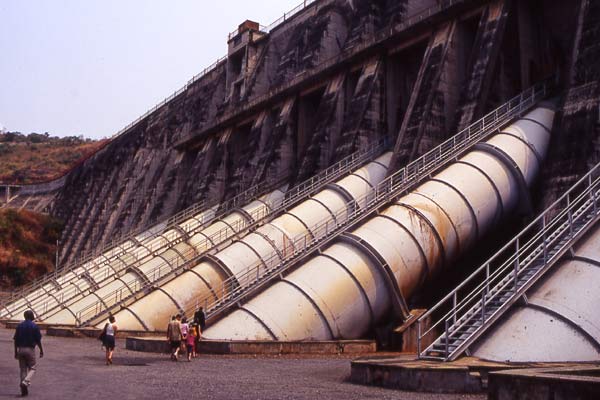
Cabinet announced yesterday it had approved a treaty between SA and the Democratic Republic of the Congo for the development of the Grand Inga hydroelectric project.
The project to exploit the Congo River for hydropower of 40,000 MW — nearly the size of SA’s current installed capacity — would be developed in phases. The additional source of electricity would be a welcome relief for SA, which is struggling to keep up with increasing demand.
Cabinet spokesman Jimmy Manyi said the purpose of the treaty was to develop an enabling framework linking Congo and SA into the Grand Inga projects, and to allow the countries to jointly explore economic feasibility for the project.
“The project will form part of SA’s government strategy to promote renewable energy in the region, contribute to a reduction of carbon emissions, ensure security of supply and to develop energy infrastructure on the continent and the Southern African Development Community region in particular,” Mr Manyi said.
The treaty could thrust Eskom into a central role in the project. Eskom yesterday declined to comment on Grand Inga, but the power utility has been contemplating its role in regional power projects.
In a speech in Pretoria on Friday, Eskom CE Brian Dames said there was potential for SA to source power from other countries in the region.
Mr Dames said the problem with big projects in the region was that none of them were bankable unless Eskom, which is Africa’s largest power utility, bought the power.
“We see ourselves in the role of buying the power,” he said.
“If opportunities arise to work in partnership with other players to be on the investment side of some of the projects, we would look at those. We are already working with independent power producers in the region ,” he said.
SA, through the integrated resource plan for electricity (IRP2010), has committed itself to a huge rollout of clean power in the period up to 2030, Mr Dames said.
“We have done a modelling exercise on the IRP2010, making certain assumptions about the role of Eskom and of independent power producers. We have found that as it stands, the plan would be extremely difficult to finance, and the cost of implementing it in its entirety out to 2030 might not be affordable for SA,” said Mr Dames.
The cost of the renewable energy, and the nuclear plans, might simply be too steep. SA was committed to reducing its carbon emissions and Eskom supported that.
He said SA was keen to leverage hydro in the north and gas fields in the east and west, as well as the extensive land which the region has available for solar generation.
Since 1994, the South African currency’s value has correlated with the emerging market index, the result of its status the currency of reference across emerging markets.
“It seems now like the market is starting to think that South Africa’s internal challenges are compromising the rand’s role as the ‘dollar of emerging markets’,” says Peter Armitage, CEO of Anchor Capital. Armitage was updating members of the Institute of Directors in Southern Africa (IoDSA) on the country’s economic outlook. “South Africa is suffering a crisis of confidence.”
Adding weight to that analysis is the cover story of the 20 October edition of The Economist: “Cry, the beloved country: South Africa’s sad decline”.
Armitage’s analysis of South Africa’s position in the global economy is troubling but not wholly negative. The country in fact does have many strengths-some of them unexpected-but it needs to use them to solve internal challenges that are in danger of becoming systemic.
Many of South Africa’s indicators look good. The country is ranked 29 on the International Monetary Fund’s 2011 gross domestic product index and, in terms of gross domestic product per person, is ahead of fellow BRICS countries China and India. Things also look rosy in the private sector, where the Johannesburg Stock Exchange (JSE) has delivered an average return of 15% per year since 1995.
“But that’s because 35% of JSE earnings comes from foreign investments, and 40% from resources,” says Armitage. “The resources boom is essentially driven by Chinese demand and is not the result of anything we are doing right-in fact, our export volumes have been declining. It’s only the fact that resources prices have risen so much that we are in positive territory.”
In short, then, South Africa’s strength is actually based on external factors with its weaknesses, sadly, internal. We are running a near-record trade and current account deficits, and are reliant on increasing amounts of foreign capital inflows. We are facing demands for huge wage increases by a work force that is relatively unskilled which are not accompanied by increased productivity. And most poisonous of all, while there is a relatively large amount of money in the country, it is not distributed evenly-hence our high GINI coefficient-and unemployment remains frighteningly high.
These problems have to be solved.
On the plus side, says Armitage, government spending and rising wages are driving consumer spending, and our financial sector is healthy. South African companies are waking up to the potential offered by the rest of Africa.
“Government spending is, however, going to drive growth internally, but we need to make sure that money gets where it should-there’s too much leakage at present,” he says.
A final important point is that the weakening rand actually acts as a buffer that protects the economy from some of the impact of higher wages, by increasing the rand value of what is exported.
The date for a national march by striking mineworkers will be confirmed by tomorrow, AngloGold Ashanti workers were told. “There will be a meeting tomorrow to confirm the date,” Democratic Socialist Movement spokesperson Liv Shange told thousands of striking workers.
The movement was calling for nationalisation of mines, much to the joy of mineworkers. The trouble in the mining sector is being exploited by a white Swedish national, it seems.
The workers were gathered on a hill at the Mponeng mine outside Fochville in the North West, attending a mass meeting. They have been on strike since September 25 for better wages. Shange said a national strike committee was formed in Rustenburg last week. It included Limpopo and Northam mines in the gold, platinum, and chrome industries.
“The next step for that committee is to march on the Union Buildings, hopefully on November 3, to take this struggle to government. We have thousands and thousands of workers that have been on strike now for weeks and government needs to feel this and needs to respond.”
Fellow spokesperson Mametlwe Sebei told the workers they were not alone.
“We are going to be intensifying and escalating the strike. We are going to make sure that there is no wheel turning in each and every mine in the entire country.”
He said their demands for better wages were not unreasonable. The movement was calling for nationalisation of mines, much to the joy of mineworkers. “Not only the few must get rich, but the communities must benefit,” Sebei told the crowd.
Workers representative Rodgers Motlhabane, said they would stay on the hilltop until their demands were met. “We are not going anywhere.”
Earlier, worker’s representative Tshepo Motloi, said one of the miners’ representatives was arrested on Monday for incitement.
Six workers were arrested on Friday for public violence. “What public violence?” he asked.
“They say they burnt people’s cars. No cars were burnt.”
The men appeared in Fochville Magistrate’s Court on Friday afternoon and were released to appear again on November 16.
Motloi said seven more people were arrested on Saturday on the same charge. They appeared in court on Monday and were released on R1 000 bail each.
One man still remained in jail as the workers tried to collect his bail, Motloi said.
This website uses cookies to improve your experience. We'll assume you're ok with this, but you can opt-out if you wish. Cookie settingsACCEPT
Privacy & Cookies Policy
Privacy Overview
This website uses cookies to improve your experience while you navigate through the website. Out of these cookies, the cookies that are categorized as necessary are stored on your browser as they are essential for the working of basic functionalities of the website. We also use third-party cookies that help us analyze and understand how you use this website. These cookies will be stored in your browser only with your consent. You also have the option to opt-out of these cookies. But opting out of some of these cookies may have an effect on your browsing experience.
Necessary cookies are absolutely essential for the website to function properly. This category only includes cookies that ensures basic functionalities and security features of the website. These cookies do not store any personal information.
Any cookies that may not be particularly necessary for the website to function and is used specifically to collect user personal data via analytics, ads, other embedded contents are termed as non-necessary cookies. It is mandatory to procure user consent prior to running these cookies on your website.


 The dollar soared Thursday as global markets reeled from the US Federal Reserve’s signal it may start to taper its massive stimulus this year.