Netherlands struggling to get politically correct as to Black Pete

In this town named after Saint Nicholas, Yuletide cheer is being clouded by controversy over the good saint’s helpers.

Across the Netherlands and Belgium, celebrations in which Saint Nicholas rolls into town surrounded by a host of “Black Petes” have come under increasing pressure year by year from complaints about racism. Pete is usually played by a white person who paints his face pitch black, dons a frizzy wig and gives himself bright red lips — stereotypes that disappeared from most countries decades ago.
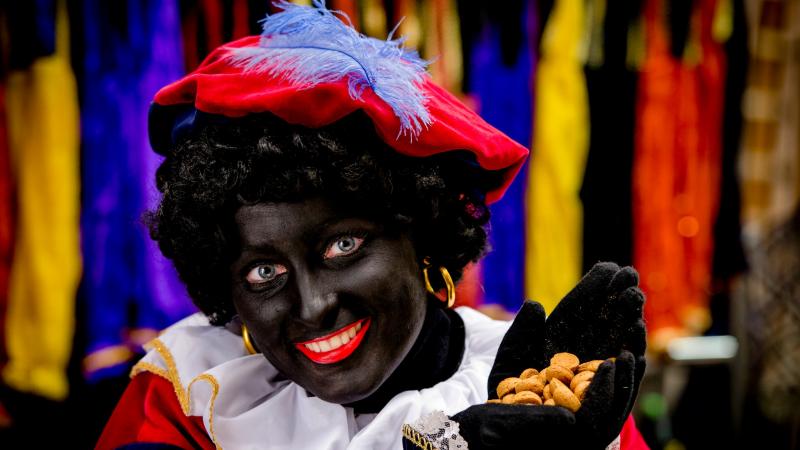
A Black Pete taking part in the festivities

Sint-Niklaas with a church and statue honoring the saint has long been one of the focal points of the celebrations. A grand entrance this Sunday is expected to bring tens of thousands of kids flocking to the “home of the saint.”

Yet even in this bastion of saintly tradition, questions are starting to be asked about Black Pete.

Wouter Van Bellingen remembers how, as a black kid growing up in mostly white Sint-Niklaas, he used to be taunted with chants of: “Look, there goes Black Pete.”

“Kids can be hard when it comes to that,” said the former Sint-Niklaas alderman and current director of the region’s Minorities Forum. “I retorted with ‘there goes White Pete.’ I always had my answer.”

Around this time of year, Saint Nicholas visits hundreds of villages in Belgium and Holland, arriving by steamer or on his white horse to the delight of shrieking kids across the two countries. The Black Petes do everything from carrying presents to throwing sweets at the kids and generally prancing about until Saint Nicholas day on Dec. 6.

The Dutch cheese capital of Gouda has come up with a strategy for reconciliation. Black Petes will walk side-by-side with yellow-colored “Cheese Petes,” a nod to the city’s most famous products but also a concession to critics of Black Pete. In another sign of changing times, the daily Dutch children’s television report on Saint Nicholas’ travels also featured White Petes on Thursday night.

Black Pete has evolved over the years. A quarter century ago, Black Pete was a scary character, carrying a big bag to hold naughty kids and a whip to punish the disobedient. Promoting him in recent years as a happy-go-lucky sidekick full of quirky madness has helped him to compete in popularity with Saint Nicholas himself.

“The last few years, Pete is at least as popular. Kids cling to him, ask him questions, hold his hand,” said Raf Rumes, the secretary of the Flanders Saint Nicholas Guild.

In another new touch, almost half of the Petes greeting kids in this town’s Saint Nicholas “mansion” — a yearly holiday attraction — are played by women. At the fun house, which reopened this week for a month-long run, children squealed as female Petes showed them Saint Nicholas’ dining room and sleeping quarters for all of the Petes.

But efforts at softening Pete’s image have failed to subdue bad blood between the pro- and anti-Black Pete camps in the Netherlands, where resentments over immigration have simmered for years. Liberals want to abolish the tradition, while the right-wing firebrand Geert Wilders and his anti-immigration Freedom Party have proposed legislation that would keep Pete black — by law.

“There is a war underway against Black Pete,” said Martin Bosma, the party’s culture spokesman. “Ministers and mayors are working to give this loyal helper another color. That must not happen. Our culture should not be damaged from on high. This law must protect Black Pete.”

Last year, more than 2 million people endorsed a Facebook petition to keep Zwarte Piet’s image unchanged. That’s nearly one-eighth of the entire Dutch population, indicating the depth of emotion over the issue.

But Van Bellingen insists democracy is not about numbers alone.

“It is about the will of the majority and the rights of the minority,” he said. “As a majority you have to be sensitive and show empathy for things that are hurtful to a minority.”

Van Bellingen agrees with Rumes that children should take center stage in the festivities — just without Black Pete.

“Saint Nicolas is a great celebration in itself,” he said. “Only, I think you need to get rid of Black Pete to turn it into a party for everyone.” – AP

Hunt for segregated toilets in SA continue

The SA Human Rights Commission on Wednesday said it would investigate another toilet segregation allegation at an animal clinic in Louis Trichardt, Limpopo.

“We are not aware of this allegation, but we will look into it,” SAHRC spokesman Isaac Mangena told Sapa.

“We will visit and see. Yes we will send investigators to that place.”

Mangena was commenting after the Sowetan newspaper reported that the Blouberg Animal Clinic had separate toilets for whites and blacks.

The clinic is located in the same area as the Vleissentraal office block, which came under fire last week after reported claims of toilet racism emerged.

Veterinarian Freddie Harris, who co-owns the clinic, declined a request from the newspaper to comment.

Last week, the same newspaper reported that the Vleissentraal office block in Louis Trichardt allocated toilets according to race groups.

The SAHRC subsequently told Sapa it had sent investigators to the building.

It launched an investigation, and warned that it would resort to approaching the Equality Court if it did not get co-operation from the building’s owner Bennie van der Merwe.

Last week Wednesday, Van der Merwe opened a case of defamation against the Sowetan newspaper over the article.

Van der Merwe denied the racism allegations to Sapa and said the newspaper was defaming its name.

“The allegations are not true. The newspaper didn’t even consult us. They didn’t phone us for comment,” he said.

He also took issue with its “whites only” headline.

Van der Merwe said another case of intimidation was also opened with the police, after the building’s manager received threatening text messages.

“We received threatening SMSes from an EFF member who threatened to burn our building, but the EFF claims it’s not from them,” he said at the time.

Mangena, meanwhile, said the commission would be meeting with Van der Merwe later on Wednesday.

“He will be coming to our offices in Polokwane today. This meeting will form part of our investigation.”

Racial incidents flood Cape

The white man who allegedly attacked a gardener with a sjambok in Claremont may be a local dentist, according to threats he levelled at his victim early on Sunday.

Gardener Muhammed Makungwa claims to have been late for work in Rondebosch. He was running down Palmyra Road when the driver of a white BMW X5 got out of the vehicle and beat Makungwa with a sjambok.

“I kept on running and he then tried to drive his car into me,” Makungwa said on Monday. “I stopped and he got out and started whipping me with a sjambok. He just went crazy and didn’t give me a chance to explain myself.”

Makungwa described his attacker as a white man in his 50s. The two went together to Makungwa’s employer, Nadia Kamies.

On Monday night Kamies told the Cape Argus that Makungwa was out of hospital but had been booked off work until Thursday.

She said the police visited her house on Monday and she supplied them with CCTV footage that clearly showed the attacker’s face, car and registration number.

“According to Muhammed, he’s a dentist in Palmyra Road,” she said. “But he also said that he was a soldier. And he said to Muhammed: ‘If I was a policeman and you were running away I could have shot you’.”

Police spokesman Captain FC van Wyk said two men had chased Makungwa. They had accused him of breaking into their vehicle.

Van Wyk confirmed that no theft out of a motor vehicle had been reported by the BMW driver.

“An altercation between the men and the Malawian resulted in the Malawian being assaulted and sustaining injuries to the face and shoulder. A case of assault with intention to do grievous bodily harm was opened, but no arrests have been made as yet.”

A similar incident last month saw swimming instructor Tim Osrin attack domestic worker Cynthia Joni in Kenilworth, while she was on her way to work. He later tried to justify his actions by saying he thought she was a sex worker.

On Sunday, two men were banned from the Cape Quarter shopping centre after the k-word slur sparked a fistfight.

A YouTube video showing the brawl next to an ATM at the centre in Green Point went viral. The video shows two white men using the ATM, while a black man in the queue behind them asks them to hurry up.

One of the white men turns around and calls the black man a “kaffir”. They begin shouting at each other, which soon escalates into physical violence. At the end of the video, the white man is on the floor after he was punched and kicked by the black man.

The Cape Quarter Lifestyle Village posted on its Facebook page on Monday: “The Cape Quarter does not condone racism and violence… The safety of our shoppers is a priority… The individuals have been banned from the centre and we’d like to thank everyone for their concern.”

Source: IOL

Celtic’s Aleksandar Tonev given seven-match ban for racist insults

Celtic have backed Aleksandar Tonev after the winger was suspended for seven matches for using “offensive, insulting and abusive language of a racist nature” against Aberdeen defender Shay Logan.

The 24-year-old Bulgarian, on loan from Aston Villa until the end of the season, was handed the hefty ban at a Scottish Football Association’s disciplinary tribunal hearing at Hampden Park on Thursday for the incident which took place in the Premiership clash between the two teams at Celtic Park on 13 September.

Aleksandar Tonev
Aleksandar Tonev

The Parkhead club immediately released a statement on their official website, saying they had accepted Tonev’s claim of innocence and confirming the player will appeal the decision.

A Celtic spokesperson said: “Racism has no place in football and, as a club for all people, Celtic absolutely abhors racism of any kind.

“This was a very unfortunate case, but the club has accepted Aleksandar’s explanation that he did not say the words that were alleged to have been said and that he is not a racist. We are, therefore, very disappointed by the outcome today and can confirm that Aleksandar will be appealing this decision.”

Two years ago, then Celtic manager Neil Lennon stated that any form of racist behaviour at the club was “an instant sackable offence” – a view with which his successor Ronny Deila appears to concur, although he too backed his player.

Speaking at the club’s Lennoxtown training complex before the verdict was announced, the Hoops boss said: “I have spoken to him. He said it was not true and I believe him. Of course we don’t want racism at Celtic – that is the total opposite as what we want to be as a club. That is not acceptable.”

The original hearing date of 9 Octoberwas postponed as Tonev, who joined Villa last summer, was on international duty with Bulgaria.

The former CSKA Sofia and Lech Poznan player was making his belated Celtic debut, after arriving at Parkhead in the summer with a groin injury, when the incident took place. Logan immediately spoke to referee Bobby Madden and skipper Mark Reynolds before informing manager Derek McInnes.

Fourth official Crawford Allan and Celtic were also made aware of the allegation by the Dons management team.

Show Racism the Red Card (SRtRC) Scotland campaign manager Vicki Burns said: “SRtRC welcome the news that the SFA investigation has now concluded. The length of the ban for Aleksandar Tonev shows how seriously the SFA are taking the issue of racism.

“While it’s always sad to see players banned, the decision is in line with bans in football over recent years for similar incidents and I think this sends out a clear message to players and fans.

“Racism has to be taken seriously and there is no room for racism in Scottish football or society.” – The Guardian

Black boys attacked at NY school and called ‘Ebola’

A group that advocates for Africans in the Bronx is calling for action after it says two brothers who had recently immigrated to the borough from Senegal were beaten and badly injured by several people who called them “Ebola” in school.

The 11- and 13-year-old boys, in sixth and eighth grade, respectively, were attacked Friday afternoon at I.S. 318 in Tremont, according to the African Advisory Council. Their father, Ousame Drame, said they were pummeled by other students in the schoolyard during lunch after enduring weeks of taunts.

The boys, who have been in the U.S. for about a month, were taken to the hospital after the attack.

Drame said his sons have been cruelly harassed for two weeks over Ebola. Days after news broke that the deadly disease was in the United States, he said students, whispering the word, “Ebola,” told other students not to talk to the boys. They were treated like cancers, he said.

“If they go to the gym they don’t want them touching the ball – ‘Oh, you have Ebola, don’t play with us,'” Drame said.

Though the children were raised in Senegal, they were born in America — and have every right to be here, their father said.

But Drame didn’t blame the students.

“They don’t know nothing. They’re babies,” he said.

Instead, Drame insisted the school system wasn’t doing enough to protect his children and others like them. He called on politicians and educators to spread awareness about the disease — and to step in when necessary.

Calling the attack “unacceptable,” advocates say it is just the latest incidence of disrespect and bullying of Africans since the outbreak of Ebola in West Africa.

“Where was the school administrators, where was the school staff when all of this was happening?” asked Charles Cooper of the African Advisory Council as he demanded more action.

Drame said his sons will return to school, but he wants confirmation they’ll be safe — physically and emotionally.

The Department of Education says it’s aware of the complaint and that it dispatched additional security to the boys’ school. The agency said it would instruct teachers and principals to be on high alert for any potential instances of bullying or discrimination. It also said it would send information to parents to help them better understand the issue and dispel any misconceptions their children might have.

“We will not tolerate intimidation or bullying of our students, especially in this moment when New Yorkers need to come together,” Schools Chancellor Carmen Farina said in a statement.

Senegal is one of several West African countries where Ebola cases have been reported, but there have been no new cases in that country since late August, according to the CDC. The World Health Organization has declared the country “Ebola-free.”

Cases continue to be reported in Guinea, Liberia and Sierra Leone. A few health care workers and travelers coming from those countries have also been diagnosed with the disease in other countries, including one person in New York City.

Source: nbcnewyork.com

Oz shuts the door on ebola

Australia has issued a blanket ban on visas from West African nations affected by the Ebola outbreak to prevent the disease reaching the country, Immigration Minister Scott Morrison said, becoming the first rich nation to shut its doors to the region.

Australia has not recorded a case of Ebola despite a number of scares, and conservative Prime Minister Tony Abbott has so far resisted repeated requests to send medical personnel to help battle the outbreak on the ground.

The decision to refuse entry for anyone from Sierra Leone, Guinea and Liberia, while touted by the government as a necessary safety precaution, was criticised by experts and advocates as politically motivated and short sighted.

“The government has strong controls for the entry of persons to Australia under our immigration programme from West Africa,” Morrison told parliament on Monday.

“These measures include temporarily suspending our immigration programme, including our humanitarian programme from Ebola-affected countries, and this means we are not processing any application from these affected countries.”

All non-permanent or temporary visas were being cancelled and permanent visa holders who had not yet arrived in Australia will be required to submit to a 21-day quarantine period, he added.

A number of US states, including New York and New Jersey, have also imposed mandatory quarantines on returning doctors and nurses amid fears of the virus spreading outside of West Africa. Federal health officials say their approach is extreme.

The Ebola outbreak that began in March has killed nearly 5 000 people, the vast majority in West Africa. The disease has an incubation period of about three weeks, and becomes contagious when a victim shows symptoms.

Ebola, which can cause fever, vomiting and diarrhoea, spreads through contact with bodily fluids such as blood or saliva.

Australia has contributed A$18 million to help fight the disease but has been criticised by medical groups, opposition lawmakers and rights groups for not sending teams to affected regions.

The risks to Australia were already small due to its geographical isolation, said Dr Adam Kamradt-Scott, a senior lecturer at the University of Sydney’s Marie Bashir Institute for Infectious Diseases and Biosecurity.

The visa ban, he said, would do nothing to protect the country from Ebola while potentially having a negative public health impact by unduly raising fears about the disease and creating a general climate of panic.

“This blanket ban actually does very little to reduce the risk of Ebola arriving in Australia. It also sends a very bad message both in terms of our humanitarian assistance programme as well as Australia’s attitude towards West Africa at the moment,” he told Reuters.

“This is purely just a political decision. There is very little scientific evidence or medical rationale why you would choose to do this, and this is the type of politics we find starts to interfere with effective public health measures.”

Earlier in October, it was revealed that Australia had turned down requests from Britain and the United States to send personnel to Sierra Leone to assist in combating the outbreak there, as well as additional funding.

Australia’s “narrow approach” to Ebola makes no sense from a health perspective, given that applicants for humanitarian visas are already screened and monitored for illnesses, said Graham Thom, a spokesperson for Amnesty International Australia.

Refusing to send healthcare workers while at the same time refusing entry to those most in need will further damage Australia’s reputation, already under fire over its tough asylum seeker policies, he said.

“There are ways and means in which people can be monitored, quarantined to insure that those who come are free from the disease,” he told Reuters.

“All it does is insure that already exceedingly vulnerable people are trapped in a crisis area and sends a signal about Australia’s commitment to actually dealing with this crisis in a responsible way as a member of the international community.”

Source: Reuters

Guinean attacked ‘for having ebola’

A Guinean woman has been attacked in a bus in Rome by angry passengers who told her she was infected by Ebola and had to get off the bus, Italian media reports. She was taken to hospital suffering from multiple bruises.

Fataomata Sompare, 26, was about to get off the bus on Monday, said Il Messaggero, an Italian newspaper, as cited by the Local.

A teenage girl who was on the bus with her friends saw Sompare and began accusing her of having the deadly virus. Then some of the teen’s relatives started beating the woman.

“They told me that I had Ebola and that I had to get off the bus,” said Sompare, who has been living in Italy for four years.

People at a bus stop near Grotte Celoni Metro station in the east of the city managed to save the woman, who suffered multiple bruises after being beaten by passengers. The police arrived and she was taken to hospital.

The incident was reported to public prosecutors by Sompare’s lawyer.

“[She is] a victim of racism, which is now rampant in this city,” the Sompare’s partner Alessandro Corbelli told Il Messaggero. He added that the incident was “shameful” and she had been attacked “only because she’s black.”

The incident is not the only example of Ebola hysteria in recent days. In the US, Ebola-phobic parents sent a Maine teacher on mandatory leave after he returned from Dallas, where first victim of the virus in the country died. In Mississippi, parents pulled their kids out of school because of the principal’s trip to Zambia.

The death toll from the Ebola virus has reached 4,877 people for far, the World Health Organization said on Wednesday.

According to the UN health body, 9,936 people in Guinea, Liberia and Sierra Leone, the three countries worst-affected by the virus, have contracted the disease.

Source: RT

No English distribution for popular French movie because of ‘racism’ fears

French film “Serial (bad) weddings,” or “Qu’est qu’on a fait au bon Dieu” – seen by more than 12 million people in France so far this year – will not make it to the United States or the UK because distributors have described it as racist and politically incorrect.

The film is about conservative, white, Catholic parents whose four daughters horrify them by marrying men from other religions and ethnicities, including an Arab Muslim.

American magazine The Hollywood Reporter did not mince its words when reviewing the movie.

bon_dieuIt has “nothing to do with quality,” the magazine said. “Although the “bad’ is in parentheses, that’s perhaps the best way to describe Serial (Bad) Weddings.”

Variety magazine said the film portrays “racist stereotypes” and feeds into “France’s ambient xenophobia.”

James Chapman – professor of film studies at the University of Leicester in England, and a media historian – said there were various factors behind the rejection of the movie by distributors.

A film that might provoke accusations of racism “can have social and political consequences” in a country, “though more so in terms of the controversies they generate than any long-term effects on people’s attitudes and behavior,” Chapman told Al Arabiya News.

He added that some movie distributors can choose not to handle a “racist” movie for fear of upsetting certain groups and generating adverse publicity.

He said U.S. distributors might shun the film to avoid possible legal prosecution against them.

In the United States, a person who commits a “hate crime” by insulting a person’s race, color, religion or national origin can face a fine or imprisonment of up to 10 years.

Reacting to the decision of American and British film distributors, Sabine Chemaly, international sales director at France’s TF1 International, said English-speaking audiences “have a very different cultural approach” compared with the French.

The former “would never laugh at blacks, Jews or Asians,” Chemaly told French weekly Le Point.

“They know that this will immediately create too much controversy at home.”

French film critics say the movie should not be seen as racist, but as a means to overcome racism in France.

“Neither Arabs, Muslims, Jews or any other community regard this movie as offensive,” Jean-Michel Frodon, film critic at French newspaper Le Monde and cinema studies professor at the National Institute of Political Sciences in Paris, told Al Arabiya News.

“It’s necessary to deal openly with existing stereotypes if we wish to go beyond them.”

He added that it was better to let such movies circulate to give an understanding of what is really happening in France, where “racism is still too present.”

Frodon said the mistake of the producers was to lack subtlety in presenting the different characters.

The film has been a success across Europe, with more than 2 million viewers in Germany. – alarabiya.net

Entitlement: Attacking whites for black shortcomings

White South Africans don’t just have an unexamined sense of entitlement, but also an embedded sense of superiority, writes Eusebius McKaiser in IOL:

What, black people, do you want from whites? To leave the country, to be denied jobs or never be promoted again? Share or give up their assets?

It’s a serious and popular set of questions many white South Africans often raise, or ask themselves but might not raise openly. And so it’s actually worth engaging the issues.

There are several problems with this set of questions.

The very framing of these questions lets white South Africans off the moral hook too easily.

These questions place the burden for thinking about the place and role of white South Africans in post-apartheid South Africa on black South Africans.

That’s like asking victims of violence against women, “What do you want men to do differently?!”

That kind of question is music to the misogynist guy’s ears. He can go fishing, and respond to the feminist critique of gender injustices by demanding that they call him when they’ve figured out what the heck they want him “to do”.

Unless and until they send him a “concrete” list of demands, he can chill and go about his unthinking male ways as usual. After all, he’s not sure what women want from him!

This, of course, is rubbish. Dangerous rubbish. The first observation to be made is that the history of oppression is not only about the material consequences of oppression. Of course colonialism and apartheid resulted in black life being materially worse off than white life. That’s still the case.

It’s right in focusing questions on the material conditions which we want to change. In that sense, we cannot as a country avoid asking, indeed, what needs to be done, practically.

But oppression, and its ongoing legacy, has many more features which this lazy demand of “what must I do?!” hides.

Focus for a minute on the psychological and moral impact anti-black racism had on whites. You’d be hard-pressed to find more than a handful of white South Africans who think of themselves as being as capable of excellence, or less capable of excellence, than black South Africans. Most regard themselves as more capable of excelling at anything.

This is in part why so many white South Africans who don’t get their desired job are shocked when that happens (and we’re talking about a thin minority among whites compared to unemployment in the rest of the population). The shock doesn’t just reflect an unexamined sense of entitlement. It also reflects an embedded, internalised sense of superiority that gets shaken in the face of a black candidate succeeding where you didn’t.

At this point, confirmation bias sets in: I didn’t get the job because I’m white; he got the job only because of affirmative action; whites have it worse in the job market than blacks; young white graduates are treated badly in democratic South Africa; etc.

Isn’t it remarkable that these thoughts are expressed not only by a racist Afrikaans oke in khaki shorts on the outskirts of Ventersdorp, but also by self-identifying progressive English whites who often fancy themselves more morally conscious than the average Beeld reader?

There is sheer arrogance involved here on the part of the white South African who can’t make sense of his or her failure without sustaining a secret belief that they are intrinsically more capable than blacks. You can only lament and be shocked by fewer job offers or promotions in the job sector if you think you deserve these more than blacks.

Nothing innocent anchors such shock and disappointment. A sense of superiority, left over from apartheid, fuels this misplaced sense of being democracy’s victim. If you conceived of the possibility you might not be the best, other responses to failure beyond shock will open up. Apartheid’s beneficiaries aren’t yet in that head-space.

This shows the psychological and moral work whites still need to do. And that’s why soem questions are so irritating. They reduce the discussion of racism’s reach to a simple transactional conversation.

Giving me your house, as a white South African, doesn’t tell me anything about your psyche. It doesn’t tell me whether you understand that past discrimination, not genetic superiority or sheer effort, explains why you’re materially better off than me and my family.

This is why the project of undoing the legacy of apartheid must address all these lingering dark truths. This in turn requires white South Africans to do much more work, a lot of it not related to policy questions about redress.

You can’t restore moral parity between whites and blacks with a cheque handed over by each white person for the material benefit of blacks.

Similarly, gender discrimination in the corporate sector, for example, cannot be adequately eliminated and addressed if men only agreed to equal pay, or reserving job spots for women, etc. Those matter, for sure. I wouldn’t oppose these interventions.

But gender equality requires deeper work. Attitudes and behaviour that exemplify the false beliefs men hold about their intrinsic superiority over women need to be addressed and corrected. If you don’t, discrimination will simply pop up in new forms beyond questions of, say, wage equality or job reservation.

More importantly, approaching the quest for gender equality as a narrow, material project simply reveals an inadequate understanding of misogyny’s full character.

The project of addressing anti-black racism’s many manifestations is equally complex, and not neatly reducible to a transactional demand.

The final point to make is that racism is about the relationship between members of different groups, even if those groups are social and political constructions. This relational element should be obvious, yet we forget about it very often. It doesn’t just take two to tango; it takes two for racism to even be possible.

By asking blacks what they want from whites you focus on one party in that stinking relationship.

If the very core of racism is about a morally warped interaction between parties, then the project of undoing that harm must be relational too.

You can’t ask the bully to do no work, to go play outside and call him in after you’ve got an answer from the victim about what she wants from the bully. Then you’ve misdiagnosed the exact nature of the wrong you’re trying to correct.

Sure, the victim may unhelpfully play along and demand concrete things – like land – but then be clear about one certainty: this will at most give you an outcome that soothes the sense of injustice of victims.

You will have failed to deal with the full might of the evil that had been experienced, leaving both the victim and the bully deeply wounded still.

The victim will remain haunted by a sense of inferiority. The arrogant bully will remain, well, bullish.

So next time a white person asks “What do you want me to do?”, tell him or her they’re asking the wrong question. They should start with reflection on the psychological and moral stains on their whiteness.

PS: I deliberately don’t qualify “white” and “black” with words like “most” or “some” here. Why? Some truths are black and white. Such qualifications allow those with most work to do to pretend they are exceptional. Let’s stop the denial by recognising reality.

Exceptions don’t change ugly patterns. We have work to do, including progressive whites helping out those whites who are blinded by their whiteness.

Stop asking blacks what you should do. That’s objectionably lazy.

‘I have ebola, I’ve been to Africa’

Amid cries of racism from black leaders including Jesse Jackson, cases of Ebola have topped 8,000 now, according to official data from the World Health Organization, though many cases could actually be unreported.

The death toll continues to climb near 4,000, and officials have stressed the outbreak is unprecedented and may continue to get worse.

Dallas County Commissioner John Wiley Price made similar arguments this week that Thomas Duncan, the first patient diagnosed with Ebola in the United States, died because his race and lack of “privilege” kept him from receiving the care he needed.

“It is historical what has happened in this community,” said Mr. Price, who is black. “If a person who looks like me shows up without any insurance, they don’t get the same treatment.”

An American passenger was booted off a US Airways flight and screened after reportedly joking that he had Ebola and telling the rest of the flyers they were “screwed.”

During a flight from Philadelphia to the Dominican Republic, the 54-year-old American – who remains unidentified – reportedly yelled, “I have Ebola, you are all screwed,” according to the Dominican news outlet Diario Libre.

He also yelled out, “I’ve been to Africa!” an airport official told Fox News Latino.

He didn’t yell “bomb,” but he might as well have. After the supposed joke was aired, there was noticeable panic and concern on the airplane, which was carrying 290 passengers. The plane was isolated as soon as it landed in Punta Cana, where a medical team outfitted with hazmat suits boarded the aircraft and removed the passenger.

After conducting a medical check, the passenger was found not to be infected with the virus. Though he was coughing on the flight, he had no fever when he was inspected. He had never been to Africa, either.

In a video captured by a passenger, an African-American can be seen being taken out of the plane by medical officials.

Fifty-eight percent of Americans supported the flight ban, according to a poll conducted in a collaboration between NBC News and SurveyMonkey.

Only twenty percent of respondents did not support a travel ban from the likes of Guinea, Liberia, and Sierra Leone.

As of earlier this week, neither the World Health Organization nor the White House endorsed an all-out travel ban to the US from affected nations.

Airplane cabin cleaning crews at New York’s LaGuardia International Airport began a 24-hour strike on Wednesday, citing, in part, possible exposure to the Ebola virus. Meanwhile, a poll found most Americans want flights banned from Africa.

“The whole country is shivering, worried about the problems of Ebola,” said Hector Figueroa, President of 32BJ Service Employees International Union, according to CBS New York.

Cabin cleaners per plane at LaGuardia have been reduced by up to half, and the time to clean planes has been cut down to as little as five minutes, workers said, as reported by CBS New York.


Racism in English football is ‘right in your face’

‘ The lack of black and ethnic minority figures in the dugout and the boardroom (is) overt’ – Jeffrey Webb

Racism in English football is overt according to Fifa’s vice-president Jeffrey Webb.

The head of Fifa’s anti-racism task force has said that discrimination in English football is “right in front of your face” and backed calls for the introduction of the Rooney Rule.

Jeffrey Webb, the Concacaf president and Fifa vice-president, said the lack of black and ethnic minority figures in the dugout and the boardroom was overt but that no one wanted to deal with the problem.

Jeffrey Webb
Jeffrey Webb

The Professional Footballers’ Association chief executive Gordon Taylor recently said that racism was a “hidden problem” in English football, making his own call for the Rooney Rule to be introduced.

Webb responded: “I don’t know how it could be hidden. You have 92 clubs, you have two coaches of colour. How many board members or executives are in various club positions or at the FA, in Uefa? So, it’s not hidden.

“It’s hidden from a discussion standpoint. No-one wants to deal with it. No-one wants to deal with it from a commercial standpoint.”

Webb said that he had recently spoken to Eddie Newton, the Chelsea youth coach who has been linked with a move to Schalke 04 with Roberto Di Matteo, who had described his frustration at being unable to secure an interview.

“I hosted a dinner a few months ago, last time I was here. I met a young guy coaching at Chelsea, assistant coach, won a Champions League final, doing well,” said Webb.

“Can’t even get an interview. Eddie Newton. I’m not talking about getting a job, getting an interview. That’s not hidden. That’s right in front of your face.”

Taylor’s intervention kicked off a renewed debate within English football about whether the Rooney Rule should be introduced.

The Kick It Out trustee Garth Crooks hit out at the Football League chairman Greg Clarke for not raising the issue at their summer meeting, while the Football Association and the Premier League have also faced questions over their stance on the issue.

Webb said the Rooney Rule, which would force clubs to ensure that at least one person from a BME background was included on each interview list, should not be necessary in the modern age, but it was.

“In this day and time, in this era, in this century, should we really be having to mandate opportunities for qualified individuals? Sadly, the answer is yes.”

Webb said the pressure for change needed to come from club owners and from fans.

“It has to come within. It has to come from the clubs. It has to start with clubs. It has to start with ownership,” he said. “And, of course, the fans have to demand that there is opportunity, that there is equality. And, unless we have that, don’t expect any changes.

“How many American owners do we have from English Premier League clubs in the UK? So, why have certain standards here and then, of course, in the US, in the NFL leagues, where you live, where you conduct business, you live by different standards?”

Webb also said that Fifa faced a “huge, huge challenge with Russia” ahead of the 2018 World Cup given the prevalence of racism in football there and said that action “must start with education, must come from the top down”. – The Guardian

Bulgarian soccer fans fly ‘Yes to racism’ banner

Bulgaria’s Levski Sofia can expect another serious sanction after further crowd disturbances by their supporters. The Ultras of the Bulgarian club again unveiled pro-racism banners during their derby against the champion Ludogorets at Georgi Asparuhov stadium last weekend.

The Blue Ultras unfurled a banner with the logo of UEFA and slogan that said ‘Say Yes To Racism’.

Levski Sofian fans with a banner stating, ‘Say Yes to Racism’
Levski Sofia fans with a banner stating, ‘Say Yes to Racism’

Racism has always been a serious problem for Bulgarian football and it is not the first time fans have brought penalties on their clubs.

It is not yet clear what action the Bulgarian Football Union will take or the scale of the penalty for Levski Sofia. In addition to a financial sanction, the club is likely to be punished with the stand closures in the Georgi Asparuhov stadium.

Levski have already played a number of games in the Bulgarian championship in front of empty stands after being punished for other infractions by their fans.

It is also unclear whether UEFA will take action against Bulgarian the club. UEFA’s message that racism, intolerance and discrimination have no place in football and must be banished from the game is not being heard in Bulgaria. – Alexander Krassimirov, insideworldfootball.com

‘92% of South African whites are racist’

I read the previous column by Jonny Steinberg on Oscar Pistorius. In my view that article was too general and gave an incorrect view on the opinions of blacks.

Though I now stay in an upmarket suburb, I spend lots of my time in the townships. In those circles, the majority of people I have spoken to are not really concerned about Oscar but are concerned about the judgment itself. It really confused them. It created more doubts than certainty about the legal system in our country and the interpretation of laws. In a nutshell, most middle-class and informed Africans were embarrassed by it. They are even reluctant to talk about it. However, the most fortunate part of our judicial system is its corrective mechanisms. To err is human.

On the current article I wish to remind Mr Steinberg that not all whites still live in the past. Maybe, about 92% of them still do. It is expecting too much from the 92% (this figure is an estimate) of white people to embrace reconciliation and not be racist. Why would they now do that? They have failed to do so in the past 600 years of the history of mankind. During those years most white people have enforced and supported slavery, racism, colonialism, apartheid and other forms of prejudices against blacks, and Africans in particular.

In my view reconciliation is too abstract a concept to embrace or even attempt to “enforce”. The best way would be for government to, among other things, enforce and implement laws that would make economic growth possible, make equitable economic redistribution possible, expedite cultural emancipation for Africans and outlaw any form of racism and/or prejudice in this country.

It is unfortunate that most of my fellow countrymen cannot define what racism is ( or other forms of prejudices such as tribalism, sexism ). It has become the most abused term; especially by the majority of white South Africans. Maybe it’s because they have never experienced racism. – Thulani Ngcobo Midrand (Originally published as a letter in Business Day)

Whites and conservatives have no rights in SA

A senior researcher at the Institute for Security Studies, confirmed in Johannesburg on Monday that farm attacks were motivated by racial hatred.

“There are allegations of race and politics being the motivation but these cannot be substantiated,” Johan Burger claimed initially, but had to concede that farm murders exploded when when former president Thabo Mbeki phased out the commando’s for purely racist reasons.

Burger, who was speaking at an SA Human Rights Commission hearing on safety and security in farming communities, said farmers became vulnerable when former president Thabo Mbeki ditched the idea of safety for white farmers.

While trying to defend the black attackers, Burger actually made a strong case for the white victims.

“There was a feeling that the commandos were an extension of right-wing groups and that blacks were under-represented in them. There was also a perception that the commandos were concerned only about the safety of white people,” he said, confirming that neither whites nor conservative groups have the right to safety.

Burger said farm attacks were always vicious.

But he also claimed that the intention of the assailants was usually simply to steal cash and goods, when black attackers almost never steal anything except cellphones which make it difficult for surviving victims to call for help.

In instances in which attackers used racist language, Burger said, it could be just “tough talk”.

“They are motivated by greed and not politics or race,” he insisted,  trying to minimize the clear evidence of racial hatred that mark the attacks.

ANC police commissioner Riah Phiyega declared that “poor adherence to labour laws” and “unsatisfactory labour relations” were a “contributory factor” in farm attacks, while conveniently ignoring ANC leaders who chant “kill a boer” at mass meetings.

The commissioner thus reiterated popular threats by the ANC to confiscate white property justified by a set of baseless claims.

“Some of the workers are not registered and are illegal immigrants and it becomes difficult to track some of the people during police investigations,” she said, also forgetting that the country has an open-border policy thanks to her party’s policies.

Police were no longer classifying crimes taking place on farms separately, in trying to hide the racist scourge that white farmers have to suffer.

Howard Mbana, a Food and Allied Workers’ Union representative, said farmworkers were still subjected to abuse by their bosses.

“There is widespread violation of farmworkers’ rights by farm owners. Workers still suffer from beatings and insults on a regular basis. Farmworkers live in conditions of indignity and slavery; animals live better,” said Mbana.

He could, as per usual, give no examples of the alleged abuse.