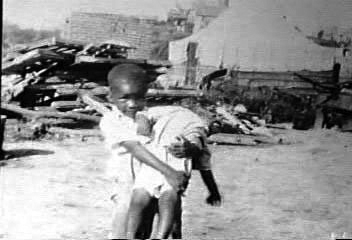
A black actress will play a journalist investigating the 1921 Oklahoma race riots, where an estimated 300 people were believed to have been murdered amid post-WWI racial tension surrounding segregation laws and the prosperous black community of Greenwood.
According to a 2011 New York Times story on the subject, “The Tulsa race riot of 1921 was rarely mentioned in history books, classrooms or even in private…an episode so brutal that this city, in a bout of collective amnesia that extended more than a half-century, simply chose to forget it ever happened.”
The announcement came as part of the net’s next slate of programming.
During an interview with CNN last week, Mark Potok of the Southern Poverty Law Center boldly claimed that more than half of white Americans hate blacks.
While discussing whether or not white on black crime has increased in recent years, Potok argued that a drastic rise was evident, alluding that American whites have become more racist due to a black president.
“Well I think the best data shows that in fact anti-black racism has risen over the last four or five years,” Potok said. “There’s polling that shows that both implicit and explicit anti-black attitudes among American whites have gone up quite significantly between 2008 and 2012 to the point where now more than half of white Americans have these anti-black attitudes.”
CNN contributor Reihan Salam, visibly shocked by Potok’s assertions, pointed to the massive strides gained in American race relations.
“I think that’s extremely misleading,” Salam said. “You’ll see for example that one out of 12 marriages in the United States are now interracial marriages.”
Salam also went on to highlight the fact that the definition of racism has drastically changed, with certain groups attempting to find racism in places it may not actually exist.
“The thing is, people are getting very creative in what they are characterizing as racism,” Salam added. “When you look at hard statistics like interracial marriages, interracial friendships, when you look at the level of racial segregation, you’ve seen enormous progress over time and I think that we should celebrate it.”
In an attempt to defend his position, Potok quickly jumped to his own organization’s statistics, claiming that American hate groups are at epidemic levels.
“We’ve also seen an enormous growth over the last 15 years or so in the number of hate groups, primarily white supremacist groups from about 600 in 2000 to more than 1,000 today,” Potok said.
While the SPLC does list some legitimate hate groups on their website, political groups with no connection to racism whatsoever now fill the vast majority of space.
Groups such as Oath Keepers, an organization filled with military, police and firefighters who support their oath to the Constitution, have been labeled as hateful and racist by the SPLC. In its desperate attempt to demonize any group that questions government corruption, the SPLC has even gone as far as labeling alternative media outlet We Are Change as racist as well.
In a surprising move, Salam went on to note the SPLC’s massive wealth increase in recent years, commenting on the groups need for increased racism to remain relevant and lucrative.
“But another thing is we have organizations like the Southern Poverty Law Center that really have grown enormously in recent years. For example, in 1995 the SPLC had net assets of about $52 million, in 2011 they had net assets over $250 million and this is not a period of time during which racism increased by a factor of five, rather they have been able to grow by drawing on instances of this kind and then weaving them into a story about racism growing,” Salam said.
Just last year, the SPLC’s CEO J. Richard Cohen sent a letter to former Department of Homeland Security Secretary Janet Napolitano and Attorney General Eric Holder, claiming the need to investigate the country’s alleged “patriot” domestic terror threat.
“Utilizing the standard SPLC modus operandi and fear tactics, Cohen conflates a small number of racist white supremacist groups with the larger and more diverse patriot community,” Kurt Nimmo. “He also characterizes growing concern on the part of millions of Americans in response to egregious violations of the Constituion as dangerous…”
To no surprise, an August 2009 Freedom of Information Act request revealed that Homeland Security’s “right-wing extremism” reports were not based on any legitimate evidence, but random articles found on the SPLC’s website.
While constantly labeling Constitution-supporting Americans from all races as dangerous, the SPLC itself is generating hate and violence.
The core principles in any justice system should be equality before the law and the impartiality of the justice system. As we have repeatedly seen in South Africa since 1994, this ideal of equality and impartiality is an absolute joke in the Mandelatopian justice system. If you are politically connected, you are much more equal than other mere mortals.
The most well-known example of this gross inequality in terms of justice is Schabir Shaik. Having been found guilty of fraud and corruption involving the president, JZ783, Shaik spent only a few months in jail, and most of these in hospital. He was then released on so-called medical parole, only to be photographed while enjoying his “terminal disease” on the golf course. On the other hand, people like Clive Derby-Lewis still languish in jail, years after he should have been released on medical parole, given that Derby-Lewis really actually has cancer. Unlike Derby-Lewis, the merry golfer is simply suffering from the terminal disease called life.
There is however a much more egregious set of double standards that exist in the Mandelatopian “justice” system. These double standards pertain to the grossly unequal treatment of whites and blacks whenever there is any incident of an interracial nature, and the prejudice that whites suffer.
Example 1: Two white students allegedly run over a black pedestrian in Bloemfontein. Predictably, the mainstream media immediately descend into an orgy of rabid, self-righteous rage, and waste no time whatsoever in hysterically labelling this as a so-called racist incident. Within days, the Human Rights Commission (HRC) announces that it too will investigate this incident.
Note the immediate assumption and prejudice, which is repeated time and again whenever blacks and whites are involved in an incident where the alleged wrongdoer is white: Racism is immediately the presumed motive of the white, no matter if there is any proof whatsoever to support this assumption.
Example 2: A black lawyer shoots a white motorcyclist in a road rage incident in Randburg. The lawyer claims the shooting was in self-defence, but this is patently absurd, given that the cowardly Randburg Backshooter shot his victim in the back, as his victim was walking away. Being a so-called lawyer, the Randburg Backshooter should surely realize that no impartial judge would ever accept self-defence as a justification for his crime in these circumstances. However, no news report labels this as a racist incident. The HRC’s silence is deafening, and there is no hint of any HRC investigation.
In contrast to the automatic assumption of a racist motive when whites are involved, there is clearly no automatic assumption of a racist motive on behalf of the Randburg Backshooter, even though he shot his victim in the back and clearly committed murder, and a cowardly murder at that. He is not prejudiced by the automatic assumption of a racist motive on his behalf, but alleged white perpetrators do suffer this prejudice.
I can, of course, quote hundreds if not thousands of cases in which black attackers viciously target whites during brutal farm invasions, hijackings, rapes and tortures, including incidents during home invasions in the suburbs. It is very, very seldom that the mainstream media would call these incidents racist, even though it is difficult to see why the brutal torture and murder of elderly whites by violent black farm attackers can be anything but the most shocking incidents of racist hate crimes.
Why is this? Why are whites involved in interracial incidents prejudiced in the media and the courts by automatically labelled as racists, and even investigated for so-called racism, while the same very seldom happens to blacks involved in crimes or attacks against whites?
It seems to me that whites are being treated unequally by both the justice system and the mainstream media. Any misstep on behalf of a white towards a black is automatically assumed to have racism as an aggravating factor or indeed its motive, whereas the reverse is not true. Because of this automatic assumption, the white perpetrator, if found guilty, would have his sentence aggravated because of the assumption, as well as the hysterical accusations of racism by the loony-left media, whereas black attackers of whites do not suffer the same fate.
The hysterical accusations of racism by the mainstream media, as well as the involvement of organizations such as the HRC, make a mockery of any fairness and impartiality towards alleged white perpetrators. Whites are subject to double jeopardy in the Mandelatopian justice system, because of the immediate additional of charges of racism in any incident involving somebody from another racial group.
Most of us are aware of the ongoing saga of the Waterkloof 4 (Tiedt, van Schalkwyk, Becker & Du Preez), four underage white boys convicted of having assaulted and killed a homeless black man. Apart from the Oscar Pistorius murder, the trial has elicited more publicity than any other in recent South African history and has led to endless denunciations of “white racism” and psycho-babble about “Afrikaner brutality”.
I have been lucky enough to read through the witness and accuseds’ testimonies, crime-scene photos and specialist statements and found all of the evidence to be extremely interesting. Unlike the Oscar Pistorius case, where many details were disclosed in the media, journalists never gave much away when reporting on the Waterkloof 4 case. Maybe it was because it appeared to be open and shut, especially judging by the public and the mainstream media who presumed them guilty before proven innocent. Nevertheless, a guilty verdict was handed down to four of the boys. I’ve decided to lay out the facts about this case by sharing my findings, which come directly from court evidence.
The so-called ‘Waterkloof 4’, from L to R: Gert van Schalkwyk, Christoff Becker, Reinach Tiedt and Frikkie du Preez
Background
August 2003: three boys who had knowledge of the crime decided to come clean regarding the incidents which took place in December 2001. These three identify the “Waterkloof 4”, aged 15 and 16 at the time of the crime, who are subsequently arrested.
July 2004: they plead not guilty
June 2005: they are found guilty
January 2007: they are sentenced to 12 years imprisonment each
April 2008: they appeal to the High Court
May 2008: their appeal is denied
June 2008: they take their case to the Supreme Court of Appeal
August 2008: their application to the Supreme Court of Appeal is turned down and they start their 12 year sentences
December 2011: two of the four have their sentences converted to correctional supervision after a successful parole hearing
June 2013: the two return to jail after their parole is appealed by Correctional Services
February 2014: the four are released on parole but two are rearrested days later after a video shows them violating prison regulations a day before their release.
The trial
In summary, the State’s case was based mostly on witness testimony that the Waterkloof 4 had assaulted an unknown black man in Constantia Park and later that night brutally assaulted and killed another unknown black man in Moreleta Park. The Waterkloof 4 denied the first assault but admitted to the second assault, with exception that they killed the man or intended to kill him. The only evidence other than witness testimony was the second victim’s body.
Constantia Park assault (alleged first assault according to witness testimony)
The accused vehemently denied this assault took place and thus the State had to prove this event occurred. As mentioned, the only evidence was that of the State’s witnesses as there was no case of assault reported to police and the unknown man was never seen or heard from again.
The Defence accused the witnesses of fabricating the story and this accusation is given some credibility when the State’s witnesses left gaps in their testimony. The judge dismissed these gaps and other anomalies due to “traumatic memory issues on behalf of the witnesses” and accepted their testimony as fact. The defence also brought up the possibility of collusion which the judge dismissed, even though the State’s witnesses had more than a year to collude.
Nevertheless, the Defence had to counter the State’s witnesses’ testimony and did so by looking at phone calls which were used to identify a time line and locations of individuals, with the help of cellular phone towers. Although the calls placed the accused in the vicinity of the second assault (Moreleta Park), they placed significant doubt on whether the Constantia Park assault was possible as it gave the accused (and witnesses which drove with the accused) a maximum of 14 minutes to drive in a fully loaded small Toyota Tazz from Hatfield, look for a shop to buy milk, assault the unknown man in Constantia, wait “5 minutes” for the other accused to meet up with them and then get to Moreleta Park. To make the State’s case worse, the State’s witnesses testified that they were not speeding but the judge corrected this and stated that they were probably speeding, overriding State’s witness testimony and again raising doubts over the credibility of their testimony. The Defence also questioned why the accused had driven through Constantia Park, as this was a longer route to where they were heading.
Although the accuseds’ testimony represented a more reasonable and logical explanation of events as it more reasonably fits the timing of the calls and the logical route to their destination, their testimony was dismissed as lies as it contradicted the testimony of the State’s witnesses. In the end there was no reliable evidence to put the accused at this crime scene other than the State’s witnesses’ testimony which was accepted as reliable.
Near the end of the examination of the Constantia Park assault, the State prosecutor went on to say that the witnesses might have mistaken this event with something that happened on another day:
“Edelagbare, oor hulle getuienis daar op kan hulle verwar het met ‘n ander dag. Dit is hoekom ek nie hard wil betoog oor hierdie klagte nie”
This was ignored by the judge.
Moreleta Park assault
The accused admitted to brutally assaulting an unknown man in Moreleta Park, who they claim was a burglar who had just robbed a residence. This was backed up by the State’s main witness. The Defence however questioned whether the man found in the park was actually the man they assaulted, an outrageous claim, but appears to be supported by the physical evidence (see below). Again the State relied heavily on the State’s witness testimony that the man found in the park was the man the accused assaulted as the man was found in “exactly” the same place the next day after the assault. It must be noted that the main State’s witness, who is not one of the Waterkloof 4, was also involved in the assault but was given immunity for turning State’s witness.
One of the State’s witnesses had disclosed to a teacher that the motive for the attack was purely racial while the accused say that they had gone after a man who had run across the road with a television. They suspected the man of being involved in a burglary. On the day of discovering the victim in the park, a car radio was found next to the victim and this was later found to be stolen as a case of robbery had been reported to the SAPS. The victim was also found with a wallet (money inside), watch, and a ring and was well dressed with new shoes, smart cap and had four tattoos, which appears contrary to the claims that this man was homeless. The State’s witness confession to the teacher prior to the arrests was that the accused never knew of the stolen goods during the attack and only used this as an excuse to do commit their foul deed. Contradicting stories meant that it was up to the State to prove murder.
Besides the State’s witness testimony, the State had very little evidence:
No physical evidence linking the accused to the victim (no DNA, no trace evidence)
No murder weapon (no knives, no hammer)
No time of death (due to “refrigeration”)
By all accounts the assault was described as brutal. Besides the melee of punching and kicking, one of the accused had demonstrated his “Naas Botha” kicks on the victim. A State’s witness testified that this accused had kicked the victim twice in the face with steel tipped shoes, one of which was later found to be dented in. This was confirmed by the aforementioned accused. The entire group had jumped with full weight on the victim like in a “loose rugby scrum”. Another of the accused had hit the victim twice on the crane of the head with a hammer, the first blow bringing the victim to his knees while the second blow floored the victim completely. All of this was admitted by the accused and agrees with State witness testimony. The State’s witness also testified that the accused had made stabbing motions towards the victim (admitted by the accused) but cannot confirm whether the accused had stabbed the victim.
The post mortem indicated that the unknown man had died of severe blood loss cause by one deep cut in his thigh. Besides this cut, the medical experts made the following findings:
There were no bruises or fractures to the skull
There was minor subdural hematoma but no swelling on the brain or any other change to structure of the brain. The fact of whether the hematoma was caused by the assault could not be determined.
Three small scars on the head, two of which had scabbed before the assault, the other one showed no signs of significant bleeding
Face, nose, tongue, throat showed no bruising, discolouration, bleeding, lacerations or scarring
There were no broken teeth
There was no bruising or trauma to the neck
There was no bruising or trauma to the chest and diaphragm
There was no bruising or trauma to the abdomen
Internal organs showed no trauma but some were bleak due to blood loss
No bruises or fracturing on the back
No noticeable bruising, fractures or trauma to the rest of the body
With regards to the cut in the thigh (cause of death), the medical experts made the following conclusions:
The victim had lost between 4 – 5 litres of blood, which meant he would have bled to death over a 24 – 48 hour period as no major arteries were penetrated.
With regards to the object that made the stab wound, the medical specialist found that: “Hierdie gat kon nie veroorsaak gewees het deur ‘n mes, of selfs ‘n dun yesterstaaf nie” or in English, this could not have been made by a knife or even a thin iron rod. The object appeared similar to a spike on a palisade fence which backs up the Defence’s claims that the victim had cut himself on a palisade fence while fleeing from a residence he had burgled.
As you can see this posed serious questions against the State’s argument that the victim found in the park was the man that the accused claim they assaulted. Some of these questions raised by the Defence were:
Physical evidence on the victim shows no correlation to the assault as described by the accused and the witnesses. There is no evidence that suggests a knife or hammer was used in the attack even though a State’s witness had testified that he had seen blood on the hammer after the attack. There was also no evidence that the boys had jumped on the victim or kicked the victim in the face. When the pathologist was asked by the Defence whether it was obvious that the body brought before her was not the body of the man as described in the assault, she answered: “Yes that is correct.” A second pathologist replied with the same answer.
The crime scene inspector found no evidence of blood on the ground near or beneath the victim, or anywhere else in the park for that matter. Where did 4 – 5 litres of blood go? The State contested that the light rain that night may have washed away any evidence of blood or that the victim’s clothing had absorbed all of the blood but this was disputed by the Defence.
The flow of blood on the victim suggests the possibility the body was moved after death and moved to the spot where the body was eventually found.
If the only injury the victim sustained was the cut to the thigh and the victim took between 24 and 48 hours to bleed to death, why did the man remain in the same spot for this lengthy period of time? Why didn’t he seek medical treatment or at least crawl/limp away from the scene?
The victim’s shoes were removed while there had been no mention of this by the accused or State’s witnesses.
In the end however the judge ruled, after quoting a previous case “the State vs. Bernardus 1965”, that the body is full of anomalies and that sometimes death can be caused by the slightest of assaults. Although this judgement contradicts all witness accounts and the physical evidence, this ultimately leads to the guilty verdict for the Waterkloof 4.
Sentencing
The Waterkloof 4 were sentenced to 12 years imprisonment each, five years after the crime was committed (13 years ago). Because of the extreme brutality of the assault, there was much public and media outcry for a harsh sentence. However the law differentiates between adults and minors for sentencing purposes. Taking into account that the perpetrators were juvenile (also first-time offenders), different sentencing laws had to be followed.
Quoting an article by Zita Hansungule, who works at UP’s Centre for Child Law: “In 2009 the Centre for Child Law had challenged the constitutionality of the Criminal Law (Sentencing) Amendment Act which provided that minimum sentences should apply to 16 and 17 year-old offenders.
The High Court found that applying minimum sentences to these offenders was not in line with the Constitution which provides that children have the right not to be detained except as a measure of last resort, and then, if detention is unavoidable, only for the shortest appropriate period of time. The High Court held that in cases pertaining to minors, the courts must consider all available sentencing options, especially non-custodial sentences, before considering detention.
The Constitutional Court was approached to confirm the decision of the High Court. It confirmed the decision and held that the Constitution envisages that detention of young offenders may be possible, but it mitigates the circumstances of detention. It confirmed that for minors, detention is not a first or intermediate resort but a last resort. The Court held that each individual case needs to be examined on an individualised basis so that an appropriate sentence can be found. It stated that ‘legislation cannot take away the right of 16 and 17–year olds to be detained only as a last resort, and for the shortest appropriate period of time, without reasons being provided that specifically relate to this group and explain the need to change the constitutional disposition applying to them’.
These judgements confirmed that children should be treated differently to adults in sentencing, no matter how old they are. Both courts were of the view that children are less physically and psychologically mature than adults, more susceptible to pressure from others and more receptive to rehabilitation than adults.”
Taking this into account the Waterkloof 4 appeared to be sentenced fairly as this is about the maximum that a juvenile will face for a single murder charge.
Parole
As with the case of sentencing, parole is also a thorny issue. In accordance with the law, the Waterkloof 4 were released on parole last week. The law allows for this if the offenders have served 50% of their sentences and have completed internal correctional programmes and have been well-behaved. According to parole documents the four were all but exemplary during their stay. I’ve looked through parole documents and found that they interacted well with other inmates and also took part in social activities. Study courses were also completed during this time. It is thus reasonable to concede that their release on parole is in accordance with the law. Subsequently however, two members of the Waterkloof 4 have been ordered to return to prison after a video showed them “living it up” in their cell a day before release.
Conclusion
It has been more than 10 years of trials, appeals, paroles and controversy, a kind of soap opera that will be remembered by most of us for many decades to come. As I’ve described, there are many questions left unanswered regarding the crimes committed in 2001, those which surfaced during trial. There are also questions we need to ask regarding our criminal justice system. I’d like others’ thoughts on this matter…
Kevin King is a professional DJ and freelance columnist
A student at McGill University in Montreal, Canada was forced to issue a formal apology for emailing a picture of President Obama kicking open a door–all because some students thought the image was somehow racist.
The image was actually an edited .gif, and was shown by Jay Leno on “The Tonight Show” last fall. It humorously suggests that the president may be fed up with press conferences. McGill student Brian Farnan, vice president of the university’s student government, sent out an email with the .gif and the harmless caption, “Honestly midterms get out of here,” according to Legal Insurrection.
What happened next is almost unbelievable: Another student issued a formal complaint against Farnan for committing a “micro-aggression.”For those not up-to-date on the PC lexicon, “micro-aggression” is the latest phrase of choice for leftist radicals seeking to blame racism for common annoyances suffered by people of all races. Minority activists at the University of Michigan, for example, have insisted that trivial slights, such as “Having your opinion second-guessed in a group assignment,” are micro-aggressions that betray the campus as a hostile place for students of color.
Angela Merkel greets one of the ‘Wise Men’ at the Chancellery in Berlin
Despite a growing PC backlash against it, blackface is still hugely popular in Germany, where people insist they aren’t racist
With Karneval ready to kick off later this month, many in Germany are picking out their festive getups and preparing to drink as much Hefeweizen as possible.
It has a long history in this country of roughly 82 million, where Nazism is banned.
“It’s horrible that black people are being portrayed as clowns and funny-looking people,” says Tahir Della, spokesperson for the Initiative for Black People in Germany, an anti-racism group. “It’s degrading.”
Hougan Jean Claude is possessed by the Spirit Ogou. Ogou is the male warrior spirit who wields a machete during the ceremony. Ogou is known as a tough task master who regularly calls people out at ceremonies to demand that the become initiated into the Vodou religion.
Mockery, if not total degradation, is part of the history of Germany’s Karneval. Though the holiday itself goes back further, the tradition of wearing costumes developed during the 1800s in the western part the country. At the time, the Germans were under French rule, and they used Karneval as a chance to mock their foreign overlords.
In the modern era, the mockery has moved into other realms. It’s all supposed to be in good fun. One advertisement for a costume on Amazon features a white actor in blackface with cartoonish red lips, a minstrel-like smile, a spear in one hand and a bone in the other (the company did not immediately respond to a request for comment). Another costume on Karneval-Megastore, a site run by the German company Kultfaktor, features a man in blackface wearing a grass skirt with a bone through his nose.
The company later apologized, saying it had returned them to the manufacturer, and expressing “regret and dismay” that anyone would think these outfits were racist.
“Karneval is all about having fun,” says the Kultfaktor spokesperson. “Of course we play with clichés, but this fact also applies at Karneval to all categories of people. We also have costumes that take light-skinned people for a ride, and this may be overlooked.”
For light-skinned people, stereotypes about black people linger: That they’re lazy, stupid, brutish and subhuman.
In Germany today, many claim that minstrel shows were a uniquely American phenomenon with little or no history on the continent. But blackface is sometimes shunned in the U.S., though there are some glaring exceptions.
Europe has been slower to change. In Germany, chocolate-covered marshmallows are still often called Negerkuss, or “Negro kiss,” and some German-made candy was pulled from the shelves in Sweden just a few weeks ago, following customer complaints that its ads were racist.
Germany’s blackface problems go far beyond costumes or candy. German Chancellor Angela Merkel posed with children dressed in blackface last year for an official event.
Two years ago, a German theater chose to feature actors in blackface—a decision that sparked online backlash. At the time, some argued that there weren’t enough black actors in Germany.
So why is it still acceptable in Germany? Part of the problem is that racism here means Nazism, according to T. Vicky Germain, a filmmaker and activist in Berlin. If you try and explain why something’s racist, people will often give you an annoyed look and say they aren’t Nazis. “That’s a serious problem,” says Germain.
Just two months ago, nearly 7 million people tuned in to ZDF, a major, publicly funded German TV station, when the program presenter on Wetten, Dass…? (Wanna Bet That…?) dared the audience to come dressed as two characters in a well-known children’s book. For one of the characters, the presenter suggested audience members use “coal or shoe polish” to blacken their faces.
The studio audience complied, and so did the mayor of Augsburg, a city of in southern Germany. After the incident, the network refused to apologize, and the local newspaper argued that the incident could not be called racist because audience members were dressing up like a “bold, adventurous and sympathetic hero.”
As one Reddit user, whose name has since been deleted, writes: “I bet that about 99 percent of Germans could not tell you what a minstrel show or blackface is. [The children’s character] has a positive image here and this has nothing to do with a minstrel type black caricature at all.”
On social media, some were outraged, as the hashtag #blackface spread widely. But the practice is still so common—in costume ads and elsewhere—that it’s not likely to disappear anytime soon.
A Florida man who shot and killed a black teenager in a dispute over loud music defended himself in court at a racially-charged trial which has revived memories of a notorious case that gripped the United States last year.
The murder trial of Michael Dunn has drawn comparisons to that of neighbourhood watch volunteer George Zimmerman, who was cleared of killing teenager Trayvon Martin after claiming self-defence under Florida’s controversial ‘stand your ground’ law.
Dunn, 47, who is white, insisted he was in fear for his life when he opened fire on a red sport utility vehicle after exchanging words with the black teenagers inside when he asked them to turn their music down.
“I was just going ‘oh my God, where is all this hostility coming from?’” Dunn told the court as he described seeing one of the teens pull out what looked to him like a shotgun.
Police did not find evidence of a gun in the vehicle and the three surviving teens testified that they never threatened Dunn.
Dunn insisted he was “in a panic” when he yanked his pistol out of his glove box as one of the teens started to get out of their car and come towards him.
“This is the point where he is coming to kill me, coming to beat me,” Dunn testified. “He made it quite clear what his intentions were.” Dunn said he kept firing as the sport utility drove away because he was afraid that he or his fiancé — who had rushed out of the gas station shop when she heard the shots — might get hit by returning fire.
On the night of the fatal gas station shooting, Dunn said the music from a red Dodge Durango parked next to him grew ‘really loud’ after his fiancée went into the store.
‘My review mirror was shaking, my eardrums were vibrating. It was ridiculously loud,’ Dunn said.
‘I said, ”Can you turn that down please?”’ he testified. ‘They turned it off. I said thank you.’
Dunn claimed that the music had not made him angry but described it as ‘rap c***’ and ‘obnoxiously loud’.
The young men in the Durango soon began using expletives, the word ‘cracker’ and then turned the volume back up, Dunn claimed.
‘I start hearing things like F-him and F-that,’ Dunn said. ‘It was mean-spirited.
‘When they turned the music on the second time i wasn’t going to ask them for any more favors again.
‘Now it got ugly. I had no reaction–I’m looking forward and hoping Rhonda comes out [of the store].
‘Now there’s thumping bass and he’s yelling over the bass. I hear ”I should kill that m***********.”’
‘I’m flabbergasted. Now I’m paying attention to what they are saying. Then I hear in a more elevated voice: ”I should f****** kill, that m**********.”’
Dunn added: ‘At this point, I think I should try and deescalate this.’
Dunn then claims that a young man, identified as Jordan Davis, who was seated in the rear of the car, bent down and appeared to pick up something by his feet.
The accused said that at this point, he did not reach for his pistol stored in the glove compartment of his car.
Dunn said Davis ‘came back up and slammed whatever it was against the door’.
He said: ‘I saw sticking above the windowsill about four inches of a barrel. It was a thump I heard against the door. It looked like a 12-gauge or maybe 20-gauge [shotgun].’
Dunn testified: ‘I was in fear for my life and I was stunned. I’ve never been threatened, let alone threatened with a firearm. I was incredulous–I couldn’t believe what I was hearing and seeing.’
The accused said that Davis began to get out of the car and yelled at him: ‘This s*** is going down now.’
Dunn said: ‘This is the point where my death is imminent, he made it very clear what his intentions were. I’ve never been in that position.’
Dunn testified that he had no idea that he had shot and killed Jordan Davis, 17, until he saw a news alert on his phone once he got back to his hotel.
He explained that he did not immediately contact local police because he wanted to get the advice of a neighbour who works in law enforcement and was convinced it was an open and shut case of self-defence.
Unlike Zimmerman — who did not face charges for weeks after claiming self-defence in the shooting of an unarmed teenager — Dunn was arrested and charged with murder the day after the shooting. He has been held in jail pending his trial.
South Africa is the rape capital of the world, but also the capital of anti-white hatred, stoked by unreconstructed (white and Indian) communists, ultraliberals, pan-Africanists and black nationalists of all kinds. Writing in the tradition of Marxist intellectuals Ruth First and Joe Slovo who endorsed the Soviet invastion of Czecho-Slovakia, the left-wing e-rag The Daily Maverick has now published yet another diatribe against the white race under the title Help me understand the white psyche.
We reproduce it here in its entirety as a document of our times, inviting comments and reactions from our readers.
Help me understand the white psyche
by Mlilo Mpondo
What do slavery, colonialism, the Jim Crow laws and Apartheid (to mention but a few), tell us about white folk? They are a) afflicted and b) have serious control issues. Much attention is paid to black history; unfortunately our only marketable history begins in the early 1800s, when we (black folk) were officially introduced to white folk. Anything prior to this epoch doesn’t seem to get the sales going.
Black kingdoms, science and academia are never mentioned. I guess the black narrative without the stroke of struggle isn’t as romantic, doesn’t quite pull at heartstrings the way anguish seems to.
But that isn’t my point today. My point, in case I have been too vague in making it, is this: much mind is paid gazing at the black condition, but not enough of that mind is lent to its white counterpart.
I am yet to stumble upon any documentary or film that engages the psyche of white people. We know much about the effects of civil rights violations on black masses, not only do examples of it impose on our daily lives, it’s also a Hollywood favourite. But what I would like to know is this: what are the effects of civil rights violations on its architects and beneficiaries?
Mlilo Mpondo
I don’t know much about white people but I have noted some tendencies. They are either one of four things, firstly: apologetic or empathetic (the latter being a lost cause). Second: not guilty, because “it wasn’t their fault”. Third: very eager to hold hands and sing Khumbaya around campfires with black chommies in a rainbow nation they are proud to be a part of. (This group is the keenest to forget, and don’t quite understand why people continue to lament about the past, especially now that blacks can shop at Woolworths). Lastly: indifferent, those who are of the notion that they saved us from ourselves. This category has a superiority complex; although they may not be hanging niggers from trees or raping maids in maize fields, they condescend with ease. They are the ones who keep a pocket book of nicknames in case a vernacular name should be too “difficult” to pronounce, are incensed when they meet a black person who cannot speak Afrikaans, and reprimand their staff for being too sensitive when said staff fails to laugh at racial jokes.
Recently I watched the cinematic genius of Steven McQueen’s, 12 Years A Slave, an extraordinary film which I implore anyone reading this to watch. Do not misunderstand me; there was nothing revealing about this film, at least nothing that Amistad, Sarafina, Mississippi Burning and a host of other films of this genre, alongside my brief module on slavery, had not already taught me. While watching the expectantly redundant, but ghastly condition, of slavery, I was not moved by the brutality exerted upon entire generations of black people; I was instead compelled to consider the psyche of white people. I could not for the life of me help but think that white people are seriously fanatical, bollocks, psychopaths, crazy, JUST PURE NUTS.
I kept wondering, what on God’s green earth had happened to these people to make them so insatiable, brutal, malevolent and just downright hateful? Again, do not misunderstand me, no race is without faults or atrocity. But none in history compares to the mayhem caused by white folk across the equator, most sorely felt in Africa.
Granted, colonialism is an experience familiar to all races, an undertaking assumed mostly by Europeans (again white folk). However, when it comes to Africa, no continent has suffered comparably. Whereas in other nations colonialism was mostly concerned with economics by way of appropriating resources to sustain a continent that had fucked up its own, when it came to Africa the mission had more depth. The colonisation of Africa was concerned with more than land conquests. Its ethos was “take the mind but keep the body”, a theory advocated by a pronounced slave owner named Willy Lynch. It emphasised the appropriating of the mind and identity.
Exhibit A: The institutionalisation of the Christian religion, followed by the disappearance of African names, then African pride and its encompassed identity. Exhibit B: Hut and Poll taxes, forcibly removing black men from their homes and placing them in mines, thereby disintegrating a family unit which to this day has been a struggle to rebuild.
Now you (white folk) may assert that this history 411 is a stifling rhetoric which serves only to continuously divide us. My response to this would be that you (white folk) continue to exist in a condition of nonchalance. For some reason unbeknown to me, you (white folk) assume that just because your daughter’s best friend is Naledi, all is well. You may be the type that has a handful of black friends, you may have even felt sorrow at the passing of Mandela, or might sponsor an NGO for black babies with HIV and may have even adopted a few, you may even pay for the school fees of your maid’s children. Yet still, perhaps unknowingly, you contribute to the dehumanised condition in which black people exist. Poverty of every dimension (mostly of the psyche) is still a black condition.
What you don’t understand is that it is perpetuated by you who remain apathetic. It is made constant by white folk who, although liberal, can casually blame the depreciation of the rand on ignorant miners, farmers, and all labourers alike that strike for better wages. Obscene bonuses of mining CEOs don’t perplex you as much as they frustrate the rest of us. You, who complain that higher wages would affect profit and dismiss Malema’s calls for nationalisation and land redistribution as foolish, ignoring the fact that a majority of black folk continue to live in squalor in shacks or derelict RDP houses. You, who complain that higher wages would affect profit and ultimately GDP. Instead you are more concerned with the negative image caused by all the toyi-toying and how blacks just don’t understand economics. Is it that you are delusional or just divorced from reality? Either way, we are asking questions.
These disregards for black people could possibly explain why in the past decade students at the University of the Free State made cleaners drink urine; why two black men on their way home from work were tied up to the back of a bakkie and had the life dragged out of them by two white men, or why that white farmer threw his black worker into a lion enclosure. It could even shed light on why two young white boys, barely out of puberty, found themselves beating the life out of a homeless black man.
How do you, on the one hand, through your passivity and continued comfort, annihilate black masses, whilst, on the other, insist that we all just get along? I just want to know what it’s like to be, in history and at present, the greatest violators of human rights, what made you this way? Unknowingly or otherwise, how are you this afflicted and so darn crazy?
I know plenty about being all kinds of black, literature has favoured us kindly. But today I would like to know what it means to be white.
Top ten academic performers at Hoërskool Wagpos, an Afrikaans government school in South Africa
by TAU Bulletin
And a school matriculation certificate is not a ticket to the corner office, the VIP lift and the executive washroom.
Education is holistic: it is not a voucher for a comfortable life, nor a ticket to the turnstile of good fortune. The dictionary defines education as “the systematic development and cultivation of the mind and other natural powers. It begins in the nursery, continues through school and also through life. The impartation of knowledge by others is but a part of education.” The dictionary’s synonyms for education include “breeding, cultivation, culture, development, discipline, information, instruction, knowledge, learning, nurture, reading, schooling, study, teaching, training and tuition”.
Education is an intrinsic ingredient of a culture: it is the living embodiment of the passing from generation to generation the means by which the people of that culture conduct their lives.
The exuberance displayed by South Africa’s Minister of Basic Education Ms. Angie Motshekga when she recently announced the matriculation pass rate for South African pupils had jumped to 76.5% (from 60,6% in 2009) was met with scepticism and even derision. According to AfriForum, the actual pass rate was less than 38%, this because only half of the students who enrolled at the beginning of their school careers finished to write Grade 12, the matric year.
Mr. Tinyiko Maluleke, deputy vice chancellor of student affairs at the University of Johannesburg asked in a hard-hitting article (Independent 5.1.14) whether the matric certificate could be trusted. He said the certificate was in danger of “meaninglessness, worthlessness and irrelevance. The country’s entire education system is at issue, and 20 years of democracy have not taught teachers and principals (of mainly black schools) to stop striking during school hours.”
Professor Jonathan Jansen, rector and vice-chancellor of the University of the Free State weighed in, saying SA’s education system is a “fraud”. He concurred with other critics that the results proffered by the Minister were “grossly misleading”. “We know that the top 5% of Grade 6 pupils know more mathematics than the bottom 20% of the maths teachers in the same grade. We know that South Africa was dead last, just above Yemen, at the bottom end of international rankings on science and mathematics.” Mediocrity has been institutionalized, he declared, while “government officials hope we are all ignorant enough to accept the ‘official lies’” because of the way the so-called pass figures were manipulated. Pass rates were “pulled up by white kids” said Graeme Bloch of Wits University. “Sorry to be racial, but if you are born on the right side of the tracks, you have a 100% chance of getting matric”.
(We must pause here to comment on this “if you are born” comment. Who you are when you are born is the result of your genetic background, a consequence of your family’s ancestral lineage. And if that history is replete with achievement, initiative, hard work, the ability to overcome obstacles and a skill and desire to move forward and improve yourself, then comparing those “born on the right side of the tracks” with those ”born into” poverty is fallacious. This delusion infers that there is some sort of pantry in the sky which dishes out ways of life to some, and other less salubrious ways of life to others.
Everyone in South Africa is a genetic descendant of his ancestors. Blaming poor education results on the “privilege” of some is disingenuous. Cultural backgrounds have played a huge role in education result disparities – Africans had no written word, while South Africa’s first-world educational system was brought to this country by European settlers who then superimposed it on Africans. Similar occurrences took place during the colonial times in other new-world lands.
As well, using the term “previously disadvantaged” (liberally utilized to neutralize white academic achievements) is to refute history. Indeed, Africans were actually advantaged by European settlement. From where did they receive everything they have now – their ability to communicate in a world language, their education, health, legal and legislative system, and the country’s first-world infrastructure?)
The laughing stock
Setting a matriculation pass mark of 30% makes South Africa the world’s laughing stock. Average grade three literacy achievements only reached 35%, with numeracy at 28%. In grade six, the language average is 28% and mathematics is 30%. These figures are a reflection of how the government has managed an education system not generic to Africa. Cultural and language problems have been swept under the carpet in the government’s rush to “prove” that education is improving, when the opposite is in fact true.
Education is not just learning – it is how you interpret, utilize and develop that which is taught. In a country where mediocrity is the norm, it is not surprising that many waving their certificates cannot get work. Dumbing down the worth of this certificate has caused heartache to millions. They were led to believe that their 30% pass would get them a job. The government has sacrificed young people as scapegoats to foster the illusion that the state’s education system is delivering.
Quality is the name of the game. Said Anne Oberholzer, Independent Examinations Board’s (IEB) CEO: “If I’m prepared to spend my salary on my child’s education … rather than buying clothes or a fancy car, you can’t stop me from doing that”. The excellent IEB pass rate was the result of “extra hard work” rather than necessarily school resources. “Success at matric starts way back – matric is a combination of all the years of school exposure”, she said.
It is a simple case of values and norms. If black teachers go on strike during class teaching times, if pupils burn down schools, if ministers don’t get school books to pupils in time, and if the government shows by example that one really doesn’t need a good education to get rich as a party hack with a cushy government job (where capacity doesn’t even come into it), why bother to learn? Why have unbelievably bad results in black schools earned the ire of government when at the same time they show by their actions you don’t have to get good marks to join the government jobs gravy train?
And why try to achieve through hard work and sacrifice when government will legally provide you with a goodly share of someone else’s company just because you are black? In both the public and private sector, there are ample opportunities to feed at the trough, so why struggle at school and university? This same hypocrisy extends to government complaining about the quality of teachers, while universities across the board give preference to blacks for academic posts. A University of Johannesburg advertisement for the Deputy Vice Chancellor: Strategic Services (24.1.14) says it is “committed to taking persons with disabilities and the potential of historically disadvantaged individuals into account in making this appointment”. So if merit is not a criteria for university posts, how will government produce good teachers, and how can this in the end provide competent students and graduates for the country’s future?
Entrepreneurship
Entrepreneurship can’t be taught, yet it is the well-spring of all economies. It emanates from within and it is difficult, fraught with risk and sometimes very disappointing. It is easier to leaching on someone else’s success, a path made easier by government policies. While informal entrepreneurship is well entrenched in South Africa – small traders in townships and city streets sell goods someone else has produced – this doesn’t grow the economy.
Where is black entrepreneurial contribution to the formal economy? A weekly Pretoria is enthusiastically supported by locals and the diplomatic community. Selling mostly food, more than seventy stalls are manned by whites, Portuguese, Indians, a Moroccan family, Greeks, some Chinese. There is not one black South African stall. What is the point of an education that cannot extend to doing something for yourself?
Farming
Paging through any SA farm magazine shows the extent to which farmers have themselves developed and streamlined their profession. They haven’t just studied agriculture, they have applied it, improved on it, created new processes, adapted international methods to South African conditions and perfected agriculture to such an extent that 35 000 of them can feed 53 million people. Education was just the beginning. Without application, initiative, resilience, the ability to overcome hardship and plain hard work, where would South Africa be in terms of food security?
Most government officials and politicians see themselves as an intrinsic part of first world South Africa. They wear the clothes and drive the cars, but many do not exhibit the values generic to this first world. Education in this context should mean:
solving the problem yourself, not hiring a consultant;
making sure the traffic lights work and if they don’t, ensuring that a point officer keeps the traffic flowing until the robot is fixed;
making sure our cities are not littered and polluted until they look like Nairobi or Lagos;
answering the phone, replying to the e-mail and delivering the service to the people who pay your salaries;
owning up, with an apology, to the fact that many in government are incompetent and are unable to run South Africa as it should be run;
accepting criticism without retaliation in the form of racism accusations;
deciding that police asleep on duty, taking bribes and generally running amok with weapons is not worthy of a law-enforcement body;
immediately sacking all persons with criminal records employed in government;
not contemptuously ignoring court judgments;
ridding yourself of a completely unjustified entitlement syndrome because you didn’t create what you are now enjoying;
not wasting taxpayer’s money with impunity, and being contemptuous when confronted with this fact;
not handing over productive farms to incompetents and admitting this policy is a failure;
trying to emulate those who achieve instead of denigrating them and accusing them of being ”privileged”.
A point to ponder about education: Zimbabwe president Robert Mugabe has three university degrees, but he remains a savage tyrant, contemptuous of his people’s quality of life, of democracy and of what others think of him. Education without values is truly just a piece of paper!
One of the leaders of Brazil’s flashmob movement that is sweeping across shopping centres, sparking violent clashes with police, is a soft-spoken 55-year-old piano teacher that has never organised a protest in his life.
Around 1,000 people are expected to turn up at São Paulo’s upmarket JK shopping centre on Saturday for a gathering – known as a ‘rolezinho’ – which he has organised over Facebook.
He was motivated by a crackdown on other flashmobs, which began last month as parties but have become more political. “I couldn’t bear to see the criminalisation of poor, black kids,” he says.
Similar protest-cum-rampages are planned in at least eight other states across Brazil this weekend, with more than 8,000 expected at one shopping centre in Rio de Janeiro. Popular among poor, largely black, Brazilians, the flashmobs have begun to snowball into a nationwide movement against racism and inequality, threatening the government with further violent mass protests just as the country prepares to host the football World Cup, academics say.
In June the biggest protests in 20 years spread across Brazil following complaints over a bus fare increase, bringing businesses in Latin America’s biggest economy to a standstill and prompting a plunge, albeit temporary, in President Dilma Rousseff’s popularity.
Rousseff called an emergency meeting, worried that the protests might spiral out of control, local media reported.
Many say the government has good reason to be worried, pointing to a similarity with the London riots of 2011.
São Paulo’s first major rolezinho took place at the beginning of last month, when about 6,000 teenagers occupied Shopping Itaquera in the city’s poor eastern suburbs.
Similar gatherings followed across the city but muggings and robberies prompted a tough response from the police. Last Saturday, military police used rubber bullets and tear gas to break up the crowds and were caught on camera beating teenagers with truncheons.
Messages of outrage spread quickly over social media in Brazil, which has the second biggest Facebook community in the world, turning the mass parties into a nationwide political movement.
At least four shopping centres across the city secured court orders to ban suspicious teenagers from entering, leading to accusations this week of racial segregation and even a “Brazilian apartheid”.
In spite of Brazil’s image as a harmonious melting pot of races, racial tensions run deep. The country still suffers from one of the most acute income divides. “Although Brazil has progressed in reducing poverty, we note that there’s still a great contrast between the situation of black Brazilians and the country’s rapid economic growth,” the UN concluded in a report last month on racism.
Income growth has inspired a sense of social ascension, leading to demands for greater equality, as well as allowing people to buy their first mobile phones, giving them access to social media.
The movement might also be the symptom of a disenchanted youth that is facing a slowing economy and a shrinking job market.
While Brazil’s unemployment rate remains at a record low of about 5 per cent, research by Ipea, a government agency, has shown many young people in poorer regions are dropping out of the workforce and are not going into higher education either.
President Barack Obama said that racial tensions may have softened his popularity among white voters within the last two years, according to a story posted on the New Yorker magazine’s website today.
“There’s no doubt that there’s some folks who just really dislike me because they don’t like the idea of a black president,” Obama said in the article by David Remnick.
Obama said this in his most direct comment on how race has affected his political standing since he’s been in office. His wife Michelle has spoken openly about race before.
Obama’s second term has been marked by controversies including a partial government shutdown in October, revelations that the National Security Agency has gathered personal mobile phone data and the troubled rollout of health-insurance expansion.
Obama’s approval rating among all voters is 39 percent and his disapproval rating is 53 percent, according to a Gallup Poll conducted Jan. 14-16. In the 2012 presidential election, Republican candidate Mitt Romney won 59 percent of the white vote, compared with Obama’s 39 percent, according to exit polling by a consortium of major news outlets. Obama won 43 percent of the white vote in 2008 against 55 percent for opponent John McCain, a Republican senator from Arizona.
The South African Police Service (SAPS) now wants to refer the Renate Barnard affirmative action case to the Constitutional Court. Yesterday, court papers were served on Solidarity which is representing Barnard. Solidarity will oppose the SAPS’s application for leave to appeal.
‘Solidarity is shocked by the SAPS’s decision to defend its unlawful race practices all the way to the Constitutional Court,’ Dirk Hermann, Solidarity’s Executive Officer said in a statement. According to Hermann, the Supreme Court of Appeal in Bloemfontein passed an excellent judgment that balances the rights of all. ‘We get the impression that the SAPS believes that affirmative action annuls the constitutional rights to equality and dignity of white employees like Barnard. Should that be the case, then affirmative action would have a higher authority than the Constitution itself. This would imply that South Africa is an affirmative action state and not a constitutional state. We are of the opinion that an appeal to the Constitutional Court is inappropriate. The SAPS should abide by the Supreme Court of Appeal’s judgment.’
Hermann says the greatest injustice brought about by this is the time it is taking to get justice for Barnard. ‘She has been fighting for justice for the past 8 years, and a constitutional court application will simply delay this process even more. She exudes passion to serve the South African public, and surely something is patently wrong if the colour of her skin is the only stumbling block preventing her to live out her calling.’
Hermann added that although Solidarity believes that, for Barnard’s sake, it is inappropriate to refer this matter to the Constitutional Court, it will be advantageous for South Africa to obtain legal certainty about these burning issues in the highest court.
In November, the Supreme Court of Appeal in Bloemfontein ruled in favour of Solidarity and Barnard. The SAPS was ordered to pay the costs associated with the litigation in the Labour, Labour Appeal Courts as well as in the Supreme Court of Appeal, as well as Barnard’s backdated remuneration.
Barnard’s affirmative action struggle began as far back as 2005. Twice, she had applied for the same position. In both instances she was found to be the best candidate and the interviewing panel recommended her appointment. The position was, however, left vacant. The position was advertised a third time, but was scrapped after she had again applied for it.
After the Omaha Police Officers’ Association highlighted a shock video of a black toddler being encouraged by his family to spout obscenities as a warning against the “cycle of violence and thuggery,” subsequent outrage was not directed against the family but against the police association for being racist.
The clip shows a black toddler in a nappy being encouraged by his foul-mouthed relatives to curse after knocking over a chair.
After the adults reference a local street gang and call the toddler a “bitch nigger,” an “asshole” while repeatedly stating, “fuck you,” and urging him to say “suck my dick,” the toddler responds with a gang sign before remarking, “You a ho, bitch,” “Shut up, bitch,” along with several other abusive insults.
“Say I need some pussy today, I’m throwing a fit right now,” the toddler’s uncle encourages him to say. The clip ends with the toddler uttering more foul-mouthed abuse as the adults laugh.
After the boy’s uncle uploaded the clip to Facebook because he found it “funny”, the Omaha Police Officers’ Association posted it on their own website as a public service to the community to, “educate the law abiding public about the terrible cycle of violence and thuggery that some young innocent children find themselves helplessly trapped in.”
Shortly after the issue began to attract wider attention, the ACLU, a community activist group, as well as pundits on CNN all insinuated that the police union was racist simply for drawing attention to the video.
“For them to take a video out of context — a 2-year-old who doesn’t have the brain capacity to know what’s going on — and to say that this child, because two adults acted inappropriately, is going to end up in a life of crime is totally inappropriate,” said Willie Hamilton, president of the community activist group Black Men United, adding that the police association had “crossed a line.”
ACLU of Nebraska Executive Director Becki Brenner said the union’s use of “racially charged language” was “very disconcerting,” adding that posting the video would erode trust amongst Omaha’s ethnic minorities, which make up around a quarter of the population.
However, the union didn’t use any racially charged language whatsoever, unlike the obscene family members in the video.
Media talking heads soon jumped on the controversy, with political commentator Marc Lamont Hill telling CNN that the clip, “sends the wrong message about young black boys.” – prisonplanet.com
Accelerated aging and a greater likelihood of suffering from an age-related illness at a younger age are two consequences being linked to African-American men who have experienced high-levels of racism throughout their lives.
A study published in the American Journal of Preventive Medicine finds that African-American men who reported high levels of racial discrimination, or who have internalized anti-black attitudes themselves, have an increased risk of premature death and chronic disease than white people.
Previous research has documented African-Americans’ shorter life expectancy and greater risk of chronic diseases, but this new study is the first to link racism-related experiences to accelerated aging at the biological, cellular level.
“We examined a biomarker of systemic aging, known as leukocyte telomere length,” Dr. David H. Chae, assistant professor of epidemiology at the University of Maryland School of Public Health and the study’s lead investigator, said in a statement.
Chae continued: “Shorter telomere length is associated with increased risk of premature death and chronic disease such as diabetes, dementia, stroke and heart disease. We found that the African American men who experienced greater racial discrimination and who displayed a stronger bias against their own racial group had the shortest telomeres of those studied.”
The “telomeres” measured in the 92 African-American men were lost at a length equivalent to 1.4 and 2.8 years of life faster. The men also had an average of 140 base pairs shorter than the average of 50-100 lost each year.
The men surveyed were asked about their experiences with racial discrimination from the police, at work, and in daily scenarios in stores and restaurants. The men were also tested using “implicit association” exams that measure their own attitudes toward various racial groups.
“Our findings suggest that racism literally makes people old,” Chae said, citing the “social toxins” African American men experience as a result of stereotyping, police harassment, and disrespect in the workplace and society. ”Stop-and-frisk policies and other forms of criminal profiling such as ‘driving or shopping while Black’ are inherently stressful and have a real impact on the health of African Americans.”
Although Chae notes that further research is needed on the correlation, he indicates that there is a growing research field for how the stress of racism on African-Americans can be harmful to health. – washington.cbslocal.com
This website uses cookies to improve your experience. We'll assume you're ok with this, but you can opt-out if you wish. Cookie settingsACCEPT
Privacy & Cookies Policy
Privacy Overview
This website uses cookies to improve your experience while you navigate through the website. Out of these cookies, the cookies that are categorized as necessary are stored on your browser as they are essential for the working of basic functionalities of the website. We also use third-party cookies that help us analyze and understand how you use this website. These cookies will be stored in your browser only with your consent. You also have the option to opt-out of these cookies. But opting out of some of these cookies may have an effect on your browsing experience.
Necessary cookies are absolutely essential for the website to function properly. This category only includes cookies that ensures basic functionalities and security features of the website. These cookies do not store any personal information.
Any cookies that may not be particularly necessary for the website to function and is used specifically to collect user personal data via analytics, ads, other embedded contents are termed as non-necessary cookies. It is mandatory to procure user consent prior to running these cookies on your website.