New leak: Current Ukranian leaders hired snipers

Anglo-American terrorists in Kiev

Details of a leaked phone call between EU foreign affairs chief Catherine Ashton and Estonian foreign affairs minister Urmas Paet presented evidence that the US-backed opposition was responsible for hiring snipers who gunned down protesters in Kiev and not the deposed government of Viktor Yanukovich, as the media widely claimed.

More than 90 people were killed and another 900 injured during the standoff between police and protesters at Maidan Saquare in Kiev last month.

During the phone call, Paet tells Ashton that evidence presented to him by a doctor, Olga Bogomolets, who treated victims of the sniper attacks clearly indicates both police and protesters were being shot at by the same people. She has also just turned down the position of Vice Prime Minister of Ukraine for Humanitarian Affairs offered by the coup-appointed regime.

“There is now stronger and stronger understanding that behind the snipers, it was not Yanukovich, but it was somebody from the new coalition,” said Paet during the phone call.

The Estonian FM has described the whole sniper issue as “disturbing” and added, “it already discredits from the very beginning” the new Ukrainian power.

His overall impressions of what he saw during his one-day trip to Kiev are “sad,” Paet said during the conversation.

He stressed that the Ukrainian people don’t trust the Maidan leaders, with all the opposition politicians slated to join the new government “having dirty past.”

The file was reportedly uploaded to the web by officers of Security Service of Ukraine (SBU) loyal to ousted President Viktor Yanukovich who hacked Paet’s and Ashton’s phones.

“And second, what was quite disturbing, this same Olga [Bogomolets] told as well that all the evidence shows that the people who were killed by snipers from both sides, among policemen and then people from the streets, that they were the same snipers killing people from both sides,” the Estonian FM added.

Ashton reacted to the information by saying: “Well, yeah…that’s, that’s terrible.”

The true narrative therefore suggests that forces within the opposition hired the snipers in order to kill protesters and then blame the deaths on Yanukovich’s administration, thereby delegitimizing his bid to hold onto power.

This is a classic example of the kind “false flag” attack that NATO, which has vehemently sided with the opposition, perfected in Europe with Operation Gladio.

“I think we do want to investigate. I mean, I didn’t pick that up, that’s interesting. Gosh,” Ashton said in response to Paet.

A secretive British “forensic team” who refused to tell the BBC who they were working for, concluded that the Yanukovich government was responsible for the “bloodbath” before any formal results were published. There is strong reason to believe they were quickly sent in to clean up the crime scenes and destroy evidence.

Paet indicated that the newly installed government had since launched a cover-up of the sniper attacks, remarking, “They don’t want to investigate what exactly happened.”

The phone call was conducted after Paet visited Kiev on February 25 at the height of the clashes between police and protesters.


Ukraine fever sweeps the Balkans

balkansAs the world watches the Ukrainians in their effort to defend themselves from Russia and become a fully European nation, close attention to the situation in Kiev and the crisis in Crimea is notable in the Balkan Muslim countries—Kosovo, Albania, Bosnia-Herzegovina—and in two with significant Muslim minorities, Montenegro and Macedonia.

In the Balkans, the threat of Serbian aggression has receded, but in a parallel with Ukraine, Russian influence is perceived behind intrigues from Belgrade. The events in Ukraine are seen in a context of the struggle against corruption and the phenomenon of the post-Communist “mafia state.”

In the first week of February, a wave of protest began in the Bosnian city of Tuzla, which is known for its tradition of multiethnic harmony among Bosnian Muslims, Croats, and Serbs. An old industrial redoubt now plagued with unemployment ranging between 40 and 60 percent, Tuzla boiled over quickly, as reported by BBC News, with attacks on official buildings.

Solidarity demonstrations spread to other Bosnian cities with economic problems, including Mostar in Herzegovina, which is divided between Muslims and Croats and has an aluminum industry, Zenica in central Bosnia, where a steel complex has been owned by ArcelorMittal since 1998, and then to Sarajevo, the capital. There, on February 7, demonstrators set fire to government buildings and fought police.

Local and foreign media, international observers, and politicians assigned blame for the Bosnian upheaval in all directions. Resentment of the excessively convoluted bureaucracy foisted by the 1995 Dayton Accords on Bosnia, which is partitioned between a so-called “Republic of Serbs” and the “Federation of Bosnia-Herzegovina,” grouping Muslims and Croats, is one issue. “Federation Bosnia” comprises 10 cantons, each with its own autonomous political and educational authorities, plus a special zone at Brcko in the northern part of the territory, all reporting—barely—to the supposed central government in Sarajevo. It has more varieties of statist delirium above and below the cantonal level: legislatures, ministries, municipalities, in a seemingly endless and redundant supply.

Economic opportunities mostly involve political malfeasance, financed by the European Union through the Office of the High Representative (OHR), the real government, with American support. The current high representative is an Austrian of Slovene background, Valentin Inzko. Bosnia-Herzegovina is therefore a place of profound despair, afflicted by brain drain. Its traditional Central European system of education, which produces well-trained graduates, sees them leave for other countries as soon as they can. A serious upheaval in Bosnia was, to anybody watching the country, obviously on the way—a matter of when, rather than why.

Also at the end of the first week of February, Kosovo saw turmoil as Ibrahim Gashi, rector of the University of Pristina, in the capital of that Balkan republic, was forced to resign after he was exposed as a falsifier of his academic work. Clashes between police and students left 29 officers hurt and 30 students arrested. Gashi’s departure from the university was followed by that of several of his colleagues.

In Podgorica, the capital of Montenegro, on February 18, hundreds of people gathered, throwing rocks at state offices, and injuring nine policemen. The Montenegrins called for “revolution.” Unemployed workers in Macedonia assembled in front of government buildings in that country’s capital, Skopje, on February 18. The next day, in Albania, after an informal strike by minivan drivers, in a country lacking a reliable public transportation system, a full one-day transport shutdown took place, with a rally in Tirana, the capital.The idiom of social rebellion is common in Balkan culture, which has undergone numerous such movements over the centuries, and where communism in the former Yugoslavia, under the charismatic dictator Joseph Broz Tito (1892-1980) kept memories of it alive in a civic myth that imposed much less conformity and silence than in other Communist lands. Lately, public acclaim for a “Balkan spring” gave way rapidly to visions of a “Bosnian-Ukrainian model.”

But in Bosnia-Herzegovina and Albania, entrenched elites quickly sought to profit from social conflict. The Bosnian politician Fahrudin Radoncic, leader of a party titled the Union for a Better Future, which holds four out of 28 seats in the weird, ineffectual House of Representatives crafted for the Muslim-Croat Federation, has been accused of organizing the assault on the government buildings in Sarajevo in an attempted coup d’etat. Radoncic, once a respected dissident, is now seen as a patron of shady deals with Serbian extremists—likewise an old motif in the Balkans. Dnevni Avaz (Daily Voice), a down-market tabloid owned by Radoncic, last week featured a column headed “Ukraine Is All of Us”—rhetoric viewed as cynical by many Bosnians.

Similarly, former Albanian prime minister Sali Berisha, an ex-Communist and leader of his country’s entrenched Democratic party, stirred the striking minivan drivers against the Socialist (i.e., neo-Communist) administration of Edi Rama, who took power last year.

As in Ukraine, allegations that discredited leaders are manipulating mass protests in Bosnia-Herzegovina and Albania to regain influence are widespread. But in the Balkan lands, they are more convincing than they appear to be in Kiev. On February 28, Zeljko Komsic, an ex-Communist and politically independent member of the three-person presidency of Bosnia-Herzegovina, declared “I am not with fascists, chauvinists, thieves, or racketeers.” Epitomizing the complexity of post-Dayton Bosnian governance, Komsic is the Croat representative in the presidency, which comprises a Bosnian Muslim, a Serbian, and a Croatian.

A legal complaint brought at the European Court of Human Rights in Strasbourg by Dervo Sejdic, a Bosnian Roma (Gypsy) representative, and Jakob Finci, president of the Bosnian Jewish Community, alleged discrimination in that, under Dayton, members of minorities are excluded from the Bosnian presidency. The Court found for the plaintiffs in the case, Sejdic and Finci v. Bosnia and Hercegovina, but a reform of the ethno-political structure has yet to be adopted.

Since the cathartic arson at government facilities in Sarajevo, protests have continued but with much-diminished participation, typically bringing together a few hundred elderly folk aggrieved mainly by the loss of pensions. Observing one such gathering on Saturday, March 1, which was Bosnian Independence Day, I noticed the prominent display of a portrait of Tito. Nostalgia for communism is an important motive for elderly Bosnians to take to the streets.

Leaflets for the March 1 assembly, taped up throughout Sarajevo, demanded “social justice for all.” Bosnia’s Muslim religious leadership, under moderate direction since the replacement of the Wahhabi-line chief cleric Mustafa Ceric by Husein Kavazovic last year, supports the call for social justice. But the Islamic approach to Bosnian problems is conservative.

At Friday prayers in Sarajevo’s exquisite and intimate 16th-century Cobanija mosque, the day before the March 1 protest, the elderly preacher, known as a khatib and different from the imam, who leads the service, pronounced blessings and immediately commenced an eloquent denunciation of violent demonstrations. With his voice repeatedly breaking, he said to stay away from barricades such as were seen in the recent uproar. He referred to violence as “Satan’s path” and called on the assembled Bosnian Muslims to be thankful for the existence of a state with a territory and constitution which they should protect and obey. He said he was a pensioner himself and that his wife had not worked for years. But he repeated, “do not go to the barricades. Do not be tempted to Satan’s path. Remember that we have a state, territory, political structures and freedom. Do not waste them or abuse them.”

Meanwhile, those who remain indignant about corruption, rulership from afar, joblessness, lack of pensions, and the other misfortunes of Dayton besetting Bosnians have been meeting in “plenums” for democratic debate and proposal of solutions.

Thus, its Balkan disarray notwithstanding, Bosnia may find a secure way to European standards of entrepreneurship, accountability, and popular sovereignty. In a land where rebellion seems deeply embedded in the culture, hope is not exhausted.

Source: www.weeklystandard.com

‘War with Russia the only solution’

General Robert Scales

The United States needs to “write Crimea off” after the invasion of Russian troops following last month’s Ukrainian uprising, retired Maj. Gen. Bob Scales said.

“They are now part of Russia. Paint them red. They have been reintegrated into the Russian republic. And there is absolutely nothing that we can do about it,” Scales, a retired Army major general, told Fox News’ “America’s Newsroom” on Tuesday, referring to the peninsula in Ukraine.

The important thing at this point was to anticipate what Russian President Vladimir Putin will do next, Scales said.

“From a military perspective, what’s important is what happens next, because of what’s at risk now. You have Russian minorities in Eastern Ukraine. You’ve got Russian minorities in Moldova, in Estonia. And all of those central European leaders are nervous,” he said.

There are numerous options for the United States from a military perspective, but Scales said he did not think President Barack Obama had plans to use forces in the conflict.

“The essence of any type of military activity in this region is to have a viable contingency plan, to have it worked out with your NATO allies. And frankly, that simply hasn’t happened,” Scales said.

Speaking on the crisis in Ukraine, Scales argued that “there should be a military option on the table.”

“Everyone I’ve seen on the news media this whole last few days talks about, ‘well, the first thing we are going to do is we’re gonna take the military option off the table,’” Scales, a former commandant of the U.S. Army War College, said: ”Oh, really? That’s our greatest advantage right now. [Russian President Vladimir] Putin doesn’t care about economic sanctions. He doesn’t care about what the E.U. thinks. The only thing he respects is power and he knows that America still is more powerful than he is.”

“I think we can commit as a demonstration,” Scales elaborated. “For example, let’s start that AMB initiative with the Czech Republic and Poland tomorrow. We have a perfect right to put ships in the Black Sea. Let’s put some ships in the Black Sea. Poland is one of the best maneuver areas in Central Europe. The U.S. military, the U.S. Army, maybe even the Marine Corps, ought to move into Poland to do maneuvers, perhaps stay awhile. We should move tier 1 and tier 2 Special Forces into the Ukraine — if the Ukraine asks for our support — so we can train their troops. Remember October ’73 when we kept Israel from collapsing by flying in high tech gear and high tech weapons? We could do that in the Ukraine.”

Source: Daily Caller/Newsmax

Nato and Russia in talks over Ukraine

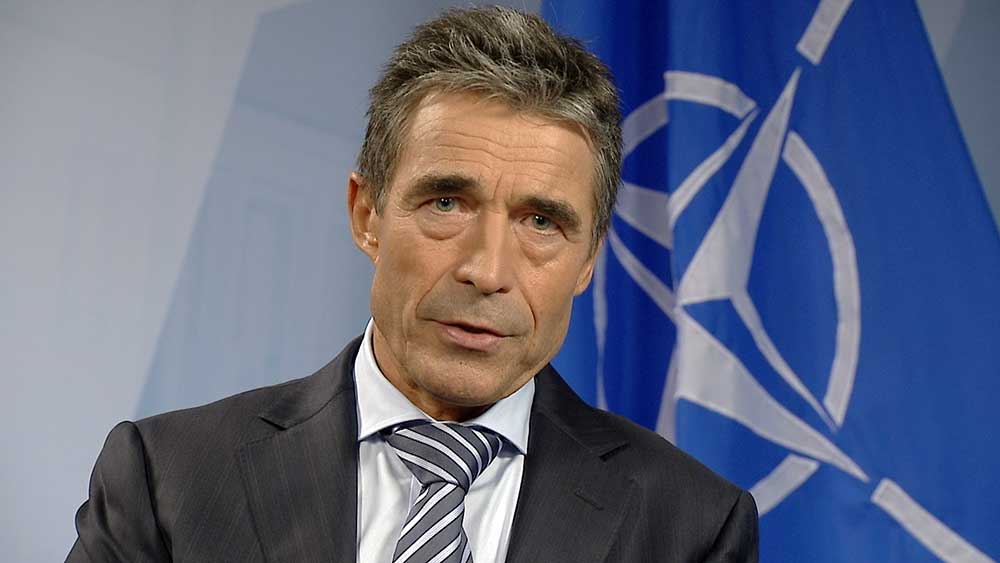
Anders Fogh Rasmussen

The NATO alliance and Russia have agreed to discuss the latest developments in Ukraine at a special meeting on Wednesday.

The alliance announced that an extraordinary NATO-Russia council will convene at the suggestion of alliance secretary-general Anders Fogh Rasmussen. Russia agreed to the meeting on Tuesday, when NATO ambassadors were further discussing the crisis among themselves.

Rasmussen has said Russia’s military intervention in Ukraine is in violation of the U.N. charter and threatens peace and security in Europe. Russian President Vladimir Putin said Tuesday that Moscow reserves the right to use its military to protect Russians there but voiced hope it won’t need to do so.

Russia took over the Crimean peninsula on Saturday, placing its troops around the region’s military bases and border posts.

China backs Russia on Ukraine

russekrim

The Russian Foreign Minister Sergey Lavrov, justified the military incursion into Ukraine on Monday and said it was necessary in order to protect his country’s citizens living there. “This is a question of defending our citizens and compatriots, ensuring human rights, especially the right to life,” he said.

Panama was invaded in 1989 over the exact same pre-text by the US. US nationals were ‘in danger’ and the US military needed to protect them, analysts pionted out. Panama was considered in the US ‘sphere of influence’ which was the reason given by the Bush senior administration to invade a sovereign nation.

Earlier on Monday, as Russia sought to draw support from the international community, Mr Lavrov said that he had discussed Ukraine with his Chinese counterpart and that the two veto-wielding UN Security Council members had “broadly coinciding points of view” and would stay in close contact on the issue.

President Vladimir Putin has defended Russia’s actions, blaming “ultra-nationalist forces” for seizing power in Kiev. A Kremlin statement posted online said Putin told the German Chancellor, Angela Merkel, on Sunday that measures taken by Russia so far were “fully adequate” and in response to the unrelenting threat of violence” to “Russian citizens and the whole Russian-speaking population”.

Russia has told Ukrainian forces surrender its control of the strategic Crimean region by 3am on Tuesday or face military assault.

Relations with the US and Britain continued to plummet as the Russian Government continued to ignore calls from their leaders to leave the Ukrainian area.

It followed claims from the Ukrainian Defence Ministry that Russian fighter jets had “violated” the country’s airspace over the Black Sea overnight and that Russian forces were now in control of the port city of Sevastopol, where the Black Sea fleet is based.

The takeover of the ferry terminal on the eastern tip of Crimea by Russian troops has exacerbated fears that Moscow is planning to bring even more troops into the strategic Black Sea region. There was no immediate comment from the Russian Defence Ministry.

During a visit to Kiev today, the Foreign Secretary William Hague described the situation as “certainly the biggest crisis in Europe in the 21st century”, adding that there was “no justification” for the actions in Crimea, where Russia had “in effect taken control”.

Echoing US President Obama’s speech on Friday, the Foreign Secretary said Moscow should be in no doubt that it faced “significant costs” for its move into the Ukrainian region.

Yesterday, Ukraine’s country’s acting Prime Minister said that his country was “on the brink of disaster”, fanning fears that his position might be in danger too.

Emerging from a closed session of parliament in Kiev, Mr Yatsenyuk described President Putin’s decision to send in troops as a “declaration of war”, and said “there was no reason for the Russian Federation to invade Ukraine.

The Nato Secretary-General, Anders Fogh Rasmussen, called on Russia to “stop its military activities and its threats” after convening an emergency meeting. “What Russia is doing now in Ukraine violates the principles of the United Nations Charter,” he said. “It threatens peace and security in Europe.”

The G7 group of major industrialised nations condemned Russia’s intrusion into Ukraine on Sunday. It has also cancelled preparations for the G8 summit that was to include Russia, scheduled for Sochi in June, the White House confirmed.

The group said in a statement: “We, the leaders of Canada, France, Germany, Italy, Japan, the United Kingdom and the United States and the President of the European Council and President of the European Commission, join together today to condemn the Russian Federation’s clear violation of the sovereignty and territorial integrity of Ukraine.

“We have decided for the time being to suspend our participation in activities associated with the preparation of the scheduled G8 Summit in Sochi in June,” it added.

The G7 also urged Russia to hold talks with Ukraine directly to address any human rights or security concerns it has.

The group expressed its support for Ukraine’s bid to secure financial help from the International Monetary Fund and to make reforms to its economy.

Source: The Independent


Crimea cannot be denied right to hold self-determination referendum

Sevastopol airport
Sevastopol airport calm

The legitimacy of the Ukrainian parliament, the Verkhovna Rada decision, which removed President Viktor Yanukovych from office, is highly doubtful, the Russian State Duma International Affairs Committee Chairman Alexei Pushkov said. “As far as I understand, the process of Yanukovych’s deposing was rather confused and its legitimacy causes qualms,” Pushkov told reporters.

The opposition leaders who struck the deal with Yanukovych on February 21 on guarantee of EU representatives agreed that he would stay in office until the presidential election.

“It seems the sole purpose of the [February] 21 agreement guaranteed by the European Union was to remove Yanukovych from office. But that agreement said he would be the president until the elections were held. This is why Yanukovych says he remains the legitimate president of Ukraine,” the parliamentarian continued.

This is a formal agreement and no one has explained why “it was suddenly disavowed,” Pushkov said, describing the situation as a serious collision.

Crimea cannot be denied the right to hold a referendum on self-determination, head of the State Duma international affairs committee Alexei Pushkov told reporters on Friday.

“If Crimea holds a referendum, this will be an absolutely legislative and legally binding base for changing its status, if the majority of the population votes for this,” he said.

Pushkov said such a referendum would be a more legal form for changing Crimea’s status than “spontaneous Maidan” in Kiev.

“If we are told that the Maidan could be a source of power, well, this is the will of the people. But why then can’t the will of the people be the source of power and self-determination for Crimea. I think it cannot be denied this right,” the parliamentarian said.

On Thursday, the parliament of the Autonomous Republic of Crimea announced it would hold a referendum of the autonomy’s status and expansion of its powers.

The Russian and Ukrainian governments continue to maintain “working” contacts following the change of power in Kiev, Russian Deputy Prime Minister Arkady Dvorkovich said.

“These contacts continue at the working level,” he told Interfax after being asked whether negotiations could be held with the Ukrainian government any time soon.

Dvorkovich declined to comment on the prospects for holding official negotiations with the Ukrainian side.

Ukraine’s interior minister claims Russian forces have now taken control of two airports in Crimea.

Shortly afterwards a military airport near the port of Sevastopol was seized. There are no reports of any bloodshed or clashes near where the Russian Black Sea fleet has a base.

Ukraine’s Interior Minister Arsen Avakov has described the raid as an armed invasion in violation of international accords.

Source: Voice of Russia, TASS, Interfax

Governed by Kalashnikov-toting people in black masks

The Filchenkov
The Filchenkov

Missing Ukrainian President Viktor Yanukovych is in Sevastopol, at a Russian miltary base in Cossack Bay, UNIAN reported citing local media.

According to sources, the channel ATR, the ex-president fled to a ship of the Russian Federation’s Black Sea Fleet.

Sources say that Yanukovych could thus leave for Russia.

The Ukrainian president went into hiding over the weekend.

Yanukovych’s removal from power has been recognized the US and EU.

Russian PM Dmitry Medvedev said however that interim authorities in Kiev had conducted an “armed mutiny”.

On Sunday, Ukraine’s parliament reduced the official status of the Russian language by cancelling a law brought in by Mr Yanukovych.

Ukraine is facing bankruptcy and a promised loan from Russia is looking increasingly unlikely.

“Strictly speaking there is no one to talk to there. There are big doubts about the legitimacy of a whole series of organs of power that are now functioning there,” Mr Medvedev told Russian news agencies.

“If you consider Kalashnikov-toting people in black masks who are roaming Kiev to be the government, then it will be hard for us to work with that government,” Medvedev said.

Izvestia Kiev reported that out of Kubinka, four ships carrying special forces, are being relocated to Anapa. From there, in four hours, they will depart for Sevastopol at a speed of 10-15 knots, citing “Izvestia in Ukraine” as a source.  According to the source, the redeployment is “qualitative, not quantitative” and that the Ukraine is following these developments.

The large landing ship Nikolai Filchenkov is believed to be en route to the Crimean port of Sevastopol carrying 200 armed soldiers, sent from the nearby Black Sea town of Temryuk.

There will be an urgent NATO Defense Ministers meeting in Brussels on Wednesday, centered on Ukraine.

Putin, Merkel want Ukraine’s territorial integrity respected

ukraine3Vladimir Putin spoke with Angela Merkel by telephone on Sunday about the situation in Ukraine. According to a statement on the chancellor’s website, both leaders agreed that Ukraine’s “territorial integrity must be respected.”

President Viktor F. Yanukovych has fled the Ukrainian capital. He was removed from power by a unanimous vote in Parliament, lawmakers moved swiftly on Sunday to dismantle his government by firing top cabinet members, including the foreign minister.

The defense minister, Pavlo Lebedev told Ukraine’s Channel 24 that he intended to remain in his post.

Parliament voted to grant Oleksandr Turchynov, the Speaker, authority to carry out the duties of the president of Ukraine.

Speculation about a major role for the freed former prime minister, Yulia V. Tymoshenko, was squashed on Saturday afternoon when she issued a statement asking not to be considered for the post again.

EU officials recall her period as prime minister after Ukraine’s 2004/5 pro-democracy Orange Revolution as hardly less corrupt than Yanukovich’s tenure. Ukraine is 144th on watchdog Transparency International’s index of perceived corruption.

“Political uncertainty has arguably increased – including around the outcome of the presidential election set for 25 May – bringing with it a potential increase in the probability of a sovereign default,” Nomura political analyst Alastair Newton said.

France and Germany’s Merkel are both quite cool on the EU enlargement. Polish Prime Minister Donald Tusk, whose country played a central role in the negotiations, is not.

The EU has found it politically difficult enough to bail out its own members during the bloc’s debt crisis. Spending on an outsider will be more fraught still.

Ukranian Rabbi urges Jews to flee Kiev

Protester shooting at police
Protester shooting at police in Kiev

Ukrainian Rabbi Moshe Reuven Azman, called on Kiev’s Jews to leave the city and even the country if possible, fearing that the city’s Jews will be victimized in the chaos, Israeli daily Maariv reported Friday.

“I told my congregation to leave the city center or the city all together and if possible the country too,” Rabbi Azman told Maariv. “I don’t want to tempt fate,” he added, “but there are constant warnings concerning intentions to attack Jewish institutions.”

According to the paper’s report Azman closed the Jewish community’s schools but still holds three daily prayers. He said the Israeli embassy told members of the Jewish community to avoid leaving their homes.

Source: Haaretz

Ukrainian president denies his resignation

peacedeal
Opposition ignoring the signed peace deal

Ukrainian President Viktor Yanukovich has called the latest developments in the country a coup d’etat, denying speculations of his resignation. He also accused international mediators of not fulfilling their obligations.

“I’m always threatened with ultimatums. I’m not going to leave the country,” Yanukovich said in an interview with local UBR TV channel. “I’m not going to resign. I’m a legitimately elected president.”

The interview with the embattled president was broadcast right after the opposition claimed it had received verbal assurances that Yanukovich was resigning.

But as parliament deputies said they were waiting for the written confirmation on his resignation, the president announced his plans to travel across the country’s southeast, which is “so far, less dangerous.”

“Everything that is happening today is, to a greater degree, vandalism and bandits and a coup d’etat,” Yanukovich said in a televised statement.

On Saturday, Ukrainian parliament (Verkhovna Rada) held a new emergency session, during which it passed a law on the return to the 2004 constitution without the president’s signature, saying that the president had removed himself from power.

It also appointed a new head of the Ministry of Interior and a new head speaker of the Rada. In addition, parliament ruled to free former Prime Minister Yulia Tymoshenko from prison and set early presidential elections for May 25.

But Yanukovich says the motions passed by parliament are illegitimate, and says he will not sign any of them.

“The decisions that they are now approving are illegal. I won’t sign anything,” he told UBR journalists in Kharkov. “This is not an opposition, these are bandits.”

The president said his car had been shot at while he was traveling to the airport to go to Kharkov.

“But I have no fear. I am overwhelmed by grief for our country. I feel responsibility,” he said.

“I’m doing everything to prevent the bloodshed of the people who are close to me,” Yanukovich stated, referring to his supportive deputies who he said are being threatened, beaten, and targeted by stone-throwing rioters.

He compared the situation in turbulent Ukraine – which is facing its worst political crisis in modern history – to the rise of the Nazis in the 1930s.

“We now see the same what was [happening] in 1930s, when the Nazis came to power. [They] forbade [political] parties…It’s the same now – [they] ban the party, stalk, beat people, burn down offices,” he said.

Yanukovich is determined to do whatever it takes to “stop the bloodshed” and protect Ukraine “from a split.” But the president admits: “I still don’t know how I am going to do it.”

The leader has stated that he expects international mediators to fulfill their commitments.

“What we are going to do depends on the reaction from the international community, how they are going to meet their responsibilities,” Yanukovich said. “The head of the Ministry of Foreign Affairs, still legitimate, reported yesterday he was speaking with Europeans, with Poland’s head of Ministry of Foreign Affairs, called the US. I hope to hold negotiations in the coming days.”

Yanukovich will call on EU mediators to stop “actions by radicals.”

“I was given guarantees of all the international mediators, with whom I worked. They gave security assurances. I’ll see how they will perform this role,” he said.

On Friday, Yanukovich and opposition leaders signed an EU-brokered agreement on ending the political crisis in the country. While it stipulated five major conditions, the agreement did not give the opposition the power to impose new laws or appointments without presidential approval, though they have attempted to do just that.

Thus the conditions of the deal are being clearly violated. However, the EU – which mediated the deal between the opposition and ruling government – remains quiet.

What the Ukrainian opposition IS NOT fulfilling:
1. Within 48 hours of the signing of this agreement, a special law will be adopted, signed and promulgated, which will restore the Constitution of 2004 including amendments passed until now. Signatories declare their intention to create a coalition and form a national unity government within 10 days thereafter.

2. Constitutional reform, balancing the powers of the President, the government and parliament, will start immediately and be completed in September 2014.

3. Presidential elections will be held as soon as the new Constitution is adopted but no later than December 2014. New electoral laws will be passed and a new Central Election Commission will be formed on the basis of proportionality and in accordance with the OSCE & Venice commission rules.

4. Investigation into recent acts of violence will be conducted under joint monitoring from the authorities, the opposition and the Council of Europe.

Lavrov to EU: Urge opposition to fulfill the deal

On Saturday, the foreign ministers of France, Poland, and Germany – the trio that most actively helped reach the deal between the rival sides in Kiev – admitted that opposition leaders have broken the agreement, according to the Russian Foreign Ministry.

The three EU ministers have spoken separately with Russian Foreign Minister Sergey Lavrov, who has voiced concerns over the Ukrainian opposition’s failure to fulfill the conditions of the agreement.

“The opposition not only has failed to fulfill a single of its obligations but is already presenting new demands all the time, following the lead of armed extremists and thugs whose actions pose direct threat to Ukraine’s sovereignty and constitutional order,” Lavrov told the ministers.

Russia’s FM has called on his counterparts to use their influence with the Ukrainian opposition to stop what he described as rampages by its supporters.

“It is time to stop misleading the international community and pretend that today’s Maidan represents the interests of the Ukrainian people,” Lavrov said.

But it seems that German Foreign Minister Steinmeier also has a separate agreement with British Foreign Secretary William Hague.

“Agreed with German Foreign Minister Steinmeier today to support new government in Ukraine and push for vital IMF financial package,” Hague stated on Twitter.

Sergey Lavrov also voiced his concerns in a talk with US Secretary of State John Kerry. The Russian FM told his counterpart that Kiev had been taken over by “illegal extremist groups,” adding that the situation in Ukraine has sharply escalated, the Russian Foreign Ministry said in a statement.

US media’s knee-jerk response to Putin leads to Berlin-Moscow axis

mercer_ilanaby Ilana Mercer

[followbutton username=’IlanaMercer’ count=’true’ lang=’en’ theme=’light’]

Like Ilana Mercer’s Facebook page

When it comes to President Vladimir Putin, who enjoys an approval rate of 65 percent among Russians, the motto of the menagerie of morons that is the American media is ignorance über alles.

The energetic and reflexive demonization of a Russian leader – unparalleled during communism – against the backdrop of the Sochi Olympic Games and the conflagration in the Ukraine, is the handiwork of a conga-line of cretins, stateside, whose bombast comports with the boorishness of their pronouncements.

The “Shangri-La of Socratic disinterest,” one wag’s delicious description of broadcaster Bill O’Reilly, is not delimited by ideology. Instead, “wanton Putin bashing,” as scholar of Russian history Stephen Cohen attests, is the order of the day at the New York Times, Washington Post, Wall Street Journal, The New Republic, CNN, Fox News, MSNBC, on and on.

As to “traditional journalistic standards”: In the service of their anti-Putin monomania, the U.S. Pussy Riot press and its approved phalanx of “experts” routinely omit “facts and context,” conflate “reporting with analysis,” and court conformity and unanimity at the cost of veracity and impartiality.

(Revered in the U.S., Pussy Riot is a punk rock Russian band of feminists, whose forté is breast-baring, defiling places of worship, punching the air while shrieking, “F–k you Putin,” and participating in public-orgy protests and other criminal acts.)

The “Shangri-La of Socratic disinterest,” fortunately, is not a feature of the nuanced and informed analysis available on the John Batchelor Show, where the scholarly host and his guest, professor Cohen, delve deeply into the region’s geopolitical dynamics.

Cohen, who tackled O’Reilly’s out-and-proud ignorance with aplomb, was slightly more flummoxed by that of MSNBC’s Andrea Mitchell. She blamed Putin for Ukraine having “spun into politician chaos.” To wit, Europe had offered Ukraine $800 million in aid. The Kremlin “outbid the West” to the tune of billions, but held back on the last installment because it wanted to see to which government Russian funds would ultimately be going. Although Putin has since released the remaining funds to Ukraine, Mitchell surmised that Putin had orchestrated recent events so as to compel Kiev to sell-out to the Kremlin.

Nonsense on stilts. If anything, Putin’s impetus would be to avert trouble in Ukraine during the Sochi Olympics. Add Putin to the list of people who do not control what unfolds in Kiev, belabors Cohen.

Into the Cannibal's Pot

Contrary to America’s Democracy Alinskyites – media, academia, members of the Stupid and Evil Parties, State Department floozy Victoria Nuland (taped plotting to “midwife a new, anti-Russian Ukrainian government”), John McMussolini – the Ukrainian People, not unlike the “American People,” are not one people. The country is riven – divided into Western and Eastern regions, respectively. The West has been seduced by EU membership; the East is culturally and historically enmeshed in Russia.

What we’re witnessing is a tale of two Ukraines.

As it stands, explains Cohen, Kiev has lost control over Western Ukraine. Moderate voices are being silenced. Armed provocateurs are inciting matters and undermining moderate leadership. Revolution is being fomented.

Ukraine is not a dictatorship, it is an anarchy.

As to the demands issued by Vice President Joe Biden that the democratically elected Ukrainian President Viktor Yanukovych withdraw forces from the Maidan, the site of the protests: “preposterous,” avers Cohen. The “occupation of government buildings in Kiev and in Western Ukraine, the hurling of firebombs at police and other violent assaults on law enforcement officers … all documented and even televised”: these would not be tolerated in any Western democracy.

Equally outrageous is the Obama administration’s improvised and impromptu demands that the same democratically elected president step down before elections are held next year. The rational solution to the chaos in Ukraine is to allow the parties to “chill out” and resolve to wait until the February elections, next year, whereupon a referendum question can be tagged to the ballot to help decide whether Ukraine should sign up with Europe or Russia. (Cohen advocates an either/or “democratic” decision; I say secession.)

Should cool heads fail to prevail in the negotiation of a political solution, the division of Ukraine is impending, with part of the country cleaving to Europe, the other to Russia.

The “struggle for Ukraine” is a chapter in a series of U.S.-orchestrated provocations, which began with the expansion of NATO (North Atlantic Treaty Organization) eastward to abut Russia’s borders – an expansion pursued by Clinton, Bush and Obama alike. It gathered momentum with the U.S.-backed attempts to incorporate Georgia and Ukraine into the North Atlantic alliance.

The next stage in goading the Russian Bear consisted in American-funded NGO political-action groups – many of them backed by George Soros – flooding Russia proper. (“Purple” in Iraq, Blue in Kuwait, Cotton in Uzbekistan, Grape in Moldova, “Orange” in the Ukraine, “Rose” in Georgia, “Tulip” in Kyrgizstan, “Cedar” in Lebanon, Jasmine in Tunisia, Green in Iran, still un-christened in Russia and Syria: Dig around and you’ll find American activists à la Alinsky behind these “color-coded,” plant-based revolutions, blessed and backed by Foggy Bottom.)

“A U.S.-NATO military outpost in Georgia and missile-defense installations near Russia” completed the provocation. “Whether this longstanding Washington-Brussels policy is wise or reckless, it – not Putin’s December financial offer to save Ukraine’s collapsing economy – is deceitful,” inveighs Cohen.

Also upon us is a second Cold War between the U.S. and Russia, which will see a close, bilateral collaboration between Berlin and Moscow – Putin and Angela Merkel enjoy a cozy and copacetic relationship and will likely work together to dominate Eurasia.

Having flouted America’s national interests and squandered Russian goodwill – the ignoramuses of the Beltway will have no place in this grand geopolitical realignment.

© 2014 by Ilana Mercer

[followbutton username=’IlanaMercer’ count=’true’ lang=’en’ theme=’light’]

Like Ilana Mercer’s Facebook page

Snipers fire at Russian media in Kiev

ruptlyRT’s camera crews have been fired upon by rioters as they tried to film the escalating violence on Kiev’s Independent Square. Armed protesters have taken control of Hotel Ukraine, trapping members of the RT crew inside.

“We were just shot at. It broke a window over here. We were standing centimeters away when a gunshot hit the room where we have our live position,” RT correspondent Aleksey Yaroshevsky said, pointing to the window that had been smashed by the gunfire. He said there were unidentified snipers firing from buildings all around Independence Square.

“There’s no truce at all,” Yaroshevsky added, describing how, a few hours earlier, he witnessed rioters pushing police back from the barricades amid weapons fire.The camera team of RT’s video agency Ruptly was shot at during filming. One of the bullets grazed the bulletproof vest of journalist Danil Asimov as he stood by the window on the 14th floor of a Kiev hotel.

Correspondent Egor Piskunov and his camera crew were also caught in the crossfire as they tried to film Independence Square from Hotel Ukraine.

“The cameraman tried to film what was happening on the other side of the hotel and he was fired at. Thankfully they missed. As soon as they [cameramen] realized there was a bullet they dropped down to the floor,” Piskunov told RT.

Armed rioters have taken control on Hotel Ukraine and are using it as a base to fire on Independence Square, reports Ruptly news agency. Piskunov and his team have barricaded themselves in their hotel room and covered the windows.

“There are live rounds being fired all around this building. Rioters are occupying the floors right now,” said Piskunov.

He confirmed that EU Foreign Ministers from Poland, France and Germany had quit the Ukrainian capital because of security concerns. They were scheduled to meet with Ukrainian President Victor Yanukovich and members of the opposition on Thursday to discuss a solution to the unrest.

US and EU are paying Ukrainian rioters and protesters

pcrBy Paul Craig Roberts.

A number of confirmations have come in from readers that Washington is fueling the violent protests in Ukraine with our taxpayer dollars. Washington has no money for food stamps or to prevent home foreclosures, but it has plenty of money with which to subvert Ukraine.

One reader wrote: “My wife, who is of Ukrainian nationality, has weekly contact to her parents and friends in Zhytomyr [NW Ukraine]. According to them, most protesters get an average payment of 200-300 grivna, corresponding to about 15-25 euro. As I additionally heard, one of the most active agencies and ‘payment outlets’ on EU side is the German ‘Konrad Adenauer Stiftung’, being closely connected to the CDU, i.e. Mrs. Merkel’s party.”

As I reported on February 12, “Washington Orchestrated Protests Are Destabilizing Ukraine,” Assistant Secretary of State Victoria Nuland, a rabid Russophobe and neoconservative warmonger, told the National Press Club last December that the US has “invested” $5 billion in organizing a network to achieve US goals in Ukraine in order to give “Ukraine the future it deserves.” Nuland is the Obama regime official who was caught red-handed naming the members of the Ukrainian government Washington intends to impose on the Ukrainian people once the paid protesters have unseated the current elected and independent government.

What Nuland means by Ukraine’s future under EU overlordship is for Ukraine to be looted like Latvia and Greece and to be used by Washington as a staging ground for US missile bases against Russia.

From the responses I received to my request for confirmations of the information sent to me from Moldova, there is enough evidence that Washington fomented the violent riots for western newspapers and TV channels to investigate. But they haven’t. As we know, the presstitutes are enablers of Washington’s crimes and duplicities. However, the US media has reported that the Ukrainian government is paying Ukrainians to rally in favor of the government.

As Karl Marx wrote, money turns everything into a commodity that is bought and sold. I wouldn’t be surprised if some protesters are working both sides of the street.

Of course, not all of the protesters are paid. There are plenty of gullible dupes in the streets who think they are protesting Ukraine government corruption. I have heard from several. There is little doubt that the Ukraine government is corrupt. What government isn’t? Government corruption is universal, but it is easy to go from the frying pan into the fire. Ukrainian protesters seem to think that they can escape corruption by joining the EU. Obviously, these gullible dupes are unfamiliar with the report on EU corruption issued February 3 by the EU Commissioner for Home Affairs. The report says that a business-political nexus of corruption affects all 28 EU member countries and costs the EU economies $162.2 billion per annum. Clearly, Ukrainians will not escape corruption by joining the EU. Indeed, the corruption will be worse.

I have no objection to Ukrainians protesting government corruption. Indeed, such gullible people could benefit from the lesson they would learn once their country is in the hands of corrupt Brussels and Washington. What I object to is the lack of awareness on the part of the protesters that by permitting themselves to be manipulated by Washington, they are pushing the world toward a dangerous war. I would be surprised if Russia is content to have US military and missile bases in Ukraine.

It was fools like Nuland playing the great game that gave us World War I. World War III would be the last war. Washington’s drive to exploit every opportunity to establish its hegemony over the world is driving us all to nuclear war. Like Nuland, a significant percentage of the population of western Ukraine are Russophobes. I know the case for Ukrainian dislike of Russia, but Ukrainian emotions fueled with Washington’s money should not direct the course of history. No historians will be left to document how gullible and witless Ukrainians set the world up for destruction.

Paul Craig Roberts was Assistant Secretary of the Treasury for Economic Policy and associate editor of the Wall Street Journal. He was columnist for Business Week, Scripps Howard News Service, and Creators Syndicate. He has had many university appointments. His internet columns have attracted a worldwide following. His latest book, HOW AMERICA WAS LOST, is now available. 

EU, US exploiting nationalism in Ukraine

EU exploiting nationalism to Russia
EU, US exploiting nationalism to fend off Russia in Ukraine

Ukraine’s opposition will march on parliament to pressure lawmakers struggling to end a deadly three-month political standoff, jeopardizing compromises that eased tensions over the past week.

Vitali Klitschko, a former boxing champion and EU man, and Arseniy Yatsenyuk, a lawmaker and former central banker, plan to lead thousands of demonstrators today on the first mass action outside their Independence Square compound since Jan. 19, when the last attempt to reach parliament erupted in clashes with police.

“If politicians don’t make a decision, we the people will,” Serhiy, a 23-year-old from the Lviv region near Poland, said inside the encampment, wearing camouflage and a bulletproof vest adorned with a paper “self defense” badge. “We’ve had enough. We’re fighters. We haven’t come here to listen to talks. If we decide to act, we’ll act.”

The standoff began Nov. 21, when Yanukovych pulled out of a free-trade deal with the EU, opting instead for President Vladimir Putin’s offer of $15 billion of aid and cheaper gas.

Russia, which stopped buying bonds from Ukraine’s cash-strapped government after Yanukovych’s Russian-born prime minister, Mykola Azarov, resigned on Jan. 28, said yesterday it will resume purchases, including $2 billion this week. Russian Finance Minister Anton Siluanov made the announcement just as Klitschko and Yatsenyuk were meeting with German Chancellor Angela Merkel in Berlin to seek financial and political backing to form a new government.

Source: Business Week