No white cadets for South African Airways

Solidarity intends campaigning against SA Airways after not a single white man was selected for its cadet programme, the trade union said on Tuesday.

“In August last year, the SAA lifted the ban on applications from white males for its cadet programme after Solidarity launched a major public protest campaign against the SAA,” deputy general secretary Dirk Hermann said.

“It is clear that the lifting of the ban was merely a smoke-screen for continued racial discrimination by the airline.”

The union said SAA announced on Monday that 40 candidates had been admitted to its cadet programme. They would undergo 14 months of theoretical and practical training to enable them to obtain their Airline Transport Pilot Licences.

This would be followed by about three years of internship. The group consisted of 10 black men, four black women, nine coloured men, one coloured woman, seven Indian men, two Indian women and seven white women, it said.

“SAA’s exclusion of white male candidates constitutes subsidised racism… .The taxpayer is forced to pay for the government’s obsession to apply national racial demographics at all levels, everywhere in South Africa,” said Hermann.

Solidarity called on white men who applied for the cadet programme, but were unsuccessful, to contact it so it could investigate taking legal action on their behalf, said Hermann.

SAA said in a statement that the final 40 candidates fell under the category of previously disadvantaged individuals as defined in the Employment Equity Act.

“It is important to note this in the context of the current reality and measures that need to be taken,” spokesman Tlali Tlali said.

“The cadet programme is the airline’s effort to transform not only its own but also the country’s flight deck community, which is nowhere close to reflecting the country’s demographics,” he said.

He said SAA’s transformation strategy was informed by the broad-based black economic empowerment aviation sector charter.

“In the case of this particular programme, when assessing all applications, SAA is obliged to give preference to previously disadvantaged groups,” said Tlali. – Sapa

Malema does not mind ‘monkey business’

Julius Malema in Pietersburg

Expelled ANC Youth League leader Julius Malema is “OK” with a picture of him under one of a monkey in a Bloemfontein school classroom, the Sowetan newspaper reported on Thursday.

“They can do that with me, displaying me next to the monkeys, it’s OK,” Malema told the newspaper.

“Nothing shocks me. Our people are subjected to harsh realities of racism everyday. As for me, once you display a racist attitude, I don’t waste time, I deal with it right away because I know that that is how they are brought up.”

The SA Human Rights Commission (SAHRC) said on Monday it would investigate allegations of racism at a Free State school.

“There were complaints that some of those kids [in the school] have been called kaffirs,” said spokesman Isaac Mangena.

The old South African flag and a picture of Malema alongside that of a monkey were also reportedly put up on a classroom wall.

The Sowetan reported that wording written on the monkey picture said primitive brains only allowed monkeys to make strange expressions when they wanted to speak.

The SAHRC said it conducted an on-site inspection of the Wilgehof Primary School in Bloemfontein, after a white pupil’s parent laid a complaint.

The SA Democratic Teachers’ Union (Sadtu) said on Wednesday racism was rife in Free State schools and called for an investigation into racism at schools in the province. – Sapa

Italian soccer fans sentenced for ‘racism’

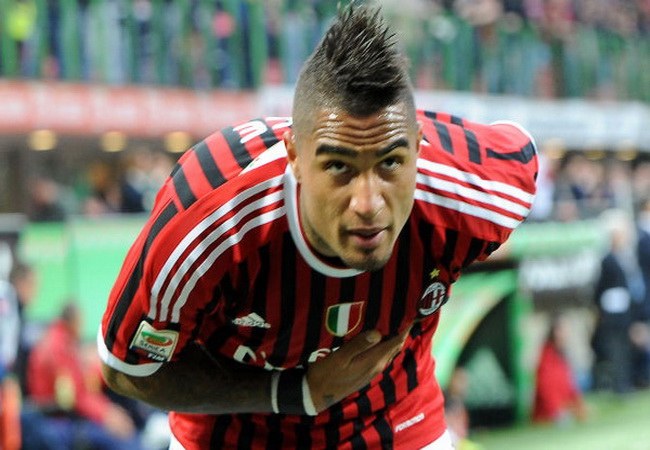
AC Milan's Kevin-Prince Boateng

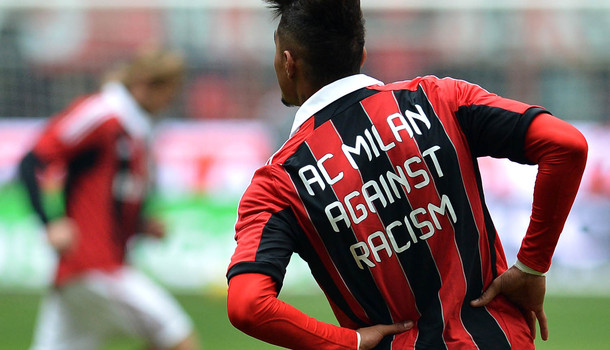
Six fans of lower-division club Pro Patria have been issued jail sentences from 40 days to two months for inciting racial hatred during a January friendly against AC Milan.

After repeated racist chants directed at him during the match, Milan and Ghana midfielder Kevin-Prince Boateng kicked the ball in anger at a section of the crowd, took off his shirt and walked off the pitch with the rest of the Rossoneri.

Milan players Urby Emanuelson, Sulley Muntari and M’Baye Niang were also targeted by the chants.

Prosecutors had requested four- to six-month sentences.

The ANSA news agency reports that one fan received a 40-day sentence after collaborating with authorities, while the other five fans received two-month sentences.

The fans were also fined a total of ?10,000 ($13,000), plus trial expenses. – AFP

Designer John Galliano ‘didn’t mean’ anti-Jewish remarks

John Galliano receiving his Legion d'Honneur from former French president Nicolas Sarkozy

Iconic British designer John Galliano, sacked by Dior in 2011 for making drunken racist tirades, says he is “grateful” for his fall from grace because it forced him to confront his drug and alcohol demons.

In what was billed as the designer’s first sober interview since the career-shattering scandal that saw him ousted from the French fashion powerhouse, Galliano told Vanity Fair he had been in denial about his substance abuse for years.

“It sounds a bit bizarre, but I am so grateful for what did happen,” Galliano told the magazine in an interview published Tuesday on its website.

“I have learned so much about myself. I have re-discovered that little boy who had the hunger to create, which I think I had lost. I am alive.”

The 52-year-old was hit with suspended fines totaling 6,000 euros ($8,400) after being found guilty of making anti-Semitic insults in public — an offense under French law — following separate incidents in 2010 and 2011.

Galliano underwent treatment at an Arizona rehabilitation center in the wake of the scandal, which broke after the emergence of a video capturing his anti-Jewish rant towards fellow patrons in a Parisian bar.

“When I saw it, I threw up,” Galliano said of the damning video evidence. “The feeling was like I was about to take a step out onto the street and a bus or truck whooshed past me and the blood was drained from my legs.”

“I was paralyzed from the fear.”

Galliano told Vanity Fair he remained baffled by the nature of his remarks, insisting he “didn’t mean” what he said.

“It’s the worst thing I have said in my life, but I didn’t mean it … I have been trying to find out why that anger was directed at this race,” he said.

“I now realize I was so … angry and so discontent with myself that I just said the most spiteful thing I could.”

Galliano meanwhile painted a picture of a life that had spiraled out of control shortly before the scandal, believing he would have ended up “in a mental asylum or six feet under” if he hadn’t changed his lifestyle.

“I never drank in order to be creative, or to do the research,” he said. “I didn’t need alcohol for any of that. At first alcohol was like a crutch outside of Dior. Then I would use it to crash after the collections.”

“I’d take a couple of days to get over it, like everyone. But with more collections, the crash happened more often, and then I was a slave to it.”

“Then the pills kicked in because I couldn’t sleep. Then the other pills kicked in because I couldn’t stop shaking. I would also have these huge bottles of liquor that people got for me. Towards the end, it was whatever I could get my hands on.”

“Vodka, or vodka-and-tonic. Wine, in the belief it would help me sleep. Wrong. I did manage to stop the voices. I had all these voices in my head, asking so many questions, but I never for one second would admit I was an alcoholic. I thought I could control it.”

Galliano, who spent nearly 15 years at Dior, is widely considered to be one of the most brilliant fashion minds of his generation.

However, his rehabilitation following the racism scandal has been difficult. Last month, New York’s Parsons School of Design canceled a workshop he had been set to give at the prestigious fashion college. – AFP

‘Racism’ at Free State school to be investigated

Racist flag?

Racism is rife at schools across the Free State and requires an investigation, the SA Democratic Teachers’ Union (Sadtu) said on Wednesday.

“We call on the department of education to investigate acts of racism beyond the issue of Wilgehof Primary School, as these practices are still rife in most of the schools in the province,” Sadtu Free State said in a statement.

The SA Human Rights Commission (SAHRC) said on Tuesday it would investigate allegations of racism at the school, in Bloemfontein. It said there were complaints that some of the children at the school had been called kaffirs.

The old South African flag had reportedly been put up on a classroom wall, as had a picture of expelled ANC Youth League president Julius Malema alongside that of a monkey.

The SAHRC conducted an on-site inspection of the school after a white pupil’s parent laid a complaint.

Sadtu said it had previously complained to the department about alleged racism at the school.

“We have on numerous occasions called for the full investigation of allegations of racism at this school, but the department has always opted for defensive tactics claiming that the concerns and complaints raised by our members are baseless and unfounded,” it said.

Sadtu said the alleged racism undermined the dignity of black people.

“The conduct at this school is not just undermining the principles of a democratic non-racial South Africa, but is a clear disregard of the dignity of the black people when they are associated with baboons,” it said. – Sapa

‘Racism’, a religious concept?

by Dan Roodt

Since the ANC takeover in South Africa, this country has become race-obsessed. Not only do we have a huge number of laws that favour blacks over whites, but not a day goes by without someone being publicly accused of “racism”.

Whereas blasphemy, or denigrating Christians generally, is considered freedom of speech, merely stating a fact about black people can often lead to public denunciations, charges of “hate speech” or worse. In South Africa, as in Britain and some other countries, there exists a “Human Rights Commission” whose sole purpose, it seems, is to sniff out “racism” in its various forms, almost like the Spanish Inquisition used to enquire into heresy in the fifteenth century.

I was recently publicly accused here in South Africa of “allowing hate speech” on my Facebook wall. To some extent the motivation was revenge as I had complained about a radio announcer’s swearing at one of my Facebook “friends”, a very civil lady from Cape Town. Within a day or two, he saw fit to retaliate by gathering a whole series of “expert comments” about the “hate speech” proliferating on my Facebook wall, as well as those of some other Afrikaner activists. I could not quite understand what it was all about, but apparently referring to black perpetrators of South Africa’s notorious farm murders as “barbarians” was a clear instance of “racism” and “hate speech”.

Please note that I did not call any black murderers “barbarians”, but some of my 7 000 Facebook friends and followers did. My sin, according to the radio station RSG, was “not removing it timeously”. My retort was that I could hardly police the utterances of the public or act as a self-appointed censor for all those people who are unhappy about the extreme levels of crime and violence in South Africa.

What I also find surprising about the logic of “hate speech”, is that the underlying cause of discontent, i.e. bloody murders and torture, seems to be morally superior to ethnic comments made in reaction to such crimes.

Since this incident about a week ago, various people, on Twitter and elsewhere, have threatened me with prosecution by the so-called Human Rights Commission for “hate speech” which I did not even utter myself but simply “tolerated”. So I suppose if you organise a public meeting in a rented hall somewhere and someone arrives to utter the word “kaffir” or “nigger”, you could be held liable.

That is why I am starting to think that “racism” is a religious concept. The extreme sensitivity that anti-racists have towards certain words or even innuendo is very much akin to intolerance of blasphemy. In Europe I know bananas have been banned in some soccer stadiums for being a form of symbolic insult to black players who have occasionally been offered such fruit on the pitch. I honestly love bananas, eat at least one every day for breakfast and would never decline the curved yellow gift of the tropics. The notion that one could be insulted or defamed by a banana is so absurd that, again, the symbolism must relate to the arcane rules of a religious cult.

Although it is more or less acceptable to criticise Muslims, specifically “Islamists”, in the West, year after year it gets more difficult to voice almost any form of censure regarding black behaviour. The amazing thing is that we now have the exact opposite of what pertained in the nineteenth century when blacks were seen to occupy the lowest rung of human and civilisational evolution. It is as if blacks have ascended to Mount Olympus itself and it is incumbent upon us to respect, nay, revere them.

In American popular culture, such as Hollywood movies, blacks are often presented as the saviours of planet earth or of America. They infuse the white world with their special, divine essence. At the very least, no white protagonist could peform his heroic duties without black assistance. While white characters tend to be fallible, human, blacks are often cast in the roles of morally umblemished near-saints or sages “keeping whites on the right track”.

Often I have been in the presence of Europeans, especially liberal Britons, who tend to be cold and dismissive of their fellow whites, but who display the most unctuous and exaggerated civility towards blacks. It is as if a black, any black, is the most interesting creature imaginable, a prophet as it were, whose very thoughts and gestures need to be attentively followed, savoured, to the exclusion of everybode else.

When it comes to black politicians like Martin Luther King or Nelson Mandela, we are treading on hallowed ground indeed. For a minister of religion, King led a debauched life and told many lies, yet his reputation as one of America’s greatest leaders and sages is unquestionable.

Although he started out as a petty terrorist, Mandela has now been anointed by the world media as nothing short of a saint, if not the reincarnation of Jesus Christ. Almost every world leader has at some point paid tribute to Mandela, with Bill Clinton in the forefront, during and after his presidency. The fact that he probably never wrote any of his speeches himself, including the oft-quoted one delivered from the dock during the so-called Rivonia trial, is simply glossed over.

One of the people who made him famous, the British journalist Anthony Sampson, had the following to say about Mandela in his autobiography, The Anatomist (2008):

“I would love to recollect that I recognised Mandela from the start as a true leader of his people, destined to change the course of history. But in truth at that time (in the 1950s – DR) I sadly underestimated him: he seemed to me too flashy and vain, with his immaculate suits and his wide smile, and he kept aloof from most white observers; I found his rhetoric too formal and stilted, full of anti-colonialist clichés.”

Questioning Mandela’s greatness will probably in itself be considered heresy, or punishable “hate speech”. Yet one cannot help but wonder at the global adoration of someone who spent half his life in prison for a half-baked plan to place bombs in public places and who would ultimately insist on not being conditionally released, but “on his own terms”.

New York Times columnists regularly accuse the Republican Party of “racism” and I suppose the only way in which the GOP could refute them would be by fielding a candidate of colour themselves. The importance of “not being racist” has assumed such proportions that it dwarfs any other political issue, including global financial problems or the wars in the Middle East.

The day is probably not far off when for white voters to vote for a white candidate would be deemed “racist” too. Certainly in South Africa, despite the increasing evidence that black government is anything but utopia, any attempt to escape from it is seen as challenging the laws of the universe. No matter how corrupt and incompetent our local black leaders and officials turn out to be, submitting to them is seen as a moral imperative.

The small community of Afrikaners living together in Kleinfontein, thereby attempting to escape the crime and financial profligacy of nearby Pretoria with its ANC municipality, was recently accused of “racism”, with both CNN and the BBC rushing in to expose their almost criminal deviancy from the multicultural norm.

Probably the most successful political system ever devised was that of Ancient Egypt which lasted several thousand years. However, the key to pharaonic dominance was not to be found in its politics, but in its strictly ordered religious system. The pharaoh was an absolute ruler, but also a god. Not submitting to him must have been unthinkable, a mere mortal rebelling against divine authority.

The vicissitudes of modern democracy being what they are, it is hard to conceive of such an absolute monarch or permanent dynasty today. But what if anti-racism had to succeed in elevating Africans to a special place on earth, as “natural rulers” over the rest of mankind? The ruling elites of Africa are today the closest thing we have to an aristocracy, given the social distance between them and ordinary people, as well as the kind of obeisance they demand, from their impoverished countrymen, but especially from whites. In South Africa, even our liberal media marvel at the glittering ostentation and partying insouciance of our black political gods, using terms like “conspicuous consumption”.

The relative ease with which a fairly unknown politician from the South Side of Chicago such as Obama managed to obtain two presidential terms in America, also shows that the cult of negritude or whatever one needs to call this new secular religion is dominant in the world’s only superpower too.

The irony, of course, is that self-confessed atheists and agnostics in the West are the most ardent adherents to the cult of the black race, adulating King, Mandela, Obama and others who will no doubt soon follow in their footsteps.

Freud thought that Moses might have been an Egyptian. If we are to believe Afrocentrists, the ancient Egyptians could have been black, another highly dubious theory.

But if Moses were black, it would certainily explain why the Judaeo-Christian world so often craves a pharaonic – in the sense of larger-than-life – black king to come and save it.

Anti-racism: an industry in decline

Brad Paisley and LL Cool J

Like coal mining in the Eighties, the anti-racism industry is in decline. Governments can no longer afford to subsidise “diversity workshops” for which there’s no demand. Especially from young people.

On both sides of the Atlantic, teenagers and students are giving the finger (as they might put it) to the hypersensitive race relations ideology drilled into them by their teachers. They laugh at jokes that, a decade ago, would have been regarded as racist. If, after a few drinks, one of their friends crosses the line into ethnic stereotyping, they’re more like to argue with them than to notify the campus police.

The disintegration of traditional anti-racism was brought home to Americans this week when Brad Paisley, a young country music star, and LL Cool J, a black rap artist, released a song entitled Accidental Racist. In it, Paisley clumsily tries to explain why he’s attracted to the Confederate flag. He sings: “I’m proud of where I’m from but not everything we’ve done/And it ain’t like you and me can rewrite history.”

Cool J replies: “Just because my pants are saggin’ doesn’t mean I’m up to no good /You should try to get to know me, I really wish you would… If you don’t judge my gold chains/ I’ll forget the iron chains.”

Cue melodramatic gasps of horror from progressive columnists. But what’s interesting is that most fans of Brad Paisley and LL Cool J (and there isn’t much overlap between the two groups) aren’t offended. A white singer takes grudging pride in the Confederate South? A black singer makes fun of his own sagging pants and refuses to harp on about slavery? Cool. Or at least, like, whatever.

This nonchalance confuses the elderly activists who, until recently, lumbered from one workshop to another, pocketing wads of cash in the process: “racial sensitivity” doesn’t come cheap.

I put those words in quotation marks because these bores did nothing to promote harmony. On the contrary, ethnic minorities were taught to be ultra-sensitive towards unintended slights (as opposed to real racism, which they didn’t need lessons in identifying).

As for white people, it was all about guilt-tripping. Chief executives booked themselves on reprogramming courses, patting themselves on the back. (One of the benefits of austerity, in my opinion, is that firms can no longer afford these feelgood exercises.) In schools, lessons focused relentlessly on race, with risible results. “Our English teacher would read poems by black authors in a Jamaican accent,” recalls a young colleague. “No one could keep a straight face.”

This readiness to mock pompous anti-racists isn’t evidence of hard prejudice. Old-style “racialism”, as it used to be called, is pretty much dead, in the sense that fewer and fewer of us are interested in the colour of people’s skin. The word “darkies” is antiquated as well as nasty. On the other hand, if young people of any background want to tease members of another group for its annoying or anti-social habits, then they go right ahead. And if they feel threatened by aggressive behaviour – for example by Islamists trying to segregate men and women at London University, as happened last month – then they won’t be silenced by right-on quangos.

I’m not denying that, in the heat of the moment, horrible things are said. This is what happens in a (mostly) colour-blind society that allows free speech, as opposed to one governed by the phoney etiquette of the grievance-mongers. But, in the words of the song, racism is increasingly accidental rather than intentional. Surely that’s progress. – Damian Thompson, From Saturday’s Daily Telegraph

Chicago to close 54, mainly black schools

Karen Lewis
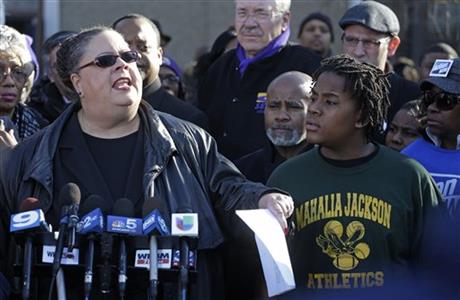
Karen Lewis of the Chicago Teacher's Union during a protest against the closure

CHICAGO (AP) — Tens of thousands of Chicago students, parents and teachers learned Thursday their schools were on a long-feared list of 54 the city plans to close in an effort to stabilize an educational system facing a huge budget shortfall.

Mayor Rahm Emanuel says the closures are necessary because too many Chicago Public School buildings are half-empty, with 403,000 students in a system that has seats for more than 500,000. But opponents say the closures will further erode troubled neighborhoods and endanger students who may have to cross gang boundaries to attend school. The schools slated for closure are all elementary schools and are overwhelmingly black and in low-income neighborhoods.

CPS officials say money being spent to keep underutilized schools open could be better used to educate students elsewhere as the district deals with a $1 billion budget deficit. About 30,000 students will be affected by the plan, with about half that number moving into new schools.

“Every child in every neighborhood in Chicago deserves access to a high quality education that prepares them to succeed in life, but for too long children in certain parts of Chicago have been cheated out of the resources they need to succeed because they are in underutilized, under-resourced schools,” said district CEO Barbara Byrd-Bennett. “As a former teacher and a principal, I’ve lived through school closings and I know that this will not be easy, but I also know that in the end this will benefit our children.”

As word of the closures trickled out, parents and teachers reacted with anger and shock, some even crying. Sandra Leon said she got a tearful call from her grandchildren’s kindergarten teacher saying the school was on the list to be closed. Her two grown children also attended the school, and Leon wiped her eyes as she waited outside for her grandchildren.

“It’s been so good for our kids,” Leon said. “This school is everything.”

Chicago officials have moved to close schools in the past, but never anywhere near the number designated at one time by the Emanuel administration. Former Mayor Richard M. Daley’s administration spread school closings over a number of years. CPS, the nation’s third-largest school district, now has 681 schools.

Chicago is among several major U.S. cities, including Philadelphia, Washington and Detroit to use mass school closures to reduce costs and offset declining enrollment. Detroit has closed more than 130 schools since 2005, including more than 40 in 2010 alone.

The issue has again pitted Emanuel against the Chicago Teachers Union, whose 26,000 members went on strike early in the school year, idling students for seven days. It has also put Emanuel and Byrd-Bennett at odds with parents, civic leaders and lawmakers, who have blasted the pair during highly charged community meetings throughout the city and at a legislative hearing earlier this week.

Union President Karen Lewis criticized Emanuel, who is out of town with his family, for being on vacation on the day of the announcement. She called the closings “an abomination.”

“This is cowardly and it is the ultimate bullying job,” Lewis said. “Our mayor should be ashamed of himself.”

The vast majority of the 54 schools are in overwhelmingly black neighborhoods that have lost residents in recent years. Chicago’s black population dropped 17 percent in the last census as African-Americans moved out to the suburbs and elsewhere. The other few schools are majority Hispanic or mixed black and Hispanic. Overall, 91 percent of Chicago public school students are minorities.

Many of the schools identified for closure are in high-crime areas where gang violence contributed to a marked increase in Chicago’s homicide rate last year. The district plans to have community groups help students get to their new locations safely.

Among the critics is Eular Hatchett, who lives in the violence-plagued neighborhood of North Lawndale and walks her 13-year-old nephew DaVontay Horace to school.

“Our parents know about this area,” she said. “They don’t know about those other areas. If they send him way north or way south, I’m not going to do that. It’s too dangerous.”

Because some schools have more than one building, a total of 61 structures will be closed. In addition to the closures, students at 11 other schools will be “co-located” with existing schools. Six schools have been targeted for academic interventions known as “turnaround.”

CPS says the plan will save the district $560 million over 10 years in capital costs and an additional $43 million per year in operating costs.

The district plans to invest $233 million into what it calls the “welcoming” schools, or the buildings that students in closed schools will be moving to. Those funds will be used for air conditioning, upgraded technology and security and to ensure every school has a library.

District officials said they couldn’t calculate how many teachers will be laid off as a result of the cuts because school leaders will make decisions about their own budgets.

Many teachers and parents expressed anger and frustration at how the news of the closures trickled out, leaving some to agonize over rumor and conjecture.

“In a word, the approach was brutal. It’s certainly not deserved by these parents and these kids,” said Mary Visconti, the director of the Better Boys Foundation, a youth organization in the Lawndale neighborhood.

At Lafayette Elementary, where 95 percent of its 483 students come from low-income families, teacher Rosemary Maurello said the principal read teachers a letter from the district Thursday morning saying the school is among those it plans to close. The letter said a final decision would be made in May after more community meetings are held and budget plans are reviewed.

But Maurello said letters and information packets were already being sent to parents and the district’s message to teachers included a mention of specific plans to move the Lafayette students to another school about 10 blocks away.

“It sounds like a done deal to me,” Maurello said.

Europeans must leave South Africa

Brad Cibane

For ages, the country today known as South Africa was no more than a loose band of separate communities. The Nguni tribes, which settled on the Southern tip of Africa around the 10th century, neither considered themselves a single nation, nor did they consider the Khoisan people already inhibiting the area part of their collective, writes Brad Cibane in the Mail&Guardian.

The Dutch settlers, who committed to transforming the Cape from a refreshment station to a settlement in the 1670s, also did not envision forming a nation with the Khoisan or the Nguni tribes. The same is apparent for the English colonists who settled in the 1820s.

The settlers and the colonists divided the country among themselves into four separate states: the Colony of Natal, the Cape Colony and the Boer Republic (Orange Free State and Transvaal). The situation persisted until the early 1900s when, after a bloody war, the Volksraad and the British embarked on negotiations, which culminated in the South African Union Act of 1909. On May 31 1910 the Union of South Africa was formed as a British dominion.

The new Union of South Africa excluded non-Europeans from its constitutional structures. The exclusion awoke the natives to the reality of their status, and drew them closer together. The loose band of tribes united to speak in unison when the South African Natives Congress was transformed into the African National Congress in 1912.

The unjust marginalisation of natives (Ngunis and Khoisan) was codified in 1913 when the government enacted a law reserving more than 87% of land for the exclusive use of whites. The government coveted ultimately to dispel all non-Europeans, and to create a “Little Europe” in Africa.

The vision started to take shape in 1948 when the National Party came into power. The National Party’s policy of “separate developments” (or “apartheid”) anaesthetised the distinction between the English and the Afrikaners. Government rhetoric opted instead for the more generic term “Europeans”. It sought to unite all whites under the “European” banner. South Africa was for (white) Europeans.

The biggest hurdle that faced the new united nation was that European South Africa and black South Africa were very different. Thabo Mbeki characterised the differences vividly in his “two nations” speech. Thus, the task of building a single nation was prodigious and it befell not just the new “black government” but all South Africans.

The characteristic terms “black” and “European” were discarded, leaving a single South Africa occupied by Africans of all races. White South Africans who had been beneficiaries of a system that pillaged and oppressed on their behalf relinquished their “European” status and citizenship. Those aggrieved by the demolition of “Little Europe” packed their bags and headed elsewhere.

It appears, however, that there are citizens of “Little Europe” (or European-South Africans) remaining in South Africa today. The problem with these people is that they do not consider themselves South African (other than “Little Europeans”). They harbour the most regressive elements.

The corollary of a South African citizenship is that it entails not just the right to co-exist with other South Africans, but also the concomitant obligations of contributing to the betterment of the nation. Citizenship in the new South Africa entails discarding racial and cultural prejudices. For the citizens of former “Little Europe”, a citizenship in the new South African also entails giving up a privilege built on many years of domination.

The nuisance with citizens of “Little Europe” currently inhibiting South Africa is that they sit elevated on a platform of perceived betterness. They harp and lash harshly at government without rolling up their own sleeves to fight the good fight. They speak with nostalgia about the good old days when their citizenship did not entail obligations towards black folk. They speak of the black inclination towards crime but make no recognition of the root causes (poverty, illiteracy and inequality).

An apt example of a citizen of “Little Europe” is a (white) man who tells foreign media that the (“black”) government is responsible for his (white) son shooting his (white) girlfriend. He makes no mention of the gun culture in which he raised his son.

South Africa faces Herculean challenges and all South Africans must battle together. The first step toward winning the battle is taking ownership of all problems by all South Africans, black or white, rich or poor. Poverty, crime and and iliteracy should concern all residents the country with similar urgency.

South Africa belongs to South Africans, citizens of “Little Europe” must leave. “Little Europe” no longer exists.

Cibane, however, likes Afrikaans. He says it’s is a beautiful language, even though it’s rather heavy. People are often curious about the difference between Afrikaans and Dutch. Except for the semantic difference, Afrikaans is much lighter, although the accent is rather heavy. Unfortunately, Afrikaans is burdened by the Soweto uprising, Skhothens, Captonian thugs and, well, the National Party.

Many young South Africans refuse to speak the language. But, if you’ve seen 7de Laan, you’ll know that it is not impossible to make love to the South African variant of Dutch.

For a non-speaker, Afrikaans gets a plus because it is exotic. Many none speaker, who at least understand the language, will appreciate hearing, “jy is pragtig” instead of “you are beautiful.”

Cibane thinks Afrikaans does not handle vulgarity well, however.

Federal prosecutor in hot water over racial remark

Supreme Court Justice Sonia Sotomayor upbraided a federal prosecutor Monday for asking racially-charged questions in court.

The justices almost never elaborate on cases they decline to hear, but Sotomayor took the unusual step of issuing a statement condemning the prosecutor, whom she did not name.

She said the prosecutor “tapped into a deep and sorry vein of racial prejudice that has run through the history of criminal justice in our nation.”

The case at hand came from a drug arrest in Texas. The defendant took a road trip with friends and said he did not know they were planning a drug deal.

The prosecutor in the case invoked racial stereotypes in questioning the defendant’s explanation.

“You’ve got African Americans, you’ve got Hispanics, you’ve got a bag full of money. Does that tell you — a light bulb doesn’t go off in your head and say, This is a drug deal?” the prosecutor asked.

Sotomayor harshly criticized the questioning in a statement sharing the African Americans’s decision not to hear an appeal from the defendant.

“Such conduct diminishes the dignity of our criminal justice system and undermines respect for the rule of law,” Sotomayor wrote. “We expect the government to seek justice, not to fan the flames of fear and prejudice.”

Justice Stephen Breyer joined her statement.

The court rejected an appeal in the case on technical grounds. Sotomayor said she agreed with that decision, noting that the defendant’s lawyers limited their ability to appeal by not initially objecting to the prosecutor’s questioning during the trial.

Sotomayor also criticized the Justice Department for downplaying the prosecutor’s remark and acknowledging too late that it was inappropriate.

“I hope never to see a case like this again,” Sotomayor said.

FIFA to discuss ‘concrete proposals’ to fight racism

FIFA is to discuss “concrete proposals” for combating racism over the next few months and plans to put them into effect in May, soccer’s governing body said on Friday.

The proposals will be chewed over by FIFA’s executive committee at its next meeting in March and then presented to the annual Congress in Mauritius in May which is expected to have the final say, FIFA said.

“I am very pleased with the ideas that have evolved today and look forward to the deliberations with the executive committee next month,” said FIFA president Sepp Blatter following a meeting of the strategic committee.

“The aim is to present to the FIFA Congress in Mauritius in May concrete actions, as well as strong sanctions which will really have an impact.”

FIFA did not elaborate on what the proposals were.

Blatter has previously suggested that points deductions and even relegation could be used as sanctions for teams whose supporters are found guilty of racist behaviour.

Bulgaria, whose fans racially insulted a Danish player, and Hungary, whose fans were found guilty of anti-Semitic behaviour during a friendly at home to Israel, were recently ordered to play their next home World Cup qualifiers behind closed doors.

Italian authorities have drawn up plans for stopping games in cases of racism. Referees and the fourth official have been told to report incidents to public security officials who would have the final say. – Reuters

Tennis player Caroline Wozniacki accused of ‘racist’ impersonation

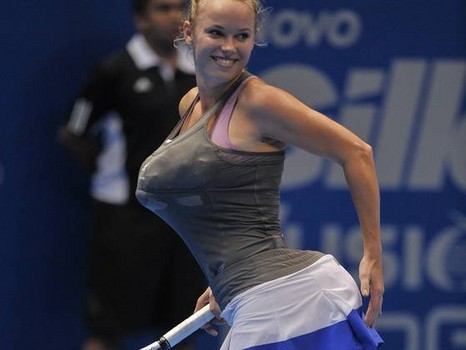
Caroline Wozniacki impersonates Serena Williams

Caroline Wozniacki has been accused of doing a ‘racist’ impersonation of fellow tennis player Serena Williams after stuffing her bra and shorts.

At a recent exhibition against Maria Sharapova in Brazil, the former world No. 1 stuffed courtside towels down her kit to replicate the body of the curvaceous Grand Slam champion.

But now the 22-year-old Dane, whose boyfriend golfer Rory McIlroy was in the crowd, has now been accused of racism by some observers.

On Tumblr, one blogger wrote: ‘This isn’t “harmless fun” as one article described it. its racist. out and outright racism. mocking and making fun of the bodies of black women for a laugh? real funny, stupid white girl. real real funny.’

Another blogger pointed out: ‘It may have been done in “jest,” but I love how people can can turn a black woman’s body and sexuality into a caricature. However, we should not have the autonomy to celebrate any successes of our own.

While on feministing.com, an article read: ‘Given the history and current-day context of racialized standards of beauty, and the hypersexualization of people of color, when a white woman makes fun of a black women’s body, especially in a way that hypersexualizes her and draws on the stereotype of black women’s big butts, it’s racist.’ – mailonline.com

‘I kill all the whites. How great is that?’

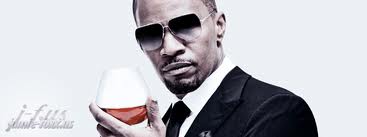
Jamie Foxx in a South African ad

Two weeks ago, Oscar-winning actor Jamie Foxx made national headlines when he called President Obama “Our lord and savior.”

While hosting NBC’s Saturday Night Live this weekend, Foxx joked about how in his new film “Django Unchained,” “I kill all the white people in the movie. How great is that?” (video follows with transcript and commentary):

JAMIE FOXX: My name is Jamie Foxx. Give it up, give it up, New York City, Saturday Night Live. Come on, make some noise, man. New York City, New York City, Brooklyn, Staten Island, Queens, it’s crazy. I’m black, and I’m dressed all black cause it’s good to be black. Black is the new white. I’m telling you, how black is this right here? Nice fly, I’m saying. You know how I know black is in right now? Cause the Nets moved to Brooklyn. How black is that? They got black jerseys, black court. I mean, how black is that? And Jay-z is the owner, a rapper. How black is that? And Jay-z only own about this much of the team. But he act like he own all of New York. How black is that?

And I got a movie coming out, “Django,” check it out. Leonardo DiCaprio, Samuel L. Jackson. “Django Unchained” I play a slave. How black is that? And in the movie I had to wear chains. How whack is that? But don’t be worried about it because I get out the chains, I get free, I save my wife, and I kill all the white people in the movie. How great is that? And how black is that?

But I’m going to tell you right now, speaking of blackness, my President, President Obama is back up in the White House four more years. How black is that? And not only that, he’s so black, he was playing basketball during the Election Day. How black is that? But he was also late for his acceptance speech. Okay, all the white people, this is your turn – how black is that?

But he going to be extra black this next four years. He going to get everything black, and white people, don’t get nervous about that because he is mixed. Now the first four years was the white side of him, because I don’t know if you saw him on Ellen when he was dancing and everything. I don’t know what this is. That wasn’t President Obama, that was President Barry Gibb Obama. But the next four years he’s even changing his name from to President Barack Dikembe Mutombo Tupac Mandela Hussein Obama X. How black is that? And the next time you see him dancing on Ellen, he gonna be dancing like this. – newsbusters.org

Miss France ‘as white as snow’

Marine Lorphelin

A black rights group on Monday slammed the latest Miss France competition for producing a “white as snow” winner from a field it claimed was unrepresentative of the country’s ethnic make-up.

Marine Lorphelin, 19, a brunette medical student from Burgundy, was on Saturday crowned Miss France 2013, having edged out Miss Tahiti, Hinarini de Longeaux, in the final round of judging.

Louis-Georges Tin, the president of the CRAN (Representative Council of Black Associations), on Monday lamented the lack of contestants from France’s African and north African communities.

“The failure to represent the contemporary French population in an event such as this is obviously serious,” Tin said in a statement issued jointly with Fred Royer, the creator of Miss Black France.

“It amounts to denying the very existence of French people of African origin.”

Of the 33 finalists in Saturday’s contest, eight were from ethnic minorities with six of those coming from France’s Pacific or Caribbean territories.

“In the antiquated world of Miss France, blacks apparently can only come from overseas departments,” the CRAN statement said.

“As for Frenchwomen of north African heritage, they were ‘represented’ by only one candidate who was quickly eliminated (too Muslim perhaps?).”

France is home to around five million Muslims, most of them of north African origin.

The statement went on to express regret that “Miss France is as white as the end of year snow on the steeples of an eternal France.”