Not white enough for Oz

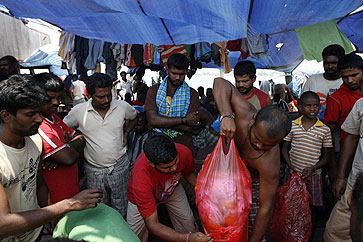
Australian Prime Minister Kevin Rudd on Sunday said he made “absolutely no apology” for his hardline new policy on asylum-seekers under which they are sent to Papua New Guinea.

Rudd quickly moved to announce a radically reshaped immigration plan under which boatpeople could be resettled in PNG, sent home, or to a third country but not Australia. His new stance reinforces the notion that Australia wants to remain a white country.

Not white enough for Oz

Under the directive, those who pay people-smugglers to arrive on unauthorised boats will be sent to the poor Pacific nation for processing and resettled there even if found to be genuine refugees.

“On the question of asylum-seekers… we’ve had to adjust our policy over time and I make absolutely no apology whatsoever for our current policy settings because the world around us has changed,” Rudd told Channel Ten.

Rudd, who was last month reinstalled as prime minister by his Labour colleagues to help turn around dire polls in an election year, had previously softened some of the former conservative government’s policies.

The plan has worried the United Nations refugee agency which said on Friday that conditions at Papua New Guinea’s Manus Island facility currently failed to adequately protect refugees.

“UNHCR is troubled by the current absence of adequate protection standards and safeguards for asylum-seekers and refugees in Papua New Guinea,” it said in its first assessment of the policy.

Australia resumed sending asylum-seekers to Manus Island and the Pacific state of Nauru in 2012 in a bid to deter record numbers of migrants arriving by boat, hundreds of whom drowned en route.

Rudd has said the new PNG policy will take some time to deter asylum-seekers, but since he announced the change just over a week ago more than 1 300 have arrived on boats.

‘You will not be settled in Australia’

“It is the implementation of that policy direction over time, resolutely, which will yield results,” he told Network Ten’s Bolt Report.

“In the interim, people smugglers will test your resolve.”

Asylum-seekers are a sensitive issue in Australia, and one set to feature prominently in the election due this year.

Rudd said while people-smugglers, who make thousands of dollars bringing asylum-seekers to Australia, would test the government’s resolve “we are not for turning”.

“Our policy is very clear… you will not be settled in Australia,” Rudd said. AFP

Biggest oil discovery in 50 years

cooberpedyIn a virtually uninhabitable section of South Australia, a discovery has been made which could rock the world.  Some are calling it the biggest discovery of oil in 50 years.  Earlier this year, a company called Linc Energy announced that tests had revealed that there was a minimum of 3.5 billion barrels of oil equivalent sitting under more than 65,000 square kilometres of land that it owns in the Arckaringa Basin.  But that is the minimum number.  It has been projected that there could ultimately be up to 233 billion barrels of recoverable oil in the area.  If that turns out to be accurate, the oil sitting under that land is worth approximately 20 trillion dollars, and it would be roughly equivalent to the total amount of oil sitting under the sands of Saudi Arabia.  In essence, it would be a massive game changer.

If the 233 billion barrel figure is accurate (and some have even suggested that the true number could actually be 400 billion barrels), that would make it nearly 10 times larger than the Bakken formation, 17 times larger than the Marcellus discovery and 80 times larger than the Eagle Ford deposit down in Texas.

It would also mean that Australia now has more “black gold” than the nations of Iran, Iraq, Canada and Venezuela.

The closest town to this oil discovery, Coober Pedy, is in the process of being totally transformed.  It normally only has about 1,700 inhabitants, but news of this discovery has drawn in 20,000 additional people already and real estate prices in the town are absolutely skyrocketing.

So does all of this mean that gas prices will go down soon?

Well, unfortunately that is not likely to be the case.

First of all, the oil in this formation in Australia is going to be quite expensive to extract.  It has been estimated that it is going to cost up to 300 million dollars just to get this site ready for production.

In addition, many of our politicians are absolutely determined to greatly punish the use of oil because they believe that it is the primary cause of global warming.  So they continue to raise taxes on gasoline consumption.

Hopefully the price of gasoline will come down a bit over the next few years, but even if it does I would not expect it to come down too much.

But what we can be sure of is that the world is not going to run out of oil any time soon.  Those that have been predicting that we are are on the verge of an “energy doomsday” can take a rest for a while.

It is time that the American people were told the truth about our energy situation, and the truth is that we have plenty of energy resources.

#1 Back in 1995, the U.S. Geological Survey told the American people that the Bakken Shale formation in western North Dakota and eastern Montana only held 151 million barrels of oil.  Today, government officials are admitting that it holds 7.4 billion barrels of recoverable oil, and some analysts believe that the actual number could be closer to 24 billion barrels of oil.

#2 It is estimated that there are 19 billion barrels of recoverable oil in the tar sands of Utah.

#3 It is estimated that there are 86 billion barrels of recoverable oil in the Outer Continental Shelf.

#4 It is believed that there are 800 billion barrels of recoverable oil in the Green River formation in Wyoming.

#5 Overall, the United States is sitting on approximately 1.442 trillion barrels of recoverable oil.

#6 According to the Institute of Energy Research, the United States has an 88 year supply of natural gas.

#7 According to the Institute of Energy Research, the United States has a 169 year supply of oil.

#8 According to the Institute of Energy Research, the United States has a 465 year supply of coal.

#9 Goldman Sachs is predicting that the United States will be the number one oil producing country in the world by the year 2017.

So the bottom line is that we have plenty of energy resources.  We do not need to be importing oil from OPEC or anyone else.

But just because we are not going to run out of oil, natural gas or coal any time soon does not mean that we should not be developing alternative energy resources.  We should definitely be seeking ways to produce energy more cheaply, more cleanly and more efficiently.

If America does not end up leading the world in developing new forms of energy, we should be ashamed of ourselves.  And right now, the Chinese appear to be way ahead of us as far as thorium energy is concerned, and Italian scientists appear to be ahead of our own scientists in developing “cold fusion” technology.

So yes, let’s be glad that we are not going to be facing a crippling energy crisis in this generation, but let’s also not be complacent.  There are lots of new technologies out there just waiting to be developed, and the rewards are going to go to those that are able to develop them first. – Economic Collapse

 

Australian minister apologises for premature announcement of Mandela’s death

Gary Gray
Gary Gray

An Australian politician has apologized to South Africa’s high commissioner for incorrectly announcing that Nelson Mandela had died.

Resources Minister Gary Gray issued a statement Thursday saying he was “deeply sorry” for wrongly telling guests at a Minerals Council of Australia dinner at Parliament House on Wednesday that the anti-apartheid leader was dead.

Gray said he had mistakenly shared what he “thought was reliable advice.”

Mandela is in critical condition at a hospital. The 94-year-old former president was admitted to the Pretoria hospital on June 8 to be treated for what the government said was a recurring lung infection.

Mandela was jailed for 27 years as a result of inciting violence to overthrow the government and was freed in 1990 and became South Africa’s first black president in 1994.

Also in Australia Kevin Rudd returned as prime minister of Australia on Thursday, three years after being replaced in the office by his then-deputy Julia Gillard.

Rudd challenged Gillard for leadership of the Labor Party on Wednesday and won a 57-45 vote among fellow Labor members of parliament.

In the Australian parliamentary system, the leader of the governing party assumes the position of prime minister and on Thursday morning, in Canberra, Rudd was sworn in for a second time.

Gillard resigned after the party vote on Wednesday night and announced she will leave politics.

A major factor in Gillard’s demise — and in Rudd’s Phoenix-like return — is the election Australia has to hold by the end of this year.

Under Gillard’s leadership, Labor was facing overwhelming defeat, according to opinion polls. But the same polls show a Rudd-led Labor Party would fare much better at the ballot box. – SAPA/AP/CNN

Australian Government shelves PRISM-like scheme

Mark Dreyfus
Mark Dreyfus

A controversial “data retention” scheme that would have required Australians’ internet and telephone activities to be stored for up to two years for law enforcement purposes has been shelved by the federal government after an inquiry that did not recommend the scheme go ahead.

The committee looking into the proposal – the most controversial among more than 40 others – as part of an inquiry into national security delivered its report on Monday.

After the report’s release, Attorney-General Mark Dreyfus said the government would not pursue data retention legislation “at this time”.

The government would now await further advice from the relevant agencies and a comprehensive consultation before proceeding further, he said. – Sydney Morning Herald

‘Intersex’ included on Australia’s new gender guidelines


The Australian government has announced new guidelines on gender recognition which state that individuals should be given the option of selecting “male”, “female” or “intersex” on their personal documents.

Attorney-General Mark Dreyfus said the new guidelines, which come into operation from July 1, will make it simpler for people to establish or change their sex or gender in personal records held by federal government departments and agencies.

“We recognise individuals may identify, and be recognised within the community, as a gender other than the gender they were assigned at birth or during infancy, or as an indeterminate gender,” Dreyfus said in a statement Thursday.

“This should be recognised and reflected in their personal records held by departments and agencies.”

The move comes after the Australian Human Rights Commission in 2009 recommended the government consider developing national guidelines concerning the collection of sex and gender information.

The new guidelines state that “where sex and/or gender information is collected and recorded in a personal record, individuals should be given the option to select M (male), F (female) or X (Indeterminate/Intersex/Unspecified)”.

They state that sex reassignment surgery and/or hormone therapy are not pre-requisites for the recognition of a change of gender in Australian government records.

When someone requests the sex on their personal record be changed, Dreyfus said the government would accept a statement from their doctor or psychologist, a valid Australian passport (which have allowed X under sex for several years), or a state or territory birth certificate or other document which shows their preferred gender status.

“Transgender and intersex people in Australia face many issues trying to ensure the gender status on their personal records matches the gender they live and how they are recognised by the community,” Dreyfus said.

“These guidelines will bring about a practical improvement in the everyday lives of transgender, intersex and gender diverse people.” – AFP

Australia, China to enable direct currency convertibility

A month ago we pointed out that as a result of Australia’s unprecedented reliance on China as a target export market, accounting for nearly 30% of all Australian exports (with the flipside being just as true, as Australia now is the fifth-biggest source of Chinese imports), the two countries may as well be joined at the hip.

Over the weekend, Australia appears to have come to the same conclusion, with the Australian reporting that the land down under is set to say goodbye to the world’s “reserve currency” in its trade dealings with the world’s biggest marginal economic power, China, and will enable the direct convertibility of the Australian dollar into Chinese yuan, without US Dollar intermediation, in the process “slashing costs for thousands of business” and also confirming speculation that China is fully intent on, little by little, chipping away at the dollar’s reserve currency status until one day it no longer is.

That said, this latest development in global currency relations should come as no surprise to those who have followed our series on China’s slow but certain  internationalization of its currency over the past two years. To wit: “World’s Second (China) And Third Largest (Japan) Economies To Bypass Dollar, Engage In Direct Currency Trade”, “China, Russia Drop Dollar In Bilateral Trade”, “China And Iran To Bypass Dollar, Plan Oil Barter System”, “India and Japan sign new $15bn currency swap agreement”, “Iran, Russia Replace Dollar With Rial, Ruble in Trade, Fars Says”, “India Joins Asian Dollar Exclusion Zone, Will Transact With Iran In Rupees”, and “The USD Trap Is Closing: Dollar Exclusion Zone Crosses The Pacific As Brazil Signs China Currency Swap.”

And while previously the focus was on Chinese currency swap arrangements, the uniqueness of this weekend’s news is that it promotes outright convertibility of the Yuan: something China has long said would happen but many were skeptical it ever would. That is no longer the case, and with Australia setting the precedent, expect many more Asian countries (at first) to follow in Australia’s footsteps, because while the developed world is far more engaged in diluting its currency as a means to spur “growth”, Asian and developing world nations are still engage in real, actual trade, where China is rapidly and aggressively becoming the world’s hub. 

More from The Australian:

Former ambassador to China Geoff Raby, now a Beijing-based business figure, told The Weekend Australian: “The value of such a deal would be substantial for exporters to China, especially those that import a lot from China like mining companies, as it would remove business constraints including exchange-rate risks and transaction costs.”


Businesses, like individuals when travelling, have to pay extra to convert currency since there are different rates for buying and selling.


So removing one step also cuts out the cost of paying for such a “spread”.


Australia has undertaken significant lobbying for the deal and the direct conversion of the yuan, also referred to as the renminbi (RMB), is identified as a priority in the government’s Asian century white paper.


“We have held preliminary discussions with the Chinese government to explore how soon direct convertibility can be practicably achieved,” the white paper says.


“We are continuing these discussions, and also exploring other opportunities to work with China to support the internationalisation of the RMB.”

Australia’s banks increasingly arrange trade finance through Hong Kong, which has developed a special role as China’s chief international finance centre.

Needless to say, China is eagerly looking forward to taking yet another bite out of the USD’s reserve status.

New President Xi Jinping, a former Communist Party secretary of Shanghai, is a champion of that city’s development as China’s finance hub, and it is believed that the Prime Minister may fly there to sign the currency conversion deal.


Ms Gillard is expected to go on from Shanghai to Beijing, where she will open the third Australia China Economic and Trade Forum organised primarily by the Australia China Business Council, which will be bringing about 100 people from Australia for the event. Participants are likely to include Andrew Harding, Rio Tinto’s new chief executive for iron ore; Warwick Smith, ANZ Bank’s chairman for NSW and the ACT; Australian Trade Minister Craig Emerson and Financial Services Minister Bill Shorten; Gao Hucheng, China’s Commerce Minister; and Gao Xiqing, the acting head of China Investment Corporation, the country’s vast sovereign wealth fund.


The ANZ Bank has been a strong advocate of direct convertibility between the dollar and the yuan. Gilles Plante, the bank’s chief executive in Asia, said in a recent report that in the last financial year, China accounted for 29 per cent of all exports and 18 per cent of imports, but the value of that trade denominated in yuan was less than 0.3 per cent.


He forecast that cross-border flows of funds would be liberalised “to support Shanghai’s plan to build itself as a global financial centre. At the time the whole world is digging out opportunities from the rise of the yuan, Australia should not lag behind.”


It was significant the liberalising governor of the People’s Bank, Zhou Xiaochuan, kept his job during the reshuffle of China’s leadership. He said last year at a conference: “The next movement related to the yuan is going to be reform of convertibility. We are moving in this direction; we need to go further, we will have some deregulation.”

Most importantly, to China, Australia will serve as the Guniea Pig – should this experiment in FX liberalization work out to China’s satisfaction, expect Beijing to engage many more trade partners in direct currency conversion.

Beijing appears to have chosen Canberra as its partner in this next movement for straightforward economic reasons, as Australia has become China’s fifth-biggest source of imports and thus, the appropriate partner for the march of its currency.


Ms Gillard and President Xi Jinping may also during the visit establish a “strategic partnership” between the countries. This will enable Australia to catch up in status with a large range of nations.

Why is this so very critical? For the simple reason that the free lunch the US has enjoyed ever since the advent of the US dollar as world reserve currency, may be coming to an end as other, more aggressive alternatives – both fiat, and hard-asset based – to the USD appear. And since there is no such thing as a free lunch, all the deferred pain the US Treasury Department has been able to offset thanks to its global currency monopoly status will come crashing down the second the world starts getting doubts about the true nature of just who the real reserve currency will be in the future. – Zero Hedge

Google must pay Australian $200 000 for defamation

Google was ordered to pay Aus$200,000 (US$208,000) in damages to an Australian Monday after a jury found the Internet giant defamed him by publishing material linking him to mobsters.

Milorad Trkulja, an entertainment promoter who is now 62, was shot in the back in 2004 in a crime that was never solved.

He accused Google of defaming him with material which he said implied he was a major crime figure in Melbourne and had been the target of a professional hit.

Searches of his name brought up references to the city’s gangsters including crime boss Tony Mokbel and a now defunct site called “Melbourne Crime” chronicling gang-related incidents.

Google denied publication in the Supreme Court of Victoria, saying it had innocently disseminated material published by others. It also disputed that the material conveyed the defamatory implications claimed by Trkulja.

But a jury ruled in his favour, finding the Internet firm had been on notice and failed to act on the issue from October 2009, when Trkulja’s lawyers wrote to them demanding action over the “grossly defamatory” content.

Bond University media law expert Mark Pearson, who specialises in social media and legal issues, said it was a “groundbreaking” precedent in Australia and could have broader implications.

“What the court’s said here is that this isn’t just innocent architecture, what this is is a human-designed software to showcase information in a certain way,” Pearson told AFP.

“The judge has said that because you (Google) have designed (the search results) to appear in this way, you are the publisher of the material.”

Google, which is understood to be contemplating an appeal, stood by its arguments in court.

“Google’s search results are a reflection of the content and information that is available on the web,” a Google spokesman told AFP.

“The sites in Google’s search results are controlled by those sites’ webmasters, not by Google.”

Judge David Beach ordered Google to pay Trkulja Aus$200,000, likening their role in publication to a library or newsagent, which have “sometimes been held to be publishers for the purposes of defamation law” in Australia.

“Google Inc is like the newsagent that sells a newspaper containing a defamatory article,” Beach said in his judgement.

“While there might be no specific intention to publish defamatory material, there is a relevant intention by the newsagent to publish the newspaper for the purposes of the law of defamation.”

Beach said the jury was “entitled to conclude that Google Inc intended to publish the material that its automated systems produced, because that was what they were designed to do upon a search request”.

Trkulja argued that his reputation was central to his work and had been seriously damaged by the defamatory material. He had already won Aus$225,000 from Yahoo in an earlier case on the same matter. – AFP

Oz lauds ‘Asian Century’

Julia Gillard has committed to 25 far-reaching goals over the next 13 years designed to tighten links with Asia and ensure that Australians are able to exploit the region’s “staggering” growth.

The measures, outlined in a report by a government-appointed taskforce, include offering thousands of scholarships to Asian students, new diplomatic posts across the region and requiring that a third of all company directors and senior civil servants have a “deep knowledge” of Asia. In addition, every schoolchild will be able to learn one of four “priority” languages: Chinese, Hindi, Japanese and Indonesian.

Ms Gillard said the “unstoppable” rise of Asia and its massive new urban middle class was “a transformation as profound as any that have defined Australia throughout our history”.

“This is good news for Australia and it should drive a profound change in our thinking about our economic relationship with Asia,” she said.

Under the long-awaited plan all schools will be partnered with schools in Asia and television stations will be encouraged to present more Asian news and programs. “Children in kindergarten now will graduate from high school with a sound working knowledge of Asia,” Ms Gillard said.

Australia has greatly benefited from the past decade of growth across Asia, which has triggered a mining boom and helped to shield the nation from the impact of the global financial crisis.

But there are growing concerns that the mining boom may have peaked and that Australia needs to find other ways to benefit from Asia’s rising prosperity.

Ms Gillard said Australia should not seek to lower wages or working conditions to try to compete with the Asian workforce but instead should boost the country’s skills and promote tourism, education and agriculture to the growing middle class, particularly in China.

“Think of it this way: back in the 80s Fosters beer tried to get into China,” Ms Gillard said. “Today it is Grange [one of Australia’s most expensive wines] carrying the flag.”

Critics largely welcomed the push for closer links with Asia but said it came too late. “The Asian century is already well underway – shouldn’t we have been planning for that quite a while ago?” Adrian Vickers, Asian Studies director at the University of Sydney, told ABC Radio.

“I think we’ve got a lot of catching up to do… The rapid advances in technology, in social change, in political change in Asia are things that we are struggling to keep up with as a nation.”

Professor Andrew MacIntyre, from the Australian National University, said the plan was visionary and would help Australia to adjust to a “new phase we are going into”.

“The scale of the change and the momentum of the change now is so huge,” he told the Daily Telegraph. “Australia has to adapt. We need to lift because the pace of change is not slowing down.”

Young Africans commit more crime in Australia

Young Somalis celebrate Australia Day

Police have expressed concern over new figures that show Somali and Sudanese-born Victorians are five times more likely to commit crime than the wider community.

While the volume of crime is not significant, police say the trend needs to be stopped.

Assistant Commissioner Stephen Fontana says he is also concerned about the age of the offenders.

“A lot of the offences that we’re concerned about are assaults and street robberies,” he said.

“We’re particularly concerned about the violence on occasions and also the age of the individuals involved.

“The vast majority are under 21 years of age.”

Mr Fontana says police are doing a lot of work with the communities.

He dismissed suggestions, however, that the social unrest experienced during the Cronulla riots could be replicated in Melbourne.

 “If we don’t stop the trend now, in the future we could have concerns.”

But Ross Barnett, the director of the Ethnic Communities Council of Victoria, has dismissed the statistics.

“Police data is notoriously unreliable, so I think we need to take it with a grain of salt,” he said.

“We do need a broader approach.

“I think, as has been pointed out by other people, there is a significant level of disengagement with African youth.”

After win over Australia, Heyneke Meyer still cautious

Australia's Mike Harris, left, scores a try as Springbok Andries Bekker, center, attempts a tackle

Coach Heyneke Meyer says South Africa must become more clinical finishers if they hope to beat New Zealand in Soweto next weekend.

The Springboks and the All Blacks square up at the 90,000-capacity Soccer City stadium where late tries by flanker Richie McCaw and full-back Israel Dagg saw the visitors snatch a 29-22 victory two years ago.

South Africa will enter the final-round Rugby Championship clash with their confidence boosted by a five-try 31-8 victory over Australia at Loftus Versfeld stadium in Pretoria Saturday.

Right wing Bryan Habana scored three tries and full-back Zane Kirchner and flanker Francois Louw one each as a fired-up Springbok pack set the platform for a convincing first success against the Wallabies in six attempts.

But Meyer was not getting carried away after the Springboks ended a dismal run in which a lucky draw away to Argentina was followed by losses in Australia and New Zealand.

“We have high standards and should have scored three more tries against the Wallabies,” said the coach who transformed the Northern Bulls into southern hemisphere provincial juggernauts and also worked with the Leicester Tigers.

“It is great to come home and win and we have not beaten Australia for some time, but we have to start taking those opportunities,” he told a Loftus media conference.

“While we want to score tries again next week, we are aware of the challenge of playing the world champions. New Zealand are a very settled side and a number of players have been part of their defensive system for ages.

“They are the world champions and one of the reasons for that is their defence. It is going to be really difficult to create and score against them,” stressed Meyer.

“We will need to be more patient with ball in hand and more tactically astute. If we get scoring chances, we will need to make them count. We are hoping that all South Africans get behind us.”

There is cause for Springbok optimism as they could have beaten New Zealand in Dunedin this month instead of losing 21-11 had seven kicks at goals not been fluffed, and endless possession squandered through mindless field kicking.

That defeat led Meyer to drop long-time fly-half Morne Steyn and 20-year-old replacement Johan Goosen recovered from a couple of early missed penalty attempts in his first Test start to regularly bring the backline into play.

Centre Jaco Taute also did well on debut after Francois Steyn withdrew with an ankle injury and flank Francois Louw from English club Bath was the pick of a Springbok pack that impressed in the set piece and loose exchanges.

[ad 1]

Australia lost so many players to injury — centre Adam Ashley-Cooper was the most serious with concussion — that they ran out of replacements and played the last eight minutes a man short.

Full-back Berrick Barnes, centre Pat McCabe and prop Benn Robinson were other first half casualties and No 8 Radike Samo quit during the second half with wrist and shoulder problems.

“We are going to have to bring some players across from Australia which will be challenging because we have already delved so deep into our resources and there are a couple who will not have visas organised,” said coach Robbie Deans.

Australia face Argentina at the Estadio Gigante de Arroyito in Rosario eight hours after the Springboks and All Blacks come face to face in a potential Championship highlight. – AFP

Australia to deal with its boatpeople this week

Australian Immigration Minister Chris Bowen on Monday said he hoped to begin sending asylum-seekers who arrive by boat to the tiny Pacific nation of Nauru later this week.

With Australia facing a record influx of asylum-seekers arriving by sea, Canberra last month announced plans to send them to Nauru and Papua New Guinea’s Manus Island in a policy aimed at stemming the flow.

Bowen tabled a document in parliament Monday designating Nauru as a regional processing country under the Migration Act so boatpeople can be sent to the small state to await their visa decision.

“Subject to both houses (of parliament) passing a resolution approving the designation, the designation will allow for the transfer of irregular maritime arrivals who arrived after 13 August to Nauru,” Bowen said.

Canberra announced its intention to transfer asylum-seekers to Nauru and Papua New Guinea in mid-August as part of a tough new policy to deter them from paying people-smugglers to attempt the dangerous sea voyage.

Since then 2,087 asylum-seekers have arrived by boat — close to capacity for the camps on Manus and Nauru, which will accommodate a total of 2,100 once completed.

Bowen would not comment on who would be part of the first transfer to Nauru or whether children would be sent but said that he hoped the first group would be transferred within days.

“Construction work on the temporary facility is nearing completion and the government expects to be able to begin transferring people to Nauru later this week,” Bowen said in a statement.

More than 9,796 asylum-seekers have arrived in Australia on boats in 2012, many of them Afghans, Iraqis and Iranians who have paid people-smugglers to ferry them from Indonesia to Australia.

Offshore processing is a sensitive issue in Australia, with Prime Minister Julia Gillard adopting the policy after months of bitter political debate and after several boats capsized en route, drowning scores of people.

The policy signals a return to the practice of the previous conservative government, which sent asylum-seekers to Nauru and Manus, that centre-left Labor rolled back soon after taking office in late 2007.

The opposition supports offshore processing but said the government’s promise that asylum-seekers won’t be resettled quicker just because they are processed on Nauru or PNG will see them stranded in the Pacific for years.

“The policy that (they) have adopted means people could expect to wait on Nauru for five years,” opposition spokesman Scott Morrison said. – AFP

Racism threatens Australia’s ‘brand’

The Sydney Morning Herald reports that Australia’s race discrimination commissioner says the nation’s ‘‘brand’’ has at times been maligned by outbreaks of of racism and there is a poor understanding of the problem in the wider community.

Helen Szoke has also identified a ‘‘cultural glass ceiling’’ that hinders certain minority groups from rising up in workplaces as among the subtler issues that must be tackled.

In advance of today releasing a national anti-racism strategy, Dr Szoke said: ‘‘We understand sex discrimination much better than we understand racism — and we know far we have got  to go with sex discrimination — so that gives you an indication of how far we have to go with racism.’’

Dr Szoke said racism in Australia existed in multiple forms. ‘‘People who actually don’t experience racism think it’s something like riots or violence whereas often racism occurs in quiet places and quiet ways.’’In a paper outlining the public awareness plan to be rolled out over three years, the Australian Human Rights Commission notes indigenous people are among the most vulnerable to racism.

The commission said the experience of people from culturally diverse backgrounds tended  to vary, ‘‘being shaped in large part by their particular histories of migration and settlement’’.

New arrivals, especially those distinguished by dress and skin colour, were more likely to encounter prejudice than ‘‘settled’’ migrants.

In an interview, Dr Szoke cited the episode involving attacks on Indian students in Victoria as particularly harming Australia’s ‘‘brand’’.

She said Victoria Police, which recently raised the alarm about youth from Sudanese and Somali backgrounds, also needed  to exercise caution in how  it engaged with such a complex matter.

‘‘As soon as you name a particular racial group and associate them with crime it has two immediate effects,’’ Dr Szoke said.

‘‘The first is that it builds a perception in the eyes of the community that all people from that racial group are criminals and the second is it actually subjects members of those community who may have a public profile to vitriol and race hate.

‘‘That’s exactly what happened in the past week. I’ve seen some of the emails that have been sent to the African community leaders with some horrific and threatening (messages).’’

Dr Szoke  acknowledged sometimes law enforcement agencies needed to name a particular racial group, but a cautious and sensitive approach was required so as to avoid stigmatising a whole ethnic community.

She rejected the notion that a repeat of the Cronulla race riot situation was on horizon.

Dr Szoke also said she believed that the asylum seeker debate had a racial element to it, ‘‘because at its heart, racism is a fear of difference’’.

Read more: http://www.smh.com.au/national/racist-outbreaks-threat-to-australias-brand-20120823-24p0g.html#ixzz24cx0ztQC

Australian parliament to apologise to ‘Black Power’ sprinter

Tommie Smith (centre) and John Carlos (right) showing the Black Power salute in the 1968 Summer Olympics while Silver medalist Peter Norman (left) wears an OPHR badge to show his support for the two Americans. Photo: Wikipedia

An Australian athlete who supported the famous Black Power salute of two black Americans at the 1968 Mexico Olympics was Monday to be the subject of a parliamentary motion that he be given an apology for how he was treated.

Peter Norman was the silver medallist in the 200m at Mexico City, and stood on the dais alongside United States athletes Tommie Smith and John Carlos, who both put a black-gloved fist in the air in a civil rights protest.

Norman, who died of a heart attack in 2006, backed their gesture and wore an Olympic Project for Human Rights badge in support.

Lawmaker Andrew Leigh said on his website that parliament would debate his motion to apologise posthumously to Norman “whose courageous stance for racial equality got him blocked from competing in subsequent Olympics”.

The motion apologises “for the wrong done by Australia in failing to send him to the 1972 Munich Olympics, despite repeatedly qualifying; and belatedly recognises the powerful role that Peter Norman played in furthering racial equality”.

Leigh, who has the support of Norman’s family, said while the selectors for the 1972 Games had passed away, he did not think Australia “did the right thing by him”.

“I don’t think we gave recognition to somebody who’d done so much to stand for racial equality,” he told the Australian Broadcasting Corporation.

Norman ran a time of 20.06 seconds in Mexico, and afterwards when the two American athletes said they were going to give the Black Power salute on the podium, said: “I’ll stand with you.”

The Australian Olympic Committee rejected the suggestion that Norman was “punished” for his role in the powerful gesture.

“He was not shunned by the AOC,” a spokesman said.

“As to his non-selection in the 1972 Olympics, it had nothing to do with the incident in Mexico City four years earlier.”

Australian Olympic historian Harry Gordon, who was present during the Mexico medals presentation, described Norman as “a sincere young man whose favourite tracksuit was adorned with the words ‘God is love'”.

He wrote that Norman was cautioned by Australia’s chef de mission at the time to be careful about his public statements but there was no punishment or reprimand. – AFP