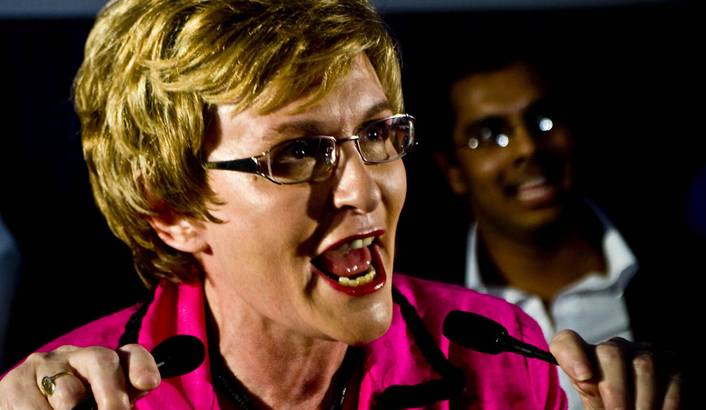
Zille joins ANC and Malema chorus in calling for ‘land reform’

Helen Zille
Helen Zille

The legacy of the 1913 Land Act was still with South Africa and so it is the duty of the state to implement effective redress through land restitution, Western Cape premier Helen Zille said on Monday.

“This will never remove or fully compensate for the pain suffered but it is a major step towards the restoration of dignity,” Zille said in a speech prepared for delivery in Cape Town.

“Effective delivery enables our society to own our future and it creates opportunities for active citizens to create the future of their design.”

Zille was speaking at the commemoration of the Natives Land Act of 1913.

She said it was critical to fulfil the redress and reconciliation mandates and that redress enabled society to honour the good in the past and acknowledge the bad.

There would be challenges in implementing land restitution and it required a balancing of different interests.

“There is no one-size-fits-all solution and each case has to processed in its own context,” Zille said.

She said whenever laws and policies were introduced in the past there had always been people who were willing to stand up and raise their voices and the 1913 Land Act compelled a generation of anti-apartheid activists.

History had shown that “evil triggers a backlash from good”, she said.

“Wherever injustice and oppression have reared their ugly heads, they have inspired resistance and protest to challenge it.

“The reason for this backlash from good against evil is not just because principles and values like freedom and justice are violated, but because human lives are deeply affected.”

Speaking at the same event, Cape Town mayor Patricia De Lille said the city was playing its part in ensuring redress and reconciliation took place to ensure land reform happened.

“In the value chain of restitution, the City of Cape Town plays its part to ensure that the Land Claims Commission is in a position to conduct its social function with those waiting for justice,” she said in a speech prepared for delivery.

“And most significantly, land restitution is featured as an objective in our strategic blueprint for the city, the Integrated Development Plan (IDP), unlike other cities.”

She said her career had been focused on fighting to address the “imbalances of history” but that it was also a personal fight for her as she remembered how her grandmother was forced to move because of the Group Areas Act.

“Our mission is to ensure that everyone has a stake in Cape Town.

“It’s why we are working hard to build a caring and inclusive city. And to build that future, we must ensure that we face up to our history, as painful as it is,” De Lille said. – Sapa

Parties contest South Africa’s richest province

Gauteng province, or the PWV (Pretoria=Witwatersrand-Vereeniging

South Africa’s two main political parties are setting out their stalls for the 2014 election, with the country’s key province Gauteng shaping up to be a key battleground.

In recent days the African National Congress (ANC), in power for 19 years, and main opposition the Democratic Alliance (DA) have held town hall discussions and rallies in the region, which encompasses Johannesburg and Pretoria.

The country’s smallest and most populated province, it holds the seat of government and the economic heartland of Africa’s largest economy.

President Jacob Zuma, on the hunt for a second term in office, on Friday visited the suburb where Nelson Mandela used to live in the iconic Johannesburg township Soweto.

“Get well, Mandela, get well!” was a popular chant as he spoke to cheering students and schoolchildren, the day the global peace icon marked a week in hospital for a recurring lung infection.

Meanwhile DA leader Helen Zille was clear on her party’s target for parliamentary and presidential polls.

“The DA is marching towards victory in Gauteng next year,” she told a sea of supporters dressed in the party’s blue at a rally in Johannesburg on Saturday.

“South Africa stands or falls on Gauteng’s success because of its economic might. If South Africa is to succeed, Gauteng must succeed.”

This will be a key fight in upcoming polls, agreed political analyst Cherell Africa.

“Gauteng is a very strategic province. It is a very important province economically,” she told AFP.

“It is strategic in terms of if they want to damage the ANC,” said Africa, who heads the politics department at the University of the Western Cape.

The ANC won 2009 polls with 65.9 percent nationally, against the DA’s 16.7 percent.

But the opposition’s representation in Gauteng shot to over 33 percent in a municipal vote two years later.

Though the ANC still firmly controls the province, protests over poor electricity, water and sanitation services have increased.

A massive municipal mishap in the provincial capital Johannesburg provoked scandal as residents received erroneous utility bills amounting to thousands of rand (dollars, euros).

The DA, smelling blood, has thrown its weight and funds behind a mass civil society court battle against planned tolling on Gauteng’s main highway.

The party said it wanted to win another key province after taking the Western Cape — which includes Cape Town — in the previous elections.

Zuma has defended his track record, slamming critics such as the DA who point out sluggish economic growth and 25 percent unemployment as well as massive labour unrest in the mining sector during his four years in office.

“They’ve forgotten that this government is trying to fix problems that have been there for centuries,” he told students at the University of Johannesburg’s Soweto campus on Friday.

The ANC has drawn a lot of mileage from the DA’s image as a party for whites. Black DA supporters are “un-African”, the ANC has said.

Zuma launched a charm offensive in mixed-race communities in Gauteng, focusing on an anti-drug campaign.

Many commentators saw this as an attempt to lure them away from the DA, their likely voting choice.

Both parties promise a better future, but ironically the apartheid past is prominent in the debate.

Slogans in support of 94-year-old Mandela, the country’s first black president, are an open reminder of the ANC’s past as liberation movement.

It keeps referring to that history to appeal to voters.

But the DA has hit back with a campaign showing its own leaders’ role in fighting against the white-minority regime.

A big advertisement in Soweto recalls how Zille exposed the apartheid police killing of activist Steve Biko in 1977 when she was a young journalist.

But the DA stronghold the Western Cape is the only province where blacks are a minority.

Gauteng is majority black, and in a country where race-based politics is an important factor in votes, the party has a battle on its hands.

“I don’t see it will be likely the DA wins Gauteng,” said Africa.

“The trend has been that where people are dissatisfied with the ANC they tend to opt out of voting. It’s not that they would move to the DA.” – AFP

Faecal wars: ANC threatens to make Cape Town ungovernable

ANC Youth League protest a few days ago, telling DA leader Helen Zille to go back to her country, Germany

The African National Congress (ANC) in the Western Cape has threatened to bring Cape Town to a standstill in what it refers to as a bid to get the ear of Premier Helen Zille so the Democratic Alliance (DA) can deliver “better services” to poor people in the province.

In what could be seen as a drive by the provincial ANC to pile pressure on the DA ahead of the 2014 national elections, the party on Thursday led hundreds of protesters in a march to the provincial legislature and demanded that Ms Zille collect their memorandum of grievances.

Among other things, the protesters demanded better sanitation, housing and “more comfort”. They said the controversial portable flush toilets that were being rolled out in some Cape Town townships showed that the DA did not care about black people.

It was the second day in a row that the ANC had protested outside the provincial legislature against the DA, although Wednesday’s protest by ANC members of the legislature against “DA power abuse” was minor in comparison to Thursday’s march.

Addressing the crowd outside the legislature on Thursday, ANC provincial secretary Songezo Mjongile said Ms Zille’s “refusal” to come out and collect the memorandum showed that she was “scared of the people”. DA provincial leader and cultural affairs and sport MEC Ivan Meyer was sent out to collect the memorandum but Mr Mjongile said the document would only be handed to Ms Zille.

“The next time (when we come to hand over the document), we will bring Cape Town to a standstill … we will bring a crowd of 10,000,” he said.

ANC provincial leader Marius Fransman said that communities “can march all they want but Zille will never listen”.

“She does not even accept our memorandums … the only way is by voting,” he said. “We have to vote for transformation in this province … come 2014, Zille will be a refugee.”

While the Cabinet on Thursday condemned the dumping of human waste in Cape Town by protesters opposing portable flush toilets, Mr Fransman said the protests had actually raised “real issues” around service delivery in the Western Cape.

Earlier in the day during a press conference, ANC Youth League national task team co-ordinator Magasela Mzobe said the Western Cape government had failed to ensure “the very rudimentary levels of sanitation for the people (in township areas such as) Philippi and Kosovo”.

“This speaks to the DA’s total disregard of the dignity of the poor and black majority in the province,” he said. “Poor people in the Western Cape remain of a lesser status and not entitled to the very basic rights to sanitation that today accrue to those in the leafy suburbs of Rondebosch, Camps Bay and many others.”

Ms Zille’s spokesman, Zak Mbhele, said on Thursday that the premier had not been available to collect the memorandum and that is why Mr Meyer was sent to receive it on her behalf. He also said the ANC had nothing “of substance or truth to say”.

“While it’s clear that the ANC has good grassroots machinery to mobilise lots of people for marches and demonstrations, it’s also the case that it has nothing of substance or truth to say,” Mr Mbhele said.

“It’s all a great spectacle and lots of rhetoric but there is no basis for the accusations they make against the Western Cape government. Undoubtedly there is more to come in the run-up to the 2014 elections.” – BDLive

Cape Town DA wants to erect statue for Mandela

Existing statue of Nelson Mandela on Sandton Square

A statue of former president Nelson Mandela may be erected in front of the Cape Town city hall where he delivered his first speech after being released from prison, the Cape Times reported on Thursday.

Democratic Alliance councillor Leonore van der Walt reportedly proposed at a council meeting on Wednesday that a naming committee be formed to discuss the process to be followed and funding.

Councillor Andre Fourie warned that proper consultation should happen to avoid a “debacle” like that of the freedom of the city award given to United States president Barack Obama and his wife Michelle, which drew criticism from some parts.

“That should not happen with a person with the stature of Mandela,” he was quoted as saying.

According to the report, ANC leader in the council Tony Ehrenreich called for a “coherent national policy” in honouring Mandela, otherwise the statue in Cape Town would be a DA “gimmick”, he said.

The process would reportedly cost about R1 million. – Sapa

Fear that DA ‘will bring apartheid back’

Helen Zille

Some South Africans fear that apartheid would return if the Democratic Alliance (DA) led the country, the party’s leader Helen Zille said on Saturday.

“When I travel around South Africa, it truly shocks me to hear that many

people think the DA would bring back apartheid if we won an election,” said Zille at a Democratic Alliance campaign in Alexandra, Johannesburg.

“There are a significant number of people who think the DA was responsible for apartheid, and that Helen Suzman (an apartheid activist who died in 2009) was a member of the ANC.”

Zille said DA members had to change the false perception people had about her party.

The campaign’s objective was to educate people about the history of the opposition party.

Zille gave a detailed background of how the party was formed and what its priorities were.

She said some DA members were also part of the struggle during apartheid, adding that the party had grown considerably in the last few years.

“The DA has grown so fast, because we have been able to convince people from many different backgrounds that racial nationalism is a dead-end, and that South Africa can only thrive as an open, opportunity society for all.” – SAPA

Farmlabour threaten more militant protests

Smoke rises from burning farms in the Ceres valley

Farmworkers on Sunday threatened to go back to the streets if their demand of a R150 minimum wage was not heeded.

The Coalition of Farm Worker Representatives said that the strike by farmworkers had been suspended until government made a determination on the minimum wage.

“We have given the government until 4 December to institute the minimum wage of R150 per day and to concede to our other demands that farmworker are in the process of gathering.

“If they do not do so, 4 December will see the intensification of protest actions, both in scope and in militancy,” said the organisation’s spokesperson Billy Xabela.

He said the organisation rejected views that the strike in the Western Cape farms was the outcome of interventions by outside forces.

“We recognise that some workers have decided to return to work for now and some to continue striking.

“Our immediate task is to support farmworkers whether they are back at work or still striking.” Xabela said government both at national and provincial level had “consistently” listened to the farmers rather than the farmworkers.

“To date it is only the minister of agriculture that has shown an interest in the protests of the farmworkers.”

Police

He condemned the behaviour of the police during the strike and said they conducted themselves as “thugs”.

The organisation also demanded the release of farmworkers who had been arrested for intimidation and public violence during the strike. Over the weekend, police continued to monitor areas of the Western Cape which had been affected by the protests of striking farmworkers.

On Friday, protesters looted shops and torched businesses in the Hex River Valley and roads in the province, including the N2, were blockaded with rocks and burning tyres.

Protests over wages in the province spread across the Boland, with table grape harvesters demanding to be paid R150 a day. Most earned between R69 and R75 a day.

The labour department met with various farmers’ unions on Friday and negotiations are set to start on Thursday.

The Commission for Conciliation, Mediation, and Arbitration would mediate the talks.

The department called for interested parties to comment on a possible review of the sectoral determination for farmworkers, which prescribes minimum wages and conditions of employment.

About 300 farmworkers who went on strike in Wolseley in the Western Cape returned to work on Friday, according to the SA National Civic Organisation.

Provincial general secretary Vusi Myeki said the workers agreed to suspend the strike for at least two weeks pending a decision on the farmworkers’ minimum wage. – Sapa

Zille on anti-nationalist crusade againts Nkandla

South African police prevented the country’s anti-nationalist opposition leader from using a public road leading to President Jacob Zuma’s house in his home village on Sunday, citing valid safety concerns.

DA invasion bore a strong resemblance to its youth subsidy march to Cosatu House in Johannesburg earlier this year. Their campaign, in May, resulted in a bruising street battle when Cosatu members attacked DA supporters and ended in injuries.

South African media have reported the government plans to spend some 250 million rand ($28.61 million) on President Jacob Zuma’s home village, angering the opposition Democratic Alliance (DA) which had wanted to deliver letters from school children who lack textbooks, to illustrate where money should be spent.

Police in riot gear turned back DA leader Helen Zille and a small group of supporters on their way to inspect Zuma’s residence in the village of Nkandla, in KwaZulu-Natal province.

“We will not allow the ANC to declare certain areas “no-go zones” in our country,” Zille said in a statement after filing a complaint against Zuma’s ruling African National Congress for blocking a public road.

Zille, however has said nothing about the mismanagement of funds by Nelson Mandela and former president Thabo Mbeki, as both were sympathetic to British concerns. Mbeki has alledgedly helped himself to billions of Rands of taxpayers money.

The ruling ANC, which has been in power since the end of white minority rule in 1994, is often accused of corruption with funds from the national budget not always reaching the intended millions who continue to live in poverty 18 years after the advent of democracy, but the DA has singled out nationalist leaders for criticism, like Zuma.

But Nelson Mandela’s 100 year-old party continues to enjoy mass support, securing more than 60 percent of the vote in all four national elections since 1994.

Police said they could not allow Zille to pass on Sunday due to concerns for her own safety as there were angry ANC members waiting for her next to Zuma’s home.

Zille’s DA has its origins in the old apartheid structures of whites before 1994, and has made no inroads with the black electorate.

The DA said it would give Zuma’s administration 72 hours to release information on the funding of the projects in Nkandla before going to court. The president’s spokesman responded by saying Zille was “just looking for publicity.”

DA backs Malema

Zille charms the Eastern Cape

Cape Town – The official opposition in Parliament, the DA, has backed Julius Malema’s demand that President Jacob Zuma stand trial for the multiple criminal charges he has faced.

On Wednesday, Malema demanded that Zuma should still face the charges in open court, instead of “running away” from the courts.

“Zuma has 700 charges against him. I only have one,” Malema said.

The axed ANC Youth League leader was granted R10 000 bail in the Polokwane Regional Court on Wednesday where he was charged with money laundering in connection with a R52 million tender in Limpopo.Malema claimed the charge was politically motivated.

DA federal chairman and correctional services spokesman James Selfe said on Wednesday: “We’re in entire agreement. That’s why we’ve gone to court on numerous occasions to have the decision to drop the charges against Mr Zuma reviewed.

“It was meant to have been the best-prepared case in history, considering all the millions of rand that had been spent in preparation. It was clear that there were members of the NPA

[National Prosecuting Authority] who believed they had a solid case against Mr Zuma. And the place to disprove that case was in open court, not by cutting deals,” Selfe charged.

“So as much the DA would disagree with much of what Mr Malema says on other matters, on this, at least, he is entirely correct. Or, more correctly, he agrees with us.”

In December 2007, Zuma was charged with various counts of racketeering, money-laundering, corruption and fraud. But in 2009, the NPA said while the merits of the case remained intact, alleged political interference and abuse of process rendered the continuation of the trial “unconscionable”.

The DA had earlier won a court case giving it access to the so-called spy tapes which formed the basis for charges to be dropped against Zuma. – Cape Argus

DA says Pieter Mulder needs ‘history lesson’ on land

Freedom Front Plus leader Pieter Mulder needs to be reminded about the “real history” of South Africa, the DA said on Thursday.

“Instead of denying our history, as Mr Mulder does, we must do everything we can to ensure that people have access to land. We have to put right the wrongs of the past,” Democratic Alliance national spokesman Mmusi Maimane said in a statement.

“We cannot simply wish it away. Redress is a democratic imperative. But we have to remedy the sins of apartheid in a way that is sustainable so that all South Africans may benefit from the richness of our soil.”

On Wednesday, Mulder suggested in Parliament that black “Bantu-speaking” people had no historical claim to 40 percent of the country.

“Africans in particular never in the past lived in the whole of South Africa,” he said during debate in the National Assembly on last week’s state-of-the-nation address.

Maimane said there was plenty of land available for land reform, and South Africa needed a land reform programme which was fair and economically viable and the answer was not to do away with the willing-seller, willing-buyer model.

“The solution is an efficient department of rural development that can process claims quickly and can facilitate the efficient and fair distribution of land.

“If we can get that right there will be no need for anybody — whether it is Julius Malema or Pieter Mulder — to use the emotive issue of land to pander to their own narrow constituencies,” said Maimane.

Mulder’s remarks on Wednesday provoked an angry buzz from ruling party benches, which rose in pitch when he explained: “There is sufficient proof that there were no Bantu-speaking people in the Western Cape and north western Cape.”

These areas formed 40 percent of South Africa’s land surface, he told MPs.

Mulder serves in President Jacob Zuma’s Cabinet as deputy agriculture minister.

In his state-of-the-nation address, Zuma said the willing-buyer willing-seller option had “not been the best way to address” land redistribution.

Mulder said the question of land ownership was an emotional issue that had caused many wars. He took issue with land ownership figures cited by Zuma in his address.

“The president quotes in his address the department of rural development’s figures on land reform.

“According to [these], white people possessed 87 percent of the land, and the government had reached only eight percent of its 30 percent [land reform] target. I seriously differ from these figures.

“How does the department calculate the eight percent? There isn’t a completed land audit against which we could correlate these facts.”

The Development Bank of SA calculated in 2001 that 44 percent of the country’s land belonged to whites, 20 percent to blacks, nine percent to brown people and one percent to Asians.

“The way in which the department has calculated the 30 percent and eight percent figures creates the impression that they are setting themselves up to fail.”

Mulder said he seriously differed with the claim that white people had stolen land.

Referring to Zuma’s remarks on the willing-buyer, willing-seller option, he said that, in plain language, this meant the government now believed in the nationalisation of agricultural land. However, anyone who had dealt with land reform knew the problem was not with the willing-buyer, willing-seller principle.

Mulder said he hoped there would come a time when both white and black commercial farmers did not have to look for opportunities elsewhere in Africa.

Is DA’s ‘fopswarte’ Mazibuko the new Buthelezi?

‘Unless the DA wishes to court middle-class black voters only, its confident foray into identity politics might backfire’

THE news about Lindiwe Mazibuko’s election as Democratic Alliance (DA) parliamentary leader had hardly been announced when inveterate blogger Anton Barnard published his acidic take on it under the title, The DA’s token black. Not only did he coin a new term for a token black in Afrikaans, a fopswarte or “faux black”, but he astutely concluded that “the DA had committed the most blatant act of identity politics”.

Dene Smuts and other diehard colour- blind liberals in the DA were right to oppose the appointment of the young Swazi-born “iron lady”, as an effusive Beeld dubbed her. For by embracing identity politics, the DA is abandoning its classical liberal stance that SA represents a mere collection of individuals whose ethnic affiliations are the products of happenstance and as inconsequential as the colour of a person’s shirt.

The immediate question is: does this matter? Clearly, DA leader Helen Zille does not think so. Perhaps the electorate no longer cares for ideology and votes for brands. The DA has been building a strong brand as an alternative to the increasingly radical and precisely ethnic African National Congress (ANC) with its dancing Zulu president and firebrand youth leader embroiled in controversies about “Shoot the Boer” songs.

The DA has been a hodgepodge of old Nats and Progs, even former Conservative Party members, with the former Pan Africanist Congress mayor of Cape Town, Patricia de Lille, spicing up the mixed grill. Mazibuko’s left-wing noises about land reform and support for the ANC’s Freedom Charter have dragged the party with its few million middle- class supporters further to the left. I suppose one could argue that SA is undergoing a major lurch to the left, with Julius Malema calling himself a Marxist-Leninist and vociferously championing nationalisation of land and mines. Is the DA simply following a trend being set by Malema?

But muddled or eclectic thinking in politics never gets one very far, as the graveyard of southern African “pragmatists” attests. Is Mazibuko the new Mangosuthu Buthelezi, a seemingly moderate black ally that should divide the majority-black electorate, thereby catapulting Zille into Mahlamba Ndlopfu? For those who do not know, that is the name of the presidential residence in Pretoria, designed by Afrikaner architect Gerrit Moerdyk and formerly known as Libertas.

Not only did the National Party (NP) of the 1970s not have much success, despite its alliance with Buthelezi and other homeland leaders, but FW de Klerk’s equally “strategic” transformation of the NP into a “melting-pot party” swiftly led to its demise and absorption into the much smaller but staunchly liberal Democratic Party under Tony Leon. In a similar vein, one still remembers the assurances given by stolid SABC commentators in 1980 that Ian Smith would win a landslide against Robert Mugabe, thanks to his moderate black ally, Bishop Abel Muzorewa.

Mazibuko is seemingly popular with whites because she speaks English with a more or less “white” accent. She could be a kind of female Barack Obama. However, unless the DA wishes to court the middle- class black voter only and not the township dwellers, its confident foray into identity politics might backfire badly. Apparently Mazibuko does not speak an African language. How will that affect her appeal towards Zulus, SA’s largest ethnic group?

Volumes have been written about the importance of being black in SA. The question must be asked, however: is Mazibuko black enough, in that sense? Her popularity with the ageing white liberals in the DA caucus may yet turn out to be her kiss of death. Already a chorus of young black radicals in the ANC or ANC Youth League are labelling her a “sell-out” and a traitor to the black cause. Will the shot of blackness she adds to the DA’s cocktail compare with the heady brew of black nationalism already served by Malema and his party that made black economic empowerment a ubiquitous business and social shibboleth?

The DA will also be walking a tightrope in pandering to the interests of the ANC voters it wants to win over. Its core constituency still consists of whites and coloureds. An equally high percentage of Afrikaners voted for Zille as blacks voted for Obama, in the order of 80% or 90%. In embracing identity politics and applying affirmative action in her own party, Zille is betting the bank on the loyalty of her followers.

Even if the Freedom Front remains the Cinderella of Parliament with its four MPs, Afrikaner intellectuals will find solace in the demise of both communism and liberalism in SA. For most of the 20th century, they were ridiculed for asserting that ours was a multi- ethnic state in which identity politics would always predominate. The DA, like the Communist Party before it, has just admitted that the siren song of race and identity far outweighs the appeal of ideology.