Zuma proposes new land reform plan

President Jacob Zuma proposed a new land reform plan in Pretoria on Monday evening.

“This is an innovative proposal that needs to be tested,” he told the first annual general meeting of the African Farmers’ Association of SA (Afasa).

The plan proposed a district-based approach to land reform and its financing.

“It proposes that each district should establish a district land reform committee where all stakeholders are involved,” Zuma said.

“This committee will be responsible for identifying 20% of the commercial agricultural land in the district and giving commercial farmers the option of assisting its transfer to black farmers.”

Implementation of this land reform proposal would include five steps.

Firstly, it would entail identifying land readily available from land already in the market; land where the farmer was under severe financial pressure; land held by an absentee landlord willing to exit; and land in a deceased estate.

“In this way, land can be found without distorting markets.”

Secondly, the state would buy the land at 50% of its market value. This, Zuma said, would be closer to its fair productive value.

The current owner’s shortfall would be made up by cash or in-kind contributions from the commercial farmers in the district who volunteered to participate.

Thirdly, in exchange, commercial farmers would be protected from losing their land and gain black economic empowerment status.

“This should remove the uncertainty and mistrust that surrounds land reform and the related loss of investor confidence.

Fourthly, a stepped-up programme of financing should also be created, Zuma said. This would involve the Treasury, the Land Bank, and established white farmers.

“The model envisages that the cost of land reform be spread between all stakeholders.

“It also envisages new financial instruments being designed for the purpose of facilitating land reform.” These could include 40-year mortgages at preferential rates for new entrants into the markets, as well as land bonds that white farmers and others could invest in.

The fifth step was increasing investment in agricultural research and development.

“We also need to use the investment more strategically.”

Zuma said the government looked forward to ongoing engagement with Afasa.

“So that we can develop and harness our vision for agriculture and food security together.” – Sapa

Malema attacks Nkandla

Julius Malema

Julius Malema on Tuesday severely criticised President Jacob Zuma for the reported R203m upgrades to his Nkandla home in KwaZulu-Natal.

This amounted to stealing and was not right, Malema told striking mineworkers in Virginia, in the Free State.

“They want to give you [miners] R16 000 but they give another man R250m to build a house,” Malema said.

Malema was addressing a group at the Meloding Stadium. Many women and children were among the striking workers who arrived to hear him talk.

He asked why Zuma’s other three homes, in Johannesburg, Durban and Cape Town, maintained by the state, could not be used for international visitors.

“Who goes to Nkandla of all places? There’s no wisdom there, nothing to learn, unless its about cultural aspects,” Malema said.

Malema told the miners that  Zuma has no respect for the country’s Constitution.

“How can Zuma ask miners to respect the Constitution if he does not,” he asked them.

He was referring to a recent Constitutional Court judgment that found invalid the appointment of Menzi Simelane as National Director of Public Prosecutions.

In reading the unanimous judgment, Judge Zak Yacoob said the court reached a number of legal conclusions, including that the NDPP’s appointment was not a matter to be determined by the subjective opinion of the president.

Malema told the miners Zuma hired Simelane against the guidelines stipulated by the Constitution. It was Zuma’s responsibility to protect the Constitution, yet he ignored it.

He referred to a recent court decision when the National Prosecuting Authority (NPA) was ordered to hand over tapes to the Democratic Alliance in relation to corruption charges against Zuma being dropped.

The NPA dropped the charges against Zuma just before he was elected African National Congress president and president of the country.

Malema told the miners that their struggle was his struggle. He also urged the community to stand by the striking workers. – Sapa

ANCYL wants Motlanthe

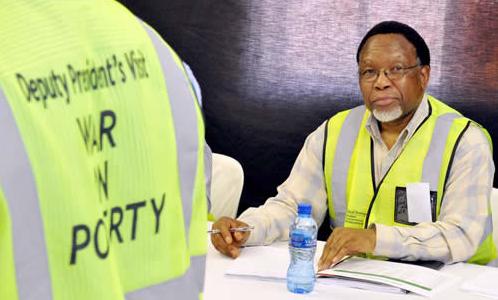
Kgalema Motlanthe

Deputy President Kgalema Motlanthe is the ANC Youth League’s choice for the position of ANC president, it said on Wednesday.

It would nominate him for this post at the African National Congress’s elective conference in Mangaung in December, ANCYL spokeswoman Khusela Sangoni-Khawe said in a statement.

“We are calling on all our structures and ANC branches… to ensure that our generational (sic) mission is fulfilled and that… tried, tested and competent comrades are elected.”

The ANCYL’s candidate for ANC secretary general was former ANCYL leader Fikile Mbalula, and for deputy president ANC treasurer Mathews Phosa or Human Settlements Minister Tokyo Sexwale. Sexwale could also be nominated as treasurer general.

The names of North West Premier Thandi Modise, Arts and Culture Minister Paul Mashatile, and former ANC deputy secretary general Thenjiwe Mtitso were also put forward.

Sangoni-Khawe said: “Primarily, the kind of political leadership that we need is leadership that adheres to our political programme for economic freedom in our lifetime.”

The next leadership needed to take a firm stand on economic policy to realise the Freedom Charter.

“What scares any investor is not nationalisation of mines or expropriation of land without compensation, but an endless discussion on the aforementioned.”

A leader needed the ability to inspire people and reinforce confidence in the ANC and transformation.

In the run-up to the elective conference in December, the party needed to take a stand against political violence and intimidation, she said.

“The ANC must act decisively to ensure that all comrades are afforded an opportunity to voice, without fear or favour, their preferences on leadership without the spectre of victimisation and even death hanging over them.” – Sapa

Zuma: More Africa seats at UN

UN - involved?

Africa needs to be better represented in the United Nations security council, President Jacob Zuma said on Friday.

“About 70% of the agenda of the UN security council is taken up by issues from the African continent,” Zuma said in a statement.

“The security council has to be expanded in both categories, with at least two seats for Africa in the permanent category and five in the non-permanent category.”

The presidency said on Friday Zuma had returned from New York, where he was attending the 67th session of the UN general assembly.

He was accompanied by International Relations Minister Maite Nkoana-Mashabane, Justice Minister Jeff Radebe and Defence Minister Nosiviwe Mapisa-Nqakula.

Zuma was appointed to serve in UN secretary general Ban ki Moon’s Education First initiative, which was launched on Wednesday.

While in the United States the president also attended meetings on the side-lines on the general assembly.

These included meetings on Somalia and the Sahel region.

[ad 1]

Zuma said: “The Somali leadership is expected to play a very critical role in developing a vision that will serve to rally Somali stakeholders and international partners in our efforts at post-transition development.”

South Africa was committed to working with Somalia to strengthen relations between the two countries, he said.

Zuma encouraged the international community to assist the people and government in the Sahel region in dealing with the challenges of drug trading, terrorism and the deteriorating humanitarian situation.

– SAPA

Government is trying to silence me: Juju

Expelled ANC Youth League president Julius Malema insisted on Wednesday that money-laundering charges against him were part of a plot to silence him.

“I am aware that senior government officials… have agitated law enforcement authorities to expedite my arrest and detain me as a means of trying to silence and disrupt the political activities I am involved in,” he said in a statement.

“Attempts to silence our political activities and involvement will never succeed because we carry a revolutionary obligation to speak on behalf of the oppressed and downtrodden masses.”

Malema said he would visit mineworkers in the North West on Thursday to pledge support for their wage protests.

“The struggle for economic freedom is in motion and no amount of suppression and intimidation will silence us,” he said.

“Attempts to banish us and isolate us from the ANC have never succeeded and… [will] never succeed.”

Malema was granted bail of R10,000 by the Polokwane Regional Court on Wednesday.

He was officially charged with money-laundering, for allegedly “receiving proceeds from unlawful activities”.

The affidavit he made in support of his application for bail was not read out in court. The case was postponed to November 30.

Malema said it was “conclusively irresponsible” for the State to issue a warrant of arrest and to take him to court, when it could not produce a docket to justify its charges.

“The rushing of the charging seems to be inspired by other considerations than justice,” he said.

“It is very strange that some political leaders, who are compromised and insisted that my arrest be expedited, are the ones who should respond to more than 700 charges of corruption, fraud and money-laundering.”

Earlier, Malema told supporters outside the court that they needed to make sure President Jacob Zuma was not re-elected at the ANC’s national conference in Mangaung at the end of the year.

“We must make sure Jacob Zuma does not become [remain] president of the ANC… Remove him as a president,” he said.

“Zuma has 700 charges against him. I only have one.”

In his statement, Malema said the “rule of law” could not be undermined by people with political power.

“All South Africans, including Jacob Zuma, should be equal before the law,” he said.

The ANC on Wednesday denied accusations that the charges brought against axed youth league leader Julius Malema were politically motivated.

“We reject this accusation with contempt, as it is misleading and seeking to undermine the rule of law and jurisprudence of the country,” spokesman Jackson Mthembu said in a statement.

“We want to appeal to our structures and to all South Africans to refrain from using inflammatory and unsubstantiated accusations against the ANC and the government agencies.”

The African National Congress in Limpopo and the ANC Youth League have accused the ruling party of using the charges against Malema to fight political battles.

Mthembu said: “In relation to charges favoured against [Malema] we want to state it categorically that the ANC, its president comrade Jacob Zuma and its leadership have no role in the charges.”

Malema appeared in the Polokwane Regional Court on Wednesday.

He was charged with money-laundering and granted bail of R10,000. The case was postponed until November 30.

The ANC called on those who had evidence of the abuse of state powers and its agencies to submit evidence in court as part of the defence.

Mthembu said the ANC was confident that the court would do its job without political motivation.

“It is evident that anybody that suggests the abuse of state powers is trying to water down the implications inherent in the charges and prejudging the case before it has even started,” he said.

“Let’s allow the law to take its course, and presume everyone appearing before the courts innocent until proven guilty.” – Sapa

70% of whites reject both Zuma and Motlanthe as SA presidential candidates – survey

Young South Africans prefer Kgalema Motlanthe to Jacob Zuma as a presidential candidate, although neither of them are that popular, according to a survey released on Monday.

“Given the choice of the two candidates, Kgalema Motlanthe is a clear winner,” said Butch Rice, market analyst for consumer insights company Pondering Panda.

In a survey of 4637 South Africans aged between 18 and 34, some 23 percent said they would like President Zuma to continue his presidency in 2014.

Thirty-six percent of respondents chose Deputy President Motlanthe, when given the choice between him and Zuma.

“It is clear that the youth of South Africa have lost faith in President Zuma. If he were to continue his presidency, it is likely to alienate young South Africans even more,” Rice said.

Forty-one percent of respondents rejected both candidates.

“However, what is most concerning is the high percentage of the youth who reject both candidates. We expect this to affect their propensity to vote in the next election, which could have a significant impact on the outcome for the different political parties.”

The survey found significant demographic differences, particularly in terms of race and region.

Young black South Africans (25 percent) were most likely to select Zuma as their preferred president.

However, 42 percent chose Motlanthe, and 33 percent disliked both candidates.

Eighty-one percent of Indians, 75 percent of coloureds, and 70 percent of whites rejected both candidates.

KwaZulu-Natal was the only region in which Zuma was preferred to Motlanthe. Here, 45 percent of respondents chose Zuma, compared to 22 percent for Motlanthe.

Motlanthe was most popular in Limpopo, where 56 percent of respondents chose him, compared to 17 percent for Zuma.

The interviews were conducted across South Africa using cellphones during the first two weeks of August. – SAPA

Clashes between Zuma and Malema supporters in Limpopo province

A scuffle broke out between police and ANC Youth League supporters outside a hall in Thohoyandou, Limpopo, on Tuesday ahead of an address by President Jacob Zuma.

The fight broke out after supporters of expelled youth league leader Julius Malema were chased out of a memorial lecture hall where Zuma was to speak.

About 300 of them were seen carrying banners, with the image of Malema, and singing: “Zuma is troubling us”.

Police arrested five people on the scene.

Some youth league supporters were apparently assaulted inside the venue by police and Zuma supporters.

Jacaranda FM’s news team tweeted that police fired teargas during the scuffle and that security was tight.

Police Minister Nathi Mthethwa condemned the incident and told SABC radio: “Those people should have known what kind of a leader Madiba was… very radical, very militant, but a very disciplined cadre of the movement and that’s how we grew through the echelons of the movement to be where he was as he left office.”

Police spokesman Brigadier Hangwani Mulaudzi and Presidency spokesman Mac Maharaj could not immediately be reached for comment. – Sapa

Zapiro’s cartoon of Zuma is ‘vulgar’ – Afriforum

Zapiro’s latest cartoon is a “vulgar portrayal” of President Jacob Zuma, lobby group AfriForum said on Monday.

The cartoon was “a vulgar portrayal of the president [and] unproductive and in poor taste.” AfriForum spokesman Ernst Roets said in a statement.

The cartoon by Jonathan Shapiro depicts an erect penis with a showerhead and legs standing before a mirror with an accompanying limerick about Zuma.

It was published in the Mail & Guardian on Friday.

Roets said the cartoon did not contribute towards finding a solution to South Africa’s problems.

“AfriForum is of the opinion that controversial issues in South Africa must be approached constructively and that it does not contribute to finding a solution when other people’s cultures are insulted in the process.”

Roets said although AfriForum supported freedom of speech and artistic experience, this cartoon called into question the matter of dignity.

He suggested artists “evaluate the possible consequences of their work before displaying it to the public”.

On Friday, government called for the removal of the cartoon from the Mail and Guardian website.

Spokesman Jimmy Manyi said the cartoon was a “defamatory attack” on Zuma’s character and violated his rights to dignity as enshrined in the Constitution.

SA Communist Party spokesman Malesela Maleka called it “B-grade schoolboy lavatory stuff, unworthy of a once talented cartoonist and unworthy of a newspaper that pretends to be serious”.

The African National Congress found it ” unacceptable and shocking”, while its Women’s League condemned it.

“The Zapiro cartoons rely on their shock value to make an impact, but calling the president of this great nation a ‘dick’ is unacceptable…” ANC Women’s League spokeswoman Troy Martens said.

Responding to criticism of the cartoon, Shapiro said on Friday the public should have the democratic right to be irreverent about leaders, especially those who “display hypocrisy”.

“My latest cartoon is meant to be scathing but humorous,” he said in an email, issued by his office, to Sapa.

“It’s also serious commentary about a seriously flawed, hypocritical leader.” – Sapa

Zuma wants to socialise land ownership, move away from ‘will buyer, willing seller model’

Johannesburg – In terms of the Constitution, the state has to ensure that citizens are able to obtain land rights, President Jacob Zuma said at the ANC’s policy conference on Tuesday.

“Our position is that the current willing buyer, willing seller model must be reviewed,” Zuma, who is also the ANC’s president, told delegates at Gallagher Estate in Midrand.

“It tends to distort the land market through inflating the prices of land earmarked for restitution.”

Zuma said the model made land reform expensive and delayed land restitution to the poor. A wide range of proposals had been submitted to the conference.

“[This will] enable faster movement on this matter, within the confines of the Constitution and the law,” Zuma said.

The ANC Youth League wants expropriation without compensation, and said it would push for a policy change at the conference. This has caused tensions between the ANCYL and opposition parties.

The youth league also wants the nationalisation of mines.

On Tuesday, Zuma said ANC delegates had to deliberate on how the state could obtain an equitable share from mineral resources.

“The state exercises sovereignty over the entire mineral and petroleum resources within the republic,” he said.

“In the same vein, Article (2)(1) of the United Nations Charter of Economic Rights and Duties of States, grants states full permanent sovereignty, including possession and disposal over all their natural resources.”

Zuma said the country needed to go “back to the basics” and take difficult decisions that it could not take in 1994. The structure of the apartheid economy had remained largely intact, and had not allowed for higher or inclusive growth.

“We must create a thriving mixed economy, where the state, private capital, co-operative and other forms of social ownership complement each other in an integrated way to eliminate poverty and foster shared economic growth,” he said.

“To achieve inclusive and labour absorbing growth, the state must play an active role in the economy, driving development especially in neglected areas.”

– SAPA

Second revolution against whites must come, says Zuma

Johannesburg – The ANC’s second transition is necessary to overcome the compromises it made in the fight for democracy, President Jacob Zuma said on Tuesday.

“One of the causes of the slow pace to economic freedom is that ahead of [the first democratic election in] 1994… we went through a negotiations process,” Zuma said in Midrand.

“We had to make certain compromises in the national interest, and these were absolutely necessary to make. We had to be cautious about restructuring the economy in order to maintain economic stability and confidence at the time.”

Zuma was opening the policy conference of the ruling African National Congress.

He said the apartheid era’s economic power had remained intact.

“The ownership of the economy is still primarily in the hands of white males, in which it has always been.”

A document on the second transition was one of the ANC’s 13 policy documents which would be discussed during the four-day conference.

Zuma said the second transition would make the country a “true democratic developmental state… which has a number of instruments it can use to facilitate change”.

The first transition was still important because it had ushered in an era of democracy in South Africa.

“The time has come to do something more drastic to accelerate change towards economic transformation and freedom.”

Zuma asked delegates to discuss the notion of a second transition when dealing with the strategy and tactics document.

“It is time to ask questions about the present and future… the last 18 years was the first transition. We are calling for a dramatic shift… to deal with the triple challenge[s] of poverty, unemployment and inequality.”

– SAPA

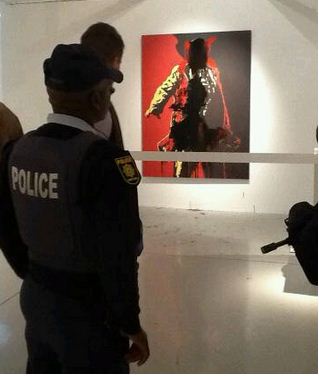
Zuma painting defaced with black paint

The defaced painting

The controversial painting of President Jacob Zuma in the Goodman Gallery in Johannesburg has been defaced, gallery staff confirmed on Tuesday.

A man is being held by the gallery security team.

“The work has been painted over with black and red paint,” a spokesman said.

Police are on their way to the scene.

On Twitter, expelled ANC youth leader Julius Malema said: “Guy who defaced Zuma spear is a national hero.”

– Sapa and Praag

‘Crude rhetoric’ from ANC leaders

by Genevieve Quintal and Hlengiwe Nhlabathi

ANC leaders on Tuesday condemned the “shockingly crude, disrespectful and un-ANC” remarks recently made by some within the party.

“The brazen and often rude and crude rhetoric to detract from real issues facing our youth does nothing to add value to the integrity of the ANC and its leagues,” secretary general Gwede Mantashe told reporters in Johannesburg.

“As national officials of the ANC, we believe the time has come to put an end to the blustering and often incomprehensible remarks that are made by various leaders and members of the ANC.”

Mantashe was joined by President Jacob Zuma, his deputy Kgalema Motlanthe, treasurer Mathews Phosa, national chairwoman Baleka Mbete and deputy secretary general Thandi Modise.

This followed ANCYL leader Julius Malema’s remarks at a centenary lecture at Wits University on Friday, that Zuma was a dictator and suppressing the league.

Mantashe said the attack on Zuma was an attack on the African National Congress.

“It makes it sound like we can’t think for ourselves. It is not a leadership of dwarfs around a dictator. This is an insult to many of us.”

Mantashe said Malema’s claim that new ideas were suppressed and that the ANC’s current leaders were dictators was a “deliberate falsehood”.

It was unfortunate that the league had chosen the ANC’s centenary year to call the party undemocratic and to try sow division within the organisation. Mantashe said these statements would be investigated.

Party leaders also bemoaned the Umkhonto we Sizwe Military Veterans Association’s call, made at another press briefing earlier in the day, for Malema to be summarily expelled from the party.

The ANC Youth League called its own media briefing at Luthuli House after the veterans had held theirs, and accused them of looking for attention and trying to impress their girlfriends.

Mantashe said the ANC’s top officials were united on discipline within the organisation. The leaders were also not fighting for positions ahead of the party’s elective conference in Bloemfontein in December.

“We remain loyal to all decisions taken. National officials are not at odds with each other.”

Mantashe said the ANC had not yet met with the league, as it was being cautious. The ANC did not want to cause confusion while disciplinary processes were ongoing, he said.

Malema is still awaiting the result of his appeal against his expulsion from the party by its national disciplinary committee.

Thandi Modise likened the ANCYL to a teenager and said tensions between it and the ANC were a given. She cautioned against a situation where antagonism replaced militancy. She also cautioned against the “bastardising” of internal ANC processes.

Asked why he did not reprimand Malema when he verbally attacked Zuma and his leadership on Friday, Phosa said he did not have the urge to immediately respond, but did so late in his speech.

“I said in response… The masses of our country do not appreciate it when leaders engage in public spats.”

He was invited to the event as a replacement for Sports Minister Fikile Mbalula, a former ANCYL leader and reportedly a Malema supporter.

Speculation was also rife that Phosa and Motlanthe were staunch Malema allies.

However, Motlanthe warned against those who used the ANC leaders’ names to divide the organisation, saying they would not be successful. Last month, he reprimanded ANCYL members in Limpopo who wore T-shirts bearing his face.

-SAPA