SA needs hate crime legislation

South Africa needs special legislation for all forms of hate crimes, a conference on crime in Sandton heard on Thursday.

“It would be helpful to have hate crime legislation because it would focus the police minds when investigating, prosecutors when prosecuting, judges when passing sentences,” said Kerry Williams, partner at law firm Webber Wentzel.

“And the legislature could give some guidance in how to handle these crimes.”

Williams told the conference on crime reduction that the perpetrators of hate crimes could be prosecuted using common law, and judges could recognise the aspect of hate when passing judgment on these cases.

She said legislation would give added focus and stipulate minimum sentences for hate crimes.

In hate crimes, the perpetrator selects his or her victim for some discriminatory reason such as race, nationality, gender, or sexual orientation.

Juan Nel, director of the centre for applied psychology at Unisa, said hate crimes were not recognised in South Africa.

“Unless they become a recognised crime category, they can’t be recorded at police station level.

“Without it being recorded as such, it is very difficult to get a sense of what the prevalence would be.

“Once we have it as a recorded category… you can get a sense as to how often it happens, to whom it happens and where it happens.”

He said recording the crime would also help research efforts aimed at understanding the nature and impact of the crimes.

Nel said the priority that was put on hate crimes was not based on prevalence, but their impact.

“We believe it extends beyond the individual, it also affects the community. It also about the psychological impact that it has: the fear, the anger that it might create, and sometimes it has [a] ripple effect.”

He said the Hate Crimes Working Group, in partnership with other civic organisations, had identified 450 hate crimes in five provinces since 2005.

These were KwaZulu-Natal, Gauteng, Western Cape, Limpopo and Eastern Cape.

The crimes consisted of 150 lesbian gay bisexual trans-gender intersex (LGBTI) cases, 150 foreign national cases and 150 other cases.

The conference was hosted by the Institute For Security Studies and would end on Friday. – Sapa

‘Inequality causes violence’ – academic

Gender and economic inequality are prevalent in violent societies, a conference on crime reduction heard on Thursday.

“South Africa is one of the wealthiest countries in Africa, but we also have one of the highest levels of violence,” said KwaZulu-Natal University academic Anthony Collins.

“There are African countries that are poor, for instance Malawi, but have less violence.”

He said rich countries, such as the United States, were also violent, because of high levels of inequality.

“What research is showing is that it is not the poverty; it is the economic inequality that is more significant,” Collins said.

“South Africa and Brazil are among the most unequal societies in the world and they also have among the highest levels of violence, although South Africa is higher.”

Collins cautioned that this was not a simple matter of cause and effect. Many other factors had to brought into the mix.

“There is a lot of social behaviour, cultural traditions, values, ideas [and] historical causes like in instances where societies have been through a lot of conflict, like South Africa.”

He said in the past there had been two views on violence. One was that people were violent because they disrespected the law.

Then, the progressive view came which said society was violent because of social circumstances.

“That was obviously true, but that got over-simplified into this claim that poverty causes violence,” said Collins.

“It is where you’ve got poverty and wealth in the same society next to each other. This creates a condition in which violence flourishes.”

Another contributing factor shown by research was the prevalence of gender inequality.

“A lot of societies where women and men have a more equal status are less violent… in a society with a lot of patriarchal structure, those societies turn to be violent,” said Collins.

Delegates from around the world attended the conference, themed “National And International Perspectives On Crime Reduction and Criminal Justice”. – Sapa

Rwanda on Security Council despite funding rebels

A country littered with dead bodiesRwanda – along with Australia, Argentina, Luxembourg and South Korea – won a seat on the U.N. Security Council on Thursday, despite accusations by a U.N. panel that Rwanda’s defense minister commands a rebellion in Democratic Republic of Congo.

Rwanda was unopposed in its bid for the African seat on the council that South Africa will vacate at the end of December, but still needed approval from two-thirds of the U.N. General Assembly members present to secure the two-year term. It won 148 votes in the 193-nation assembly.

Argentina also was elected to the council unopposed, winning 182 votes. Australia won a seat with 140 votes, Luxembourg with 131 votes and South Korea with 149.

Cambodia, Bhutan and Finland failed to secure two-year seats on the council.

There are five veto-holding permanent members of the council – the United States, Britain, France, Russia and China – and 10 temporary members without veto power. Thursday’s election was for the term from Jan. 1, 2013, to Dec. 31, 2014.

Rwanda’s government said that it would work with all members of the council to ensure “it is responsive and reflective of the views & aspirations of the developing world.”

“Rwanda’s troubling and tragic past allows it to bring to the UNSC a unique perspective on matters of war and peace,” it posted on a Twitter account created for its Security Council term (@RwandaUNSC).

Before the vote, the Congolese delegation told the General Assembly it objected to Rwanda joining the Security Council, accusing its neighbor of harboring “war criminals operating in the eastern part of the DRC and who are being sought by international justice.”

A confidential U.N. report, seen by Reuters on Tuesday, cast a shadow over Rwanda’s election to the 15-member U.N. power center – which has the ability to impose sanctions and authorize military interventions.

The Security Council’s “Group of Experts” said that Rwanda and Uganda – despite their strong denials – continued to support M23 rebels in their six-month fight against Congolese government troops in the east of the country.

BLATANT VIOLATIONS?

Rwandan President Paul Kagame posted a declaration on Twitter welcoming the result: “No matter what haters say … justice&truth will prevail!!! Sometimes it just requires a bit of good fight for all that…!!!”

Speaking to reporters in New York, Rwandan Foreign Minister Louise Mushikiwabo complained about the timing of the leak of the experts report to Reuters two days ahead of the Security Council vote, but added that the leak was “predictable.”

She also sought to assure Congo that Rwanda would be a responsible council member. “I believe the Democratic Republic of Congo should see Rwanda on the Security Council as value addition,” she said after the vote.

Philippe Bolopion of the advocacy group Human Rights Watch criticized the inclusion of Rwanda on the Security Council

“After blatantly violating the Security Council’s arms embargo and undermining the work of the U.N. by propping up the abusive M23 rebels, Rwanda is rewarded with a seat at the table,” he said.

“Kigali is now in a position to try to shield its own officials implicated in abuses from U.N. sanctions, which is a flagrant conflict of interest,” Bolopion said in a statement. “Other Security Council members now have an even greater responsibility to hold Rwanda to account.”

Britain’s Deputy U.N. Ambassador Philip Parham put a more positive spin on Rwanda’s election, saying: “We look forward to working with them on issues of international peace and security including the efforts to try to end the cycle of violence in the eastern DRC.”

Australian Foreign Minister Bob Carr described Australia’s election as a “big juicy, decisive win” that endorsed the country as a good global citizen.

“For us as a middle power a long way from the centers of clout in the world, the centers of power in the world, this is a lovely moment,” Carr told reporters after the vote.

South Africa, Colombia, Germany, India and Portugal are leaving the Security Council in December. Azerbaijan, Guatemala, Pakistan, Togo and Morocco will remain until the end of 2013.

The last time Rwanda was on the council was in 1994-95. That coincided with a genocide in which 800,000 people were killed when Rwanda’s Hutu-led government and ethnic militias went on a 100-day killing spree, massacring Tutsis and moderate Hutus.

The Congolese government on Wednesday demanded targeted sanctions against Rwandan and Ugandan officials named in the U.N. experts report.

According to the U.N. experts, who monitor compliance with sanctions and an arms embargo on the Congo, Rwandan Defense Minister General James Kabarebe was ultimately commanding the rebellion and both Rwanda and Uganda were providing weapons, troops and military and political aid to the insurgency. – Reuters

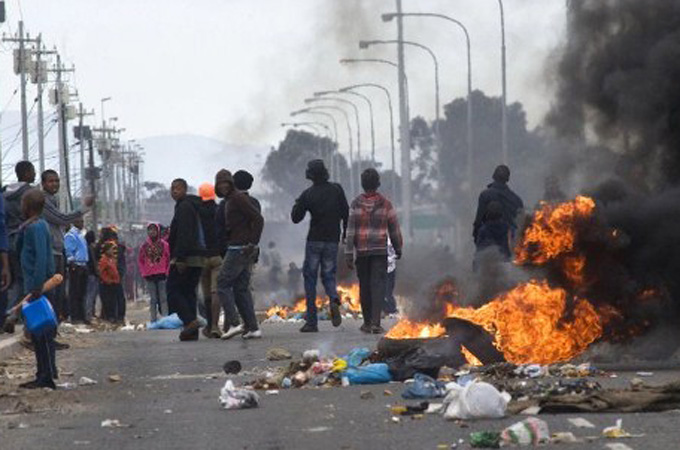
March turns violent as thousands protest service delivery

Over 7 000 protesters, carrying sticks and knobkerries, arrived at the Benoni Customer Care Centre, at the corner of Elston Avenue and Tom Jones Street, in separate groups on October 17, to hand over a memorandum.

The town was brought to a standstill for two hours, from 8am, and almost all the shops were closed for safety reasons.

The protesters, some as young as 10, vandalised a number of shops, stoned passing motorists, stole goods belonging to hawkers and upturned rubbish bins.

The door of the Department of Education was also broken in the process. No one has been arrested, despite all of this.

The situation calmed as both the SAPS and Metro Police started to arrive in numbers. A police helicopter was also hovering in the sky, to try to keep order.

The protesters were residents of the Actonville hostel and the informal settlements in Actonville and Wattville.

Residents said they wanted houses.

“We have been living in shacks for many years and we are tired of this,” said a woman who wanted to remain anonymous.

An Actonville Hostel resident said they have sewage running all over the hostel and that they were promised proper housing, but that nothing has naterialised.

After handing over their memorandum, the protesters tried to break down the Customer Care Centre fence, in order gain access to the premises, but police used stun grenades to disperse the crowed.

The protesters were then escorted out of town by a police officers. Benoni resident Stephen Frances (19) was beaten with sticks and robbed of his money and cellphone by unruly protesters.

He was walking along Elston Avenue when a mob of protesters pounced on him for no particular reason.

“I did nothing to these people, but they decided to beat me up and take my money and cellphone,” said Frances, who emerged from the crowd running for his life.

He showed the City Times the marks sticks left on his body. –  The Citizen

The West has failed Christians

Too young to be a victim

In January 1945, my mother, too young even for school, joined millions of other ethnic Germans fleeing westwards from Breslau as the Red Army advanced. My forefathers had lived in this region of Silesia (German since 1242) for at least nine generations that I know of. The forced repatriation – a process that might now be called ethnic cleansing – of my mother’s family and millions of other civilians from groups whose nationality would in future be inextricably linked to their ethnicity, was largely overlooked in the euphoria that swept the world at the end of World War II.

They never returned.

Now we are witnessing another wave of civilian displacement in the Middle East with hundreds of thousands of Christians being forced to flee  as they are banished from their 2,000 year old homelands in today’s remarkable surge in Arabian people power.

Their fate has been largely forgotten as the global media attention has moved on from Egypt and Libya and encamped in Syria to watch the terrible bloodshed in Damascus, Houla, Aleppo and Homs. Innocent people on all sides are enduring awful hardship, death and torture; civil war does not discriminate between young and old, rich or poor. In the ghastly bloodletting we are now seeing, no one seems safe from the prospect of sudden death and destruction of property.

Desperation

Yet for the two million plus Syrian followers of Christ, whose lineage goes back 2000 years to St Paul’s proselytising in the first century AD, these are especially desperate times. Ethnic cleansing is an ugly phrase, but that’s just what is going on right now for Christians in Syria. The unspeakable truth now is that the sizeable Christian communities in war-torn Syria are at greater threat of ethnic cleansing from their ancestral homes than has been the case for generations – often at the hands of the self-styled freedom fighters so feted by the Western press.

These fighters, increasingly rent-a-mob Jihadists with no real stake in the affairs of Damascus, do not see the enclaves of Christians as genial neighbours who they have lived alongside for centuries, as many Syrian rebels do. It is true religious minorities often find their most assured protection under dictatorships. It pays not to rock the status quo.

But to use this as a reason to attack them, destroy ancient churches and hold them to ransom seems a convenient excuse. The Jihadists  simply see them as representing an infidel faith and have turned their attentions on them in a way that was so much rarer for the Syrian-based rebels. Syria’s Christians, who make up less than 10 per cent of the estimated 23 million population, include Greek Orthodox, Syriac Orthodox, Maronite and Melkite Greek Catholic faithful.

Already thousands have left, part of a larger tide of displaced Syrians escaping the conflict in which opposition groups say 27,000 people have died. In the Homs area 80,000 have fled as churches and community centres have been targeted, defaced, and their religious icons stolen. Whilst it is true that some Christians have held prominent positions under Assad  they have also taken leading roles in the political opposition to Assad’s rule, there are other Christians, like George Sabra, who ran for presidency of the opposition Syrian National Council, who have been staunchly anti-Assad.

The Iraqi example

These Christians are now abroad, staying with friends, in gardens or in churches in Lebanon, in Turkey, anywhere out of the firing line. Some have resorted to taking the Government’s side and bearing arms, a move anathema to them throughout history. What my Syrian Christian constituents fear is that once gone, there will be no coming back. A rebel victory and a harder Islamist regime, may very well not want the return of a pluralist society, with Christians living alongside Shiite and Sunni Muslims as they have since biblical times.

Events in Iraq provide us with a timely example. Amidst savage bloodletting between Sunnis and Shiites in the aftermath of the US-led invasion of Iraq in 2003, the story of Iraq’s Christian population is one that is rarely told. But since the invasion it is estimated that half their number has desperately been driven to exile outside the country.

Some 330,000 Iraqi Christians fled in the past decade to Syria alone – and are now fleeing again. Others have found safe haven in Jordan and naturally some have come to these shores, including to my constituency, the Cities of London and Westminster. Under Saddam Hussein, some Christians had risen to the top of politics, most notably Tariq Aziz, Hussein’s Deputy Prime Minister. Yet since the dictator’s fall, violence against the Christian minority, who were often associated with the “crusading invaders”, has included kidnappings, the beheading of a priest, the bombing of ancient churches and forced conversion to Islam.

This is the backdrop to the fate that I fear will within a decade or so befall the long established Christian population in this region.

The West must act now to protect the Christians of Syria, Egypt and Iraq and make sure religious freedoms for Christians are enshrined in the laws of any future new regimes if we wish to avoid a similar scale of civilian displacement. And we must ensure that the banishment from their homelands of Middle Eastern Christians over the years ahead is not a dark derivative of the Middle Eastern uprising. – Mark Field, The Independent

White farmers 13 times more likely to be attacked

SAIRR has amended their view on farm attacks. According to Institute’s calculations white farming families may be 13 times more likely to be attacked.

This Research and Policy Brief paper seeks to determine the extent to which farmers are uniquely vulnerable to armed attack in South Africa. It draws comparisons between the rate of attack on farmers and their families to that of other citizens in South Africa.

On 5 October 2012 the South African Institute of Race Relations released a statement on farm attacks in South Africa. The statement was based on farm attack data by the Transvaal Agricultural Union (TAU). It has since been drawn to our attention by James Myburgh that the TAU data is compromised by a significant undercount of as much as 7:1 in terms of the actual number of farm attacks. Our initial analysis has therefore been revised accordingly. The revised analysis follows below.

The table below compares the farm attack rate for farmers and their families to the house robbery rate, aggravated robbery rate, and combined aggravated robbery and murder and attempted murder rates for the broader population.  It is based on three assumptions. The first is that there are 47 000 commercial farmers in South Africa. This is based on StatsSA’s Census of Commercial Agriculture 2007. The second is that the average household size for farmers is 3. This is the average household size for white South Africans. The third is that, following from James Myburgh’s analysis, TAU undercounts farm attacks by an average of 7 to 1. The fourth is that attacks on smallholdings should be included as attacks on farms.

  47 000 farmers + 2 dependants each = 141 000 people National population = 50.6 million people Ratio of farm attacks to attacks on general population
 

Rate per 100 000 people

Farm attacks vs house robberies 422 33 12.8 to 1
Farm attacks vs aggravated robbery 422 200 2.1 to 1
Farm attacks vs aggravated robbery + murder + attempted murder 422 260 1.6 to 1

Table 1: Attacks on farmers and their families compared to other citizens (smallholdings included)

The table shows that based on those four assumptions the number of attacks on farmers and their dependants is 422/100 000. The number of house robberies in the broader population is 33/100 000. In this comparison farming families are 13 times more likely to be attacked than other families. However, farm attacks also include all forms of robbery and not just house robbery.

For that reason the table also compares the farm attack rate to the broader armed robbery rate in the country. Here the farm attack rate, which remains at 422/100 000, must be compared to the national armed robbery rate of 200/100 000. In terms of this comparison farmers and their families are twice as likely to be attacked as other citizens. Farm attacks also involve murder and attempted murder.

For this reason the table also compares the farm attack rate to the joint aggravated robbery/murder/attempted murder rate for the broader population. Here the farm attack rate, which remains at 422/100 000, can be compared to the national murder and aggravated robbery rate of 260/100 000. Even on this analysis farmers remain more vulnerable to attack by a ratio of 1.6 to 1.

However, the argument can be made that smallholdings are basically large urban plots and not really farms. For that reason we have published the table below which compares farm attacks, excluding attacks on smallholdings, to criminal attacks in the broader population. The other three assumptions made about the data (above) are unchanged.

  47 000 farmers + 2 dependants each = 141 000 people National population = 50.6 million people Ratio of farm attacks to attacks on general population
 

Rate per 100 000 people

Farm attacks vs house robberies 262 33 7.9 to 1
Farm attacks vs aggravated robbery 262 200 1.3 to 1
Farm attacks vs aggravated robbery + murder + attempted murder 262 260 1 to 1

Table 2: Attacks on farmers and their families compared to other citizens (smallholdings excluded)

This table shows that when smallholdings are taken out of the equation the farm attack rate declines to 262/100 000 farmers and their families. Compared to the national house robbery rate of 33/100 000 farmers are on this measure eight times more likely to be attacked than other citizens.

However, the table shows that when this new farm attack rate is compared to the broader aggravated robbery rate of 200/100 000 this ratio comes down to 1.3 to 1. Furthermore, when the farm attack rate is compared to the broader aggravated robbery/murder/attempted murder rate of 260/100 000 that ratio reaches a level of parity of 1 to 1. In other words, on this measure farming families are no more likely to be attacked than other citizens.

We have also conducted an analysis of the murder of farmers, based on TAU’s more complete murder figures. In order to produce a figure for the highest possible murder rate the table below assumes that only the 47 000 farmers, and not their families, are targeted in farm murders.

  47 000 farmers National population = 50.6 million Ratio of farmer murders attacks to murders in the general population
 

Rate per 100 000 people

Farm murders vs all murders 68 31 2.2 to 1

Table 3: The murder of farmers

On this measure the table shows that in 2011 some 68/100 000 farmers in the country were murdered. This compares to a national murder rate of 31/100 000. On this analysis farmers are twice as likely to be murdered as ordinary citizens.  However, while farmers are particularly likely to be murdered, it is true that family members may also be murdered in attacks. It is for this reason that we have prepared the final table below, which compares the murder rate for farmers and their families to that of other citizens.

  47 000 farmers + 2 dependants each = 141 000 National population = 50.6 million Ratio of farmer/family murders to murders in the general population
 

Rate per 100 000 people

Farm murders vs all murders 33 31 1.1 to 1

Table 4: The murder of farmers and their families

This table shows that in 2011 the murder rate for farmers and their families was 33/100 000. The murder rate for the broader population was 31/100 000. On this comparison farmers and their families are not more likely to be murdered than other citizens.

Keep in mind that our analysis has excluded the 220 000 emerging commercial farmers, some of whom are large producers, who may also be attacked. We have also excluded from this analysis farm managers and extended families that may live on farms and become victims of attack. Our figures therefore suggest worst-case scenarios for farming families.

What conclusions can be drawn? The first is that the past week has seen a sharp increase in the quality and level of analysis of farm attacks in South Africa. It has also focused considerable media attention on the problem. Both of these are good things.

The second is that it is possible to argue that farmers are uniquely vulnerable to attack contrary to our initial conclusions drawn from the incomplete TAU data. This is especially so where a straight comparison is drawn between the house robbery rate and the farm attack rate. The same is true for the murder rate of farmers (excluding family members).

The third is that by changing some assumptions it is possible to reach somewhat different conclusions. For example, it is reasonable to compare farm attacks, which is a term inclusive of robbery and murder, to the broader robbery and murder rates of the society. When this is done farmers remain more at risk, although by a smaller measure. However, it is when the assumptions shift to exclude smallholdings that the picture changes significantly. Then the comparisons suggest that farmers are not uniquely vulnerable to violent attack.

However, even this result should not be taken to suggest that farmers are safe. Analysts of our data must consider that South Africa’s crime rates are uniquely high. Our murder rate, for example, is 500% higher than that of the United States and 3000% higher than parts of Western Europe such as the United Kingdom and Germany. This brings us to our fourth conclusion that all South Africans face an extraordinary criminal onslaught. People who have previously regarded farm attacks as a somewhat distant problem, nothing to do with them, must realise that they arguably live in as much peril as farmers do. It is clear therefore, regardless of how they rank compared to other citizens, that as a best-case scenario, farmers live a perilous existence in a largely lawless society.

The fifth conclusion is that, unlike urban middle class residents, farmers do not have the benefit of armed response companies or nearby police stations. Rather they depend on their own defences to secure themselves and their families. In addition, no analysis of the security position of farmers would be complete without noting the role of the State in exacerbating their vulnerability. The closure of the commandos and the Government and the African National Congress’s ambivalence at best toward the incitement by some of their own members to kill farmers creates an environment in which South Africa’s farmers are likely to be killed.

The final conclusion is that there can ultimately be no solution to farm attacks without a broader solution to the general problem of criminal violence in our society. In other words, farmers will not be safe until other citizens are safe and vice-versa. This is a point that advocacy groups can use to great effect in their important campaigns to alert policy makers and the international community to the murder of farmers in South Africa.

Issued by Frans Cronje, Lucy Holborn, Boitumelo Sethlatswe, South African Institute of Race Relations, October 10 2012

Violent protests rise dramatically

Rising expectations

Protest activity rose dramatically in the first eight months of this year, according to a report by the Multi-Level Government Initiative.

About 80% of the protests were violent.

The Multi-Level Government Initiative, which tracked protests between February 2007 and August 2012, released its protests barometer in Cape Town yesterday.

The research corroborates the findings of local governments and data collated by intelligence service Municipal IQ.

It shows that there has been an unprecedented increase in the number of protests and in the use of violence by protesters.

Western Cape felt most of the protesters’ wrath.

“Protest” is defined by the researchers as “any complaint or issue cited by protesters in reports, whether related to the delivery of municipal services or not, over which citizens decide to, and actually engage in, [sic] organised public protest activity”.

Findings included that:

  • Protest activity rose dramatically in the first eight months of 2012, with 226 protests;
  • If current trends continue, this year will have more than twice as many protests as last, and more than in 2010 and 2011 together;
  • Western Cape surpassed Gauteng as the province with the highest number of violent protests this year;
  • Before 2012, Western Cape recorded its highest protest activity during an election year;
  • Western Cape, Eastern Cape and Gauteng accounted for 56.98% of protests; and
  • Occupation and housing were the most cited issues, 303 in the six-year period. Poor service delivery was second, with 218 protests. Grievances related to broken promises and government officials ignoring protesters’ complaints have risen exponentially since 2010 but account for less than 10% of complaints.

This year , Western Cape shot past Gauteng as the province with the biggest number of violent protests.

The head of the research project, Professor Jaap de Visser, said the researchers had begun collecting information on a very complicated issue.

“Let us build up our knowledge about protests over a period of time.

“The government should put serious effort into analysing protest activity and use the information to improve its performance and engagement,” he said.

Body of councillor found

Political differences between IFP and ANC ironed out

The body of an Inkatha Freedom Party councillor, who was abducted, has been found in a sugar cane field on the outskirts of Durban, the IFP said on Sunday.

IFP spokesman Albert Mncwango said Themba Xulu’s body was found in an area known as eTafulene, near Durban.

Police spokesman Colonel Jay Naicker confirmed the discovery of the body.

He said people collecting mushrooms had discovered the body and alerted police.

Naicker, speaking from the crime scene, said Xulu sustained multiple gunshot wounds and his body appeared to show early signs of decomposition.

While this indicated that Xulu had already been killed on Friday night, a post mortem would confirm this fact.

Xulu was abducted from his home in KwaMashu’s A-Section on Friday, allegedly by five men posing as policemen.

Mncwango said party leaders were at the scene and had told him that it was Xulu. He had been shot.

He appealed for calm and said that he and the IFP leadership were due to hold a meeting with the police at KwaMashu police station.

“We need to know who committed this heinous crime.”

On Saturday national police minister Nathi Mthethwa spoke to residents at a mass meeting of about 2000 people in KwaMashu’s A-Section, which hasnumerous hostels and shacks.

Shortly after he left the meeting a woman was wounded in the face while an IFP supporter was shot dead near Tembalihle station.

Tensions in the area have been high ever since Xulu was arrested and charged for the attempted murder of a National Freedom Party (NFP) member.

The NFP was formed prior to the 2011 local government elections when the former IFP national chair Zanele Magwaba-Msibi left the party.

Naicker said the provincial commissioner had requested an extra 110 police officers be deployed to the hostel areas of KwaMashu’s A-Section as political party leaders attempted to diffuse he situation. – Sapa

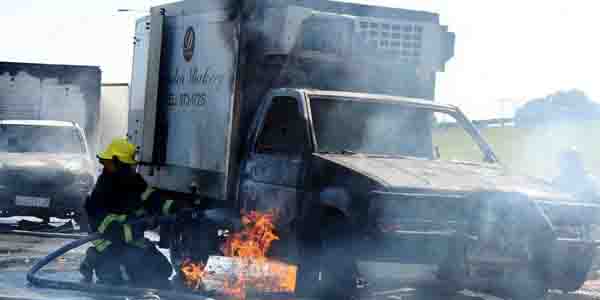
Strikers attack truck and driver

Torched truck on the East Rand, N12 motorway

A truck driver and two other people were in hospital on Thursday after their truck was torched on the N12, Ekurhuleni metro police said.

“The driver and his two co-drivers were seriously injured…. The three were battered by angry mob of striking truck drivers,” said spokesman Superintendent Vusi Mabanga.

The attackers ran away and no arrests were made.

Striking truck drivers have been accused of violence and intimidation since the strike began.

On Wednesday, two trucks were set alight and another was stoned in Cape Town.

Talks to end the strike collapsed on Thursday when unions rejected a third offer.

Drivers wanted a 12 percent salary increase, while employers offered 8.5 percent for next year, and another 0.5 percent the following year. – Sapa

Violence explodes in black US cities

Black Mobs on a Rampage

As more and more Americans across the country become impoverished by rising costs for essential goods, falling wages, job losses, and an unraveling social safety net, those with nothing left to lose are becoming more daring, more aggressive and more ruthless.

Nowhere is this as apparent than in the cities of Chicago, where police have compared the explosion in violence to a tribal warfare akin to what we’ve seen in Iraq or Afghanistan, and Detroit, Michigan, where acres upon acres of dilapidated homes have been razed and police have simply stopped responding to emergency calls in certain areas.

The rule of law is steadily collapsing, and in due time you may see it in your city:

Even the old-timers in Detroit never have seen anything like this… A mob of 40 black people moved into a convenience store and will not leave.

They say they now own it. They eat. Smoke. Cuss.Threaten. Spit. Rob. Sell drugs. All on video.

Police, ministers, neighbors, the store owner and just about everyone else seems powerless to stop them.

“It’s a Bad Crew gas station,” said one of the mob to the local Fox affiliate. “If you don’t know what that is, I can’t even tell you.”

The owner calls police, but nothing happens. The police “come here and then they leave. Two minutes later they (the mob) are back.”

Source: WND

Also: Mob Beats Detroit shopkeeper:

“I am shocked he is still alive,” said the store owner. “They came into the gas station and said ‘we own this. This is our hood. This is our gas station. We are going to take whatever we want.’ It’s a war zone.”

We are living in a society where legislation and law enforcement have been aimed squarely at law abiding Americans while criminals are allowed to do as they please. As criminals realize they can indiscriminately pillage and attack innocents without being held to account under existing laws, we can fully expect this trend to spread to currently peaceful neighborhoods. At some point the violence will simply overwhelm local police departments.

At that point, it’ll be up to each individual American to look out for themselves and their families. Or, things will get so bad that the government will announce ‘temporary’ local, state or national emergencies, declare martial law and deploy military personnel on the streets of America in response to the disturbances and rampant crime waves.

Whatever the outcome, those who play by the rules, follow the laws, and respect the individual rights of others will be the losers.

White office workers threatened by strikers

AngloGold Ashanti's Mponeng gold mine near Fochville

Striking black mine workers at the Mponeng mine near Carletonville, west of Johannesburg, have issued death threats to white office workers at the mine. Yesterday they were told not to come to work today, unless they wanted to be killed.

White office staff were told to assemble at the Jacaranda garage in Fochville. An eyewitness and businesswoman in the town lives about 800 meters from the garage and she saw 200 white mine and office workers at the garage this morning.

Helicopters were circling from early this morning, with emergency vehicles coming and going.

Yesterday an unspecified number of people were hurt in the strikes, with several mine workers arrested.

According to the businesswoman, “Things are bad here in Fochville.”

Strike violence causes traffic chaos near Johannesburg airport

Three people were injured in protests by striking truck drivers in Ekurhuleni, east of Johannesburg, on Thursday morning, metro police said.

“Up to now we can say three people [have] sustained injuries following truck protests around 7am,” said Inspector Kobeli Mokheseng.

“There were calls coming in on Thursday morning that on the R21 to Pretoria, one light delivery vehicle was burned, and truckers stoned two trucks.”

He said the R21 north to Pretoria, opposite OR Tambo International Airport, was closed.

“The R24 is affected going east and, if you are on the R21 going towards Pretoria, it is affected up to Griffiths Road offramp,” said Mokheseng.

“We are diverting traffic from East Rand Mall heading to Pretoria and… directing it on to the Griffiths Road offramp.”

Traffic on the R24 was also being redirected from Barbara Road.

“No arrests have been made. Police are dealing with the situation as it is happening,” he said.

Meanwhile, wage negotiations between the Road Freight Employers’ Association (RFEA) and unions remained deadlocked.

RFEA spokeswoman Magretia Brown-Engelbrecht said the situation had not changed since Wednesday.

“We have committed ourselves to being available for further talks. Nothing has been forthcoming thus far and we shall see where we go,” she said.

“We are hopeful that between today [Thursday] and tomorrow [Friday] we can get the process going again.”

The unions involved are the SA Transport and Allied Workers’ Union (Satawu), the Professional Transport and Allied Workers’ Union SA (PTAWUSA), the Transport and Allied Workers’ Union of SA (TAWU) and the Motor Transport Workers’ Union (MTWU).

[ad 1]

PTAWUSA road freight co-ordinator Puncho Ndevu confirmed that the situation remained unchanged on Thursday, with unions in discussions among themselves regarding the next step forward.

About 20,000 workers in the road freight transport sector have been on strike over wages since Monday.

Unions have reverted to a 12 percent pay demand after rejecting a lower offer tabled by employers on Tuesday.

The RFEA had proposed a staggered increase of 8.5 percent effective from March, and a further 0.5 percent from September next year. – Sapa

SA truckers’ strike turning violent

This delivery van was attacked yesterday by striking truck drivers near Isando station on the East Rand

Ekurhuleni emergency services were on high alert on Thursday after violent protests by striking truck drivers resulted in the people being injured and vehicles damaged.

“We, together with Ekurhuleni metro police department, are on high alert for any incidents of violence during the truck drivers strike,” said spokesman William Ntladi.

He said a truck was stoned by protesters in Kempton Park on Wednesday, but no injuries were reported.

In Germiston, on the M2 and Refinery road, protesters stopped a truck with three occupants.

“The two assistants in the truck driver were hospitalised after being assaulted by the protesters, but the driver managed to escape and opened a case…[with the] police,” Ntladi said.

The truck was set alight.

About 20,000 workers in the freight transport sector are on strike over wages. Their unions have reverted to a 12 percent pay demand after rejecting a lower offer tabled by employers on Tuesday.

The Road Freight Employers’ Association (RFEA) had proposed a staggered increase of 8.5 percent effective from March, and a further 0.5 percent from September next year.

Workers embarked on a protected strike on Monday after wage negotiations deadlocked.

The four unions involved are the SA Transport and Allied Workers’ Union (Satawu), the Professional Transport and Allied Workers’ Union SA (PTAWUSA), the Transport and Allied Workers’ Union of SA (TAWU) and the Motor Transport Workers’ Union (MTWU).

Striking truck drivers also set alight vehicles and intimidated a driver in Cape Town and Durban, police said.

A driver and his two assistants were hospitalised after being injured while trying to escape angry protesters.

[ad 1]

The driver collided with a car, then hit a tree.

He sustained serious head wounds. His two assistants were lightly injured.

In Cape Town, striking truck drivers set alight two trucks in Nyanga.

Investment Solutions economist Chris Hart told the New Age newspaper on Thursday that South Africa might slip into a second recession if the transport strike was protracted. – Sapa

Is South Africa the next Liberia?

by Dan Roodt

I ended off my last column with a reference to “the dark eye of Africa”, a term used by Laurens van der Post in his eponymous lecture in 1954. Following in the footsteps of Van der Post, how are we supposed to make sense of the sadistic violence, murders and rapes taking place in South Africa every day?

Just yesterday on this website I read of a case where a 38-year old black man raped and murdered his own 92-year old grandmother. Over the last two weeks we have had at least three very high-profile murders, on 13-year old Alyssa Botha, 50-year old André Jordaan and only a few days ago, on the world-famous boxer Corrie Sanders.

According to at least one expert who has analysed our crime statistics released last week, every white person in this country will be exposed to a so-called “contact crime” – an armed robbery or violent attack on his person – over the next three and a half years. More than fifty people are murdered every day, as many as are murdered in some European countries in a whole year!

The worst is, much of the “xenophobic killings” of foreign Africans do not even get reported by the police. Some of them are in the country illegally and the local black policemen turn a blind eye when they are murdered, except where it gets video-ed. Then you might get an account published in the New York Times as happened last year when Barry Bearak described such a murder in Watching the Murder of an Innocent Man.

Many people still pretend that South Africa is a normal society, even a liberal democracy. But they are simply dishonest or blind to the reality that we have become a kind of Barbary Coast, albeit inland, where the rules of pirates prevail. Also the events and controversies surrounding Julius Malema are to be seen in this light, as manifestations of pirates quarrelling over stolen loot.

Malema is rumoured to have ties with organised gangs and black mercenaries from Zimbabwe. Against the backdrop of a sadistic society with atrocities being committed almost as part of a daily ritual like shaving or brushing one’s teeth, the internecine power struggle between Malema and the establishment ANC portend still more conflict ahead.

Both the American Stephen Ellis and the French journalist Stephen Smith characterised the civil war or anarchy in Liberia as a defining moment in Africa after the Cold War. The “paradise of cruelty” created by Charles Taylor in Liberia and Sierra Leone with child soldiers committing atrocities, resonates profoundly with present-day South Africa.

Ironically, South Africa has attained barbarism at the very moment when many international observers – let’s call them naïve do-gooders – saw the country elevating itself to Wesern-style democracy. Even the mayor of Ekurhuleni, the sprawling conglomeration of municipalities cobbled together by the ANC on the East Rand, described the murderers of Corrie Sanders as “barbarians”. And he is both black and an ANC politician, therefore an incumbent of “democracy”; which makes his use of the word so much more significant, even poignant.

Those same “angels of virtue”, the international do-gooders – but who naturally have their own interests at heart too – are fond of explaining our problems by way of institutional failure, socio-economic conditions, “inequality”, or even the ubiquitous scapegoat, “apartheid”. Yet the barbarian urge at the heart of the New South Africa goes far deeper than that. It is more a problem of consciousness. A society can only sustain so much violence. After that it becomes self-perpetuating, a conditioned reflex, a way of life.

Zuma’s little war chant, “Bring me my machine gun”, acquires a whole new meaning, as the motto not only of ANC rule, but of a whole epoch.

[ad 1]

The mine workers at Marikana seem to have opted for violence and intimidation as a far better way of negotiating with mine owners than our byzantine labour laws and regulations. Given the success of their strategy so far, they appear to have been vindicated.

South Africa has become so phantasmagorical, so far removed from any semblance of normality that one has to look to fiction, especially science fiction or a futuristic horror world to gain any understanding of what is going on here. Mad Max comes to mind. But at least Max was driven by rage at the killing of his wife, baby and best friend. Our killers are actuated by pure sadism, by the mystical pleasure of killing, raping and hurting.

 South Africa seems to be doomed to a kind of reverse narcissism. The more it stares into the mirror, especially that mirror held up to it by the mass media, the more it sees an image that is the opposite of itself. During the previous dispensation, which was mostly orderly and without the gratuitous viciousness of the present order, many people saw us as a profoundly evil society. Nowadays, with things falling apart completely and anarchy upon us, those same people and newspaper pundits discern in this utterly sick society a pristine exemplar of liberal democracy and human rights.

 Malema is already the Big Man of South African politics. He just needs a militia to take us, as they say, to the next level.