Opponents of Scottish independence speak of pensions being lost in the potential separation from the UK. It comes after a recent poll showed that the gap between Yes and No votes is narrowing, with unionists losing ground.
The landmark ICM survey revealed Sunday a decline of the No vote from 46 per cent to 42 percent over the past month. At the same time the Yes vote remained steady at 39 percent. With the “don’t knows” excluded from the count, the No vote stands at 52 percent, just four percent ahead of the Yes vote.
It’s the highest level of support for Scotland’s independence since last August, and with only five months remaining till the September 18 referendum, the poll opened to criticism the campaigning of those wishing to keep the union in place.
“These are very encouraging polls and show the yes campaign has the momentum because it is more positive and more trusted than the no campaign,” said Scottish First Minister Alex Salmond.
“In contrast, the No campaign is in a panic because they are seen as negative and unbelievable,” he added, saying the campaign was stuck in a “rut of negativity.”
As the poll results were published, in emerged that Labour is planning to step up campaigning for keeping Scotland part of the United Kingdom.
MEXICO CITY — Gabriel Garcia Marquez, the Colombian author whose beguiling stories of love and longing brought Latin America to life for millions of readers and put magical realism on the literary map, died on Thursday. He was 87.
A prolific writer who started out as a newspaper reporter, Garcia Marquez’s masterpiece was One Hundred Years of Solitude, a dream-like, dynastic epic that helped him win the Nobel Prize for Literature in 1982.
Garcia Marquez died at his home in Mexico City, where he had returned from hospital last week after a bout of pneumonia.
Known affectionately to friends and fans as “Gabo”, Garcia Marquez was Latin America’s best-known and most beloved author and his books have sold in the tens of millions.
Although he produced stories, essays and several short novels such as Leaf Storm and No One Writes to the Colonel early in his career, he struggled for years to find his voice as a novelist.
He then found it in dramatic fashion with One Hundred Years of Solitude, an instant success on publication in 1967. Mexican author Carlos Fuentes dubbed it “Latin America’s Don Quixote” and Chilean poet Pablo Neruda also compared it to Miguel de Cervantes’ 17th century tour de force.
Garcia Marquez’s novel tells the story of seven generations of the Buendia family in the fictional village of Macondo, based on the languid town of Aracataca close to Colombia’s Caribbean coast where he was born on March 6 1927, and raised by his maternal grandparents.
In it, Garcia Marquez combines miraculous and supernatural events with the details of everyday life and the political realities of Latin America. The characters are visited by ghosts, a plague of insomnia envelops Macondo, swarms of yellow butterflies mark the arrival of a woman’s lover, a child is born with a pig’s tail and a priest levitates above the ground.
At times comical and bawdy, and at others tragic, it sold over 30-million copies, was published in dozens of languages and helped fuel a boom in Latin American fiction.
A stocky man with a quick smile, thick mustache and curly hair, Garcia Marquez said he found inspiration for the novel by drawing on childhood memories of his grandmother’s stories — laced with folklore and superstition but delivered with the straightest of faces.
“She told things that sounded supernatural and fantastic, but she told them with complete naturalness,” he said in a 1981 interview. “I discovered that what I had to do was believe in them myself, and write them with the same expression with which my grandmother told them: with a brick face.” Although One Hundred Years of Solitude was his most popular creation, other classics from Garcia Marquez included Autumn of the Patriarch, Love in the Time of Cholera and Chronicle of a Death Foretold.
Tributes poured in following his death.
“The world has lost one of its greatest visionary writers — and one of my favourites from the time I was young,” said US President Barack Obama.
“Your life, dear Gabo, will be remembered by all of us as a unique and singular gift, and as the most original story of all,” Colombian pop star Shakira wrote on her website alongside a photograph of her hugging Garcia Marquez.
In Aracataca, a lone trumpet played on Thursday night as residents held a candlelight vigil for the man who made the town famous.
Magic and reality
Garcia Marquez was one of the prime exponents of magical realism, a genre he described as embodying “myth, magic and other extraordinary phenomena”. His most prolific years coincided with a turbulent period in much of Latin America, where right-wing dictators and Marxist revolutionaries fought for power.
Chaos was often the norm, political violence ripped some countries to shreds and life verged on the surreal. Magical realism struck a chord.
“In his novels and short stories we are led into this peculiar place where the miraculous and the real converge. The extravagant flight of his own fantasy combines with traditional folk tales and facts, literary allusions and tangible — at times obtrusively graphic — descriptions approaching the matter-of-factness of reportage,” the Swedish Academy said when it awarded Garcia Marquez the Nobel Prize in 1982.
Garcia Marquez admired Franz Kafka’s Metamorphosis and was also influenced by esteemed Latin American writers Juan Rulfo of Mexico and Argentina’s Jorge Luis Borges.
US author William Faulkner inspired Garcia Marquez to create “the atmosphere, the decadence, the heat” of Macondo, named after a banana plantation on the outskirts of Aracataca.
“This word had attracted my attention ever since the first trips I had made with my grandfather, but I discovered only as an adult that I liked its poetic resonance,” he wrote in his memoirs, Living to Tell the Tale. Fans will pay their last respects to him in the Palace of Fine Arts in Mexico City on Monday and he will be cremated in a private ceremony.
Politics, literary feud
Like many of his Latin American literary contemporaries, Garcia Marquez became increasingly involved in politics and flirted with communism.
He spent time in post-revolution Cuba and developed a close friendship with communist leader Fidel Castro, to whom he sent drafts of his books.
“A man of cosmic talent with the generosity of a child, a man for tomorrow,” Mr Castro once wrote of his friend. “His literature is authentic proof of his sensibility and the fact that he will never give up his origins, his Latin American inspiration and loyalty to the truth.” The US banned Garcia Marquez from visiting for years after he set up the New York branch of communist Cuba’s official news agency and was accused of funding leftist guerrillas at home.
He once condemned the US war on drugs as “nothing more than an instrument of intervention in Latin America” but he became friends with former US president Bill Clinton.
“He captured the pain and joy of our common humanity in settings both real and magical. I was honoured to be his friend and to know his great heart and brilliant mind for more than 20 years,” Mr Clinton said on Thursday.
Despite his reputation as a left-leaning intellectual, critics say Garcia Marquez didn’t do as much as he could have done to help negotiate an end to Colombia’s long conflict, which has killed tens of thousands of people.
Instead, he left his homeland and went to live in Mexico.
The damning criticism he leveled at his homeland still rings heavily in the ears of some Colombians.
He was also a protagonist in one of literature’s most talked-about feuds with fellow Nobel laureate Mario Vargas Llosa of Peru.
The writers, who were once friends, stopped speaking to each other after a day in 1976 when Mr Vargas Llosa gave Garcia Marquez a black eye in a dispute — depending on who one believes — over politics or Mr Vargas Llosa’s wife.
But Mr Vargas Llosa paid tribute to Garcia Marquez on Thursday, calling him a “great writer” whose novels would live on.
Politics and literary spats aside, Garcia Marquez’s writing pace slowed down in the late 1990s.
A heavy smoker for most of his life, he was diagnosed with lymphatic cancer in 1999, although the disease went into remission after chemotherapy treatment.
None of his latest works achieved the success of his earlier novels.
One of those, Love in the Time of Cholera, told the story of a 50-year love affair inspired by his parents’ courtship.
It was made into a movie starring Spanish actor Javier Bardem in 2007, but many critics were disappointed and said capturing the sensuous romance of Garcia Marquez’s novel had proved too tough a challenge.
Garcia Marquez’s most recent work of fiction, Memories of My Melancholy Whores, got mixed reviews when it was released in 2004. The short novel is about a 90-year-old man’s obsession with a 14-year-old virgin, a theme some readers found disturbing.
Garcia Marquez is survived by Mercedes Barcha, his wife of more than 55 years, and by two sons, Rodrigo and Gonzalo.
When he was working, Garcia Marquez would wake up before dawn every day, read a book, skim through the newspapers and then write for four hours. His wife would put a yellow rose on his desk.
His last public appearance was on his 87th birthday in March when he came out from his Mexico City home to smile and wave at well-wishers, a yellow rose in the lapel of his gray suit. – Reuters
The head of Europe’s biggest newspaper publisher by circulation has accused Google of seeking to establish a digital “superstate” free from the constraints of antitrust regulators and privacy concerns.
Google controls so much data, becoming the global equivalent of what Deutsche Post once was to mail or Deutsche Telekom to making phone calls in Germany, which is why it is so important for the American giant to be transparent and fair,
In a provocative open letter to Google chief Eric Schmidt, the chief executive of Axel Springer, says: “We are afraid of Google. I have to say so clearly and honestly because hardly any of my colleagues dares to do so publicly.”
Mathias Döpfner’s assault on Google begins on familiar terrain by lamenting the US tech company’s dominance of the search engine market, but shifts into broader anxiety about the extent of Google’s ambitions, including its development of driverless cars and purchase of dronemaker, Titan Aerospace.
He writes: “Google not only knows where we’re going in our cars but also what we do while we’re driving. Forget Big Brother – Google is better!”
The letter is published in Wednesday’s edition of the Frankfurter Allgemeine Zeitung, an upmarket conservative daily which is not part of the Springer stable, and responds to a guest column in the same newspaper by Mr Schmidt.
In his column, Google’s executive chairman welcomed an advertising partnership between the US company and Springer, which appeared to mark the end of a long confrontation between the two.
Springer is among the publishers that lobbied for ancillary copyright legislation that would give publishers the right to license their web content for use by others.
The changes to copyright law were passed by Germany’s parliament last year but watered down to enable news aggregators to continue to publish newspaper excerpts free of charge.
Mr Döpfner criticised the EU’s recent settlement with Google, which permitted the internet group to continue publishing paid-for links at the top of its pages ahead of algorithmically chosen results.
Google agreed with Brussels to allow rival search engines a showing alongside its own results, a concession Mr Döpfner described as “protection money”.
“As the saying goes: ‘if you don’t want us to kill you, you’ll have to pay,’” the Springer chief executive wrote.
The combative letter describes the US company as “Goliath” to Springer’s “David”.
In a passage speculating that Google may be planning to build offshore working environments to escape democratic accountability, Mr Döpfner writes: “Is Google planning to operate in a legal vacuum without the hassle of anti-trust regulators and data protection… does Google plan in all seriousness a digital superstate in which its citizens will naturally only do good and “won’t be evil”.”
Springer, publisher of the tabloid Bild, has long been reviled by German leftwingers for its ultraconservative views and political influence.
Mr Döpfner has reoriented the business away from print, selling regional newspapers including the Hamburger Abendblatt, the first daily newspaper created by company founder Axel Springer, and acquiring a 24 hour news channel that will be used to supply video for its digital platforms.
A Google spokesman declined to comment, but referred to Mr Schmidt’s column last week, in which he called for co-operation with publishers and warned against “heavy-handed regulation” such as copyright charges.
Mr Schmidt wrote that such regulation risked creating an “innovation desert” in Europe. “Some companies will leave and, worse still, others will never get off the ground – blocked by rules designed to protect incumbents.”
I’m confused. A few weeks ago we were told in the West that people occupying government buildings in Ukraine was a very good thing. These people, we were told by our political leaders and elite media commentators, were ‘pro-democracy protestors’.
The US government warned the Ukrainian authorities against using force against these ’pro-democracy protestors’ even if, according to the pictures we saw, some of them were neo-Nazis who were throwing Molotov cocktails and other things at the police and smashing up statues and setting fire to buildings.
Now, just a few weeks later, we’re told that people occupying government buildings in Ukraine are not ‘pro-democracy protestors’ but ’terrorists’ or ’militants’.
Why was the occupation of government buildings in Ukraine a very good thing in January, but it is a very bad thing in April? Why was the use of force by the authorities against protestors completely unacceptable in January, but acceptable now? I repeat: I’m confused. Can anyone help me?
The anti-government protestors in Ukraine during the winter received visits from several prominent Western politicians, including US Senator John McCain, and Victoria Nuland, from the US State Department, who handed out cookies. But there have been very large anti-government protests in many Western European countries in recent weeks, which have received no such support, either from such figures or from elite Western media commentators. Nor have protestors received free cookies from officials at the US State Department.
Surely if they were so keen on anti-government street protests in Europe, and regarded them as the truest form of ’democracy’, McCain and Nuland would also be showing solidarity with street protestors in Madrid, Rome, Athens and Paris? I’m confused. Can anyone help me?
A few weeks ago I saw an interview with the US Secretary of State John Kerry who said, “You just don’t invade another country on phony pretexts in order to assert your interests.” But I seem to recall the US doing just that on more than one occasion in the past 20 years or so.
Have I misremembered the ’Iraq has WMDs claim’? Was I dreaming back in 2002 and early 2003 when politicians and neocon pundits came on TV every day to tell us plebs that we had to go to war with Iraq because of the threat posed by Saddam’s deadly arsenal? Why is having a democratic vote in Crimea on whether to rejoin Russia deemed worse than the brutal, murderous invasion of Iraq – an invasion which has led to the deaths of up to 1 million people? I’m confused. Can anyone help me?
We were also told by very serious-looking Western politicians and media ’experts’ that the Crimea referendum wasn’t valid because it was held under “military occupation.” But I’ve just been watching coverage of elections in Afghanistan, held under military occupation, which have been hailed by leading western figures, such as NATO chief Anders Fogh Rasmussen as a “historic moment for Afghanistan”and a great success for “democracy.” Why is the Crimean vote dismissed, but the Afghanistan vote celebrated? I’m confused. Can anyone help me?
Syria too is rather baffling. We were and are told that radical Islamic terror groups pose the greatest threat to our peace, security and our ’way of life’ in the West. That Al-Qaeda and other such groups need to be destroyed: that we needed to have a relentless ’War on Terror’ against them. Yet in Syria, our leaders have been siding with such radical groups in their war against a secular government which respects the rights of religious minorities, including Christians.
When the bombs of Al-Qaeda or their affiliates go off in Syria and innocent people are killed there is no condemnation from our leaders: their only condemnation has been of the secular Syrian government which is fighting radical Islamists and which our leaders and elite media commentators are desperate to have toppled. I’m confused. Can anyone help me?
Then there’s gay rights. We are told that Russia is a very bad and backward country because it has passed a law against promoting homosexuality to minors. Yet our leaders who boycotted the Winter Olympics in Sochi because of this law visit Gulf states where homosexuals can be imprisoned or even executed, and warmly embrace the rulers there, making no mention of the issue of gay rights.
Surely the imprisonment or execution of gay people is far worse than a law which forbids promotion of homosexuality to minors? Why, if they are genuinely concerned about gay rights, do our leaders attack Russia and not countries that imprison or execute gay people? I’m confused. Can anyone help me?
We are told in lots of newspaper articles that the Hungarian ultra-nationalist party Jobbik is very bad and that its rise is a cause of great concern, even though it is not even in the government, or likely to be. But neo-Nazis and ultra-nationalists do hold positions in the new government of Ukraine, which our leaders in the West enthusiastically support and neo-Nazis and the far-right played a key role in the overthrow of Ukraine’s democratically elected government in February, a ‘revolution’ cheered on by the West. Why are ultra-nationalists and far-right groups unacceptable in Hungary but very acceptable in Ukraine? I’m confused. Can anyone help me?
We are told that Russia is an aggressive, imperialist power and that NATO’s concerns are about opposing the Russian ‘threat’. But I looked at the map the other day and while I could see lots of countries close to (and bordering) Russia that were members of NATO, the US-led military alliance whose members have bombed and attacked many countries in the last 15 years, I could not see any countries close to America that were part of a Russian-military alliance, or any Russian military bases or missiles situated in foreign countries bordering or close to the US. Yet Russia, we are told, is the ‘aggressive one’. I’m confused. Can anyone help me?
The Ukraine military push appears to be losing momentum in the east of the country, CNN reported.
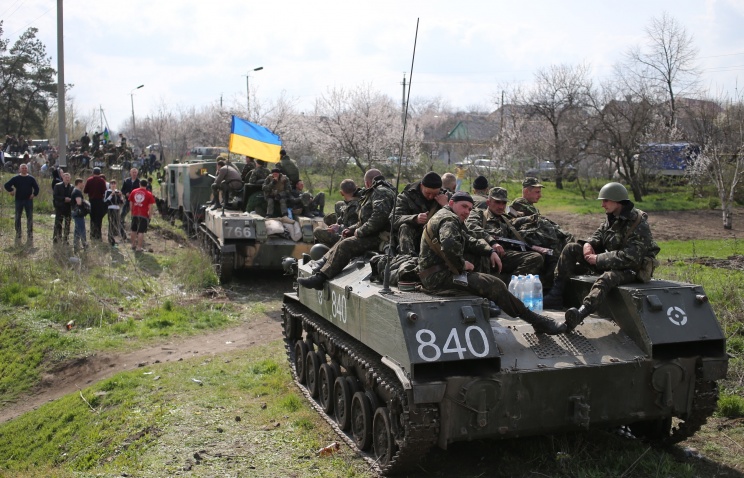
Fifty Ukrainian soldiers sent to the eastern town of Kramatorsk for military operations against pro-federalization protesters have defected to the side of the demonstrators, local self-defense activists told RIA Novosti Wednesday.
“We have seen that these people are neither separatists nor terrorists, but just ordinary people and we refuse to fight them,” one of the soldiers told RIA Novosti, as the military men took down Ukrainian flags and directed their vehicles to nearby Slaviansk.
The soldiers who switched allegiances are all from Dnepropetrovsk, and came from six crews of airborne combat vehicles, several crews of infantry combat vehicles and one armored carrier.
Some of them raised Russian flags and Air Force banners. Several of their vehicles are now stationed near the Slaviansk City Council, which has been under the control of federalization advocates for several days.
Local residents are taking pictures against the backdrop of the combat vehicles and talking freely with their crews.
Several military units in Kramatorsk still remain loyal to Kiev, including tanks. In Kramatorsk the protesters also control the city council, and have erected several roadblocks. No shooting between security forces loyal to Kiev and the opposition have been reported. Protesters still control Slaviansk, with no military loyal to Kiev present in the area.
The Ukrainian army started a special operation Tuesday to crack down on self-defense activists in eastern Ukraine. The operation targeted the cities of Kramatorsk and Slaviansk in the Donetsk region.
First Deputy Prime Minister Vitaliy Yarema said Wednesday the country’s parliament, the Verkhovna Rada, had signed off on operation.
A public university in Washington state is looking for advice on how to rid itself of white people.
According to Campus Reform,Western Washington University included a survey in its daily newsletter that read: How do we make sure that in future years “we are not as white as we are today?”
Several links offering additional information are listed below the question, including a link to a blog post from Western Washington University President Bruce Shepard, who believes the school will have “failed” if the number of white students remains constant in the years ahead.
Campus Reform included a quote from a 2012 Shepard address:
“Every year, from this stage and at this time, you have heard me say that, if in decades ahead, we are as white as we are today, we will have failed as university.”
The obsession with skin color is on full display in Shepard’s blog post.
“In the decades ahead, should we be as white as we are today, we will be relentlessly driven toward mediocrity; or, become a sad shadow of our current self,” he wrote in explaining his position.
It’s enough to make one wonder if white students walk around campus with their heads hung in shame, apologizing for bringing failure upon the school. How is it possible for a student not be judged by the color of their skin in an environment where their value is directly attributed to their skin pigmentation?
Pointing to the “rapidly decreasing” number of high school graduates the school has “traditionally drawn upon” — code for white people? — Shepard insists ”it’s not about keeping whites out.”
“It is about whether we will have the wisdom, the culture, the commitment, to be able to attract a sufficient number of students from diverse backgrounds,” he stated.
Meanwhile, the marginalization of white people to correct the marginalization of people of color continues unabated on college campuses across America. But then, isn’t that what critical race theory is all about?
Perhaps Western Washington University should just hang a sign it’s door that reads “whites need not apply.”
South Korean President Park Geun-hye apologized on Tuesday for the latest scandal to rock the intelligence service where three officials have been charged with conspiracy to fabricate evidence against a man accused of spying for North Korea.
The case is the latest in a long line of controversies marking the National Intelligence Service’s troubled history that have triggered calls for reform.
Park warned the service must mend its ways.
“Regrettably, the National Intelligence Service’s wrongful practices and a system of lax oversight were revealed and caused concern among the public, and I would like to apologize for this,” Park said at a cabinet meeting.
Park’s father, Park Chung-hee, was assassinated in 1979 by the disgruntled head of the agency’s precursor at the peak of a power struggle that involved the late president’s close aides.
The intelligence service has since undergone two name changes and numerous organizational reforms.
South Korea and the North are still technically at war after their 1950-53 civil conflict ended in a mere truce, not a peace treaty.
On Monday, prosecutors announced indictments against two agency officials after charging one in March for their suspected role in fabricating Chinese immigration documents to support the case against an individual accused of being a North Korean spy.
But prosecutors said they found no reason to believe senior agency officials, including its chief, Nam Jae-joon, were involved in the conspiracy and closed its investigation.
The political opposition accused the prosecution of allowing the agency to take care of its own.
Very soon, the IMF will cease to be the world’s only organization capable of rendering international financial assistance. The BRICS countries are setting up alternative institutions, including a currency reserve pool and a development bank.
The BRICS countries (Brazil, Russia, India, China and South Africa) have made significant progress in setting up structures that would serve as an alternative to the International Monetary Fund and the World Bank, which are dominated by the U.S. and the EU. A currency reserve pool, as a replacement for the IMF, and a BRICS development bank, as a replacement for the World Bank, will begin operating as soon as in 2015, Russian Ambassador at Large Vadim Lukov has said.
Brazil has already drafted a charter for the BRICS Development Bank, while Russia is drawing up intergovernmental agreements on setting the bank up, he added.
In addition, the BRICS countries have already agreed on the amount of authorized capital for the new institutions: $100 billion each. “Talks are under way on the distribution of the initial capital of $50 billion between the partners and on the location for the headquarters of the bank. Each of the BRICS countries has expressed a considerable interest in having the headquarters on its territory,” Lukov said.
It is expected that contributions to the currency reserve pool will be as follows: China, $41 billion; Brazil, India, and Russia, $18 billion each; and South Africa, $5 billion. The amount of the contributions reflects the size of the countries’ economies.
The discovery of large hydrocarbon deposits in the Arctic has sparked international competition over resources in frozen waters. Regional powers are quickly filing claims for the sea shelf, with Russia preparing to bring in the biggest bid to the UN.
Ahead of Moscow preparing to file a 1.2 million square kilometer Arctic waters bid to the UN later this year, President Vladimir Putin commissioned Russian ministries to get ready to take the new territories in the Sea of Okhotsk under full control and protection.
The Russian president ordered maintenance of border patrols of the extended sea shelf be in place by July 1, 2014.
Russia’s Defense Ministry has been instructed to ensure maritime authorities extend the Russian shelf in the Sea of Okhotsk beyond the generally recognized 200 nautical miles zone by December 1, 2015.
The Foreign Ministry is obliged to bring all the necessary documents, including new maps of the Sea of Okhotsk and scientific data serving as proof of Russia’s bid, to the UN by March 1, 2015.
Experts say the future of the world economy, to some extent, is dependent on the Arctic.
Last year, Russian energy giants, Gazprom and Rosneft, were granted rights to develop large hydrocarbon deposits recently discovered in the Pechora and Kara seas. The find could be a pot of gold for Russia’s gas industry.
The melting Arctic ice cap has made way for shipping routes and the exploration of resources at the bottom of the world’s smallest ocean. The North Pole icecap has decreased by 40 percent since 1979, opening up two shipping routes, the North Sea route and the Northwest Passage, with extremely high economic potential.
Approximately 30 percent of the world’s undiscovered natural gas and 15 percent of its oil lie in the Arctic. But the majority, 84 percent, of the estimated 90 billion barrels of oil and 47.3 trillion cubic meters of gas remain off shore.
According to the UN’s sea convention, any country has sovereign rights to resources within 200 nautical miles of its territorial waterways. There are five countries with territories in the Arctic: Canada, Denmark, Norway, Russia and the US.
As the icecaps are melting, a military race is also building up in the region.
The US Navy recently debuted a revised roadmap focused on expanding America’s muscle in the world’s coldest ocean over the next decade, increasing the number of personnel trained in Arctic operations, advancing technical equipment and surveillance needs.
The ultimate goal appears to be establishing international order under US leadership.
Earlier this year, NATO countries participated in a Norwegian-led Cold Response exercise in the Arctic, rehearsing high intensity operations with 16,000 troops deployed in extreme conditions. Non-NATO participants, Sweden and Switzerland, also took part.
“The United States is anxious to militarize the Arctic Ocean. It has to do it via its relations with Canada and it is also seeking to do it via NATO, through the participation of Norway and Denmark in NATO. And now it is calling upon Sweden and Finland to essentially join NATO with a view to establishing a NATO agenda in the Arctic,” Michel Chossudovsky, from the Centre for Research on Globalization in Montreal, revealed.
Meanwhile, Canada has been staging its own independent drills with hundreds of soldiers participating in cold-weather winter warfare exercises.
Not to be left out, last year Russia announced the resumption of a constant armed presence in the Arctic, which was abandoned by the military after the fall of the USSR.
Back in 2012, Russia’s former envoy to NATO and current Vice Prime Minister, Dmitry Rogozin, said that by the middle of the 21st century the fight for resources between various states will become “uncivilized.”
In about 40 years, Russia may lose its sovereignty if it fails to clearly set out its national interests in the Arctic, Rogozin said.
“It’s crucially important for us to set goals for our national interests in this region. If we don’t do that, we will lose the battle for resources which means we’ll also lose in a big battle for the right to have sovereignty and independence,” Rogozin stated at a Marine Board meeting in Moscow.
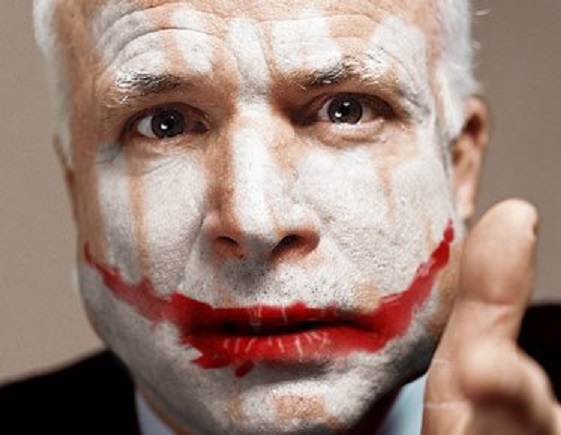
American senator, Republican John McCain, who is currently on a visit to Estonia, has urged to “provide weapons to Ukraine” speaking at a live show of one of the local TV channels.
“We should provide weapons to Ukraine so that it could defend itself,” the 77-year-old senator from Arizona said.
John McCain, the ex-presidential candidate from the Republicans on 2008 elections, believes that Russia threatens its neighbor. “Russia is provoking the West by staging actions in Ukraine’s East. Maybe, it wants to increase its influence on the South as well,” the senator suggested.
An advisor to Secretary of State John Kerry said Monday that the United States may decide to send arms to eastern Ukraine as tensions continue to worsen there between pro-Russian protesters and supporters of the country’s interim government.
Reuters reported on Monday that US State Department Counselor Thomas Shannon — a senior diplomat and member of Sec. Kerry’s inner circle — said the possibility of providing arms to Ukrainian forces is indeed currently on the table.
Oleksandr Turchynov, the acting president of Ukraine, has since asked for the UN to conduct a joint “anti-terrorist operation” in that region as activity intensifies.
Seven weeks after the right-wing coup in Ukraine, evidence is mounting that the Western-backed opposition at the time was responsible for the lethal shootings in Independence Square on February 20. This was suggested by a report on the German public television programme “Monitor” last Thursday evening, and which is available online in German.
“According to research it appears unlikely that the shots on demonstrators came exclusively from the side of the old regime,” stated a press release made available prior to the program. In its report, “Monitor” raised the question, “Did radical oppositionists end up shooting in order to produce chaos and place the blame on Yanukovitch?” The presented videos, interviews and sound recordings suggest precisely this!
“Monitor” presented an extract of radio traffic from alleged sharp-shooters of the Yanukovitch regime, who were positioned on various rooftops in the centre of Kiev on February 20. The discussion was picked up by a Ukrainian radio amateur. One of the snipers can be heard asking his colleagues, “Hey guys, they are over there, on the right of the hotel Ukrayina. Who is shooting? Our people don’t shoot at unarmed civilians.” Then he calls, “Guys, there is a sniper who is aiming at me. Who is he aiming at from the corner? Look out.” A short time later someone else says, “Someone shot him. But not us. Are there more snipers over there? And who are they?”
On other videos, activists who marched along Institutska Street on February 20, can be seen being shot not only from the front, that is, from the direction of government buildings, but also from behind. Nikola, an eyewitness who is visible on several videos, confirmed, “Yes, on the 20th [February] we were shot from behind, from the Hotel Ukrayina, from the eighth or ninth floor. People were standing up there and shooting at us and we were also shot from the other direction.”
Responding to the question as to who had shot them from the Hotel Ukrayina, he answered, “I don’t know. They were soldiers, certainly professionals.”
On the day of the shootings, the Hotel Ukrayina was firmly under the control of the opposition and was heavily guarded. Numerous witnesses, journalists and oppositionists confirmed this to “Monitor”. On the morning of February 20, the opposition even introduced entry controls. Only those with a room key or identification were allowed into the hotel. The “Monitor” reporters come to the conclusion, “Therefore it would have been very difficult for a sniper to sneak in.”
In addition, the reporters reviewed pictures from Russian television, which allegedly show armed oppositionists firing at demonstrators. “Precisely who is shooting at whom is not possible to confirm,” However, it was determined that “the recording was definitely made in the Hotel Ukrayina.” It was also confirmed that “not only oppositionists, but also the government militias were shot at. And perhaps this was also by the same people.”
A doctor, who treated victims on both sides, confirmed this in an interview. “The injured who we treated had the same type of bullet wounds. I’m speaking about the type of bullets we took out of the bodies in operations. They were identical. I can’t say any more”, he stated.
The explosive report concurs with the intercepted telephone call between Estonian foreign minister Urmas Paet and the foreign policy head of the EU, Catherine Ashton, at the beginning of March. Paet also based himself on information from doctors and stated that “the same snipers shot people on both sides.” He warned that “the conclusion that not Yanukovitch, but members of the new coalition were behind the shootings is increasingly reinforced.”
Since then, the transitional government in Kiev and its Western allies have desperately sought to cover up the true course of events. Only last week, Ukrainian general state prosecutor Oleg Machnizki of the fascist Svoboda, arrested 12 members of the now dissolved special Berkut unit and presented them as the main suspects in the shootings.
“Monitor” cites a high-ranking member of the investigative committee, who calls the version of events from the state prosecutor into doubt. “My investigation results do not agree with those presented by the state prosecutor at the press conference,” said the investigator, who wished to remain anonymous, in an interview.
A lawyer for the victims suggested that the entire investigation was a deliberate ploy by the transitional government to bury their own crimes. “None of us are getting any information on the investigation”, he complained. “And if you ask me, there is one simple reason for this: it is not being investigated properly. As a lawyer of the victims I am saying to you that the state prosecutor is not investigating properly. They are covering for their own people. They are as partisan as before.”
NATO is creating a naval battle group outside Russian borders, a Russian military source told Interfax news agency.
On April, 3, Foreign Minister Sergey Lavrov accused NATO of violating the Montreux Convention, which regulates the number ships that can enter the Black Sea, saying that “US warships have extended their deployment beyond the set terms a couple of times lately.”
According to the treaty, warships from non-Black Sea states can only stay in the basin for up to 21 days consecutively. USS Taylor spent 11 more than that in the region in February and March.
Russia’s Foreign Ministry expressed “bemusement” over the move.
“Turkey [which administers the treaty] did not inform us about the overstay. We have expressed our concern to the Turkish and US side in a verbal note,” said a statement on the ministry website.
A Russian fighter jet made multiple, close-range passes near an American warship in the Black Sea for more than 90 minutes Saturday.
Officials said the Russian Fencer made 12 passes, and flew within 1,000 yards of the USS Donald Cook, a Navy destroyer, at about 500 feet above sea level.
The U.S. warship, equipped with the powerful Aegis missile defense system and carrying helicopters, issued several radio queries using international emergency circuits. A Russian Navy ship, a frigate, has been shadowing the U.S. warship, remaining within visual distance.
U.S. military officials have said the deployment is part of an effort to “reassure” allies and partners in the region. A second U.S. Navy warship – a frigate from the Navy’s Sixth Fleet in the Mediterranean Sea – is also heading to the Black Sea.
It appears however that no official communication or protests by the U.S. to the Russians about incident have been made. It is also not clear how an American military build-up in the region could be reassuring, as it increases the likelyhood of conflict.
Paul Craig Roberts recently wrote that democracy and freedom require an independent and aggressive media, an independent and aggressive judiciary, and an independent and aggressive Congress. He said the US had none of the above.
The US media consistently lies for the government. Reuters continues to report, falsely, that Russia invaded and annexed Crimea. The Washington Post ran an obviously false story planted on the paper by the Obama regime that the massive protests in former Russian territories of Ukraine are “rent-a-mobs” instigated by the Russian government.
The CIA director has been sent to Kiev to launch a military suppression of the Russian separatists in the eastern and southern portions of Ukraine.
Washington’s plan to grab Ukraine overlooked that the Russian and Russian-speaking parts of Ukraine were not likely to go along with their insertion into the EU and NATO while submitting to the persecution of Russian speaking peoples, Roberts said.
Self-determination will not be recognized by the UN as the UN is essentially a Washington-financed organization, and will follow Washington’s orders. Roberts warned that money is more important to European politicians than humanity’s survival, and Washington pays them well.
China on Tuesday condemned Britain for interfering in its domestic affairs, in response to a human rights report, a day after the British government said Beijing had called off human rights talks. Britain listed China as “a country of concern” in its annual human rights report last week, saying it had observed increased curbs on freedom of expression, association and assembly in 2013.
It also cited reports of “the forcible suppression of ethnic unrest in Tibet and Xinjiang.”
China reacted by calling off talks with Britain on Beijing’s human rights record. Chinese and British officials had been due to hold a round of the two-way Human Rights Dialogue in London on Wednesday.
The two countries had agreed to resume the regular meetings during a trip to China by British Prime Minister David Cameron in December.
Chinese Foreign Ministry spokeswoman Hua Chunying accused Britain of issuing the report with “irresponsible remarks made about the Chinese political system, rudely slandering and criticizing China’s human rights situation”.
Britain must immediately stop using human rights as a pretext for interfering in China’s internal politics and judicial sovereignty, Hua told a daily news briefing. “Britain’s path on this issue is not helpful to dialogue and discussion on the subject of human rights, and not good for the stable development of the health of China-UK relations,” Hua added.
Cameron’s visit was aimed at spurring closer trade and business links between Britain and the world’s second biggest economy and at drawing a line under a dispute involving Tibet’s spiritual leader that had led to a diplomatic freeze.
But Britain’s Foreign Office said Beijing had pulled out of the first round of the talks, the resumption of which Cameron had hailed at the time as a significant achievement. “We are disappointed that the Chinese government last week unilaterally postponed the dialogue, which was due to take place on 16 April,” a Foreign Office spokeswoman said in a statement. “It is not for us to say why it was postponed. We are now in discussion to agree new dates,” she said.
A spokeswoman at the Chinese embassy in London said she was unaware the talks had been cancelled.
Much like the US Supreme Court, upon which Germany’s highest court was partially modeled after World War II, the German Federal Constitutional Court is the final interpreter of constitutional law. Accordingly, it has the last word on the legality of any treaties, agreements or actions undertaken by Germany at the European level.
The court already has challenged German involvement in some of the more creative legal acrobatics undertaken by the European Union. These include the establishment of the EU emergency bond-buying plan known as the Outright Monetary Transactions program. In that case, the German Federal Constitutional Court proceeded with caution and referred the case to the European Court of Justice. But there are strong indications that it could be more aggressive in future cases. A rejection of government moves in a landmark case, such as one involving potential German participation in a strengthened quantitative easing program, could derail the American project for Europe.
Economic policy is not the only issue on which the court has proven to be a thorn in German Chancellor Angela Merkel’s side. German electoral law currently requires a party to win a minimum of 5 percent of the national vote to enter the national parliament, a measure designed to keep small radical parties out of an already relatively fragmented parliament. Berlin used to apply a similar threshold to German parties seeking access to the European Parliament. The German constitutional court recently struck down this requirement, and some politicians fear it could soon do the same for German federal elections. The current surge in popularity of nationalist parties heretofore excluded from the legislature may jeopardize the existence of a pro-American government in Berlin, the only real decision-making body to take NATO forward.
The court’s current course of action poses an existential threat to Merkel’s political career and to Germany’s political affiliation. Should the court so rule, Germany could rapidly lose its place as the Continent’s strongman, being condemned instead to internal paralysis as it watches Europe slowly turn east.
As with most of the really important developments in Europe, the battle between the court and the German government will be drawn out and will remain out of the public eye for now. Still, the very existence of open discussions about reducing the power of one of the most trusted and impartial institutions in Germany testifies to how seriously the chancellor’s office takes the danger of the fallout from the court’s potential ruling.
The European Parliament approved Tuesday the last elements of a new regulatory system meant to prevent failing banks from ever again driving EU member states into bankruptcy.
With banking union draft passed by a very large majority, “we now have in place a true European system to supervise the eurozone banks and deal with any future failures,” EU Financial Markets Commissioner Michel Barnier said.
A white man has been sentenced to “death” of a different kind for calling Metro FM communications manager Happy Ngidi a baboon and a kaffir.
On Friday the Roodepoort Magistrate’s Court sentenced Simon Phillips, 39, to a two-year prison term, suspended for five years on condition that he works at the mortuary section of the Chris Hani-Baragwanath Hospital for a total of 720 hours.
The sentence is equal to 18 working weeks at 40 hours a week
This was after the same court found Phillips guilty of crimen injuria last month. Phillips was granted R10 000 bail.
Ngidi was leaving Virgin Active’s parking lot in Constantia Kloof, north west of Johannesburg, last year in July, for home when it happened.
She was reversing out of a parking area and noticed a white VW Polo belonging to Phillips approaching her. She said that, being a careful driver, she took her time reversing out.
This irked Phillips, who called her a baboon and a kaffir.
The court, in sentencing Phillips, said that crimen injuria – intentionally and unlawfully impairing the dignity or privacy of another – was a sub-species of assault.
At the mortuary section, Phillips will receive and attend to visitors to the mortuary, clean and clothe the corpses and prepare the bodies for collection.
Any breach will result in Phillips being jailed for two years.
The court considered a number of sentencing options, such as a jail time and a fine, but decided against a prison sentence because of the effect this would have on his two-year-old child.
The court believed Phillips could still be rehabilitated.
It heard from Phillips’s father, George, that he worked for three days a week.
The court indicated that Ngidi may pursue a civil claim if interested.
On Friday, Ngidi was ecstatic about the sentencing.
The Malaysian Defence Ministry plans to announce soon a tender for delivery of multipurpose fighters, Russia will participate in it with upgraded fighter Su-30MKM, Nikolay Dimidyuk, the director for special commissions of company Rosoboronexport, the only Russian state-run mediator for export and import of the whole scope of military and dual-purpose end products, technologies and services, said in an exclusive interview with ITAR-TASS.
“The Malaysian Defence Ministry plans to announce a tender for delivery of 1-2 squadrons of multipurpose fighters. We will participate in it with upgraded fighter Su-30MKM,” Dimidyuk said, noting that a final form of the fighter plane would be made after an official request was received and technical tender requirements were surveyed.
“We believe that we will have high chances in this tender taking into account successful operation of fighters Su-30MKM and fighters MIG-29N delivered under the 2003 contract. A well-known Malaysian aerobatic team Smokey Bandits that is a landmark of the country’s Air Force steers MIG-29N,” the source said.
This website uses cookies to improve your experience. We'll assume you're ok with this, but you can opt-out if you wish. Cookie settingsACCEPT
Privacy & Cookies Policy
Privacy Overview
This website uses cookies to improve your experience while you navigate through the website. Out of these cookies, the cookies that are categorized as necessary are stored on your browser as they are essential for the working of basic functionalities of the website. We also use third-party cookies that help us analyze and understand how you use this website. These cookies will be stored in your browser only with your consent. You also have the option to opt-out of these cookies. But opting out of some of these cookies may have an effect on your browsing experience.
Necessary cookies are absolutely essential for the website to function properly. This category only includes cookies that ensures basic functionalities and security features of the website. These cookies do not store any personal information.
Any cookies that may not be particularly necessary for the website to function and is used specifically to collect user personal data via analytics, ads, other embedded contents are termed as non-necessary cookies. It is mandatory to procure user consent prior to running these cookies on your website.


 Opponents of Scottish independence speak of pensions being lost in the potential separation from the UK. It comes after a recent poll showed that the gap between Yes and No votes is narrowing, with unionists losing ground.