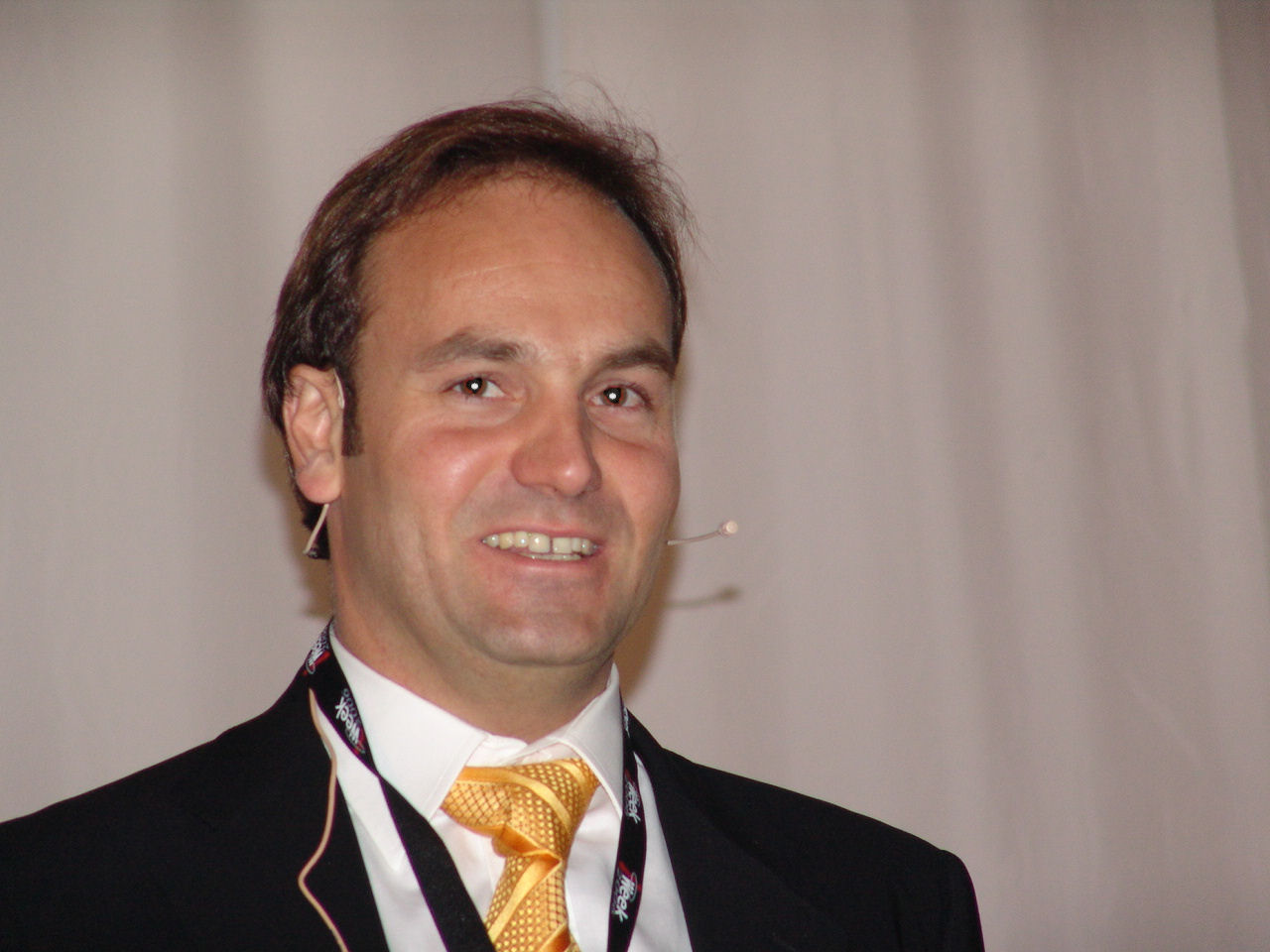
Sen. Tim Kaine, a Virginia Democrat, delivered a speech on the Senate floor in Spanish on Tuesday as he made his push for the chamber to pass his immigration bill.
Mr. Kaine said he would deliver his remarks in Spanish but said he would put an English translation into the Congressional Record.
The move highlighted the growing power of Spanish-language speakers in the U.S. Mr. Kaine, whose Spanish is outstanding after spending time as a Catholic missionary in Honduras, has used the language in his outreach to Hispanic voters.
Speaking Spanish in floor speeches is rare, but not unprecedented.
To use another language on the floor requires unanimous consent of the other senators, which Mr. Kaine sought and was granted. – Washington Times
A virtually impenetrable ring of security surrounds the Pretoria hospital at which former president Nelson Mandela remains in “a serious but stable condition”.
Armed police are closely inspecting every vehicle and everyone who enters the Mediclinic Heart Hospital in Arcadia. Mandela – who spent a fourth day in the intensive care unit yesterday – continues to battle a recurring lung infection.
On Monday, a security guard allegedly attacked Pretoria News photographer Phill Magakoe when he took snaps of Mandela’s former wife Winnie Madikizela-Mandela and her daughter Zindzi leaving the hospital.
Yesterday, 20 policemen manned the hospital’s entrances to keep the media at bay.
Inside the hospital The Times found plain-clothes policemen keeping a close watch on those entering and leaving.
The Times learned from patients, visitors, doctors, nurses and medical staff of the rapidly intensifying security measures.
Stairwells are being guarded, lifts are being monitored and the exact condition of Mandela is being kept under wraps.
Staff at the Wiesenhof coffee shop in the hospital said that everyone was being watched.
“It’s over the top. Everywhere you go you see police and security.
“Some of them are in civilian clothes, others in uniform.
“I tried to use the steps because the lift was full but was stopped and questioned.”
While The Times team sat in the coffee shop, a plain-clothes policeman entered and questioned several visitors drinking coffee about their business at the hospital.
“If you have no business here, you should leave,” said an officer, who refused to identify himself.
When told that several coffee shop patrons were waiting to visit patients, the officer took notes and left.
A doctor’s assistant revealed that even the movements of medical staff were restricted.
“It’s crazy. From yesterday [Monday] no one can come in or out without being stopped and searched.
“There are certain floors to which access, even for medical staff, has been limited.
“Though restrictions are understandable, they have become extreme,” she said.
A doctor said everyone was being searched.
“It is so bad our patients are staying away. Every time Mandela is admitted, the security situation becomes worse.
“The whole world knows he is here. In the past, people thought he was taken to 1 Military Hospital but he has never been there.
“Every time he was admitted to hospital it was here, with a specialist team [from] the military assisting him,” she said.
Presidential spokesman Mac Maharaj yesterday said President Jacob Zuma had faith in Mandela’s medical team.
“Zuma met the medical team. They gave him a thorough briefing,” Maharaj said.
“He has full confidence in them, and is satisfied that they are doing their best.” – timeslive.co.za
Billionaire entrepreneur Mark Shuttleworth’s bid to have South Africa’s exchange control system declared unconstitutional could have a devastating effect on the country, the SA Reserve Bank (SARB) said on Tuesday.
Jeremy Gauntlett SC, for the SARB, argued that the order sought by Shuttleworth in the High Court in Pretoria was “the most radical court order imaginable”.
“He quite deliberately decided to attack the heart of the scheme and seeks to bring down the pillars of the temple,” said Gauntlett.
“If the applicant succeeds in striking down Section Nine of the Currency Act and declaring all orders and rules unconstitutional, there would be no inhibition on removing capital from this country at all.
“Section Nine is the heart of the exchange control system and he wants to knock [it] down.”
Gauntlett said Shuttleworth claimed it was in the interest of all South Africans to destroy the entirety of the exchange control system in the country.
“He couldn’t get his money out of the country. Now he wants to pull the whole system down. Why should this financial refugee, living on the Isle of Man, speak on behalf of the entirety of South African society?”
Apart from his constitutional challenge to the exchange control system, Shuttleworth wants the court to set aside the levy of more than R250 million he had to pay to get some of his assets out of the country in 2009, and to order the SARB to return the money.
He further seeks an order declaring that the SARB’s so-called “closed door policy” of insisting that members of the public communicate with it through the intermediation of authorised banks is unconstitutional and invalid.
Shuttleworth has blamed the existing system of exchange control in South Africa for “forcing” him to emigrate in 2001.
He had assets worth over R4.27 billion in South Africa when he emigrated, but he transferred the assets out of the country in 2008 and 2009, each time subject to the payment of a 10 percent “exit charge”.
The government abandoned the levy a year after Shuttleworth moved the remainder of his assets out of the country.
Gauntlett argued that Shuttleworth’s application on the levy should be dismissed because he had attacked the wrong decision-maker, as the SARB was only carrying out a decision announced by the finance minister during a speech in Parliament in 2003.
He said the minister’s decision was authorised by statute, and the primary reason for the levy was to dissuade capital flight out of the country and not to raise revenue.
He said the context was that foreign exchange reserves were vulnerable, and that few countries were able to look at a flight of capital comfortably. If a crisis developed overnight there would be the need for swift action.
“There are sophisticated economic forces at work, and there’s a need for fast action for the purpose of protecting the currency. There’s nothing wrong with such a legislative scheme.”
If you have to engage the public before you make a regulation, all regulations in the country could be struck, Gauntlett said.
“When you control foreign exchange, you cannot conceivably say: ‘Let’s put up a billboard somewhere and consult the public.’ You cannot do things that day because people will take their money and go.”
He said these were the realities of how legislatures worked.
“This argument is nonsense on stilts. It was decided it [the 10 percent exit levy] was no longer needed, but that may change,” Gauntlett said.
Buffalo City mayor Zukiswa Ncitha spent almost R800,000 of ratepayers’ money on domestic travel for events, most of which did not appear on her official diary, Dispatch Online reported on Wednesday.
The money was reportedly spent on luxury vehicles and hotel accommodation around the country.
Documents which the Dispatch said it had obtained showed that some of Ncitha’s trips, including one which cost more than R12,000, were made while she was in meetings at her East London City Hall offices.
The trips were billed under difference references — mayor Zukiswa Ncitha, Z Ncitha, M Ncitha, and Z Ncitha mayor.
Her son, Zukile, who carries the same initials as her, also works for the Buffalo City metro, according to the report.
Contacted for comment by the Dispatch, Ncitha dismissed any suggestion that her son or any of her family might have used her mayoral travel budget. – Sapa
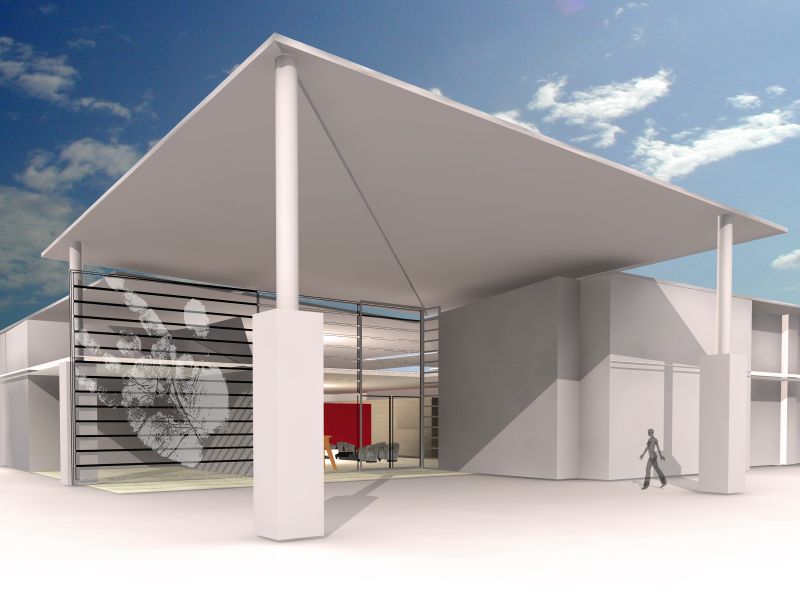
Artist's impression of the Nelson Mandela Centre of Memory
By Christopher Torchia, Associated Press
The desk is spotless and books neatly line the shelves in Nelson Mandela’s office at a Johannesburg-based foundation that carries his name, but the former South African president and anti-apartheid leader hasn’t worked there for years.
The meticulously preserved room is one of many tributes to the legacy of a former prisoner who became so revered for his efforts to reconcile a racially divided nation that many South Africans cannot bring themselves to speak openly about the possibility of his death. That reluctance is gradually eroding as the 94-year-old receives treatment for a recurring lung infection, spending a fourth day in a Pretoria hospital on Tuesday.
President Jacob Zuma called Mandela’s condition “very serious” but said he has stabilized, in an interview with state broadcaster SABC.
Prayers are pouring in for Mandela, adding to a mood of urgency about his deteriorating health that has been compounded by a series of hospital stays in recent months. The description of Mandela as “ravaged by time,” in a statement from a foundation led by retired archbishop Desmond Tutu and his wife, speaks to the fragile state of a man who is so mighty in stature.
Concerns about his health already had been heightened in recent weeks after a video broadcast on state television in April showed him silent and unresponsive, even when Zuma tried to hold his hand.
“He was a very fruitful fighter, but he’s only human,” said Thabiso Masemola, a 21-year-old student. “He’s reached a point in life where he needs to rest. Let him go, let him be. He’s finished his purpose in life.”
Such a view is gaining currency as South Africans become uneasy with the protracted decline of Mandela, who endured 27 years in prison during white minority rule and became the first black president in all-race elections in 1994. At the other end of the spectrum is a stubborn hope that this larger-than-life figure will somehow defy the inevitable.
The aversion to blunt talk of Mandela’s eventual demise stems partly from traditional respect for the living, but also from adulation in a country that put Mandela’s image on its banknotes and erected busts and statues in his likeness. The intensity of emotion among some South Africans is an indicator of the outpouring of feeling that will accompany Mandela’s passing, whenever it comes.
Mzinkosi Tantsi, a driver for a neighbor of Mandela in the Johannesburg neighborhood of Houghton, said it had been a “blessing” to shake the former president’s hand.
“I see him as my father,” said 12-year-old Kutlwano Hlabana, whose school group was visiting the Apartheid Museum, which documents the repressive system of racial segregation and the fight against it. The Johannesburg site invites visitors to experience a taste of apartheid’s arbitrariness by choosing between two entrances labeled “Whites” and “Non-Whites.”
For Johannesburg resident Mokgadi Mabuti, Mandela’s sacrifice and contribution to reconciliation amount to a psychological balm. She struggles with the idea of his departure even though South Africa, for all its inequality and other social problems, is relatively stable.
“I’m worried about what might happen when he’s dead. Most of the things that have happened in South Africa are because of him, so I’m not ready to let him go,” she said.
Mabuti would rather skirt the subject of Mandela’s eventual end, quoting a biblical passage about the impact of words.
“The tongue is very powerful. What you say with your tongue can speak into the future,” she said. “So it’s not good that they should speak of him as if he doesn’t exist anymore.”
Cashing in is on the minds of some in Qunu, the rural village in the Eastern Cape province where Mandela grew up. The Sowetan newspaper reported that a number of people were preparing to rent rooms in their homes on the assumption that there would be a big influx of visitors if he dies.
After his retirement from the presidency, Mandela regularly worked from an office in the recently refurbished building that houses the Nelson Mandela Centre of Memory, which promotes the former leader’s values.
The office, which is open by appointment, resembles the kind of hallowed memorial usually reserved for those no longer among the living.
There are framed photographs of Mandela in healthier times with his wife, Graca Machel, former U.N. chief Kofi Annan, fellow activist Walter Sisulu, who died a decade ago, and others. His volumes include the Quran, “A Briefer History of Time” by Stephen Hawking and a book about leadership. A boxing glove, cricket bat and a British police helmet are among the gifts on display.
Glass cases at the center show penned messages in books given to Mandela from people including Nadine Gordimer, a South African author and winner of the Nobel literature prize in 1991. She wrote that the anti-apartheid leader had read a smuggled copy of her then-banned novel, “Burger’s Daughter,” while held at the Robben Island prison.
“You most likely didn’t bring the book back with you when you returned to us, and lived magnificently, untiringly, leading the Struggle, so I thought I’d like to replace the ‘imprisoned’ copy,” Gordimer wrote.
Cornel West, an American civil rights activist, addressed his book, “Democracy Matters,” to: “Bro’ Nelson Mandela.”
In his autobiography, “Long Walk to Freedom,” Mandela summarized a life of struggle:
“I have walked that long road to freedom. I have tried not to falter; I have made missteps along the way. But I have discovered the secret that after climbing a great hill, one only finds that there are many more hills to climb.”
Now he is climbing the last hill.
—
Associated Press writer Wandoo Makurdi contributed to this report from Johannesburg.
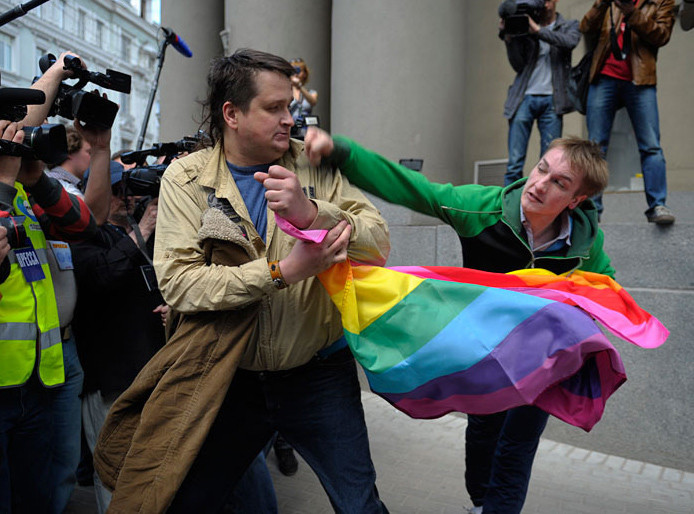
More than two dozen activists were detained in Moscow on Tuesday as they were protesting a bill that stigmatizes the gay community and bans the giving of information about homosexuality to children.
The protesters attempted to rally outside the Russian State Duma before what is expected to be a final vote on the bill banning “propaganda of nontraditional sexual relations.”
Police moved in after supporters of the bill started showering the protesters with eggs and water. Some of the protesters who were not detained were viciously attacked by masked men on a central street a mile away.
The Kremlin-backed legislation imposes hefty fines for providing information about the lesbian, gay, bisexual and transgender community to minors or holding gay pride rallies.
Russia is also considering banning citizens of countries that allow same-sex marriage from adopting Russian children.
Lawmakers changed the wording of “homosexual propaganda” to “propaganda of nontraditional sexual relations,” which backers of the bill define as “relations which are not conducive to procreation.”
Breaching the law carries a fine of up to 5,000 rubles ($156) for an individual and up to 1 million rubles ($31,000) for media.
Earlier Tuesday a dozen anti-gay activists picketed the Duma. One of them held a poster that read: “Lawmakers, protect the people from perverts!”
The bill has been seen as Putin’s attempt to consolidate his support base which includes many conservative Russian Orthodox voters.
Russian and foreign rights activists have decried the bill as violating basic rights. Human Rights Watch on Monday said the bill would “infringe Russian citizens’ freedom of expression and information, and discriminate against Russia’s LGBT community.”
Russian officials have rejected criticism. Foreign Minister Sergey Lavrov defended the bill in February, saying that Russia does not have any international or European commitment to “allow propaganda of homosexuality.”
Russia decriminalized homosexuality in 1993 but anti-gay sentiment is still high. – AP
South Africa President Jacob Zuma appeared on state television Tuesday to reassure an uneasy nation that Nelson Mandela, although in a serious condition, is receiving the best of care.
In a brief recorded interview Zuma reiterated that the anti-apartheid icon and father of modern South Africa was in a stable condition.
“We are all feeling it, that our president, the real father of democracy in South Africa is in the hospital,” Zuma, looking relaxed and clad in a sweater, told the South African Broadcasting Corporation.
Mandela was rushed to hospital in the early hours of Saturday, to receive treatment for a lung infection.
“Yesterday I met the team of doctors who are treating him. They gave me a very thorough briefing and really I was very confident that they know what they are doing and they’re doing a very good job,” Zuma said.
“Whilst it is very serious but he’s stabilised and we are all praying for him really to recuperate quickly.”
Although Mandela was only president for one five-year term, he bestrides South African politics.
In prison for 27 years for his beliefs, he became the undisputed face of the anti-apartheid movement.
“We need him to be with us and I’m sure that all the messages that have been pouring in to wish him a quick, speedy recovery, they are highly welcome,” Zuma said.
“But that also indicates the love of our people to him and we certainly join everyone to say he should recover quickly.”
“And I’m sure, knowing him as I do, he’s a good fighter and he’ll be with us very soon.”
Mandela’s latest hospitalisation, the fourth in seven months, has been met with a sense of resignation among many South Africans, who have come to terms with their icon’s mortality. – Sapa
The throng outside the Medi-clinic Heart Hospital in Pretoria
Pedestrians passing the Pretoria hospital where ailing former president Nelson Mandela is apparently being treated, were curious about his health on Tuesday.
This was heightened by the presence of 10 police officers at the private hospital’s entrance, parameter fences, a police tape cordon, and media camping across the street.
“I do not want to just go home without knowing what is happening to Madiba. He is in our neighbourhood and even though he is unwell, I am excited to an extent,” said university student Aymee Zwane.
She stood next to local and international photographers whose lenses were focused on the hospital’s main entrance.
“I wish I knew more about his condition, but from what I’ve heard so far, Tata is unwell. My family prays for him every time. He will be fine,” she said.
Another passer-by, Simon Moereng, 57, said he felt helpless at not being able to do anything to assist Mandela.
“Here is a man who did a lot for millions of us. He is lying in hospital, sick and there is nothing we can do for him. That depresses me a lot,” he said.
“We are poor people, we don’t have much, but only our well wishes. Mandela should live long in our democracy. He is missed in our nation’s day to day running.”
Some passengers in passing taxis used their cellphones to photograph the journalists and the hospital.
Mandela’s ex-wife, ANC MP Winnie Madikizela-Mandela was seen leaving the hospital before 6pm.
She and her daughter Zindzi were driven off in a black Audi, escorted by a white Mercedes-Benz. Both cars had flashing, blue, police lights.
Earlier, the other two of Mandela’s three surviving children arrived at the hospital in separate cars.
Makaziwe Mandela’s red Range Rover was followed by that of Zenani Mandela, South Africa’s ambassador to Argentina.
Tuesday was Mandela’s fourth day in hospital.
The presidency said the doctors treating him ad given President Jacob Zuma a thorough briefing on Monday night.
“President Zuma has full confidence in the medical team, and is satisfied that they are doing their best to make Madiba better,” spokesman Mac Maharaj said in a statement.
Mandela was still in a “serious but stable” condition.
Maharaj dismissed media reports that Zuma would visit Mandela on Tuesday.
“That is incorrect. The president is in Cape Town preparing for the budget vote of the presidency,” he said.
On Saturday, the presidency announced that Mandela had been admitted to hospital in the early hours of the morning.
On Monday, the presidency said his condition was unchanged, and that he was receiving intensive care.
Security at the hospital, in Arcadia, was tightened, with police officers manning its two entrances.
Brigadier Phuti Setati said the police at the hospital were part of the presidential protection services team, whose task included protecting former presidents.
He did not specifically confirm that Mandela was in the hospital.
Local and international media have camped outside the facility, and at Mandela’s Houghton, Johannesburg, home since Saturday.
This is the third time the Nobel Peace Prize laureate has been hospitalised this year.
At the end of March and in April, he spent nine days in hospital receiving treatment for recurring lung problems.
Earlier in March, he was admitted to a Pretoria hospital for a scheduled check-up and was discharged the following day.
An embattled UN rights expert who probes Israel’s conduct towards Palestinians on Tuesday rejected calls to step down, saying his opponents were trying to silence his criticism of the Jewish state by labelling him anti-Semitic.
“I don’t intend to resign, and there doesn’t seem to be any formal initiative that is seeking my dismissal,” Richard Falk told reporters, a day after calling for an international investigation of Israel’s treatment of Palestinian prisoners.
Falk, an 82-year-old American who is an emeritus law professor at Princeton University, has been the UN Human Rights Council’s monitor for the Palestinian territories since 2008.
He rejected claims of anti-Semitism, saying they were “hurtful” and “completely malicious”, given that he is Jewish himself.
“It makes it appear as if criticising Israel is tantamount to what everybody agrees to be objectionable, which is anti-Semitism. I’m not willing to be intimidated in this way,” he said.
“The attack on the messenger is a way of diverting attention from the message.”
Falk has repeatedly locked horns with Israel, the United States, Canada and some human rights groups for positions including labelling Israel’s 2008 offensive against Gaza a war crime and urging a boycott of companies helping Israel’s settlement drive in the Palestinian territories.
Washington has said he should quit his UN role, which like other rights monitors at the world body he holds on an unpaid, voluntary basis.
Falk has also come under fire for alleged anti-Israel bias from UN Watch, a lobby group affiliated with the American Jewish Committee.
In April, Canada asked the rights council for Falk’s departure after UN Watch highlighted comments he had made that could be interpreted as linking the Boston marathon bombing to Washington’s support of Israel.
Falk said his remarks were “spun” by opponents, that he had condemned the Boston attack as “terrorist criminality”, and that his goal was to examine the roots of antipathy towards US policies.
“I’ve criticised the US frequently, and I don’t feel I’m anti-American,” he said.
“Why do I keep getting into trouble? It’s because of my role in trying to speak honestly about the situation that Palestinians are facing under this condition of prolonged occupation,” he added.
Nelson Mandela’s ex-wife, ANC MP Winnie Madikizela-Mandela arrived on Tuesday at the Pretoria hospital where the ailing elder statesman is believed to be receiving treatment.
She and her daughter Zindzi arrived after 3pm in a black Audi, escorted by a white Mercedes-Benz. Photographers tried to take photos of them through the car’s tinted windows.
Earlier, the other two of Mandela’s three surviving children arrived at the hospital in separate cars.
Makaziwe Mandela’s red Range Rover drove past numerous police officers at the hospital’s entrance. Her car was followed by that of Zenani Mandela, South Africa’s ambassador to Argentina.
This was Mandela’s fourth day in hospital.
The presidency said on Tuesday that the doctors treating Mandela had given President Jacob Zuma a thorough briefing on Monday night.
“President Zuma has full confidence in the medical team, and is satisfied that they are doing their best to make Madiba better,” spokesman Mac Maharaj said in a statement.
Mandela was still in a “serious but stable” condition.
Maharaj dismissed media reports that Zuma would visit Mandela on Tuesday.
“That is incorrect. The president is in Cape Town preparing for the budget vote of the presidency,” he said.
On Saturday, the presidency announced that Mandela had been admitted to hospital in the early hours of the morning.
On Monday, the presidency said his condition was unchanged, and that he was receiving intensive care.
Security at the hospital, in Arcadia, was tightened, with police officers manning its two entrances.
Brigadier Phuti Setati earlier said the police at the hospital were part of the presidential protection services team, whose task included protecting former presidents.
He did not specifically confirm that Mandela was in the hospital.
Local and international media have camped outside the facility, and at Mandela’s Houghton, Johannesburg, home since Saturday.
People continued leaving messages of support outside his home on Tuesday.
A couple wearing T-shirts bearing the words “We love you Papa Mandela” and “We love you Papa Madiba” placed a teddy bear in a similar T-shirt at one of the sunken pot plants, where others had left messages of support on stones.
A boy in school uniform hopped out of a car opposite the house’s gate to leave a large red envelope filled with letters, wishing Madiba the best, from a Grade Five class at the King Edward VII Preparatory School.
On Tuesday morning, a group of children from the Rainbow Hill Christian School in Orange Grove arrived at the house and sang “Get well Tata Mandela, get well”.
This is the third time this year the Nobel Peace Prize laureate has been hospitalised.
At the end of March and in April, he spent nine days in hospital receiving treatment for recurring lung problems.
Earlier in March, he was admitted to a Pretoria hospital for a scheduled check-up and was discharged the following day. – Sapa
National police confirmed on Tuesday that ailing former president Nelson Mandela was being treated at the Medi-Clinic Heart Hospital in Pretoria.
This was the first official confirmation that he was being treated there, following rumours and visits by his family members to the hospital in the past few days.
Security at the facility had been tightened, with police officers manning the two entrances.
“President Mandela is a former president so it’s our duty as police to ensure safety around dignitaries and former presidents,” Brigadier Phuti Setati said, confirming that police stationed at the hospital were part of the presidential protection services team.
Mandela was admitted to hospital in the early hours of Saturday morning in a “serious but stable” condition, the presidency said.
The number of news crews camping outside the hospital continued to swell on Tuesday. By 11am, there were 13 outside broadcast vehicles along the street near the hospital’s main entrance. Hundreds of media personnel, including logistical and technical staff, milled outside the main entrance.
Some of the media crews had generators and had erected tents at the second entrance, adjacent to a busy street leading to the Pretoria CBD.
Local and international journalists were also camped outside Mandela’s Houghton, Johannesburg, home.
A group of school children from the Rainbow Hill Christian School in Orange Grove arrived at the house on Tuesday morning and sang “Get well Tata Mandela, get well”.
After they finished, one boy stepped out of the group and read from a card, thanking Mandela for what he had done for South Africa, wishing him the best, and saying he was loved.
On Monday, the presidency said Mandela’s condition was “unchanged” from Saturday.
“President Jacob Zuma reiterates his call for South Africa to pray for Madiba and the family during this time.”
Presidency spokesman Mac Maharaj said Mandela was receiving intensive care. All vehicles entering the facility were being checked and searched.
Barricades were erected at the spot where journalists had been camping on Monday, forcing the press to move across the street. Police tape was used to cordon off the area.
This was the third time this year the Nobel Peace Prize laureate had been in hospital. At the end of March and in April this year he spent nine days in hospital receiving treatment for recurring lung problems.
Earlier in March, he was admitted to a Pretoria hospital for a scheduled check-up and discharged the following day. – Sapa
Kentucky Senator Rand Paul took to Fox News Sunday to declare his legal opposition to the NSA’s surveillance programs. “I’m going to be seeing if I can challenge this at the Supreme Court level,” Paul said.
“I’m going to be asking all the internet providers and all of the phone companies: ask your customers to join me in a class action lawsuit,” Paul told host Chris Wallace. “If we get ten million Americans saying we don’t want our phone records looked at, then maybe someone will wake up and something will change in Washington.”
Like many lawmakers, Paul drew a distinction between targeted surveillance and the blanket surveillance revealed this week.
“They are looking at a billion phone calls a day,” Paul said. “That doesn’t sound to me like a modest invasion of primary, it sounds like an extraordinary invasion of privacy.”
“I have no problem if you have probable cause, you target people who are terrorists, and you go after them,” Paul continued. “But we’re talking about trolling through billions of phone records…That is unconstitutional.”
Paul also said he would introduce the Fourth Amendment Restoriation Act, though he offered few details about the still-hypothetical legislation.
“If you talk to young people who use computers every day, they’re absolutely with me,” Paul said. “What I spend on my Visa each month, that’s my business, where I spend it, and whether I read conservative magazines, whether I subscribe to Fox News, or whether I subscribe to Yahoo or Google—what I do with my private life is my private life. If you suspect me of a crime, have probable cause.”
“So much of our life now is digitalized, that we have to protect it from a snooping government,” Paul said. “We’ve now got a government that appears to target people based on their political beliefs. I don’t want my phone records being given to an administration I can’t trust.”
Paul remembered that the public outrage against SOPA and PIPA legislation last year were somewhat successful in pushing back the laws, and predicted that if people reacted with similar severity to the current surveillance measures, they would be successful in repealing them. – MediaITE
Germany appears to be the most snooped on EU country by the US, the map of secret surveillance activities by the National Security Agency shows. ‘Boundless Informant’ is among the data disclosed by former CIA contractor and NSA consultant Edward Snowden.
The color-coded map of secret surveillance activities by the NSA ranks countries according to how much surveillance they are currently undergoing – green for the least and red for the most watched.
While all EU member states boast variant shades of green, Germany stands out color-coded orange.
The source behind the revelation of the top-secret NSA surveillance program, already referred to as one of the most significant intelligence leaks in US history, was uncovered late last week. 29-year-old Snowden asked The Guardian to reveal his identity, having fled to Hong Kong to escape retaliation by the US authorities.
“The NSA has built an infrastructure that allows it to intercept almost everything. With this capability, the vast majority of human communications are automatically ingested without targeting,” he told The Guardian.
“I, sitting at my desk, certainly had the authority to wire-tap anyone … even if you are not doing anything wrong, you are being watched and recorded,” he added.
The Boundless Informant documents show NSA collecting up to 3 billion pieces of intelligence from US computer networks over a 30-day period ending in March 2013, according to The Guardian. The tool reportedly allows users to select a country on a map, view the metadata volume and select details about the collections against this or that state.
Germany’s Interior Ministry had already been in contact with US officials to find out whether there had been any infringement of German citizens’ privacy lately. Chancellor Angela Merkel is due to raise the issue of the NSA’s eavesdropping on Germany with President Barack Obama, who said the monitoring program is a means of defense against terrorism.
Iran is on top of the surveillance list, with more than 14 billion data reports in March, while Pakistan came in a close second at 13.5 billion reports. Jordan, a close US ally, as well as Egypt and India are also near the top, according to the data.
Senior European Union officials are also expected to discuss the impact of NSA’s programs on the privacy of EU citizens during a trans-Atlantic ministerial meeting in Dublin on Thursday.
“This case shows that a clear legal framework for the protection of personal data is not a luxury or constraint, but a fundamental right,” European Commissioner for Justice Viviane Reding said.
The European Parliament said it is always firm on data protection within the EU, as well as when negotiating with third countries, including the US.
“It would be unacceptable and would need swift action from the EU if indeed the US National Security Agency were processing European data without permission,” Guy Verhofstadt of the parliament’s liberal bloc said.
NSA’s tradition to survey international communities reportedly goes back to the Cold War era, when the agency used monitoring sites in Germany, Britain and other countries to spy on communications within the Soviet Union and its East European allies.
UK Foreign Secretary William Hague has meanwhile cancelled his trip to Washington to speak about The Guardian’s latest NSA report.
He assured parliament that accusations that the UK government allegedly used information provided by the Americans to circumvent laws were “baseless.”
“Our agencies practice and uphold UK law at all times,” he stated, “even when dealing with information from outside the UK.”
In an interview with the British newspaper, successful NSA consultant Snowden leaked top-secret documents that revealed the existence of the US National Security Agency’s extensive internet spying program PRISM, which records digital communications and allows for real-time online surveillance of US citizens. PRISM gives US intelligence agencies direct access to files stored on the servers of major internet companies, including Google and Facebook, to identify and target potential terror suspects. – RT
The scene outside former president Nelson Mandela’s Johannesburg home was quiet on Tuesday morning, as the ailing icon entered his fourth day in a Pretoria hospital.
Several journalists milled around on the street corner opposite the Houghton house drinking coffee and talking among themselves, with portable broadcasting equipment and cameras nearby.
Johannesburg metro police officers, with two cars posted up the street, told journalists to park on the outside lawns of nearby houses instead of on the road.
Curious members of the public slowed down to survey the scene as they drove past.
Local and international media also continued to camp outside the Pretoria hospital where Mandela was believed to have been admitted.
Security at the facility had been tightened as police officers were called in to man the two entrances.
The main entrance to the hospital in Arcadia was guarded by several police officers.
All vehicles entering the facility were checked and searched.
Barricades were erected at the spot where journalists had been camping on Monday forcing the press to move across the street.
Police tape was used to cordon off the area.
Mandela was admitted to hospital in the early hours of Saturday morning.
The presidency at the time said he was in a “serious but stable” condition.
On Monday, the presidency said Mandela’s condition was “unchanged”.
“President Jacob Zuma reiterates his call for South Africa to pray for Madiba and the family during this time.”
Presidency spokesman Mac Maharaj said Mandela was receiving intensive care.
African National Congress MP and Mandela’s ex-wife Winnie Madikizela-Mandela had been at the hospital on Monday.
This is the third time this year the Nobel Peace Prize laureate has been in hospital.
At the end of March and in April this year he spent nine days in hospital receiving treatment for recurring lung problems.
Earlier in March, he was admitted to a Pretoria hospital for a scheduled check-up and discharged the following day. – Sapa
This website uses cookies to improve your experience. We'll assume you're ok with this, but you can opt-out if you wish. Cookie settingsACCEPT
Privacy & Cookies Policy
Privacy Overview
This website uses cookies to improve your experience while you navigate through the website. Out of these cookies, the cookies that are categorized as necessary are stored on your browser as they are essential for the working of basic functionalities of the website. We also use third-party cookies that help us analyze and understand how you use this website. These cookies will be stored in your browser only with your consent. You also have the option to opt-out of these cookies. But opting out of some of these cookies may have an effect on your browsing experience.
Necessary cookies are absolutely essential for the website to function properly. This category only includes cookies that ensures basic functionalities and security features of the website. These cookies do not store any personal information.
Any cookies that may not be particularly necessary for the website to function and is used specifically to collect user personal data via analytics, ads, other embedded contents are termed as non-necessary cookies. It is mandatory to procure user consent prior to running these cookies on your website.