Malema does not mind ‘monkey business’

Julius Malema in Pietersburg

Expelled ANC Youth League leader Julius Malema is “OK” with a picture of him under one of a monkey in a Bloemfontein school classroom, the Sowetan newspaper reported on Thursday.

“They can do that with me, displaying me next to the monkeys, it’s OK,” Malema told the newspaper.

“Nothing shocks me. Our people are subjected to harsh realities of racism everyday. As for me, once you display a racist attitude, I don’t waste time, I deal with it right away because I know that that is how they are brought up.”

The SA Human Rights Commission (SAHRC) said on Monday it would investigate allegations of racism at a Free State school.

“There were complaints that some of those kids [in the school] have been called kaffirs,” said spokesman Isaac Mangena.

The old South African flag and a picture of Malema alongside that of a monkey were also reportedly put up on a classroom wall.

The Sowetan reported that wording written on the monkey picture said primitive brains only allowed monkeys to make strange expressions when they wanted to speak.

The SAHRC said it conducted an on-site inspection of the Wilgehof Primary School in Bloemfontein, after a white pupil’s parent laid a complaint.

The SA Democratic Teachers’ Union (Sadtu) said on Wednesday racism was rife in Free State schools and called for an investigation into racism at schools in the province. – Sapa

Land affairs minister damaging investor confidence in South Africa – Agri SA

Johannes Möller

Policy uncertainty is affecting investor confidence in the country, farmer union Agri SA president Johannes Möller said on Tuesday.

“It is important to guard against South Africa being seen as a risky, unstable and uncompetitive economy by investors,” he said in a statement.

“A visible lack of consensus on economic and social policy is undermining the feasibility of the National Development Plan and confidence in the country as an investment destination.”

Möller said that in light of the decline of the rand last week, the country’s economy paid a “high price” for uncertainty and its handling of problems in the labour market.

“The negative sentiment extends further than mere concern about wage demands and violent unrest,” he said.

“It is exacerbated by sharp increases in administered prices, such as those of electricity and fuel; unhappiness with and mass action due to poor service delivery; and, alarming statements regarding property-related issues.”

He said parliamentary debates on budget votes served as guidelines that local and foreign investors responded to.

Möller said Agriculture Minister Tina Joemat-Pettersson’s budget speech was “moderate”, and her support for farmworker organisations could contribute to further unrest in the industry.

He said Rural Development and Land Reform Minister Gugile Nkwinti’s budget speech ended on a “low note”.

Nkwinti said on Friday it was an “honour” to have South Africa’s land reform process compared to what had happened in Zimbabwe.

Möller said he hoped Nkwinti’s comments on land reform were made “in the heat of the debate”.

“However, the potential damage that remarks of this nature can cause should not be underestimated.”

Government had developed good policy documents, which would result in a better society if implemented effectively.

“The National Development Plan is a good example of this, which should be used more consistently by all role-players,” he said. – Sapa

Influx of West African immigrants to South Africa

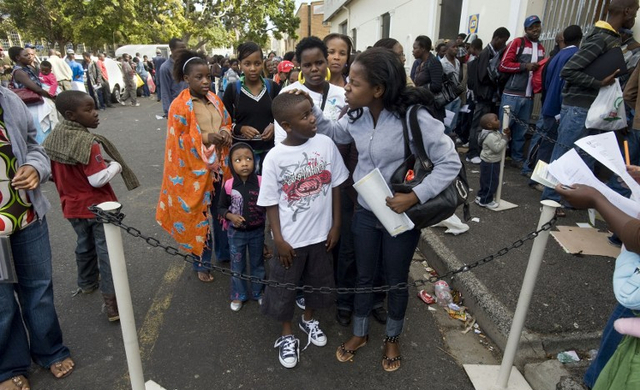
Asylum seekers queuing in front of a Home Affairs office in Pretoria

Government should take measures to assimilate foreigners into the diversified South African community, an asylum-seeker rights group said on Wednesday.

Foreigners in South Africa lived on a knife’s edge, International West Africa Asylum Seekers Foundation managing director Victoria Philips-Olaboye said.

“You need to see the multitude of people which gathers at Marabastad [home affairs offices]. They come from all over to get asylum papers in Pretoria and it is not easy.

“Some have to sleep on the ground through the night. We have a lot of rape victims there and the people are being robbed. Some of the people are pregnant, some have small children.”

She said the influx of immigrants to South Africa, particularly from West Africa, was influenced by political upheavals, economic hardship, and family disputes.

“The belief is that South Africa is better than any country in West Africa so they think they can make it here. Some have sex-related issues, they are not accepted because they are gay.”

She said her organisation wanted to engage South African authorities to help provide housing for asylum seekers.

“We have not seen much from the government. We would like to see more being done regarding the welfare of asylum seekers,” said Philips-Olaboye.

“Around 90 percent of asylum seekers are not working. They tell us that even though they are qualified, South Africans are preferred for job opportunities.”

According to Philips-Olaboye, the organisation had more than 700 members who were constantly exposed to xenophobia, discrimination, and crime.

Providing jobs for immigrants would also discourage them from venturing into crime, she said.

Nigerian immigrant Omokhagbor Michael said he arrived in South Africa two months ago in the hope of finding better economic opportunities in the entertainment sector. He said his stay so far had been horrific.

“Most of the language used in addressing us [foreigners] is vulgar; we just have to bear it. Being Africans, I think we should be treated politely,” he said.

“We had a number of challenges, including riots and [a] political crisis [in Nigeria]. In these days you find yourself in a situation where you have to go and seek shelter. In running for your life, you find yourself anywhere.”

Michael’s renewable asylum-seeker permit had since expired and he said he had not been able to renew it.

“The South African government has been wonderful to us. Somebody who gives you a house definitely wants you to be there. We face the problem of individuals who want to satisfy their pride.

“I have been trying to renew my asylum-seeker permit for two weeks. I was initially given one month to stay. One becomes scared and you keep turning left and right,” he said.

On Monday, the Somali government called on South Africa to protect Somali nationals living in the country after a spate of attacks on foreigners.

Residents in a township near Johannesburg rioted against the Somali community last week. Tensions also flared in Port Elizabeth and other parts of the country.

Scores of people were arrested following the attacks, which were reminiscent of the wave of xenophobic violence that left at least 60 foreigners dead in 2008. – Sapa

Italian soccer fans sentenced for ‘racism’

AC Milan's Kevin-Prince Boateng

Six fans of lower-division club Pro Patria have been issued jail sentences from 40 days to two months for inciting racial hatred during a January friendly against AC Milan.

After repeated racist chants directed at him during the match, Milan and Ghana midfielder Kevin-Prince Boateng kicked the ball in anger at a section of the crowd, took off his shirt and walked off the pitch with the rest of the Rossoneri.

Milan players Urby Emanuelson, Sulley Muntari and M’Baye Niang were also targeted by the chants.

Prosecutors had requested four- to six-month sentences.

The ANSA news agency reports that one fan received a 40-day sentence after collaborating with authorities, while the other five fans received two-month sentences.

The fans were also fined a total of ?10,000 ($13,000), plus trial expenses. – AFP

Designer John Galliano ‘didn’t mean’ anti-Jewish remarks

John Galliano receiving his Legion d'Honneur from former French president Nicolas Sarkozy

Iconic British designer John Galliano, sacked by Dior in 2011 for making drunken racist tirades, says he is “grateful” for his fall from grace because it forced him to confront his drug and alcohol demons.

In what was billed as the designer’s first sober interview since the career-shattering scandal that saw him ousted from the French fashion powerhouse, Galliano told Vanity Fair he had been in denial about his substance abuse for years.

“It sounds a bit bizarre, but I am so grateful for what did happen,” Galliano told the magazine in an interview published Tuesday on its website.

“I have learned so much about myself. I have re-discovered that little boy who had the hunger to create, which I think I had lost. I am alive.”

The 52-year-old was hit with suspended fines totaling 6,000 euros ($8,400) after being found guilty of making anti-Semitic insults in public — an offense under French law — following separate incidents in 2010 and 2011.

Galliano underwent treatment at an Arizona rehabilitation center in the wake of the scandal, which broke after the emergence of a video capturing his anti-Jewish rant towards fellow patrons in a Parisian bar.

“When I saw it, I threw up,” Galliano said of the damning video evidence. “The feeling was like I was about to take a step out onto the street and a bus or truck whooshed past me and the blood was drained from my legs.”

“I was paralyzed from the fear.”

Galliano told Vanity Fair he remained baffled by the nature of his remarks, insisting he “didn’t mean” what he said.

“It’s the worst thing I have said in my life, but I didn’t mean it … I have been trying to find out why that anger was directed at this race,” he said.

“I now realize I was so … angry and so discontent with myself that I just said the most spiteful thing I could.”

Galliano meanwhile painted a picture of a life that had spiraled out of control shortly before the scandal, believing he would have ended up “in a mental asylum or six feet under” if he hadn’t changed his lifestyle.

“I never drank in order to be creative, or to do the research,” he said. “I didn’t need alcohol for any of that. At first alcohol was like a crutch outside of Dior. Then I would use it to crash after the collections.”

“I’d take a couple of days to get over it, like everyone. But with more collections, the crash happened more often, and then I was a slave to it.”

“Then the pills kicked in because I couldn’t sleep. Then the other pills kicked in because I couldn’t stop shaking. I would also have these huge bottles of liquor that people got for me. Towards the end, it was whatever I could get my hands on.”

“Vodka, or vodka-and-tonic. Wine, in the belief it would help me sleep. Wrong. I did manage to stop the voices. I had all these voices in my head, asking so many questions, but I never for one second would admit I was an alcoholic. I thought I could control it.”

Galliano, who spent nearly 15 years at Dior, is widely considered to be one of the most brilliant fashion minds of his generation.

However, his rehabilitation following the racism scandal has been difficult. Last month, New York’s Parsons School of Design canceled a workshop he had been set to give at the prestigious fashion college. – AFP

‘Racism’ at Free State school to be investigated

Racist flag?

Racism is rife at schools across the Free State and requires an investigation, the SA Democratic Teachers’ Union (Sadtu) said on Wednesday.

“We call on the department of education to investigate acts of racism beyond the issue of Wilgehof Primary School, as these practices are still rife in most of the schools in the province,” Sadtu Free State said in a statement.

The SA Human Rights Commission (SAHRC) said on Tuesday it would investigate allegations of racism at the school, in Bloemfontein. It said there were complaints that some of the children at the school had been called kaffirs.

The old South African flag had reportedly been put up on a classroom wall, as had a picture of expelled ANC Youth League president Julius Malema alongside that of a monkey.

The SAHRC conducted an on-site inspection of the school after a white pupil’s parent laid a complaint.

Sadtu said it had previously complained to the department about alleged racism at the school.

“We have on numerous occasions called for the full investigation of allegations of racism at this school, but the department has always opted for defensive tactics claiming that the concerns and complaints raised by our members are baseless and unfounded,” it said.

Sadtu said the alleged racism undermined the dignity of black people.

“The conduct at this school is not just undermining the principles of a democratic non-racial South Africa, but is a clear disregard of the dignity of the black people when they are associated with baboons,” it said. – Sapa

Bribe was a ‘gesture of goodwill’

An environment official was told that the money a Stellenbosch property developer gave him was not a bribe, but a token of goodwill, a Cape Town court heard on Wednesday.

Luxolo Kula was testifying in the trial of Asrin Properties’ director Shiraz Hassan in the Bellville Specialised Commercial Crime Court.

He told the court Hassan gave him the money during a meeting at a Cape Town coffee shop last April.

“I immediately informed Hassan that I could not accept it,” he said.

“[Hassan] insisted that I keep it and urged me to consider it a token of goodwill, and not as a bribe.”

Hassan has pleaded not guilty to a charge of corruption.

Kula told the court Asrin Properties was busy with a development outside Stellenbosch. Asrin had taken over the project from another developer.

He said the processing of an application filed by Hassan to amend the original environmental authorisation was delayed because it went to the wrong section in the department as a result of an incorrect signature.

Kula was appointed as case officer responsible for resolving the problem.

At the coffee shop, Hassan complained about the delay and allegedly told Kula he would look after him if he expedited the matter. Kula said he ignored the remark.

However, as he was gathering his papers and files afterwards, he found a small transparent bag of money containing R500 in R100 notes.

At Hassan’s insistence, he took the money, but reported the incident to his supervisor, who was shocked, and went to one of the department’s directors. The director called the police and photocopied the banknotes. Kula made an affidavit about what had happened.

Asked by prosecutor Xolile Jonas what he thought when he was given the money, Kula answered: “I considered it inappropriate and said I could not accept it.”

Asked what his reaction would be if Hassan denied the incident, Kula said: “When I lifted the files to leave, and saw the plastic container with money in it, I said I could not take money and he said I must not take it as a bribe, but as his gesture of goodwill.”

The case continues on 4 October. – Sapa

‘Racism’, a religious concept?

by Dan Roodt

Since the ANC takeover in South Africa, this country has become race-obsessed. Not only do we have a huge number of laws that favour blacks over whites, but not a day goes by without someone being publicly accused of “racism”.

Whereas blasphemy, or denigrating Christians generally, is considered freedom of speech, merely stating a fact about black people can often lead to public denunciations, charges of “hate speech” or worse. In South Africa, as in Britain and some other countries, there exists a “Human Rights Commission” whose sole purpose, it seems, is to sniff out “racism” in its various forms, almost like the Spanish Inquisition used to enquire into heresy in the fifteenth century.

I was recently publicly accused here in South Africa of “allowing hate speech” on my Facebook wall. To some extent the motivation was revenge as I had complained about a radio announcer’s swearing at one of my Facebook “friends”, a very civil lady from Cape Town. Within a day or two, he saw fit to retaliate by gathering a whole series of “expert comments” about the “hate speech” proliferating on my Facebook wall, as well as those of some other Afrikaner activists. I could not quite understand what it was all about, but apparently referring to black perpetrators of South Africa’s notorious farm murders as “barbarians” was a clear instance of “racism” and “hate speech”.

Please note that I did not call any black murderers “barbarians”, but some of my 7 000 Facebook friends and followers did. My sin, according to the radio station RSG, was “not removing it timeously”. My retort was that I could hardly police the utterances of the public or act as a self-appointed censor for all those people who are unhappy about the extreme levels of crime and violence in South Africa.

What I also find surprising about the logic of “hate speech”, is that the underlying cause of discontent, i.e. bloody murders and torture, seems to be morally superior to ethnic comments made in reaction to such crimes.

Since this incident about a week ago, various people, on Twitter and elsewhere, have threatened me with prosecution by the so-called Human Rights Commission for “hate speech” which I did not even utter myself but simply “tolerated”. So I suppose if you organise a public meeting in a rented hall somewhere and someone arrives to utter the word “kaffir” or “nigger”, you could be held liable.

That is why I am starting to think that “racism” is a religious concept. The extreme sensitivity that anti-racists have towards certain words or even innuendo is very much akin to intolerance of blasphemy. In Europe I know bananas have been banned in some soccer stadiums for being a form of symbolic insult to black players who have occasionally been offered such fruit on the pitch. I honestly love bananas, eat at least one every day for breakfast and would never decline the curved yellow gift of the tropics. The notion that one could be insulted or defamed by a banana is so absurd that, again, the symbolism must relate to the arcane rules of a religious cult.

Although it is more or less acceptable to criticise Muslims, specifically “Islamists”, in the West, year after year it gets more difficult to voice almost any form of censure regarding black behaviour. The amazing thing is that we now have the exact opposite of what pertained in the nineteenth century when blacks were seen to occupy the lowest rung of human and civilisational evolution. It is as if blacks have ascended to Mount Olympus itself and it is incumbent upon us to respect, nay, revere them.

In American popular culture, such as Hollywood movies, blacks are often presented as the saviours of planet earth or of America. They infuse the white world with their special, divine essence. At the very least, no white protagonist could peform his heroic duties without black assistance. While white characters tend to be fallible, human, blacks are often cast in the roles of morally umblemished near-saints or sages “keeping whites on the right track”.

Often I have been in the presence of Europeans, especially liberal Britons, who tend to be cold and dismissive of their fellow whites, but who display the most unctuous and exaggerated civility towards blacks. It is as if a black, any black, is the most interesting creature imaginable, a prophet as it were, whose very thoughts and gestures need to be attentively followed, savoured, to the exclusion of everybode else.

When it comes to black politicians like Martin Luther King or Nelson Mandela, we are treading on hallowed ground indeed. For a minister of religion, King led a debauched life and told many lies, yet his reputation as one of America’s greatest leaders and sages is unquestionable.

Although he started out as a petty terrorist, Mandela has now been anointed by the world media as nothing short of a saint, if not the reincarnation of Jesus Christ. Almost every world leader has at some point paid tribute to Mandela, with Bill Clinton in the forefront, during and after his presidency. The fact that he probably never wrote any of his speeches himself, including the oft-quoted one delivered from the dock during the so-called Rivonia trial, is simply glossed over.

One of the people who made him famous, the British journalist Anthony Sampson, had the following to say about Mandela in his autobiography, The Anatomist (2008):

“I would love to recollect that I recognised Mandela from the start as a true leader of his people, destined to change the course of history. But in truth at that time (in the 1950s – DR) I sadly underestimated him: he seemed to me too flashy and vain, with his immaculate suits and his wide smile, and he kept aloof from most white observers; I found his rhetoric too formal and stilted, full of anti-colonialist clichés.”

Questioning Mandela’s greatness will probably in itself be considered heresy, or punishable “hate speech”. Yet one cannot help but wonder at the global adoration of someone who spent half his life in prison for a half-baked plan to place bombs in public places and who would ultimately insist on not being conditionally released, but “on his own terms”.

New York Times columnists regularly accuse the Republican Party of “racism” and I suppose the only way in which the GOP could refute them would be by fielding a candidate of colour themselves. The importance of “not being racist” has assumed such proportions that it dwarfs any other political issue, including global financial problems or the wars in the Middle East.

The day is probably not far off when for white voters to vote for a white candidate would be deemed “racist” too. Certainly in South Africa, despite the increasing evidence that black government is anything but utopia, any attempt to escape from it is seen as challenging the laws of the universe. No matter how corrupt and incompetent our local black leaders and officials turn out to be, submitting to them is seen as a moral imperative.

The small community of Afrikaners living together in Kleinfontein, thereby attempting to escape the crime and financial profligacy of nearby Pretoria with its ANC municipality, was recently accused of “racism”, with both CNN and the BBC rushing in to expose their almost criminal deviancy from the multicultural norm.

Probably the most successful political system ever devised was that of Ancient Egypt which lasted several thousand years. However, the key to pharaonic dominance was not to be found in its politics, but in its strictly ordered religious system. The pharaoh was an absolute ruler, but also a god. Not submitting to him must have been unthinkable, a mere mortal rebelling against divine authority.

The vicissitudes of modern democracy being what they are, it is hard to conceive of such an absolute monarch or permanent dynasty today. But what if anti-racism had to succeed in elevating Africans to a special place on earth, as “natural rulers” over the rest of mankind? The ruling elites of Africa are today the closest thing we have to an aristocracy, given the social distance between them and ordinary people, as well as the kind of obeisance they demand, from their impoverished countrymen, but especially from whites. In South Africa, even our liberal media marvel at the glittering ostentation and partying insouciance of our black political gods, using terms like “conspicuous consumption”.

The relative ease with which a fairly unknown politician from the South Side of Chicago such as Obama managed to obtain two presidential terms in America, also shows that the cult of negritude or whatever one needs to call this new secular religion is dominant in the world’s only superpower too.

The irony, of course, is that self-confessed atheists and agnostics in the West are the most ardent adherents to the cult of the black race, adulating King, Mandela, Obama and others who will no doubt soon follow in their footsteps.

Freud thought that Moses might have been an Egyptian. If we are to believe Afrocentrists, the ancient Egyptians could have been black, another highly dubious theory.

But if Moses were black, it would certainily explain why the Judaeo-Christian world so often craves a pharaonic – in the sense of larger-than-life – black king to come and save it.

France attacks Amazon ‘destroyer of bookshops’

France’s culture minister has branded online retailer Amazon a “destroyer” of bookshops in the latest confrontation between the Socialist government in Paris and America’s giants of the digital economy.

“Today, everyone has had enough of Amazon, which, by dumping, slashes prices to get a foothold in markets only to raise them once they have established a virtual monopoly,” Culture Minister Aurelie Filippetti said.

“It is destructive for bookshops,” the minister told a conference of booksellers Monday in the southwestern city of Bordeaux.

Filippetti said that she would be examining measures that could curb Amazon’s growth in France by restricting the American giant’s ability to combine offers of free deliveries with discounts of up to five percent on cover prices, which is the maximum allowed in France under existing legislation designed to protect small booksellers.

The attack on Amazon is the latest in a series of disputes between the French government and American companies including Google, Yahoo! and Apple.

French authorities are already embroiled in a dispute with Amazon over a $252 million tax bill related to the company’s sales in France between 2006 and 2010.

The dispute arose because of Amazon’s practice of reporting European sales through a Luxembourg-based holding company, taking advantage of the tiny Duchy’s relatively low corporation tax rates for earnings outside its borders.

Amazon insists the arrangement, which has been criticised by politicians across Europe, is legal under the European Union’s single market rules.

Industrial Renewal Minister Arnaud Montebourg last month also infuriated Yahoo! by placing a series of conditions on its proposed takeover of French video-sharing site Dailymotion, causing the deal to collapse.

France is meanwhile at loggerheads with Google over privacy issues and over demands that it pass on part of its advertising revenues to newspapers and other content providers that the search engine links to.

The Paris government has also clashed with Apple and other hi-tech manufacturers over proposals to tax smartphones and tablets to fund French-language creative and artistic projects. – AFP

Why black is beautiful…

According to the Body Image Report 2013 by WhyFive, whites have the least healthy body self-image whereas blacks are the most comfortable with their physical appearance.

About 1210 people, with an average monthly household income of about R10000, were asked to complete a 20-minute online questionnaire.

It was hoped that the results would help the fashion, health and beauty industries in their marketing campaigns.

Aspects taken into consideration included consumption of alcohol and red meat, smoking, the use of nutritional supplements and dieting.

The majority of those surveyed were married with children and most (34%) between 35 and 49.

Just over half (55%) of the respondents agreed that they felt good if they looked good, but white women (69%) were especially prone to agreeing to this statement. The people least likely to agree with this statement were black men (64%).

White females (87%) were the most likely to diet and black males (41%) the least.

Only 7% of the total sample had gone under the knife to improve their looks – but white women were the most likely to consider cosmetic surgery, and black men the least.

Men (39%) were more likely to feel happy with their health than females (27%).

Of the 18% who were smokers, most were black men. According to the responses, 10% drank daily, especially white men.

The report said: “It’s noteworthy that [in the media] the “official body” is predominantly pale.

“This is the most likely reason why white people have such poor body images compared to their black counterparts.”

WhyFive director Stuart Lowe said yesterday: “Generally, white people are subjected to a European construct – skinny and unobtainable – that black people either don’t care about or have not necessarily been exposed to.” – timeslive.co.za

Top cops bust for huge heists

Crime intelligence policemen – some of whom have the country’s highest security clearances – have been arrested after being linked to deadly cash-in-transit heists involving millions.

The arrests of two crime intelligence officers brings to an end a three-year undercover operation.

Four other crime intelligence officers are being investigated and three civilians have been arrested.

The operation mounted against the officers – whose jobs included the assessment of threats to the state – was led by the Hawks and involved the cooperation of cash-management companies.

The policemen are believed to have planned some of the biggest cash heists in South Africa.

According to police sources, the arrested officers were believed to have been planning what would have been one of South Africa’s biggest heists, on heavily guarded trucks transporting cash and gold bullion to the Reserve Bank, in Pretoria.

The police breakthrough came after a crime intelligence captain known as ”Mr KGB” was arrested on Saturday night near the Durban beachfront, hours before he was to have competed in the Comrades Marathon.

The officer – the ringleader, according to police and cash-in-transit company sources – was wanted in connection with an attack on a Protea Coin cash-in-transit van in the Free State town of Sasolburg in February. In all, R3-million was stolen and none of it has been recovered.

Another officer was arrested last week.

The two will appear in the Sasolburg Magistrate’s Court tomorrow along with three other men wanted for a spate of armed robberies that claimed several lives.

Police sources said yesterday that the arrested officers’ jobs involved intelligence gathering and threat assessments of attacks on cash-in-transit trucks and on vehicles carrying gold or platinum.

Senior police officers said the heads of cash-management companies and the national police commissioner, Riah Phiyega, were scheduled to meet later this week to discuss the implications of the arrest of officers with top security clearances.

Hawks spokesman Captain Paul Ramaloko confirmed the policemen’s arrests on armed robbery and attempted murder charges.

He would not say whether more police officers faced arrest.

“The case is sensitive. We cannot elaborate on what had [been] or is being planned.

“What I can say is that the policemen allegedly used their work knowledge, which involved security assessments, to commit crime,” Ramaloko said. – timeslive.co.za

Republicans are throwing their conservative white base under the bus

Ted Kennedy masterminded America's ethnic transformation

by Georgina Lee

Propaganda is only effective if it tells people what they want to believe, or what they know to be true from their lives’ experiences.

During the 1960s liberal Democrats told white blue-collar workers that the real problem was not crime in the streets but white racism. White blue-collar workers were often the victims of black crime, as were their friends and relatives. They knew what the problem was. They rejected the liberal message, and began voting Republican.

In the 60’s when America was still 90% white and crime was almost non-existent, we were told not to have too many kids that we could not afford. To thinking whites, this made perfect sense as we are an independent lot.

Shortly after that the drunken, belligerent, loudmouth Ted Kennedy told us our demographics would not be affected by immigration.

Now, American politics sits at the side of the cliff with Republicans scrambling and scrounging for any colored vote they can get… all the while throwing their conservative white base under the bus over and over again. Makes no sense to me because to pander to the Latino vote (which they will never get) is political suicide. I see America being run under a Democrat dictatorship for decades to come with only small pockets of Republican rule in the “white flight” areas. I have lived in Southern California my whole life and have seen city after city get taken to ruins by mass influxes of immigrants from third-world cesspools.

Others can have Chinatown and Little Saigon and other sef- imposed “Apartheids” but Damn to Hell the Blue-Eyed Devil for wanting to live among his own kind! Humans are tribal creatures. Perceived “racism” is only a matter of self-preservation – something even animals have a right to.

So yes, to make a long story short – there is massive, massive anger out there, world-wide, at the third-world colonization of Western countries. At first I thought, it was just my being more aware, but there is too much proof that this is real and growing. There is a trends forecaster by the name of Gerald Celente. Back in about 2007, he predicted the riots and anti-immigrant sentiment the world over that is now happening. He ties it in to global financial meltdown (creating more poverty) and the obvious mass influx of immigrants who are a blight to civilized society. This was obviously planned!

‘Exiles in our own fatherland’ – Kleinfontein residents

Show of force: municipal posse driving into Kleinfontein

There are no signs that say “Whites Only.”

There are, though, men in military fatigues who log the license plates of vehicles approved to enter Kleinfontein, a rural enclave that is home to about 1,000 Afrikaner whites. And there is a bust of Hendrik Verwoerd, the former South African leader who spearheaded white racist rule.

This exercise in separate, self-sufficient living near the South African capital, Pretoria, is more than just a throwback to the apartheid era that ended with the country’s first all-race elections in 1994. In recent days, Kleinfontein and its campaign to be formally recognized as a township have become a touchstone for fresh debate about law, freedom and the kind of “rainbow nation” that South Africa is trying to be.

Kleinfontein, which is all private property, requires its residents to be Afrikaners, descendants of settlers who arrived from Europe centuries ago and speak Dutch-based Afrikaans, the idiom of South Africa’s former overseers. That brings accusations of racism in a nation whose population of over 50 million is mostly black, but the community skirts race references in its manifesto. Descendants of British settlers, for example, would not be welcome to live here.

The community is not organized “on the basis of race,” said Jan Groenewald, chairman of the board of directors of Kleinfontein, which means “Little Fountain” in Afrikaans. Instead, he said, the goal is to preserve a cultural bedrock that stretches back to the lore of the hardy Voortrekker settlers.

The dig-in mindset at the austere settlement echoes that of its ancestors, who drew ox wagons into a defensive circle, a tactic that helped them defeat a much bigger Zulu force at the Dec. 16, 1838 Battle of Blood River. The date has near-mystical import for staunch Afrikaners, though the vast majority of whites accepted South Africa’s new, multi-racial order in 1994 as part of a negotiated settlement.

“We are here to stay,” read Afrikaans-language signs outside modest brick-and-tile homes linked by dirt roads in Kleinfontein.

Residents don’t pay taxes on municipal services because they don’t receive them. They draw water from a spring and are building a sewage system. There is a cafe, a primary school and a care center for the elderly. Zebra, antelope and wildebeest roam in one part of the fenced, 721-hectare (1,780-acre) property. Residents buy many of their goods from outside the fence.

“If I was a racist, we wouldn’t speak to a black. We wouldn’t do business with them,” said Annatjie Oncke, a 49-year-old house cleaner living in a caravan park. She and other poor residents do the kind of menial labor reserved for blacks in the era when whites were in charge. Kleinfontein also has engineers and other skilled workers, as well as retirees.

In the past, small bands of Afrikaners have sought to establish enclaves elsewhere in South Africa, notably in the Northern Cape community of Orania, founded in 1990. Nelson Mandela, South Africa’s first black president, traveled to Orania in 1995 and had coffee there with Verwoerd’s widow in a show of racial reconciliation. Verwoerd was assassinated in 1966.

Kleinfontein has been around almost as long as Orania, but is now under scrutiny in part because it wants local authorities to recognize it as an entity with the right to run its own affairs. The Times, a South African newspaper, reported that provincial lawmakers were informed last year that black police officers were barred from entering the enclave.

Last week, members of the Democratic Alliance, a political party, protested outside Kleinfontein.

“By creating a ‘whites-only’ area, this community is saying that it has no respect for people who are different from them. It is saying that it fears people who are different,” said Mbali Ntuli, the party’s youth leader.

On Wednesday, Kgosientso Ramokgopa, the mayor of Pretoria and surrounding areas, visited Kleinfontein as part of an inquiry into its alleged failure to comply with municipal planning laws. Delegations of the two sides met in a hall with a corrugated iron roof, a church bell mounted outside in a scaffold.

Ramokgopa noted the right of every citizen to “reside in any part of the country,” while Groenewald, Kleinfontein’s chairman, spoke of the right to “self-determination.”

The mood was diplomatic, and jovial at times. Ramokgopa joked about “koeksusters,” a fried, sugary snack favored by his Afrikaner hosts. Groenewald referred to Mandela’s leadership, but also hinted at his resolve with a mention of Koos de la Rey, a general in the 1899-1902 Anglo-Boer war who did not want conflict but fought hard when it began.

South Africa’s national flag does not fly in Kleinfontein, though some residents were seen recently with the “Vierkleur” (“Four-color”), the flag of the Transvaal republic, which in the 19th century formed part of what is now South Africa. A community member handed out a declaration that complained of betrayal and persecution of the “Boer-Afrikaner nation,” and described South African democracy as a sham.

“We find ourselves exiles in our own fatherland,” the statement said. “We experience this new dispensation not as a democracy, but as the dictatorship of an alien majority.”

For some observers, any uproar over Kleinfontein masks bigger challenges about racial integration in South Africa, where average income levels of whites still outstrip those of blacks. Unemployment is high and residents of some districts have protested violently against the government’s failure to provide basic services, a fact that Kleinfontein’s leaders did not let slip in their discussions with Pretoria officials.

Author Eusebius McKaiser said the country is still wrestling with the legacy of “apartheid geography,” in which some districts originally designed for different races still remain largely segregated.

“We need to stop gloating about the anger we feel towards people like those who live in Kleinfontein,” McKaiser wrote in The Star newspaper. “They are honest and crude about their revulsion of people who are different to themselves. We are not fundamentally different to Kleinfontein’s people. We are just less honest, more subtle.”

Ramokgopa, the mayor, toured Kleinfontein in a convoy of vehicles that kicked up dust and had residents peering at the commotion from their windows. He said the “inherent contradictions” at play over Kleinfontein would emerge elsewhere.

“The nature of the conflict in South Africa is defined by race and that’s something that we need attend to,” he said. “The next generation will still be grappling with this question.” – Sapa/AP

China benefits most from Iraq oil

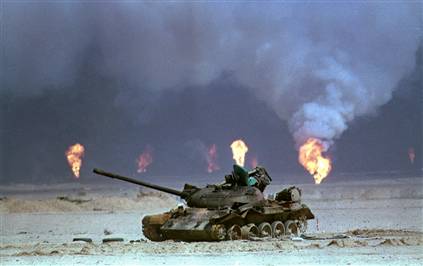
China already buys nearly half the oil that Iraq produces, nearly 1.5 million barrels a day, and is angling for an even bigger share, bidding for a stake now owned by Exxon Mobil in one of Iraq’s largest oil fields.

“The Chinese are the biggest beneficiary of this post-Saddam oil boom in Iraq,” said Denise Natali, a Middle East expert at the National Defense University in Washington. “They need energy, and they want to get into the market.”

Before the invasion, Iraq’s oil industry was sputtering, largely walled off from world markets by international sanctions against the government of Saddam Hussein, so his overthrow always carried the promise of renewed access to the country’s immense reserves. Chinese state-owned companies seized the opportunity, pouring more than $2 billion a year and hundreds of workers into Iraq, and just as important, showing a willingness to play by the new Iraqi government’s rules and to accept lower profits to win contracts.

“We lost out,” said Michael Makovsky, a former Defense Department official in the Bush administration who worked on Iraq oil policy. “The Chinese had nothing to do with the war, but from an economic standpoint they are benefiting from it, and our Fifth Fleet and air forces are helping to assure their supply.”

The depth of China’s commitment here is evident in details large and small.

In the desert near the Iranian border, China recently built its own airport to ferry workers to Iraq’s southern oil fields, and there are plans to begin direct flights from Beijing and Shanghai to Baghdad soon. In fancy hotels in the port city of Basra, Chinese executives impress their hosts not just by speaking Arabic, but Iraqi-accented Arabic.

Notably, what the Chinese are not doing is complaining. Unlike the executives of Western oil giants like Exxon Mobil, the Chinese happily accept the strict terms of Iraq’s oil contracts, which yield only minimal profits. China is more interested in energy to fuel its economy than profits to enrich its oil giants.

Chinese companies do not have to answer to shareholders, pay dividends or even generate profits. They are tools of Beijing’s foreign policy of securing a supply of energy for its increasingly prosperous and energy hungry population. “We don’t have any problems with them,” said Abdul Mahdi al-Meedi, an Iraqi Oil Ministry official who handles contracts with foreign oil companies. “They are very cooperative. There’s a big difference, the Chinese companies are state companies, while Exxon or BP or Shell are different.”

China is now making aggressive moves to expand its role, as Iraq is increasingly at odds with oil companies that have cut separate deals with Iraq’s semiautonomous Kurdish region. The Kurds offer more generous terms than the central government, but Iraq and the United States consider such deals illegal.

Late last year, the China National Petroleum Corporation bid for a 60 percent stake in the lucrative West Qurna I oil field, a stake that Exxon Mobil may be forced to divest because of its oil interests in Iraqi Kurdistan. Exxon Mobil, however, has so far resisted pressure to sell, and in March the Chinese company said it would be interested in forming a partnership with the American company for the oil field.

If the United States invasion and occupation of Iraq ended up benefiting China, American energy experts say the unforeseen turn of events is not necessarily bad for United States interests. The increased Iraqi production, much of it pumped by Chinese workers, has also shielded the world economy from a spike in oil prices resulting from Western sanctions on Iranian oil exports. And with the boom in American domestic oil production in new shale fields surpassing all expectations over the last four years, dependence on Middle Eastern oil has declined, making access to the Iraqi fields less vital for the United States.

At the same time, China’s interest in Iraq could also help stabilize the country as it faces a growing sectarian conflict.- NYT