American ‘secede’ petitions reach 675,000 signatures, 50-state participation

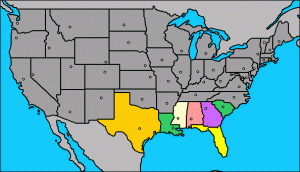
Less than a week after a New Orleans suburbanite petitioned the White House to allow Louisiana to secede from the United States, petitions from seven states have collected enough signatures to trigger a promised review from the Obama administration.

By 6:00 a.m. EST Wednesday, more than 675,000 digital signatures appeared on 69 separate secession petitions covering all 50 states, according to a Daily Caller analysis of requests lodged with the White House’s “We the People” online petition system.

A petition from Vermont, where talk of secession is a regular feature of political life, was the final entry.

Petitions from Alabama, Florida, Georgia, Louisiana, North Carolina, Tennessee and Texas residents have accrued at least 25,000 signatures, the number the Obama administration says it will reward with a staff review of online proposals. 

The Texas petition leads all others by a wide margin. Shortly before 9:00 a.m. EST Wednesday, it had attracted 94,700 signatures. But a spokesperson for Gov. Rick Perry said Tuesday afternoon that he does not support the idea of his state striking out on its own.

“Gov. Perry believes in the greatness of our Union and nothing should be done to change it. But he also shares the frustrations many Americans have with our federal government,” according to a statement from the governor’s office.

A backlash Monday night saw requests filed with the White House to strip citizenship rights from Americans who signed petitions to help states secede.

And in a similar nose-thumbing aimed at Texas’ conservative majority, progressives from the liberal state capital of Austin responded Monday with a petition to secede from their state if Texas as a whole should decide to leave the Union.

Late Tuesday a second group of Texans, this one from Houston, lodged their own White House petition. Secession-minded Texans, they wrote, “are mentally deficient and [we] do not want them representing us. We would like more education in our state to eradicate their disease.”

Houstonian “Kimberly F” — The White House does not provide last names — submitted the petition. She told TheDC in an email that ”[w]e need both sides presented, or we all look like a bunch of fools.”

A group from El Paso, too, wants no part of an independent Texas. “Allow the city of El Paso to secede from the state of Texas,” their petition reads. “El Paso is tired of being a second class city within Texas.”

But smaller petitions like theirs are a political side show of a political side show. One effort, aimed at Missourians, called for a nationwide catered pizza party to celebrate when the Show Me State left the U.S. 

States whose active petitions have not yet reached the 25,000 signature threshold include Alaska, Arkansas, Arizona, California, Colorado, Connecticut, Delaware, Hawaii, Idaho, Illinois, Indiana, Iowa, Kansas, Kentucky, Maine, Maryland, Massachusetts, Michigan, Minnesota, Mississippi, Missouri, Montana, Nebraska, Nevada, New Hampshire, New Jersey, New Mexico, New York, North Dakota, Ohio, Oklahoma, Oregon, Pennsylvania, Rhode Island, South Carolina, South Dakota, Utah, Vermont, Virginia, Washington, West Virginia, Wisconsin and Wyoming.

Read more

Afrikaner enclave of Kleinfontein investigated by ANC provincial officials

Kleinfontein, east of Pretoria, from the air

Business Day reports that tHE Gauteng legislature’s portfolio committee for community safety on Tuesday announced that it had launched an inquiry into the whites-only Afrikaner “cultural village” of Kleinfontein following police complaints about a lack of access to the estate.

Kleinfontein, 30km southeast of Pretoria, is a 500-hectare Afrikaner settlement similar to Orania, the Afrikaner enclave in the Karoo in the Northern Cape. Its mission is to preserve the culture, language and religion of the Afrikaner people without being threatened or harassed.

But that ideal may be tested on Friday when the portfolio committee will meet residents at the Kleinfontein community hall.

The chairman of the Kleinfontein board of directors, Jan Groenewald, said they welcomed the two-day engagement which would address their concerns about policing.

In a statement on Tuesday, the portfolio committee said it was concerned about complaints it had received from the local Boschkop police station.

The police had apparently found it difficult to get into the village to perform their duties.

“The purpose of the inquiry is to investigate challenges experienced by the community of Kleinfontein in integrating with the rest of the local community and co-operation of the community with law enforcement agencies in combating crime and ensuring safety,” said committee spokesman Takalani Ndou.

Mr Ndou said the committee would also investigate the activities of a private security company working in the community and its role in law enforcement and community safety.

Access to social services would also be discussed, he said.

The committee has invited the MEC for community safety, Faith Mazibuko, the station commander of the Boschkop police station, Col Schoombe Reinsburg, and Brigadier Welcome Kweyama to give evidence.

Mr Groenewald has also been invited to attend.

Members of the Kleinfontein community will have the opportunity to make oral presentations during the inquiry.

Mr Groenewald said that besides the access control at the entrance, the community did not make use of private security guards and the police were welcome to access the village.

“The engagement has been very civil with the portfolio committee. The meeting will be an opportunity for us to be transparent,” he said.

Mr Groenewald said that as a cultural village, the group’s right to territorial independence was protected in the constitution.

According to the Kleinfontein website (kleinfontein.net), the enclave provides retirement accommodation, sport and cultural facilities as well as a nature reserve. It has its own bank, school and a rugby team, which managed to beat its Orania counterparts earlier this year.

It was established in 1992, when a group of Afrikaners realised that power would eventually be handed over to the black majority and that “no consideration was given to the future existence of the Afrikaner people”. Today up to 900 people are economically active in the town and it boasts 650 residents and 400 shareholders.

Mr. Jaco Mulder, the only provincial councillor from an explicitly Afrikaner party, the Freedom Front Plus, will be in attendance on Friday in an attempt to protect the community from political harassment.

Will the US Follow South Africa Down the Path of White Decline?

by Dan Roodt

In the aftermath of President Obama’s victory, the Wall Street Journal described the GOP as the WOP, the White Old Party. Indeed, the Republican Party finds itself in a demographic death spiral as youth, single women, blacks, Hispanics, and Asians overwhelmingly vote Democrat.

In fact, the Democratic Party could become the American version of South Africa’s ANC as immigration and high non-white birth rates ensure a steady stream of Democratic voters eager for “change” or even South African-style “transformation:” the ANC’s term for racial revolution and ever tighter anti-white measures.
The latest proposal is for all charities, such as orphanages or soup kitchens to lose their non-profit status if they serve any whites at all. It would mean that charitable organizations could serve only blacks and that whites would not be allowed to help each other in any organized way, even to alleviate poverty or care for orphaned white children.

In the United States, such extreme anti-white measures are probably unthinkable today, but as recently as the early 1980s the idea of a black president in South Africa was deemed equally unthinkable. Even Prime Minister Margaret Thatcher’s spokesman Bernard Ingham said at the time: “Anyone who thinks the ANC will form the government of South Africa is living in cloud cuckoo-land.”

In the 1960s, so-called apartheid South Africa was still considered such a desirable place to live that 500,000 Britons emigrated there, fleeing socialist Britain.

The question therefore arises: how could South Africa, once seen as a leading Western power more or less on par with Canada or Australia, collapse so quickly to become “just another African country?” And what lessons can white Americans draw from our tragic demise, as they ponder the outcome of a Presidential election in which the evidence of a demographic turn for the worse is clear for all to see?

Ilana Mercer’s book, Into The Cannibal’s Pot: Lessons for America from Post-Apartheid South Africa went some way towards portraying the horrors and mayhem of whites living under a hostile black government, but the underlying causes of South Africa’s spectacular collapse still need explanation.

A century ago, South African whites still enjoyed demographic parity with blacks and were a majority in most towns and cities. In 1950, demographers sympathetic to the National Party shocked everyone at a Stellenbosch University conference by stating that the black population could grow from 8 million to 20 million by 2000. This prediction seemed so outlandish no one believed it. The recent census confirmed that blacks now represent 40 million, far overshooting the “nightmare scenario” of 1950.

South African whites feared communism more than anything else, but American racial ideologies such as affirmative action and so-called BEE (“black economic empowerment—our version of minority procurement) are doing vastly more damage to them. At least under communism the Bolshoi ballet still functioned and the Soviet Union still had a space program. The pursuit of diversity and multiculturalism in South Africa has, however, led to across the board decline; some small towns regularly suffer water and electricity shortages.

In my opinion, America’s future will not resemble its past, but will look more like today’s South Africa. As the number of whites declines, loss of power will follow, leading to aggressive legislation pushing whites out of jobs and most positions of power.

Many whites will emigrate or move to the remaining red states, just as South Africa’s whites have emigrated since 1994. But ultimately there will be no place to go as the global demographic decline of whites means that even European countries suffer the same fate of dispossession.

Demography is destiny, as Auguste Comte said. There is a mysterious process whereby whites react to racial domination not by rioting or claiming special privileges as other races do, but by working harder, having even fewer children, and quarrelling among themselves. We see this happening in South Africa, in Western Europe and, of course, in America where white Republicans and Democrats are like two dogs fighting over a bone, while a third is about to run away with it and leave them with nothing.

The Republican Party is poised to adopt the attitude of South Africa’s liberal opposition party, the Democratic Alliance, which has forsaken its core white support and practices affirmative action in its own ranks. There are three women on its election posters: one white, one colored or mixed-race, and one black, at once expressing the party’s diversity and its disdain for the white male.

Jared Taylor asks that the Republican Party be loyal to its electorate and become the unabashed champion of white interests. Again, the history of South Africa is instructive. British Prime Minister Harold McMillan made a famous speech in the South African parliament  on February 3, 1960 in which he warned us that “the wind of change is blowing through the African continent” and that ultimately we would have to surrender power to the nonwhite majority. Our brilliant leader, Hendrik Verwoerd, promptly replied in an unprepared speech that “the tendency in Africa for nations to become independent, and at the same time to do justice to all, does not only mean being just to the black man of Africa, but also being just to the white man of Africa.”

Verwoerd’s slogan of “justice for the white man too” was rejected by most of the Western world. Lest we forget, the rank and file of the Republican Party rebelled against Ronald Reagan’s veto and passed sanctions against South Africa on Sept. 29, 1986.

Since that time, the U.S. has consistently pursued an anti-white foreign policy. In Southern Africa it supported black Marxist movements such as the African National Congress (ANC) and the South West African Peoples Organization (SWAPO). In Europe, it has called for a large Muslim state, Turkey, to be included in the European Union. Would the American elite ever adopt a pro-white policy domestically while pursuing the opposite of such a policy externally?

There are three forces that are likely to determine the Republican Party’s position on white interests. The first is the wishes of its own electorate; the second is the corporate sector that funds the party, and the third is the mainstream media. America’s large corporations support affirmative action and diversity, while the media support multiculturalism. The GOP will follow their bidding and betray its voters.

Like the whites of the former Rhodesia, South West Africa, and South Africa, Republicans will embark on a forlorn search for conservative allies “of color” whom non-white voters will reject as “traitors.” Even if a black woman such as Condoleezza Rice could be fielded as the next Republican presidential candidate, it is doubtful whether many blacks or Hispanics would vote for her.

Pat Buchanan and others have already chronicled “the death of the West,” but we need to understand the laws of this process, because it follows a pattern of false hopes, interspersed with successive betrayals by white leaders. The final days of the Roman Empire followed the same fatal chain of events.

The crisis is far deeper than most Americans realize. South Africa went from being a powerful, Western country to capitulation in just ten years: from 1980 to 1990. President Barack Obama has already started to fire some of his best generals, just like F.W. de Klerk purged his army of all pro-white generals prior to surrendering to the ANC.

I fear that white Americans take false comfort in “still being the majority.” They do not realize how quickly they will lose that status as global demographics change, and immigration to the US accelerates. South Africa is now being overrun by immigrants from sub-Saharan Africa. But America too will become a haven for African immigrants as the population of our continent doubles from the current one billion to two billion within the next 30 or 40 years.

It could even be that Africa’s burgeoning population poses a far greater demographic risk to Americans than Mexicans. Unprecedented technological change, especially in communications, has put immigration information at the disposal of Africans in even the remotest villages.
American whites could become a minority much sooner than they think. That has been our experience in South Africa; people appreciate the enormity of the changes only after it is too late.

Some white Americans may clamor for self-determination, and the South may want to secede again. However, any breakaway group will find itself in the political wilderness, without media support and fighting the forces of demography and history.

We need to form a global network to keep America from falling into the hands of anti-white zealots. We should constantly compare notes on successes and failures, taking heart from every advance. The United States is such a military and economic power that the battle now taking shape within its borders could well determine the fate of the West. If the United States goes the way of South Africa, whites everywhere will be in danger.

Art theft: Overseas shopping list?

Maggie Laubser Cat and Japonicas, 1936 oil on board 560 x 610mm

An official hinted on Monday that growing international demand for South African artwork might be the reason for a brazen robbery at the Pretoria Art Museum where art worth about R17.5m was stolen.

Five pieces were stolen from the museum’s permanent collection on Sunday when thieves posing as art students staged a daring arm robbery.

“Three men, under the pretence of being students and their art lecturer, asked to view specific pieces. After they were shown the paintings, they then tied up the museum official at gunpoint and took off with six paintings,” mayoral spokesperson Pieter de Necker said.

“They left one painting [by] Irma Stern behind. Presumably because it was too big to fit into their [getaway] car.”

The thieves left as private security guards at the museum drew close to them, he said.

According to museum staff, the thieves arrived with a “shopping list” of what they wanted, and demanded to be given specific paintings, Sapa reported.

After holding staff member Dawood Khan at gunpoint, they took out their list, and demanded to know where the paintings were.

De Necker said he and others believe the thieves were commissioned to go after those specific pieces because of their behaviour at the museum, according to AP.

“We’re very, very surprised. It is very uncommon,” he said.

“We have realised also that over the last few years … the overseas market has grown into wanting South African art.”

The robbers favoured oil paintings in their theft, grabbing a 1931 painting by artist Irma Stern of brightly coloured fishing boats waiting against a pier (Fishing Boats), a gouache drawing of an eland and bird (Eland And Bird – 1961) by landscape artist JH Pierneef, a pastel-toned street scene (Street Scene) by Gerard Sekoto, a thick-stroked oil painting of a chief (Hottentot Chief) by Hugo Naude and a 1936 picture of a cat near a vase full of petunias (Cat And Petunias) by Maggie Laubser.

Lucrative crime

Art theft is the third most lucrative crime in the world, after drugs and illicit arms sales, according to Interpol and the FBI.

However, actually selling famous works remains difficult for criminals either locally where the theft happened or abroad, authorities say.

Despite the challenges, estimates suggest there are billions of dollars made in stolen art sales annually across the world.

De Necker said national and international art organisations had been notified about the robbery and had been forwarded details of the paintings.

Police spokesperson Katlego Mogale said authorities had been alerted in case the thieves tried to take the art work outside of the country.

“The investigation is continuing,” Mogale said. “Every measure is being put in place.”

The museum has closed provisionally and will re-open on on 20 November.

“The art museum has taken precautionary steps by removing other valuable pieces until the police have completed their investigation,” De Necker said.

He said that the city would also tighten security at the museum.

Three private security guards were on duty when the robbery took place, and security cameras were out of order.

“It is unfortunate the CCTV cameras were not working this weekend. A fault was reported on Thursday and has been fixed today,” said De Necker.

He said the brazen robbery was a wake-up call that security needed to be tightened at museums across South Africa.

“Security at museums should be improved. This incident calls for extra measures to be implemented,” he said. – Sapa/AP

Plane catches fire at OR Tambo

A Global Aviation charter plane caught fire while it was aborting take off at OR Tambo International Airport on Tuesday morning, the Airports Company SA (Acsa) said.

One of its tyres exploded, causing the plane to catch fire, Acsa spokesperson Solomon Makgale said.

The aircraft, destined for Lilongwe, Malawi, was carrying 120 passengers and seven crew.

No injuries were reported and the fire had been extinguished. Only one runway was currently operating at the airport.

Acsa said some flights could be delayed as a result of the accident.

Huge sewage spill threatens agriculture

Damage that will last a decade

A sewerage spill into the Jukskei river from Northern Waste Water Works is the worst in 25 years.

Environmental consultant and chairman of the Jukskei Catchment Area Management Forum, Paul Fairall, said the sewerage effluent spill started on 24 October. Many environmental and public health activists were angered at the slow response from Johannesburg Water.

“The sewage spill severely raised the level of e.coli in the small river and had a far-reaching affect on the community. It could take decades to resolve as e.coli can live in silt for up to seven years,” said Fairall.

Sewerage had overflowed from an emergency dam number 02, at the water treatment works between the R511 and R114 roads, east of Heronbridge college.

“The Jukskei river is usually a brownish colour, but I have never seen it this black before. The e.coli presence is at the highest possible level.

Joburg Water fits belt presses

Johannesburg Water spokesman Millicent Kabwe said, “The sewerage spill is due to a current [BEE: Black Economic Empowerment] contract to install and commission new belt presses into the existing system. This work caused solids to build up in the system that resulted in reduced treatment capacity.

“The rain season also contributed to overflow and spillage. The problem will be solved once the new belt presses are fully operational and high solids build-up in the system is cleared. If all goes well, the new belt presses should be fully operational by the end of next week.”

Kabwe said several months of backlog in the system would then start clearing and a “great improvement is expected in December.”

Four sludge digesters

Fairall warned Fourways residents to should stay clear of the Jukskei river banks and wetlands. “Only two of the four sludge digesters were working to handle 430 mega-litres of sewage flow per day”.

However, Kabwe said all four sludge digesters were working. Fairall warned Johannesburg Water that when Helderfontein Estate and Steyn City would be fully developed and functional, “this water works would have an even greater volume of sewerage to treat. It needs a more effective system.”

Jukskei, Hartbeespoort, Hennops link

Jukskei river is indirectly linked to Hartbeespoort dam and Hennops River, which could result in e.coli laden water reaching 13 000 ha of irrigation systems in the Pretoria and Brits areas in North-West province.

Fairall said the dam produces a third of South Africa’s fresh produce due to major irrigation schemes at Brits and further north.

Kabwe recognised that the spill could affect Hartbeespoort dam, but said mitigation plans were being explored to prevent this.

She said Joburg Water was monitoring the environmental health of rivers upstream and downstream since the spill started.

Fairall noted that several infomal settlements used water from the Jukskei River. The 10 000 ha Rhenosterspruit conservancy is also downstream of the spill, and chairman Helen Duigan said the Jukskei river was already under severe pressure from tons of littler and effluent dumped into it at Alexandra and Diepsloot. – looklocal

‘Racist’ history of gun control

In a Pew Research study from March of last year, a full 64 percent of Black Americans said that state and local governments should be allowed to pass laws restricting handguns. Only 38 percent of whites agree with that statement. Over the years, Blacks have become all too aware of the damage handguns can unleash on communities, which is why they’ve become major proponents of gun laws. But a new book about the history of American gun regulation shows how ironic Black support of widespread gun restriction actually is.

While doing research for Gunfight: The Battle over the Right to Bear Arms in America, UCLA constitutional law professor Adam Winkler discovered that, contrary to modern America, there was a time in U.S. history when African-Americans were actually fighting against gun regulation.

Starting as early as the Dred Scott decision in 1857, the American federal government made a point to keep guns out of African-American hands. When then-Chief Justice Roger Taney wrote his decision that Blacks couldn’t be considered full citizens, he noted that if they were, they would be allowed “full liberty of speech … to hold public meetings on political affairs, and to keep and carry arms wherever they went.” Taney and others were terrified of a full-scale Black revolt, which meant they were completely in favor of keeping Blacks unarmed.

After the Civil War, the Southern states created so-called “Black Codes,” laws that restricted the rights of newly freed blacks. Can you guess what one of the main oppressions was? Blacks couldn’t own guns. Even when Blacks did get their hands on weapons, the nascent Ku Klux Klan would frequently go on raids of Black homes and take away their weapons, making them even more vulnerable to Klan attacks.

These kinds of arbitrary restrictions on gun ownership traveled all the way to the civil rights era, when the archaic Black Codes continued to prevent African-Americans from arming themselves. Even Dr. Martin Luther King Jr. applied for a gun permit after his house was firebombed. Despite King being a respected community leader and a man of the cloth, the Alabama police denied his request.

Nowadays, things have obviously turned around drastically. Blacks have won the right to own guns, but awful gun violence has also wreaked havoc on Black communities from coast to coast. The Klan was wrong: Rather than attacking them with guns, some African-Americans started attacking each other over gang territory and drug battles. It’s no wonder today’s African-American leaders herald gun restrictions. And one has to consider whether winning the right to carry handguns everywhere was really that wonderful of a victory. – bet.com

‘Blacks should buy guns’

Leave it to Ann Coulter and the like to conquer the ever-vexing issue of race relations, unequivocally internalize the volcanic plight of blacks and other minorities everywhere, rather than simplistically merge theories relative to both to the point of irrefutable resolution— all in a matter of a less than a minute TV sound bite.

In the wake of the Trayvon Martin shooting tragedy, the incorrigibly bombastic, right-wing activist took to the Fox News airwaves and the “Bill O’Reilly Show” recently to expound upon and defiantly reaffirm her dangerously hot-headed and shortsighted views regarding the one singular instrument that has truly proven to be a weapon of mass destruction in minority communities everywhere.

“We don’t know all the facts yet,” Coulter later wrote in a blog post chronicling the deadly encounter that left the 17-year-old Martin mortally wounded at the hands of volunteer neighborhood watchmen George Zimmerman. “But let’s assume the conclusion MNSBC is leaping to is accurate: George Zimmerman stalked a small, black child and murdered him in cold blood, just because he was black.

“If that we’re true,” she continued, “every black person in America should get a gun and join the National Rifle Association, America’s oldest and most august civil rights organization.”

Alas, with allies like Ann Coulter and her Republican counterparts, who can afford to have enemies? Indeed, it’s funny how those who know the least sometimes reveal the most. Coulter’s words are a clear illustration to one and all of an approach and road best less traveled. They harken to a society and atmosphere that only further propagates a war among races in which no group can truly win.

What Coulter seems to remain blind about and oblivious to— conveniently so I might add— is the fact that an eye-for-eye way of being ultimately only comes to leave us all blind. And statistics speak to that darkness, with the free-flow of more handguns almost automatically leading to more deaths and shootings in each and every instance.

Beyond the mere numbers, one need look no further than my childhood hometown of Chicago— the South Side’s Englewood neighborhood for an even more exact locale— to painfully bring those words to heart.

During the St. Patrick’s Day weekend preceding the Martin shooting and only days before Coulter was making her rather reckless proclamation, 49 people were shot, at least 11 of them fatally, across the city. Overall, murders were up by more than 60 percent over the first three months of 2012 compared to the year before, with Englewood’s 15 homicides nearly doubling those committed in any of the city’s other enclaves.

In Englewood, since 1960 the community population has dipped from a high of 100,000 to just 30,000 and falling, with more and more families still desperately seeking to get out. More than 4,100 abandoned buildings now riddle the neighborhood, as the gang-laden, arms-packing residents grow more brazen and deadly in their dealings.

Harsh realities such as those are why Coulter’s words aren’t so easily dismissive. When has violence, or setting the course for it, ever led to anything other than more violence? Given all that, is there anyone among us, Ann Coulter included, that can truly advocate for such a society and rest in good conscious?

Count the Rev. Al Sharpton, the NAACP and the parents of Trayvon Martin among those who have come to an equally raised level of understanding. On the 20th anniversary of the deadly race riots that saw much of Los Angeles go up in flames following the Rodney King acquittal, it’s why they all convened in the city Thursday night to plead for greater tolerance and an end to all the violence.

“There are Trayvons all over the country,” boomed Sharpton. “What kind of world are we living in that we can put a black man in the White House, but a black can’t walk through a gated community?”

Thing is, in the kind of world Ann Coulter is calling for, neither may truly have the chance to reach their destination. – blackamericaweb.com

Gun sales soar

Owners of guns have been stocking up because they are concerned about a potential tightening of regulations on assault weapons in the president’s second term.

In October the number of background checks on people applying to buy guns, an indicator of future sales, increased by 18.4 per cent.

There was a similar jump when President Obama was first elected in 2008. A total of 12.7 million background checks were carried out that year, up from 11.2 million the year before, and the number has been rising since then.

Shares in weapons manufacturers like Smith & Wesson and Sturm, Ruger also surged after Mr Obama’s re-election.

During the election campaign Mr Obama mostly steered clear of discussing gun control, but in a presidential debate on Oct 16 he gave his clearest statement yet on the issue.

He said: “What I’m trying to do is to get a broader conversation about how do we reduce the violence generally. Part of it is seeing if we can get an assault weapons ban reintroduced.”

President Bill Clinton introduced had restrictions limiting the use of semi-automatic weapons in 1994, but the ban expired in 2004. Under the Clinton-era ban magazines with more than 10 rounds, and weapons with threaded barrels, pistol grips and bayonets were prohibited.

Mr Obama would still have to get any new restrictions past Republicans in Congress, but gun owners say they fear a limiting of their right to bear arms which is enshrined in the Second Amendment to the Constitution.

Mel Bernstein, owner of Dragonman Arms in Colorado Springs, told KOAA-TV that sales of semi-automatic weapons had boomed in recent days.

He said: “We’re going from normally six to eight guns a day, to 25. I stocked up, I got a stockpile of these AK-47s, we’re selling these like hot cakes. Luckily I had an idea of what was going on because it happened with Clinton.”

Mr Bernstein said he normally orders up to 7,000 rounds a week from distributors but could now only get hold of 3,000 because of demand.

John Kielbasa, owner of Fernwood Firearms in Hankins, New York, told CNN: “Sales are up. I had a guy waiting here first thing in the morning (the day after the election.) He came in, bought two AK-47s. It’s going to be good for me for business.” – The Telegraph

Google must pay Australian $200 000 for defamation

Google was ordered to pay Aus$200,000 (US$208,000) in damages to an Australian Monday after a jury found the Internet giant defamed him by publishing material linking him to mobsters.

Milorad Trkulja, an entertainment promoter who is now 62, was shot in the back in 2004 in a crime that was never solved.

He accused Google of defaming him with material which he said implied he was a major crime figure in Melbourne and had been the target of a professional hit.

Searches of his name brought up references to the city’s gangsters including crime boss Tony Mokbel and a now defunct site called “Melbourne Crime” chronicling gang-related incidents.

Google denied publication in the Supreme Court of Victoria, saying it had innocently disseminated material published by others. It also disputed that the material conveyed the defamatory implications claimed by Trkulja.

But a jury ruled in his favour, finding the Internet firm had been on notice and failed to act on the issue from October 2009, when Trkulja’s lawyers wrote to them demanding action over the “grossly defamatory” content.

Bond University media law expert Mark Pearson, who specialises in social media and legal issues, said it was a “groundbreaking” precedent in Australia and could have broader implications.

“What the court’s said here is that this isn’t just innocent architecture, what this is is a human-designed software to showcase information in a certain way,” Pearson told AFP.

“The judge has said that because you (Google) have designed (the search results) to appear in this way, you are the publisher of the material.”

Google, which is understood to be contemplating an appeal, stood by its arguments in court.

“Google’s search results are a reflection of the content and information that is available on the web,” a Google spokesman told AFP.

“The sites in Google’s search results are controlled by those sites’ webmasters, not by Google.”

Judge David Beach ordered Google to pay Trkulja Aus$200,000, likening their role in publication to a library or newsagent, which have “sometimes been held to be publishers for the purposes of defamation law” in Australia.

“Google Inc is like the newsagent that sells a newspaper containing a defamatory article,” Beach said in his judgement.

“While there might be no specific intention to publish defamatory material, there is a relevant intention by the newsagent to publish the newspaper for the purposes of the law of defamation.”

Beach said the jury was “entitled to conclude that Google Inc intended to publish the material that its automated systems produced, because that was what they were designed to do upon a search request”.

Trkulja argued that his reputation was central to his work and had been seriously damaged by the defamatory material. He had already won Aus$225,000 from Yahoo in an earlier case on the same matter. – AFP

The D-bomb has dropped

by Ilana Mercer

In our democracy – for we are no longer a republic that upholds individual rights and limits central power – you vote not for the representative who will defend your inalienable, individual rights. Rather, if you are The Rich – whom the left treats as a reified, rigid state-of-being – you vote defensively. If you are The Poor, you vote extractively – you empower your guy to steal The Other Guy’s stuff and hand it over.

Elections are when the politically dominant majority gets to thump the politically weak minority.

The Moron Media, left and right, are sticking to their story. Barack Obama had “out-hustled” Mitt Romney. Obama ran a better “ground game.” He triumphed “in the trenches,” “neutralized” his rival. He had not stopped campaigning since 2008. The president’s mega-machine was unbeatable, even though his vision was lacking. (As I like to say, a visionary bureaucrat is a voracious one. The best leader is one who leads in limiting his leadership.)

Had Romney, say some of the analysts, been a better tactician, scrappier, less of a patrician – he’d have won.

The media so arguing have advocated for immigration policies that have helped, over the decades, to replace the American people with a new, vastly different people. Although whites broke for Romney in a big way – as a proportion of the voting public, the founding majority is teetering on minority status. It has shrunk to the point where it is becoming powerless against a coalition in opposition.

As an extension of their life’s work, the “news” people aforementioned have anointed a string of progressive commentators who are distinguished from the Democrats with whom they cavort in studios in one way only: They call themselves Republicans.

This lot’s line on the Republicans’ Nov. 6 defeat went as follows: Be nicer to the axis of Asians, blacks, browns (and brown-nosing bimbos) who handed the Democrats a handy victory.

In a word, neutralize the D-Bomb.

Order lIana Mercer’s brilliant polemical work, “Into the Cannibal’s Pot: Lessons for America from Post-Apartheid South Africa”

For years, those of us who’ve warned about demographics have been dubbed racists. But the D- Bomb has dropped. Its debris is scattered across “the field” upon which Mitt Romney said he “left everything.”

Asians, blacks and Latinos united for Obama.

As always, women voted with their wombs, although married sisters were less wild for big daddy O. (Oh, how we suffer for the female suffrage! I once vowed to “give up my vote if that would guarantee that all women were denied the vote.”)

To the pox of the 19th Amendment – it granted women the vote – add the 26th Amendment. Smuggled into the Constitution by statute, it artificially swelled the ranks of Democratic voters by millions of 18-, 19- and 20-year-olds. While they don’t work for a living, the vote grants youngsters a claim on the livelihood of those who do.

Overlapping voter categories notwithstanding, Obama thus curried favor with females – single ladies, in particular – the faithless, kids and minorities.

Put differently, those earning less than $50,000 trended Barack Obama; those earning more than $50,000, and certainly individuals in the upper-income tax bracket, preferred Mitt Romney.

People with higher incomes constitute a minority, an economically dominant minority (to paraphrase Amy Chua). People with low incomes are in the majority, a politically dominant majority.

The rich are politically impoverished; the poor politically rich. The rich dominate the economy; the poor dominate the polity.

When elections roll around, the politically powerful exact their revenge against the economically powerful.

What kind of a right gives one man control over another man’s life? In a democracy, the right to vote does just that.

As for demographics, they have become destiny. They were not necessarily so. Demographics have been the excuse central planners have advanced to persevere with immigration policies that destroy civil society and shore up the welfare state.

The now-waning West became great not because it outbred the rest of the world. The West was once great because of its human capital – innovation, exploration, science, philosophy; because of superior ideas and the willingness to defend such a civilization, not because it was more populated than the rest of the world.

America doesn’t need more people; it needs better people.

Making nice with constituencies that vote repeatedly and habitually for the candidate who promises them more stuff is tantamount to sleeping with the enemy. The only voters who could be swayed by the promise of the free market are the Democratic Party’s Asian supporters, since they enjoy higher incomes and stabler families than the party’s Hispanic and black devotees.

Ultimately, elections are about perception – the way in which the people perceive the political planks of the two parties.

The American people perceive the Democratic Party as the party of entitlements. They think of the Republican Party as the party of austerity.

History and reality tell us that both parties have grown government into the gigantic, intractable, wealth-gobbling Thing that it is. But in the age of reality TV, reason and reality are meaningless.

Perception is everything.

The idea of an American People is yet another misconception. The extravaganza that had one adorable, carrot-topped kid bawling “no more ‘Bronco Bamma’ and Mitt Romney, please” has ended. But if this advance auction of stolen goods – H. L. Mencken’s definition of an election – proved anything, it is that America is a mass of competing factions.

Some vie to keep more of their rightful property; others fight to get their paws on that very property.

And the tipping point has arrived. This, Nov. 6, 2012, has proven.

Ilana Mercer is a classical liberal (libertarian) writer and a fellow at the “Jerusalem Institute for Market Studies.” She is the author of “Into the Cannibal’s Pot: Lessons For America From Post-Apartheid South Africa.” “The titular tease,” explains Ilana in the book, “is meant as a metaphor and is inspired by Ayn Rand’s wise counsel against prostrating civilization to savagery.” Ilana’s website is IlanaMercer.com.. She blogs at www.barelyablog.com.

Did Romney kill his own campaign?

As Republicans try to explain their Election Day losses in terms of policy, tactics, and strategy, one factor is emerging as the essential difference between the Obama and Romney campaigns on November 6: the absolute failure of Romney’s get-out-the-vote effort, which underperformed even John McCain’s lackluster 2008 turnout. One culprit appears to be “Orca,” the Romney’s massive technology effort, which failed completely.

A source within the Romney campaign agreed to share his reflections on Project Orca with Breitbart News:

It’s easy to point fingers after a loss and I wouldn’t normally do it, but consider what happened.

Project Orca was supposed to enable poll watchers to record voter names on their smartphones, by listening for names as voters checked in. This would give the campaign real-time turnout data, so they could redirect GOTV resources throughout the day where it was most needed. They recruited 37,000 swing state volunteers for this.

I worked on the Colorado team, and we were called by hundreds (or more) volunteers who couldn’t use the app or the backup phone system. The usernames and passwords were wrong, but the reset password tool didn’t work, and we couldn’t change phone PINs. We were told the problems were limited and asked to project confidence, have people use pencil and paper, and try to submit again later.

Then at 6PM they admitted they had issued the wrong PINs to every volunteer in Colorado, and reissued new PINs (which also didn’t work). Meanwhile, counties where we had hundreds of volunteers, such as Denver Colorado, showed zero volunteers in the system all day, but we weren’t allowed to add them. In one area, the head of the Republican Party plus 10 volunteers were all locked out. The system went down for a half hour during peak voting, but for hundreds or more, it never worked all day. Many of the poll watchers I spoke with were very discouraged. Many members of our phone bank got up and left.

I do not know if the system was totally broken, or if I just saw the worst of it. But I wonder, because they told us all day that most volunteers were submitting just fine, yet admitted at the end that all of Colorado had the wrong PIN’s. They also said the system projected every swing state as pink or red.

Regardless of the specific difficulties, this idea would only help if executed extremely well. Otherwise, those 37,000 swing state volunteers should have been working on GOTV…

Somebody messaged me privately after my email and told me that North Carolina had the same problems — every pin was wrong and not fixed until 6PM — and was also told it was localized to North Carolina. 

The problems with Orca appear to have been nationwide, and predated Election Day itself. At Ace of Spades, John Ekdahl reported his frustrations as a volunteer in the field:

From the very start there were warning signs. After signing up, you were invited to take part in nightly conference calls. The calls were more of the slick marketing speech type than helpful training sessions. There was a lot of “rah-rahs” and lofty talk about how this would change the ballgame.

Working primarily as a web developer, I had some serious questions. Things like “Has this been stress tested?”, “Is there redundancy in place?” and “What steps have been taken to combat a coordinated DDOS attack or the like?”, among others. These types of questions were brushed aside (truth be told, they never took one of my questions). They assured us that the system had been relentlessly tested and would be a tremendous success.

Ekdahl describes how volunteers were expected to print their own materials, and were mistakenly not told to bring their poll watching credentials to polling places. Attempts to communicate with the Romney campaign to ask for assistance were unsuccessful:

By 2PM, I had completely given up. I finally got ahold of someone at around 1PM and I never heard back. From what I understand, the entire system crashed at around 4PM. I’m not sure if that’s true, but it wouldn’t surprise me. I decided to wait for my wife to get home from work to vote, which meant going very late (around 6:15PM). Here’s the kicker, I never got a call to go out and vote. So, who the hell knows if that end of it was working either.

Likewise, Twitchy recorded widespread real-time complaints and criticisms on Twitter by Project Orca volunteers. At one point during Election Day, the system had malfunctioned so badly that desperate volunteers wondered if the program had been hacked.

Romney volunteers in Virginia confirmed that the campaign had relied entirely on Project Orca to turn out the vote in key areas such as Roanoke, where Romney and Ryan had made appearances. Volunteers who had driven to Virginia from safely-Republican Tennessee were shocked at the disorganization they encountered.

While the Romney campaign waited for Orca to function as planned, the Obama campaign had placed signs outside every one of the city’s thirty-three polling places, and was fully staffed with two volunteers outside each polling place, and a strike list volunteer inside, all day long from 6 a.m. to 7 p.m. The best that the short-handed Tennessee volunteers could manage was 40% coverage of polling places; the local GOP, they said, had relied entirely on the campaign’s centralized Orca system in Boston to turn out the local vote.

Ekdahl concludes his account by hoping that the failures of Orca did cost Romney the election:

We lost by fairly small margins in Florida, Virginia, Ohio and Colorado. If this had worked could it have closed the gap? I sure hope not for my sanity’s sake.

In fact, Orca diverted scarce resources that would have been better used physically moving voters to polling places. By a rough calculation, Romney lost the election by falling 500,000 to 700,000 votes short in key swing states. If each of the 37,000 volunteers that had been devoted to Orca had instead brought 20 voters to the polls in those states over the course of the day, Romney would have won the election.

Before the election, there was much fear-mongering on the Democratic side about the Republicans’ supposed plans to suppress turnout among Obama voters. After the election, GOP strategist Karl Rove accused the Obama campaign of “suppressing the vote” by running a negative campaign against Romney that kept voters at home.

The truth is much worse. There was, in fact, massive suppression of the Republican vote–by the Romney campaign, through the diversion of nearly 40,000 volunteers to a failing computer program.

There was no Plan B; there was only confusion, and silence. Microsoft wrote the software and they tested it for months, however.

Microsoft in Washington State was very much against the Romney campaign. It wouldn’t be difficult to sabotage, said one technical advisor, a Microsoft Certified Systems Engineer. You could have a problem and blame the end user if you had an agenda, he said. – breitbart.com

Deep South states reject black president

Before Election Day, there was widespread suspicion that enough white voters would balk at voting for an African-American candidate for president that the polls would be proved wrong.

It didn’t turn out that way.

Barack Obama won a convincing popular and electoral victory Tuesday. According to exit polls, the Illinois senator did better with white voters than the past two Democratic nominees, Massachusetts Sen. John Kerry and Vice President Al Gore, did in the 2004 and 2000 elections.

However, while Obama was improving on Kerry’s performance in most states — including such critical battlegrounds as Pennsylvania, Ohio, Michigan, Indiana and North Carolina — he did worse than Kerry among white voters in a handful of states — especially Alabama, Mississippi and Louisiana.

In Louisiana, Obama’s support among white voters was 10 percentage points below what Kerry received. That was the sharpest decline in white support for the Democratic ticket from 2004 to 2008 recorded in any state.

In other words, white voters in a select group of Deep South states proved especially resistant to Obama’s appeal, said David Bositis, an analyst at the Joint Center for Political and Economic Studies in Washington, who looked at the racial patterns in the 2008 exit polls. The exit polls, as in the past, were conducted by Edison/Mitofsky for a consortium of news agencies

“They are moving contrary to the rest of the country,” said Bositis, who said Obama’s race — and the historic pattern of racially polarized voting in these states — seemed the most obvious reason. How else, he said, to explain how Kerry, a quintessential East Coast liberal, did better than Obama with white voters in those states on his way to losing the presidency, than Obama did on his way to winning it?

Nationally, Obama won 43 percent of the white vote: 46 percent of white women and 41 percent of white men. He ran 12 percentage points behind Republican John McCain with white voters.

That’s the same percentage gap by which Gore trailed George W. Bush in the virtual dead-heat election of 2000, but it’s five points smaller than the Democrats’ deficit four years ago.

Obama built his margin by increasing the turnout and percentage of the African-American vote and dramatically improving the party’s performance with Hispanic voters. Obama also did especially well with younger and more-educated voters.

But according to demographer William Frey of the Brookings Institution in Washington, none of that diminishes how important it was for Obama to shave some points off the usual Republican advantage with white voters. And, Frey said, Obama’s big gains were among white men — usually the toughest constituency for Democrats — where he narrowed the Democratic deficit by nine percentage points.

“A lot of Obama’s demographic gains were among Hispanics, young people, the college-educated, but there is also this big chunk of white men who are almost always very reliably Republican,” Frey said. “To some degree they went to him this time — not because of any transformational change, but because of the economy.”

Charles Gallagher, a sociologist at La Salle University in Philadelphia who has studied white racial attitudes, seconded Frey’s assessment.

“What did it take for white America to want to vote for a black man? If there had not been this collapse of the economy, there would have been no Barack Obama mandate,” Gallagher said. “Class trumped race.”

White support in N.O.

Except perhaps, Frey said, in the Deep South states where Obama fared so poorly. Those states, Frey said, remain the most culturally Southern and demographically unchanged.

Frey said that 57 percent of all eligible voters in Louisiana and 60 percent in Alabama are Southern-born white people. In North Carolina, the percentage is only a little more than half, and in Virginia, Georgia and Florida, it’s well below half.

Obama won North Carolina with 35 percent of the white vote. He won Virginia with 39 percent of the white vote. And he won Florida with 42 percent of the white vote. He lost Georgia with 23 percent of the white vote.

Meanwhile, in every state with a large enough black population to create an adequate sample for exit polling, Obama’s black support was above 90 percent, often in the high 90s. In Alabama and Mississippi, Obama won 98 percent of the black vote; in Louisiana, he won 94 percent.

In Orleans Parish, according to a precinct analysis by University of New Orleans political scientist Edward Chervenak, white voters behaved very differently than white voters in the rest of the state.

According to the national exit polls, Obama won 14 percent of the white vote in Louisiana — 10 percentage points less than Kerry won in 2004 — and a lower percentage than in any state except Alabama, where Obama carried 10 percent of the white vote, and Mississippi, where he won 11 percent.

But Chervenak found that even though Kerry lost the whitest precincts in Orleans Parish in 2004 by three percentage points, Obama won those same precincts by a sliver of a percent.

Chervenak said the outcome comported with his own yard-sign observations.

Even in predominantly white neighborhoods, he said, “I saw far more Obama signs than McCain signs.”

Lower appeal elsewhere

Outside New Orleans, the white vote in Louisiana took on very different contours.

“Once you get above I-12, voters are just culturally conservative Christians who just have a natural affinity for the Republican Party,” Chervenak said. And, he said, “certainly race is a consideration. The fact is that a liberal African-American candidate is just not attractive to a large number of white voters in Louisiana.”

And unlike the results in many states, younger white voters in Louisiana, Mississippi and Alabama were hardly more likely to vote for Obama than older white voters.

By contrast, in North Carolina, Obama won 35 percent of the white vote overall, but 56 percent of white voters age 18 to 29. Similarly, in Indiana, he won 45 percent of the white vote and 57 percent of younger white voters.

Steve Suitts, vice president of the Atlanta-based Southern Education Foundation, said Tuesday’s results reveal again “how distinct the South is from the nation as a whole in racial voting.”

“We’re just maybe a few generations behind the rest of the country in understanding what (the Rev. Martin Luther) King told us about it’s not the color of your skin, but the content of your character,” said Suitts, who supported Obama.

Jonathan Tilove can be reached at jtilove@timespicayune.com or 202.383.7827.

America’s racial divide grows

In 2008, minority voters turned out in record numbers, propelling Barack Obama to the White House. Similar results fueled his second-term victory on Tuesday. A 2-percentage-point increase in nonwhite votes—to 28 percent—sealed Obama’s reelection, and data seem to indicate minority influence at the polls has grown stronger in the past four years.

Obama managed to win again, despite securing only 39 percent of white voters–who still represent the nation’s largest voting bloc at 72 percent.

Poll after poll indicated the issue atop all voters mind this election season was the still-weak economy, a color-blind issue affecting nearly everyone.

However, analysis of voter data shows that the racial divide that dominated much of the race in 2008 is getting wider. Obama failed to capture the majority of the white vote in many of the nation’s states–even the ones that traditionally bleed blue–and endured a 4-point drop among white votes over 2008.

Based on racial exit-poll data available from select states, Obama would have definitively lost 12 states to Republican nominee Mitt Romney if only white voters mattered. Add another three possible toss-up states and that’s a full 242 possible electoral votes that Obama would not have.

Using the link, toggle between the reality of the 2012 vote and a projected electoral map that uses white-only voter preferences. You can also clearly see what Obama gained and lost using white-only votes from 2008 to 2012. Hint: It’s a lot. – National Journal