Is Israel the Sixth Eye?

five_eyesIt’s common to hear when Israeli prime ministers travel to the White House that there isn’t ‘an inch of daylight’ between Israel and the U.S. That’s how damn close we are. It’s one thing (and troubling enough) to say this about political issues. But now it appears that our respective intelligence operations are increasingly coordinated and overlapping. Of course, there continues to be intensive spying by Israeli agents within the U.S. (Pollard and others agents exposed over the years following testify to this). But increasingly there appears to be no reason for Israel to attempt to penetrate U.S. security as we’re willing to give them the store.

Yesterday, I reported that Israeli security correspondent Ronen Bergman had revealed the NSA maintained a secret facility in Jerusalem that monitored all U.S. satellites. I also reported something not in Bergman’s interview: that this base was part of another secret agreement allowing Israel to share in all intelligence information produced as part of the Five Eyes network. In effect, Israel has become the Sixth Eye.

Working with an Israeli researcher, I’m publishing the first known picture of the facility, which is located on Martin Buber Street near the Hebrew University campus on Mt. Scopus. This is one of the highest points in Jerusalem and would offer the best vantage point to receive and transmit signals to space satellites. The NSA facility is located within an IDF SIGINT base called Ofrit, which intercepts telecommunications throughout the West Bank. Frankly, I’ve never heard of a U.S. intelligence facility housed within an Israeli military base. This brings home even more strongly how little separation there now is between Israeli and American intelligence operations. Or to paraphrase Lennon-McCartney: I am you and “you are me and we are all together.”

Source: richardsilverstein.com

Silence is Golden: BuBa backing away from gold repatriation

bar-of-goldI am typically hesitant to highlight foreign articles that have been translated by others from languages I can’t comprehend. That said, Koos Jansen of In Gold We Trust, is someone who does great work and so I am running with his latest blog post on German gold repatriation, or a lack thereof.

According to Peter Boehringer, Founder German Precious Metal Society, it appears that the German Bundesbank is backing away from a specific repatriation schedule for the nation’s gold. He sources this claim from a recent article written in the Handelsblatt, titled ”Silence is Golden.” So in other words, the Federal Reserve told them to get lost.

Here are excerpts from Koos’ translation of Peter’s piece:

Due to new developments, the initiators of the Repatriate Our Gold action today publish a small update. The print version of the German Handelsblatt today (02.06.2014) published a substantial three page feature exclusively on the German Gold Reserves, widely known to be stored by the German Bundesbank, the Fed, the Banque de France, and the Bank of England. Under the ambiguous title ”Silence is Golden,” no less than four Handelsblatt editors along with Norbert Häring, a senior and competent voice in matters of Gold vs Money, delivered a piece that is in parts pretty critical against the Bundesbank.

Source: libertyblitzkrieg.com

Naspers attacks Google over international tax practices

google
Eric Schmidt

Google is once again under fire for its international tax practices. This time though, the flak isn’t coming from an international government, but South Africa’s largest online publisher.

In a statement issued to the press 24.com CEO Geoff Cohen said: “In the digital age, we accept that we compete with businesses from all over the world.

“However, it is clearly wrong that, as we invest in building a tax-paying business employing hundreds of South Africans, we are competitively disadvantaged through aggressive tax planning strategies of global businesses.”

The publisher, which is a division of emerging markets media and internet giant Naspers, says that Google’s use of various off-shore accounts for its transactions means that it’s not paying anywhere near as much tax in the country as it should be.

This it says, means that South African publishers are simply unable to operate on a level playing field with the internet giant.

As Memeburn pointed out in mid 2013, Google pulls in around R1 billion in advertising a year in South Africa.

That’s about as much as South Africa’s digital ad industry makes as a whole. Google makes this revenue with very little infrastructure development needed and with only a small satellite office of about 30 or so people.

24.com reckons that this puts lost tax revenue from Google at an estimated R140 million per annum in corporate taxes, and possibly a further R100 million in PAYE.

They resort to tax-avoidance strategies known as the ‘Double Irish’ or ‘Dutch Sandwich’.

Google however strongly denies that this is the case, especially when it comes to PAYE, noting that it pays that tax for every employee it has in South Africa.

When Memeburn approached Google for comment on Cohen’s statement, a Google spokesperson said the company “complies with tax laws in South Africa and every country where we operate.

Google has come under fire for its international tax policies in the UK after it emerged that it had paid just £6 million on £2.5 billion worth of sales in the country in 2012.

A number of countries have now instituted special Google taxes in a bid to curb that kind of behaviour.

The most recent country to institute a Google tax is Italy, which did so in December 2013.

Other countries, such as France, have issued Google with massive fines for tax non-compliance.

24.com is in favour of applying the former approach in South Africa. Significant legislative changes will be required before South African internet businesses will be able to compete with some of their global counterparts on a level tax playing field, it says.

The state appears to be heading in that direction, as it readies legislation that will force overseas companies selling digital goods to South Africans to pay VAT on those sales.

In a 2012 interview, Google Chairman Eric Schmidt said he was “proud” of the way Google had avoided paying taxes. “It’s called capitalism,” he said, “We are proudly capitalistic. I’m not confused about this.”

Source: Memeburn.com

Low-tech power grid attack baffles authorities

Moss Landing
Moss Landing

They came after midnight, two or more armed individuals so deft that they cut telecommunication cables in an underground vault and outsmarted security cameras and motion sensors at the power substation in a remote corner of Santa Clara County.

At daylight, FBI agents began poring over time-lapse photographs from the surveillance cameras. But the photos revealed only staccato muzzle flashes from a semiautomatic weapon and sparks as shots hit rows of transformers. There was not a face, not a shadow, of who was doing the firing.

The military-style raid on April 16 knocked out 17 giant transformers at the Metcalf Transmission Substation, which feeds power to Silicon Valley. The FBI is still working the case, and agents say they are confident it was not the work of terrorists.

What they do not have is a motive, fingerprints or suspects. But theories are piling up.

No one was injured. But it took utility crews nearly a month to repair the damage.

Four Democratic senators, including California’s Dianne Feinstein, chairwoman of the Senate Intelligence Committee, and Senate Majority Leader Harry Reid of Nevada, on Friday urged utility regulators to beef up security at power plants and substations around the nation. They said the “sophisticated attack” was a “wake-up call” about threats to crucial infrastructure.

Counter-terrorism officials have repeatedly warned of a potential cyberattack that could disable or crash electric grids, but the assault 15 miles southeast of San Jose was decidedly low-tech.

Law enforcement sources and others briefed on the investigation say the gunmen fired 120 rounds from a high-powered rifle and that nearly every shot hit the transformers 40 yards away in a 20-minute period.

The transformers began to leak tens of thousands of gallons of oil. They overheated and shut down, but did not explode.

Officials say the attackers brought night-vision scopes for their weapons, used heavy wire cutters to snip fiber-optic cables in a below-ground bunker and knew the specific manholes to open to reach the right cables.

The team briefly disabled the 911 emergency system and phone lines. They set off a motion detector by the fence before leaving, but the facility sits beside U.S. 101, a convenient escape route.

Source: LA Times

Western Maryland wants own State

secessionA tale of two Marylands: Western Maryland and the rest of the state. Fed up with high taxes and gun control, some people want to break away and go it alone.

Mary Bubala explains why they’re trying to form their own state.

There’s a storm brewing over the beautiful mountains and valleys of Western Maryland. More and more people in those five counties say Governor Martin O’Malley is out of touch and they want to break away from the rest of the state.

“I can’t imagine Maryland without Western Maryland,” said Governor Martin O’Malley.

“Do you actually care about your citizens?” questioned Rob Parr.

“I certainly don’t live in a bubble and I go around the state all the time,” O’Malley said.

“Why don’t you want to listen to people that you don’t agree with?” said Suzanne Olden.

“I spend my whole day listening,” O’Malley said.

Scott Strzelczyk, Suzanne Olden and Rob Parr are part of a growing group that wants to rip Maryland in two, creating the nation’s 51st state. They met recently at O’Lordan’s Irish Pub in Westminster to tell WJZ they’re fed up with politics as usual in Annapolis.

“If your vote doesn’t count, it’s the same as having no vote. We’re not free,” Strzelczyk said. “We’re doing exactly what they did in 1776. I just simply want to live as a free human being with limited government intrusion in my life and that’s really why I do this.”

They claim Maryland’s lawmakers don’t listen to their concerns so they want to form a state more in sync with their beliefs.

“I’ve gone down to Annapolis. I’ve complained; I’ve been in rallies,” said Parr. “It all falls on deaf ears.”

“The attitude is sit down, shut up, we don’t care what you think,” said Olden.

“We are enslaved to this government in Maryland that we want nothing to do with. All we simply want to do is peacefully leave,” Strzelczyk said.

“It’s a free country. People are allowed to express those opinions but we’re one Maryland and we’re stronger together,” O’Malley said.

Maryland isn’t the only state where frustrated citizens want to break away. It’s happening in Colorado, California, Arizona and Michigan.

“Republican counties are becoming more emphatically Republican; Democratic counties are becoming more emphatically Democratic, which means the divisions between Republican and Democratic counties are becoming all the more sharp,” said Johns Hopkins University professor Matthew Crenson.

Now the movement here is picking up steam. More than 8,000 people like the Facebook page for the Western Maryland Initiative and more than a thousand have signed petitions–but could they really form a new state?

“This is a peaceful way to resolve irreconcilable differences,” Strzelczyk said. “Lots of people out there feel like there is no recourse, there is no hope.”

But they know their chances of success are slim to none.

“Maryland’s my home. I was born here. It’s my home,” Olden said.

“If we leave and other people come in our place, buy our homes or whatever the case, these problems still exist,” Strzelczyk said.

“A diversity of perspectives and a diversity of people. That’s what makes us one Maryland,” O’Malley said.

“Why would anyone want to deny us our right of self-determination when that’s the basis of how all our governments are formed in this country? Why would anyone want to deny us that?” Strzelczyk said.

The Western Maryland Initiative is still working on a name for its proposed state. So far, the choices include Liberty, Antietam and Augusta.

More evidence that OBL’s death was faked

devgruMore evidence suggesting the entire story surrounding Osama bin Laden’s death is a fabricated lie.

A newly-released email shows that 11 days after the (alleged) killing of terror leader Osama bin Laden in 2011, the U.S. military’s top special operations officer ordered subordinates to destroy any photographs of the al-Qaida founder’s corpse or turn them over to the CIA.

The email was obtained under a freedom of information request by the conservative legal group Judicial Watch. The document, released Monday by the group, shows that Adm. William McRaven, who heads the U.S. Special Operations Command, told military officers on May 13, 2011 that photos of bin Laden’s remains should have been sent to the CIA or already destroyed. Bin Laden was killed by a special operations team in Pakistan on May 2, 2011.

McRaven’s order to purge the bin Laden material came 10 days after The Associated Press asked for the photos and other documents under the U.S. Freedom of Information Act. Typically, when a freedom of information request is filed to a government agency under the Federal Records Act, the agency is obliged to preserve the material sought — even if the agency later denies the request.

On May 3, 2011, the AP asked Special Operations Command’s Freedom of Information/Privacy Act Division office for “copies of all e-mails sent from and to the U.S. government account or accounts” of McRaven referencing bin Laden. McRaven was then vice admiral.

A May 4, 2011 response from the command’s FOIA office to the AP acknowledged the bin Laden document request and said it had been assigned for processing. AP did not receive a copy of the McRaven email obtained by Judicial Watch.

The Department of Defense FOIA office told the AP in a Feb. 29, 2012 letter that it could find no McRaven emails “responsive to your request” for communications about the bin Laden material.

Source: AP

Cops caught in cash for gay rape scam

atmTwo police officers accused of paying off a rape victim were granted R1000 bail each in the Giyani Magistrate’s Court on Monday, the Hawks said.

The officers responded to a rape complaint in December last year in Gandlanani village in Giyani.

When they arrived at the scene, a 32-year-old man told police he had been raped by his partner, a 28-year-old man.

“The police allegedly influenced the victim not to lay charges in return for a R9 000 upfront payment by the suspect,” Ramaloko said.

The man who was accused of the rape went to an ATM, accompanied by the police officers to withdraw the requested amount.

“The police allegedly handed R3 000 to the victim and shared R6 000 between them,” he said.

The rape victim later reported the matter to police because he felt cheated, Ramaloko said. He was expecting to receive the full amount of R9 000.

All three men appeared in the Giyani Magistrate’s Court on Monday and were each granted R1000 bail.

The case against Constable Thambo Hector Nsimbhini, 39, and Constable Ronny Gezani Baloyi, 34, was postponed to March 12, Captain Paul Ramaloko said.

The police officers face charges of corruption and the man faces a charge of rape.

France’s sinking leftist newspaper to become ‘social network’

Nicolas Demorand, the editor
Nicolas Demorand, the struggling editor

Started by French philosopher Jean-Paul Sartre in 1973 as a leftwing title, Liberation has been a mainstay on newsstands, especially in left-leaning anti-Catholic circles.

The militant journalists at France’s third-biggest  and struggling national newspaper are reacting with fury at a surprise plan by the owners to try to turn around the struggling daily by transforming it into a “social network”.

The three main owners of Liberation, businessman Edouard de Rothschild (of the famed banking family), real estate developer Bruno Ledoux, and the Italian wealth management group Ersel, say they hope their “innovative” plan will turn around its fortunes.

The owners also want to convert the multi-million-euro building currently rented by the newsroom in central Paris into an all-day cultural centre featuring a cafe, TV studio and business area to help start-ups.

Outraged Liberation journalists vented their opposition to the plan on the cover of the weekend edition, which had the frontpage headline: “We are a newspaper, not a restaurant, not a social network, not a cultural space, not a TV studio, not a bar, not a start-up incubator.”

The staff voted Sunday not to repeat a 24-hour strike they staged Thursday upon learning of what the owners had in mind. Instead they vowed to fight against the “illegal” project in their newspaper’s pages.

But it has long trailed the more prestigious Le Monde and Le Figaro dailies, and, with a circulation of just 100,000, it has been a loss-making enterprise for shareholders.

In 2013, Liberation lost more than a million euros ($1.3 million) as sales plummeted 15 percent — the biggest slide among French newspapers.

“Our project is the only viable solution for Liberation,” Ledoux told AFP on Saturday.

He criticised what he said was a “symptomatic” reflex to reject innovation among the paper’s journalists, and warned: “If the staff refuse, Liberation won’t have a future. What’s at stake is its death.”

The paper’s staff, though, are sceptical of Ledoux’s claims, pointing out that he is the owner of the building rented by Liberation, and therefore in a position to make millions if he turfs the daily out after making it bankrupt.

“The newspaper is our weapon,” said one of its journalists who spoke on condition of anonymity. “We might also do an investigation into our shareholder Bruno Ledoux.”

Source: Yahoo

World Bank to map Africa’s natural resources

africa3The World Bank plans to launch in July a $1 billion plan to map Africa‘s natural resources with the aim of delineating more clearly the continent’s uncovered mineral wealth.

The project, dubbed the Billion Trillion Dollar Map, “will unlock the true worth of Africa’s mineral endowment,” Tom Butler, mining specialist at the Bank’s private finance arm, the International Finance Corp, said yesterday.

Speaking in Cape Town, South Africa, Butler said most of Africa’s subsoil resources have not been surveyed.

Doing so, in a public way, would be useful to policy makers, investors and the public, helping to boost development, he said, according to prepared remarks.

“There is yet an enormous amount of wealth left to discover,” he said.

“Coupled with in-country training and institutional support, and the work of exploration companies, this initiative will unlock the true worth of Africa’s mineral endowment.”

The World Bank , which calls accessible data on resources a “public good”, said it has already invested over $200 million in developing geological data for Africa over the past 10 years.

Currently, it is supporting a comprehensive airborne geological survey of the entire country of Malawi.

The World Bank will be using satellites and airborne surveys to fill geological gaps across the continent where a lack of adequate data hampers mining investments.

Mining companies and governments from sub-Saharan Africa who have expressed interest, a senior bank official told Reuters on Wednesday.

“Times are tough, so the mining companies are counting their pennies, but there is a lot of interest because it is exactly when commodity prices are low and the companies are reducing their investment budgets that having the information to guide their priorities is valuable,” said Paulo de Sa, senior manager at the World Bank’s mining unit.

De Sa met with 10 mining companies on the sidelines of an African mining conference, including Rio Tinto and Ivanhoe Mines, who were interested in the fund.
Initially targeting southern and eastern Africa, De Sa said the fund would aim to collate existing data onto a single, digital platform that would be accessible to the public.

Besides helping to guide exploration investment, African governments could benefit by being able to negotiate better deals when handing concessions to mining companies, he said.
“If they know what they have in their territory, they are in a better position to fine-tune and calibrate the fiscal regime and mining laws,” De Sa said.

When Mozambique, for example, privatised its giant Moatize coal mine, it did not know the true potential of the coal basin until Brazilian miner Vale started exploration work.

De Sa said the bank, which has received expressions of interest from Malawi and Mozambique to assist with geological mapping, hoped to identify copper prospectivity in Zambia, Africa’s top producer of the metal.

“There is a lot more copper in Zambia than what is known, so we hope to identify the areas with more prospectivity and then the government will be able to attract more investment to areas because they know there will be a lot more certainty, a lot less risk,” he said.

The data could also be used by governments when planning infrastructure development or water resource allocations.

De Sa said the mapping fund hoped to unearth up to $1 trillion worth of new mineral resources on the continent.

Source: Business Standard

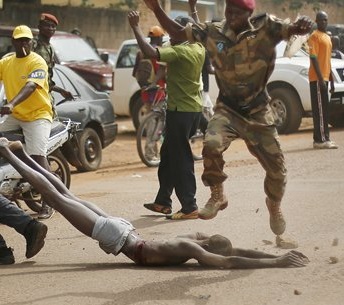
Grisly lynching just minutes after CAR peace promise

car2
Army recruits stomp on a suspected rebel

A group of soldiers in the turbulent Central African Republic capital of Bangui lynched a suspected rebel on Wednesday, minutes after hearing CAR’s new president promise to restore peace at a ceremony reinstating the divided country’s army.

A Reuters witness saw about 20 uniformed soldiers accuse a member of the crowd at a training centre in the capital Bangui of having belonged to Seleka, the mostly Muslim rebel group that seized power in a coup last March.

They then stabbed him repeatedly until he was dead. A soldier stamped on the lifeless body, which was then dragged through the streets, dismembered and set alight as residents looked on and took photographs.

Ten minutes earlier, about 20 metres away, the new interim president, Catherine Samba-Panza, had addressed the crowd of at least 1,000 soldiers at a ceremony meant to re-introduce the army to the nation after it effectively disappeared from view during Seleka’s rule.

“Within a month, I would like to fully secure the greater part of the country, and I aim to stick to my word,” she said.

Samba-Panza was appointed two weeks ago to lead the country until elections are held next February, after coup leader Michel Djotodia stepped down under intense international pressure. She made clear it would take time to restore order.

“At a certain point, everyone will be held responsible for their acts. I am warning troublemakers who continue to sow disorder in the country,” she said.

Seleka’s 10-month occupation of cities and towns across the country has been marked by rampant looting, torture and murder.

The deep resentment they spawned among the Christian majority led to the formation of Christian “anti-balaka” militias, meaning “anti-machete” in the local Sango language, further fanning the flames of inter-religious bloodshed.

About 1 million people, a quarter of the former French colony’s population, have fled their homes. Even the presence of 1,600 French soldiers and 5,000 African troops has so far failed to stop the tit-for-tat violence, which the UN says has already killed more than 2,000 people.

At least 22 people, including 16 women, were killed on Wednesday when Seleka fighters attacked the northwestern city of Nzakone, according to a resident of the village contacted by Reuters.

Chadian peacekeepers have been accused of facilitating the movements of Seleka leaders responsible for a new wave of atrocities.

Many of Seleka’s fighters come from Chad and Sudan, but Chadian officials deny supporting the rebels.

Chadian military officials said on Wednesday they had detained and disarmed 262 fleeing Seleka fighters that had entered Chad, seizing more than 300 weapons, ammunition and a dozen vehicles.

“We didn’t want to give our weapons to the French, so we crossed over to give them to the Chadians,” Seleka’s Colonel Ahmat Abdelkérim Bahar told a Reuters journalist in the town of Doba.

France’s defense minister says the military is likely to extend its mission in Central African Republic.

Jean-Yves Le Drian told RTL radio Thursday that extending the UN-mandated six-month mission was probably the best way to ensure a peaceful political transition.

Source: France24

Misread telexes on Iran’s nuclear led to fundamental error

iaeaWhen Western intelligence agencies began in the early 1990s to intercept telexes from an Iranian university to foreign high technology firms, intelligence analysts believed they saw the first signs of military involvement in Iran’s nuclear programme. That suspicion led to U.S. intelligence assessments over the next decade that Iran was secretly pursuing nuclear weapons.

The supposed evidence of military efforts to procure uranium enrichment equipment shown in the telexes was also the main premise of the International Atomic Energy Agency’s investigation of Iran’s nuclear programme from 2003 through 2007.

But the interpretation of the intercepted telexes on which later assessments were based turned out to have been a fundamental error. The analysts, eager to find evidence of an Iranian nuclear weapons programme, had wrongly assumed that the combination of interest in technologies that could be used in a nuclear programme and the apparent role of a military-related institution meant that the military was behind the procurement requests.

The intercepted telexes that set in train the series of U.S. intelligence assessments that Iran was working on nuclear weapons were sent from Sharif University of Technology in Tehran. Credit: public domain
In 2007-08, Iran provided hard evidence that the technologies had actually been sought by university teachers and researchers.

The intercepted telexes that set in train the series of U.S. intelligence assessments that Iran was working on nuclear weapons were sent from Sharif University of Technology in Tehran beginning in late 1990 and continued through 1992. The dates of the telexes, their specific procurement requests and the telex number of PHRC were all revealed in a February 2012 paper by David Albright, the executive director of the Institute for Science and International Security, and two co-authors.

The telexes that interested intelligence agencies following them all pertained to dual-use technologies, meaning that they were consistent with work on uranium conversion and enrichment but could also be used for non-nuclear applications.

But what raised acute suspicions on the part of intelligence analysts was the fact that those procurement requests bore the telex number of the Physics Research Center (PHRC), which was known to have contracts with the Iranian military.

U.S., British, German and Israeli foreign intelligence agencies were sharing raw intelligence on Iranian efforts to procure technology for its nuclear programme, according to published sources.
The telexes included requests for “high-vacuum” equipment, “ring” magnets, a balancing machine and cylinders of fluorine gas, all of which were viewed as useful for a programme of uranium conversion and enrichment.

The Schenck balancing machine ordered in late 1990 or early 1991 provoked interest among proliferation analysts, because it could be used to balance the rotor assembly parts on the P1 centrifuge for uranium enrichment. The “ring” magnets sought by the university were believed to be appropriate for centrifuge production.

The request for 45 cylinders of fluorine gas was considered suspicious, because fluorine is combined with uranium to produce uranium hexafluoride, the form of uranium that used for enrichment.

The first indirect allusion to evidence from the telexes in the news came in late 1992, when an official of the George H. W. Bush administration told The Washington Post that the administration had pushed for a complete cutoff of all nuclear-related technology to Iran, because of what was called “a suspicious procurement pattern”.[related_articles]

Then the Iranian efforts to obtain those specific technologies from major foreign suppliers were reported, without mentioning the intercepted telexes, in a Public Broadcasting System “Frontline” documentary called “Iran and the Bomb” broadcast in April 1993, which portrayed them as clear indications of an Iranian nuclear weapons programme.

The producer of the documentary, Herbert Krosney, described the Iranian procurement efforts in similar terms in his book “Deadly Business” published the same year.

In 1996, President Bill Clinton’s CIA Director John Deutch declared, “A wide variety of data indicate that Tehran has assigned civilian and military organisations to support the production of fissile material for nuclear weapons.”

For the next decade, the CIA’s non-proliferation specialists continued to rely on their analysis of the telexes to buttress their assessment that Iran was developing nuclear weapons. The top-secret 2001 National Intelligence Estimate bore the title “Iran Nuclear Weapons Program: Multifaceted and Poised to Succeed, but When?”

Former IAEA Deputy Director General for Safeguards Olli Heinonen recalled in a May 2012 article that the IAEA had obtained a “set of procurement information about the PHRC” – an obvious reference to the collection of telexes – which led him to launch an investigation in 2004 of what the IAEA later called the “Procurement activities by the former Head of PHRC”.

But after an August 2007 agreement between Iran and IAEA Director-General Mohamed ElBaradei on a timetable for the resolution of “all remaining issues”, Iran provided full information on all the procurement issues the IAEA had raised.

That information revealed that the former PHRC head, Sayyed Abbas Shahmoradi-Zavareh, who had been a professor at Sharif University at the time, had been asked by several faculty departments to help procure equipment or material for teaching and research.

Iran produced voluminous evidence to support its explanation for each of the procurement efforts the IAEA had questioned. It showed that the high vacuum equipment had been requested by the Physics Department for student experiments in evaporation and vacuum techniques for producing thin coatings by providing instruction manuals on the experiments, internal communications and even the shipping documents on the procurement.

The Physics Department had also requested the magnets for students to carry out “Lenz-Faraday experiments”, according to the evidence provided, including the instruction manuals, the original requests for funding and the invoice for cash sales from the supplier. The balancing machine was for the Mechanical Engineering Department, as was supported by similar documentation turned over to the IAEA. IAEA inspectors had also found that the machine was indeed located at the department.

The 45 cylinders of fluorine that Shahmoradi-Zavareh had tried to procure had been requested by the Office of Industrial Relations for research on the chemical stability of polymeric vessels, as shown by the original request letter and communications between the former PHRC head and the president of the university.

The IAEA report on February 2008 recorded the detailed documentation provided by Iran on each of the issues, none of which was challenged by the IAEA. The report declared the issue “no longer outstanding at this stage”, despite U.S. pressure on ElBaradei to avoid closing that or any other issue in the work programme, as reported in diplomatic cables released by WikiLeaks.

The IAEA report showed that the primary intelligence basis for the U.S. charge of an Iranian nuclear weapons programme for more than a decade had been erroneous.

That dramatic development in the Iran nuclear story went unnoticed in news media reporting on the IAEA report, however. By then the U.S. government, the IAEA and the news media had raised other evidence that was more dramatic – a set of documents supposedly purloined from an Iran laptop computer associated with an alleged covert Iranian nuclear weapons programme from 2001 to 2003. And the November 2007 NIE had concluded that Iran had been running such a programme but had halted it in 2003.

Despite the clear acceptance of the Iranian explanation by the IAEA, David Albright of ISIS has continued to argue that the telexes support suspicions that Iran’s Defence Ministry was involved in the nuclear programme.

In his February 2012 paper, Albright discusses the procurement requests documented in the telexes as though the IAEA investigation had been left without any resolution. Albright makes no reference to the detailed documentation provided by Iran in each case or to the IAEA’s determination that the issue was “no longer outstanding”.

Ten days later, the Washington Post published a news article reflecting Albright’s claim that the telexes proved that the PHRC had been guiding Iran’s secret uranium enrichment programme during the 1990s. The writer was evidently unaware that the February 2008 IAEA report had provided convincing evidence that the intelligence analyst’s interpretations had been fundamentally wrong.

Source: IPS

Gareth Porter, an investigative historian and journalist specialising in U.S. national security policy, received the UK-based Gellhorn Prize for journalism for 2011 for articles on the U.S. war in Afghanistan. His new book “Manufactured Crisis: the Untold Story of the Iran Nuclear Scare”, will be published in February 2014.

‘F–k the EU’

nulandThe State Department’s top official for Europe apologized today after being caught making a crude and dismissive remark about the European Union, one of America’s top allies.

A leaked phone call posted on YouTube caught Assistant Secretary of State for European and Eurasian Affairs Victoria Nuland saying “f–k the EU” while speaking with U.S. ambassador to Ukraine Geoffrey Pyatt.

Nuland used the expletive while complaining that the European Union hasn’t done enough to get Ukraine to break an agreement with Russia and instead sign on to a trade agreement with Europe.

Dmitry Loskutov, an aid to Russian Deputy Prime Minister Dmitry Rogozin, tweeted, “Sort of controversial judgment from Assistant Secretary of State Victoria Nuland speaking about the EU.”

State Department spokeswoman Jen Psaki said today that Nuland has apologized for the remark.

Psaki would not say to whom Nuland apologized.

The four-minute conversation was about a Jan. 25 offer by Ukranian President Viktor Yanukovich to two opposition leaders, who want him to sign the EU deal, to become prime minister and deputy prime minister.

Nuland said she wanted one of the two leaders to join the government, but that another was too inexperienced and should stay outside officialdom.

Asked if Nuland’s expletives reflected a wider frustration within the State Department towards the EU, Psaki said she had a certain comfort level with expletives.

Enter Numsa and the classless society

marxistjokeSouth African “comrades” are preparing for the rebellion of the landless, the poor and the unemployed.

The National Union of Metalworkers of South Africa (Numsa) are on the forefront with “political schools” in the country. The point of the schools is “to bring capitalism down”, but in South Africa’s racial reality it probably means a new, organized anti-white front.

“Numsa has taken the lead in the establishment of a new United Front that will co-ordinate struggles in the workplace and in communities,” read one of their key resolutions from their special national congress in December last year.

One of the speakers at the week-long school held in Gauteng, from the University of Johannesburg, is academic dr Carin Runciman. She assures the comrades once more that world we are living in is divided into two.

Runciman is lecturing on “Marxism as the dominant working-class ideology and programme in the 20th century”.

No one seems to mind her heavy Scottish accent. Strangely, dr Runciman has not a sinle photograph of herself on the Internet, although she works in the field of “social change”.

Runciman sifts through 10 years of data analysing protests in the country.

“There is this idea that the recent protests in Madibeng have been ‘popcorn protests’ with no informed organisation or outcome, but that isn’t true,” says Runciman.

She shows us a graph illustrating 24 protests recorded in the municipality since 2007. “Eleven of these cited water as a grievance,” Runciman says. “In 2013, all the protests in the area were related to water and sanitation.”

Her audience is suitably bamboozled by the graphs, stats and academese.

Numsa invited more than 100 small community organisations and grassroots protest movements to engage in the Marxist debate.

They aim to be “very democratic”, with all views allowed, but in fact the whole exercise is nauseatingly doctrinaire.

Numsa spokesperson Castro Ngobese laughs off rumours of Numsa joining the EFF or Wasp [Workers and Socialist Party].

“We’re playing the long game. We’re not in a rush like these guys,” says Ngobese.

More rumours abound about how true Marxist ideology at Numsa could single-handedly realign South African politics at the polls if it wanted to, in tearing the ANC apart.

Opinion is divided among the shop stewards in attendance at the course.

So-called “social movements”, many funded from outside the country, all hope that Numsa might deliver.


Massive corruption in SA’s schools

corruptschoolsThere is massive evidence of corruption in schools, a Corruption Watch report revealed on Thursday.

The organisation said 12% of reports on corruption it had received since its inception in 2012 related to alleged corruption in schools. Corruption Watch spokesperson Patience Mkosana said her organisation received reports of corruption directly from the public and then followed them up through door-to-door investigations.

The reports indicated that principals, school governing body (SGB) members and, to an extent, teachers, manipulated and abused the school system to enrich themselves. The concerns ranged from abuse of public funds received for infrastructure maintenance and upgrading, and sourcing of learning materials, to funding of feeding schemes.

The organisation conducted a survey after receiving reports on corruption at schools. It was conducted through social networking platform Mxit and sampled 3284 respondents aged between 13 and 34. Fifty-three percent of this group believed corruption in schools
was on the rise.

The Eastern Cape was the province perceived to have the most corrupt principals, according to 61% of respondents

Almost half of the respondents were pupils at school or at a further education and training college, while 31% were family members of a school pupil. At least 30% of pupils surveyed were from public schools and 8% were from private schools. There was no major difference between corruption at public schools and corruption at private schools.

Favours for better marks and the selling of exam papers were the most common forms of bribery. The selling of test and exam papers was a particular problem in Mpumalanga, where 23% of respondents believed it happened.

The misuse of school money or property was especially prevalent in the Free State, according to 30% of respondents, and the North West (31%). The main person behind such corruption, according to 47% of the respondents, was the school principal. Thirty-three percent said it was teachers and 14% claimed an SGB member was the culprit.

The Eastern Cape was the province perceived to have the most corrupt principals, according to 61% of respondents. The Free State had the worst teachers, and the Northern Cape the most corrupt SGB members, according to respondents.

Source: SABC