The two missiles that ended a confrontation in Syria

TridentA well informed diplomatic source told a Lebanese newspaper that “the US war on Syria had started and ended the moment those two ballistic missiles were fired, leaving inconsistent information, as Israel denied and Russia confirmed, until an Israeli statement was issued indicating they were fired in the context of an Israeli-US joint drill and fell in the sea, and that they were not related to the Syrian crisis.”

The source further told the Lebanese daily As-Safir that “the US forces fired these two rockets from a NATO base in Spain, and were instantly detected by the Russian radars and confronted by the Russian defense systems, so one of them exploded in the airspace and the second one diverted towards the sea.”

In this context, the source pointed out that “the statement issued by the Russian Defense Ministry, which stated the detection of two ballistic missiles fired towards the Middle East, intended to neglect two points: the first was the location from which the two rockets were fired, and the second was their downing. Why? Because the moment the full military operation was launched, Head of the Russian Intelligence Service contacted the US intelligence and informed it that “hitting Damascus means hitting Moscow, and we have removed the term “downed the two missiles” from the statement to preserve the bilateral relations and to avoid escalation. Therefore, you must immediately reconsider your policies, approaches and intentions on the Syrian crisis, as you must be certain that you cannot eliminate our presence in the Mediterranean.”

“This unannounced direct confrontation between Moscow and Washington increased the Obama Administration’s confusion and certainty that the Russian side was ready to move until the end with the Syrian cause, and that the US did not have a way out of its impasse except through a Russian initiative which would save America’s face…” he added.

From this point, the diplomatic source clarified that “in order to avoid further US confusion, and after Israel denied knowing anything about the rocket firing in its first statement, which is the truth, Washington demanded Tel Aviv to adopt the rocket firing to save its face in front of the International Community, especially since these two rockets were the beginning of the US aggression on Syria and the announcement of the beginning of military operations, after which US President Barack Obama was supposed to go to the G20 Summit in Russia to negotiate the destiny of Syrian President Bashr Al-Assad. However, he went to find a way out of the impasse he’s in.”

The source further indicated that “after the US-Russia rocket confrontation, Moscow intended to increase its number of military experts in Russia, and added to its military units and destroyers to enhance its military presence in the Mediterranean. It also set a time for announcing about its initiative on stopping the aggression on Syria after the G20 Summit, after drawing a side scene on the sidelines of the summit which was followed by two successive visits for Iranian Foreign Minister, Hussein Amir Abdul Lahyan, and Syrian Foreign Minister, Walid Al-Moallem, in which a way out was agreed on with the Russian side, and it included a Syrian announcement on approving the Russian initiative regarding putting Syrian chemical weapons under international supervision and preparing Syria for joining the non-proliferation treaty.

Finally, the source pointed out that “One of the first results of the US-Russian military confrontation was the British House of Commons’ rejection to participate in a war on Syria. This was followed by European stances, most significantly, the German stance announced by Chancellor Angela Merkel.” – almanar.com

Russia considers ban om GMO’s

mielieAs one of the few nations in the world with a GMO-free platform, Russia does not allow any cultivation of GMOs for commercial purposes. Their regulatory agencies recently suspended the import and use of an American GM corn following a study suggesting a link to breast cancer and organ damage. The Russian Prime Minister has now ordered the same agencies to consider a possible ban on all GMO imports into Russia.

The Russian Federal Environmental Assessment Commission has not adopted any commercialized GM varieties for agricultural use.

The recent decision by the Russians to suspend authorisation for American GM corn threatens to trigger a transatlantic commercial and diplomatic row.

A growing body of scientific research – done mostly in Europe, Russia, and other countries – showing that diets containing engineered corn or soya cause serious health problems in laboratory mice and rats.

Experts at the University of Caen conducted an experiment running for the full lives of rats – two years.

The findings, which were peer reviewed by independent experts before being published in a respected scientific journal, found raised levels of breast cancer, liver and kidney damage.

Russia’s consumer rights watchdog and Health Ministry, Rospotrebnadzor, announced one year ago that it had suspended the import and use of the Monsanto GM corn.

Now, the Russian Prime Minister Dmitry Medvedev has ordered the relevant agencies to consider a possible ban of all imports into Russia of products containing genetically modified organisms (GMOs) by October 15.

The order is addressed to Rospotrebnadzor, the Agriculture Ministry, and the Trade and Economic Development Ministry. They have been ordered to “submit proposals on amendments to the Russian legislation aimed at tightening control over the turnover of products containing components obtained from GMOs together with the relevant federal executive bodies.”

The aforementioned agencies are also ordered to submit proposals “on the possibility of banning the import of such products into the Russian Federation.”

A list of the prime minister’s orders was drawn up to fulfill the presidential orders issued after the meeting on the socio-economic development of the Rostov region held on September 18. Medvedev’s orders have been posted on the government website, Interfax news agency reported last September 25.

Russia is currently taking a hard line on GMOs — in August the first independent project for identifying whether Russian farmers are growing illegal GM crops started in the Belgorod region.

NAGS (The National Association for Genetic Safety) conducted the first checks of agricultural crops for the presence of GMOs. No GMO plants were found in any Belgorod fields.

According to the current law, 19 GM lines are allowed in foodstuffs, but the cultivation of GMOs is not allowed.

After joining the World Trade Organisation (WTO), Russia is being pressured simplify the procedure for registration of genetically modified products, seed and feed, to stop their safety checks, and to stop controls over their distribution.

Glyphosate is the world’s top selling herbicide, and Monsanto’s formulations Roundup is used with more than 80 percent of all genetically modified (GM) crops grown globally. But evidence of its extreme toxicity has been emerging within the past decade. Glyphosate was found to kill human placental cells at concentrations below that recommended for agricultural use and approved by our regulators, while Roundup was lethal at even lower concentrations.

The toxic effects of Roundup (R400) begin at 5 ppm, and the first endocrine disrupting action is already evident at 0.5 ppm, 800 times lower than the level of 400 ppm authorized by the US Environment Protection Agency in food or feed.

Denmark has imposed widespread bans on the spraying of glyphosate in response to research showing that the sprays have been contaminating the countrys groundwater.

The chemical has, against all expectations sieving down through the soil and polluting the ground water at a rate of five times more than the allowed level for drinking water, according to tests done by the Denmark and Greenland Geological Research Institution (DGGRI).

A decade ago, the Danish environment minister Hans Christian Schmidt announced unprecedented restrictions on glyphosate, the country’s and Europe’s most widely used herbicide. – wakingtimes.com

The great ‘non-story’ of Iraq

iraq2By Neil Clark

Another day and yet more death and destruction in the Middle East country.

The latest violence has killed at least 54 people and injured over 100 others. In July, over 1,000 people were killed and over 2,300 wounded.

You probably think I’m talking about Syria. But I’m not. I’m talking about Iraq. The country that George W. Bush and Tony Blair ‘liberated’ in 2003. The western military intervention was, we were told, going to usher in a wonderful era of democracy, freedom and human rights. Instead, it has ushered in an appalling decade-long blood-fest, with ordinary Iraqis having to endure a living nightmare of life in what has become one of the most dangerous countries on earth.

Rather like Sherlock Holmes’ The Curious Incident of the Dog in the Night-Time, the silence of pro-war commentators and politicians when it comes to the ongoing bloodshed in Iraq is most revealing.

The same elite figures in the West who couldn’t stop writing or talking about Iraq in 2002 and early 2003, telling us what a terrible threat Saddam Hussein’s ‘weapons of mass destruction’ were to us all, and how we needed to go to war with Iraq not only to disarm its evil dictator but to ‘liberate’ its people, are now silent in the light of the continuing bloodshed and havoc that the illegal invasion caused. In the run up to the invasion of March 2003, you couldn’t switch on a television news program in Britain or America without seeing a neo-con or ‘liberal interventionist’ obsessing about Iraq. In the lead-up to war, these great ‘humanitarians’ feigned concern for the plight of Iraqis living under Saddam’s dictatorship – but today show little or no concern for the plight of Iraqis being blown to pieces by bombs on a regular, almost daily basis. There are no calls from the ‘usual suspects’ for a Western ‘humanitarian’ intervention to stop the killing in Iraq. For these serial interventionists, Iraq, post-invasion, has become the greatest ‘non-story’ of the modern era. Instead, the same people who couldn’t stop talking about Iraq in 2002-2003 now can’t stop talking about Syria – feigning concern over the plight of Syrians in the same way they shed crocodile tears over Iraqis in early 2003.

It’s interesting that when it comes to casualty tolls, pro-war politicians can tell us exactly how many people have died in Syria since the violence started there in 2011, (and of course for them, all the deaths are the personal responsibility of President Assad), whereas when it comes to Iraq and the number of people who have been killed there since March 2003, there’s a great deal more vagueness. “We don’t do body counts on other people” Donald Rumsfeld famously declared in November 2003. The Iraqis killed since March 2003 (and casualty figures vary from around 174,000 to well over one million) are, for our political elite, ‘non-people.’ In 2013, it’s only dead Syrians (and Syrians whose deaths can be blamed on Syrian government forces) that matter – not dead Iraqis.

Because Iraq is deemed a ’non-story’ and our leaders never talk about the situation there, it’s no surprise to see that public perceptions of the death toll are way below even the most conservative estimates. Sixty-six percent of Britons in a poll earlier this year estimated that 20,000 or fewer Iraqis had died since the invasion of 2003. Donald Rumsfeld would no doubt be delighted to hear that.

If they had any sense of shame, the people who have destroyed Iraq would at least have had the grace to retire from public life. But neo-cons and liberal imperialists don’t do shame or remorse. The same bunch of ’humanitarian’ interventionists and hawks who urged the invasion of Iraq in 2003 have spent the last two years propagandizing for an attack on Syria. These manic warmongers would rather we ‘move on’ from Iraq to focus on the next Middle Eastern country on their hit list. But we must never ’move on’ from Iraq until those who destroyed the country are put in the dock. The chaos and bloodshed we see in Iraq today is a direct consequence of the destabilizing and destructive neo-con policies of the US and Britain and those responsible for ‘the supreme international crime’ of waging a war of aggression against a sovereign state must be held to account for the enormous amount of human misery they have caused.

Remorseless black baby killers sentenced

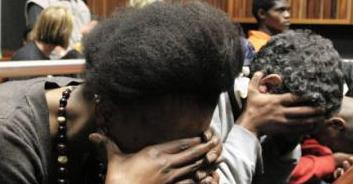
The black mother and father
The black mother and father in court

The black couple accused of the rape and culpable homicide of their 10-month-old baby were sentenced to 18 years in prison by the High Court sitting in the Palm Ridge Magistrate’s Court, Johannesburg, on Wednesday.

Judge Majeke Mabesele gave the coloured Adriaan Netto and his black girlfriend each four years for culpable homicide, three for child abuse and 15 for rape.

The sentences for the culpable homicide and rape would run concurrently.

Convicted baby killers Adriaan Netto and his girlfriend are cold and remorseless, Johannesburg Judge Majeke Mabesele said on Monday.

“We watched the parents testify. They were cold, but when each witness saw the pictures they (the witnesses) broke down because they once took care of her [the baby],” Mabesele said in the High Court sitting in the Palm Ridge Magistrate’s Court.

The pair were found guilty on September 18 of raping, assaulting, and causing the death of their 10-month-old baby girl.

The 34-year-old woman may not be named to protect the identities of her other children. Both remained in custody.

Mabesele listened to the pair’s legal representatives as they made pleas for lesser sentences based on personal circumstances. The mother cried as she was asked about her other children, who are under the care of relatives.

“I don’t think there are any words to describe how I’m feeling. I feel terrible, it’s something that will haunt me for the rest of my life,” she told the court.

The judge said their personal circumstances and the problems they faced while growing up were no excuse for the crime they committed.

Prosecutor Riana Williams told the court the woman had shown no remorse.

“The only remorse you have is that you are here and are going to be sentenced,” Williams said.

Mabesele said they should both go to jail as their lack of remorse might result in them doing the same to the other children.

“They are a danger to their children and they are not remorseful. Crying is not remorse. The fact that she is crying means nothing to me,” he said.

William Karam, for 37-year-old Netto, asked the court to be lenient on his client. He said the lack of evidence against his client should be taken into consideration.

“The lack of direct evidence and the incidents of aggression by accused two 1/8Netto 3/8 ought to cast them in a different light when it comes to sentencing,” he said.

Karam argued that a lack of witnesses and evidence of Netto physically abusing the child should be a factor for mitigation of sentence. He recounted Netto’s troubled childhood.

Mabesele and Williams said they were satisfied that relatives were taking care of the other children. – Sapa

Rapist cops a disturbing trend

saps5Criminologists have warned of a new “disturbing trend” – policemen who rape.

In the police watchdog’s latest annual report, released yesterday, the Independent Police Investigative Directorate’s acting executive director, Koekie Mbeki, said it was investigating 168 cases in which cops were accused of rape.

Mbeki said this figure was “substantially higher” than the 40 rape cases reported in the preceding financial year .

“It is a concern that officers face such serious charges,” she said, attributing the increase of rape in police custody to a lack of “command and control”.

Citing the current court case of a Randburg constable who was initially investigated for three alleged rapes but is now on trial for 17 counts of rape, Mbeki said: “There are standing orders to address rape but the implementation is inadequate.”

Western Cape (37) and Gauteng (27) have the highest number of such rape cases.

Institute of Security Studies policing researcher Johan Burger said: “In the past you thought of police criminality as corruption, murder and armed robbery, not rape.

“These figures bring home that rape committed by police is a real threat.”

The report also stated that 431 people had died as a result of police action this financial year, and 275 in police custody.

The document revealed a 37% increase in crimes by police – from 4923 cases in the 2011-2012 financial year to 6728 cases this latest financial year.

The majority of cases relate to assault (4137), the unlawful discharging of a firearm (676) and other criminal matters, including 539 cases of attempted murder.

The report said 42 people had died in domestic violence incidents involving police officers and 32 people were killed by officers allegedly driving negligently. There were 50 reported cases of police torture.

The number of deaths was highest in Gauteng (170) and KwaZulu-Natal (146).

Mbeki said 1088 cases were reported to the National Prosecuting Authority while 1040 were reported to police management for internal disciplinary procedures.

She said her directorate secured 57 criminal convictions. – timeslive.co.za

IMF wants trade unions reined in, labour brokers rewarded

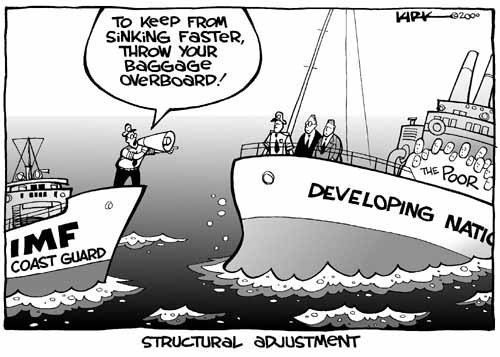
imfTrade unions need to be reined in. That is the advice given in an International Monetary Fund report on South Africa released on Tuesday .

The report strangely recommends the use of labour brokers. Labour broking has been called “human trafficking and a modern form of slavery” as it treats workers as profit-making commodities.

Brokers are generally viewed as parasites because they make labour more expensive in a country where unemployment is rife.

It urges the government to move more quickly in implementing its National Development Plan and massive infrastructure spending proposals. It also supported lower wage demands.

Noting that South Africa’s economic growth is lower than that of other emerging countries, and is too low to cut unemployment, the IMF suggests “a social bargain” that would pull together trade unions, business, government and labour brokers.

It urges “commitments to wage restraint” by trade unions. Increases of as much as 100% were demanded this year in the gold mining sector.

As the report was released, workers in the automotive components industry were past the three-week mark in their strike for higher wages. They are demanding an increase of more than 10% and have paralysed vehicle manufacturing.

Production at the world’s biggest platinum mining company, Anglo Platinum, has been disrupted. Members of the Association for Mineworkers and Construction Union have been on strike since Friday.

At South African Breweries, workers downed tools on Monday. The Food and Allied Workers’ Union is demanding a 9.5% increase.

The IMF report flags “escalating labour tensions” as “a key domestic risk”, the Times reported.

The IMF says that more jobs would be created if economic growth were stronger and the labour market “more flexible”.

“Unemployment remains stubbornly above 20%, or more than 30% when including those who have given up looking for a job. Youth unemployment is even higher at more than 50%,” says the report.

The IMF points to recent reforms in Mexico and suggests that South Africa should do something similar to loosen the hold of trade unions on the labour market. This hold, it said, has “produced an insider-outsider system that creates too few jobs and stifles growth”.

Compared to its peers, South Africa has been falling behind.

“Since 2009, South Africa’s growth has averaged 3% compared with 5% for emerging markets and 4% for commodity exporters,” says the report.

The IMF expects South Africa’s growth to slow to 2%.

It urges the government to “resist” a proposal to restrict the use of labour brokers , noting that temporary employment was responsible for a large share of employment growth in recent years.

Trade union federation Cosatu has been vocal in its campaign to get labour brokers banned.

The Treasury yesterday skirted around responding to calls for comprehensive reform of the labour market. It claimed that the issues raised by the IMF were already part of government policies and programmes.

“At its lekgotla in August, the cabinet agreed on a number of measures aimed at reigniting economic growth.

“These measures are in part informed by the recognition that the economy can no longer rely heavily on the global economy to reignite growth and create jobs for the millions of unemployed South Africans,” said the Treasury.

It said “actions are being taken to improve labour relations in key sectors”.

The IMF sees South Africa as more susceptible to shocks.

“In recent years, South Africa’s vulnerabilities [to adverse economic conditions] have increased considerably.”

ANC meeting ends in violence

ancA meeting of the ANC’s biggest branch in the Western Cape erupted in chaos this weekend when some of its members attacked others with knobkieries and pangas.

Four of the party’s members were rushed to a nearby hospital with head and back injuries.

The branch in Ward 40 Gugulethu met on Saturday evening in a rush to meet the deadline of nominating who should represent the party in next year’s provincial and national elections. The branch has 1 496 members and is expected to send 19 delegates to the list conference.

This represents nearly four percent of the 480 delegates at the party’s provincial list conference on October 19. This is the branch in which former ANC councillor Andile Lili and Loyiso Nkohla have large support and which ANC MPL Mcebisi Skwatsha belongs to.

Skwatsha was at the national executive committee meeting in Johannesburg at the weekend.

Other ANC heavyweights from the branch are Parliament’s Deputy Speaker Nomaindia Mfeketo and former chief whip Tony Yengeni.

Dullah Omar regional secretary Vuyiso Tyhalisisu said it was dark when the attack took place at the Baptist Church Hall in Barcelona informal settlement, Gugulethu.

Some members were still busy with registration. The meeting did not quorate at that time,” he said.

Tyhalisisu said a group of 15 people on the back of a white bakkie stopped outside and walked to the hall.

“They had knobkieries and pangas and started attacking people. People ran in every direction,” Tyhalisisu said. “The meeting never started.”

He said some ANC members were identified among the group.

Tyhalisisu said four of its members suffered head and back injuries and were taken to the KTC Day Hospital.

“They were discharged after a few hours,” he said.

Tyhalisisu said the ANC’s regional executive council (REC) had received information that the group had been given alcohol at a nearby tavern before the meeting.

“It is a serious issue. Some of our members would be too scared in the future to come to meetings for fear this could happen to them,” he said.

He said the branch will call those members identified to a disciplinary hearing.

ANC provincial secretary Songezo Mjongile said the party’s provincial executive committee (PEC) met on Monday and discussed the attack. He condemned the attack and said the PEC will investigate.

Police spokesman Tembinkosi Kinana said police had been called to the church hall after the assault.

“The suspects who could not be identified at the time fled in a white bakkie.

“Police have opened a charge of intent to cause grievous bodily harm,” he said. – Cape Times

Greece to draft ‘hate speech’ laws

Nikolaos Mihaloliakos

The leftist Greek government said on Monday it would soon present a bill targeting “racist hate speech”, part of a crackdown on the Golden Dawn party after an anti-fascist rapper died.

“(The bill) will be submitted to parliament in a matter of days. It has symbolic and moral value,” Deputy Prime Minister Evangelos Venizelos told reporters, adding that it would align Greek legislation with European standards.

Greece’s ruling coalition had been at loggerheads over whether it needed a new anti-racism law to deal with inflammatory talk used by Golden Dawn.

Venizelos’s Socialist PASOK party had pushed for a new law, while the main ruling conservative party of Prime Minister Antonis Samaras had argued that current legislation was enough.

But the murder of rapper Pavlos Fissas on September 17 by a suspected Golden Dawn supporter prompted a crackdown on Greece’s third-most popular party, whose fierce anti-immigrant rhetoric has attracted support amid a severe economic crisis.

Golden Dawn leader Nikolaos Mihaloliakos and four other party lawmakers are due to appear in court this week to respond to charges of forming a criminal organization.

The government is also preparing another law that would suspend Golden Dawn’s state funding on the grounds that its leadership is facing prosecution on felony charges.

“Democracy can’t fund its opponents,” Venizelos said.

Prosecutors are investigating the party for links to about 30 violent attacks, including the killing of the rapper and a Pakistani immigrant.

The party has denied any connection to the rapper’s death and also rejects the neo-Nazi label.

An outright ban of a political party is difficult under Greek law. The government plans instead to undermine Golden Dawn by cutting its money flows and dismantling its leadership.

Twitter hosting terror feeds and suggesting terrorists to follow

bridgetjohnsonBy Bridget Johnson.

Twitter has increasingly come under criticism for hosting terror feeds. Al-Shabaab is on it sixth account after getting suspended in the past for tweeting photos of a dead French special ops soldier, and most recently the Somali terror outlet blazed through a few accounts after suspensions for gloating about the Westgate mall massacre.

Their latest account has remained active for many days now and has racked up 59 tweets. During the attack and its aftermath, journalists were checking the Shabaab feed for its latest claims and links to statements.

So when al-Qaeda announced it had launched its first official Twitter account, I, like other journalists who cover terrorism, hit the follow button. The account was suspended Sunday by Twitter after being allowed to remain open since Tuesday, posting nearly 50 tweets.

On Saturday, I received one of those occasional emails from Twitter offering suggestions based on a recent follow — suggesting that I follow other terrorists.

The first suggested account, “Islam Workshop,” is connected to an al-Qaeda web forum to “rouse the believers”. On Saturday the feed posted a video removed by YouTube for violence, showing Qaeda- and Muslim Brotherhood-backed jihadists Ansar Beit al-Maqdes fighting Egyptian forces in the Sinai.

The second appears to be linked to the Al-Battar training camp, al-Qaeda’s program that has offered DIY as well as hands-on terrorist advice. These days Muaskar Al-Battar (Camp of the Sword) concentrates largely on bringing together groups with the same goal in a loosely connected network. The feed even has a nice camp photo as its backdrop, with more than a few Tsarnaev look-a-likes in the wooded hills.

The third suggested Twitter account appears linked to a Kurdistan-based affiliate of al-Qaeda.

The fourth claims to be “one of the foot soldiers” of Al-Shabaab, and posted several press photo from the Westgate attack while gloating about Shabaab’s gruesome accomplishments.

The last account, posing with the girl, is former Guantanamo Bay detainee Abdulaziz Sayer Owain al Shammari, who was arrested by Pakistan in 2001 and transferred to his home country Kuwait in 2005.

“Based on detainee’s deception history, it is assessed that he has received training on advanced counter-terrorism techniques, as well as above average terrorist training typically taught by Al-Qaida,” reads a 2004 Defense Department memo. “…Detainee is assessed to have connections to high-ranking Al-Qaida members.”

Twitter has said it can’t comment on users when asked to explain why terrorist accounts remain up. The only reason Al-Shabaab’s account fell a couple of times after the horrific Westgate attack was because of intense pressure from angry Twitter users.


Black students rally to keep racial privileges

What does it take to become equal?

Parliament should not “entertain” the memorandum by the youth wing of AfriForum, the Afrikaans rights lobby group, demanding universities should stop asking students to declare their race on application forms for placements and bursaries, said the Higher Education Transformation Network (HETN) on Monday.

“We urge Parliament to reject the proposals of AfriForum [Youth], as contained in their memorandum, on the grounds that the reasons for [declaring] race on forms and elsewhere in statutory bodies have not been addressed, let alone solved,” said Hendrick Makaneta, HETN’s spokesperson.

“It therefore remains inappropriate to even think of entertaining the memorandum from AfriForum,” he said.

AfriForum Youth delivered to Parliament on Heritage Day last week what they said was a memorandum against “racial profiling” by admission policies of the country’s universities. Charl Oberholzer, the organisation’s chairperson, told the Mail & Guardian on Monday it wants university admission policies to favour “all poor people, not just black people”.

“If we use socioeconomic conditions as a yardstick, instead of race, we’d all be better off. This would help all South Africans,” said Oberholzer.

“We shouldn’t have pro-race policies, but pro-poor policies. We can’t say all blacks are poor and all whites are rich.”

Race-based admissions
But HETN reminded AfriForum that race-based admissions are key to help empower disadvantaged communities and redress inequalities in the country.

“It is necessary for students to enter their race on admission and bursary forms in order to enable the institutions to keep track of whether or not they are doing enough to reverse more than three centuries of oppression and academic exclusion of black students, particularly in historically white institutions,” Makaneta said.

“The call from AfriForum is misplaced as it lacks the necessary will to take into cognisance more than 350 years of colonialism and oppression, which affected Africans in particular and black people in general.”

A lobby group that is already challenging institutions such as the University of Pretoria to transform, HETN claims to have up to 3 000 alumni members – most of whom are black. But Oberholzer dismissed it as an “organisation that has no support, [and] speaks for a few individuals”.

Oberholzer said AfriForum Youth’s proposal is designed to ensure the “black elite don’t benefit” from admission policies. “For example, it’s not fair that Tokyo Sexwale’s son benefits from affirmative action or gets into medical school based on his race. He’s already a billionaire,” he said.

He said there are many poor whites that are denied access. Whether one was poor could be determined in the same way candidates are granted study loans by the National Student Financial Aid Scheme of South Africa (NSFAS).

“When you apply for NSFAS, they know your parents’ income and where you come from. The same would apply for admissions.”

Afrikaans students
The AfriForum Youth student members who delivered the memorandum came from the University of Stellenbosch, the University of the Free State, the University of Pretoria and the North-West University, the organisation said. These are universities with sizeable number of Afrikaans students.

Moeketsi Letseka, senior researcher at the University of South Africa, said AfriForum Youth’s argument “doesn’t gel, not in this country”.

“Within 20 years of democracy we can’t just act like we’re a race-free country,” said Letseka.

“We can’t dispute that blacks have endured 350 years of unfairness.”

The white South Africans who usually “get paraded on TV as poor” are “not even a fraction of whites”, the majority of whom are wealthy, said Letseka.

There was still pressure on the country’s universities to ensure empowerment of the majority, he said. The declaration of a potential student’s race and supply of pertinent circumstantial information on application forms help universities establish the background of applicants, said Letseka. – M&G

Disgruntled black residents rise up

Burning tyres, a regular occurrence in South Africa

Disgruntled residents of Orange Grove in East London are threatening to make the Buffalo City Metro ungovernable. This after a meeting with Buffalo City Metro mayor Zukiswa Ncitha failed to yield positive results.

Residents are demanding RDP houses from the municipality. It’s alleged that the municipality has discovered that some of those on the list to get RDP houses do not actually qualify for them.

Meanwhile, a 17-year old girl has been shot dead during service delivery protests in Cato Crest near Durban. The young woman was part of a group demanding RDP houses that clashed with police.

In another protest incident, protesters at Mooiplaas informal settlement in Pretoria West have stoned police Nyalas, following an apparent service delivery protest.

The stoning of police vehicles comes after the R55 that connects Pretoria and Sandton was re-opened early Monday afternoon.

Protesters blocked the road with burning tyres and rocks in the morning. Police say there are unconfirmed allegations that some shops in the area have been burned.

The protesters were meeting community leaders and officials of the Tshwane metro. – Additional Reporting by Sapa.

Swiss war game sees bankrupt French invasion

suisseHordes of bankrupt French invade Switzerland to get their hands on their “stolen” money — such is the imaginary scenario cooked up by the Swiss military in simulations revealed over the weekend.

Carried out in August, the apparently outlandish army exercise was based on the premise of an attack by a financially stricken France split into warring regions, according to Matin Dimanche, the Lausanne-based daily.

One of these, “Saônia,” corresponding to the existing Jura region, was preparing attacks on Switzerland to retrieve money it had apparently swiped from France.

Operation “Duplex-Barbara” went as far as imagining a three-pronged invasion from points near Neufchâtel, Lausanne and Geneva, according to a map published in the Swiss newspaper.

Behind the dastardly raid was a paramilitary organisation dubbed BLD, the Dijon Free Brigade bent on grabbing back “money that Switzerland had stolen from Saônia”.

“For its credibility, the Swiss army must work (to ward against) threats of the 21st century,” Antoine Vielliard, Hauate-Savoie councillor, told Matin Dimanche.

However, Daniel Berger, captain of the Swiss armoured brigade, sought to play down the specificity of the threat.

“The exercise has strictly nothing to do with France, which we appreciate” he told the Swiss press. “It was prepared in 2012, when fiscal relations between both countries were less tense.” “French towns were cited to provide soldiers with a real scale,” he said.

Famous for its bank secrecy laws, Switzerland often comes under criticism for allowing foreign account holders to hide their wealth from tax officials at home.

But these opaque laws are coming under increasing fire as France and the US, among others, are cracking down on tax evasion during a period of economic hardship.

This is by no means the first imaginary scenario dreamed up by the Swiss army. Last year, it carried out an exercise based on the premise that a huge wave of refugees crossed into the country after the implosion of the European Single Currency and ensuing chaos across the continent.

“Stabilo Due” centered around a risk map created in 2010 and envisaged internal unrest between warring factions as well as the possibility of refugees from Greece, Spain, Italy, France, and Portugal.

Warning of an escalation of violence in Europe, defense minister Ueli Maurer said at the time: “I can’t exclude that in the coming years we may need the army.” The military is a hot topic in Switzerland, which has mandatory military service. Under Swiss law, all able-bodied men at age 19 have to undergo five months of training, followed by refresher courses of several weeks over the next decade.

A referendum held a week ago saw a large majority of Swiss voters reject plans to abolish conscription.

The current number of recruits stands at around 155, 000 — the biggest army in Europe relative to population size.

Some 73.2 per cent of Swiss said “no” to proposals by the anti-military group, Group for a Switzerland Without an Army, to have either a professional army or one made up of volunteers.

Neutral Switzerland has not been invaded since the Napoleonic Wars of the early 19th century.

Recent scholars have questioned the belief that the Swiss military’s complex of underground bunkers deterred an invasion by the Nazis during the Second World War.

Some historians argued that Adolf Hitler left the Swiss alone because he wanted to use their banks. – The Telegraph

Maponya criticises BEE

Richard Maponya
Richard Maponya

Businessman Richard Maponya criticised the government and black economic empowerment in an interview published in the Sowetan on Monday.

“It (BEE) is not a real thing because it takes away the self-initiative needed from young and up and coming entrepreneurs who must wake up and want to do the things themselves,” he said at the sixth birthday celebrations of Maponya Mall in Soweto on Friday.

He said broad-based black economic empowerment (BBBEE) was a good idea in principle, but in practice it did not always work.

“I really blame our government for the economic situation because we are nearly 20 years into our new dispensation but we have not come up with a bank that would give people a risk fund.”

He also said black and white business needed to unite, but added that white business people and foreigners should not be allowed to dominate business in townships.

“Soweto has suddenly become a place where white business people want to do business, when small entrepreneurs of the area should be given an opportunity to own business here,” said Maponya. – Sapa