President Jacob Zuma has informed Parliament that 1345 soldiers have been deployed to the Democratic Republic of Congo (DRC), the presidency said on Friday.
“Our soldiers are doing exceptionally well in the continent. We congratulate them and assure them of the support of their compatriots as they continue to contribute to the building of a better Africa, as a force for peace,” Zuma said in a statement.
“We are very proud of them and their contribution to African renewal and development.”
The deployment was from June 13, 2013 to March 31, 2014. The expected cost of the deployment was R402,800,000.
The soldiers would be part of a “force intervention brigade”, under the United Nations Monusco peacekeeping force.
Zuma arrived in Luanda, Angola, on Thursday for consultations with Angolan President José Eduardo dos Santos and DRC President Joseph Kabila Kabange.
“The three heads of state are expected to discuss a range of issues relating to peace and stability in the region, particularly the current peace efforts in the DRC,” Zuma’s spokesman Mac Maharaj said in a statement at the time.
The SA National Defence Force said on Friday that South African soldiers in the DRC had not been engaged in armed combat with rebels in the country,
“I can confirm that… the DRC [defence] force engaged with the M23 rebels,” SANDF spokesman Siphiwe Dlamini said.
“We are in a defensive line — we are not engaging.”
He said the intervention brigade comprising of soldiers from South Africa, Tanzania, and Malawi was mandated to engage “armed groups”.
“They will not wait and watch while civilians are being attacked by armed groups,” Dlamini said.
“They will intervene to engage, neutralise, and disarm.”
On Thursday news agency Agence France-Presse reported that fresh fighting broke out outside the city of Goma.
M23 rebels attacked government-held positions on Wednesday night 20 kilometres north of the capital of North Kivu province.
Both sides said they were not yet able to say how many people had been killed or wounded. – Sapa
US actor Ben Affleck will replace Christian Bale in the next Batman film, Warner Bros. Pictures said.
Affleck will appear in a Batman-Superman mega flick slated for release in 2015 that follows on the heels of this summer’s Superman hit “Man of Steel.”
Bale, who played the title role in Christopher Nolan’s “Batman” trilogy, had left the doors wide open for a new successor.
“We knew we needed an extraordinary actor to take on one of DC Comics’ most enduringly popular super heroes, and Ben Affleck certainly fits that bill and then some,” said Warner Bros. president Greg Silverman in a statement.
The film, which is not yet titled, will be directed by Zack Snyder, who was behind this summer’s “Man of Steel” starring Henry Cavill of Britain.
Cavill will appear alongside Affleck in the 2015 film.
“Ben provides an interesting counter-balance to Henry’s Superman. He has the acting chops to create a layered portrayal of a man who is older and wiser than Clark Kent and bears the scars of a seasoned crime fighter, but retain the charm that the world sees in billionaire Bruce Wayne,” Snyder said.
“Man of Steel” has earned some $650 million worldwide and $290 million in North America alone.
Affleck is no stranger to superheros, having played Matt Murdock in the 2003 flop “Daredevil.”
More notably, Affleck arrived at the pinnacle of Hollywood accomplishment in 2013 when his movie “Argo” won the Oscar for best film last February. – AFP
Police are investigating another 44 people with possible links to an international child pornography ring, and have obtained at least 30 search warrants so far, a spokesman said on Friday.
“We did an investigation on 50 suspects… we then obtained 30 search warrants early in August,” said Lt-Gen Solomon Makgale.
“We executed those warrants and that’s how we arrested those six. The six are part of the 50.”
Police had followed up on a tip-off from Interpol last Thursday and arrested six men in four provinces for possession of child porn.
The accused were arrested in Lichtenburg, Bloemfontein, White River, Douglasdale, Florida, and Potchefstroom.
They were a teacher, a retired school principal, a headmaster, a lawyer, a dermatologist, and a businessman.
Since the arrests, they had appeared in various South African courts separately and had their cases postponed.
Makgale said police were trying to obtain the remaining 20 search warrants.
He could not confirm a report in The Times that among the alleged paedophiles were top executives of banks, insurance firms, legal practices, and IT companies.
On Wednesday, the newspaper reported the case had links to Canada, the United Kingdom, the United States, Western Europe, and Australasia.
It reported that children as young as five were believed to have been groomed to have sex with each other and adults. – Sapa
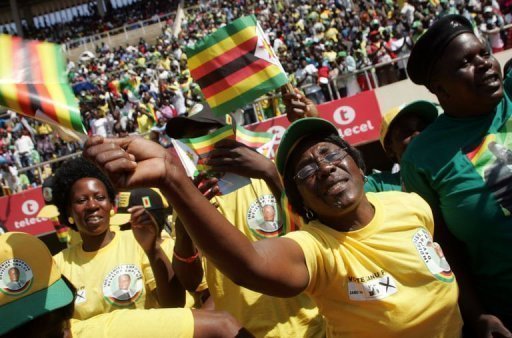
Flag-waving Mugabe supporters on 13 August 2013 in Harare (AFP file photo)
by Reagan Mashavave
Veteran Zimbabwean President Robert Mugabe hit out at “vile” Western critics as he was sworn in for another five-year term Thursday in a stadium packed with jubilant supporters.
Festooned in a sash, garland and medals, the 89-year-old dismissed accusations the July 31 election that returned him to power was rigged and vowed to rejuvenate the foreign-dominated banking and mining sectors.
Mugabe’s 33-year rule since Zimbabwe’s independence has been marked a drive to transfer foreign-owned and white-owned assets, including farms, to blacks.
“I promise you better conditions,” he told the 60,000 capacity crowd of supporters at a stadium in Harare.
“The mining sector will be the centrepiece of our economic recovery and growth. It should generate growth spurts across sector, reignite that economic miracle which must now happen.”
Mugabe’s inner circle has faced decades of international sanctions over rights abuses, and the veteran leader said he expected the punitive measures to continue.
“Most likely we shall remain under these sanctions for much longer.”
“We continue to look East,” Mugabe said lampooning, Western countries which have called into question the legitimacy of his election victory.
“We dismiss them as the vile ones whose moral turpitude we must mourn,” he said venting against Britain, Australia, Canada and the United States.
Former colonial power Britain called Thursday for an “independent investigation” into the conduct of the election, which Mugabe officially won by a landslide.
Unlike previous low-key investitures, Thursday’s event — replete with banners, flags and chants — carried strong echoes of Mugabe’s inauguration as prime minister of a newly independent Zimbabwe in 1980.
A no-show by many leaders from neighbouring countries — including President Jacob Zuma of regional power-broker South Africa — did little to dampen enthusiasm.
Neither did a boycott by opposition leader and former prime minister Morgan Tsvangirai, who insists the July 31 vote was stolen.
Mugabe was greeted in the stadium by thunderous cheers and whistling. On board a military truck he inspected assembled military personnel.
Gates to the Chinese-built stadium, the venue of Mugabe’s inauguration as president in 1987, opened shortly after dawn.
The day was declared a public holiday, helping boost attendance.
“Mr Mugabe, you are one of a kind,” sang a group of supporters slamming the sides of the minibus taking them to the stadium, while others waved fists as drivers honked their horns.
“It is a great day for Zimbabwe and the world will come to a standstill today,” said Alfred Tome, the Harare provincial administrator and spokesman for the organisers.
A concert will include artists from South Africa, Zambia and Jamaica –whose iconic singer Bob Marley played at Zimbabwe’s independence event.
Banners around the oval stadium carried messages praising African leaders and denouncing Western governments accused of meddling in Zimbabwe’s political affairs.
“Which African ever observed elections in Europe, America?” read one banner. “Africa has spoken, respect it’s voice,” said another.
The inauguration had been delayed after Tsvangirai challenged the poll results — which he denounced as “massive fraud” — in a petition to the Constitutional Court that was later withdrawn.
Among a series of complaints, Tsvangirai queried the suspiciously high number of voters who were turned away from polling stations in urban areas, which are considered opposition strongholds.
He also charged that his party’s supporters in rural areas were intimidated by Mugabe party backers into feigning illiteracy and voting in the presence of police and election officers.
The Constitutional Court confirmed Mugabe as president and declared the elections “free, fair and credible”, saying the results “reflected the free will of the people of Zimbabwe”.
‘Farewell event for Mugabe’
Eldred Masunungure, a political scientist from the University of Zimbabwe, said the event was at once Mugabe’s victory lap and his “last supper”.
“This inauguration is being projected as the crowning of a victory of a struggle for the past 13 years against big Western powers,” he said.
There is however also an “unintended meaning”, he said. “It can be read as a farewell event for Mugabe. It reminds one of Jesus’s Last Supper.”
The electoral commission declared Mugabe winner with 61 percent of the vote, against 34 percent for former prime minister Tsvangirai.
The vote ended a shaky power-sharing government formed by Mugabe and Tsvangirai four years ago to avoid a tip into all-out conflict following a bloody presidential run-off election in 2008.
Local observers judged the elections flawed and Western powers have raised serious doubts over the vote.
But regional groupings the Southern African Development Community and the African Union were less critical. – AFP
The march on Washington that took place on 28 August 1963. About 80% of participants were black and an estimated 250 000 people took part.
by Shaun Tandon
As 250,000 people packed central Washington to push for civil rights 50 years ago, the actor Burt Lancaster opened a scroll and read a petition brought in from Paris.
The statement, signed by 1,500 Americans in the French capital, saluted the March on Washington for providing “an example of what America aspires to become.”
“All Americans, traveling no matter where in the world today, are in the position of ambassadors and are very often made bitterly aware of our country’s reputation,” said the petition, read by Lancaster in his crisp delivery.
“It is not easy to be an American abroad,” said the petition, calling the movement for civil rights part of a “struggle toward freedom” being waged worldwide.
American students learn of the March on Washington for Jobs and Freedom as a defining moment in the nation’s history, with Martin Luther King Jr. delivering his “I Have a Dream” speech and Congress less than a year later banning laws that enforced racial segregation.
But the march also carried an international dimension, coming at a delicate moment in the Cold War in which the United States increasingly realized that its oppression of African Americans cost it dearly on the global stage.
The march was one of the first events to be broadcast live internationally, with the BBC and other networks in Europe fed from the then-revolutionary Telstar satellite. The now defunct Washington Evening Star reported that police issued media credentials to television crews from Canada, France, Germany and Japan.
The Americans in Paris, in an initiative organized partly by self-exiled novelist James Baldwin, walked to the US embassy ahead of the march to show solidarity. Similar gatherings took place in other cities, although — in one echo of how little has changed 50 years later — authorities prevented a demonstration in Cairo.
Mary L. Dudziak, a professor at the Emory University School of Law and author of the book “Cold War Civil Rights,” said that John F. Kennedy’s administration initially opposed the march but, unable to stop it, gave out talking points to US diplomats.
The message, she said, was to cast the march not as a protest against racial injustice but as a triumph of free expression that could not happen under Communism. Much of the global media embraced a similar narrative, other than in the Soviet bloc where newspapers were predictably critical.
“The US government felt like they had effectively used the story of the march to reinforce their Cold War message about the wonders of democracy,” Dudziak said.
The United States, which since its independence has prided itself on its values, has faced international pressure at various points of its history over its own human rights record.
Abolitionist Frederick Douglass campaigned in England before the US Civil War. In more recent times, the United States has faced European criticism over capital punishment and its prison camp for terror suspects at Guantanamo Bay in Cuba.
But Dudziak said that 1963 was a particularly sensitive moment, with much of Africa freshly independent and Cold War alliances not yet solidified.
“In this very dynamic and fluid environment, the US cared a lot about the American image. American diplomats and presidents thought that that was going to have an impact on their ability to develop alliances and keep countries on the democratic side of the column,” she said.
In a cause of deep embarrassment, African diplomats were routinely snubbed when traveling near Washington. A highway cafe in Maryland in 1961 refused to serve the ambassador of newly independent Chad as he was heading to Washington from New York to present his credentials to Kennedy.
Besides Africa, the United States paid close attention to coverage of the civil rights movement in India, a democracy which refused to take sides in the Cold War.
In an editorial at the time, The Indian Express said that African Americans “have every right to feel frustrated” with their conditions but lauded the “new mood” represented by the peace march.
In a news article, the newspaper said that the US ambassador, Chester Bowles, had sent a telegram to King voicing support for the march and noting that the civil rights leader was inspired by Mahatma Gandhi, India’s independence leader and apostle of non-violence. – AFP
South Africa hope to maintain the momentum from four victories and 25 tries this season when they face Argentina for the second consecutive weekend in Mendoza Saturday.
The Springboks made a dream start to the Rugby Championship last Saturday in Soweto, scoring nine tries in a 73-13 romp against Los Pumas.
It was a record winning margin for the southern hemisphere championship and cast South Africa in a new light of adventurous and exciting rugby rather than a predictable kick-and-chase outfit.
Full-back Willie le Roux
South Africa scored 23 tries in 12 Tests last year — this season they have already notched 25 against Italy, Scotland, Samoa and Argentina with JJ Engelbrecht and Bryan Habana claiming four each.
The try fest stems from a settled backline with full-back Willie le Roux, wings Bjorn Basson and Habana, centres Engelbrecht and Jean de Villiers, and star goal-kicking fly-half Morne Steyn beginning all four games.
Forwards have also got in on the scoring act with hooker Adriaan Strauss and flank Francois Louw bagging two apiece and four others also dotting down.
Satisfied that the team have improved since he took charge last year, coach Heyneke Meyer wants to see the recent home form transferred to western Argentina.
His ambition with an unchanged starting line-up is another bonus-point victory against opponents who have made five alterations, three of them injury induced.
“We are developing a killer instinct as a team and the challenge now is to have the same attitude away from home,” Meyer told reporters.
“Last weekend has to be forgotten and we must show ruthlessness against a wounded opponent. We were clinical in Soweto and we must be equally clinical in Mendoza.
“Those tries did not come from throwing the ball around, the team played with structure and purpose and wore down the Pumas. That is what we must build on.”
Meyer hardly needs to remind his men in green and gold how close they came to suffering a first defeat in Argentina at the Estadio Malvinas Argentinas last season.
A try by currently injured centre Francois Steyn after he charged down a clearance kick gave the Springboks a 16-16 draw they did not deserve.
Among the Argentine stars last August in the city at the foothills of the Andes were prop Rodrigo Roncero and No.8 and captain Juan Martin Hernandez Lobbe.
They instilled a passion to the Pumas pack that was sadly lacking last weekend with the South Americans a beaten team long before the final whistle.
It did not help a team competing in the Championship for only the second season that they lost lock Patricio Albacete and full-back Juan Martin Hernandez to early injuries.
Nor were chances of a maiden win boosted by the yellow carding of hooker Eusebio Guinazu for a deliberate knock-on and No.8 Leonardo Senatore for a high, dangerous tackle.
England-based Guinazu and Senatore are in the starting line-up again, but veteran workhorse Albacete and enterprising Hernandez have not recovered.
Lobbe, who helped French side Toulon win the Heineken Cup last season, remains sidelined and his continued absence is a massive blow.
“We had a lot of things to do this week, starting with the mentality of the players,” admitted Argentina coach and former star forward Santiago Phelan.
“The team realises that the second season is going to be much tougher than the first and we are up against the three best rugby teams in the world.
“We need to grow up, we need to learn about intensity, we need to keep playing the top teams in order to learn and improve,” he stressed.
Dominant in the set pieces and loose exchanges a week ago, South Africa seem set to triumph in a country where their biggest winning margin was 32 points nine years ago.
But if Argentina can rekindle the passion of last season and tackle better — they missed one in three in Soweto — another humiliating defeat should be avoided. – AFP
Drugs worth millions were found in a suitcase at the OR Tambo International Airport, the Hawks said on Friday.
“Yesterday [Thursday] at around 4pm…the police at the airport and customs searched an unclaimed luggage bag containing 20kg of crystal meth worth R56m,” said Captain Paul Ramaloko.
“When we tried to check who the person was, by that time, the person disappeared.”
No arrests had been made yet.
The bag had come off a flight from Abu Dhabi. – Sapa
The Arkansas National Guard forcing the school to accept nine black students in Little Rock, Arkansas
As the USA commemorates with fanfare the so-called “March on Washington in August 1963” by black Americans, here follows some of the milestones on the road to equal rights between blacks and whites in the United States:
December 1955 -MONTGOMERY BUS BOYCOTT: Rosa Parks, an African American from Montgomery, Alabama, became an icon of the civil rights movement. Age 42 at the time, she refused to vacate her bus seat for white passengers. She was arrested and sentenced to a fine for violating segregation laws. Black people led by the clergyman Martin Luther King Jr organised a boycott of the city’s buses in protest. Thirteen months later, the Supreme Court in Washington ruled that segregation on public buses was unconstitutional.
September 1957 – LITTLE ROCK NINE: Nine black students became the first African Americans to be admitted into a previously all-white public high school in Little Rock, Arkansas. The governor deployed the National Guard to prevent them from attending the school. US president Dwight D Eisenhower federalised the National Guard and established his own command above the governors, and deployed soldiers to enforce integration. A 1954 ruling by the Supreme Court in Washington had officially ended racial segregation in public schools, but it took years until that was fully implemented within individual states. February 1960 – RESTAURANT SIT-IN: Four African American students sat at a restaurant counter reserved for whites only in Greensboro, North Carolina. Their sit-in was the start of many nonviolent actions across the South to demand the end of segregation in public places. This group evolved into the Student Nonviolent Coordinating Committee (SNCC).
August 1963 – MARCH ON WASHINGTON: Around 250,000 people rallied in Washington to protest discrimination in jobs and living, at the time the largest demonstration in the history of the United States. The highlight of the event was Martin Luther King Jr’s “I Have a Dream” speech, in which he demanded that blacks and whites live as equals. King was awarded the Nobel Peace Prize in 1964 for his non-violent fight to end segregation. Four years later at age 39, he was felled by an assassin’s bullet.
March 1965 – SELMA-MONTGOMERY MARCHES: Civil rights groups launched in Selma, Alabama, a programme to register blacks to vote. On March 7, 600 people started to march from Selma to the Alabama state capital Montgomery, 86 kilometres away. Police attacked participants. The so-called “Bloody Sunday” left scores of people injured, and single participants were later killed. The second march also failed to reach its desired destination. After a third march that was protected by the National Guard, King addressed 25,000 people in Montgomery in March 24. In August 1965, US president Lyndon B Johnson signed into law the Voting Rights Act, which banned poll taxes and literacy tests that kept blacks from registering to vote. Millions signed up after the act passed. – dpa
Police say a young woman photojournalist has been gang raped while her male colleague was tied up and beaten in India’s business hub of Mumbai. The case was reminiscent of the December gang rape of a young university student in the Indian capital.
Police said the woman was on assignment to take pictures of an abandoned textile factory in south Mumbai late Thursday when five men confronted her, and offered to help her get permission to shoot inside the building. Police Commissioner Satyapal Singh told reporters that the men tied her colleague’s hands with a belt while she was gang raped. The woman, reported to be in her early 20s, is in stable condition in hospital.
The assault comes amid heightened concerns about sexual violence in India. – AP
Egypt’s toppled dictator Hosni Mubarak was transferred from prison to house arrest at a military hospital on Thursday, in a move overshadowed by a blistering crackdown against his Islamist successors.
The former strongman, forced to quit in early 2011, was flown by medical helicopter to a military hospital, where he will remain under house arrest as he stands trial on corruption and murder charges.
His ouster in 2011 was a pivotal moment in regional democratic upheavals that in Egypt led to an Islamist government, which lasted a year before a popularly backed military coup last month.
In other circumstances, the 85-year-old’s removal from prison might have caused shockwaves.
But with Egypt mired in a deadly conflict between the military-installed government and Islamists, Mubarak’s transfer took place amid little fanfare or protest.
He was ordered released after his lawyer argued Mubarak’s stay in prison had exceeded the maximum pre-verdict detention, and Mubarak made financial amends for one of his charges.
He still faces trial for corruption and his role in the deaths of protesters during the uprising that toppled him, with his next hearing on Sunday.
Prime Minister Hazem al-Beblawi, empowered with the authority to order arrests under the current state of emergency, ordered Mubarak to be placed under house arrest after release from jail.
Mubarak chose to be held at the military hospital, the official MENA news agency reported.
The decision to grant Mubarak pre-trial release added a volatile new element to the political turmoil that has gripped Egypt since the army ousted Islamist president Mohamed Morsi on July 3 following massive protests against him.
More than 1,000 people have been killed in the past week in violence following the forcible break-up of two pro-Morsi camps in the capital.
Authorities have arrested dozens of members of Morsi’s Muslim Brotherhood, including its supreme guide Mohamed Badie — the first time the group’s chief has been arrested since 1981.
Morsi himself is being held at a secret location and faces charges related to his 2011 escape from prison and inciting the death and torture of protesters.
The juxtaposition between the fates of the two ousted presidents, Mubarak and Morsi, is notable, analyst Hisham Kassem said.
Mubarak “committed numerous crimes… against the country, but managed to hide the evidence, particularly as all the state’s institutions were working for him at the time he was overthrown”.
“The opposite is true for Morsi, who was thrown in prison while all the state’s apparatus were against him.”
Arrests of Brotherhood leaders continued, with authorities detaining Ahmed Aref, a spokesman for the group, in Cairo.
Despite the pressure, a Brotherhood-led coalition has defiantly called for mass rallies on Friday, in a test of its support following the crackdown.
Egypt has experienced unprecedented political bloodletting since August 14, when security forces stormed two pro-Morsi protest camps in the capital.
The crackdown and resulting violence across the country killed nearly 600 people in a single day, the bloodiest in Egypt’s recent history.
Islamists have been accused of torching and attacking dozens of Christian churches, schools, businesses and homes — mostly in the rural south –accusing Egypt’s sizable Coptic minority of backing Morsi’s ouster.
On Thursday, Human Rights Watch condemned the government for failing to protect churches, but also the Brotherhood for failing to halt incitement against Christians.
Violence has also targeted police and soldiers, including two who were killed in a drive-by shooting near the Suez Canal town of Ismailia on Thursday.
The unrest has prompted international criticism, and EU foreign ministers agreed at an emergency meeting Wednesday to suspend the sale of arms and security equipment to Cairo in response to the mounting violence.
They issued a statement calling recent security operations “disproportionate”, while also condemning “acts of terrorism” in the Sinai and the church attacks.
But they expressed concern over the economic situation and said “assistance in the socio-economic sector and to civil society will continue”.
The United States has also criticised the violence, as well as Badie’s arrest, and announced the cancellation of joint military exercises.
But it has stopped short of halting its $1.3 billion annual defence aid package to Egypt, and denied reports it was withholding aid.
Washington on Thursday also sidestepped questions about Mubarak’s release, saying it was a matter for Cairo to decide, but called for Morsi to be freed.
“With respect to the Mubarak trial and decisions made, this is an internal Egyptian legal matter,” said State Department spokeswoman Jen Psaki.
“Our position on Mr. Morsi remains the same. We believe there should be a process for his release,” Psaki said.
Reporters had for days asked the State Department to comment on the seemingly paradoxical situation of the two leaders.
Oil-rich Saudi Arabia, which backs the army-installed interim government, has said it would step in with other Arab nations to fill any funding gap if Washington halts aid.
Meanwhile, a Hamas official said Egypt was set to reopen the Rafah border crossing with the Gaza Strip daily from Saturday after closing it in the wake of last week’s bloodshed. – AFP
Germany’s decade-long failure to uncover a neo-Nazi cell blamed in the killings of immigrants was the fault of incompetence in the police and intelligence services, a commission of inquiry was expected to report Thursday.
Eight Turkish shopkeepers, a Greek man and a policewoman were shot to death in attacks in multiple cities from 2000 to 2007, but police only connected the crimes to the self-styled National Socialist Underground (NSU) four years after the last slaying.
The commission, made up of members of parliament, is to publish its findings after a year and a half of hearings and is to recommend reforms.
Sebastian Edathy, an opposition Social Democrat who chaired the inquiry, said the committee determined that the most horrifying suspicion, that detectives or secret agents might have protected the gang of two men and one woman, was unfounded.
“We did not find any evidence whatsoever that the authorities knew who was behind the crimes or looked the other way or even deliberately helped the perpetrators,” Edathy said. “We followed up every clue.”
Instead, the committee was expected to attribute the failure to across-the-board incompetence by about three dozen squabbling investigative agencies.
“This was a failure by the authorities without historical parallel,” Edathy said.
“November 4, 2011, when the trio was discovered was to us what September 11, 2001, was to the Americans,” he said. “It was the day we realized that our complete security architecture in Germany was not attuned to things like far-right terrorism.”
Germany monitors the wider neo-Nazi movement, which numbers about 5,000, and pays insiders to be informers but overlooked the cell.
The 1,000-page report was expected to conclude that police and agents failed to follow up clues, such as sightings of the neo-Nazis; worked under false assumptions because of institutional racism; and refused to share data with one another because of turf wars.
A parliamentary debate on the report was scheduled September 2.
The two accused gunmen died in a killing-cum-suicide before they could be caught. A judicial finding of their responsibility in the crimes was expected at the end of the current trial of Beate Zschape, the female survivor of the trio. She is charged as an accomplice to murder. – dpa
A principal of a high profile private school in Mpumalanga has been fired after being arrested in connection with an international child pornography syndicate.
The man who cannot be named until he pleads appeared in the White River Magistrate’s Court on Wednesday and was released on R1000 bail, a Sapa correspondent reported.
“Today, we have come up with an agreement to terminate his position in the school,” the school board announced in a statement on Wednesday.
The board said it regarded the allegation in the most serious light while respecting his constitutionally protected right to be presumed innocent until proven guilty.
The accused, who is an award-winning author, has been headmaster at the preparatory school for the past three years.
The board described him as a man “characterised by exceptional professionalism,” who also enjoyed the respect of his teaching colleagues, parents and pupils alike.
He is suspected of being part of a syndicate, which includes five other people across the country.
A total of six professionals have appeared in courts throughout the country for child pornography.
The six included two teachers and a retired principal, a lawyer, a dermatologist, and a businessman.
Police spokesman Lt-Gen Solomon Makgale said the accused were arrested in Lichtenburg, Bloemfontein, White River, Douglasdale, Florida, and Potchefstroom.
“They are all suspected to have been involved in an international child pornography syndicate,” said Makgale.
Makgale said police were investigating whether the six were involved in distribution and manufacturing of child pornography, and if they were linked to an international syndicate.
At the weekend, police raided several homes in KwaZulu-Natal, Eastern Cape, Western Cape and Free State.
Among the items seized were 672 dvds, 22 memory sticks, eight laptops, two computer tablets, 39 external hard drives, and 25 books containing child porn.
The Times reported the case had links to Canada, the United Kingdom, the United States, Western Europe, and Australasia.
It reported that children as young as five were believed to have been groomed to have sex with each other and adults. The images were believed to have been generated overseas, and local police — with the help of their international counterparts — were investigating whether South African children were involved.
Their cases were postponed in court and they would appear separately on different dates in the next two months.
The Film and Publications Board (FPB) commended police for the arrests.
FPB acting CEO Jonas Phoshoko expressed disappointment at the fact that the crimes were committed by those who ought to be protectors.
“Looking at the profile of those arrested, it affirms that these crimes attract even the most trusted within society,” he said in a statement.
He hoped those found in transgression of the Film and Publications Act by being in possession, creating or distributing child pornography would be severely punished if found guilty.
Phoshoko urged parents to be vigilant and guard their children against potential abusers, both physically and on the internet. – Sapa
This website uses cookies to improve your experience. We'll assume you're ok with this, but you can opt-out if you wish. Cookie settingsACCEPT
Privacy & Cookies Policy
Privacy Overview
This website uses cookies to improve your experience while you navigate through the website. Out of these cookies, the cookies that are categorized as necessary are stored on your browser as they are essential for the working of basic functionalities of the website. We also use third-party cookies that help us analyze and understand how you use this website. These cookies will be stored in your browser only with your consent. You also have the option to opt-out of these cookies. But opting out of some of these cookies may have an effect on your browsing experience.
Necessary cookies are absolutely essential for the website to function properly. This category only includes cookies that ensures basic functionalities and security features of the website. These cookies do not store any personal information.
Any cookies that may not be particularly necessary for the website to function and is used specifically to collect user personal data via analytics, ads, other embedded contents are termed as non-necessary cookies. It is mandatory to procure user consent prior to running these cookies on your website.


 President Jacob Zuma has informed Parliament that 1345 soldiers have been deployed to the Democratic Republic of Congo (DRC), the presidency said on Friday.