Obama talks to Rouhani

Pres. Rouhani
Pres. Rouhani

President Obama announced today that he talked on the phone with Iranian president Rouhani: “Just now I spoke on the phone with President Rouhani of the Islamic Republic of Iran,” he said. “The two of us discussed our ongoing efforts to reach an agreement over Iran’s nuclear program.”

This is the first time leaders from America and Iran have spoken since 1979.

“I reiterated to President Rouhani what I said in New York. While there will surely be important obstacles to moving forward and success is by no means guaranteed, I believe we can reach a comprehensive solution.

“I’ve directed Secretary Kerry to continue pursuing this diplomatic effort with the Iranian government. We had constructive discussions yesterday in New York with our partners, the European Union, the United Kingdom, France, Germany, Russia, and China, together with the Iranian foreign minister, and going forward, President Rouhani and I have directed our teams to continue working expeditiously in corporation with the P-5 plus one to pursue an agreement. And throughout this process we will stay in close touch with our friends and allies in the region, including Israel.

“Now we are mindful of all the challenges ahead. The very fact that this was the first communication between an American and Iranian president since 1979 underscores the deep mistrust between our countries.”

Obama said that “Iran’s supreme leader has issued a fatwa against the development of nuclear weapons, President Rouhani has indicated that Iran will never develop nuclear weapons.”

“I have made clear that we respect the right of the Iranian people to access peaceful nuclear energy in the context of Iran meeting its obligations. So the test will be meaningful, transparent, and verifiable actions,” said Obama, which could lead to a relaxation of sanctions.

Obama talked of a new relationship between the U.S. and Iran, if his diplomatic efforts succeed. – TWS

WalMart shooter picked white victims

Lakim Faust
Lakim Faust

A black American who shot four people near a Greenville, NC, Wal-Mart in June picked out his victims because they were white, according to several indictments handed down against him.

Lakim Faust had more than 100 rounds of ammunition when he started shooting at people who were standing outside at a law firm and a shopping center in June, authorities said.

A grand jury indicted Faust on 14 charges Monday, including four counts of attempted first-degree murder.

Faust, who is black, picked out his victims based on their race, according to the indictments. The documents didn’t specify why Faust wanted to shoot white people, and police have not talked about why he picked out his targets. Earlier reports had indicated that Faust was  shooting “indiscriminately.”

Police said Faust’s first victim on June 21 was an insurance adjustor in the parking lot of a law firm. He then crossed a five-lane highway and shot three more people in the parking lot of a Wal-Mart, investigators said.

Three of the four people wounded in the shooting suffered permanent and debilitating injuries, according to the indictments. Details of those injuries were not specified.

Faust, 23, was shot by police. He recovered and is now in jail.

Police seized computers and documents from Faust’s home that showed he had a plan for the attack and wanted to shoot a large number of people, investigators said. – AP/CBS Radio

Ban on dreadlocks, Afros causes outrage

dreads“Why are you so sad?” a TV reporter asked the little black girl with a bright pink bow in her hair.

“Because they didn’t like my dreads,” she sobbed, wiping her tears. “I think that they should let me have my dreads.”

With those words, second-grader Tiana Parker of Tulsa, Okla., found herself, at age 7, at the center of decades of debate over standards of black beauty, cultural pride and freedom of expression.

It was no isolated incident at the predominantly black Deborah Brown Community School, which in the face of outrage in late August apologized and rescinded language banning dreadlocks, Afros, mohawks and other “faddish” hairstyles it had called unacceptable and potential health hazards.

A few weeks earlier, another charter school, the Horizon Science Academy in Lorain, Ohio, sent a draft policy home to parents that proposed a ban on “Afro-puffs and small twisted braids.” It, too, quickly apologized and withdrew the wording.

But at historically black Hampton University in Hampton, Va., the dean of the business school has defended and left in place a 12-year-old prohibition on dreadlocks and cornrows for male students in a leadership seminar for MBA candidates, saying the look is not businesslike.

Tiana’s father, barber student Terrance Parker, said he and his wife chose not to change her style and moved the straight-A student to a different public school, where she now happily sings songs about her hair with friends.

“I think it stills hurts her. But the way I teach my kids is regardless of what people say, you be yourself and you be happy with who you are and how God made you,” he said.

Tiana added: “I like my new school better.” As for the thousands of emails and phone calls of support the family has received from around the world, she said she feels “cared about.”

Deborah Brown, the school’s founder, did not return a call from The Associated Press. Jayson Bendik, dean of students at Horizon in Lorain, said in an email that “our word choice was a mistake.”

In New York City, the dress code at 16-year-old Dante de Blasio’s large public high school in Brooklyn includes no such hair restrictions. Good thing for Dante, whose large Afro is hard to miss at campaign stops and in a TV spot for his father, Bill de Blasio, who is running for mayor.

There is no central clearinghouse for local school board policies on hairstyles, or surveys indicating whether such rules are widespread. Regardless, mothers of color and black beauty experts consider the controversies business as usual.

“Our girls are always getting messages that tell them that they are not good enough, that they don’t look pretty enough, that their skin isn’t light enough, that their hair isn’t long enough, that their hair isn’t blond enough,” said Beverly Bond of the New York-based esteem-building group Black Girls Rock.

“The public banning of our hair or anything about us that looks like we look, it feels like it’s such a step backward.”

Bond founded the organization in response to an episode in 2007 when radio host Don Imus called members of the Rutgers women’s basketball team “nappy-headed hos.” He later apologized.

In Chicago, Leila Noelliste has been blogging about natural hair at Blackgirllonghair.com for about five years. She has followed the school cases closely. The 28-year-old mother with a natural hairstyle and two daughters who also wear their hair that way said it is a touchy issue among African-Americans and others.

“This is the way the hair grows out of my head, yet it’s even shocking in some black communities, because we’ve kind of been told culturally that to be acceptable and to make other people kind of comfortable with the way that we look, we should straighten our hair, whether through heat or chemicals,” she said. “So whether we’re in non-black communities or black communities, with our natural hair, we stand out. It evokes a lot of reaction.”

Particularly painful, said Noelliste and others, is the notion that natural styles are not hygienic.

“Historically natural hair has been viewed as dirty, unclean, unkempt, messy,” she said. “An older black generation, there’s this idea of African-American exceptionalism, that the way for us to get ahead is to work twice as hard as any white person and to prove that if we just work hard and we look presentable we’ll get ahead, and that’s very entrenched. My generation, we’re saying that that’s not fair. We should be able to show up as we are and based on our individual merit and effort be judged on that.”

Ryan Kiesel, executive director of the Oklahoma chapter of the American Civil Liberties Union, said legal rulings on hair and other issues pertaining to school dress codes have been fairly clear.

“For decades now, Supreme Court precedent has reaffirmed that clothing, including hairstyle, is part of a student’s speech, and if you’re going to interfere with that, then the school district has to make some findings beforehand demonstrating that there is an immediate threat to the academic environment,” he said. “That wasn’t the case here and in most dress-code cases.”

Denene Millner in Atlanta created a blog, Mybrownbaby.com, for other African-American moms and also followed the school hair controversies. She went natural nearly 14 years ago for the sake of her daughters, now 11 and 14.

“I didn’t want them to grow up with the same idea that I had when I was little, that there was something wrong with the way that my hair grew out of my head,” said Millner, 45. “It’s something that we’ve grappled with for a very, very long time. There’s a whole lot of assumptions made about you that may not necessarily be true: that you’re political, that you’re Afro-centric, that you might be vegetarian, that you’re kind of a hipster.”

She said watching Tiana sob on camera “about these grown-ups, black folks, who are supposed to not just educate her but show her how to love herself, it tore my heart to shreds.” – AP

Americans prefer Putin on Syria

A man at an Ohio Romney rally wears a 'put the white back into the white house' tshirtA recently released YouGov poll shows that Americans overwhelming believe Russian President Vladimir Putin has been far more effective during the Syrian chemical weapons crisis than President Obama.

In fact, it was not even close.

When asked, “Which world leader was most effective during the Syrian chemical weapons crisis?”, 49 percent of Americans gave the nod to Putin while only 25 percent pointed to Obama.

Among Republicans, the ratio was 63 percent for Putin to only 7 percent for Obama. Democrats gave Obama just under 50 percent approval while giving Putin 37 percent.

In response to, “Which world leader was the least effective during the Syrian chemical weapons crisis?”, Obama got 44 percent while Putin only received 10 percent among those polled.  – breitbart.com

American security team inside Kenya mall during attack, says Harvard lawyer

BenditaMalakia
Bendita Malakia

An American woman who was trapped inside the Nairobi mall as terrorists ran amok claims she was eventually rescued by an ‘American security team’.

That is according to Bendita Malakia, the Harvard-trained lawyer who was caught up in the siege and hid along with 15 others in a store inside the mall for five hours before the armed men arrived to lead them to safety.

Thirty-year-old Malakia, who is from Elizabeth City, North Carolina, recounted the frantic scene tonight in an interview with NBC News as her rescuers bluntly told her, ‘If you guys want to get out, we understand it’s dangerous, but this is probably your best shot. If you don’t get out now you may not get out.’

Rushing to the exit, accompanied by the armed security men who she believed were from the United States, two grenades thrown from only 30-feet away detonated near to them, but thankfully for Malakia she escaped and returned home to her parents on Monday.

While there has been no official confirmation of any direct American involvement in the stand-off between the heavily-armed militants from the Somalia-based al Shabaab and Kenyan Defence Forces, the statement from World Bank employee, Malakia, seems to suggest there was.

It has been reported that three floors of the Israeli-owned mall has since collapsed, trapping several hostages. – Daily Mail

Another CA county votes for secession

californiaThe Modoc County Board of Supervisors today voted to join neighboring Siskiyou County in its bid to secede from the State of California.

Board Chairman Geri Byrne said a measure to join the push to form a State of Jefferson was approved by a vote of 4-0, with one supervisor absent.

“I put the measure on the agenda because I heard from a number of people in my district that wanted to do such,” Byrne said. “We’re not saying we’re seceding today, we’re saying let’s look into it.”

Roughly 40 people turned out for the board meeting, Byrne said a standing-room only crowd in the Modoc County chambers. About a dozen spoke in favor of the measure with only two raising objections.

“This is going to have to be something the people bring forward,” Byrne said. “It’s going to have to be from the bottom up, not from the top down.”

The move makes Modoc the second county to join in the fight to form the State of Jefferson in less than a month. Siskiyou County passed a measure to start the secession process at the supervisor’s Sept. 3 meeting.

Mark Baird, a spokesperson for the Jefferson Declaration Committee, said the group hopes to have a dozen counties commit their support before asking California legislators to allow the formation of the new state.

“California is essentially ungovernable in its present size,” Baird said. “We lack the representation to address the problems that affect the North State.”

“We’re looking for 12 counties, though we can certainly do it with less,” he said.

If all goes according to plan, Baird said the new state’s economy could be 15 percent larger than that of New Mexico.

Still, most of the more populated counties in Northern California have yet to lend their support, though a number are considering it, including Shasta County and Redding, the most populous city north of Sacramento.

Siskiyou County has a population of just over 44,100, while Modoc has about 9,300 residents, according to the most recent U.S. Census data.

Supervisors in Butte County, the most populated municipality to consider joining the movement, have scheduled a vote for Oct. 22.

The Redding City Council has yet to set a date for a discussion on the topic, which is being sought by Vice Mayor Patrick Jones.

Jones has said action by the city would send a strong message against Sacramento politics. He has said the area gets no representation from the State Capitol.

He noted at the time that Lassen County was considering a vote on withdrawing from the state.

Residents, many who live in rural setting, no longer feel as if California is their state, and they identify little with the central and southern part of the state, he said.

“When they’re that diverse, (the state) should split,” Jones said. “At this point, I don’t care how the state is split as long as they cut me off from Sacramento and beyond.” – redding.com

Daughter of British soldier said to be involved in Kenyan terror attack

lewthwaiteKenyan officials have given contradictory statements about whether a British woman may have been involved in the attack on the Westgate mall which has left at least 62 people dead.

Samantha Lewthwaite, a 29-year-old Muslim convert, nicknamed the “White Widow” is in the spotlight after a Kenyan minister said a British woman was among the Islamist attackers who shot dead dozens of people at a Nairobi shopping mall.

Her alleged involvement and South African passport was reported on a pro-Israeli website.

The Briton was married to Germaine Lindsay, one of four suicide bombers who attacked the London transport network in July 2005, killing 52 people.

The mother-of-three has been on the run in East Africa for around two years and is wanted by Kenyan police for alleged involvement in a terror plot.

Foreign Minister Amina Mohamed told US public broadcaster PBS that a British woman was among those to blame, along with two or three American men.

“And she has, I think, done this many times before,” Mohamed said, without identifying her.

But Kenyan Interior Minister Joseph Ole Lenku earlier denied that any of the insurgents were women, saying some male attackers “had dressed like women.”

The British government refused to be drawn on suggestions one of its citizens was among the attackers.

The daughter of a British soldier, Lewthwaite professed herself appalled when her Jamaican-born husband detonated a rucksack full of explosives and blew himself up on a London Underground train on July 7, 2005, killing 26 people.

She was pregnant with their second child at the time.

“I totally condemn and am horrified by the atrocities which occurred in London,” she said, describing Lindsay as “a good and loving husband and a brilliant father, who showed absolutely no sign of doing this atrocious crime”.

Lewthwaite had met Lindsay in an Internet chat forum when she was 17, having converted to Islam two years earlier.

Described as a bubbly teenager, schoolfriends said she had an ordinary upbringing in the market town of Aylesbury, northwest of London.

Kenyan police released wanted notices saying she was travelling on a false South African passport under the name Natalie Faye Webb, accompanied by her three children, a girl and two boys.

The children would be now roughly aged between seven and 12.

South African authorities said they were carrying out a “thorough investigation” into the passport issue.

Raffaello Pantucci, a terror expert at Britain’s Royal United Services Institute, said Lewthwaite had acquired a “semi-mythical status”.

“I don’t think we’ve had any concrete evidence of her being involved in this incident,” he said.

“But the fact of her being mentioned in this context is not surprising because of her connections.”

Rumours abound that Lewthwaite is behind the Twitter handle @MYC_Press — Kenya’s radical Muslim Youth Centre — which regularly comments on Kenyan extremism, as well as entering into a war of words with rival Islamists.

American Islamist Omar Hammami — who fought in Somalia but was killed by former Shehab comrades this month — in April scoffed via Twitter that she was just “a girl in Kenya”.

MYC_Press in turn replied: “Sam Lewthwaite thinks ur (you are) a irritating obnoxious contemptible little Muj (mujahedeen) PRAT.”

MYC_Press — which has been notably silent since the attack began on Saturday — also told AFP in April that Lewthwaite had “returned to Luton”, a town outside London and close to where she grew up. – Sapa/AFP

Six Americans among Nairobi mall attackers

kenyamall
Shopping hostages set free

Al-Shabab has released the names of the attackers in the weekend mall siege in Nairobi, Kenya, and they include at least six Americans, two from Minnesota, one from Kansas City, as well as one each from Maine, Illinois, and Arizona.

The attackers sparked a two-day hostage crisis at the upscale Westgate Mall which has killed at least 68 and has fueled concerns about al-Shabab’s revitalization in the region, despite many, many times when they were predicted to be on the verge of defeat.

The attack is believed to be retaliation against Kenya for its military operations in southern Somalia.

Though the group’s rank-and-file are overwhelmingly Somalis, the attackers were predominantly ethnic Somalis from overseas, and mainly Western countries including not only the Americans, but Canadians, English, Swedish and Finnish citizens.

Journalists and their cameras have been moved and no longer have a clear sight of the mall, but can see its perimeter.

Gunfire and explosions have been heard throughout the day from the Nairobi mall where fighters are holed up, possibly holding a number of civilians hostage.

Three al-Shabab fighters have been killed and ten soldiers wounded in the military operation to end the standoff, Kenya’s Cabinet Secretary for the Interior Ole Lenku said on Monday.

“We don’t want to give you a definitive position on when we think the process will come to an end, but we are doing anything reasonably possible, cautiously though, to bring this process to an end,” Lenku told a news conference.

Black smoke was seen rising over the mall complex, two days after it was stormed by al-Shabab fighters. Lenku said the smoke came from a fire set by the fighters.

Television images on Monday showed troops in camouflage running to new positions, while an armoured personal carrier was also seen shifting position

“They’ve got a huge job to secure the premises,” a former officer in the British special forces regiment, the SAS, told Al Jazeera, adding that the operation would likely take another 24 hours. – Al Jazeera/antiwar.com

Al Qaeda-linked chemical weapons program in Somalia?

John Miller
John Miller

A document filed before the attack on a shopping mall in Nairobi Kenya, in a still-developing terrorism case in New York seems to confirm the long-held fear that al Qaeda is working to develop chemical weapons.

On Wednesday, CBS News obtained a document filed by the United States Attorney’s Office for the Eastern District of New York indicating that three men charged with being members of the al-Shabab terrorist group in Somalia had “substantial knowledge regarding an al-Shabaab research and development department that was developing chemical weapons.”

CBS News senior correspondent John Miller told “CBS This Morning” the lead defendant in the case, Mahdi Hashi, and two others were arrested in August, 2012, by African authorities while allegedly on their way to Yemen. They are charged with participating in a weapons and training program with al-Shabab over a four-year period beginning in 2008.

Hashi, who left his home in the U.K. to join the Somali group, had been part of an elite suicide bomber unit with al-Shabab. – CBSNews

Oil, fracking chemicals spill into Colorado’s floodwaters

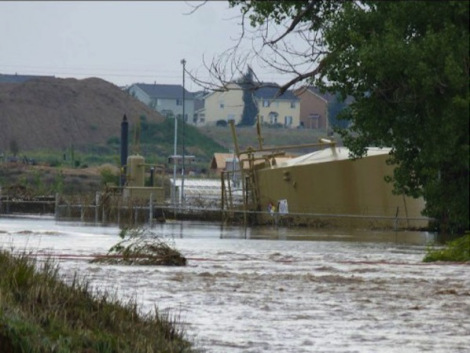
Fracking equipment damaged

Heavy rains returned to Colorado in the US on Sunday and hampered rescue efforts after last week’s flash floods. The confirmed death toll has risen to seven, and hundreds are still unaccounted for. An estimated 1,500 homes are destroyed. Some 1,000 people in Larimer County, north of Boulder, were awaiting airlifts that never came on Sunday — they were called off because of the foul weather.

The floods have also triggered other problems that have gotten a lot less media attention: Fracking infrastructure has been inundated and its toxic contents have spilled out. Pipelines that transport fossil fuels are sagging and snapping under pressure. Tanks that store chemicals and polluted water are being overwhelmed and toppling over. Oil and gas wells are flooding.

The Boulder Daily Camera reports:

Lafayette-based anti-fracking activist Cliff Willmeng said he spent two days “zig-zagging” across Weld and Boulder counties documenting flooded drilling sites, mostly along the drainageway of the St. Vrain River. He observed “hundreds” of wells that were inundated. He also saw many condensate tanks that hold waste material from fracking at odd angles or even overturned.

“It’s clear that the density of the oil and gas activity there did not respect where the water would go,” Willmeng said. “What we immediately need to know is what is leaking and we need a full detailed report of what that is. This is washing across agricultural land and into the waterways. Now we have to discuss what type of exposure the human population is going to have to suffer through.” …

A spokesman for the Colorado Oil and Gas Conservation Commission said the agency is aware of the potential for contamination from flooded drilling sites, but there simply is no way to get to those sites while flooding is ongoing and while resources are concentrated on saving lives.

The Denver Post interviewed a farmer who ignored evacuation orders and watched as floodwaters overwhelmed a drilling operation on his land and released some oil. The newspaper also reported that at least one oil pipeline was confirmed to have been broken open by the floodwaters. From the article:

Oil drums, tanks and other industrial debris mixed into the swollen [South Platte River] flowing northeast. …

One pipeline has broken and is leaking, Weld County Emergency Manager Roy Rudisill. Other industry pipelines are sagging as saturated sediment erodes around the expanding river.

East Boulder County United, a group that fights fracking, has been posting photographs on its Facebook page of fracking tanks and other equipment toppled over or submerged by floodwaters. Blogger TXsharon has also been posting updates and photographs.

Meanwhile, experts are beginning to discuss the links between climate change and the floods. The flooding was worsened by drought and wildfires, both of which have been linked to global warming and which left the ground dry and hard. That reduced the amount of water that the soil could absorb from the unusual late-summer inundation.

“This was a totally new type of event: an early fall widespread event during one of the driest months of the year,” Brad Udall of the University of Colorado-Boulder told National Geographic News. “As the climate warms further, the hydrologic cycle is going to get more intense.”

Climate Central notes that it “will take climate scientists many months to complete studies into whether manmade global warming made the Boulder flood more likely.” But the wild weather hitting the state lately fits general climate change projections:

An increase in the frequency and intensity of extreme precipitation events is expected to take place even though annual precipitation amounts are projected to decrease in the Southwest. Colorado sits right along the dividing line between the areas where average annual precipitation is expected to increase, and the region that is expected to become drier as a result of climate change.

That may translate into more frequent, sharp swings between drought and flood, as has recently been the case. Last year, after all, was Colorado’s second-driest on record, with the warmest spring and warmest summer on record, leading to an intense drought that is only just easing.

Might the fracking industry have worsened Colorado’s floods by contributing to climate change, then spilled its toxic chemicals into those floodwaters? That would be a cruel double-punch. – grist.org

Belgium investigates suspected cyber spying by foreign state

belgacom_tvBelgium said on Monday it was investigating suspected foreign state espionage against its main telecoms company, which is the top carrier of voice traffic in Africa and the Middle East, and a newspaper pointed the finger at the United States.

Federal prosecutors said in a statement that the former state telecoms monopoly Belgacom had filed a complaint in July about the hacking of several servers and computers.

“The inquiry has shown that the hacking was only possible by an intruder with significant financial and logistic means,” they said.

“This fact, combined with the technical complexity of the hacking and the scale on which it occurred, points towards international state-sponsored cyber espionage.” The prosecutors declined to say which foreign state they suspected.

Documents leaked by the former U.S. intelligence contractor Edward Snowden have revealed a vast National Security Agency (NSA) electronic surveillance program that has tracked enormous quantities of both Americans’ and foreigners’ email and telephone data.

This has mostly been done by agreement with telecommunications or internet providers or foreign government intelligence agencies.

However, the Brazilian television network Globo this month alleged that the NSA had tapped into the computer systems of companies including Google Inc. and the Brazilian state oil firm Petroleo Brasileiro, as well as France’s Foreign Ministry and the Belgian-based international banking cooperative SWIFT, which handles international financial transactions.

The Belgian daily De Standaard said the NSA had been monitoring international telephone traffic through Belgacom for two years. It said the hackers had been primarily interested in Belgacom’s subsidiary BICS, a wholesale provider of international phone lines and biggest voice carrier in Africa and the Middle East.

The government of Belgium, which has a majority stake in Belgacom, condemned the intrusion and the violation of a public company.

Prosecutors said the intruder had used malicious software and advanced encryption techniques with the aim of gathering strategic information, and had not sabotaged Belgacom’s data or sought to cause direct economic damage.

Belgacom itself said it had carried out work over the weekend to improve security and remove an unknown virus from its internal systems, adding that at the moment there was no indication of any impact on customers or their data. It said it had filed a complaint against an unknown third party.

Globo’s revelations were based on leaked U.S. documents provided by Guardian journalist Glenn Greenwald, who has worked with Snowden to expose the extent of U.S. spying.

James Clapper, the U.S. Director of National Intelligence, responded last week by saying U.S. agencies did collect information about economic and financial matters, which was used to combat terrorist financing and predict problems that could lead to financial crises or disrupt financial markets.

“What we do not do,” Clapper said in a statement, “is use our foreign intelligence capabilities to steal the trade secrets of foreign companies on behalf of – or give intelligence we collect to – U.S. companies to enhance their international competitiveness or increase their bottom line.” – Reuters

Brazil to break free from US-centric internet

brazilBrazil plans to divorce itself from the US-centric Internet over Washington’s widespread online spying.

This is a move that many experts fear will be a potentially dangerous first step toward politically fracturing a global network built with minimal interference by governments.

President Dilma Rousseff has ordered a series of measures aimed at greater Brazilian online independence and security following revelations that the US National Security Agency intercepted her communications, hacked into the state-owned Petrobras oil company’s network and spied on Brazilians who entrusted their personal data to US tech companies such as Facebook and Google.

Internet security and policy experts say her government’s reaction to information leaked by former NSA contractor Edward Snowden is understandable, but warn it could set the Internet on a course of Balkanization.

“The global backlash is only beginning and will get far more severe in coming months,” said Sascha Meinrath, director of the Open Technology Institute at the Washington-based New America Foundation think tank.

“This notion of national privacy sovereignty is going to be an increasingly salient issue around the globe.”

While Brazil isn’t proposing to bar its citizens from US-based Web services, it wants their data to be stored locally as the nation assumes greater control over Brazilians’ Internet use to protect them from NSA snooping.
Brazil intends to increase its independent Internet connections with other countries.

The danger of mandating that kind of geographic isolation, Meinrath said, is that it could render inoperable popular software applications and services and endanger the Internet’s open, interconnected structure.

The effort by Latin America’s biggest economy to digitally isolate itself from US spying not only could be costly and difficult, it could encourage repressive governments to seek greater technical control over the Internet to crush free expression at home, experts say.

In December, countries advocating greater “cyber-sovereignty” pushed for such control at an International Telecommunications Union meeting in Dubai, with Western democracies led by the United States and the European Union in opposition.

US digital security expert Bruce Schneier says that while Brazil’s response is a rational reaction to NSA spying, it is likely to embolden “some of the worst countries out there to seek more control over their citizens’ Internet. That’s Russia, China, Iran and Syria. That’s Tunisia. That’s Egypt.”

Rousseff says she intends to push for new international rules on privacy and security in hardware and software during the UN General Assembly meeting later this month.

Among Snowden revelations: the NSA has created backdoors in software and Web-based services.

Brazil is now pushing more aggressively than any other nation to end US commercial hegemony on the Internet. More than 80 percent of online search, for example, is controlled by US-based companies.

Most of Brazil’s global Internet traffic passes through the United States, so Rousseff’s government plans to lay underwater fibre optic cable directly to Europe and also link to all South American nations to create what it hopes will be a network free of US eavesdropping.

More communications integrity protection is expected when Telebras, the state-run telecom company, works with partners to oversee the launch in 2016 of Brazil’s first communications satellite, for military and public Internet traffic.

Brazil’s military currently relies on a satellite run by Embratel, which Mexican billionaire Carlos Slim controls.

Rousseff is urging Brazil’s Congress to compel Facebook, Google and other US companies to store all data generated by Brazilians on servers physically located inside Brazil in order to shield it from the NSA.

If that happens, and other nations follow suit, Silicon Valley’s bottom line could be hit by lost business and higher operating costs: Brazilians are among the most voracious consumers of social media, ranking No. 3 on Facebook and No. 2 on Twitter and YouTube. An August study

by a respected U.S. technology policy nonprofit estimated the fallout from the NSA spying scandal could cost the U.S. cloud computing industry, which stores data remotely to give users easy access from any device, as much as $35 billion by 2016 in lost business.

Brazil also plans to build more Internet exchange points, places where vast amounts of data are relayed, in order to route Brazilians’ traffic away from potential interception.

And its postal service plans by next year to create an encrypted email service that could serve as an alternative to Gmail and Yahoo!, which according to Snowden-leaked documents are among US tech giants that have collaborated closely with the NSA.

“Brazil intends to increase its independent Internet connections with other countries,” Rousseff’s office said.

It cited a “common understanding” between Brazil and the European Union on data privacy, and said “negotiations are underway in South America for the deployment of land connections between all nations.”

It said Brazil plans to boost investment in home-grown technology and buy only software and hardware that meet government data privacy specifications.

While the plans’ technical details are pending, experts say they will be costly for Brazil and ultimately can be circumvented. Just as people in China and Iran defeat government censors with tools such as “proxy servers,” so could Brazilians bypass their government’s controls.

International spies, not just from the United States, also will adjust, experts said. Laying cable to Europe won’t make Brazil safer, they say. The NSA has reportedly tapped into undersea telecoms cables for decades.

Meinrath and others argue that what’s needed instead are strong international laws that hold nations accountable for guaranteeing online privacy.

“There’s nothing viable that Brazil can really do to protect its citizenry without changing what the US is doing,” he said.

Matthew Green, a Johns Hopkins computer security expert, said Brazil won’t protect itself from intrusion by isolating itself digitally.

It will also be discouraging technological innovation, he said, by encouraging the entire nation to use a state-sponsored encrypted email service.

“It’s sort of like a Soviet socialism of computing,” he said, adding that the US “free-for-all model works better.”
-Sapa

11 Million users quit Facebook over spying

facebookA new report by the Daily Mail reveals Facebook users are abandoning the social media giant at an unprecedented rate over privacy concerns.

New research shows Facebook has lost a total of eleven million users, nine million in the US and two million in Britain. Researchers at the University of Vienna analyzed 600 users and found that almost half quit as a result of privacy concerns.

Studies show the majority of users that quit the site were older males.

Facebook, among other tech giants, have been repeatedly under scrutiny for their lack of user privacy, including turning over thousands of user’s info to the government. In August, Infowars revealed Facebook submitted information on approximately 38,000 users in 74 countries during the first half of 2013.

Over half of the requests originated from inside of the United States. Tech giants are unable to reveal absolute numbers on how many requests they’ve submitted to because the government prohibits them from doing so. However, companies like Google, Microsoft, Facebook and Yahoo have formed a unique alliance and are fighting back.

The tech alliance is putting pressure on the Foreign Intelligence Surveillance (FISA) court by filing motions asking to publicly disclose more details about secret national intelligence requests, instead of just releasing approximations.

“We believe there is more information that the public deserves to know, and that would help foster an informed debate about whether government security programs adequately balance privacy interests when attempting to keep the public safe,” said Facebook’s general counsel Colin Stretch.

“Editor of the journal Cyberpsychology, Behaviour and Social Networking which published the findings, said: ‘Given high profile stories such as WikiLeaks and the recent NSA surveillance reports, individual citizens are becoming increasingly more wary of cyber-related privacy concerns,’” reported Mail Online.

Facebook has also been under close examination for their recently updated “Statement of Rights and Responsibilities” policy which states users’ profile data including their profile picture, name and personal information “could show up as part of a Facebook ad their friends may see on the site,” according to a report by Mashable.

Even more controversy surrounded the social media giant when they announced the update of the “Tag Suggest” feature, which would allow facial recognition technology “to speed up the process of ‘tagging’ friends and acquaintances who appear in photos posed on the network,” reported Reuters.

As you can see, users’ concerns over privacy, or lack thereof, are certainly substantiated. However, if your information isn’t being collected through Facebook, NSA’s spy program, PRISM, is sure to scoop up your info in some other way, most likely through email or cellular data. – infowars.com


Washington shooter told cops he was being ‘bombarded with microwave signals’

navyshootingSix weeks before going on a killing spree at the Washington Navy Yard, Aaron Alexis told Rhode Island police that he was being followed by individuals who were using a “microwave machine” to send vibrations into his body that kept him from falling asleep, according to a bizarre police report.

On August 7, Alexis summoned Newport cops to a Marriott hotel where he was staying. During a 6:30 AM interview, the 34-year-old–who said he was a “naval contractor” who traveled often–told officers that voices were harassing him through a hotel wall, adding that he was fearful he could be harmed.

Alexis explained to police that he had previously gotten into an argument prior to boarding a plane in Virginia, and believed that the person with whom he quarreled had dispatched three individuals “to follow him and keep him awake by talking to him and sending vibrations into his body.” While he had not seen these individuals, Alexis said he “believes they are two black males and a black female.”

While Newport cops have confirmed that Alexis is the subject of their report, his name has been redacted from the document.

Additionally, Alexis claimed that the voices had forced him to flee two prior hotels, one of which was on Naval Station Newport (where Alexis was apparently set to do contracting work). Alexis refused to tell cops what the voices were saying to him “through the walls, floor and ceiling.”

The unknown individuals, Alexis said, were using “some sort of microwave machine” to send vibrations into his body. Alexis assured cops that he did not have a history of mental illness in his family or any sort of prior “mental episode.”

A Newport patrolman advised Alexis to “stay away from the individuals that are following him” and notify police “if they attempt to make contact with him.”

Alarmed by Alexis’s behavior–and concerned about possible “Naval Base implications”–a Newport police sergeant faxed a copy of the department’s report to naval station police. A Navy cop–whose name is redacted from the Newport Police Department report–advised that they “would follow up on this subject and determine if he is in fact, a naval contractor.” – thesmokinggun.com