Native American confronts ‘anti-illegal immigration’

A Native American man criticized protesters at an Arizona rally against illegal immigration, calling them the real “illegals” for invading his country and killing Native Americans when Europeans first settled on US soil.

“You’re all f*cking illegal. You’re all illegal,” the Native American man yelled at the protesters, who had gathered in Tucson, Arizona to demonstrate their opposition to illegal immigration by Central and South Americans. “We didn’t invite none of you here. We’re the only native Americans here.”

Some have applauded the man for pointing out the protesters’ hypocrisy, who at one point immigrated to the US themselves or are descendants of immigrants. The Native American man, who was pushing his baby through town in a stroller, staged his own protest when he came across the rally.

“Get on with your bogus arguments. We’re the only legal ones here,” he yelled.

One protester was caught standing near the angry Native American and became the target of his criticism. The man was carrying a small American flag and a sign that read, “We should have put that sign up when you sons-of-bitches came.”

Pointing towards the American flag held by the protester, the Native American said that it “represents blood spilled by Native Americans, protecting this land from the invaders.”

“You don’t want to hear the God damn truth!” he yelled. “Get on, bitch! All the Native Americans you killed, you plant your houses here. That’s the truth.”

With Arizona’s proximity to the Mexican border, it has long been a hub for anti-immigration protests and initiatives. The state passed the “Support Our Law Enforcement and Safe Neighborhoods Act” in 2010, which is a strict anti-illegal immigration measure that has stimulated significant controversy. The law made it a misdemeanor crime for an “alien” to be in the state of Arizona without carrying registration documents. It also allows law enforcement officers to stop any individual that they suspect of being an illegal immigrant, thereby promoting racial profiling. It also imposes heavy penalties on those involved in sheltering or hiring unregistered aliens.

The law’s controversial provisions were blocked by the US Department of Justice, but the Supreme Court in 2012 ruled to uphold the “show me your papers” provision allowing law enforcement to stop anyone who looks like an illegal immigrant.

But the Native American man who staged his own protest at the rally considers it hypocritical for Americans to criticize others for immigrating into the US when everyone but Native Americans at one point did so themselves.

“That’s what [the American] flag stands for – all the Native Americans you killed to plant your houses here,” he said. “That’s the truth.” – RT

Critics of Michelle’s bum are racist

The Washington Post today published an article by a reporter who is not a member of the editorial staff suggesting in no uncertain terms that those who criticize First Lady Michelle Obama for holding too much weight in her derriere are racist.

While opening her article by reporting an obviously insulting remark by a high school football coach, reporter Krissah Thompson goes on to write statements and include quotes indicating a general racist intent on the part of those who find Michelle to be overweight if they believe she has excess weight in her posterior.

From the article:

But what is it with Michelle Obama’s critics and the fixation with her derriere?

“We have a history in this country of white people not showing adequate respect for and devaluing the bodies of black women, and this most definitely falls in line with that,” says Ayana Byrd, the co-editor of the anthology “Naked: Black Women Bare All About Their Skin, Hair, Hips, Lips and Other Parts . . . ”

The first lady’s critics “are reacting to the culture in which they’ve grown up or they are using it as a code to racialize Michelle Obama and remind people that she’s black,” says Andra Gillespie, an associate professor of political science at Emory University.

In her own analysis, Thompson, who covers race issues for the post, links comments about Michelle’s posterior to slavery.

The focus on this first lady’s posterior has historical antecedents. It reaches back to the imagery of Hottentot Venus, a woman from what is now South Africa whose naked body and pronounced posterior were paraded in shows throughout 19th-century Europe. On to the selling and trading of black women’s bodies through slavery.

Without question, some mentions of Michelle’s posterior are animated by racism and racial stereotyping. But the article suggests that any reference to the size of a portion of Mrs. Obama’s anatomy is racist.

The article includes no quotes or commentary that might provide balance by raising the topic of whether it is fair to discuss the first lady’s own weight as she leads a campaign to reduce the amount of fat kids are carrying around.

The piece also indicates a political bias in favor of the first lady and her agenda, calling a criticism of her Let’s Move program “the latest public rant” against low calorie lunches in schools that features “the usual protest against the federal government meddling in local business.” – whitehousedossier.com

More U.S. troops died by suicide than in Afghanistan combat in 2012

Suicides by active duty U.S. troops last year exceeded the number of servicemen and women killed in combat in Afghanistan. More than half of the soldiers who killed themselves had already sought help from a mental health

The statistics are stunning. According to the Associated Press, suicides among active-duty troops reached a new high last year. The suicide rate has been rising since 2001. And last year, 349 service members took their lives, much more than the 295 killed in combat in Afghanistan. The suicide figures are tentative, pending completion of pathology reports later this year.

This is a rising trend.It’s an uptick that over the past several years, where we have seen more and more soldiers take their lives with suicide and unfortunately also die in other accidents.It’s the tip of an iceberg of a bigger problem affecting the force at large.

About 100,000 or so Army soldiers and Marines will be leaving the military. There are going to be budget cuts. And all these things are putting great burden on the leadership and great burden on the soldiers on the front lines.

What should be recognized is that this is an epidemic, in the sense that it’s across the Army. The whole Army has been — and Marine Corps and the other services.

An estimated 22 military veterans take their lives every day in America, according to the study helmed by Robert Bossarte, an epidemiologist and researcher who works with the Department of Veterans Affairs.

“While the percentage of all suicides reported as Veterans has decreased, the number of suicides has increased,” the conclusion of the study stated.

Specific trends were observed during the course of the study regarding the age and gender of veterans who most frequently committed suicide.

“A majority of Veteran suicides are among those age 50 years and older. Male Veterans who die by suicide are older than non-Veteran males who die by suicide,” the study’s findings stated. “The age distribution of Veteran and non-Veteran women who have died from suicide is similar.”

The study was conducted over the course of two years, and is, according to Bossarte, indicative mainly of veteran suicides playing a part in what is a national problem.

“There is a perception that we have a veterans’ suicide epidemic on our hands.”

The Washington Post is reporting that the rate of veteran suicides discovered by Bossarte is approximately 20 percent higher than 2007 figures offered by the VA.

The rise of the machine

Early in his first term Barack Obama joked that he would “keep an eye on the robots in case they try anything”. He should have known resistance is futile. During Mr Obama’s presidency, IBM’s Watson has proved computers can outfox the most agile minds, drones have become America’s weapon of choice, the driverless car is now a reality and the word “app” has been detached from its origin. No longer the realm of science fiction, the rise of robots now poses the central economic dilemma of the Obama era.

With each month, the US economy becomes steadily more automated. In January the US economy added just 4,000 manufacturing jobs, and the net increase since July is zero. Yet last month, manufacturing activity rose by its fastest rate since April, according to the Institute for Supply Management. The difference boils down to robots, which pose an increasingly nagging paradox: the more there are, the better for overall growth (since they boost productivity); yet the worse things become for the middle class. US median income has fallen in each of the last five years.

Things cannot continue as they are. Yet change is speeding up. Manufacturing employment is shrinking around the world. Among other countries, China is moving even faster towards industrial robotics, an area in which German and Japanese manufacturers dominate. Last year Foxconn, the Shenzhen-based assembler for Apple, Nokia and others, said it was buying 1m robots in the next three years to substitute for workers performing repetitive manual tasks. At the other end of the spectrum, a restaurant in Harbin, northern China, last year became the first to be entirely waited on by robots. Last month, China opened the world’s first museum of 3D printing.

The potential is huge. But in the developed world, the distribution of the benefits is unsustainable. The bulk of US jobs growth since mid-2009 has been in low-skilled areas, such as food preparation and domestic aides. In the second place is jobs growth in high-end services. Middle income jobs have cratered. According to the National Employment Law Project, low wage jobs (that pay between $7.69 and $13.83 an hour) formed 22 per cent of job losses in the recession but 58 per cent of recovery jobs since then – a mirror image of the picture for middle income jobs ($13.84 to $21.18).

Unsurprisingly, people are reverting to borrowing to stay in the game. Last week, Hero Wallet, a financial advisory firm, showed that one in four US workers were dipping into their retirement funds to meet current spending needs – in spite of the penalties that accrue. This usually involves taking out loans against their retirement accounts. The median income is almost 9 per cent lower today than when Mr Obama took office. It is unclear what he can do to prevent it from falling further, even if the US returns to a higher rate of economic growth.

The effects of technology are only just beginning to be felt in education and healthcare – the two most labour-intensive areas of the US economy that both suffer from productivity stagnation. Online education is beginning to spread. The mid-level private universities do not know what is about to hit them.

Even in healthcare, which reliably added jobs when every other sector was shedding them, technology is starting to look labour-saving.

But the spread of the robots will leave a large and growing chunk of the US labour force in the lurch. In their excellent primer, Race Against The Machine , Erik Brynjolfsson and Andrew McAfee point out that in the contest between changing technology and education, the former is winning. Too few Americans are prepared. Some, such as Mr Cowen, fear many never will be. He believes the federal government should pay a basic guaranteed income to all Americans – a despairing view that accepts there will be permanent losers.

Mr Obama is more optimistic. In his first term, he set a target that the US should graduate every American by 2020. Even if that were possible, it may not be a panacea. Incomes for those with only a college degree have also stagnated since 2000 (and fallen for men). Yet a healthy economy cannot for long be upheld by a minority of its workforce.

At some point, policy makers will be forced to grapple with what is intuitively obvious – that sustained growth is inconsistent with declining middle class incomes. In their book, Brynjolfsson and McAfee cite a meeting between Henry Ford and Walter Reuther, the union leader. Pointing at his new robots, Mr Ford says, “How will you get union dues from them?” Mr Reuther replied: “How will you get them to buy your cars?” – FT

Stunning drop in US GDP

The U.S. economy posted a stunning drop of 0.1 percent in the fourth quarter, defying expectations for slow growth and possibly providing incentive for more Federal Reserve stimulus.

The economy shrank from October through December for the first time since the recession ended, hurt by the biggest cut in defense spending in 40 years, fewer exports and sluggish growth in company stockpiles.

The Commerce Department said Wednesday that the economy contracted at an annual rate of 0.1 percent in the fourth quarter. That’s a sharp slowdown from the 3.1 percent growth rate in the July-September quarter.

The surprise contraction could raise fears about the economy’s ability to handle tax increases that took effect in January and looming spending cuts.

Still, the weakness may be because of one-time factors. Government spending cuts and slower inventory growth subtracted a total of 2.6 percentage points from growth.

And those volatile categories offset faster growth in consumer spending, business investment and housing — the economy’s core drivers of growth.

Another positive aspect of the report: For all of 2012, the economy expanded 2.2 percent, better than 2011’s growth of 1.8 percent.

The economy may stay weak at the start of the year because Americans are coming to grips with an increase in Social Security taxes that has left them with less take-home pay.

Subpar growth has held back hiring. The economy has created about 150,000 jobs a month, on average, for the past two years. That’s barely enough to reduce the unemployment rate, which has been 7.8 percent for the past two months.

Economists forecast that unemployment stayed at the still-high rate again this month. The government releases the January jobs report Friday.

The slower growth in stockpiles comes after a big jump in the third quarter. Companies frequently cut back on inventories if they anticipate a slowdown in sales. Slower inventory growth means factories likely produced less.

Heavy equipment maker Caterpillar, Inc. said this week that it reduced its inventories by $2 billion in the fourth quarter as global sales declined from a year earlier.

The biggest question going forward is how consumers react to the expiration of a Social Security tax cut. Congress and the White House allowed the temporary tax cut to expire in January, but reached a deal to keep income taxes from rising on most Americans.

The tax increase will lower take home pay this year by about 2 percent. That means a household earning $50,000 a year will have about $1,000 less to spend. A household with two high-paid workers will have up to $4,500 less.

Already, a key measure of consumer confidence plummeted this month after Americans noticed the reduction in their paychecks, the Conference Board reported Tuesday.

Economists expected the first reading on gross domestic product to show growth of 1 percent, down from the third quarter’s reading of 3.1 percent. – AP

Uncle Tom’s Cabin, with white slaves

When was the last time you saw Uncle Tom’s Cabin in a theater? The answer is probably never. As far as I can tell, a theatrical version of Harriet Beecher Stowe’s controversial novel hasn’t been performed in the Philadelphia area for many decades, and that also appears to be true for the rest of the country, with the exception of a couple of attempts in New York City over the years. But one Philadelphia theater company says that it’s time to bring the story back to the stage, but with a twist.

EgoPo Classic Theater, a company that describes itself as “edgy, innovative, and inspiring,” is set to debut Uncle Tom in May at Delancey Place’s Plays & Players Theater. Auditions begin this weekend. The show will mark the end of EgoPo’s vaudeville-themed season, which started with their excellent all-female Assassination of Jesse James and continues in March with The Life (and Death) of Harry Houdini.

Uncle Tom was quickly transformed into a theatrical work after the novel’s 1852 publication. And although the book was immensely popular (its sales in the 1800s were only surpassed by those of the Bible), the various theatrical versions were even more so.

Because copyright laws were not what they are today, the scripts strayed freely from the original text, and the show eventually became a centerpiece of minstrel performances, complete with blackface and the most exaggerated racial stereotypes possible. Plus, the book itself wound up on some “banned book” lists, and the NAACP objected to its language and characterizations. No wonder the progressive theater world sought to distance itself in later years.

For the May production, EgoPo artistic director Lane Savadove and Glenn Odom, a literary studies professor at Rowan University, are creating a new script. “We’re doing a realistic, naturalistic version that will be incredibly respectful of the novel,” promises Savadove. “We’re not writing anything. We’re using the book word-for-word, cutting it just so that it works in a theatrical format. I really want the novel to speak for itself on the stage. This is not going to be some post-modern version of Uncle Tom’s Cabin.”

I asked him why it was important to do Uncle Tom now, why he wants to pick it up after all these years.

“The play got tagged as racist not because of the book but because of the minstrel shows,” he explains. “The book was written as an anti-racist piece, and in the last 10 years, the top African American scholars like Henry Louis Gates and Cornel West have gone back to reclaim it as an important part of racial history. And so, we wanted to go back now that it’s seen in this new light and create a new theater version.”

One person who is not convinced that this is necessarily a good idea is Philadelphia actor James Ijames, who teaches the most prominent version of the Uncle Tom scripts in his “Race on the Stage” course at Temple University.

“The citing of Henry Louis Gates and Cornel West to somehow say, ‘See, the black guy said it’s OK!’ is problematic,” says Ijames. “Citing the elder statesmen is akin to the ‘some of my best friends are black’ argument. That notion and rebuttal and defense doesn’t have anything to do with anything.”

Further complicating the matter is Savadove’s decision to swap races in the casting process. In other words, white actors will play slaves while black actors will play their owners.

I talked to one white actor who plans to audition for the show, even though his concerns are “numerous.” The actor, who asked to remain anonymous, points out that many of the stereotypes commonly associated with black culture can be traced back to Uncle Tom, from the “Aunt Jemima” figure to the hyper-educated, very proper black man.

“Those stereotypes were built off of white characterizations of blacks,” he says. “I don’t know how having white actors playing black characters introduces anything new to this story. I sincerely hope that there is an artistic objective beyond being edgy for the sake of being edgy.”

But his biggest and “admittedly selfish” concern is the dialect and language that he’ll be expected to use.

“I have a hard time listening to myself delivering the language,” he notes. “It sounds like a blatantly racist caricature.” He says that he can’t even read his lines in public.

Savadove tries to explain his unusual casting decision: “Even though, by all accounts, the dialogue is incredibly historically accurate, it’s a loaded subject to have a black man speak in a Southern slave dialect. And so we’re switching the races. And we’re painting a picture of an America where it happens to be that the whites became enslaved and the blacks became the slave owners. We’re pointing out the randomness with which the blacks became enslaved and the whites became empowered.”

When I asked Savadove if staging the play was the subject of much debate within EgoPo, he told me it wasn’t. “We are clear in what we are doing,” he says. “And we articulated it clearly to our board.”

In light of Savadove’s justification for the racial switch and his comments regarding “randomness,” Ijames wondered about the racial makeup of that board, as did Ardmore-based playwright Quinn Eli, whose newest play will debut at Plays & Players in April alongside works by Suzan-Lori Parks and other African American playwrights.

And so I asked Savadove point blank if there were any black people on his board. He refused to answer directly. Then he pointed to EgoPo’s 2012 production of A Dybbuk, perhaps the most important play in Jewish history and one with its own controversies surrounding mysticism and Kabbalah. “You didn’t call me then and ask me if any of my board members were Jewish,” he said. No, I didn’t. But, then, A Dybbuk is no Uncle Tom’s Cabin.

In any event, both Eli and Ijames say that they intend to go see EgoPo’s Uncle Tom. And so do I.

“I’ll find it difficult to absorb the image of whites in place of blacks as slaves,” says Eli. ”And I question how effective it will be for white members of the audience who won’t have to take the horror of what happened to those who it actually happened to. It presupposes that a lot of our notions about race have changed more dramatically than I think they have. But that doesn’t mean it won’t make for interesting theater.” – The Philly Post

Shale gas boom visible from space

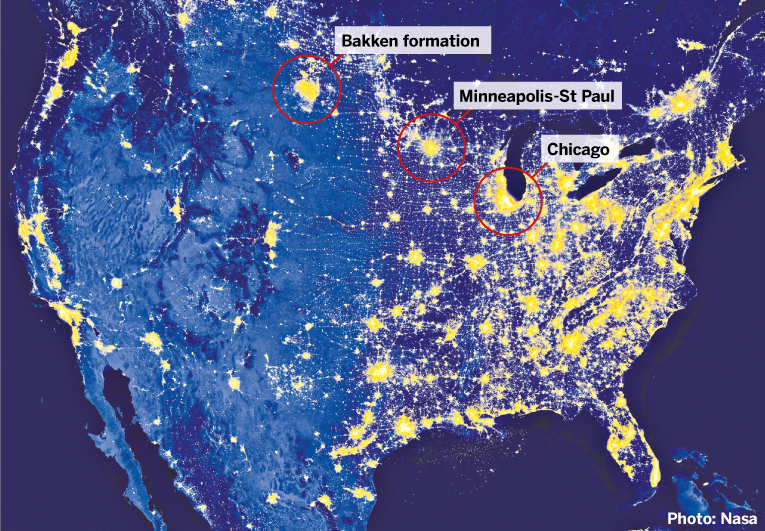
Oil companies at the heart of the US shale oil boom are burning off enough gas to power all the homes in Chicago and Washington combined in a practice causing growing concern about the waste of resources and damage to the environment.

The volume of unwanted gas being flared off in North Dakota, the state leading the shale revolution transforming the outlook for US energy, rose about 50 per cent last year. The surge at the state’s Bakken formation is being replicated in other shale regions with the Texas state regulator issuing 1,963 permits to flare in 2012, more than six times the number of 306 in 2010.

The rapid increase has made the US one of the world’s worst countries for gas flaring. The volume of gas flared in the US has tripled in just five years, according to World Bank estimates and is now fifth highest in the world, behind Russia, Nigeria, Iran and Iraq.

The flaring is a result, in large part, of the low price of natural gas in North America, which can make it uneconomic to build pipelines and tanks to handle the gas released by oil production. Flaring is often the safest way to dispose of it.

The lights of the flares burning in the Bakken and Texas’ Eagle Ford shale fields can clearly be seen in night-time satellite photography.

Flaring has been attracting attention from investors and environmental campaigners because of the waste of gas and its consequences for greenhouse gas emissions, local air pollution and disturbance to nearby communities.

Flaring in North Dakota increases by about 20 per cent the greenhouse gas emissions resulting from the state’s oil production, refining and transport, compared with the US average, according to Financial Times analysis of official data.

Investors managing a total of $500bn last year wrote to oil companies including ExxonMobil, Chevron, Statoiland US independents urging them to do more to cut their flaring. They warned that “excessive flaring, because of its impact on air quality and climate change, poses significant risks for the companies involved.”

Since then, flaring in the US and concerns over it have only increased.

The North Dakota legislature is considering a bill to encourage flaring reduction through tax breaks. The state is also pushing producers to use gas to power drilling rigs.

After child abuse, Americans have elder abuse

MASON, Ohio (AP) — She raises her hands to her snow-white hair in a gesture of frustrated bewilderment, then slowly lowers them to cover eyes filling with tears. The woman, in her 70s, is trying to explain how she wound up in a shelter that could well be where she spends the rest of her life.

While the woman was living with a close family member, officials at the Shalom Center say, her money was being drained away by people overcharging for her grocery shopping, while her body and spirit were sapped by physical neglect and emotional torment. She says she was usually ordered to “go to bed,” where she lay in a dark room, upset, unable to sleep.

“She just yelled at me all the time. Screamed at me, cussed me out,” the woman says of a family member. “I don’t know what happened. She just got tired of me, I guess.”

The Shalom Center offers shelter, along with medical, psychological and legal help, to elderly abuse victims in this northern Cincinnati suburb. It is among a handful in the country that provide sanctuary from such treatment, a problem experts say is growing along with the age of the nation’s population.

The number of Americans 65 and over is projected to nearly double by 2030 because of the 74 million baby boomers born in 1946-64, and the number of people 85 and over is increasing at an even faster rate. The number of seniors being abused, exploited or neglected every year is often estimated at about 2 million, judging by available statistics and surveys, but experts say the number could be much higher. Some research indicates that 1 in 10 seniors have suffered some form of abuse at least once.

“That’s a big number,” said Sharon Merriman-Nai, project director of the Clearinghouse on Abuse and Neglect of the Elderly, based at the University of Delaware. “It’s a huge issue, and it’s just going to get bigger.”

Recognition of and mechanisms for dealing with elder abuse are many years behind strides that have been made in child abuse awareness and protection, experts say.

Getting comprehensive numbers of the abused is complicated, experts say, because the vast majority of cases go unreported out of embarrassment, fear of being cut off from family — most abuse is at the hands of relatives — or confusion about what has happened.

Abuse sometimes comes to light only by chance. County-level adult protective services caseworkers can get anonymous tips. In one recent Ohio case, a hair stylist noticed her elderly client was wincing in pain and got her to acknowledge she had been hit in the ribs by a relative. Another Shalom Center patient was referred by sheriff’s detectives who said his son beat him.

“Are these older people going to be allowed to live their lives the way they deserve to?” said Carol Silver Elliott, CEO of the Cedar Village retirement community, of which the Shalom Center is a part. “We really are not addressing it as a society the way we should.”

The Obama administration has said it has increased its focus on protecting American seniors by establishing a national resource center and a consumer protection office, among other steps. But needs are growing at a time when government spending on social services is being cut on many levels or not keeping up with demand.

In Ohio, slowly recovering from the recession, budgets have been slashed in such areas as staffs that investigate elderly abuse cases.

Staff at the Job and Family Services agency in Hamilton County in Cincinnati is about half the size it was in 2009, spokesman Brian Gregg said. Even as national statistics indicate elder abuse is increasing, the number of elder abuse cases the agency can probe is lower, down from 574 cases in 2009 to 477 last year, he said.

There are no longer enough adult protective services investigators to routinely check on older adults unless there is a specific report of abuse or neglect.

“We do the best we can down here,” Gregg said, noting that the agency has a hotline to take anonymous reports and that it is seeing more financial scams targeting elderly people.

The price for not getting ahead of the problem and preventing abuse of people who would otherwise be healthy and financially stable will be high, warned Joy Solomon, a former Manhattan assistant prosecutor who helped pioneer elder abuse shelters with the Weinberg Center for Elder Abuse Prevention, which opened in 2005 at the Hebrew Home community in New York City.

“My argument always is, if all you do is come in when the crisis has occurred, it is much more costly than preventative care,” said Solomon, director of the shelter, which takes in about 15 people a year. “We’re going to have to pay for it anyway.”

She and others in the field say the first steps are to raise public awareness and train police, lawyers, criminal justice officials and others to recognize and respond to signs of abuse.

Prosecutors often have been reluctant to purse elder abuse cases, which can be complex because of medical and financial complications, the witness’ ability to testify or reluctance to testify against relatives, according to research for the National Institute of Justice.

In suburban Los Angeles, Orange County started an Elder Abuse Forensic Center nearly 10 years ago; it helps police, geriatrics specialists, lawyers and social services workers coordinate efforts to identify, investigate and prosecute abuse cases.

New York City started its Elder Abuse Center to 2009 to bring a multi-organization approach to the problem, saying nearly 100,000 older people are abused in their homes in the city alone. While he was Ohio’s attorney general, Richard Cordray, now director of the federal Consumer Financial Protection Bureau, initiated in 2009 the state Elder Abuse Commission, something current Attorney General Mike DeWine has continued.

The commission has focused on training and education and hopes to launch a public awareness campaign this year, said Ursel McElroy, the longtime adult protection services investigator who leads it. The commission also has been pushing for legislation to improve legal protection and abuse prevention, expand training, and improve statistical data.

In New York, part of the Weinberg Center’s mission is to help other communities replicate it. It has assisted shelter startups in upstate New York, Connecticut, Rhode Island and Minnesota along with the Shalom Center in Ohio.

The center marked its anniversary in January. While more than 40 people have been referred to the nonprofit, faith-based center, only three have gone through with admittance, signs of the reluctance of people who fear losing family relationships — even if they are bad — or the feeling of being at home.

Set up as a “virtual shelter” because victims are integrated into the full Cedar Village retirement community, it is meant to provide 60- to 90-day emergency stays while caseworkers provide help and seek out the best alternative, such as with a different caregiver or relative.

In the case of the woman who complained of abuse in a relative’s home, a call to adult protective services by someone familiar with her led to an investigation and her referral to the shelter.

She has little money, health problems and few alternatives, and after a while, she asked if she could stay at Cedar Village permanently. Caseworkers and officials at the nonprofit, faith-based home agreed that was the best place for her.

The center asked that her identity be protected for this story because the close relatives who allegedly abused her don’t know where she is.

She paints, plays in a residents’ bell choir, plays bingo with others regularly, and has her own room and TV to watch favorites such as “Ellen” and reruns of “I Love Lucy.”

The healthy diet the center keeps her on means she misses some of her favorite foods — beans and corn bread, fried pork chops. But she loves the tuna salad, the group activities and having a life with people who care about her.

“I’ve got quite a few friends,” she says. “They’re just nice people here. I have somebody to talk to, and I appreciate it.”

Fatal attraction

Is it African symbolism, or just plain attraction?

The buzzing insect stole the show as the President announced two new members of his second administration, cutting wild loops around the leader of the free world before landing squarely on his forehead.

The official White House transcript simply reads: “This guy is bothering me here – (swatting at a fly.)”

Meanwhile, the pool report which describes the President’s movements throughout the day noted that “the president spoke for about five minutes while being menaced by a house fly”.

It wasn’t the first time Mr Obama has shared camera time with a fly. In June 2009, the newly-elected president dealt some tough justice to one which interrupted an interview.

And during a 2010 announcement on healthcare reform, Mr Obama cut off an emotional story about an American struggling without health insurance as a fly zipped around him.

In that instance, the fly did manage to land briefly on his face, providing an unsightly addition to the mole on the left side of his nose.

Obama to move on gun control

President Barack Obama is launching the most sweeping effort to curb American gun violence in nearly two decades, and New York lawmakers easily passed the toughest gun control law in the country, as gun control advocates move to act swiftly after a massacre at an elementary school last month.

Obama is urging a reluctant Congress to ban military-style assault weapons and high-capacity ammunition magazines like those used in the Dec. 14 massacre of 20 elementary school children in Newtown, Connecticut.

The broad package Obama will announce Wednesday is also expected to include more than a dozen steps the president can take on his own through executive action. Those measures will provide a pathway for skirting opposing lawmakers, but they will be limited in scope, and in some cases, focused simply on enforcing existing laws.

But Congress would have to approve the bans on assault weapons and ammunition magazines holding more than 10 bullets, along with a requirement for universal background checks on gun buyers. Some gun control advocates worry that opposition from Republicans and conservative Democrats, as well as the National Rifle Association, will be too great to overcome.

The NRA released an online video Tuesday that called Obama an “elitist hypocrite” for having armed Secret Service agents protect his daughters at school while not committing to installing armed guards in all schools.

White House officials signaled that Obama would seek to rally public support for the measures he puts forward, perhaps holding events around the country or relying on Organizing for America, his still-operational presidential campaign.

For many Americans, gun ownership is a cherished right protected by the Second Amendment of the U.S. Constitution. Others argue that the country’s founders in the 18th century could never have envisioned the sort of high-powered assault weapons used in the Newtown attack.

White House officials, seeking to avoid setting the president up for failure, have emphasized that no single measure – even an assault weapons ban – would solve a scourge of gun violence across the country. But without such a ban, or other sweeping Congress-approved measures, it’s unclear whether executive actions alone can make any noticeable difference.

“It is a simple fact that there are limits to what can be done within existing law,” White House spokesman Jay Carney said Tuesday. “Congress has to act on the kinds of measures we’ve already mentioned because the power to do that is reserved by Congress.”

Obama will announce his proposals in a midday event at the White House, flanked by children who wrote to him about gun violence following the massacre of 20 students and six adults at Sandy Hook Elementary School. Law enforcement officials, mayors from across the country and supportive congressional lawmakers are also expected to attend.

According to a lobbyist briefed Tuesday, Obama will present a three-part plan focused on gun violence, education and mental health.

The president will call for a focus on universal background checks. Some 40 percent of gun sales take place without background checks, including those by private sellers at gun shows or over the Internet, according to the Brady Campaign to Prevent Gun Violence.

The president will call for banning assault weapons and limiting ammunition magazines to 10 rounds or fewer, and also propose a federal statute to stop “straw man” purchases of guns and crack down on trafficking rings. He’ll order federal agencies to conduct more research on gun use and crimes, something Republican congressional majorities have limited through language in budget bills, the lobbyist said.

Obama has pledged urgent action to prevent future mass shootings, and his plan – coming just one month after the Newtown attacks – is swift by Washington standards.

The president’s framework is based on recommendations from Vice President Joe Biden, who led a wide-ranging task force on gun violence. Beyond the gun control measures, Biden also gave Obama suggestions for improving mental health care and addressing violent images in video games, movies and television.

The vice president’s proposals included 19 steps that could be achieved through executive action.

Obama may order the Justice Department to crack down on people who lie on background checks; only a tiny number are now prosecuted. Such a step has support from the National Rifle Association, which has consistently argued that existing laws must be enforced before new ones are considered.

He also could take steps ordering federal agencies to make more data on gun crimes available and conduct more research on the issue, something Republican congressional majorities have limited through language in budget bills. And he may order tougher penalties against gun trafficking and give schools flexibility to use grant money to improve safety.

Gun control proponent Rep. Bobby Scott, a Democrat who met with Biden on Monday, said the president is also likely to take executive action to ensure better state reporting of mental health and other records that go into the federal background check database. But he, too, acknowledged there were clear limits to what Obama can do without Congress’ say-so.

“You can’t change the law through executive order,” Scott said.

States and cities have been moving against gun violence as well.

New York’s Assembly voted 104-43 on Tuesday to approve a law calling for a tougher assault weapons ban and provisions to try to keep guns out of the hands of the mentally ill who make threats. Democratic Gov. Andrew Cuomo quickly signed the measure into law.

“Common sense can win,” Cuomo said. “You can overpower the extremists with intelligence and with reason and with common sense.”

The NRA criticized the bill in statement. “These gun control schemes have failed in the past and will have no impact on public safety and crime,” the group said.

The measure also calls for restrictions on ammunition and the sale of guns.

Under current state law, assault weapons are defined by having two “military rifle” features such as folding stock, muzzle flash suppressor or bayonet mount. The proposal reduces that to one feature and includes the popular pistol grip.

Private sales of assault weapons to someone other than an immediate family will be subject to a background check through a dealer. New Yorkers also would be barred from buying assault weapons over the Internet, and failing to safely store a weapon could lead to a misdemeanor charge.

Ammunition magazines will be restricted to seven bullets, from the current 10, and current owners of higher-capacity magazines will have a year to sell them out of state. An owner caught at home with eight or more bullets in a magazine will face a misdemeanor charge.

White House officials signaled that Obama would seek to rally public support for the measures he puts forward Wednesday, perhaps holding events around the country or relying on Organizing for America, his still-operational presidential campaign.

“The president’s success in using this strategy, I think, is pretty notable,” Carney said of Obama’s efforts to engage the public in previous legislative fights.

Still, it’s unclear how much political capital Obama will exert in pressing for congressional action.

The White House and Congress will soon be consumed by three looming fiscal deadlines, each of which is expected to be contentious. And the president has also pledged to tackle comprehensive immigration reform early this year, another effort that will require Republicans’ support and one in which Obama may be more likely to get their backing.

Sen. Mitch McConnell, the chamber’s top Republican, has warned the White House that it will be at least three months before the Senate considers gun legislation. And Senate Majority Leader Harry Reid, a Democrat, has said immigration, not gun control, is at the top of his priority list after the fiscal fights. – AP

Obama Cabinet: Too white

Clarence Thomas 'is white'

MSNBC host and commentator Melissa Harris Perry surprisingly defended the lack of diversity in President Obama’s second term cabinet in an appearance on the network this morning. Harris Perry says just because someone is of one gender and not the other or has a certain skin color doesn’t mean they are representative of that specific group. Harris Perry cites Supreme Court Justice Clarence Thomas as an example, who she says doesn’t represent “the vast majority” of African-Americans.

MSNBC host and commentator Melissa Harris Perry says we should “be careful” when it comes to calling out the hypocrisy of President Obama for having a not so diverse cabinet. Perry says we don’t want to “assume that any given physical body carries with it a set of political ideas.”

Harris Perry names Supreme Court Justice Clarence Thomas as an example. Harris Perry says just because he is black it “does not mean Justice Thomas is representing necessarily the positions, the issues, even the Constitutional interpretation that is shared by the vast majority of civil rights organizations, by the vast majority of African-Americans.”

Setting a new record: Chicago’s murder rate

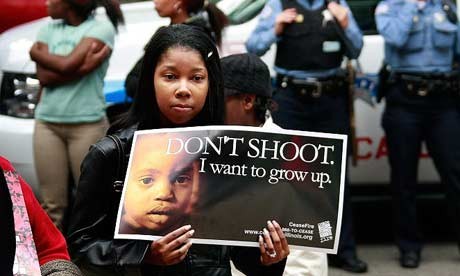
With still a few days to go until the new year, 40-year-old Nathaniel T. Jackson became the five-hundredth person killed in Chicago, Illinois since the start of 2012.

In 2011, the city saw only 435 homicides.

Superintendent Garry McCarthy confirmed to the Chicago Tribune late Thursday night that the passing of Mr. Jackson marked murder number 500 for the Windy City, and that no suspect had been identified by the police at that point. On Friday afternoon, though, the department issued a statement to the press reclassifying a death earlier in the week as being still under investigation. With that update, the slaying of Jackson makes him one murder shy of the 500 mark, but with a homicide rate of more than one per day, that milestone is expected to be met before 2012 comes to a close.

Discussing the grim news on Friday, Chicago Mayor Rahm Emanuel said it was “an unfortunate and tragic milestone, which not only marks a needless loss of life but serves as a reminder of the damage that illegal guns and conflicts between gangs cause in our neighborhoods.”

Emanuel, a former Obama administration staffer known like the president for his staunch pro-gun control stance, condemned the National Rifle Association earlier this month after the NRA’s vice president asked for armed guards in every school across America.

“That is not the right answer for our society, our schools and most importantly our children,” Emanuel said.

Even as adamantly opposed to guns on the streets as Emanuel is, however, the mayor has a seemingly impossible task of turning around a surge in violent crimes as murders have skyrocketed under his administration. According to the police statistics provided to the Tribune, “homicides were up 17 percent over last year in Chicago, and shootings had increased by 11 percent.”

All the way back in June, Roseanna Ander of the University of Chicago Crime Lab warned The Daily that Chicago was already on the path to having a particularly bloody year.

“Violence has always been most pronounced on summer weekends in Chicago,” Ander said, adding, “One likely factor is the warmer-than-usual weather and the early spring. Over 80 percent of shootings occur outdoors and in public places.”

Ander’s prediction proved right, and as the summer months progressed matters were only made worse. In late August, 19 people were shot in a single evening in Chicago. It may have been a big number at the time, but was only a few shots beyond what the city saw months earlier.

“Over the Memorial Day weekend, in a 72-hour period, we had 12 people killed and another 45 people shot.” WBEZ Chicago Public Radio host Robert Wildeboer told National Public Radio during a July 10 interview.

“Thirteen people were shot in one 90-minute stretch, and so that’s really focusing public attention on this issue right now,” Wildeboer added. “You know, just last night, eight people were shot in the city of Chicago. But some of the numbers were just so shocking, A, that murder’s up 40 percent over last year. B, there have been a number of really violent weekends in Chicago where the numbers are just so striking, everybody’s just, like, what in the world?”

The last time Chicago saw this many deaths in a single year was 2008, when 512 people were killed. Meanwhile in New York, Police Commissioner Raymond Kelly says the murder rate in the Big Apple is down nearly 19 percent in 2012.

“I’m thankful for the fact that this year there will be the lowest number of murders that we’ve had since we started to record them in 50 years, even though the population is as high as it’s ever been,” Kelly tells reporters this week.

Detroit, an education wasteland

Detroit Public Schools (DPS) also need metal detectors

In the public schools in Detroit, Mich., according to the U.S. Department of Education, only 7 percent of the eighth graders are grade-level proficient or better in reading.

Detroit public-school eighth graders do even worse in math than they do in reading, according to the Department of Education. While only 7 percent scored highly enough on the department’s National Assessment of Educational Progress test in 2011 to be rated “proficient” or better in reading, only 4 percent scored highly enough to be rated “proficient” or better in math.

Statewide in Michigan, only 32 percent of public-school eighth graders scored grade-level proficient or better in reading, and only 31 percent scored grade-level proficient or better in math.

68 percent of Michigan public-school eighth graders are not proficient in reading and 69 percent are not proficient in math.

Over the past decade, Michigan’s public school have shown no improvement at all in teaching children how to read. In 2002 just as in 2011, according to the U.S. Department of Education, only 32 percent of Michigan public-school eighth graders scored proficient or better in reading. – CNSNews

Economic warfare provoked Pearl Harbor

Robert Higgs

Many people are misled by formalities. They assume, for example, that the United States went to war against Germany and Japan only after its declarations of war against these nations in December 1941. In truth, the United States had been at war for a long time before making these declarations. Its war making took a variety of forms. For example, the U.S. navy conducted “shoot [Germans] on sight” convoys – convoys that might include British ships — in the North Atlantic along the greater part the shipping route from the United States to Great Britain, even though German U-boats had orders to refrain (and did refrain) from initiating attacks on U.S. shipping. The United States and Great Britain entered into arrangements to pool intelligence, combine weapons development, test military equipment jointly, and undertake other forms of war-related cooperation. The U.S. military actively cooperated with the British military in combat operations against the Germans, for example, by alerting the British navy of aerial or marine sightings of German submarines, which the British then attacked. The U.S. government undertook in countless ways to provide military and other supplies and assistance to the British, the French, and the Soviets, who were fighting the Germans. The U.S. government also provided military and other supplies and assistance, including warplanes and pilots, to the Chinese, who were at war with Japan.[1] The U.S. military actively engaged in planning with the British, the British Commonwealth countries, and the Dutch East Indies for future combined combat operations against Japan. Most important, the U.S. government engaged in a series of increasingly stringent economic warfare measures that pushed the Japanese into a predicament that U.S. authorities well understood would probably provoke them to attack U.S. territories and forces in the Pacific region in a quest to secure essential raw materials that the Americans, British, and Dutch (government in exile) had embargoed. [2]

Roosevelt had already led the United States into war with Germany in the spring of 1941—into a shooting war on a small scale. From then on, he gradually increased U.S. military participation. Japan’s attack on December 7 enabled him to increase it further and to obtain a war declaration. Pearl Harbor is more fully accounted for as the end of a long chain of events, with the U.S. contribution reflecting a strategy formulated after France fell. . . . In the eyes of Roosevelt and his advisers, the measures taken early in 1941 justified a German declaration of war on the United States—a declaration that did not come, to their disappointment. . . . Roosevelt told his ambassador to France, William Bullitt, that U.S. entry into war against Germany was certain but must wait for an “incident,” which he was “confident that the Germans would give us.” . . . Establishing a record in which the enemy fired the first shot was a theme that ran through Roosevelt’s tactics. . . . He seems [eventually] to have concluded—correctly as it turned out—that Japan would be easier to provoke into a major attack on the Unites States than Germany would be. [3]

The claim that Japan attacked the United States without provocation was . . . typical rhetoric. It worked because the public did not know that the administration had expected Japan to respond with war to anti-Japanese measures it had taken in July 1941. . . . Expecting to lose a war with the United States—and lose it disastrously—Japan’s leaders had tried with growing desperation to negotiate. On this point, most historians have long agreed. Meanwhile, evidence has come out that Roosevelt and Hull persistently refused to negotiate. . . . Japan . . . offered compromises and concessions, which the United States countered with increasing demands. . . . It was after learning of Japan’s decision to go to war with the United States if the talks “break down” that Roosevelt decided to break them off. . . . According to Attorney General Francis Biddle, Roosevelt said he hoped for an “incident” in the Pacific to bring the United States into the European war.[4]

These facts and numerous others that point in the same direction are for the most part anything but new; many of them have been available to the public since the 1940s. As early as 1953, anyone might have read a collection of heavily documented essays on various aspects of U.S. foreign policy in the late 1930s and early 1940s, edited by Harry Elmer Barnes, that showed the numerous ways in which the U.S. government bore responsibility for the country’s eventual engagement in World War II—showed, in short, that the Roosevelt administration wanted to get the country into the war and worked craftily along various avenues to ensure that, sooner or later, it would get in, preferably in a way that would unite public opinion behind the war by making the United States appear to have been the victim of an aggressor’s unprovoked attack.[5] As Secretary of War Henry Stimson testified after the war, “we needed the Japanese to commit the first overt act.” [6]

At present, however, seventy years after these events, probably not one American in 1,000—nay, not one in 10,000—has an inkling of any of this history. So effective has been the pro-Roosevelt, pro-American, pro-World War II faction that in this country it has utterly dominated teaching and popular writing about U.S. engagement in the “Good War.”

In the late nineteenth century, Japan’s economy began to grow and to industrialize rapidly. Because Japan has few natural resources, many of its burgeoning industries had to rely on imported raw materials, such as coal, iron ore or steel scrap, tin, copper, bauxite, rubber, and petroleum. Without access to such imports, many of which came from the United States or from European colonies in Southeast Asia, Japan’s industrial economy would have ground to a halt. By engaging in international trade, however, the Japanese had built a moderately advanced industrial economy by 1941.

At the same time, they also built a military-industrial complex to support an increasingly powerful army and navy. These armed forces allowed Japan to project its power into various places in the Pacific and East Asia, including Korea and northern China, much as the United States used its growing industrial might to equip armed forces that projected U.S. power into the Caribbean, Latin America, and even as far away as the Philippine Islands.

When Franklin D. Roosevelt became president in 1933, the U.S. government fell under the control of a man who disliked the Japanese and harbored a romantic affection for the Chinese because, some writers have speculated, Roosevelt’s ancestors had made money in the China trade. [7] Roosevelt also disliked the Germans in general and Adolf Hitler in particular, and he tended to favor the British in his personal relations and in world affairs. He did not pay much attention to foreign policy, however, until his New Deal began to peter out in 1937. Thereafter he relied heavily on foreign policy to fulfill his political ambitions, including his desire for reelection to an unprecedented third term.

When Germany began to rearm and to seek Lebensraum aggressively in the late 1930s, the Roosevelt administration cooperated closely with the British and the French in measures to oppose German expansion. After World War II commenced in 1939, this U.S. assistance grew ever greater and included such measures as the so-called destroyer deal and the deceptively named Lend-Lease program. In anticipation of U.S. entry into the war, British and U.S. military staffs secretly formulated plans for joint operations. U.S. forces sought to create a war-justifying incident by cooperating with the British navy in attacks on German U-boats in the northern Atlantic, but Hitler refused to take the bait, thus denying Roosevelt the pretext he craved for making the United States a full-fledged, declared belligerent—a belligerence that the great majority of Americans opposed.

In June 1940, Henry L. Stimson, who had been secretary of war under William Howard Taft and secretary of state under Herbert Hoover, became secretary of war again. Stimson was a lion of the Anglophile, northeastern upper crust and no friend of the Japanese. In support of the so-called Open Door Policy for China, Stimson favored the use of economic sanctions to obstruct Japan’s advance in Asia. Treasury Secretary Henry Morgenthau and Interior Secretary Harold Ickes vigorously endorsed this policy. Roosevelt hoped that such sanctions would goad the Japanese into making a rash mistake by launching a war against the United States, which would bring in Germany because Japan and Germany were allied.

The Roosevelt administration, while curtly dismissing Japanese diplomatic overtures to harmonize relations, accordingly imposed a series of increasingly stringent economic sanctions on Japan. In 1939, the United States terminated the 1911 commercial treaty with Japan. “On July 2, 1940, Roosevelt signed the Export Control Act, authorizing the President to license or prohibit the export of essential defense materials.” Under this authority, “[o]n July 31, exports of aviation motor fuels and lubricants and No. 1 heavy melting iron and steel scrap were restricted.” Next, in a move aimed at Japan, Roosevelt slapped an embargo, effective October 16, “on all exports of scrap iron and steel to destinations other than Britain and the nations of the Western Hemisphere.” Finally, on July 26, 1941, Roosevelt “froze Japanese assets in the United States, thus bringing commercial relations between the nations to an effective end. One week later Roosevelt embargoed the export of such grades of oil as still were in commercial flow to Japan.” [8] The British and the Dutch followed suit, embargoing exports to Japan from their colonies in Southeast Asia.

Roosevelt and his subordinates knew they were putting Japan in an untenable position and that the Japanese government might well try to escape the stranglehold by going to war. Having broken the Japanese diplomatic code, the American leaders knew, among many other things, what Foreign Minister Teijiro Toyoda had communicated to Ambassador Kichisaburo Nomura on July 31: “Commercial and economic relations between Japan and third countries, led by England and the United States, are gradually becoming so horribly strained that we cannot endure it much longer. Consequently, our Empire, to save its very life, must take measures to secure the raw materials of the South Seas.”[9]

Because American cryptographers had also broken the Japanese naval code, the leaders in Washington also knew that Japan’s “measures” would include an attack on Pearl Harbor.[10] Yet they withheld this critical information from the commanders in Hawaii, who might have headed off the attack or prepared themselves to defend against it. That Roosevelt and his chieftains did not ring the tocsin makes perfect sense: after all, the impending attack constituted precisely what they had been seeking for a long time. As Stimson confided to his diary after a meeting of the War Cabinet on November 25, “The question was how we should maneuver them [the Japanese] into firing the first shot without allowing too much danger to ourselves.” After the attack, Stimson confessed that “my first feeling was of relief . . . that a crisis had come in a way which would unite all our people.”[11]

Robert Higgs is senior fellow in political economy for the Independent Institute and editor of The Independent Review. He is the 2007 recipient of the Gary G. Schlarbaum Prize for Lifetime Achievement in the Cause of Liberty. Send him mail.

Notes

[1] See “Flying Tigers,” Wikipedia. Available at: http://en.wikipedia.org/wiki/Flying_Tigers .

[2] Robert Higgs, “How U.S. Economic Warfare Provoked Japan’s Attack on Pearl Harbor,” The Freeman 56 (May 2006): 36-37.

[3] George Victor, The Pearl Harbor Myth: Rethinking the Unthinkable (Dulles, Va.: Potomac Books, 2007), pp. 179-80, 184, 185, emphasis added.

[4] Ibid ., pp. 15, 202, 240.

[5] See Perpetual War for Perpetual Peace: A Critical Examination of the Foreign Policy of Franklin Delano Roosevelt and Its Aftermath, edited by Harry Elmer Barnes (Caldwell, Id.: Caxton Printers, 1953).

[6] Stimson as quoted in Victor, Pearl Harbor Myth, p. 105.

[7] Harry Elmer Barnes, “Summary and Conclusions,” in Perpetual War for Perpetual Peace: A Critical Examination of the Foreign Policy of Franklin Delano Roosevelt and Its Aftermath, edited by Harry Elmer Barnes (Caldwell, Idaho: Caxton Printers, 1953), 682-83.

[8] All quotations in this paragraph are from George Morgenstern, “The Actual Road to Pearl Harbor,” in Barnes, ed., Perpetual War for Perpetual Peace, 322-23, 327-28.

[9] Quoted in Morgenstern, “The Actual Road to Pearl Harbor,” 329.

[10] Robert B. Stinnett, Day of Deceit: The Truth About FDR and Pearl Harbor (New York: Free Press, 2000).

[11] Quoted in Morgenstern, “The Actual Road to Pearl Harbor,” 343, 384.

This talk by Robert Higgs was the Arthur M. Krolman Lecture at the 30th Anniversary Supporters Summit of the Ludwig von Mises Institute, Callaway Gardens, Georgia, on October 26, 2012. Originally posted at the Ludwig von Mises Inistitute