A Russian warship was docked in Havana Wednesday, without explanation from Communist Cuba or its state media.
The Viktor Leonov CCB-175 boat, measuring 91.5 meters (300 feet) long and 14.5 meters wide, was docked at the port of Havana’s cruise ship area, near the Russian Orthodox Cathedral.
The Vishnya, or Meridian-class intelligence ship, which has a crew of around 200, went into service in the Black Sea in 1988 before it was transferred seven years later to the northern fleet, Russian media sources said.
Neither Cuban authorities nor state media have mentioned the ship’s visit, unlike on previous tours by Russian warships.
The former Soviet Union was Cuba’s sponsor state through three decades of Cold War. After a period of some distancing under former Russian president Boris Yeltsin, the countries renewed their political, economic and military cooperation.
The ship is reportedly armed with 30mm guns and anti-aircraft missiles.
Its visit comes as isolated Havana’s current economic and political patron, Venezuela, is facing unprecedented violent protests against President Nicolas Maduro’s government.
Cuban President Raul Castro’s Communist government, Americas’ only one-party regime, got a handshake from president Obama recently at Nelson Mandela’s memorial service.
The Dec. 10 handshake signalled a warming of ties between the two nations after decades of animosity.
Fidel Castro congratulated his brother after he greeted the head of the U.S. government in English, saying ‘Mr. President, I’m Castro.’”
Who started the craze? Eugene Terre’blanche wearing a real one
It’s shear madness! The beard craze has grown so popular that men in New York are rushing to doctors for “facial hair transplants” — surgery that helps make beards look thicker and less patchy, sources said.
Stubble-challenged guys are forking over up to $8,500 for the beard-boosting procedure, which has spiked in popularity in recent months, plastic surgeons told The Post.
“Brooklyn is probably the nucleus of the trend, it’s the hipster ‘look’ guys want. If you have a spotty beard, and you let it grow out, it looks sloppy, ” said Dr. Jeffrey Epstein, a Midtown-based plastic surgeon.
“[Clients] want full beards because it’s a masculine look. Beards are an important male identifier,” he added.
Epstein performs two or three beard implants per week — up from just a handful each year a couple years ago, he said.
The specific style — a lumberjack-meets-roadie hybrid — was made popular in neighborhoods such as Williamsburg, Bushwick and Park Slope, doctors and patients said.
One happy patient is Danny, 27, whose beard used to be so patchy, he was forced to “fill it in” with an eyebrow pencil, he said.
Two years ago, he paid $8,500 for the surgery, which he considers a fashion statement.
“I have a baby face but now I’m able to look older. My fashion statement is a little edgy, and I do like the ‘rugged look,’” he said,
He added, “It’s one of the best investments I’ve ever made.”
During the procedure, doctors remove hair from other body parts, including the head and chest, before implanting it in the face.
New beards grow back normally and can be shaved.
The hair-raising trend is also popular with female-to-male transgenders, Hasidic Jews, and guys who simply aren’t very hairy, doctors said.
“It’s the style. It’s just more common now to see scruff than ten years ago,” said Dr. Yael Halaas, a Midtown plastic surgeon, who performs the procedure.
“We’ve been getting a lot more calls about it,” she said.
A 39-year-old New Yorker, who works in catering industry, got a beard transplant to make him feel younger, DNAinfo.com reported.
“I had contemplated [getting a beard transplant] for approximately eight months,” he said, “Knowing the results, I wish I hadn’t wasted so much time deciding,” he said.
One man’s terrorist is another man’s freedom fighter
We mapped the Facebook fans of some of the most violent jihadi organizations in the world.
Pop stars, sports teams and Hollywood actors aren’t the only ones with global followings on Facebook. Jihadis, too, have lots of rabid fans from around the world.
This global fandom to some degree mirrors the diversity of fighters on the ground in Syria, where the combatants have come from more than 80 countries, including Western nations like the U.K., France and the Netherlands.
Of those Facebook jihadi fans we were able to identify via their publicly available data, many express a strong religious affiliation, citing the likes of Al Qaeda or U.K., France and the Netherlandsas their employer. But despite a growing concern for privacy, and a near-ubiquitous trend for Western employers using social media profiles to screen employees, a large percentage of people who had liked extreme jihadi groups on Facebook did so side-by-side with listings for their actual places of work and study in Western countries. They list themselves as attending well-to-do high schools, Ivy League universities and military academies in the U.K., U.S. and elsewhere. They work at Google, Microsoft, Pizza Hut, JCPenney, Aeropostale and other globally recognized businesses.
Where in the West are the biggest pockets of radical Islam fandom? To find out, we picked 10 outspoken jihadis on Facebook and identified some of the groups they follow. We chose a total seven groups, covering a range of different countries, and then looked at where the people who follow those groups’ Facebook pages said they live. We also sorted the results to get rid of duplications among the people doing the liking.
As more jihadi groups use social networks to proselytize and even communicate with one another, governments and law-enforcement agencies halfway around the world are eager to know where the receptive audiences are located.
Turns out, Europe has way more jihadi fans than the U.S. does. Of the total 49,631 members in the groups we selected, 1,463 identify themselves as coming from European countries, while about 325 say they’re in the United States.
In Europe, the U.K. boasts 548 fans of the same pages—and London, with 260 fans, is far and away the most well-represented city in the data. Paris a distant second. Three of the four most well-represented cities in Europe are in the United Kingdom, with Birmingham and Manchester joining the capital on the list.
The U.S. numbers are much smaller, with New York City topping the city scales, and California taking the title for the state where most people are active on the jihadi Facebook pages we identified.
This ISIS page was deleted soon after we concluded our analysis.
Judging by their profiles, it’s clear that some are most likely expressing a passing interest or curiosity, while others may be monitoring the pages for work (journalists and academics). But others express consistently extreme views on their own page and also like a broad network of jihadi pages.
And some of these fans may be doing more than just liking the jihadi pages. While studies suggest that larger jihadi networks still rely on their own trusted forums, some rebel groups are using Facebook as a supplementary mechanism for contacting potential fighters.
Indeed, a large population of web-savvy European fighters have already made the trip to Syria, and they circulate that intelligence back to would-be jihadis. You can find long online conversations on social media that delve into the specifics of how to cross borders, how much money to bring, and what to expect upon arriving in the war zone.
So it stands to reason that the first contact a jihadi-curious teen or young adult may have with someone on the front line could be through Facebook.
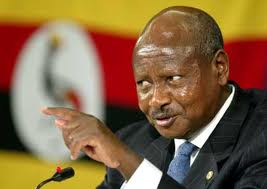
The Ugandan tabloid, Red Pepper, has named the country’s 200 top homosexuals, a day after President Yoweri Museveni signed into law a bill toughening penalties for gay people.
The list appeared under the headline: “Exposed”. Western governments have condemned Mr Museveni’s decision to approve the bill, but South Africa would not be drawn into the debate.
Homosexuality is also frowned upon by most South African blacks. The ANC fears that an open debate would upset their voters ahead of the coming elections.
The Ugandan bill includes life sentences for gay sex and same-sex marriage, but a clause criminalising those who do not report gay people was removed as well as a proposed sentence of up to 14 years for first-time offenders.
But the passing of the bill has been popularly received in Uganda, where Museveni — in power for 28 years — faces reelection in 2016..
Earlier, government spokesman Ofwono Opondo told Reuters news agency Mr Museveni wanted “to demonstrate Uganda’s independence in the face of Western pressure and provocation”.
Uganda is a deeply conservative society where most people oppose homosexuality.
Homosexual acts were already illegal in Uganda, but the new law bans the promotion of homosexuality and covers lesbians for the first time.
There was applause when Yoweri Museveni spoke out againts gays: “Society can do something about it to discourage the trend”.
Last year the Red Pepper published photographs of retired gay British man Bernard Randall, taken from his stolen laptop, who then arrested and deported last month. The new list also includes some Ugandans still in the closet, the Associated Press news agency reported.
On Monday, US Secretary of State John Kerry said Mr Museveni’s decision would launch an internal review of US assistance programmes to Uganda.
Uganda receives a reported $400m in annual aid from the US.
Sweden’s Development Assistance Minister Hillevi Engstrom called Mr Museveni’s decision “terrible” and said that direct aid to Uganda, worth about $10.8m, could be withdrawn.
As a result of the new law, the Netherlands has stopped a $9.6m subsidy to Uganda’s judicial system.
Norway and Denmark said they would transfer direct aid – together totalling about $17m – to non-governmental organisations.
Sweden’s Finance Minister Anders Borg, who is visiting Uganda for meetings on trade and economic issues, has met with gay rights activists.
Homophobia is widespread in Uganda, where evangelical Christianity is on the rise.
Museveni earlier this month also signed into law anti-pornography and dress code legislation which outlaws “provocative” clothing.
Ukrainian Rabbi Moshe Reuven Azman, called on Kiev’s Jews to leave the city and even the country if possible, fearing that the city’s Jews will be victimized in the chaos, Israeli daily Maariv reported Friday.
“I told my congregation to leave the city center or the city all together and if possible the country too,” Rabbi Azman told Maariv. “I don’t want to tempt fate,” he added, “but there are constant warnings concerning intentions to attack Jewish institutions.”
According to the paper’s report Azman closed the Jewish community’s schools but still holds three daily prayers. He said the Israeli embassy told members of the Jewish community to avoid leaving their homes.
Ukrainian President Viktor Yanukovich has called the latest developments in the country a coup d’etat, denying speculations of his resignation. He also accused international mediators of not fulfilling their obligations.
“I’m always threatened with ultimatums. I’m not going to leave the country,” Yanukovich said in an interview with local UBR TV channel. “I’m not going to resign. I’m a legitimately elected president.”
The interview with the embattled president was broadcast right after the opposition claimed it had received verbal assurances that Yanukovich was resigning.
But as parliament deputies said they were waiting for the written confirmation on his resignation, the president announced his plans to travel across the country’s southeast, which is “so far, less dangerous.”
“Everything that is happening today is, to a greater degree, vandalism and bandits and a coup d’etat,” Yanukovich said in a televised statement.
On Saturday, Ukrainian parliament (Verkhovna Rada) held a new emergency session, during which it passed a law on the return to the 2004 constitution without the president’s signature, saying that the president had removed himself from power.
It also appointed a new head of the Ministry of Interior and a new head speaker of the Rada. In addition, parliament ruled to free former Prime Minister Yulia Tymoshenko from prison and set early presidential elections for May 25.
But Yanukovich says the motions passed by parliament are illegitimate, and says he will not sign any of them.
“The decisions that they are now approving are illegal. I won’t sign anything,” he told UBR journalists in Kharkov. “This is not an opposition, these are bandits.”
The president said his car had been shot at while he was traveling to the airport to go to Kharkov.
“But I have no fear. I am overwhelmed by grief for our country. I feel responsibility,” he said.
“I’m doing everything to prevent the bloodshed of the people who are close to me,” Yanukovich stated, referring to his supportive deputies who he said are being threatened, beaten, and targeted by stone-throwing rioters.
He compared the situation in turbulent Ukraine – which is facing its worst political crisis in modern history – to the rise of the Nazis in the 1930s.
“We now see the same what was [happening] in 1930s, when the Nazis came to power. [They] forbade [political] parties…It’s the same now – [they] ban the party, stalk, beat people, burn down offices,” he said.
Yanukovich is determined to do whatever it takes to “stop the bloodshed” and protect Ukraine “from a split.” But the president admits: “I still don’t know how I am going to do it.”
The leader has stated that he expects international mediators to fulfill their commitments.
“What we are going to do depends on the reaction from the international community, how they are going to meet their responsibilities,” Yanukovich said. “The head of the Ministry of Foreign Affairs, still legitimate, reported yesterday he was speaking with Europeans, with Poland’s head of Ministry of Foreign Affairs, called the US. I hope to hold negotiations in the coming days.”
Yanukovich will call on EU mediators to stop “actions by radicals.”
“I was given guarantees of all the international mediators, with whom I worked. They gave security assurances. I’ll see how they will perform this role,” he said.
On Friday, Yanukovich and opposition leaders signed an EU-brokered agreement on ending the political crisis in the country. While it stipulated five major conditions, the agreement did not give the opposition the power to impose new laws or appointments without presidential approval, though they have attempted to do just that.
Thus the conditions of the deal are being clearly violated. However, the EU – which mediated the deal between the opposition and ruling government – remains quiet.
What the Ukrainian opposition IS NOT fulfilling:
1. Within 48 hours of the signing of this agreement, a special law will be adopted, signed and promulgated, which will restore the Constitution of 2004 including amendments passed until now. Signatories declare their intention to create a coalition and form a national unity government within 10 days thereafter.
2. Constitutional reform, balancing the powers of the President, the government and parliament, will start immediately and be completed in September 2014.
3. Presidential elections will be held as soon as the new Constitution is adopted but no later than December 2014. New electoral laws will be passed and a new Central Election Commission will be formed on the basis of proportionality and in accordance with the OSCE & Venice commission rules.
4. Investigation into recent acts of violence will be conducted under joint monitoring from the authorities, the opposition and the Council of Europe.
Lavrov to EU: Urge opposition to fulfill the deal
On Saturday, the foreign ministers of France, Poland, and Germany – the trio that most actively helped reach the deal between the rival sides in Kiev – admitted that opposition leaders have broken the agreement, according to the Russian Foreign Ministry.
The three EU ministers have spoken separately with Russian Foreign Minister Sergey Lavrov, who has voiced concerns over the Ukrainian opposition’s failure to fulfill the conditions of the agreement.
“The opposition not only has failed to fulfill a single of its obligations but is already presenting new demands all the time, following the lead of armed extremists and thugs whose actions pose direct threat to Ukraine’s sovereignty and constitutional order,” Lavrov told the ministers.
Russia’s FM has called on his counterparts to use their influence with the Ukrainian opposition to stop what he described as rampages by its supporters.
“It is time to stop misleading the international community and pretend that today’s Maidan represents the interests of the Ukrainian people,” Lavrov said.
But it seems that German Foreign Minister Steinmeier also has a separate agreement with British Foreign Secretary William Hague.
“Agreed with German Foreign Minister Steinmeier today to support new government in Ukraine and push for vital IMF financial package,” Hague stated on Twitter.
Sergey Lavrov also voiced his concerns in a talk with US Secretary of State John Kerry. The Russian FM told his counterpart that Kiev had been taken over by “illegal extremist groups,” adding that the situation in Ukraine has sharply escalated, the Russian Foreign Ministry said in a statement.
Israeli arms dealers tried to send spare parts for F-4 Phantom aircraft via Greece to Iran in violation of an arms embargo, according to a secret probe by the US government agency Homeland Security Investigations (HSI) carried out in cooperation with the drugs and weapons unit of Greece’s Financial Crimes Squad (SDOE).
According to the probe, which Kathimerini has had access to, the operation was carried out in two phases – one in December 2012 and the second in April 2013. In both cases, officials traced containers packed with the F-4 parts on Greek territory. The cargo had been sent by courier from the Israeli town of Binyamina-Giv’at Ada and had been destined for Iran, which has a large fleet of F-4 aircraft, via a Greek company registered under the name Tassos Karras SA in Votanikos, near central Athens. SDOE officials established that the firm was a ghost company, while the company’s contact number was found to belong to a British national residing in Thessaloniki who could not be located.
According to HSI memos, the cargo appears to have been sent by arms dealers based in Israel, seeking to supply Iran in contravention of an arms embargo, and using Greece as a transit nation.
A TV sketch lampooning the banning of Jews from Norway in the country’s first constitution has been condemned as “shocking” and “embarrassing” by a leading politician in the country.
The sketch, which starred comedian Atle Antonsen, imagines how it came about that Norway’s founding fathers added a notorious clause outlawing Jews from the country to the 1814 constitution.
“It is shocking and embarrassing to create humour from this clause which shut the Jews out of our country!” Dagrun Eriksen, deputy chairman of the Christian Democratic Party, said on Sunday night as the sketch was broadcast on NRK.
“The Jewish clause is part of our dark history,” she told VG later, adding that the events remained “painful” for Norwegian Jews.
You might think you have to pay through the nose at the moment to access the Internet.
But one ambitious organisation called the Media Development Investment Fund (MDIF) is planning to turn the age of online computing on its head by giving free web access to every person on Earth.
Known as Outernet, MDIF plans to launch hundreds of satellites into orbit by 2015.
And they say the project could provide unrestricted Internet access to countries where their web access is censored, including China and North Korea.
Using something known as datacasting technology, which involves sending data over wide radio waves, the New York-based company says they’ll be able to broadcast the Internet around the world.
The group is hoping to raise tens of millions of dollars in donations to get the project on the road.
The Outernet team claim that only 60% of the world’s population currently have access to the wealth of knowledge that can be found on the Internet.
This is because, despite a wide spread of Wi-Fi devices across the globe, many countries are unable or unwilling to provide people with the infrastructure needed to access the web.
The company’s plan is to launch hundreds of low-cost miniature satellites, known as cubesats, into low Earth orbit.
Here, each satellite will receive data from a network of ground stations across the globe.
Using a technique known as User Datagram Protocol (UDP) multitasking, which is the sharing of data between users on a network, Outernet will beam information to users.
Much like how you receive a signal on your television and flick through channels, Outernet will broadcast the Internet to you and allow you to flick through certain websites.
By June of this year the Outernet project aims to begin deploying prototype satellites to test their technology.
‘We have a very solid understand of the costs involved, as well as experience working on numerous spacecraft,’ said Project Lead of Outernet Syed Karim, who fielded some questions on Reddit.
‘There isn’t a lot of raw research that is being done here; much of what is being described has already been proven by other small satellite programs and experiments.
There’s really nothing that is technically impossible to this.
But at the prospect of telecoms operators trying to shut the project down before it gets off the ground, Karim said: ‘We will fight… and win.’
If everything goes to plan, the Outernet project aims to ask NASA for permission to test the technology on the International Space Station.
And their ultimate goal will be to beginning deploying the Outernet satellites into Earth orbit, which they say can begin in June 2015.
Finally, the wait is over. The design of World’s first Thorium based nuclear reactor is ready.
India Today Online brings you the first look of design and prototype of the Advanced Heavy Water Reactor, also termed as AHWR.
It is the latest Indian design for a next-generation nuclear reactor that will burn thorium as its fuel ore.
The design is being developed at Bhabha Atomic Research Centre (BARC), in Mumbai, India and aims to meet the objectives of using thorium fuel cycles for commercial power generation.
The AHWR is a vertical pressure tube type reactor cooled by boiling light water under natural circulation. The unique feature of this design is a large tank of water on top of the primary containment of vessel, called the gravity-driven water pool (GDWP). This reservoir is designed to perform several passive safety functions.
Dr R K Sinha, chairman, Atomic Energy Commission, in an exclusive interview to India Today Online said, “This reactor could function without an operator for 120 days.”
The AHWR is a unit that will be fueled by a mix of uranium-233 and plutonium – which will be converted from thorium by previously deployed and domestically designed fast breeder reactors.
Thorium is an element that is three times more abundant globally than uranium. As all mined thorium is potentially usable to breed reactor fuel. India’s abundant reserves of thorium, constitute 25 per cent of the world’s total reserves.
Earlier, India produced the world’s first thorium nuclear reactor, the Kakrapar-1, in 1993, and as part of India’s three-stage fuel cycle plan, a new Advanced Heavy Water Reactor (AHWR) is being designed, slated for operation in 2016. The country hopes to use thorium-based reactors to meet 30 per cent of its electricity demands by 2050.
The AHWR is slated to form the third stage in India’s three-stag fuel-cycle plan. It is supposed to be built starting with a 300 MW prototype in 2016. Later, the first megawatt of electricity would be be generated by 2025. “To generate a single megawatt of electricity from this world’s first thorium based reactor it would take at least 7-8 years,” said Dr Sinha.
Dr Sinha said, “This will reduce our dependence on fossil fuels, mostly imported, and will be a major contribution to global efforts to combat climate change.”
It is also said to be the most secured and safest reactor, which in future, could be set up in populated cities, like – Mumbai or Delhi, “within the city”.
The latest AHWR design incorporates several passive safety features. These include: Core heat removal through natural circulation; direct injection of emergency core coolant system (ECCS) water in fuel; and the availability of a large inventory of borated water in overhead gravity-driven water pool (GDWP) to facilitate sustenance of core decay heat removal. The emergency core cooling system (ECCS) injection and containment cooling can act (SCRAM) without invoking any active systems or operator action.
The reactor also incorporates advanced technologies, together with several proven positive features of Indian pressurised heavy water reactors (PHWRs). These features include pressure tube type design, low pressure moderator, on-power refueling, diverse fast acting shut-down systems, and availability of a large low temperature heat sink around the reactor core.
The construction on the first AHWR is scheduled to start in 2016 – though no site has yet been announced. Sources says, “nothing has decided, it could be Tarapur in Mumbai or some other location in India”.
Ugandan President Yoweri Museveni plans to sign a very popular bill into law that prescribes life imprisonment for some homosexual acts, officials said Friday, in a country where homosexuality already has been criminalized.
Museveni announced his decision to governing party lawmakers, said government spokesman Ofwono Opondo. Opondo said the legislators “welcomed the development as a measure to protect Ugandans from social deviants.”
homosexual acts,warned Museveni on Sunday that enacting an anti-gay law would complicate U.S. relations with Uganda and would be a “step backward for all Ugandans.”
His national security adviser, Susan Rice, said via Twitter that she had spoken by phone to Museveni on Saturday night to protest after he told members of his party that he would sign the law.
“As we have conveyed to President Museveni, enacting this legislation will complicate our valued relationship with Uganda,” Obama said.
Museveni’s decision was based on a report by medical experts presented at the retreat, saying that “homosexuality is not genetic but a social behavior,” said Opondo.
Evelyn Anite, a spokeswoman for the governing party, said the report, which had been requested by the president, was prepared by more than a dozen scientists from Uganda’s Health Ministry.
Homosexuality already is illegal in Uganda under a colonial-era law that criminalizes sex acts “against the order of nature.”
The bill is popular in Uganda, one of many sub-Saharan African countries where homosexuals face severe discrimination if not jail terms. A new law in Nigeria last month increased penalties against gays.
After the Ugandan bill was passed late last year, Museveni called for a “scientifically correct” position on homosexuality, ordering the team of government scientists to investigate whether homosexuality is a lifestyle, according to Anite.
Their report led Museveni to believe homosexuality should be punished, she said.
Museveni believes gays should be “rehabilitated”.
Museveni has been under pressure within his own party to sign the legislation, which has wide support among Christian clerics and lawmakers who say it is needed to deter white homosexuals from recruiting Ugandan children.
10,000 racist tweets are sent ever day, a major new study into racism on social networks has discovered.
Research by the think tank Demos found the biggest insult was ‘white boy’.
Researchers analysed 126,975 English-language tweets from across the globe over a 9-day period in the biggest ever study of Twitter racism.
The Demos researchers claim 10,000 racist slurs are tweeted every day.
The study found that slurs were employed in six distinct ways: negative stereotype; casual use of slurs; targeted abuse; appropriated; non-derogatory; and offline action/ideologically driven.
The most common type of slurs were actually meant in a non-offensive, non-abusive manner, or to express in-group solidarity.
This group represented between 47.5-70 percent of tweets, depending on whether human or computer analysis were employed.
Researchers revealed the most common racial slurs used on the micro-blogging site included ‘whitey’ and ‘pikey’.
However, as many as 70% of tweets using such language were deemed to be using slurs in non-derogatory fashion.
‘This sparks the debate about the extent to which Twitter truly is a platform for racism and abusive language,’ the report claims.
Jamie Bartlett, Director of CASM at Demos and author of the report, said: ‘Twitter provides us with a remarkable window into how people talk, argue, debate, and discuss issues of the day.
‘While there are a lot of racial slurs being used on Twitter, the overwhelming majority of them are not used in an obviously prejudicial or hateful way.
Of the 126,975 English-language tweets from across the globe, further analysis suggests only 1% of tweets used a racial slur in an ideological context within a political statement or in a call to action in the real world.
Analysis found that as few as 500 tweets a day were directed at an individual and appeared on first sight to be abusive.
It’s common to hear when Israeli prime ministers travel to the White House that there isn’t ‘an inch of daylight’ between Israel and the U.S. That’s how damn close we are. It’s one thing (and troubling enough) to say this about political issues. But now it appears that our respective intelligence operations are increasingly coordinated and overlapping. Of course, there continues to be intensive spying by Israeli agents within the U.S. (Pollard and others agents exposed over the years following testify to this). But increasingly there appears to be no reason for Israel to attempt to penetrate U.S. security as we’re willing to give them the store.
Yesterday, I reported that Israeli security correspondent Ronen Bergman had revealed the NSA maintained a secret facility in Jerusalem that monitored all U.S. satellites. I also reported something not in Bergman’s interview: that this base was part of another secret agreement allowing Israel to share in all intelligence information produced as part of the Five Eyes network. In effect, Israel has become the Sixth Eye.
Working with an Israeli researcher, I’m publishing the first known picture of the facility, which is located on Martin Buber Street near the Hebrew University campus on Mt. Scopus. This is one of the highest points in Jerusalem and would offer the best vantage point to receive and transmit signals to space satellites. The NSA facility is located within an IDF SIGINT base called Ofrit, which intercepts telecommunications throughout the West Bank. Frankly, I’ve never heard of a U.S. intelligence facility housed within an Israeli military base. This brings home even more strongly how little separation there now is between Israeli and American intelligence operations. Or to paraphrase Lennon-McCartney: I am you and “you are me and we are all together.”
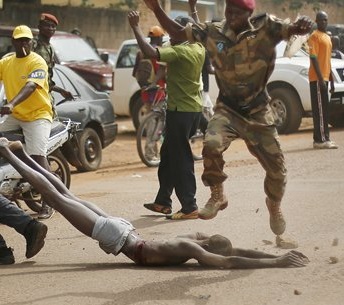
A group of soldiers in the turbulent Central African Republic capital of Bangui lynched a suspected rebel on Wednesday, minutes after hearing CAR’s new president promise to restore peace at a ceremony reinstating the divided country’s army.
A Reuters witness saw about 20 uniformed soldiers accuse a member of the crowd at a training centre in the capital Bangui of having belonged to Seleka, the mostly Muslim rebel group that seized power in a coup last March.
They then stabbed him repeatedly until he was dead. A soldier stamped on the lifeless body, which was then dragged through the streets, dismembered and set alight as residents looked on and took photographs.
Ten minutes earlier, about 20 metres away, the new interim president, Catherine Samba-Panza, had addressed the crowd of at least 1,000 soldiers at a ceremony meant to re-introduce the army to the nation after it effectively disappeared from view during Seleka’s rule.
“Within a month, I would like to fully secure the greater part of the country, and I aim to stick to my word,” she said.
Samba-Panza was appointed two weeks ago to lead the country until elections are held next February, after coup leader Michel Djotodia stepped down under intense international pressure. She made clear it would take time to restore order.
“At a certain point, everyone will be held responsible for their acts. I am warning troublemakers who continue to sow disorder in the country,” she said.
Seleka’s 10-month occupation of cities and towns across the country has been marked by rampant looting, torture and murder.
The deep resentment they spawned among the Christian majority led to the formation of Christian “anti-balaka” militias, meaning “anti-machete” in the local Sango language, further fanning the flames of inter-religious bloodshed.
About 1 million people, a quarter of the former French colony’s population, have fled their homes. Even the presence of 1,600 French soldiers and 5,000 African troops has so far failed to stop the tit-for-tat violence, which the UN says has already killed more than 2,000 people.
At least 22 people, including 16 women, were killed on Wednesday when Seleka fighters attacked the northwestern city of Nzakone, according to a resident of the village contacted by Reuters.
Chadian peacekeepers have been accused of facilitating the movements of Seleka leaders responsible for a new wave of atrocities.
Many of Seleka’s fighters come from Chad and Sudan, but Chadian officials deny supporting the rebels.
Chadian military officials said on Wednesday they had detained and disarmed 262 fleeing Seleka fighters that had entered Chad, seizing more than 300 weapons, ammunition and a dozen vehicles.
“We didn’t want to give our weapons to the French, so we crossed over to give them to the Chadians,” Seleka’s Colonel Ahmat Abdelkérim Bahar told a Reuters journalist in the town of Doba.
France’s defense minister says the military is likely to extend its mission in Central African Republic.
Jean-Yves Le Drian told RTL radio Thursday that extending the UN-mandated six-month mission was probably the best way to ensure a peaceful political transition.
Source: France24
This website uses cookies to improve your experience. We'll assume you're ok with this, but you can opt-out if you wish. Cookie settingsACCEPT
Privacy & Cookies Policy
Privacy Overview
This website uses cookies to improve your experience while you navigate through the website. Out of these cookies, the cookies that are categorized as necessary are stored on your browser as they are essential for the working of basic functionalities of the website. We also use third-party cookies that help us analyze and understand how you use this website. These cookies will be stored in your browser only with your consent. You also have the option to opt-out of these cookies. But opting out of some of these cookies may have an effect on your browsing experience.
Necessary cookies are absolutely essential for the website to function properly. This category only includes cookies that ensures basic functionalities and security features of the website. These cookies do not store any personal information.
Any cookies that may not be particularly necessary for the website to function and is used specifically to collect user personal data via analytics, ads, other embedded contents are termed as non-necessary cookies. It is mandatory to procure user consent prior to running these cookies on your website.