Gold miners vowed on Thursday to take their silicosis lawsuit against London-listed Anglo American to South Africa’s courts, after a British court refused to hear their case.
London’s High Court ruled on Wednesday that it did not have jurisdiction over claims by miners that they fell victim to the deadly lung disease while working deep underground in the company’s South African mines.
Lawyers for the miners plan to appeal against that decision, but will also press ahead with individual cases in the South African legal system, said attorney Zanele Mbuyisa.
“We are going to issue the same claims in South Africa on an individual basis,” Mbuyisa told AFP.
“In the next two days, we will have the first 50 claims and it would go further on a rolling basis,” she added.
South African and British lawyers initially filed the class action for 450 people who had worked on gold mines from 1960 to 1998.
“Several hundreds more” have since been added, according to Mbuyisa.
The miners claimed they contracted the disease with no known cure from inhaling dangerous levels of silica dust while drilling rocks in gold mines.
When miners are exposed to excessive amounts, silica dust gets locked into the lungs and permanently scars the organ.
The result is silicosis. Symptoms include persistent coughing and shortness of breath. It often leads to tuberculosis and death.
Anglo American moved its headquarters from Johannesburg to London in 1999, a year after grouping its gold operations into Anglo Gold, now Anglo Gold Ashanti.
It has since sold its gold interests.
The firm welcomed Wednesday’s ruling, agreeing that a British court “does not have jurisdiction to hear this claim,” spokesperson Hulisani Rasivhaga told AFP. – Sapa/AFP
Until recently, Tony Blair had never visited Malawi. Last summer there was a lot of international press coverage on the discovery of oil under Lake Malawi. Since then he’s developed an interest in the country’s “governance” and has visited twice in nine months.
He arrives in Malawi today, having successfully shoehorned a couple of staffers from his “Africa Governance Initiative” into high-level advisery roles with Joyce Banda’s government.
It’s anyone’s guess why Blair still believes he and his cronies are worth listening to. Presumably for the same reason he saw fit to rack up bills of £1m a year at the American Colony Hotel in Jerusalem while working as a “peace envoy”. (He’s obviously doing a terrific job and no doubt the Middle East will be at peace any time now). Egyptians know him as an astute analyst of international affairs — remember how he pointed out that Mubarak was “an immensely courageous and a force for good” in, ahem, February 2011?
One thing Blair is very good at is getting large amounts of cash out of governments (just ask Kazakhstan) by riding the global gravy train for all it’s worth. He’s also good at setting up mystifying financial structures so nobody knows where he’s channeling his money.
It will certainly be a boost for him to be photographed with Malawi’s president, Joyce Banda, who despite facing a vigorous opposition at home nonetheless has far greater credibility on the international scene than he does (just last year Desmond Tutu called for Blair to be tried for his crimes at the Hague).
Malawians should protest against Blair’s visit and show Banda that she shouldn’t welcome such a person to Malawi, still less take any advice from him. The man who led the disastrous New Labour project in the UK, as well as waging two catastrophic wars, can have nothing useful to tell Banda. Malawian readers will understand what I mean when I say that Tony Blair is a stupid man. He will have plenty to say about things like “strengthening capacity” but it seems that the only thing Blair has shown a consistent commitment to is exploiting his former office in order to accrue vast personal wealth.
It should be noted that anybody who attempts to arrest Tony Blair during his Malawian safari can receive approximately 1.1 million Kwacha (£2,150), thanks to the Arrest Blair campaign established by British journalist George Monbiot. Here’s a helpful guide to making a citizen’s arrest, and the rules about how to make sure you get the cash.
Malawians like to reflect on their history by observing that they are a peace-loving people. As Blair arrives in the country, they should tell him only one thing: Choka! – The Guardian
The Norwegian town of Rjukan is shrouded in darkness for five months every year, but a project completed this month promises to bring a bright spot to the town’s central square via the recently completed installation of a series of massive mirrors that will reflect sunlight onto the meeting spot.
The Mirror Project was originally conceived by a Norwegian industrialist almost 100 years ago, but the lengthy wait has not dampened enthusiasm about the project’s completion.
Rjukan, which is located about halfway between Bergen and Oslo and is encircled by sun-obstructing mountains, is a dreary place to be between September and March, when the sun’s rays cannot reach its quaint streets.
But the effort, dubbed the “Mirror Project,” will ensure that Rjukan residents have a place to bask even in the darkest days of frigid Scandinavian winters.
“The aim of this project is to illuminate the town square of Rjukan with reflected sunlight. Rjukan is a town surrounded by mountains which prevent the sun from reaching the floor of the valley for five months of the year,” an online description of the plan states. “The project will result in a permanent installation which, with the help of 100 [square-meter] mirror[s], will redirect the sun down into the valley. The square will become a sunny meetingplace in a town otherwise in shadow.”
The 538-foot mirrors, which were installed in July with the help of helicopters, have yet to be tested, but as the sun recedes behind the mountains for the last time this year in September, the town’s residents and science-lovers around the world will be watching to see if they can really keep the town from its typical winter gloom. – ibtimes.com
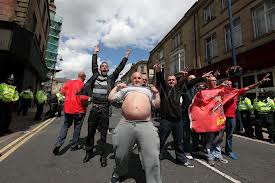
Protesters have been injured and a police officer hospitalised with concussion after police and far-right demonstrators clashed at an English Defence League (EDL) rally in Birmingham.
Hundreds of EDL supporters gathered in the city’s Centenary Square on Saturday, with Unite Against Fascism members forming a counter-protest in nearby Chamberlain Square.
Soon after EDL leader Tommy Robinson began his speech to the crowd, protesters started tussling with police, with some pulling down fences around a new University of Birmingham construction site and hurling smashed cobble-stones and bottles at officers.
Several protesters were seen with blood pouring from their heads after police equipped with riot gear and armed with batons confronted the crowd.
“Police injured, Broad St bar doors smashed, building site materials thrown at police, shops closed, work lost. Another peaceful EDL protest,” tweeted Birmingham Labour MP Ian Austin.
West Midlands Police said that four arrests had been made and that 1,000 extra officers had been drafted in before the demonstration to help cope with any disorder.
The EDL said they were marching for the reintroduction of CCTV cameras in the Washwood Heath and Sparkbrook areas of the city. The cameras were originally installed as a counter-terrorism measure, but removed in 2011. – ibtimes.com
Some 20 cars have been torched and four people detained in a second night of violence in suburbs west of Paris, a result of tensions linked to authorities’ handling of France’s ban on Muslim face veils.
France’s interior minister said Sunday that the incidents overnight targeted the town of Elancourt.
Police union official said on BFM television that about 50 assailants were involved, some firing weapons and a gasoline bomb at police.
The night before, about 250 people hurling projectiles clashed with police firing tear gas in the nearby town of Trappes in apparent protest over the enforcement of France’s ban on Islamic face veils. Five people were injured and six detained in the violence, authorities said Saturday.
The interior minister urged calm and dialogue, insisting on both the need for public order and respect for France’s Muslims. The incident in the town of Trappes on Friday night reflected sporadic tensions between police upholding France’s strict policies of secularism and those who accuse authorities of discriminating against France’s No. 2 religion.
A few garbage dumpsters in the area were torched and a bus shelter shattered in the Trappes unrest. Spent tear gas capsules lay on the road Saturday near the police station at the center of the violence.
A 14-year-old boy suffered a serious eye injury in the violence, from a projectile of unknown provenance, Prosecutor Vincent Lesclous told reporters. Four police officers were injured and six people were detained in the violence, said an official with the regional police administration. The official spoke on condition of anonymity because he was not authorized to be named due to his department’s rules.
On Saturday night, fearing new violence, riot police deployed around the town, but the atmosphere appeared calm.
The Friday night violence came after a gathering of about 200-250 people to protest the arrest of a man whose wife was ticketed Thursday for wearing a face veil. The husband tried to strangle an officer who was doing the ticketing, the prosecutor said.
France has barred face veils since 2011. Proponents of the ban — which enjoyed wide public support across the political spectrum — argue the veil oppresses women and contradicts France’s principles of secularism, which are enshrined in the constitution. In addition to small fines or citizenship classes for women wearing veils, the law includes a hefty 30,000 euro ($39,370) fine for anyone who forces a woman to wear one.
The law affects only a very small proportion of France’s millions of Muslims who wear the niqab, with a slit for the eyes, or the burqa, with a mesh screen for the eyes. But some Muslim groups argue the law stigmatizes moderate Muslims, too. France also bans headscarves in schools and public buildings.
The Collective Against Islamophobia in France urged Interior Minister Manuel Valls, who recently joined Muslim leaders in a fast-breaking sundown feast for holy month of Ramadan, to crack down on insults and attacks against Muslims.
Valls urged calm after the Trappes violence, and pledged to stand against “all those who attack Muslim buildings or our compatriots of Muslim faith.”
But he also came down firmly against those who attack police.
“There is no valid reason for the violence seen in Trappes,” he told reporters in the southern city of Marseille, which has seen a wave of urban unrest. “The law should be applied, and applies to everyone.”
The anti-Islamophobia collective said in a statement that it was contacted by the veiled woman ticketed in Trappes on Thursday, and that she said the police officer yanked her by the veil and pushed her mother.
Police argue they are doing their jobs and that veiled women are breaking a well-known law.
Trappes was among many towns around France that saw rioting in 2005 by disillusioned youth in neglected housing projects, many with origins in former French colonies in North and West Africa.
Valls acknowledged the “difficulty our fellow citizens have living in these working class neighborhoods, especially young people. What they need is jobs, hope, training.”
“Only in dialogue can we find the solutions to the problems of our society, of joblessness, the sentiment of discrimination and exclusion,” he urged. “Violence leads to nothing.” – CBS News
Muslim rioters threw rocks and set fires following a police check of a completely veiled woman in Trappes, a western suburb of Paris, newspaper Le Parisien reported Saturday.
The gathering of 200 to 400 people became “violent” at about 8:30 pm (1830 GMT) Friday, the report said. The mob vandalized a bus shelter and set refuse bins on fire.
Two police officers were injured, a police union spokesman said. An unconfirmed report said that one boy was injured and rushed to hospital.
Police surrounded their station with emergency vehicles to protect it from the rioters.
The mob in the town of 30,000, 30 kilometres from central Paris, was angered by the arrest of a 21-year-old man on Thursday, who attacked a police officer after objecting to a police check of his fully veiled wife.
In France, the wearing of burqas and other veils in public is prohibited. – dpa
Black footballer Balotelli on the cover of the Italian VanityFair
by Michele Leridon, Davide Lerner
From monkey chants in football stadiums to threats against the first black minister, racial outbursts in Italy reflect the profound social change taking place in a country relatively new to immigration.
Shocking episodes of racism have multiplied over the past few months, from hooligans taunting star striker Mario Balotelli with inflatable bananas to crude and vicious insults against the country’s Immigration Minister Cecile Kyenge, an Italian citizen born in the Democratic Republic of Congo.
Kyenge, who refuses to write Italy off as racist, has taken the brunt of the abuse since her election in April, shrugging off derogatory nicknames or photograph montages online in which her head is superimposed onto the bodies of indigenous African women.
“Why does no one rape her, so she can understand what the victims of atrocious crime feel?” a party official with Italy’s anti-immigrant Northern League party wrote of her last month in a Facebook post, while last week the vice-president of the Senate compared her to an orangutan.
The former was given a 13-month suspended sentence and was banned from public office for three years, while senator Roberto Calderoli is being investigated for inciting racial hatred — though he refuses to resign, insisting he has done enough by apologising to Kyenge with a bunch of flowers.
Bizarrely, the probe against him was only opened after a consumers association, Condacons, launched a complaint. And despite a petition signed by 200,000 people calling for Calderoli’s removal, the League member has so far managed to hold on to his prestigious Senate post.
“Italy is no more racist than other European countries, but sensitivity to the issue is not as developed here,” Italian historian Marco Fossati told AFP.
Michela Marzano, a philosopher and deputy from the centre-left Democratic Party (PD), said: “there is an extreme tolerance towards intolerance.”
“Italy has not had many opportunities to enter into contact with ‘the Other’, because it has always been a country of emigration rather than immigration,” she said.
While millions of Italian fleeing poverty emigrated to the United States, Latin America and other parts of Europe throughout the Twentieth century, the Mediterranean country has only had to absorb large numbers of immigrants over the past 20 years or so.
“We have remained very provincial, and the Calderoli affair has sparked a lot of indignation but no concrete action,” said Fossati, adding: “anyone who reacts with indignance is seen as a moralist, someone who is infected with the ‘politically correct’ virus.”
Luigi Manconi, head of the civil rights commission in the Senate, dates the ‘legitimisation’ of racial abuse back to an episode in 2007, when an Italian woman was raped by a Romanian man ahead of municipal elections, kicking off a fear-based campaign equating Romanians to rapists.
From that point, Manconi says, the Northern League — and Calderoli in particular — have felt increasingly free to be racist and “have played a fundamental role in the legitimation of xenophobia.”
Adriano Prosperi, modern history professor at Pisa University, compares Italians’ apathy in the face of racism today with the introduction of racial laws in 1938 which were “passively absorbed by Italian society” under dictator Benito Mussolini’s Fascist regime.
Centre-right former premier Silvio Berlusconi, renowned for off-colour comments, sparked a backlash in January when he stated during the inauguration of a Holocaust museum that the regime “in many ways did good things” for Italy — before retracting his comment.
Despite such incidents, Prosperi said he does not think Italy is “profoundly racist at heart”. While the League may generate shock headlines — its former leader Umberto Bossi once said immigrants arriving by boat should be shot at with cannons — it won just four percent in the last elections.
The real reason Calderoli has not been forced out, Prosperi says, is that the current government “has sacrificed values for the sake of realpolitik.” – AFP
“People see what they think they want to see,” explains a director, who has been creating her famous faux celebrity shoots for 15 years, after a scrumage in a London park to see the “royal baby”.
“There is a wall of myth around royals and A-list celebrities . We see them on magazine covers so often that we think we know them intimately, and we want to learn more. I like to burst that bubble a little.”
We are rabbits in the headlights, a gold strike in the Klondike, the centre of a British Lions scrum. Paparazzo-style cameras zoom in from everywhere, mobile phones are held aloft, mobs of screaming tourists in bikinis descend, doting abaya-ed mummies prove unable to resist a peek, even large Swedish males with plaster casts rush towards the pram.
We circle it and prepare to make a stand.
“Does this happen often?” I ask the duchess, who seems more embarrassed than distressed. “Well, you never know how people are going to react,” she says, with a surprising Essex twang.
And with that the couple trot off, rolling the pram and smiling at the shrieking crowd, as a German TV crew documents their every step and a slender, elegant woman in black calls out instructions.
The wave of royal mania recedes as sharply as a turning spring tide (though the giggles intensify), the 100-plus fans suddenly realising their eyes have deceived them. “Lookalike!” the cries go up. These lucky few have just been subject to a walking, talking Madame Tussauds show: an Alison Jackson photoshoot.
How we have managed to fool strangers into believing the royal baby has not only been born, but that the royal couple would potter outside Kensington Palace without so much as a bodyguard, is staggering – but not to Jackson.
And she succeeds in making us suspend our disbelief at apparent shots of George Bush struggling with a Rubik’s cube in the Oval Office or the queen on the loo – and actively enjoy our voyeurism. – The Daily Telegraph
When the Obama administration discusses matters of sensitive diplomacy, it isn’t always a model of clarity.
But this week reporters have struggled to get a direct answer to what would seem to be a simple question: Is President Barack Obama still planning to attend a summit meeting with Russian President Vladimir Putin in Moscow in early September?
What’s become increasingly evident is the planned summit meeting is now entangled in the delicate negotiations between Messrs. Obama and Putin over the fate of former NSA contractor Edward Snowden.
Let’s back up to mid-June.
Mr. Obama was in Northern Ireland, meeting with various counterparts, including Mr. Putin. The two men held a private session, at which they agreed to take part in a summit meeting in Moscow prior to a separate Group of Twenty meeting in St. Petersburg, Russia.
Ben Rhodes, deputy national security adviser for strategic communications, said in a press briefing at the time: “So we’ll be going to Moscow before we go to St. Petersburg for the G-20.”
But the following week, Mr. Snowden left his hiding place in Hong Kong and showed up in Russia. Since then, the Obama administration has been imploring Russia to return Mr. Snowden to the U.S. to face criminal charges. So far, Mr. Putin hasn’t complied.
Now the summit may be a casualty of the Snowden negotiations.
In his daily briefings this week, White House Press Secretary Jay Carney has been giving careful answers to questions about whether the Obama-Putin summit is still on.
On Wednesday, he was asked if Russia’s handling of the Snowden case has any bearing on Mr. Obama’s decision to attend the scheduled summit meeting with Mr. Putin.
Mr. Carney replied that “the president intends to travel to Russia for the G20 Summit. And I have no further announcements to make beyond what we’ve said in the past about the President’s travel to Russia in the fall.”
Can he definitively say whether Mr. Obama will go to Moscow?
“I can say that the president intends to travel to Russia for the G20 Summit. I don’t have anything to add to what we’ve said in the past about that trip,” Mr. Carney said.
Later in the briefing, another reporter asked him to clarify that answer.
Mr. Carney replied that he “might have been deliberately vague, so I’m not sure I can clarify.”
He went on to say that “I have no further announcements on our travel to Russia. The President intends to go to Russia in September.”
“But you won’t say Moscow?” the reporter said.
“I just have nothing else to say on it,” Mr. Carney said.
All this seems to leave open the possibility that Mr. Obama might call off the summit. In any case, the White House statements may be a signal to Moscow that Mr. Snowden’s status and the summit’s future are now linked, one foreign policy expert said.
“I do think it is a signal,” said Heather Conley, director of the Europe Program at the Center for Strategic & International Studies.
The White House, she said, is “having to rethink [the Moscow summit] right now. This is going to be a very fluid situation.” – WSJ
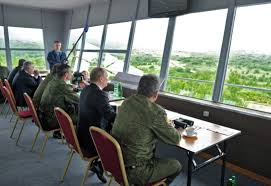
Russia is in the midst of its biggest war games since Soviet times, with 160,000 troops, 130 planes, 70 ships and thousands of tanks and armored vehicles participating in the country’s Far East, according to media reports.
Russian President Vladimir Putin ordered the drills last Friday and they began that night, according to reports from the RIA Novosti news agency. Putin flew to Sakhalin island off the eastern coast to oversee the games on Tuesday, Russia’s presidential press service reported.
“The main purpose of the activities is to check the readiness of the military units to perform assigned tasks and evaluate of the level of personnel’s training and technical preparation as well as the level of equipment of units with arms and military equipment,” the Russian Defense Ministry said in a statement reported by Russian Television.
“The Sakhalin part of the maneuvers was intended to simulate a response to a hypothetical attack by Japanese and U.S. forces,” Konstantin Sivkov, who is retired from the Russian military’s General Staff, told the Nezavisimaya Gazeta newspaper, according to a report from the BBC.
But Russia’s deputy defense minister, Anatoly Antonov, said the games were designed to “enhance the army’s combat readiness” and were not directed against any specific nations, the BBC reported.
Some of the units involved in the exercises moved more than 3,000 kilometers (1,800 miles) from their bases to participate, according to the Russian media reports.
The current drills, which are expected to last through the week, are the latest in a series of snap exercises conducted by the Russian military this year, Russian Television reported. Similar drills have been conducted in the country’s west, south and central military districts, the report said. – CNN
Russia’s President Vladimir Putin says Edward Snowden, who has been stuck in a Moscow airport for weeks, will leave Russia as soon as he is able to.
Putin on Monday also accused Washington of preventing the fugitive, US intelligence leaker Edward Snowden, from leaving Russia after he arrived from Hong Kong on June 23. “He arrived on our territory uninvited, he did not fly to us,” Russian news agencies quoted Putin as saying.
“They themselves [Washington] scared off all the other countries, no one wants to take him, and therefore they essentially themselves trapped him on our territory,” added the president, according to the agencies.
Meanwhile, Putin said on Monday that he saw signs that Snowden was shifting towards stopping “political activity” directed against the United States.
Putin, who previously refused to hand Snowden over to the US authorities, said the fugitive’s situation remained unresolved after Washington had blocked his further movements.
Asked on an island in the Gulf of Finland about Snowden’s future, Putin said: “How do I know? It’s his life, his fate.”
Putin has stated Snowden should stop activity harmful to the United States if he wanted refuge in Russia, and said he saw signs that the former contractor with the National Security Agency was moving in this direction.
“As soon as there is an opportunity for him to move elsewhere, I hope he will do that. The conditions for granting political asylum are known to him. And judging by his latest actions, he is shifting his position. But the situation has not been clarified yet,” Putin said.
Breaking weeks of silence, Snowden on Friday said at a Moscow airport where he has been camped since late June that he was seeking temporary asylum in Russia before he can safely travel to Latin America. Venezuela, Bolivia and Nicaragua have offered him asylum. – AFP, Reuters
Mugabe visiting the Queen: Not boosting the British economy…
Kate Middleton and Prince William are expecting their first child within days, and U.K. and global media outlets are gearing up for what is expected to be the biggest royals story of the year.
The royal birth will directly boost U.K. retail sales by around $367 million (£243 million), according to an estimate by the Centre for Retail Research in Nottingham, England. The figure covers all of July and August.
Festivities-related expenses will lead the way with an estimated $131 million (£87 million) in additional business thanks to the royal baby, according to the research. That includes increased spending on alcohol ($94 million, or £62 million), with the group predicting three million bottles of champagne and sparkling wine will be opened across the country, mostly in informal celebrations, to celebrate the baby.
“We expect plenty of people, not necessarily fervent royalists, to welcome the happy event in a demonstrative way,” the center said in a report.
Souvenirs and toys tied to the baby could bring in $121 million (£80 million), a figure that includes items sold overseas, it estimated.
And spending on royals- and royal baby-related books, DVDs and media could reach $115 million (£76 million), according to the Centre for Retail Research.
Beyond sales within the U.K., sales abroad of souvenirs, toys, books and DVD/media could also add to the economic impact to the tune of $56 million (£37 million), according to the center. That estimate includes overseas sales by U.K. online retailers.
“There is considerable interest in this event across the world, but particularly in North America, parts of Europe and Australia and New Zealand,” the center’s report said. “The Cambridges are seen as a “good news” story and surprisingly normal.
Bookies and betters are also looking to make money off the royal baby.
Bookmaker William Hill says the royal baby betting market might see $150,000 spent on various bets – from the gender and name of the baby to its hair color.
But that would be a minimal sum compared to the hundreds of millions of pounds placed on Britain’s annual Grand National horse race.
“Since the announcement that the Duchess was pregnant, there has been considerable interest in her changing shape, the sex of the baby, what new things she is wearing, as well as the baby products that are being acquired,” according to the report from the Centre for Retail Research.
It projects that in the months after the baby is born money spent on strollers could rise by 13 percent, or $50 million (£33 million) “as new parents “trade up” to more exclusive baby carriages following a trend that is expected to be set by the royals.”
Said the center: “The lucky manufacturer can expect a similar boost in sales to that achieved by iCandy Peach when Victoria Beckham adopted one for her daughter Harper.”
Observers have already spoken of the “Kate Effect” in such areas as fashion as items that Middleton wears tend to see a sales boost.
Similar gains are also expected to be made by the manufacturers of the royal baby’s clothes, crib and other products associated with the baby and its parents, according to the center. – The Hollywood Reporter
Omar Diallo’s head is still swollen after a recent assault on the streets of Athens which left him with several stitches.
Having fled his troubled homeland of Guinea, the 28-year-old is no stranger to violence, but the virulent racism he says he has experienced in crisis-hit Greece has come as a shock.
In the Athens neighbourhood where he lives — an area full of empty, graffiti-covered shops with “for rent” and “for sale” signs on the windows. “There are zones where we no longer have the right to go, or where we can only go in groups.”
He was on his own when he was assaulted. The attack was swift and silent, unaccompanied by racist taunts or demands.
“Four people got hold of me on the street, one of them hit me with some object on the head. I fell down and they hit me. When they finished, they left.”
Omar fled his west African home after a September 2009 stadium massacre during an opposition rally. His father was among the 157 killed, while he was thrown in jail.
After being released he decided to leave his country where he said he feared for his life.
But just a few years after coming to Athens in search of a better future, he found himself lying in the street, blood dripping from his head, until police officers found him and took him to the hospital.
His story is not unique.
“I saw a young Pakistani being beaten right in front of me, by two giants, who ran through the whole bus to get to him and then kicked him violently out on the street. I did not interfere because I was scared,” a mortified retired Frenchman, who has been living in Athens for a year, told AFP.
A watchdog recording racial violence counted 154 victims in 2012, 107 of whom were assaulted in Athens. In at least eight cases, victims or witnesses said they recognised people associated with neo-Nazi party Golden Dawn.
Omar, who used to study international relations in Conakry, feels that racial attacks have surged since conservative Prime Minister Antonis Samaras came to power in June 2012.
That is when Golden Dawn was elected into parliament for the first time, winning 18 seats out of an overall 300.
“They felt politically fortified,” Omar said.
Racist attacks ‘almost every day’
According to the report on racial violence, only 24 of the victims made a formal complaint to the police in 2012.
“In my understanding, they (perpetrators) try not to kill, but to make visible injuries, so as to spread the fear to the communities,” said Doctor Nikitas Kanakis, secretary general of the Greek branch of the non-governmental group Doctors of the World.
Kanakis has long tried to highlight the problem, and victims of racial attacks often turn to him instead of going to a hospital.
He has brought attention to several attacks such as the case of a 14-year-old Afghan boy, whose face was slashed by a broken bottle in an Athens neighbourhood dominated by neo-Nazis.
“Almost every day in various parts of the country, particularly in Athens, racist attacks occur,” said Giorgos Tsabropoulos, head of the UNHCR’s Athens office.
The government’s response to the problem has been ambiguous.
It has condemned Golden Dawn’s attacks as unacceptable, and Public Order Minister Nikos Dendias recently told the BBC that “Golden Dawn… is clearly a neo-Nazi party.”
He said a special police unit had been created to deal with racist crimes and “that the people who act unlawfully should end up in prison.”
But in the same interview he said “creating new legislation won’t help” , despite being under pressure from the Council of Europe to do so.
Dendias said the rise of Golden Dawn and its xenophobic and racist doctrine was linked to a surge in undocumented migrants arriving in Greece, which he said were “are a huge burden to our society.”
Dendias has appealed to the EU for financial aid to deal with the increasing number of migrants.
The premier recently made a big show of his meeting with Greek star basketball player of Nigerian origin Giannis Adetokunbo, who was drafted into the NBA, to counter accusations of racism.
Eva Cosse from Human Rights Watch admits that there has been some progress, notably the appointment of a special prosecutor in Athens, but “there is still a lot of work to do.”
“They need to assure that every migrant and asylum seeker, even undocumented, has the right to access the judicial system,” she told AFP.
Meanwhile, the US Embassy in Greece has warned US citizens travelling to Greece to be wary of “a rise in unprovoked harassment and violent attacks against persons who, because of their complexion, are perceived as foreign migrants.”
“US citizens most at risk are those of African, Asian, Hispanic or Middle Eastern descent in Athens and other major cities,” the statement on the embassy’s website, first posted last November, reads. – SAPA/AFP
Samples taken at the Syrian town where chemical weapons were allegedly used indicate that it was rebels – not the Syrian army – behind the attack, Russia’s UN envoy Vitaly Churkin has said.
Russia has handed over the analyzed samples to the UN, he added.
“I have just passed the analysis of samples taken at the site of the chemical attack to the UN Secretary General (Ban Ki-moon),” Churkin said on Tuesday.
Evidence studied by Russian scientists indicates that a projectile carrying the deadly nerve agent sarin was most likely fired at Khan al-Assal by the rebels, Churkin pointed out.
“It was determined that on March 19 the rebels fired an unguided missile Bashair-3 at the town of Khan al-Assal, which has been under government control. The results of the analysis clearly show that the shell used in Khan al-Assal was not factory made and that it contained sarin,” he said.
Churkin added that the contents of the shell “didn’t contain chemical stabilizers in the toxic substance,” and therefore “is not a standard chemical charge.” The RDX – an explosive nitroamine commonly used for industrial and military applications – found in the warhead was not consistent with what the armed forces use.
According to Moscow, the manufacture of the ‘Bashair-3’ warheads started in February, and is the work of Bashair al-Nasr, a brigade with close ties to the Free Syrian Army.
Churkin stressed that unlike other reports which have been handed to the UN, the samples were taken by Russian experts at the scene, without any third party involvement.
More than 30 people died in the Khan al-Assal incident in the northern province of Aleppo in March. Damascus was the first to ask for the UN investigation, accusing opposition fighters of launching a chemical weapon attack. Syrian rebel groups denied the accusations, in turn blaming government forces.
However, the UN investigation has largely become stalled after a group of Western nations insisted on launching an inquiry into a separate case of alleged chemical weapons use in Homs in December 2012. The inquiry requires access to military objects, which Damascus has been unwilling to give.
The UN has also decided to exclude Russian and Chinese experts from the investigation team, with Syria protesting this decision.
So far, the UN commission of inquiry for Syria has not found any conclusive evidence proving that either side of the conflict used chemical weapons. This is despite several reports submitted by the US, UK and France, which claim to show that Syrian President Bashar Assad’s forces used such weapons.
Syria finds enough chemicals to ‘destroy the whole country’
The Syrian government invited chief UN chemical weapons investigator Ake Sellstrom and UN disarmament chief Angela Kane for talks in Damascus on Monday, announcing that a rebels-linked storage site containing piles of dangerous chemicals had been discovered.
“The Syrian authorities have discovered yesterday in the city of Banias 281 barrels filled with dangerous, hazardous chemical materials,” Syrian UN Ambassador Bashar Ja’afari said, adding that the chemicals were “capable of destroying a whole city, if not the whole country.”
The chemicals, which included monoethylene glycol and polyethylene glycol, were found in a storage site used by “armed terrorist groups,” Ja’afari explained. He said that Syria has started an investigation into the discovery.
The Syrian envoy expressed Damascus’ confidence that there will be “constructive negotiations with the Syrian officials in order to reach an agreement,” particularly in terms of “reference, mechanism, and time frame” of the UN mission.
Ja’afari added, however, that one should not “jump to the conclusion” that the Monday invitation means that Syria would consider allowing the UN team access to sites beyond Aleppo.
UN Secretary-General Ban Ki-moon’s spokesman, Martin Nesirky, reacted by calling the invitation “a move in the right direction,” but did not say whether UN investigators would accept it. The UN has been demanding that Sellstrom’s team be granted access across Syria “without further delay and without conditions,” ordering the Aleppo investigation not to begin until those demands were reached.Following Churkin’s announcement, both US and UK officials voiced their disbelief over any evidence suggesting that Syrian rebels used chemical weapons, stating they have yet been unable to see the whole report of Russia’s UN envoy.
The US has “yet to see any evidence that backs up the assertion that anybody besides the Syrian government has the ability to use chemical weapons, has used chemical weapons,” White House spokesman Jay Carney said.
When asked whether Washington had seen the Russian report, Carney replied that it had not.
The UK also voiced its skepticism regarding the report, stating that it didn’t believe the opposition could have obtained chemical weapons.
“We will examine whatever is presented to us, but to date we have seen no credible reporting of chemical weapons use by the Syrian opposition, or that the opposition have obtained chemical weapons,” BBC quoted a UK government spokesman as saying. – RT
This website uses cookies to improve your experience. We'll assume you're ok with this, but you can opt-out if you wish. Cookie settingsACCEPT
Privacy & Cookies Policy
Privacy Overview
This website uses cookies to improve your experience while you navigate through the website. Out of these cookies, the cookies that are categorized as necessary are stored on your browser as they are essential for the working of basic functionalities of the website. We also use third-party cookies that help us analyze and understand how you use this website. These cookies will be stored in your browser only with your consent. You also have the option to opt-out of these cookies. But opting out of some of these cookies may have an effect on your browsing experience.
Necessary cookies are absolutely essential for the website to function properly. This category only includes cookies that ensures basic functionalities and security features of the website. These cookies do not store any personal information.
Any cookies that may not be particularly necessary for the website to function and is used specifically to collect user personal data via analytics, ads, other embedded contents are termed as non-necessary cookies. It is mandatory to procure user consent prior to running these cookies on your website.


 Gold miners vowed on Thursday to take their silicosis lawsuit against London-listed Anglo American to South Africa’s courts, after a British court refused to hear their case.