Sixteen years ago, Clayton Christensen laid out his theory of ‘disruption’ in the book The Innovator’s Dilemma. From steel mills to floppy disk drives, he saw innovation led by small players trying, failing, trying again and eventually creating products that superseded the market leaders. The book became a bible of Silicon Valley. Last month, in an interview with Wired, he proposed that, having changed the way we shop and communicate, the internet is moving into a new phase – disrupting essential industries like education and healthcare.
Christensen’s right, but he’s missing a far deeper change. It is the disruption of some of our most fundamental notions: value, ownership, and attachment to place. In the past fortnight, we’ve seen the price of Bitcoin (a new online-only ‘cryptocurrency’) skyrocket while gold – traditionally a safe investment in times of crisis – hit a 30-year low. In the workplace, more and more people are shunning office-based roles in place of bespoke careers, requiring only a Wi-fi connection. And an increasing number of our assets – music, films, documents – are not just intangible but notionally are not even in our possession, existing instead “in the cloud”.
The music industry is a prime victim of internet disruption. People now expect to pay close to nothing for content, and the old structures must adapt or implode. In response, many artists charge little for their music and make their money through expensive tour tickets; Prince gave away his 2007 album Planet Earth free in the Mail on Sunday and netted $18.8 million from 21 nights at the O2. This separation of ‘experiential’ from ownership is characteristic of the younger generation, known as ‘digital natives’. Marketers and forward-looking brands like Red Bull have been quick to capitalise on this, with an emphasis on sponsorship of gigs and extreme sports events.
A shifting sense of value could have contributed to the noughties seeing the first drop in home ownership and rise in rental of the last century. Property is the preserve of the pre-digital generation and the few that do find their way on to the ladder have their sense of ownership diluted by government-subsidised schemes and mortgages backed by parental equity. Meanwhile the internet has allowed us a more participatory relationship with property through couch surfing, air b’n’b and easy-to-access subletting.
And why tie yourself to one location, when your work doesn’t necessitate it? A series of articles in The Atlantic last year, looking at the US, compared the rise of the freelancer to the industrial revolution. The internet allows us to develop a range of skills and gives us a marketplace in which to monetize them. “We’re no longer simply lawyers, or photographers, or writers.” It read. “Instead, we’re part-time lawyers-cum-amateur photographers who write on the side.”
Every time you walk into a coffee shop full of caffeinated hipsters tapping away on Macs, you could well be looking at the future. Last year, Google opened Campus, a co-working space in Old Street, providing all the resources needed (ie. roof, internet connection, vending machines) to work online. With money pumping into ‘tech hubs’ across the UK, we’re sure to see more of the same. Where the States lead, we tend to follow; but when Google goes, we’re there.
Economics has always been a nebulous thing: a belief system rather than a science or even an art, based on notions of interest, loans, capital and deeper still on belief and trust. Much of this can be traced back to the advent of Protestantism and the removal of the sin of usury under Henry VIII, allowing money lending. Perhaps, decades from now, when the dust of this disruption has settled, we will look back and agree with Silicon Valley that The Innovator’s Dilemma was a book deserving of the highest possible reverence.
Like coal mining in the Eighties, the anti-racism industry is in decline. Governments can no longer afford to subsidise “diversity workshops” for which there’s no demand. Especially from young people.
On both sides of the Atlantic, teenagers and students are giving the finger (as they might put it) to the hypersensitive race relations ideology drilled into them by their teachers. They laugh at jokes that, a decade ago, would have been regarded as racist. If, after a few drinks, one of their friends crosses the line into ethnic stereotyping, they’re more like to argue with them than to notify the campus police.
The disintegration of traditional anti-racism was brought home to Americans this week when Brad Paisley, a young country music star, and LL Cool J, a black rap artist, released a song entitled Accidental Racist. In it, Paisley clumsily tries to explain why he’s attracted to the Confederate flag. He sings: “I’m proud of where I’m from but not everything we’ve done/And it ain’t like you and me can rewrite history.”
Cool J replies: “Just because my pants are saggin’ doesn’t mean I’m up to no good /You should try to get to know me, I really wish you would… If you don’t judge my gold chains/ I’ll forget the iron chains.”
Cue melodramatic gasps of horror from progressive columnists. But what’s interesting is that most fans of Brad Paisley and LL Cool J (and there isn’t much overlap between the two groups) aren’t offended. A white singer takes grudging pride in the Confederate South? A black singer makes fun of his own sagging pants and refuses to harp on about slavery? Cool. Or at least, like, whatever.
This nonchalance confuses the elderly activists who, until recently, lumbered from one workshop to another, pocketing wads of cash in the process: “racial sensitivity” doesn’t come cheap.
I put those words in quotation marks because these bores did nothing to promote harmony. On the contrary, ethnic minorities were taught to be ultra-sensitive towards unintended slights (as opposed to real racism, which they didn’t need lessons in identifying).
As for white people, it was all about guilt-tripping. Chief executives booked themselves on reprogramming courses, patting themselves on the back. (One of the benefits of austerity, in my opinion, is that firms can no longer afford these feelgood exercises.) In schools, lessons focused relentlessly on race, with risible results. “Our English teacher would read poems by black authors in a Jamaican accent,” recalls a young colleague. “No one could keep a straight face.”
This readiness to mock pompous anti-racists isn’t evidence of hard prejudice. Old-style “racialism”, as it used to be called, is pretty much dead, in the sense that fewer and fewer of us are interested in the colour of people’s skin. The word “darkies” is antiquated as well as nasty. On the other hand, if young people of any background want to tease members of another group for its annoying or anti-social habits, then they go right ahead. And if they feel threatened by aggressive behaviour – for example by Islamists trying to segregate men and women at London University, as happened last month – then they won’t be silenced by right-on quangos.
I’m not denying that, in the heat of the moment, horrible things are said. This is what happens in a (mostly) colour-blind society that allows free speech, as opposed to one governed by the phoney etiquette of the grievance-mongers. But, in the words of the song, racism is increasingly accidental rather than intentional. Surely that’s progress. – Damian Thompson, From Saturday’s Daily Telegraph
The reason why theSouth African consumer has to pay more for electricity, lies with the corrupt dealings between the Chamber of Mines and BHP Billiton.
About BHP Biliton’s power contracts with Eskom, Xolani Mkhwanazi warnes that BHP Biliton “expects contracts to be honoured”. Mkhwanazi also happens to be chairman of BHP Biliton SA.
The same Mkhwanazi was CEO of the National Energy Regulator.
Mr Chris Yelland has pointed out that some of the BHP power contracts had to be approved by this National Energy Regulator as required by law. The NER was established in 1995. The NER was the legal predecessor of the 2004 NERSA.
Xolani Mkhwanazi was the CEO of NER from 1999 till 2004. During this time period the NER would have approved the extensions from 2020 to 2028 of the Hillside 1 and II power contracts. At the time 2020-2028 was so far into the future, that the extensions were irrational. Would Mkhwanazi in his honest mind claim that by 2020, South-Africa would still not be utilising Eskom’s surplus capacity of 2000?
Also during same time period Mozal I and Mozal II smelters in Mozambique were approved by the NER. By then there was already a huge surplus capacity of primary aluminium ingot smelting for off-take by the local industry. Thus the long term Mozal power contracts were irrational too.
Readers must not forget: all of BHP Biliton’s aluminium smelters at Southern African ports import all of their ore from BHP-bauxite mines in Australia on the other side of the globe. South-Africa has the bulk of the worlds chrome ore, none of its aluminium ore. South-Africa also produces its own reducdant for ferrochrome smelting. All reductant for all of BHP’s import aluminium ore is imported, mostly from the USA.
How come then Mkhwanazi, former CEO of the NER, approving unique power contracts between Eskom en BHP Biliton, later CEO of BHP Billiton Aluminium South-Africa, now chairman of BHP Billiton SA, is also chairman of the South-African Chamber of Mines? With the hundreds of thousands of tons of imported aluminum ore per annum, Mkhwanazi should have been chairman of Australia’s Chamber of Mines.
Eskom has asked NERSA to review the BHP Biliton power contracts. Within 2 months, NERSA will hold public hearings in this regard. The NER as legal predecessor of NERSA, who had approved these controversial contracts will come into the spotlight. So will the chairman of BHP Biliton SA, Xolani Mkhwanazi’s former position as CEO of the NER, during the time period when most of these controversial contracts and their irrational extensions were approved by the NER.
Andile Mngxitama has called for violence to be inflicted on a white journalist on social media.
Mngxitama, who holds an MA in Sociology from Wits, works at the Foundation for Human Rights as a policy advisor. The foundation’s director, Yasmin Sooka, hastily promised that the foundation did not condone violence or the incitement to violence and/or the expression of hate speech, and they intended to investigate the matter fully and to take “appropriate action”.
Jared Sacks – an independent journalist, social justice activist, and founder of the NGO Children of South Africa – apparently doesn’t want to get involved since his writing might invite more anti-white comments.
But the Facebook rant has hurt the feelings of other whites who like to befriend blacks. The likes of Zackie Achmat, Jane Duncan, Ayanda Kota and Nathan Geffen sent a letter conveying their hurt to the Mail & Guardian, accusing Mngxitama of “downright unethical” behaviour in threatening Sacks with violence on a public platform.
“To want to settle a political dispute through a physical fight, which is what Mngxitama calls for on his page [befriended by more than 5,000 people] is a terrible message for a public intellectual of Mngxitama’s stature to be communicating,” the letter read.
The fearless Xhosa has threatened Afrikaner farmers as well as author Dan Roodt on numerous occasions, but this only invited support by the same group now complaining.
Mngxitama previously called 5fm DJ Gareth Cliff “the poster boy of post-1994 racism”; accused the DA Students’ Organisation (Daso) of “selling the politics of racism as anti-racism”; and Jewish author Jonny Steinberg a “polite fascist”.
An opinion piece by Jared Sacks in the Mail & Guardian attracted Mngxitama’s ire. Headlined “Biko would not vote for Ramphele”, Sacks argues that Mamphela Ramphele’s political philosophies are far removed from Biko’s theories of Black Consciousness.
Stephen Bantu Biko was an anti-apartheid activist in South Africa in the 1960s and 1970s. A student leader, he later founded the Black Consciousness Movement which would empower and mobilize much of the urban black population.
“She has replaced Biko’s profound concept of Black Consciousness with an airy hope of a ‘South African Consciousness’, a nationalism predicated on the denial of the realities of race,” Sacks wrote. “[Biko] genuinely believed in the black masses and in their ability to lead the revolution and collectively build a wholly new society. The mineworkers, shack-dwellers and farmworkers of this country stand diametrically opposed to everything Ramphele believes in.”
Sacks thus expressed skepticism about the launch of Ramphele’s new political party platform, Agang. Another individual who voiced cynicism was Mngxitama himself, who wrote on Twitter shortly after Ramphele’s February announcement: “The tragedy of Agang is its ideological slant is its ideological slant. We don’t need another neo-liberal gang. The ANC and DA have done enough damage already.”
Mngxitama’s later comments to the Guardian voiced similar views to those of Sacks on Ramphele: “She’s linked to the white capital mining sector,” Mngxitama said. “She can’t claim to be part of black consciousness.”
Despite their similar views, Mngxitama nonetheless attacked Sacks. As the GroundUp website reported on Monday, Mngxitama used Facebook to vent his frustrations on the same day that the article by Sacks was published online.
“I don’t easily call for physical violence but I believe if there are any real Bikoists out there whenever we see that white little bastard called Jared Sacks we must beat the shit out of him,” Mngxitama wrote. “They are now pissing on Biko’s face. They can diss Mamphele all they want, but to insult us like this? When I see Jared he must beat me up. That’s the deal.”
In response to comments on his post, he added: “I know this white boy. He goes to the township, fucks up community organisations, and now he is fucking with Biko and BC. No! This is not a joke. He better be prepared. I’m black consciousness bruh and I know what white arrogance is. Jared will pay for this.”
Mngxitama makes it clear what his real issue with Sacks is: that the white journalist claims to understands black consciousness. “We don’t need Sacks to talk on our behalf, nor shall we allow him to insult Biko’s name and philosophy,” he wrote not long ago.
Mngxitama believes: “Each year, Biko’s memory is appropriated to serve anti-black agendas. His philosophy needs to be defended and elaborated by true Bikoists.”
He is probably dead right about that. South Africa has become the graveyard of white opportunists like Sacks who claim to speak for blacks. – Editor
When affirmative action is for the benefit of a minority, its effects can be absorbed without the majority being discriminated against. But if 93% of the country’s wealth, including industries, businesses, land and real estate, must be black owned, as intended by amendments to the BBBEE Act and the Employment Equity Act, the result will be radical discrimination.
The amendments to the Mario Ambrosini and the Employment Equity Act require the long overdue policy discussion avoided when we negotiated the Interim Constitution. I witnessed then how consensus in economic matters was reached on the strength of misunderstandings between the prevailing views of blacks and whites.
For most of the whites, the transition was about transferring political power to a black majority without changing how society and the economy operated. The communist and insurrectional components within the ANC aimed at transforming society by transferring not only political, but also social and economic, power to the black majority within 25 years. Hence they wanted no constitutional provision inhibiting the power of Parliament to achieve this goal and avoided discussing economic matters at that time. In this, they found support from the DP which stuck by the neo-liberal understanding that a constitution should have no provision shaping our economic future, save for a strong property clause, which they did not get. Having little appreciation of these themes, the NP said nothing valuable.
The IFP was alone in wanting to negotiate a full “economic constitution” at the World Trade Centre (WTC) and in tabling issues such as the preferential rate of affirmative action for employment and public tender purposes, and the terms of a really full land reform rather than mere land restitution. The IFP sought an economic settlement through the mandatory expedited privatisation of “parastatal” and other public property for the benefits of blacks only, as a compromise which would give blacks a new assets basis of land and state assets while entrenching white private property. Independent technical commissions modeled after the post-communist Eastern European experiences would have reduced the economic costs of wealth transfers and associated corruption.
These issues were ignored and no settlement was reached about the constitutionally and politically permissible modalities of bringing about economic transfers from whites to blacks.
The legislation before Parliament is based on the policy goal of ensuring that both wealth distribution and employment in South Africa reflect our racial composition, viz. 93% of the country’s wealth, including industries, businesses, land and real estate, must be black owned, and 93% of those employed from management level down must be black. Ownership must be real and effective and not perfunctory, and any scheme departing from this requirement will be criminalised. Employment requirements must be met irrespective of qualifications or suitability, as, in substance, it will be prohibited to hire more suitable or qualified white people above the 7% quota.
This policy goal was not discussed at the WTC and would have not been accepted by white interests. This policy goal is achieved by means of legally mandatory discrimination against whites who in effect, will not be allowed to do business with their own government or with any entity doing or intending to do business with the government. Since our government’s spending controls over one third of our GDP, and most of our economy relies on soft loans, subsidies, tenders and other government benefits available only to non-whites and BBBEE compliant entities, whites will be driven out of independent economic activities. Whites will not find relief in working as employees, as businesses comply with the employment equity and try to maximise their points on the BBBEE scorecard necessary to do business with government and receive its subsidies and other benefits.
I know of no other cases in a democracy in which a large majority made it legally mandatory to discriminate against a small minority, save for Malaysia which prompted the Chinese to leave it to form Singapore. When affirmative action is for the benefit of a minority, its effects can be absorbed without the majority being discriminated against, but with our percentages and with the modalities of our BBBEE, radical discrimination ensues.
This mandatory legal discrimination is meant to apply on a purely racial and not economic basis, leaving no hope for the about 760,000 whites who in the past 19 years have moved from a dignified life into squatter camps and below the poverty line. What policy justification can there be to discriminate against them?
Discrimination also applies to whites born after 1992, who did not benefit from Apartheid and should not be responsible for paying for its crimes. Because our inheritance taxation, related costs and inflation cut more than 50% off wealth transfers between generations, there are no economic bases to indiscriminately penalise children for their fathers’ economic gains, especially when this discrimination applies to affluent children and those who inherited nothing.
As it is morally repugnant, undemocratic and unconstitutional to hold children responsible for their fathers’ alleged or actual crimes, or ascribe collective culpability, what are the policy bases to discriminate again them? What are the policy bases to discriminate against foreigners who came to South Africa after 1992 or white freedom fighters?
If a tax on being white is probably unconstitutional, what about the effective ban from work and economic opportunities? Without a social compact reached at a new economic Convention for a Democratic South Africa (Codesa), it will be difficult to make acceptable legislation adopted by one group, no matter how large, to benefit itself at the expense of the other group.
Setting moral and policy issues aside, in economic terms this plan cannot work and will damage all, including those whom it intends benefitting. BBBEE mandatory requirements increase economic costs as they allocate resources away from Pareto optimality [in a Pareto efficient economic allocation, no one can gain without making at least one individual worse off] with no identifiable added value. Furthermore, they seal our marketplace from international non-BBBEEE competition, thereby creating conditions for ever-rising prices, market inefficiency and reduced productivity. Moreover, by creating a class of economic parasites and “tenderpreneurs” who have not grown through the ranks of building businesses or creating new products, government patronage will deprive our economy of its most important force: real-world business experience. All this will result into a lower rate of economic growth.
The entire policy is based on impossible to calculate facts: What was the “black” assets basis in 1992 and how does it compare with the white? Surely, it was not 0% to 100%, which would require an impossible nationwide universal asset evaluation as per 1992.
At what point the target distribution of 93% Black and 7% White will be deemed to have been achieved through the opportunities offered to blacks and not the actual outcome thereof? Will the same “multiplicator” of up to 48%, which turned opportunities into contribution given by the DTI to foreigners on the arms deal’s trade offset, apply to the opportunities transferred from whites to blacks? Will BBBEE continue until the set goal is actually achieved or also thereafter to sustain it from potential erosion by whites?
These calculations cannot be made with a perfect scale and often the scale is affected by those controlling it.
When the Gauls invaded Rome they negotiated a gold ransom to solve an impasse: they were unable to conquer the Capitol and the Romans unable to repel them from Rome. When found cheating on the weighing of the gold, Gaul general Brennus threw his sword on the scale and famously said “Vae victis” (“woe on the loser”), and usually that is the end of it. In that specific case, at that moment, the retired Roman general, Furius Camillus, showed up with an army of farmers and, sword in hand, screamed “ferro not auro Roma redemptur!” (“with steel, not gold, Rome buys its freedom”). The Gauls were killed or driven back to France where the next saw a Roman two centuries later, when they were conquered Caesar.
As South African whites are no Romans, and have no Furius Camillus, they may just have to bow to the victor’s law or call for an economic Codesa.- Mario Ambrosini, member of the black IFP party
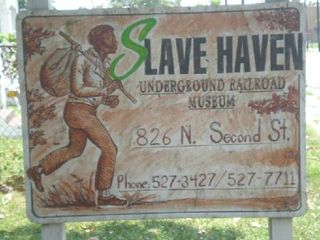
On a windy afternoon a few days ago I went to a depressed section of North Memphis to visit an old clapboard house that was once owned by a German immigrant named Jacob Burkle. Oral history—and oral history is all anyone has in this case since no written survive—holds that Burkle used his house as a stop on the underground railroad for escaped slaves in the decade before the Civil War. The house is now a small museum called Slave Haven. It has artifacts such as leg irons, iron collars and broadsheets advertising the sale of men, women and children. In the gray floor of the porch there is a trapdoor that leads to a long crawl space and a jagged hole in a brick cellar wall where fugitives could have pushed themselves down into the basement. Escaped slaves were purportedly guided by Burkle at night down a tunnel or trench toward the nearby Mississippi River and turned over to sympathetic river traders who took them north to Cairo, Ill., and on to freedom in Canada.
Burkle and his descendants had good reason to avoid written records and to keep their activities secret. Memphis, on the eve of the Civil War, was one of the biggest slave markets in the South. After the war the city was an epicenter for Ku Klux Klan terror that included lynching, the nighttime burning of black churches and schools and the killing of black leaders and their white supporters, atrocities that continued into the 20th century. Martin Luther King Jr. was assassinated in Memphis in 1968. If word had gotten out that Burkle used his home to help slaves escape, the structure would almost certainly have been burned and Burkle or his descendants, at the very least, driven out of the city. The story of Burkle’s aid to slaves fleeing bondage became public knowledge only a couple of decades ago.
The modest public profile of the Burkle house stands in stunning contrast with the monument in the center of Memphis to native son Nathan Bedford Forrest. Forrest, who is buried in Forrest Park under a statue of himself in his Confederate general’s uniform and mounted on a horse, is one of the most odious figures in American history. A moody, barely literate, violent man—he was not averse to shooting his own troops if he deemed them to be cowards—he became a millionaire before the war as a slave trader. As a Confederate general he was noted for moronic aphorisms such as “War means fighting and fighting means killing.” He was, even by the accounts of those who served under him, a butcher. He led a massacre at Fort Pillow in Henning, Tenn., of some 300 black Union troops—who had surrendered and put down their weapons—as well as women and children who had sheltered in the fort. Forrest was, after the war, the first grand wizard of the Ku Klux Klan. He used his skills as a former cavalry commander to lead armed night raids to terrorize blacks.
Forrest, like many other white racists of the antebellum South, is enjoying a disquieting renaissance. The Sons of Confederate Veterans and the West Tennessee Historical Commission last summer put up a 1,000-pound granite marker at the entrance to the park that read “Forrest Park.” The city, saying the groups had not obtained a permit, removed it with a crane. A dispute over the park name, now raging in the Memphis City Council, exposes the deep divide in Memphis and throughout much of the South between those who laud the Confederacy and those who detest it, a split that runs like a wide fault down racial lines.
A call last week by Memphis City Councilwoman Janis Fullilove, who is African-American, to strip Forrest’s name from the park and rename it after the crusading black journalist Ida B. Wells set off such an acrimonious debate between her and some white council members that Fullilove left a meeting in tears.
Wells was one of the nation’s most courageous and important journalists. She moved to Memphis as a young woman to live with her aunt. Her investigations revealed that lynching was fundamentally a mechanism to rid white businessmen of black competitors. When Thomas Moss of Memphis, a black man who ran the People’s Grocery Co., was murdered with his partners by a mob of whites and his store was looted and destroyed, Wells was incensed. “This is what opened my eyes to what lynching really was,” she wrote. She noted “that the Southerner had never gotten over this resentment that the Negro was no longer his plaything, his servant, and his source of income” and was using charges of rape against black business owners to mask this resentment. The lynching of Moss, she wrote, was “[a]n excuse to get rid of Negroes who were acquiring wealth and property and thus keep the race terrorized and ‘keep the nigger down.’ ”
Her newspaper, Free Speech, which railed against white mob violence, the inadequate black schools, segregation, discrimination and a corrupt legal system that denied justice to blacks, was destroyed by whites. Wells was forced to flee the city, becoming, as she wrote, “an exile from home for hinting at the truth.”
The split between those in Memphis who hold up authentic heroes—those who fought to protect, defend and preserve life, such as Wells and Burkle—and those who memorialize slave traders and bigots such as Forrest points up a disturbing rise of a neo-Confederate ideology in the South. Honoring figures like Forrest in Memphis while ignoring Wells would be like erecting a statue to the Nazi death camp commander Amon Goeth in the Czech Republic town of Svitavy, the birthplace of Oskar Schindler, who rescued 1,200 Jews.
The rewriting of history in the South is a retreat by beleaguered whites into a mythical self-glorification. I witnessed a similar retreat during the war in Yugoslavia in the 1990s. As Yugoslavia’s economy deteriorated, ethnic groups built fantasies of a glorious past that became a substitute for history. They sought to remove, through exclusion and finally violence, competing ethnicities to restore this mythological past. The embrace by nationalist groups of a nonreality-based belief system made communication with other ethnic groups impossible. They no longer spoke the same cultural language. There was no common historical narrative built around verifiable truth. A similar disconnect was illustrated last week in Memphis when the chairman of the city’s parks committee, William Boyd, informed the council that Forrest “promoted progress for black people in this country after the war.” Boyd argued that the KKK was “more of a social club” at its inception and didn’t begin carrying out “bad and horrific things” until it reconstituted itself with the rise of the modern civil rights movement.
“Lord, have mercy,” Fullilove muttered as she listened.
But Forrest is only one of numerous flashpoints. Fliers reading “Loyal White Knights of the Ku Klux Klan Wants You to Join” appeared in the mailboxes of white families in Memphis in early January. The Ku Klux Klan also distributed pamphlets a few days ago in an Atlanta suburb. The Tennessee Legislature last year officially declared July 13 as Nathan Bedford Forrest Day to honor his birthday. There are 32 historical markers honoring Forrest in Tennessee alone and several in other Southern states. Montgomery, Ala., which I visited last fall, has a gigantic Confederate flag on the outskirts of the city, planted there by the Sons of Confederate Veterans. Confederate monuments dot Montgomery’s city center. There are three Confederate state holidays in Alabama, including Martin Luther King/Robert E. Lee Day. Alabama, Florida, Georgia and Mississippi also honor Lee’s birthday. Jefferson Davis’ birthday is a state holiday in Alabama and Florida. And re-enactments of Confederate victories in the Civil War crowd Southern calendars.
The steady rise of ethnic nationalism over the past decade, the replacing of history with mendacious and sanitized versions of lost glory, is part of the moral decay that infects a dying culture. It is a frightening attempt, by those who are desperate and trapped, to escape through invented history their despair, impoverishment and hopelessness. It breeds intolerance and eventually violence. Violence becomes in this perverted belief system a cleansing agent, a way to restore a lost world. There are ample historical records that disprove the myths espoused by the neo-Confederates, who insist the Civil War was not about slavery but states’ rights and the protection of traditional Christianity. But these records are useless in puncturing their self-delusion, just as documentary evidence does nothing to blunt the self-delusion of Holocaust deniers. Those who retreat into fantasy cannot be engaged in rational discussion, for fantasy is all that is left of their tattered self-esteem. When their myths are attacked as untrue it triggers not a discussion of facts and evidence but a ferocious emotional backlash. The challenge of the myth threatens what is left of hope. And as the economy unravels, as the future looks bleaker and bleaker, this terrifying myth gains potency.
Achilles V. Clark, a soldier with the 20th Tennessee Cavalry under Forrest during the 1864 massacre at Fort Pillow, wrote to his sister after the attack: “The slaughter was awful. Words cannot describe the scene. The poor deluded negroes would run up to our men, fall upon their knees, and with uplifted hands scream for mercy but they were ordered to their feet and then shot down. … I, with several others, tried to stop the butchery, and at one time had partially succeeded, but General Forrest ordered them shot down like dogs and the carnage continued. Finally our men became sick of blood and the firing ceased.”
Chris Hedges, whose column is published Mondays on Truthdig, spent nearly two decades as a foreign correspondent in Central America, the Middle East, Africa and the Balkans. He has reported from more than 50 countries and has worked for The Christian Science Monitor, National Public Radio, The Dallas Morning News and The New York Times, for which he was a foreign correspondent for 15 years.
By Chris Hedges. This article was originally posted at TruthDig
Every culture has a Story of the People to give meaning to the world. Part conscious and part unconscious, it consists of a matrix of agreements, narratives, and symbols that tell us why we are here, where we are headed, what is important, and even what is real. I think we are entering a new phase in the dissolution of our Story of the People, and therefore, with some lag time, of the edifice of civilization built on top of it.
Sometimes I feel intense nostalgia for the cultural mythology of my youth, a world in which there was nothing wrong with soda pop, in which the Superbowl was important, in which the world’s greatest democracy was bringing democracy to the world, in which science was going to make life better and better. Life made sense. If you worked hard you could get good grades, get into a good college, go to grad school or follow some other professional path, and you would be happy. With a few unfortunate exceptions, you would be successful if you obeyed the rules of our society: if you followed the latest medical advice, kept informed by reading the New York Times, and stayed away from Bad Things like drugs. Sure there were problems, but the scientists and experts were working hard to fix them. Soon a new medical advance, a new law, a new educational technique, would propel the onward improvement of life. My childhood perceptions were part of this Story of the People, in which humanity was destined to create a perfect world through science, reason, and technology, to conquer nature, transcend our animal origins, and engineer a rational society.
From my vantage point, the basic premises of this story seemed unquestionable. After all, it seemed to be working in my world. Looking back, I realize that this was a bubble world built atop massive human suffering and environmental degradation, but at the time one could live within that bubble without need of much self-deception. The story that surrounded us was robust. It easily kept anomalous data points on the margins.
Since my childhood in the 1970s, that story has eroded at an accelerating rate. More and more people in the West no longer believe that civilization is fundamentally on the right track. Even those who don’t yet question its basic premises in any explicit way seem to have grown weary of it. A layer of cynicism, a hipster self-awareness has muted our earnestness. What was once so real, say a plank in a party platform, today is seen through several levels of “meta” filters to parse it in terms of image and message. We are like children who have grown out of a story that once enthralled us, aware now that it is only a story.
At the same time, a series of new data points has disrupted the story from the outside. The harnessing of fossil fuels, the miracle of chemicals to transform agriculture, the methods of social engineering and political science to create a more rational and just society – each has fallen far short of its promise, and brought unanticipated consequences that threaten civilization. We just cannot believe anymore that the scientists have everything well in hand. Nor can we believe that the onward march of reason will bring on social utopia.
Today we cannot ignore the intensifying degradation of the biosphere, the malaise of the economic system, the decline in health, or the persistence and indeed growth of global poverty and inequality. We once thought economists would fix poverty, political scientists would fix social injustice, chemists and biologists would fix environmental problems, the power of reason would prevail and we would adopt sane policies. I remember looking at maps of rain forest decline in National Geographic in the early 1980s and feeling both alarm and relief – relief because at least the scientists and everyone who reads National Geographic is aware of the problem now, so something surely will be done.
Nothing was done. Rainforest decline accelerated, along with nearly every other environmental threat that we knew about in 1980. Our Story of the People trundled forward under the momentum of centuries, but with each passing decade the hollowing-out of its core, that started perhaps with the industrial-scale slaughter of World War One, extended further. When I was a child, our system of ideology and mass media still protected that story, but in the last thirty years the incursions of reality have punctured its protective shell and have ruptured its essential infrastructure. We no longer believe our storytellers, our elites. We don’t believe the politicians, we don’t believe the doctors, we don’t believe the professors, we don’t believe the bankers, we don’t believe the technologists. All of them imply that everything is under control, and we know that it is not. We have lost the vision of the future we once had; most people have no vision of the future at all. This is new for our society. Fifty or a hundred years ago, most people agreed on the general outlines of the future. We thought we knew where society was going. Even the Marxists and the capitalists agreed on its basic outlines: a paradise of mechanized leisure and scientifically engineered social harmony, with spirituality either abolished entirely or relegated to a materially inconsequential corner of life that happened mostly on Sundays. Of course there were dissenters from this vision, but this was the general consensus.
When a story nears its end it goes through death throes, an exaggerated semblance of life. So today we see domination, conquest, violence, and separation take on absurd extremes that hold a mirror up to what was once hidden and diffuse. The year 2012 ended with just such a potent story-disrupting event: the Sandy Hook massacre. Even realizing that far more, equally innocent, children have been killed in the last few years by, say, U.S. drone strikes, it really got under my skin. No one was immune. I think that is because its utter senselessness penetrated every defense mechanism we have to maintain the fiction that the world is basically OK. Unlike 9/11 or Oklahoma City, and certainly unlike the horrors that go on around the world, there was no convenient narrative to divert the raw pain of what happened. We cannot help but map those murdered innocents onto the young faces we know, and the anguish of their parents onto ourselves. At the base of our Story of the People is separation, of humanity from nature, of me from you, of each from all, and this event united everyone, of whatever culture, nationality, or political persuasion. For a moment, we all felt the exact same thing. For at least a moment, I am sure, most people were in touch with the simplicity of what is important; I am sure many people had that fleeting feeling, “It doesn’t have to be that difficult, if only we could remember what is so obvious now, that love is all there is.” We humans have made such a mess of things, forgetting love. It is the same realization we have when a loved one is going through the dying process, and we think, “Ah, how precious this person is – why couldn’t I see that? Why couldn’t I appreciate all those moments we had together? All the arguments and grudges seem so tiny now.”
Following that moment, of course, people hurried to make sense of the event, subsuming it within a narrative about gun control, mental health, or the security of school buildings. Maybe I am imagining things, but I don’t think anyone really believes deep down that these responses touch the heart of the matter. Gun culture, we know, is a symptom of something deeper, and the violence that finds expression through guns would, even in their absence, come out in some other way. Mental illness too is a problem so vast that it is essentially unsolvable in our current system; it too comes from a deeper source. As for school security, a Chinese saying describes all the measures proposed: they stop the gentleman but not the villain.
No one would say that Sandy Hook was more horrible than the Holocaust, the Stalinist purges, or the imperialistic wars of the 20th century and 21st, but it was less comprehensible. Try as we might, we cannot fit it into our Story of the World. It is the anomalous data point that unravels the entire narrative – the world no longer makes sense. We struggle to explain what it means, but no explanation suffices. We may go on pretending that normal is still normal, but this is one of a series of “end time” events that is dismantling our culture’s mythology.
The evident futility of the responses that we are capable of imagining also points to this deep ideological breakdown. The responses are all about more control. Yet control, as we may or may not realize, is a key thread of the old story of humanity rising above nature, imposing technology and reason on the wild world and the uncivilized human. All around us, we see our efforts at control backfiring: wars to fight terrorism breed terrorism, herbicides breed superweeds, antibiotics breed superbugs, psychiatric medications lead to explosive outbursts of violence.
Looking back on the community schools a couple generations past, where children and parents could walk in and out of any door, can we say that the inexorable trend toward fortress schools in a fortress state is something anyone would have chosen? The world was supposed to be getting better. We were supposed to be becoming wealthier, more enlightened. Society was supposed to be advancing. Here I am in America, the most “advanced” nation on Earth, yet even as our financial wealth has doubled and doubled again in fifty years, we have lost wealth of a more basic form; for example, the social capital of feeling safe, feeling at home where we live. Is more security the best we can aspire to? What about a society where safety does not equal security? What about a world where no human being wields an assault rifle? What about a world where we mostly know the faces and stories of the people around us? What about a world where we know that our daily activities contribute to the healing of the biosphere and the well-being of other people? We need a Story of the People that includes all of those things – and that doesn’t feel like a fantasy.
Various visionary thinkers have offered versions of such a story, but none of them has yet become a true Story of the People, a widely accepted set of agreements and narratives that gives meaning to the world and coordinates human activity towards its fulfillment. We are not quite ready for such a story yet, because the old one, though in tatters, still has large swaths of its fabric intact. And even when these unravel, we still must traverse the space between stories, a kind of nakedness. In the turbulent times ahead our familiar ways of acting, thinking, and being will no longer make sense. We won’t know what is happening, what it all means, and, sometimes, even what is real. Some people have entered that time already.
I wish I could tell you that I am ready for a new Story of the People, but even though I am among its many weavers, I cannot yet fully inhabit the new vestments. In other words, describing the world that could be, something inside me doubts, rejects, and underneath the doubt is a hurting thing. The breakdown of the old story is kind of a healing process, that uncovers the old wounds hidden under its fabric and exposes them to the healing light of awareness. I am sure many people reading this have gone through such a time, when the cloaking illusions fell away: all the old justifications, rationalizations, all the old stories. Events like Sandy Hook help to initiate the very same process on a collective level. So also the superstorms, the economic crisis, political meltdowns… in one way or another, the obsolescence of our old mythos is laid bare.
We do not have a new story yet. Each of us is aware of some of its threads, for example in most of the things we call alternative, holistic, or ecological today. Here and there we see patterns, designs, emerging parts of the fabric. But the new mythos has not yet emerged. We will abide for a time in the space between stories. Those of you who have been through it on a personal level know that it is a very precious – some might say sacred – time. Then we are in touch with the real. Each disaster lays bare the real underneath our stories. The terror of a child, the grief of a mother, the honesty of not knowing why. In such moments we discover our humanity. We come to each other’s aid, human to human. We take care of each other. That’s what keeps happening every time there is a calamity, before the beliefs, the ideologies, the politics take over again. Events like Sandy Hook, for at least a moment, cut through all that down to the basic human being. In such times, we learn who we really are.
How can we prepare? We cannot prepare. But we are being prepared.
Charles Eisenstein is an essayist and author of the books Sacred Economics and The Ascent of Humanity. He is a contributor to Shareable, where this article first appeared.
A woman in her late 20’s came to the hospital today with her 8th pregnancy. She said to me me “My mum told me that I am the breadwinner for the family.”
I asked her to explain. She said that she can make babies and babies get money from the State for the family.
It goes like this: The Grandma calls the Department for work and pensions, and states that the unemployed daughter is not capable of caring for all of her kids. DWP agrees, and tells her the children will need to go into foster care.
The Grandma then volunteers to be the foster parent, and receives a cheque for 700 per child each month. Total yearly income: 58,800 soon to become 67200 when the 8th one is born, tax-free and nobody has to go to work!
In fact, they get more if there is no husband/father/man in the home! The brother does not count. Not to mention free dental treatment, free housing, free council tax free school dinners, free tuition fees at college or Uni, free eyecare and glasses, free prescriptions and various other benefits…
Total value of all benefits combined probably approaching 100,000 per annum which would require an income of around 148000 to create.
That’s about my salary as a senior consultant with years of experience and surgical skills in a central London teaching hospital.
Indeed, Grandma was correct that her fertile daughter is the “breadwinner” for the family.
This is how the politicians spend our taxes. When this generous programme was invented in the ’60s, the Great Society architects forgot to craft an end date… and now we are hopelessly overrun with people who vote only for those who will continue to keep them on the dole…..
No wonder our country is broke!
Worse, our Muslim brothers have been paying attention, and by mandating that each Muslim family have eleven children, they will soon replace the voting bloc above and can be running this country.
Are we alarmed yet, is anybody listening?
Sincerely, Sebastian J. Ciancino – Urologist, Guys Hospital trust – London
Oh yes, and don’t forget to pay your taxes! There are a lot of “breadwinners” depending on you!
SOUTH AFRICA TODAY: Farms in the Western Cape region are being burned, shops in small towns ransacked, people assaulted and intimidated. At least two people have been shot. Reports that a white farmer had been dragged from his vehicle and murdered.
This is total chaos; yet the ANC government and its trade union partner Cosatu are ENCOURAGING the carnage! Very few reports go out on the mainstream media, indicating a media black-out. Social networks like Facebook and Twitter are our only means of information and action.
Make no mistake – this is a xenophobic attack aimed at white people. This had been going on for years now with thousands of Afrikaners/Boers murdered and attacked; yet there is no outcry from the world.
WE URGE you – please use your status in your country’s Parliament to make this known to the world; to impose sanctions against the black racist government of South Africa until they stop the madness.
We are not going to sit back and follow the route of Zimbabwe where all whites were bankrupted, murdered and forced to flee. We are 4,5 million – and as God is my witness – this madness has all the elements of turning into a full scale race war.
We need you and your country to stand up TODAY and stop the nonsense.
On July 1, Canada Day, this year, Canadians awoke to a startling, if pleasant, piece of news: For the first time in recent history, the average Canadian is richer than the average American.
According to data from Environics Analytics WealthScapes published in the Globe and Mail, the net worth of the average Canadian household in 2011 was $363,202, while the average American household’s net worth was $319,970.
A few days later, Canada and the U.S. both released the latest job figures. Canada’s unemployment rate fell, again, to 7.2 percent, and America’s was a stagnant 8.2 percent. Canada continues to thrive while the U.S. struggles to find its way out of an intractable economic crisis and a political sine curve of hope and despair.
The difference grows starker by the month: The Canadian system is working; the American system is not. And it’s not just Canadians who are noticing. As Iceland considers switching to a currency other than the krona, its leaders’ primary focus of interest is the loonie — the Canadian dollar.
As a study recently published in the New York University Law Review pointed out, national constitutions based on the American model are quickly disappearing. Justice Ruth Bader Ginsburg, in an interview on Egyptian television, admitted, “I would not look to the United States Constitution if I were drafting a constitution in the year 2012.” The natural replacement? The Canadian Charter of Rights and Freedoms, achieving the status of legal superstar as it reaches its 30th birthday.
Good politics do not account entirely for recent economic triumphs. Luck has played a major part. The Alberta tar sands — an environmental catastrophe in waiting — are the third-largest oil reserves in the world, and if America is too squeamish to buy our filthy energy, there’s always China. We also have softwood lumber, potash and other natural resources in abundance.
Policy has played a significant part as well, though. Both liberals and conservatives in the U.S. have tried to use the Canadian example to promote their arguments: The left says Canada shows the rewards of financial regulation and socialism, while the right likes to vaunt the brutal cuts made to Canadian social programs in the 1990s, which set the stage for economic recovery.
The truth is that both sides are right. Since the 1990s, Canada has pursued a hardheaded (even ruthless), fiscally conservative form of socialism. Its originator was Paul Martin, who was finance minister for most of the ’90s, and served a stint as prime minister from 2003 to 2006. Alone among finance ministers in the Group of Eight nations, he “resisted the siren call of deregulation,” in his words, and insisted that the banks tighten their loan-loss and reserve requirements. He also made a courageous decision not to allow Canadian banks to merge, even though their chief executives claimed they would never be globally competitive unless they did. The stability of Canadian banks and the concomitant stability in the housing market provide the clearest explanation for why Canadians are richer than Americans today.
Martin also slashed funding to social programs. He foresaw that crippling deficits imperiled Canada’s education and health- care systems, which even his Conservative predecessor, Brian Mulroney, described as a “sacred trust.” He cut corporate taxes, too. Growth is required to pay for social programs, and social programs that increase opportunity and social integration are the best way to ensure growth over the long term. Social programs and robust capitalism are not, as so many would have you believe, inherently opposed propositions. Both are required for meaningful national prosperity.
Martin’s balanced policies emerged organically out of Canadian culture, which is fair-minded and rule-following to a fault. The Canadian obsession with order can make for strange politics, at least in an American context. For example, of all the world’s societies, Canada’s is one of the most open to immigrants, as anyone who has been to Toronto or Vancouver will have seen. Yet Canada also imposes a mandatory one-year prison sentence on illegal immigrants, and the majority of Canadians favor deportation. Canadians insist that their compassion be orderly, too.
This immigration policy is neither “liberal” nor “conservative” in the American political sense. It just works. You could say exactly the same thing about Canada’s economic policies.
Canada has been, and always will be, overshadowed by its neighbor, by America’s vastness and its incredible versatility and capacity for reinvention. But occasionally, at key moments, the northern wasteland can surprise. Two hundred years ago last month, the War of 1812 began. Thomas Jefferson declared, “The acquisition of Canada, this year, as far as the neighborhood of Quebec, will be a mere matter of marching.” The U.S. was comparatively enormous — with almost 8 million people, compared with Canada’s 300,000. The Canadians nonetheless turned back the assault.
Through good luck, excellent policy and even some heroism, Canada survived the war. But it has taken 200 years for Canada to become winners.
(Stephen Marche is a novelist and columnist for Esquire Magazine. His most recent book is “How Shakespeare Changed Everything.” The opinions expressed are his own.)
Opium, famine and banks all played their part in Britain’s plundering of the globe.
Why now? It’s not as if this is the first time Britain’s representatives have been caught out. The history of governments in all countries is the history of scandal, as those who rise to the top are generally the most ambitious, ruthless and unscrupulous people politics can produce. Pushing their own interests to the limit, they teeter perennially on the brink of disgrace, except when they fly clean over the edge. So why does the current ballyhoo threaten to destroy not only the government but also our antediluvian political system?
The past 15 years have produced the cash-for-questions racket, the Hinduja and Ecclestone affairs, the lies and fabrications that led to the invasion of Iraq, the forced abandonment of the BAE corruption probe, the cash-for-honours caper and the cash-for-amendments scandal. By comparison to the outright subversion of the functions of government in some of these cases, the is small beer. Any one of them should have prompted the sweeping political reforms we are now debating. But they didn’t.
For the past 300 years, the revolutions and reforms experienced by almost all other developed countries have been averted in Britain by foreign remittances.
The social unrest that might have transformed our politics was instead outsourced to our colonies and unwilling trading partners. The rebellions in Ireland, India, China, the Caribbean, Egypt, South Africa, Malaya, Kenya, Iran and other places we subjugated were the price of political peace in Britain. After decolonisation, our plunder of other nations was sustained by the banks. Now, for the first time in three centuries, they can no longer deliver, and we must at last confront our problems.
There will probably never be a full account of the robbery this country organised, but there are a few snapshots. In his book Capitalism and Colonial Production, Hamza Alavi estimates that the resource flow from India to Britain between 1793 and 1803 was in the order of £2m a year, the equivalent of many billions today. The economic drain from India, he notes, “has not only been a major factor in India’s impoverishment … it has also been a very significant factor in the industrial revolution in Britain”. As Ralph Davis observes in The Industrial Revolution and British Overseas Trade, from the 1760s onwards India’s wealth “bought the national debt back from the Dutch and others … leaving Britain nearly free from overseas indebtedness when it came to face the great French wars from 1793”.
In France by contrast, as Eric Hobsbawm notes in The Age of Revolution, “the financial troubles of the monarchy brought matters to a head”. In 1788 half of France’s national expenditure was used to service its debt: the “American War and its debt broke the back of the monarchy”.
Even as the French were overthrowing the ancien regime, Britain’s landed classes were able to strengthen their economic power, seizing common property from the country’s poor by means of enclosure. Partly as a result of remittances from India and the Caribbean, the economy was booming and the state had the funds to ride out political crises. Later, after smashing India’s own industrial capacity, Britain forced that country to become a major export market for our manufactured goods, sustaining industrial employment here (and avoiding social unrest) long after our products and processes became uncompetitive.
Colonial plunder permitted the British state to balance its resource deficits as well. For some 200 years a river of food flowed into this country from such places as Ireland, India and the Caribbean. In The Blood Never Dried, John Newsinger reveals that in 1748 Jamaica alone sent 17,400 tons of sugar to Britain; by 1815 this had risen to 73,800. It was all produced by stolen labour.
Just as grain was sucked out of Ireland at the height of its great famine, so Britain continued to drain India of food during its catastrophic hungers. In Late Victorian Holocausts, Mike Davis shows that between 1876 and 1877 wheat exports to the UK from India doubled as subsistence there collapsed, and several million died of starvation. In the North-Western provinces famine was wholly engineered by British policy, as good harvests were exported to offset poor English production in 1876 and 1877.
Britain, in other words, outsourced famine as well as social unrest. There was terrible poverty in this country in the second half of the 19th century, but not mass starvation. The bad harvest of 1788 helped precipitate the French revolution, but the British state avoided such hazards. Others died on our behalf.
In the late 19th century, Davis shows, Britain’s vast deficits with the United States, Germany and its white dominions were balanced by huge annual surpluses with India and (as a result of the opium trade) China. For a generation “the starving Indian and Chinese peasantries … braced the entire system of international settlements, allowing England’s continued financial supremacy to temporarily co-exist with its relative industrial decline”. Britain’s trade surpluses with India allowed the City to become the world’s financial capital.
Its role in British colonisation was not a passive one. The bankruptcy, and subsequent British takeover, of Egypt in 1882 was hastened by a loan from Rothschild’s bank whose execution, Newsinger records, amounted to “fraud on a massive scale”. Jardine Matheson, once the biggest narco-trafficking outfit in history (it dominated the Chinese opium trade), later formed a major investment bank, Jardine Fleming. It was taken over by JP Morgan Chase in 2000.
We lost our colonies, but the plunder has continued by other means. As Joseph Stiglitz shows in Globalisation and its Discontents, the capital liberalisation forced on Asian economies by the IMF permitted northern traders to loot hundreds of billions of dollars, precipitating the Asian financial crisis of 1997-98. Poorer nations have also been strong-armed into a series of amazingly one-sided treaties and commitments, such as trade-related investment measures, bilateral investment agreements and the EU’s economic partnership agreements. If you have ever wondered how a small, densely populated country which produces very little supports itself, I would urge you to study these asymmetric arrangements.
But now, as John Lanchester demonstrates in a fascinating essay in the London Review of Books, the City could be fatally wounded. The nation that relied on financial services may take generations to recover from their collapse. The great British adventure – three centuries spent pillaging the labour, wealth and resources of other countries – is over. We cannot accept this, and seek gleeful revenge on a government that can no longer insulate us from reality.
AUSTIN, Texas — Walking across the South Mall, or scanning the football stadium’s 100,000 seats on game day, University of Texas admissions Director Kedra Ishop sees how much has changed since the 1990s, when she was a black student at what was an inordinately white school.
This giant flagship campus — once so slow to integrate — is now awash in color, among the most diverse in the country. The student body, like Texas, is majority-minority.
At the dining hall, minority students no longer cluster together. Actually, it’s more a high-end food court now, and many tables are racial mosaics — white, black, Latino, Asian.
So is this the “critical mass” of minority students that the U.S. Supreme Court narrowly endorsed in 2003 as an educational goal important enough to allow colleges to factor the race of applicants into admissions decisions?
That question will be front and center Wednesday when a more conservative Supreme Court revisits affirmative action for the first time since that landmark case nine years ago involving the University of Michigan.
Abigail Fisher, who was denied admission to the University of Texas because of race preference
This time, it’s Texas defending the use of race in admissions, fighting a discrimination lawsuit from Abigail Fisher, a rejected white applicant. As it happens, the court’s decision will affect relatively few students at Texas, which admits most students through a system that doesn’t factor in race.
But a broad ruling rolling back affirmative action could be an earthquake at other campuses across the country that make more use of race, potentially changing the educational trajectories of millions of students.
For all the wrenching debates about opportunity and fairness the affirmative action debate evokes, the outcome will likely come down to how the current justices fill out the answer to questions they began to answer in 2003: What is critical mass, and how far can a university go to achieve it?
Generally, it’s the point where there’s enough diversity on campus to provide a rich educational environment. But beyond that, it’s a concept critics call maddeningly vague and supporters necessarily so. Is it enough for the student body to be diverse overall, or must all groups be well represented? What if there’s diversity in the student body, but not in most individual classrooms?
Texas will swallow its pride and argue that for all its progress, it’s still short of critical mass. Under state law, most UT students are admitted automatically based on their high school GPA, with race playing no role. But for the smaller remainder of its class where it enjoys more leeway, Texas argues it should be able to use race as a factor.
The reason: Some groups, especially blacks, remain underrepresented compared to Texas’ population. And minority students clump together academically, leaving most classes with no more than a single black or Latino voice.
But the university won’t give a target number, something the court would likely call an unconstitutional quota.
“There’s never been a discussion of ‘this is the target, this is what it looks like, this is where we’re trying to go,'” Ishop said. “We know what it doesn’t look like. And we know without the ability to examine students in their completeness that we can get back there very quickly.”
Such arguments sound mushy to UT’s opponents, who call the school’s goals for critical mass a quota in disguise. They say the university has gone too far using race in admissions, abusing the discretion the court granted colleges to define critical mass for themselves.
“It is a squishy concept that’s being manipulated,” said Terence Pell, president of the Center for Individual Rights, which argued against affirmative action in the Michigan case and has filed a brief against Texas in the current one. “It’s just sort of diversity for its own sake,” he added, “with no end and no limit.”
History’s role
History isn’t central to the legal issues in the affirmative action debate, but it’s an issue at UT-Austin. The football team didn’t integrate until 1970, and even as minority enrollment expanded, UT little resembled increasingly diverse Texas, leaving minority students feeling isolated.
“It was very seldom three or more were gathered,” said Machree Gibson, who arrived on campus in 1978, earned two degrees and later became the first black female president of the Texas Exes, the university’s powerful alumni group. “We used to joke, ‘Three in a room, we’re a gang.'”
Today, even a short drive through campus leaves Gibson amazed how things have changed.
But UT still doesn’t look like Texas. Of its 52,000 students, 5 percent are black (compared to 12 percent of the state population). Latinos make up 18 percent at UT (38 percent statewide) and Asians 15 percent (4 percent statewide).
Greek life and off-campus housing for upperclassmen remain mostly segregated — the West Campus neighborhood is mostly white, Riverside more black and Latino, and the Far West neighborhood Asian, limiting interactions. Academically, many departments have few non-white faces. Senior Kristin Thompson says she’s one of just two black female civil engineers in her class, despite aggressive recruiting. She’s found her community outside class, but her academic experience has been lonely.
“At UT we talk about what starts here changes the world, but I think we’re doing a disservice to students by not preparing them for a world that doesn’t have these demographics,” she said.
In the Michigan case nine years ago, psychologists, educators and, most influentially, the military flooded the court with briefs arguing a diverse learning environment helped prepare students —- whites and minorities —- for jobs and citizenship. Many also argued it takes a critical mass of minorities
How many? There was no magic number. But enough for minorities not to feel isolated in the classroom, and non-minorities to realize minorities’ views weren’t one-size-fits-all.
Those arguments persuaded Justice Sandra Day O’Connor, the court’s key swing vote. In her majority opinion in the 5-4 case, she gave Michigan and other universities leeway to define critical mass in terms of their own educational goals, and to use race as a plus-factor in admissions to get there (O’Connor has since been replaced by Justice Samuel Alito, a strong affirmative action skeptic).
In Texas, a 1996 federal appeals court ruling had prohibited UT from using race in admissions, and black enrollment had plummeted. A year later, the Texas Legislature passed a “Top 10 percent” law, guaranteeing UT admission to any student at the top of his or her Texas high school.
The law was race-neutral, but it boosted the number of minorities — by some measures, close to current figures. To UT’s opponents, that proves UT can reach ample diversity — even “critical mass” — without resorting to racial preferences.
But UT says the diversity produced by the 10 percent law was stilted. Ninety percent of smaller classes had one or zero blacks, and 43 percent no more than one Latino. A student survey found minorities felt isolated, and a majority of all students felt there weren’t enough minorities for “the full benefits of diversity to occur.”
The university wanted leeway to recruit more minorities with different interests, to ensure fields such as geosciences, architecture and Thompson’s civil engineering had a critical mass, not just the campus overall.
So for the relatively small portion of its class — currently about one-quarter — not admitted automatically by their high school performance, UT designed a system to mimic what the court had allowed in the Michigan case. In that second system UT emphasizes race is a small factor, among many “special circumstances” that may be considered. It’s also not automatic, and could benefit any applicant, even a white one in some cases.
Both sides acknowledge the effect of race in UT’s system is modest (Fisher contends race is decisive for just 33 additional minority enrollees per year). To UT, that shows race is used along the limited lines the court has allowed. To Fisher, it shows that UT doesn’t need to use race at all.
On campus, critical mass evokes a range of responses. Jesse Hernandez, a senior who attended a virtually all-Latino high school in the Rio Grande Valley, says its benefits include generating a vibrant multicultural social life. Latino cultural groups, and fraternities and sororities, help minorities find a community at a huge school, but also benefit the broader student body by sharing their culture on campus.
Thompson, the civil engineering student, says she’ll recognize critical mass “when there are less racial incidents on campus, when students feel like they can go anywhere on campus and feel welcome, can go anywhere and speak their mind and not feel like they’re going to be chastised for it, ridiculed for it, looked at crazy,” she said. She loves UT, but says it’s not there yet.
“To me that’s the end goal: a welcoming campus, not a quantity of students.”
Senior Jordan Grenadier’s experience has been different.
“I don’t ever feel like I walk on campus or walk into a classroom and only see one particular type of people,” said Grenadier, who leads the campus chapter of the group Young Conservatives of Texas. On West Mall, where student groups set up tables, “it’s so diverse whenever you walk down there, it’s almost hard to imagine the university saying ‘that’s not good enough.'”
The question isn’t “whether or not (diversity) is important,” she said. “It’s, ‘Is it justified? Can someone who is qualified to attend the university not get accepted because someone who is maybe not as qualified gets in because of racial preferences?'”
UT-Austin’s president, Bill Powers, who agrees critical mass is the “central question” in the case, says UT isn’t just saying “we’ll know it when we see it.” He says “analytics,” such as classroom diversity surveys, will show UT if it’s successfully preparing students to live and work in a diverse world.
“Right now, African-Americans and Hispanics are underrepresented,” Powers said in an interview in his library-like office on campus. “We’ll reach a critical mass when you can (see it) both in the campus atmosphere and the milieu in individual classes. Not 100 percent, but where a sufficient number of individual classes bring this cross-cultural environment.”
“It really is going to hinge on what lens the court looks at the campus through,” said Gerald Torres, who says diversity is key to meaningful conversations about environmental justice in his law school courses. “Is it the lens of the classroom or is it the lens of the campus? If it’s the lens of the campus, then (the court) is likely to say the percentage increase of students of color under the 10 percent plan is sufficient. If they look at the classroom, I think they’ll say it’s not.”
Attorneys for Fisher, who sued Texas after she was denied admission to UT-Austin in 2008, contend that by even referencing the state’s demographics in its critical mass goals, UT is acknowledging a quota. They also argue the Supreme Court never intended to make diversity in every classroom the benchmark for critical mass.
“As long as you have a critical mass in the school as a whole, you’re going to bump into people in the dorms, in the all-night bull sessions,” Pell said. “That’s what’s going to give you the benefits of diversity. Now Texas says that’s not good enough, you have to have diversity in every corner of the university, in every classroom, every major.” – Associated Press
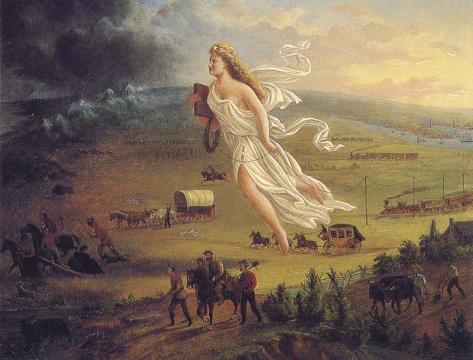
The US is engaged in wars with no end in sight. Unlike the Indians Wars on the North American Continent prior to and after the founding of the American nation, these wars in Iraq and Afghanistan will not be won by “Manifest Destiny”.
Manifest Destiny was the belief widely held by Americans in the 19th century that the United States was destined to expand across the continent. The concept, born out of “a sense of mission to redeem the Old World”, was enabled by “the potentialities of a new earth for building a new heaven”. The phrase itself meant many different things to many different people. The unity of the definitions ended at “expansion, prearranged by Heaven”. Mid‑19th century Democrats would use it to explain the need for expansion past the Louisiana Territory.
Manifest destiny provided the dogma and tone for the largest acquisition of U.S. territory. It was used by Democrats in the 1840s to justify the war with Mexico and it was also used to acquire portions of Oregon from the British Empire. But Manifest Destiny always limped along because of its internal limitations and the issue of slavery, says Merk, and never became a national priority. By 1843 John Quincy Adams, a major supporter, had changed his mind and repudiated Manifest Destiny because it meant the expansion of slavery in Texas.
The legacy is a complex one. The belief in an American mission to promote and defend democracy throughout the world, as expounded by Abraham Lincoln and later by Woodrow Wilson and George W. Bush, continues to have an influence on American political ideology
It is one thing to occupy a continent with settlers who outpopulate the indigenous peoples. These Native Americans were placed on reservations. The March of Tears during Andrew Jackson’s presidency demonstrates the cruelty necessary to defeat and neutralize entire indigenous populations who have vastly different cultures and religions.
Is it possible to kill enough Afghanistanis and Pakistanis, Africans, Muslims, Chinese, Russians, etc., to accomplish what the US wants in the world? To eliminate terrorism is to eliminate the weak, and if you believe the Pentagon, everyone outside the US is “weak” . Could the British invade and kill enough Irish in Northern Ireland to eliminate terrorism? By changing their tactics, The British finally eliminated terrorism in Northern Ireland, only to have it re-instituted in London by jihadists. It just never goes away.
With the possibility that banks may continue to fail and the deterioration of the economic situation in the US, contingency plans need to be made to deal with this domestic economic crisis. Global warming, food shortages and rising populations are here already. To virtually ignore these crises while chasing the golden ring of oil in the Middle East, is foolhardy at best. The economic collapse of the US is a real risk. Americans have fallen into the trap of hubris, by believing the world is an extension of home.
Both Democrats and Republicans are pursuing, and have been pursuing, the far-right’s foreign policy for decades. Especially plans for “regional diplomacy”. And these thoughts on regional diplomacy are alarmingly thin, on closer inspection. It has become like fighting needles by burning haystacks.
To launch a comprehensive regional and international diplomatic initiative, that includes key nations in the region, to help achieve a new political settlement among different peoples, start a civil war, and initiate a humanitarian catastrophe and regional conflict. But it comes at an enourmous cost to American soft power.
Americans need to pressure their candidates to stop talking in vague general terms, and demand that Washington’s long-practiced foreign policies that have real American people on the front lines, become more realistic.
Those being exploited around the globe for their nations’ resources are not winning Americans any friends. Can they all be either killed or put in reserves?
The finance industry must take the blame for the growing divide between the rich and poor in the United States, says Nobel Prize-winning economics professor Joseph Stiglitz. In an interview with SPIEGEL, he accuses the industry of preying on the poor and buying government policies that help them get richer
American economist and 2001 Nobel Prize winner Joseph Stiglitz works as a professor at Columbia University. Stiglitz discusses how wealth disparity is dividing America and how Europe can best overcome the euro crisis.
SPIEGEL: What is the scale this inequality?
Stiglitz: In the last decades, income and wealth disparity have grown dramatically in this country. Let me give you an example: In 2011, the six heirs to the Walmart empire commanded wealth of almost $70 billion, which is equivalent to the wealth of the entire bottom 30 percent of US society.
SPIEGEL: What has become of the American dream?
Stiglitz: This belief is still powerful, but the American dream has become a myth. The life chances of a young US citizen are more dependent on the income and education of his parents than in any other advanced industrial country for which there is data. The belief in the American dream is reinforced by anecdotes, by dramatic examples of individuals who have made it from the bottom to the top — but what matters most are an individual’s life chances. The belief in the American dream is not supported by the data.
There has been no improvement in well-being for the typical American family for 20 years. On the other side, the top one percent of the population gets 40 percent more in one week than the bottom fifth receive in a full year. In short, we have become a divided society. America has created a marvelous economic machine, but most of the benefits have gone to the top.
SPIEGEL: With five more weeks to go in the presidential campaign, inequality hasn’t played a serious role yet, though.
Stiglitz: It has been a topic, but typically only underneath the surface. One cannot expect a scientific debate on the Gini coefficient, the statistical measure of inequality.
SPIEGEL: But who exactly represents the one percent?
Stiglitz: It is the group of people who get 20 to 25 percent of the income. Their share has doubled in the last 30 years. And they own about 35 percent of the wealth or more. They have the best houses, the best education and the best lifestyles.
SPIEGEL: Don’t the rich also give something in return? In Germany, the upper one percent contributes almost a quarter to the tax revenue, and the top ten percent more than half of the taxes. Isn’t that an appropriate share?
Stiglitz: I don’t know about the German numbers. What I can say is that the top one percent in the United States has an average tax rate of less than 30 percent of their reported income, and the large proportion who take much of their income as capital gains pay far less. And we know that they are not reporting all of their income.
SPIEGEL: We thought that as a rule Americans don’t begrudge the rich their wealth, though.
Stiglitz: There is nothing wrong if someone who has invented the transistor or made some other technical breakthrough that is beneficial for all receives a large income. He deserves the money. But many of those in the financial sector got rich by economic manipulation, by deceptive and anti-competitive practices, by predatory lending. They took advantage of the poor and uninformed, as they made enormous amounts of money by preying upon these groups with predatory lending. They sold them costly mortgages and were hiding details of the fees in fine print.
SPIEGEL: Why didn’t the government stop this behavior?
Stiglitz: The reason is obvious: The financial elite support the political campaigns with huge contributions. They buy the rules that allow them to make the money. Much of the inequality that exists today is a result of government policies.
SPIEGEL: Can you give us an example?
Stiglitz: In 2008, President George W. Bush claimed that we did not have enough money for health insurance for poor American children, costing a few billion dollars a year. But all of a sudden we had $150 billion to bail out AIG, the insurance company. That shows that something is wrong with our political system. It is more akin to “one dollar, one vote” than to “one person, one vote.”
SPIEGEL: Ninety-nine percent against 1 percent: That actually sounds like the perfect setting for a revolution. Why are things still so calm in the US?
Stiglitz: The United States doesn’t have much of a revolutionary spirit. My real concern is that people get alienated from politics. In the last election we had a voter turnout among young people of around 20 percent. These are the people whose future is most at stake, and 80 percent of them think it’s not worth to vote because it is a rigged system and in the end the banks are going to run the country anyway.
SPIEGEL: With a debt burden of $16 trillion there is not much room for maneuvering.
Stiglitz: The United States can borrow at close to a zero percent interest rate, we would be stupid not to invest more money and create jobs. And we could also make efforts to ensure that the super-wealthy pay their fair share. We could raise more money in a variety of ways. Look at the mining companies: The government grants them the right to extract resources for far less than it should, but auctions could make sure that they pay appropriately.
SPIEGEL: So your answer to the inequality problem is to transfer money from the top to the bottom?
Stiglitz: First, transferring money from the top to the bottom is only one suggestion. Even more important is helping the economy grow in ways that benefit those at the bottom and top, and ending the “rent seeking” that moves so much money from ordinary citizens to those at the top.
SPIEGEL: Is redistribution also the strategy when it comes to Europe and the euro crisis — moving money from the north to the south?
Stiglitz: The main problem in Europe right now are the austerity packages, they depress demand and weaken economic growth. The reversal of this policy is absolutely essential to develop growth and more equality. Spain, for example, gets weaker and weaker, money flows out of the country, and it is a vicious downward spiral.
SPIEGEL: Isn’t the real problem the lack of competitiveness? Spain and the other countries in crisis have lived beyond their means, that’s why they are in trouble.
Stiglitz: No, Europe’s crisis is not caused by excessive long-term debts and deficits. It is caused by cutbacks in government expenditures. The recession caused the deficits, not the other way around. Before the crisis Spain and Ireland ran budget surpluses. They cannot be accused of fiscal profligacy. More fiscal discipline will only worsen the downturn. No economy ever recovered from a downturn through austerity.
SPIEGEL: You assume that a government knows best where to create jobs. Don’t you overestimate that ability?
Stiglitz: We need roads, bridges and airports. That’s obvious. The returns from public investments in technology on average have been very high — think about the Internet, the Human Genome Project and the telegraph.
SPIEGEL: There are also many examples of public money that was wasted. The US space program cost a fortune, and the results were questionable.
Stiglitz: But even those expenditures are still less than the money wasted by America’s private financial sector, and the billions spent to bail out companies from the financial sector. One corporation alone, AIG, got more than $150 billion — more than was spent on welfare for needy families from 1990 to 2006.
SPIEGEL: The government also became owner of these companies and even managed to sell parts of them with a profit, though. Aren’t you afraid that this strategy of ever bigger stimulus packages might lead to inflation?
Stiglitz: Not necessarily. The central bank has the ability to take out liquidity from the system.
SPIEGEL: But it is much harder getting the liquidity out than getting it in.
Stiglitz: A well-managed central bank has lots of tools. It can raise interest rates or reserve requirements for private banks. So I think there is actually relatively little danger. The weakness in the European economy poses much more of a risk than any risk of moderate inflation. Better some job where the pay has declined in real terms by a few percent than no job at all.
SPIEGEL: What do you think Europe’s future prospects are?
Stiglitz: Europe is facing a critical point. The alternatives are “more Europe” or “no Europe.” The halfway configuration is unstable.
SPIEGEL: Which option would be better for Germany?
Stiglitz: Both strategies will cost Germany money, but the “more Europe” option will cost less. Europe needs a common banking system and a common financial framework. If Europe borrows as a whole it could have even better access to credit than the United States. So “more Europe” is not only better for Spain or Italy, but also for Germany.
This website uses cookies to improve your experience. We'll assume you're ok with this, but you can opt-out if you wish. Cookie settingsACCEPT
Privacy & Cookies Policy
Privacy Overview
This website uses cookies to improve your experience while you navigate through the website. Out of these cookies, the cookies that are categorized as necessary are stored on your browser as they are essential for the working of basic functionalities of the website. We also use third-party cookies that help us analyze and understand how you use this website. These cookies will be stored in your browser only with your consent. You also have the option to opt-out of these cookies. But opting out of some of these cookies may have an effect on your browsing experience.
Necessary cookies are absolutely essential for the website to function properly. This category only includes cookies that ensures basic functionalities and security features of the website. These cookies do not store any personal information.
Any cookies that may not be particularly necessary for the website to function and is used specifically to collect user personal data via analytics, ads, other embedded contents are termed as non-necessary cookies. It is mandatory to procure user consent prior to running these cookies on your website.


 Sixteen years ago, Clayton Christensen laid out his theory of ‘disruption’ in the book The Innovator’s Dilemma. From steel mills to floppy disk drives, he saw innovation led by small players trying, failing, trying again and eventually creating products that superseded the market leaders. The book became a bible of Silicon Valley. Last month, in an interview with Wired, he proposed that, having changed the way we shop and communicate, the internet is moving into a new phase – disrupting essential industries like education and healthcare.