Oil price hikes are manufactured

Today’s double dose of codswallop is the oil price.

Turmoil in Iraq is the predictable last chapter of the fiasco that began with a pack of lies about atomic bicycles from Dubya and Blair. Same old same old: US goes on silly half-baked venture, UK crawls up its backside, West gets bored, Islamists sit quietly waiting for laurel-resting….and then move back in.

But it’s the idea that crude oil prices have been “boosted” by the unsettled Iraqi situation that strikes me as complete poppycock. While Iraq has probably the world’s largest untapped oil reserves, it still has eleven producers ahead of it – and with the world careering towards recession aka slump, 9% of total output isn’t any kind of game changer….even if disruption were to be 100%…um, as it was when the Blair-Dubya Grand Alliance gave us all Schlockanawe.

No, the price has gone up because (1) Bourses overreact to everything – or ignore everything – depending on whether we’re talking QE or oil; and (2) the smart aka crooked money got in there first and directionalised the saps.

Remember, dark pool, algorithmic and/or speed-of-light trading (they overlap) is estimated to account for around 2 in 5 trades on the NYSE today. Or using another dimension of market concentration, just six firms on Wall Street account for 33% of all trades:

Markets are no longer there to raise money for dynamic businesses, they exist to make money for banking firms and their vaguely defined ‘clients’.

All these firms know the numbers. Their job is to suggest danger to the nervous, get them to buy, wait for the truth to dawn…and then buy back at a price lower than where they sold.

The practice contributes nothing to the real economy, but quite a lot to the unreal bonus.

If you want to see some really significant moves on this front, then look at Venezuela and Ukraine.

It’s another reason why Bourse-obsessed capitalism is on the skids.

http://investmentwatchblog.com/


Soros meets with the President of Ukraine

Multibillion dollar loans don’t come without a few strings attached.

President Petro Poroshenko held a meeting with billionaire crony opportunist George Soros, at which Soros informed the head of state about his initiative to create a “strategic plan of reforms” for Ukraine.

“We set up a strategic consultative group for immediate reactions to challenges as they arise,” the press service of the Ukrainian president reported on Monday, citing Soros.

Source: economicpolicyjournal.com

‘Ukraine will hurt its own economy’, says Gazprom head

Gazprom considers Ukraine’s position a form of blackmail and a method to negotiate an ultra-low price, Aleksey Miller, head of Russia’s Gazprom, said on Monday.

“These absurd and unreasonable actions will ultimately hurt the Ukrainian economy, but after the Minister of Foreign Affairs comment last week, I am surprised by very little,” Prime Minister Dmitry Medvedev said after holding talks with Gazprom head Aleksey Miller and Russia’s Energy Minister Aleksandr Novak.

“Russia is ready to continue gas talks with Ukraine, but only on the condition of debt repayment,” Medvedev said at the meeting, noting Ukraine’s outstanding debt of $4.5 billion.

On Monday Gazprom introduced a prepayment system for Ukraine, who is months behind on its gas bills, and in the future will only get natural gas it pays for in advance.

Russia has offered Ukraine a final gas price of $385 per 1,000 cubic meters, but Ukraine has requested an interim price of $326, which was suggested by the EU.

“The terms offered to Kiev on gas were better than those that were given to the Yanukovich government,” Miller said. Under Yanukovich’s tenure, Ukraine scored a major discount and imported natural gas for $268.50 per 1,000 cubic meters, which was cancelled after his overthrow and the establishment of a coup-appointed government in Kiev.

“The system for prepaid gas is the result of the Ukrainian government’s unconstructive stance,” Gazprom head added.

Ukraine’s energy minister Yuriy Prodan in turn has confirmed that gas supplies from Moscow to Kiev have been reduced to zero, but insists that deliveries to Europe are safe.

Only 185 million cubic meters of natural gas per day will be transported through Ukraine to European markets, Prodan said.

Ukraine has more than 14 billion cubic meters of gas in underground storage, enough to meet its needs until December, the chief executive of state gas company Naftogaz said on Monday.

Prodan’s comments echo the earlier statements from Gazprom’s spokesperson, who said that as of Monday, Naftogaz, Ukraine’s state-owned gas and oil company, will receive gas only for which prepayment has been made, and since it has paid for nothing, it will receive nothing.

“Volumes of gas for European customers will be fully met in compliance with their contracts. Naftogaz must ensure transportation to the delivery points,” Kupriyanov said earlier. – RT.COM

Ukraine crisis raises risk for nuclear reactors

chernobyl09Ukraine’s volatility exacerbates the risk for the country’s 15 Soviet-style nuclear reactors, warn German experts. They demand more attention for the country where the world’s worst nuclear accident took place.

The recent news of a water shortage due to a broken pipeline affecting thousands in strife ravaged Eastern Ukraine spells trouble for the safety of the country’s nuclear power plants.

That’s because the security and reliability of a country’s critical infrastructure like its electrical power and water grid is essential to safely run nuclear reactors.

“Once you have decided to operate a nuclear power plant or like in this case a nuclear reactor park, you must guarantee you don’t have unstable social situations and you definitely can’t have a war,” Michael Sailer, chairman of the German Nuclear Waste Management Commission and member of the German Reactor Safety Commission, told DW.

“We are talking about nuclear power plants that have a high risk even when they are constructed well and properly maintained,” Sailer who also heads Freiburg-based environmental think tank Öko-Institut added.

“And in the Ukraine we are talking about the additional problem that there is an increased potential for human error due to less motivated nuclear operators than elsewhere and the fact that the security features of these reactors are a lot weaker than those of modern reactors.”

Ukraine currently has four nuclear power plants with 15 reactors online providing roughly half of the country’s energy needs which makes it practically impossible to shut them down during the crisis. All of the reactors stem from the Soviet era, went on the grid in the 1980s and are similar to the Chernobyl reactor that blew in 1986 causing the worst nuclear accident in history. Ukraine’s largest plant in Zaporizhia is located about 200 kilometers from Donetsk, the epicenter of the clash between pro-Russian militants and the Kyiv government.

The older Soviet-style reactors are already less safe than those in Western Europe, Lothar Hahn, former director of the Gesellschaft für Anlagen- und Reaktorsicherheit (GRS), Germany’s leading nuclear safety research center, told DW. “But this is even overshadowed by the danger of sabotage or war. Then you would immediately have a dramatic situation on your hands.”

The experts did not want to describe possible sabotage or war scenarios on the record, but stressed that they consider this a real danger. “You don’t need an army, only 20 to 30 highly trained men,” said Hahn. “These things are totally incalculable.”

Nuclear experts usually don’t focus on such instable situations and the people who are concerned with instable situations like diplomats usually don’t realize how sensitive a nuclear power plant is.”

Source: DW

NATO acting out a deliberate charade in Europe

foolsjohnstoneby Diana Johnstone.

NATO leaders are currently acting out a deliberate charade in Europe, designed to reconstruct an Iron Curtain between Russia and the West.

With astonishing unanimity, NATO leaders feign surprise at events they planned months in advance. Events that they deliberately triggered are being misrepresented as sudden, astonishing, unjustified “Russian aggression”. The United States and the European Union undertook an aggressive provocation in Ukraine that they knew would force Russia to react defensively, one way or another.

They could not be sure exactly how Russian president Vladimir Putin would react when he saw that the United States was manipulating political conflict in Ukraine to install a pro-Western government intent on joining NATO. This was not a mere matter of a “sphere of influence” in Russia’s “near abroad”, but a matter of life and death to the Russian Navy, as well as a grave national security threat on Russia’s border.

A trap was thereby set for Putin. He was damned if he did, and damned if he didn’t. He could under-react, and betray Russia’s basic national interests, allowing NATO to advance its hostile forces to an ideal attack position.

Or he could over-react, by sending Russian forces to invade Ukraine. The West was ready for this, prepared to scream that Putin was “the new Hitler”, poised to overrun poor, helpless Europe, which could only be saved (again) by the generous Americans.

In reality, the Russian defensive move was a very reasonable middle course. Thanks to the fact that the overwhelming majority of Crimeans felt Russian, having been Russian citizens until Khrushchev frivolously bestowed the territory on Ukraine in 1954, a peaceful democratic solution was found. Crimeans voted for their return to Russia in a referendum which was perfectly legal according to international law, although in violation of the Ukrainian constitution, which was by then in tatters having just been violated by the overthrow of the country’s duly elected president, Victor Yanukovych, facilitated by violent militias. The change of status of Crimea was achieved without bloodshed, by the ballot box.

Nevertheless, the cries of indignation from the West were every bit as hysterically hostile as if Putin had overreacted and subjected Ukraine to a U.S.-style bombing campaign, or invaded the country outright – which they may have expected him to do.

U.S. Secretary of State John Kerry led the chorus of self-righteous indignation, accusing Russia of the sort of thing his own government is in the habit of doing. “You just don’t invade another country on phony pretext in order to assert your interests. This is an act of aggression that is completely trumped up in terms of its pretext”, Kerry pontificated. “It’s really 19th century behavior in the 21st century”. Instead of laughing at this hypocrisy, U.S. media, politicians and punditry zealously took up the theme of Putin’s unacceptable expansionist aggression. The Europeans followed with a weak, obedient echo.

It Was All Planned at Yalta

In September 2013, one of Ukraine’s richest oligarchs, Viktor Pinchuk, paid for an elite strategic conference on Ukraine’s future that was held in the same Palace in Yalta, Crimea, where Roosevelt, Stalin and Churchill met to decide the future of Europe in 1945. The Economist, one of the elite media reporting on what it called a “display of fierce diplomacy”, stated that: “The future of Ukraine, a country of 48m people, and of Europe was being decided in real time.” The participants included Bill and Hillary Clinton, former CIA head General David Petraeus, former U.S. Treasury secretary Lawrence Summers, former World Bank head Robert Zoellick, Swedish foreign minister Carl Bildt, Shimon Peres, Tony Blair, Gerhard Schröder, Dominique Strauss-Kahn, Mario Monti, Lithuanian president Dalia Grybauskaite, and Poland’s influential foreign minister Radek Sikorski. Both President Viktor Yanukovych, deposed five months later, and his recently elected successor Petro Poroshenko were present. Former U.S. energy secretary Bill Richardson was there to talk about the shale-gas revolution which the United States hopes to use to weaken Russia by substituting fracking for Russia’s natural gas reserves. The center of discussion was the “Deep and Comprehensive Free Trade Agreement” (DCFTA) between Ukraine and the European Union, and the prospect of Ukraine’s integration with the West. The general tone was euphoria over the prospect of breaking Ukraine’s ties with Russia in favor of the West.

Conspiracy against Russia? Not at all. Unlike Bilderberg, the proceedings were not secret. Facing a dozen or so American VIPs and a large sampling of the European political elite was a Putin adviser named Sergei Glazyev, who made Russia’s position perfectly clear.

Glazyev injected a note of political and economic realism into the conference. Forbes reported at the time on the “stark difference” between the Russian and Western views “not over the advisability of Ukraine’s integration with the EU but over its likely impact.” In contrast to Western euphoria, the Russian view was based on “very specific and pointed economic criticisms” about the Trade Agreement’s impact on Ukraine’s economy, noting that Ukraine was running an enormous foreign accounts deficit, funded with foreign borrowing, and that the resulting substantial increase in Western imports could only swell the deficit. Ukraine “will either default on its debts or require a sizable bailout”.

The Forbes reporter concluded that “the Russian position is far closer to the truth than the happy talk coming from Brussels and Kiev.”

As for the political impact, Glazyev pointed out that the Russian-speaking minority in Eastern Ukraine might move to split the country in protest against cutting ties with Russia, and that Russia would be legally entitled to support them, according to The Times of London.

In short, while planning to incorporate Ukraine into the Western sphere, Western leaders were perfectly aware that this move would entail serious problems with Russian-speaking Ukrainians, and with Russia itself. Rather than seeking to work out a compromise, Western leaders decided to forge ahead and to blame Russia for whatever would go wrong. What went wrong first was that Yanukovych got cold feet faced with the economic collapse implied by the Trade Agreement with the European Union. He postponed signing, hoping for a better deal. Since none of this was explained clearly to the Ukrainian public, outraged protests ensued, which were rapidly exploited by the United States… against Russia.

Ukraine as Bridge…Or Achilles Heel

Ukraine, a term meaning borderland, is a country without clearly fixed historical borders that has been stretched too far to the East and too far to the West. The Soviet Union was responsible for this, but the Soviet Union no longer exists, and the result is a country without a unified identity and which emerges as a problem for itself and for its neighbors.

It was extended too far East, incorporating territory that might as well have been Russian, as part of a general policy to distinguish the USSR from the Tsarist empire, enlarging Ukraine at the expense of its Russian component and demonstrating that the Soviet Union was really a union among equal socialist republics. So long as the whole Soviet Union was run by the Communist leadership, these borders didn’t matter too much.

It was extended too far West at the end of World War II. The victorious Soviet Union extended Ukraine’s border to include Western regions, dominated by the city variously named Lviv, Lwow, Lemberg or Lvov, depending on whether it belonged to Lithuania, Poland, the Hapsburg Empire or the USSR, a region which was a hotbed of anti-Russian sentiments. This was no doubt conceived as a defensive move, to neutralize hostile elements, but it created the fundamentally divided nation that today constitutes the perfect troubled waters for hostile fishing.

The Forbes report cited above pointed out that: “For most of the past five years, Ukraine was basically playing a double game, telling the EU that it was interested in signing the DCFTA while telling the Russians that it was interested in joining the customs union.” Either Yanukovych could not make up his mind, or was trying to squeeze the best deal out of both sides, or was seeking the highest bidder. In any case, he was never “Moscow’s man”, and his downfall owes a lot no doubt to his own role in playing both ends against the middle. His was a dangerous game of pitting greater powers against each other.

It is safe to say that what was needed was something that so far seems totally lacking in Ukraine: a leadership that recognizes the divided nature of the country and works diplomatically to find a solution that satisfies both the local populations and their historic ties with the Catholic West and with Russia. In short, Ukraine could be a bridge between East and West – and this, incidentally, has been precisely the Russian position. The Russian position has not been to split Ukraine, much less to conquer it, but to facilitate the country’s role as bridge. This would involve a degree of federalism, of local government, which so far is entirely lacking in the country, with local governors selected not by election but by the central government in Kiev. A federal Ukraine could both develop relations with the EU and maintain its vital (and profitable) economic relations with Russia.

But this arrangement calls for Western readiness to cooperate with Russia. The United States has plainly vetoed this possibility, preferring to exploit the crisis to brand Russia “the enemy”.

Plan A and Plan B

U.S. policy, already evident at the September 2013 Yalta meeting, was carried out on the ground by Victoria Nuland, former advisor to Dick Cheney, deputy ambassador to NATO, spokeswoman for Hillary Clinton, wife of neocon theorist Robert Kagan. Her leading role in the Ukraine events proves that the neo-con influence in the State Department, established under Bush II, was retained by Obama, whose only visible contribution to foreign policy change has been the presence of a man of African descent in the presidency, calculated to impress the world with U.S. multicultural virtue. Like most other recent presidents, Obama is there as a temporary salesman for policies made and executed by others.

As Victoria Nuland boasted in Washington, since the dissolution of the Soviet Union in 1991, the United States has spent five billion dollars to gain political influence in Ukraine (this is called “promoting democracy”). This investment is not “for oil”, or for any immediate economic advantage. The primary motives are geopolitical, because Ukraine is Russia’s Achilles’ heel, the territory with the greatest potential for causing trouble to Russia.

What called public attention to Victoria Nuland’s role in the Ukrainian crisis was her use of a naughty word, when she told the U.S. ambassador, “Fuck the EU”. But the fuss over her bad language veiled her bad intentions. The issue was who should take power away from the elected president Viktor Yanukovych. German Chancellor Angela Merkel’s party has been promoting former boxer Vitaly Klitschko as its candidate. Nuland’s rude rebuff signified that the United States, not Germany or the EU, was to choose the next leader, and that was not Klitschko but “Yats”. And indeed it was Yats, Arseniy Yatsenyuk , a second-string US-sponsored technocrat known for his enthusiasm for IMF austerity policies and NATO membership, who got the job. This put a U.S. sponsored government, enforced in the streets by fascist militia with little electoral clout but plenty of armed meanness, in a position to manage the May 25 elections, from which the Russophone East was largely excluded.

Plan A for the Victoria Nuland putsch was probably to install, rapidly, a government in Kiev that would join NATO, thus formally setting the stage for the United States to take possession of Russia’s indispensable Black Sea naval base at Sebastopol in Crimea. Reincorporating Crimea into Russia was Putin’s necessary defensive move to prevent this.

But the Nuland gambit was in fact a win-win ploy. If Russia failed to defend itself, it risked losing its entire southern fleet – a total national disaster. On the other hand, if Russia reacted, as was most likely, the US thereby won a political victory that was perhaps its main objective. Putin’s totally defensive move is portrayed by the Western mainstream media, echoing political leaders, as unprovoked “Russian expansionism”, which the propaganda machine compares to Hitler grabbing Czechoslovakia and Poland.

Thus a blatant Western provocation, using Ukrainian political confusion against a fundamentally defensive Russia, has astonishingly succeeded in producing a total change in the artificial Zeitgeist produced by Western mass media. Suddenly, we are told that the “freedom-loving West” is faced with the threat of “aggressive Russian expansionism”. Some forty years ago, Soviet leaders gave away the store under the illusion that peaceful renunciation on their part could lead to a friendly partnership with the West, and especially with the United States. But those in the United States who never wanted to end the Cold War are having their revenge. Never mind “communism”; if, instead of advocating the dictatorship of the proletariat, Russia’s current leader is simply old-fashioned in certain ways, Western media can fabricate a monster out of that. The United States needs an enemy to save the world from.

The Protection Racket Returns

But first of all, the United States needs Russia as an enemy in order to “save Europe”, which is another way to say, in order to continue to dominate Europe. Washington policy-makers seemed to be worried that Obama’s swing to Asia and neglect of Europe might weaken U.S. control of its NATO allies. The May 25 European Parliament elections revealed a large measure of disaffection with the European Union. This disaffection, notably in France, is linked to a growing realization that the EU, far from being a potential alternative to the United States, is in reality a mechanism that locks European countries into U.S.-defined globalization, economic decline and U.S. foreign policy, wars and all.

Ukraine is not the only entity that has been overextended. So has the EU. With 28 members of diverse language, culture, history and mentality, the EU is unable to agree on any foreign policy other than the one Washington imposes. The extension of the EU to former Eastern European satellites has totally broken whatever deep consensus might have been possible among the countries of the original Economic Community: France, Germany, Italy and the Benelux states. Poland and the Baltic States see EU membership as useful, but their hearts are in America – where many of their most influential leaders have been educated and trained. Washington is able to exploit the anti-communist, anti-Russian and even pro-Nazi nostalgia of northeastern Europe to raise the false cry of “the Russians are coming!” in order to obstruct the growing economic partnership between the old EU, notably Germany, and Russia.
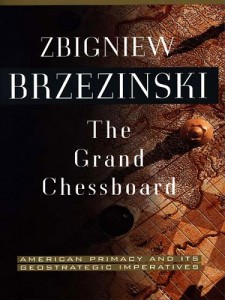
le-grand-echiquier-2Russia is no threat. But to vociferous Russophobes in the Baltic States, Western Ukraine and Poland, the very existence of Russia is a threat. Encouraged by the United States and NATO, this endemic hostility is the political basis for the new “iron curtain” meant to achieve the aim spelled out in 1997 by Zbigniew Brzezinski in The Grand Chessboard: keeping the Eurasian continent divided in order to perpetuate U.S. world hegemony. The old Cold War served that purpose, cementing U.S. military presence and political influence in Western Europe. A new Cold War can prevent U.S. influence from being diluted by good relations between Western Europe and Russia.

Obama has come to Europe ostentatiously promising to “protect” Europe by basing more troops in regions as close as possible to Russia, while at the same time ordering Russia to withdraw its own troops, on its own territory, still farther away from troubled Ukraine. This appears designed to humiliate Putin and deprive him of political support at home, at a time when protests are rising in Eastern Ukraine against the Russian leader for abandoning them to killers sent from Kiev.

To tighten the U.S. grip on Europe, the United States is using the artificial crisis to demand that its indebted allies spend more on “defense”, notably by purchasing U.S. weapons systems. Although the U.S. is still far from being able to meet Europe’s energy needs from the new U.S. fracking boom, this prospect is being hailed as a substitute for Russia’s natural gas sales – stigmatized as a “way of exercising political pressure”, something of which hypothetic U.S. energy sales are presumed to be innocent. Pressure is being brought against Bulgaria and even Serbia to block construction of the South Stream pipeline that would bring Russian gas into the Balkans and southern Europe.

From D-Day to Dooms Day

Today, June 6, the seventieth anniversary of the D-Day landing is being played in Normandy as a gigantic celebration of American domination, with Obama heading an all-star cast of European leaders. The last of the aged surviving soldiers and aviators present are like the ghosts of a more innocent age when the United States was only at the start of its new career as world master. They were real, but the rest is a charade. French television is awash with the tears of young villagers in Normandy who have been taught that the United States is some sort of Guardian Angel, which sent its boys to die on the shores of Normandy out of pure love for France. This idealized image of the past is implicitly projected on the future. In seventy years, the Cold War, a dominant propaganda narrative and above all Hollywood have convinced the French, and most of the West, that D-Day was the turning point that won World War II and saved Europe from Nazi Germany.

Vladimir Putin came to the celebration, and has been elaborately shunned by Obama, self-appointed arbiter of Virtue. The Russians are paying tribute to the D-Day operation which liberated France from Nazi occupation, but they – and historians – know what most of the West has forgotten: that the Wehrmacht was decisively defeated not by the Normandy landing, but by the Red Army. If the vast bulk of German forces had not been pinned down fighting a losing war on the Eastern front, nobody would celebrate D-Day as it is being celebrated today.

Putin is widely credited as being “the best chess player”, who won the first round of the Ukrainian crisis. He has no doubt done the best he could, faced with the crisis foisted on him. But the U.S. has whole ranks of pawns which Putin does not have. And this is not only a chess game, but chess combined with poker combined with Russian roulette. The United States is ready to take risks that the more prudent Russian leaders prefer to avoid… as long as possible.

Perhaps the most extraordinary aspect of the current charade is the servility of the “old” Europeans. Apparently abandoning all Europe’s accumulated wisdom, drawn from its wars and tragedies, and even oblivious to their own best interests, today’s European leaders seem ready to follow their American protectors to another D-Day … D for Doom.

Can the presence of a peace-seeking Russian leader in Normandy make a difference? All it would take would be for mass media to tell the truth, and for Europe to produce reasonably wise and courageous leaders, for the whole fake war machine to lose its luster, and for truth to begin to dawn. A peaceful Europe is still possible, but for how long?

Diana Johnstone is the author of Fools’ Crusade: Yugoslavia, NATO, and Western Delusions.

Source: Counterpunch

Marine Le Pen: EU indifferent to suffering in eastern Ukraine

france-le-penThe leader of the Front National party Marine Le Pen talks to Sophie Shevardnadze on RT.

SS: Obama said the security of America’s European allies is sacrosanct, promising to boost U.S. military deployments and exercises around Europe. Does Europe need this kind of support?

MP: To defend ourselves against whom? […] To defend ourselves against whom? Well, you know that we are for leaving NATO, for France leaving NATO, we have a Gaullian vision of what international politics must be like, we are for developing our relations with Russia, without breaking ties with the United States. We believe that France must maintain its relations with all of the world’s great nations, and we do not want to be imposed with a way of seeing things by anybody. We aspire to have the freedom to determine the quality and the level of our international relations. But… to defend ourselves against whom? When we asked this question to a French politician, his answer was “China”. It almost makes you laugh. We can clearly see that, as a matter of fact, this is an opportunity for the United States to carry out military integration, and maybe tomorrow, economic integration, to extend the scope of its influence. The free-trade agreement that the United States want to sign at any price is really just another way to tie the European Union, in a quasi-definitive way, to the United States. This is, once again, a loss of independence, not to mention the catastrophic consequences that this free-trade agreement would have for us in terms of agriculture, industry, defence, etc. So this is much more a geopolitical treaty than a purely commercial or economic treaty.

S: The G7 condemned Russia for the situation in Ukraine, vowed more sanctions…Why are Western leaders calling on Russia and President Putin to end the violence, and not the government in Kiev, the newly-elected president they’ve been meeting with?

MP: That’s a good question. Because we are at the culmination of a Cold War that has been fought against Russia by the United States, to which the European capitals have completely submitted on an international level. It’s as simple as that, and a shame as well. And I would like to seize this opportunity to express my compassion and my sadness and my disgust to see these civil victims in the East of Ukraine, who are dying surrounded by the general indifference of the European political world and media. It is a real scandal which is happening on our doorstep, and you are right to say that from the moment Ukraine has a legitimate government, it is the government which must take responsibility. But for this, we would need to demand that the Ukrainian government dismantle and disarm the reigning militia, which would most likely embarrass a number of people.

SS: The elections in Ukraine were quick to be accepted by the major powers in the West – despite the civil war that’s going on in the country and the fact that there was no vote in the country’s rebellious East. At the same time, the elections in Syria, were branded illegitimate even before they were held. Why?

MP: Yes, but this has been happening for years! I mean, such and such decides who is on the good side and who is on the bad side. And this can change at any moment. The good guys of today will be the bad guys of tomorrow, and maybe the bad guys of today will become good tomorrow, if Washington decides that it is to their advantage to make them good. It is a shame, since there is a substantial amount of mistakes that have been made at an international level under Washington’s influence, especially in Syria. We were the only ones among the French political parties to oppose intervention in Syria, the first and only ones who, from the beginning, said that we were arming Islamic fundamentalists, who would, if they did win, implement a reign of terror like they did in Libya. This was, once again, because of us. We helped them come to power. This is the American method, the international American method: they defend their interests, or they think that they are defending them, since sometimes they make serious mistakes. What is terrible is that European countries no longer have a say in things. There are no more sovereign nations in Europe that can be the voice of reason for peaceful settlement of conflicts, the voice of balance between different interests of different nations.

SS: You’ve said the EU is responsible for the situation in Ukraine – did it ever know what it was getting into?

MP: By definition, it is not up to me to defend the competency of these bodies. To not know this would be tragic – such geopolitical ignorance seems astounding to me. Nevertheless, the result is there – the European Union did not play the role that it could have played, and it contributed to aggravating the situation. What is really a shame is that countries like France no longer have a diplomatic voice – because here is a conflict in which France, if it had kept a strong political voice, a balancing voice like the one I want it to recover, it could totally manage to overcome these difficulties. The diplomacy of the European Union is a catastrophe, and not only in Ukraine – each time the European Union participates on the global stage, it is usually either to create a problem or to aggravate it.

SS: A little while back there was talk about the new rising superpower – the European Union. These elections showed that the bloc is far from being a universally approved, superstate. Will Europe never unite now?

MP: Europe is not at stake; it is the European Union that is at stake. Europe exists, and it consists of nations whose wealth lies in their uniqueness, their sovereignty, their freedom, their democracy. So, I am for a Europe of nations – I wish that tomorrow we can constitute a Europe that could expand, but to countries that have preserved their sovereignty and that would work together on cooperative projects. This is what works, and this is what I want to implement, but in order to do this, we have to deconstruct this European Union.

Source: RT

The death of money

 James Rickards
James Rickards

The collapse of the monetary system awaits the world in the near future, says financial expert James Rickards. Russia and China’s desire to rid the US dollar of its global reserve currency status is an early sign of the “increasingly inevitable” crisis.

“China has three trillion dollars, but they are buying gold as fast as they can. China worries that the US is going to devalue the dollar through inflation so they want to have a hedge if the dollar goes down, so the gold will go up,” Rickards told RT.

As one of the key events in support of his forecast, Rickards points to the words uttered by Russian President Vladimir Putin at the 18th International Economic Forum in St. Petersburg that took place earlier this month.

“Putin said he envisions a Eurasian economic zone involving Eastern Europe, Central Asia, and Russia. The Russian ruble is nowhere near ready to be a global reserve currency, but it could be a regional reserve currency,” he said, as quoted by ETF Daily News.

Rickards’ book about the demise of the dollar was released in April under quite an apocalyptic name – ‘The Death of Money.’ However, the author is surprised that the events are unfolding much faster than he predicted.

“If anything, the tempo of events is faster than expected. Therefore, some of these catastrophic outcomes may come sooner than I wrote about.”

Last Wednesday, China and Russia signed a historic US$400 billion gas deal which will provide the world’s fastest growing economy with the natural gas it needs to keep pace for the next 30 years. Experts say this could be the catalyst that dethrones the greenback as the world’s reserve currency.

The best-selling author writes that the “linchpin” of the collapse is the approaching failure of the dollar since it is at the foundation of the system. Powerful countries such as Russia, China, Iran, and India do not rely on the US in their national security and would benefit from the US economy being weaker, thus desiring to break free from the dollar standard.

He elaborates that the dual collapse “looks increasingly inevitable.”

“The mistakes have already been made. The instability is already in the system. We’re just waiting for that catalyst that I call the snowflake that starts the avalanche,” he said, as quoted by ETF.

There are three big international factors that are pressuring the dollar right now – Russia, China, and Saudi Arabia.

“Since the 1970s, Saudi Arabia [has been] the leader in what’s called the petrodollar. It basically means that Saudi Arabia and, by extension, OPEC, price oil in dollars, so the world market is in dollars.

“Russia is a major natural resource exporter; they price their exports in dollars as well. But Russia now is engaged in a financial war with the US around the issues in Crimea and Ukraine.”

The threats to the dollar are “ubiquitous,” the author states in his book. The only way the US can pay off its $17 trillion debt is with inflation, which would drive other countries away from the dollar while the accumulation of gold by Russia and China presages the shift to a new reserve asset.

“The next time we will have a liquidity crisis in the world it’s going to be bigger than the ability of central banks to deal with it. The IMF will basically have to bail out the world by printing the SDRs (an international reserve asset created by the IMF in 1969 to supplement its member countries’ official reserves). By that time, you will see the SDR emerge as the new global world currency,” Rickards told RT.

Americans turn anti-War

warlibertyThe American people are now overwhelmingly opposed to more war in Ukraine, Syria, Iran and elsewhere.

A new Wall Street Journal/NBC poll shows:

Americans in large numbers want the U.S. to reduce its role in world affairs even as a showdown with Russia over Ukraine preoccupies Washington ….

In a marked change from past decades, nearly half of those surveyed want the U.S. to be less active on the global stage, with fewer than one-fifth calling for more active engagement—an anti-interventionist current that sweeps across party lines.

A Pew poll from December found a majority of Americans – more than ever before in Pew’s 50-year history of polling this question – think the U.S. “should mind its own business internationally and let other countries get along as best they can on their own.”

A Pew/USA Today poll conducted over the weekend found that Americans oppose – by a 2-1 margin – any U.S. military aid to Ukraine.

A YouGov poll conducted last month found that only 14 percent of Americans said the U.S. has “any responsibility” to get involved in Ukraine, and only 18 percent think the U.S. “has any responsibility to protect Ukraine if Russia were to invade.”

Huffington Post reports:

Americans are more likely than not to say that the United States has no responsibility to get involved in Ukraine even under extreme circumstances, the new survey shows ….

Pluralities of Democrats, Republicans and independents agreed that the U.S. does not have a responsibility to protect Ukraine.

Support for a war against Syria is less than one-sixth the approval level Americans had for the Iraq war in 2003 (Americans would rather have a root canal or a colonoscopy than bomb Syria).

A USA Today/Pew Poll from January shows that Americans now believe by a 50%-38% margin that war against Iraq was stupid.

Support even for the Afghanistan war has collapsed. For example, only 35% of all Americans support the Afghanistan war, according to a 2011 CNN poll.

Most Americans are now strongly opposed to intervention in any Arab country.

The warmongers, however, are desperate to drum up business.

Obama has also declared a war on inequality. But given that income inequality has increased more under Obama than under Bush, and that bad policy enacted on a bipartisan basis is making inequality worse and worse, we may be in real trouble.

Of course, neither mainstream political party represents the interests of the people … as revealed by polls.

Source: washingtonsblog.com

Geert Wilders says EU responsible for mess in Ukraine

wildersThe EU is responsible for “the mess” in Ukraine, Geert Wilders, Holland’s Party for Freedom leader, told RT. Wilders wonders why the bloc has got involved in a country where half the population is against joining Europe.

Wilders, who was speaking exclusively on RT’s SophieCo, believes the EU should have kept out of the conflict and only made things worse by giving the country hopes of a pre-accession treaty to the union, when the people of Ukraine were not in unison about joining the organization.

“It was a very delicate balance in Ukraine with 50 percent looking eastwards, towards Russia, and 50 percent of the population looking westwards, towards the European Union. So I think it was very irresponsible what the EU did; they should have kept out of it,” Wilders said.

The leader of the right-wing Party for Freedom criticized politicians from Europe, the US and from his home country for appearing in Kiev and giving the impression that Ukraine had the complete support of the West while completely ignoring the fact that Ukraine remains a very complex situation.

“I believe Europe was more thinking about itself and expanding it and its territory than really thinking about the whole of Ukraine, let alone the stability in that region.”

Wilders admits he understands the gripes of those living in the east of the country, who were unhappy when the coup-appointed government took power in Kiev. “The best thing to do is to de-escalate by taking the Russian minority in eastern Ukraine seriously; give them rights and make them really feel as important as the other half of Ukraine,” the 50 year-old Eurosceptic continued.

The Dutch politician says Russia is also partly to blame and that retaining the territorial integrity of Ukraine is of the utmost importance.

“I’m not only blaming the EU, I’m blaming both Russia and the EU. But I have to be honest, the European Union made a terrible move in the beginning of November last year, and they at least partially started a lot of the troubles, and that analysis is shared by more parties in the EU for sure,” said the leader of the Party for Freedom.

The US and the EU recently introduced more economic sanctions against Russia as they believe the country is having a destabilizing effect on Ukraine. However, Wilders says this will help neither the Russians nor the EU and cannot have a “positive effect.”

Wilders has achieved success in his native Netherlands on a ticket of euro skepticism and is adamant that his country should leave the EU. “We can deal better economically when we are in charge of our country, again, when it comes to national sovereignty – so, yes, we would like to leave the EU and be stronger as a national country,” the Dutchman said.

Wilders cites the example of Switzerland, as a model that his country could follow, with the Alpine nation being one of the richest on the continent, despite never having joined the EU.

“We lost our identity; we lost our national sovereignty to the EU, an institution that really a lot of people in the West don’t like so much anymore. I have nothing against Europe, but I have a lot against the EU as an organization,” Wilders concluded.

Source: RT

Towards the End of U.S. Propaganda

Stengel and his black prop

By Thierry Meyssan.

The Anglo-Saxon Empire is based on a century of propaganda. It managed to convince us that the United States is “the land of the free” and that it engaged in wars to defend its ideals. But the current crisis over Ukraine has changed the rules of the game. Now Washington and its allies are not the only speakers. Their lies are openly challenged by the government and media of another major state, Russia. In the era of satellites and the Internet, Anglo-Saxon propaganda no longer works.

Rulers have always tried to convince their subjects of the correctness of their actions, because crowds never follow men they know to be bad. The twentieth century has seen new ways of spreading ideas unburdened by the truth. Westerners trace modern propaganda to Nazi minister Joseph Goebbels. It is a way to forget that the art of distorting the perception of things was previously developed by Anglo-Saxons.

In 1916, the United Kingdom created Wellington House in London, followed by Crewe House. Simultaneously, the United States created the Committee on Public Information (CPI). Considering the First World War was between masses and no longer between armies, these organizations tried to intoxicate their own people as well as those of their allies and those of their enemies with propaganda.

Modern propaganda started with the publication in London of the Bryce Report on German war crimes, which was translated into thirty languages. According to this document, the German army had raped thousands of women in Belgium. The British Army was thus fighting against barbarism. At the end of the First World War it was discovered that the entire report was a hoax, made up of ​​false testimony with the help of journalists.

For his part, in the United States, George Creel invented a myth that World War II was a crusade by democracies for peace to protect the rights of humanity.

Historians have shown that World War I was responding to causes as deep and as profound, the most important being the competition between major powers to expand their colonial empires.

The British and U.S. bureaus were secret organizations working on behalf of their states. Unlike Leninist propaganda, which aspired to “reveal the truth” to the ignorant masses, the Anglo-Saxons sought to deceive in order to manipulate them. To this end, Anglo-Saxon state agencies had to hide and usurp false identities.

After the demise of the Soviet Union, the United States neglected propaganda and favoured public relations. It was no longer a matter of lying, but of holding journalists’ hands that they may see only what they are shown. During the Kosovo war, NATO appealed to Alastair Campbell, an adviser to the British Prime Minister to tell the press an uplifting dayly story. While journalists reproduced this story, the Alliance could bomb “in peace.” The story telling was less designed to lie than to distract.

However, story telling is back with a vengeance with the September 11 attacks : it consisted of focussing public attention on the attacks on New York and Washington so that people would not perceive the military coup organized that day : the transfer of the executive powers of President Bush to a secret military unit and the house arrest of all parliamentarians. This intoxication was especially the work of Benjamin Rhodes, now an adviser to Barack Obama.

In subsequent years, the White House installed a system of propaganda with key allies (the UK, Canada , Australia and of course Israel). Every day these four governments received instructions or pre-written speeches from the Office of global media to justify the war in Iraq or vilify Iran. [1]

For the rapid spread of its lies since 1989, Washington relied on CNN. Over time, the United States created a cartel of satellite information (Al- Arabiya , Al- Jazeera , BBC , CNN, France 24 , Sky) channels. In 2011, during the bombing of Tripoli , NATO surprisingly convinced Libyans that they had lost the war and that it was useless to continue resisting. But in 2012, NATO failed to replicate this model and to convince the Syrians that their government would inevitably fall. This tactic failed because the Syrians were aware of the operation carried out by international television in Libya and were able to prepare [2]. And this failure marked the end of the hegemony of the “information”cartel.

The current crisis between Washington and Moscow about Ukraine has forced the Obama administration to review its system. Indeed, Washington is now no longer the sole speaker, it must contradict the Russian government and media accessible anywhere in the world via satellite and Internet. Secretary of State John Kerry appointed a new deputy for propaganda, in the person of the former editor of Time Magazine, Richard Stengel [3]. Stengel wrote Nelson Mandela’s autobiography, Long Walk to Freedom, a total fabrication of the the life of the black “freedom fighter”. Before taking the oath on April 15, he was already occupying his office and, on March 5, sent a “fact sheet” to major Atlanticist media on “10 counter-truths” that Putin would have pronounced on the Ukraine [4]. He reoffended on April 13 with a second sheet with “10 other counter-truths ” [5].

What strikes one in reading this prose is its ineptitude. It aims to validate the official history of a revolution in Kiev and discredit the Russian discourse on the Nazi presence in the new government. However, we know today that in fact this “revolution” was indeed a coup staged by NATO and implemented by Poland and Israel by mixing recipes for “color revolutions” and the “Arab spring”. [6] Journalists who received these files and relayed them are fully aware of the recordings of telephone conversations between the Assistant Secretary of State, Victoria Nuland and Minister for Estonian Foreign Affairs, Urmas Paets, on how Washington would change the regime at the expense of the European Union, and on the true identities of the Maidan snipers. In addition, they learned later revelations of the Polish weekly Nie about the training two months before the events of the Nazi rioters at the Academy of Polish police. As to denying the presence of Nazis in the new Ukrainian government, this amounts to a claim that the night is luminous. It is not necessary to go to Kiev but just to read the writings of the current ministers or listen to their remarks to see this is the case. [7]

Ultimately, if these arguments help give the illusion of a consensus in the large Atlanticist media, they have no chance of convincing curious citizens. Instead, it is so easy with the Internet to discover the deception that this type of manipulation cannot but further undermine Washington’s credibility.

The unanimity of the Atlanticist media on September 11 helped convince international public opinion, but the work done by many journalists and citizens, of which I was the precursor, showed the physical impossibility of the official version. Thirteen years later, hundreds of millions of people have become aware of these lies. This process will only grow with the new propaganda devices manipulated by the US. In short, all those who relay the arguments of the White House , including the governments and media of NATO, destroy their own credibility.

Barack Obama and Benjamin Rhodes , John Kerry and Richard Stengel act only in the short term. Their propaganda convinces the masses for only a few weeks and then helps create revulsion when the people understand they are being manipulated. Unwittingly, they undermine the credibility of the state institutions of NATO who consciously relay them. They forget that the propaganda of the twentieth century could only succeed because the world was divided into blocks that did not communicate with one another, and this monolithic principle is incompatible with the new means of communication.

The crisis in Ukraine is not over, but it has already profoundly changed the world : by publicly contradicting the President of the United States, Vladimir Putin has taken a step that henceforth prevents the success of U.S. propaganda.

French intellectual, specializing in international relations in Arabic, Spanish and Russian. His last two books published in English : 9/11 the Big Lie and Pentagate.

Translation – Roger Lagassé – Source – Al-Watan (Syria)

[1] “Un réseau militaire d’intoxication” , Voltaire Network, 8 December 2003.

[2] “NATO preparing vast disinformation campaign”, by Thierry Meyssan, Komsomolskaya Pravda , Voltaire Network, 10 June 2012.

[3] “TIME Magazine Managing Editor becomes new US propaganda chief”, Voltaire Network , 16 April 2014.

[4] “State Department Fact Sheet on Putin’s False Claims About Ukraine” , Voltaire Network , 5 March 2014.

[5] “Media Note by the U.S. Departement of State on Russian Support for Destabilization of Ukraine” , Voltaire Network , 13 April 2014.

[6] “Ukraine : la Pologne avait formé les putschistes deux mois à l’avance”, by Thierry Meyssan , Réseau Voltaire, 17 April 2014 .

[7] “Who are the Nazis in the Ukrainian government ?”, By Thierry Meyssan , Voltaire Network , 2 March 2014.


Ukranian crime boss mayor shot in the back

Crime boss Kernes
Crime boss Kernes

The Jewish mayor of Kharkov was shot in the back raising fears that prominent public figures were being targeted for assassination.

While America and the European Union impose new sanctions on Russia, violence and turmoil continues unabated in eastern Ukraine.

The attempted murder of Gennady Kernes, the mayor of the country’s second-largest city has caused fear that the US invasion would plunge the country into more bloodshed.  Last night Kernes was “fighting for his life”, said his spokesman, after emergency surgery.

Kernes, who has convictions for theft and fraud, was allegedly linked in the past to organised crime. He is also one of the most prominent Jews in the country; there has been rise in anti-semitism recently, but the mayor’s colleagues say he had not received any threats on religious grounds.

Kernes, a colourful character who regularly posted photographs of himself on social media was gunned down while he was out cycling, jogging, or swimming according to differing accounts of what took place. Valeriy Boyko, the director of Surgery institute in Kiev, where he was being treated, said the mayor “had suffered a very serious wound with a number of organs damaged”.

The 64-year-old billionaire businessman banned protests in Kharkov under an emergency order which had been put in place to “avoid the spread of infectious diseases”.

Officials said Kernes had made a public statement that he was being subjected to “political persecution”, adding that Arsen Avakov, Minister of Internal Affairs of Ukraine, was linked to threats against Kernes and the attack on him.

The two men have clashed in the past with Avakov accusing Kernes, to whom he lost the mayoral race in 2010, of organising gangs of thugs.

Ukraine is currently being looted by billionaires, but pickings might be slim.

Gunmen took over the police headquarters and municipal offices at Kosryantynivka on Monday, a city half way between Slovyansk and Donetsk, replacing the Ukrainian flag with those of the Peoples Republic of Donetsk and Russia.

Juliana Anatoliyevna, 40, standing outside the municipal building, wanted to stress: “We had been waiting for this to happen. We saw other places becoming free and we were kept waiting. We have had 22 years of Ukraine and all that has given us is misery, industries shutting down and unemployment. All we want now is a referendum, as soon as possible.”

Amid escalating tensions in Ukraine, the local population remains unclear who the army is ‘defending’.

A taxi driver confronted a military checkpoint in Ukraine’s eastern town of Slavyansk, asking the Interior Troops stationed there: “Who are you guarding against here?”

In response he received a confused answer from one of the soldiers: “We’ve been doing that since December, nobody really knows against whom.”

The taxi driver stood up to Ukrainian soldiers that had been demanding to see his identification, claiming that they are there “to prevent transportation of forbidden items to or out of Slavyansk,” as part of the “anti-terrorist operation.”

Ukrainian authorities have been pushing ahead with ‘anti-terrorist’ ops in the east of the country, which has been opposing the coup-appointed government in Kiev.

Just last week five anti-government protesters reportedly were killed and one injured in Slavyansk after Kiev authorities sent tanks and armored vehicles against the local population.

On Saturday, leaked satellite images revealed that Ukrainian tanks and armored vehicles have been stationed en masse around Slavyansk. A Russian defense source said that artillery and rocket systems have also been deployed to the area.

RIA Novosti published the satellite images showing the buildup of troops. The photos were dated April 24-25. The images appear to show part of military hardware used for the current Ukrainian troops’ objective of “isolating” Slavyansk.

‘US and West provoked Ukrainian crisis’

Vaclav Klaus
Vaclav Klaus

The West and the United States provoked the Ukrainian crisis, former President of the Czech Republic Vaclav Klaus said in an interview to Czech television (CT24).

“I think that not Russia is to blame for the outbreak in Kiev on the Maidan (Independence Square). Western Europe and the United States aggravated the situation,” he said.

“I had told them from the very beginning not to exert pressure on Ukraine, as it will only destroy and disintegrate it. Unfortunately, that is exactly what has happened,” Klaus said.

At present, in his view, the country is undergoing a difficult satge, and it is hard to “clearly say whether it wants to rely on the West or on Russia.” However, Ukraine should independently decide its own future.

“Let them determine their future for themselves – without any interference from outside,” the former Czech president said.

Source: ITAR-TASS

Ukrainian military operation loosing steam

Loosing steam
Loosing steam? Tanks blocked in Pchelkino

The Ukraine military push appears to be losing momentum in the east of the country, CNN reported.

Fifty Ukrainian soldiers sent to the eastern town of Kramatorsk for military operations against pro-federalization protesters have defected to the side of the demonstrators, local self-defense activists told RIA Novosti Wednesday.

“We have seen that these people are neither separatists nor terrorists, but just ordinary people and we refuse to fight them,” one of the soldiers told RIA Novosti, as the military men took down Ukrainian flags and directed their vehicles to nearby Slaviansk.

The soldiers who switched allegiances are all from Dnepropetrovsk, and came from six crews of airborne combat vehicles, several crews of infantry combat vehicles and one armored carrier.

Some of them raised Russian flags and Air Force banners. Several of their vehicles are now stationed near the Slaviansk City Council, which has been under the control of federalization advocates for several days.

Local residents are taking pictures against the backdrop of the combat vehicles and talking freely with their crews.

Several military units in Kramatorsk still remain loyal to Kiev, including tanks. In Kramatorsk the protesters also control the city council, and have erected several roadblocks. No shooting between security forces loyal to Kiev and the opposition have been reported. Protesters still control Slaviansk, with no military loyal to Kiev present in the area.

The Ukrainian army started a special operation Tuesday to crack down on self-defense activists in eastern Ukraine. The operation targeted the cities of Kramatorsk and Slaviansk in the Donetsk region.

First Deputy Prime Minister Vitaliy Yarema said Wednesday the country’s parliament, the Verkhovna Rada, had signed off on operation.

Source: CNN/RIA Novosti

Selling war with Russia

McCain kissing up to black Republican Mia Love

American senator, Republican John McCain, who is currently on a visit to Estonia, has urged to “provide weapons to Ukraine” speaking at a live show of one of the local TV channels.

“We should provide weapons to Ukraine so that it could defend itself,” the 77-year-old senator from Arizona said.

John McCain, the ex-presidential candidate from the Republicans on 2008 elections, believes that Russia threatens its neighbor. “Russia is provoking the West by staging actions in Ukraine’s East. Maybe, it wants to increase its influence on the South as well,” the senator suggested.

An advisor to Secretary of State John Kerry said Monday that the United States may decide to send arms to eastern Ukraine as tensions continue to worsen there between pro-Russian protesters and supporters of the country’s interim government.

Reuters reported on Monday that US State Department Counselor Thomas Shannon — a senior diplomat and member of Sec. Kerry’s inner circle — said the possibility of providing arms to Ukrainian forces is indeed currently on the table.

Oleksandr Turchynov, the acting president of Ukraine, has since asked for the UN to conduct a joint “anti-terrorist operation” in that region as activity intensifies.

Seven weeks after the right-wing coup in Ukraine, evidence is mounting that the Western-backed opposition at the time was responsible for the lethal shootings in Independence Square on February 20. This was suggested by a report on the German public television programme “Monitor” last Thursday evening, and which is available online in German.

“According to research it appears unlikely that the shots on demonstrators came exclusively from the side of the old regime,” stated a press release made available prior to the program. In its report, “Monitor” raised the question, “Did radical oppositionists end up shooting in order to produce chaos and place the blame on Yanukovitch?” The presented videos, interviews and sound recordings suggest precisely this!

“Monitor” presented an extract of radio traffic from alleged sharp-shooters of the Yanukovitch regime, who were positioned on various rooftops in the centre of Kiev on February 20. The discussion was picked up by a Ukrainian radio amateur. One of the snipers can be heard asking his colleagues, “Hey guys, they are over there, on the right of the hotel Ukrayina. Who is shooting? Our people don’t shoot at unarmed civilians.” Then he calls, “Guys, there is a sniper who is aiming at me. Who is he aiming at from the corner? Look out.” A short time later someone else says, “Someone shot him. But not us. Are there more snipers over there? And who are they?”

On other videos, activists who marched along Institutska Street on February 20, can be seen being shot not only from the front, that is, from the direction of government buildings, but also from behind. Nikola, an eyewitness who is visible on several videos, confirmed, “Yes, on the 20th [February] we were shot from behind, from the Hotel Ukrayina, from the eighth or ninth floor. People were standing up there and shooting at us and we were also shot from the other direction.”

Responding to the question as to who had shot them from the Hotel Ukrayina, he answered, “I don’t know. They were soldiers, certainly professionals.”

On the day of the shootings, the Hotel Ukrayina was firmly under the control of the opposition and was heavily guarded. Numerous witnesses, journalists and oppositionists confirmed this to “Monitor”. On the morning of February 20, the opposition even introduced entry controls. Only those with a room key or identification were allowed into the hotel. The “Monitor” reporters come to the conclusion, “Therefore it would have been very difficult for a sniper to sneak in.”

In addition, the reporters reviewed pictures from Russian television, which allegedly show armed oppositionists firing at demonstrators. “Precisely who is shooting at whom is not possible to confirm,” However, it was determined that “the recording was definitely made in the Hotel Ukrayina.” It was also confirmed that “not only oppositionists, but also the government militias were shot at. And perhaps this was also by the same people.”

A doctor, who treated victims on both sides, confirmed this in an interview. “The injured who we treated had the same type of bullet wounds. I’m speaking about the type of bullets we took out of the bodies in operations. They were identical. I can’t say any more”, he stated.

The explosive report concurs with the intercepted telephone call between Estonian foreign minister Urmas Paet and the foreign policy head of the EU, Catherine Ashton, at the beginning of March. Paet also based himself on information from doctors and stated that “the same snipers shot people on both sides.” He warned that “the conclusion that not Yanukovitch, but members of the new coalition were behind the shootings is increasingly reinforced.”

Since then, the transitional government in Kiev and its Western allies have desperately sought to cover up the true course of events. Only last week, Ukrainian general state prosecutor Oleg Machnizki of the fascist Svoboda, arrested 12 members of the now dissolved special Berkut unit and presented them as the main suspects in the shootings.

“Monitor” cites a high-ranking member of the investigative committee, who calls the version of events from the state prosecutor into doubt. “My investigation results do not agree with those presented by the state prosecutor at the press conference,” said the investigator, who wished to remain anonymous, in an interview.

A lawyer for the victims suggested that the entire investigation was a deliberate ploy by the transitional government to bury their own crimes. “None of us are getting any information on the investigation”, he complained. “And if you ask me, there is one simple reason for this: it is not being investigated properly. As a lawyer of the victims I am saying to you that the state prosecutor is not investigating properly. They are covering for their own people. They are as partisan as before.”

NATO is creating a naval battle group outside Russian borders, a Russian military source told Interfax news agency.

On April, 3, Foreign Minister Sergey Lavrov accused NATO of violating the Montreux Convention, which regulates the number ships that can enter the Black Sea, saying that “US warships have extended their deployment beyond the set terms a couple of times lately.”

According to the treaty, warships from non-Black Sea states can only stay in the basin for up to 21 days consecutively. USS Taylor spent 11 more than that in the region in February and March.

Russia’s Foreign Ministry expressed “bemusement” over the move.

“Turkey [which administers the treaty] did not inform us about the overstay. We have expressed our concern to the Turkish and US side in a verbal note,” said a statement on the ministry website.

A Russian fighter jet made multiple, close-range passes near an American warship in the Black Sea for more than 90 minutes Saturday.

Officials said the Russian Fencer made 12 passes, and flew within 1,000 yards of the USS Donald Cook, a Navy destroyer, at about 500 feet above sea level.

The U.S. warship, equipped with the powerful Aegis missile defense system and carrying helicopters, issued several radio queries using international emergency circuits. A Russian Navy ship, a frigate, has been shadowing the U.S. warship, remaining within visual distance.

U.S. military officials have said the deployment is part of an effort to “reassure” allies and partners in the region. A second U.S. Navy warship – a frigate from the Navy’s Sixth Fleet in the Mediterranean Sea – is also heading to the Black Sea.

It appears however that no official communication or protests by the U.S. to the Russians about incident have been made. It is also not clear how an American military build-up in the region could be reassuring, as it increases the likelyhood of conflict.

Paul Craig Roberts recently wrote that democracy and freedom require an independent and aggressive media, an independent and aggressive judiciary, and an independent and aggressive Congress. He said the US had none of the above.

The US media consistently lies for the government. Reuters continues to report, falsely, that Russia invaded and annexed Crimea. The Washington Post ran an obviously false story planted on the paper by the Obama regime that the massive protests in former Russian territories of Ukraine are “rent-a-mobs” instigated by the Russian government.

The CIA director has been sent to Kiev to launch a military suppression of the Russian separatists in the eastern and southern portions of Ukraine.

Washington’s plan to grab Ukraine overlooked that the Russian and Russian-speaking parts of Ukraine were not likely to go along with their insertion into the EU and NATO while submitting to the persecution of Russian speaking peoples, Roberts said.

Self-determination will not be recognized by the UN as the UN is essentially a Washington-financed organization, and will follow Washington’s orders. Roberts warned that money is more important to European politicians than humanity’s survival, and Washington pays them well.