Gupta family’s use of Waterkloof ‘an insult’ – Cosatu

South Africans have been insulted by the Gupta family’s alleged misuse of government resources, Cosatu said on Wednesday.

“It is an absolute insult to the people of South Africa that private individuals can use a public facility for their social activities and that state officials should escort them,” the trade federation’s spokesman Patrick Craven said in a statement.

The Congress of SA Trade Unions (Cosatu) along with the SA Communist Party (SACP) were reacting to claims made on Tuesday, that access was granted to the Guptas, to land an aircraft ferrying their friends and family from India, at the Waterkloof Airforce Base in Pretoria.

“There is no reason in our view that such should have been allowed as it can possibly compromise the security of our country and its sovereignty,” the SACP said in a statement.

On Tuesday, ANC spokesman Jackson Mthembu called for those who authorised the landing at the national key point to explain how they got to that decision.

“Those who cannot account must be brought to book. The African National Congress will never rest where there is any indication that all and sundry may be permitted to undermine the Republic, it’s citizens and its borders,” he said.

Earlier in the day, SA National Defence Force (SANDF) spokesman, Siphiwe Dlamini said the force was not aware of any permission granted for the Gupta family to use the base in Pretoria.

However Gupta family spokesman Gary Naidoo insisted in a brief statement that permission was obtained from the SANDF to use the base.

He said the Indian High Commission, and not the family, applied for and was granted the permission.

Attempts to confirm this with the High Commission in Pretoria were unsuccessful.

The affluent Guptas were celebrating the wedding of Vega Gupta, 23, to Indian-born Aaskash Jahajgarhia at the Sun City resort in the North West. – Sapa

Farmlabour threaten more militant protests

Smoke rises from burning farms in the Ceres valley

Farmworkers on Sunday threatened to go back to the streets if their demand of a R150 minimum wage was not heeded.

The Coalition of Farm Worker Representatives said that the strike by farmworkers had been suspended until government made a determination on the minimum wage.

“We have given the government until 4 December to institute the minimum wage of R150 per day and to concede to our other demands that farmworker are in the process of gathering.

“If they do not do so, 4 December will see the intensification of protest actions, both in scope and in militancy,” said the organisation’s spokesperson Billy Xabela.

He said the organisation rejected views that the strike in the Western Cape farms was the outcome of interventions by outside forces.

“We recognise that some workers have decided to return to work for now and some to continue striking.

“Our immediate task is to support farmworkers whether they are back at work or still striking.” Xabela said government both at national and provincial level had “consistently” listened to the farmers rather than the farmworkers.

“To date it is only the minister of agriculture that has shown an interest in the protests of the farmworkers.”

Police

He condemned the behaviour of the police during the strike and said they conducted themselves as “thugs”.

The organisation also demanded the release of farmworkers who had been arrested for intimidation and public violence during the strike. Over the weekend, police continued to monitor areas of the Western Cape which had been affected by the protests of striking farmworkers.

On Friday, protesters looted shops and torched businesses in the Hex River Valley and roads in the province, including the N2, were blockaded with rocks and burning tyres.

Protests over wages in the province spread across the Boland, with table grape harvesters demanding to be paid R150 a day. Most earned between R69 and R75 a day.

The labour department met with various farmers’ unions on Friday and negotiations are set to start on Thursday.

The Commission for Conciliation, Mediation, and Arbitration would mediate the talks.

The department called for interested parties to comment on a possible review of the sectoral determination for farmworkers, which prescribes minimum wages and conditions of employment.

About 300 farmworkers who went on strike in Wolseley in the Western Cape returned to work on Friday, according to the SA National Civic Organisation.

Provincial general secretary Vusi Myeki said the workers agreed to suspend the strike for at least two weeks pending a decision on the farmworkers’ minimum wage. – Sapa

Zuma victory is in the bag

President Jacob Zuma’s supporters should focus on life after Mangaung because his victory at the ANC national conference was “sealed”, Cosatu president S’dumo Dlamini boldly claimed in Durban on Sunday.

“It is obvious that Zuma will win at Mangaung. This victory is now sealed. But some people are already plotting to make his life a living hell after Mangaung. And if you lower your guard, those people will be ahead of you.”

Dlamini said Cosatu had taken a decision to support Zuma as president, Kgalema Motlanthe as deputy president and Gwede Mantashe as secretary-general.

He admitted that Cosatu leaders had been asked to engage Motlanthe so that he should not contest against Zuma, but said “that matter may have to resolve itself politically”.

Addressing the provincial shop stewards’ council, Dlamini said members of the ANC and Cosatu should be “combat-ready” to defend Zuma and Cosatu unions after Mangaung.

“We are faced with a serious problem where we are under attack from all quarters… We understand that the battle ahead will be tough. The ANC needs to be on its toes.”

Dlamini said the attack on Cosatu affiliates such as the National Union of Mineworkers was part of a bigger plot by some organisations and individuals who wanted to destroy the ANC. “They realise that the ANC keeps on winning the elections, but they want to take over, so now they are trying to destroy the ANC by destroying Cosatu first.”

Dlamini applauded the ANC members who blocked DA leader Helen Zille’s visit to Nkandla.

He said some organisations like the Friends of the Youth League had exploited some genuine demands by the workers for their own gains.

Themba Mthembu, the provincial secretary of the SACP, agreed, saying there was an “antimajoritarian offensive” being waged by parties like the DA against the ANC-led government.

“This hate campaign seeks to undermine the majority rule and the privileges that should be reaped by the majority party.”

Also speaking at the gathering, Senzo Mkhize, a member of the provincial executive committee of the ANC, was also confident Zuma would win at Mangaung, saying that he would be the one delivering the January 8 statement next year. “We will come back from Mangaung with a Zuma moment.”

Mkhize was at pains to explain that the province was not backing Zuma because he was a Zulu.

He said there had been many achievements under the Zuma-led ANC and government and that these included improving relations with alliance partners and providing clear leadership on the issue of HIV/Aids.

At the weekend, the eThekwini region also nominated ANC leader Cyril Ramaphosa with regional chairman Sibongiseni Dhlomo, saying the ANC was spoilt for choice as it had many capable leaders who could fill the post.

Dhlomo said, however, the region would be willing to be “influenced” on its list of preferred candidates.

This is an indication that the pro-Zuma supporters can still back Motlanthe for re-election as deputy president, only if he does not contest the position of president.

The region also nominated Zweli Mkhize for the position of treasurer-general, Mantashe for secretary-general, Jessie Duarte for deputy secretary-general and Baleka Mbete for national chairwoman.

Meanwhile, the provincial nominations conference of the ANC Youth League could not decide on its preferred leaders at a meeting on Saturday after a quorum could not be reached. – Daily News

Cosatu’s workers ‘agree to stop violence’

Angie Motshekga

Western Cape farmworkers will suspend their protests over wages and living conditions for two weeks, Acting Labour Minister Angie Motshekga said on Wednesday.

She said the Congress of SA Trade Unions (Cosatu) had consulted workers and it was agreed they would return to work on Thursday and desist from violence and vandalism.

The suspension was on condition that the sectoral determination for agriculture be looked at by the Employment Condition Commission next Wednesday.

This meant the R70 a day minimum wage for farmworkers would be cancelled and renegotiated.

Motshekga was addressing reporters in Cape Town, on behalf of Labour Minister Mildred Oliphant, who was out of the country.

Grape harvesters in the Hex River Valley have been protesting for more than a week about their wages, demanding R150 a day.

Most earn between R69 and R75 a day, with R80 being the highest and only offer from farmers so far.

Sixteen towns in the province have been affected by the protest action, including blocked roads and burning tyres.

Agriculture Minister Tina Joemat-Pettersson described the labour action as a service delivery strike, and said workers in De Doorns, for instance, wanted housing and basic services.

She condemned those who said the matter was purely political.

“This is not a political matter. This an initiative of workers themselves. This is indeed a service delivery strike.”

Agri SA said on Wednesday said it was definitely a political matter.

“This is the worst violence that we have ever experienced… For sure it is forces from the outside. It is political,” Agri SA Western Cape president Cornie Swart said.

“People are being driven in by buses and taxis. It’s not a strike. It’s a total, political, blown-up thing.”

The labour department expressed condolences to the family of a farmworker killed in Wolseley on Wednesday morning and called for an end to violence by workers and victimisation by farmers.

Western Cape police confirmed that a man had been killed as a result of police action and five other people injured during protests in Wolseley.

Lt-Col Andre Traut said the Independent Police Investigative Directorate (Ipid) would investigate.

Ipid spokesman Moses Dlamini said an investigator was on his way to the scene where the protester was shot to get more details.

“I can confirm that one person was killed. However, we only have a report that three were injured. An investigator is on his way to gather more details.”

Joemat-Pettersson said her state security and police counterparts, Siyabonga Cwele and Nathi Mthethwa, would “engage further in the matter”.

“To give information now [on the death] would be very clumsy and irresponsible,” she said.

The SA National Editors’ Forum (Sanef) said two photographers were injured while covering protests during the day.

“This morning [Wednesday] Mandla Mnyakama, a photographer from the Daily Sun, was allegedly shot in the back with a rubber bullet by police whilst covering unrest near Robertson in the Western Cape,” Sanef chairman Mondli Makhanya said.

He said Mnyakama was hurt, but that his primary concern was the “treatment” he received from the police.

Die Burger photographer Lulama Zenzile was hurt in the same protest, while standing 20 yards (about 18 metres) from the police.

“He was taken to a clinic, and after X-rays confirmed his nose was not broken, he was discharged,” Makhanya said.

Sanef was still waiting for a response from the police.

A notice indicating the intent to call all interested parties to comment on the sectoral determination will be published by next Friday.

Joemat-Pettersson said the sectoral determination could only be revised once a year.

A revision would affect all farmworkers across the country, regardless of produce.

Trade and industry minister Rob Davies, fresh from a visit to Brazil on wine-related matters, said the government needed to look into the ethical trading of wine.

“I’m not surprised there’s been an explosion of this sort,” he said.

“I think there’s a link between the conditions of farmworkers, the degree to which they are seen to benefit from the fruits of the industry and the ability to market this product internationally.”

He would re-visit proposals to carry “ethical trading” stickers on wine bottles from farms with fair labour practices. – Sapa

South African mining crisis puts traditional unions on the spot

Miners assembling on a hillside in Marikana to mourn their colleagues killed by police

The violent crisis that has shaken South Africa’s mines shows workers’ distrust for traditional trade unions, up to now the guardians of social peace despite the country’s deep inequality.

Miners this week clawed record salary increases of 22 percent from the Lonmin platinum mine operators after a near six-week wildcat strike that killed 46.

Having rejected major player the National Union of Mineworkers (NUM), miners appointed their own representatives at the negotiations.

The unprecedented agreement may upend the whole mining industry, a fifth of the GDP of Africa’s largest economy, analysts said, and bodes ill for the country’s powerful trade union federation COSATU, and NUM, its main member.

Wildcat strikes have already spread to other gold, platinum and chrome mines, including world number one Anglo American Platinum and Gold Fields.

“Marikana holds the potential for an era in South African labour relations where violent strike action forces the hand of weakened management as opposed to historical collective bargaining promoted by COSATU and its affiliate unions,” said independent analyst Daniel Silke.

The country’s labour movement has been formalised for decades, and representative unions have exclusive negotiation rights with employers in an extremely structured process.

Unions also formed a formidable opposition to the white minority regime during apartheid. Since its inception in 1985, COSATU was affiliated with the African National Congress.

This alliance helped to avoid major social unrest when the ANC took over government in 1994 after the first all-race elections, and COSATU only gained in power through the deal.

But now the partnership threatens to taint the federation.

“COSATU has moved away from its roots to become a political organisation, while its supposed to be a labour movement,” economist Dawie Roodt told AFP.

On the ground, mineworkers say they live in hell, pointing to shacks without electricity, water or sanitation.

“Because of the separation between the grassroots and leadership, the mine worker feels his interests are not being protected anymore. This guy from the union is more interested to become a mine shareholder, and has forgotten about the worker’s wages,” said Roodt.

But it has not all been bad. The Chamber of Mines has said workers have it good compared to others in South Africa amid a 40 percent unemployment rate.

“The National Union of Mineworkers has done too good a job for its members over the past 30 years, especially the past 10, getting its members double-digit, double-inflation wage increases with no increases in productivity,” Peter Major, mining and resources head at consulting company Cadiz Corporate Solutions, wrote in the weekly Mail & Guardian.

Now, the same workers are abandoning the old guilds in favour of new ones, like the Association for Mineworkers and Construction Union (AMCU), which has been blamed for inciting the violence at Lonmin.

Other miners go it alone. Wildcat strikes have increased since the start of the year. They often erupt into violence, with intimidation against non-strikers. Some clashes spill explode into deadly violence.

Police shot dead 34 people on August 16 at the Marikana mine, a week after clashes between workers left 10 dead. Two people died in subsequent violence.

“The key issue here is whether the trade union movement, whether COSATU itself, can keep a handle on the more militant workers who have smelled blood with management as a result of Marikana,” said Silke.

“The pressure will really be on COSATU to retain a level of organisation …to attempt to elicit a better deal for members or face the potential of political polarisation.”

Unions were losing membership “without a doubt”, added Roodt.

“The political outcome will be (that) we need a separation between labour and government. (The situation) is untenable.” – Sapa

Cosatu fat cats enjoy five-star luxury

Delegates to the Cosatu conference in Midrand were noticed this morning at the Palazzo Hotel at Montecasino where they were tucking into breakfasts costing R200 per head. All the delegates at the hotel in Fourways, Johannesburg, were dressed in their red T shirts and wearing black caps.

These members of the working class who normally fulminate at executive salaries were staying in a hotel costing between R3000 and R5000 ($400 to $800) per night. A cup of coffee costs R20 and a drink anything from R50 upwards.

Marikana is a dangerous precedent, says Vavi

Zwelinzima Vavi

by Genevieve Quintal and Gillian Jones

The Marikana wage deal set a dangerous precedent, the Congress of SA Trade Unions (Cosatu) general secretary Zwelinzima Vavi said on Wednesday.

“If those workers forced the hand of the company in that fashion through an unprotected strike, what stops Driefontein in doing the same,” Vavi asked delegates at Cosatu’s national congress in Midrand, Johannesburg.

Earlier on Wednesday Vavi had to leave the congress to deal with a strike at Gold Fields Driefontein mine in Carletonville where 15,000 workers have been on an illegal strike for the past 10 days.

Leaders of the National Union of Mineworkers (NUM) accompanied him.

On his return from the mine Vavi said the mineworkers were demanding a salary of R12,500. This was the same demand made by workers at Lonmin’s Platinum mine in Marikana, North West.

On Tuesday Lonmin workers accepted a final offer of a 22 percent increase giving some workers R11,000 a month.

Vavi warned that other workers would think that they too could get substantial increases by going on illegal strikes.

“We are not saying that workers do not deserve their money, but if we are not careful this may mean an end of the central bargaining system in the country.

“Workers will just embark on wildcat strikes and steam ahead and force us to follow them.”

He called for the congress to come up with a radical commitment to putting workers interests first.

He said the Driefontein workers were having problems with their NUM branch leaders. “[However] they all remain loyal members of NUM.”

The workers said they would not abandon the union just because of their problems with the branch leaders.

Vavi said the workers were demanding that the leaders be dismissed and would not listen to argument that according to Cosatu’s constitution there were processes to follow.

The NUM would hold a special national executive committee meeting on Wednesday night to discuss the issue. – Sapa

‘Radical phase of transition’ needs ‘radical and militant campaigning’ – Cosatu

Do not underestimate “enemies” seeking to create divisions before the ANC’s December elective conference in Mangaung, Cosatu president Sidumo Dlamini said on Monday.

“Comrades, we must not make a mistake and underestimate the enemy,” he told the Congress of SA Trade Unions’ (Cosatu) 11th national congress in Midrand.

“The systematic attack we see today directed at us is based on evidence of what a united alliance is capable of doing to defend and advance the NDR [National Democratic Revolution].”

But, these enemies were making a mistake, Dlamini said.

“We will not go to Mangaung divided; but we will go there with a clear class agenda to defend and advance the progressive outcomes of [the last ANC conference in] Polokwane.”

Dlamini said it was for this reason that the African National Congress, the SA Communist Party, and Cosatu, as the tripartite alliance, needed to ensure they were unified around “class interests”.

“We must not allow tactical differences to be elevated to strategic differences,” Dlamini said.

“They [the enemies] have seen what a united alliance can achieve. It is because of this proven track record of resilient struggle and victories that the rightwing and the demagogues would prefer to have us divided and weak going to the 53rd national congress of the ANC.”

He said the “plight of workers” was being used to weaken the alliance.

“The strategy includes buying the emotions of the masses and society and us[ing] that support to stab Cosatu and the liberation movement in the back and allow it to bleed to near death so that they… come as heroes to save the movement,” Dlamini said.

“We must not fall into a trap of competing with demagogues. Instead we should honestly be with the workers to listen to them and engage the employers; force them to address the demands raised by the workers.”

Cosatu’s congress should be used by workers to tell it where it had deviated from its mission.

“These four days will be your opportunity to tell us on our faces where we have deviated. An organisation becomes stronger by purging itself.”

Cosatu also had to respond to “systematic attacks” against it in the wake of the Marikana shooting, Dlamini said.

“The problem in Marikana is not rivalry between unions, nor can it simply be put as being a widening gap between leaders and members.

“This will obviously be a matter which we will have to honestly confront during our discussions, but the central issue is that workers in the mines are rising against their continued exploitation by employers,” Dlamini said.

“Mineworkers cannot be expected to keep quiet and say ‘thank you baas’ when they know that the financial officer of Lonmin, Alan Ferguson, earns R10,254,972 a year or R854,581 a month, which is 152 times higher than the salary of a rock drill operator.”

Last month, 34 striking workers were shot dead and 78 were wounded when police opened fire on them at Lonmin’s Marikana mine in North West.

“Workers… [were] simply saying we produce wealth and we want our reasonable share and they expect to be given a fair share,” Dlamini said.

“It is not just workers from North West that are speaking; this is a reflection of the demands being harboured by millions of our people.”

It was “interesting to note” that most of the richest people in South Africa came from those in charge of the mining sector.

Dlamini said the attack on Cosatu was similar to an attack on it by the Democratic Alliance, which marched to Cosatu’s headquarters in Johannesburg earlier this year.

“The majority of those in the DA march were the African people being instigated to march against other African workers,” he said.

“A strategy that was used by the apartheid government to set blacks against each other, the same strategy we saw being used at Marikana where African workers are being set against each other.”

The reality was that more than six million workers lived on less than R10 a day.

“It is for this reason that we will continue to argue that it is mistaken to think that any kind of job will reduce poverty,” Dlamini said.

“If employment is to be the primary instrument to fight poverty and inequality, then such employment will have to be decent and labour brokers cannot deliver decent jobs and similarly the youth wage subsidy cannot deliver decent jobs except making employers richer through the provision of cheap labour by our children.”

Dlamini said South Africa needed to look to models of social and economic justice used by several South American countries.

Brazil, under President Lula da Silva, defied conventional economic prescriptions, and advanced economic strategies to redistribute incomes by raising wage levels and social protection.

“The… radical phase of our transition will not happen if we do not build a radical and militant campaigning Cosatu, SACP, and ANC as mass-based organisations, which derive their perspectives from the masses,” Dlamini said.

“We need to build these as organisations that do not identify with the people out of pity, but [which are] grounded on the masses and connect with community struggles… [and build] them as fighting organisations that must continue to enjoy respect and credibility by the working class.” – Sapa

FW de Klerk pontificates on inequality and our ‘catastrophic education system’

FW de Klerk, former President of South Africa

The outcome of the ANC’s elective conference in Mangaung at the end of the year could have a big effect on South Africa’s future, former president FW de Klerk said on Thursday.

“I do think the choice of leadership in this December can positively or negatively effect our future in the short and the medium term,” he said, speaking at a Cape Town Press Club memorial dinner.

It was important that African National Congress members attending the conference acted in the interests of the country, and not individuals.

“Therefore I think it’s important that, in the context of a party structure, that the conference goers take good account of what is in the best interests not of person A or person B, but what is in the best interests of South Africa.”

De Klerk called for a return to the spirit of seeking reconciliation that prevailed in the country in the years immediately after 1994.

“How can we rise above grabbing and looking for positions and filling your pockets?”

South Africa needed political leaders who could serve communities and “put their hands and their heads together in ensuring we tackle the challenges we face”.

Responding to a question on whether South Africa should not be promoting itself with a massive international “road show”, De Klerk said investors had been frightened by what they had seen happening in South Africa over the past 18 months.

“What has happened at Marikana will make a joke of any road show,” he said, referring to the shooting dead of 34 striking mineworkers by police in North West on August 16.

They were also put off by reports of corruption.

“Investors are put off by factual accounts of the unbridled corruption that is taking place in South Africa. You can’t have a road show unless your house is in order.

“We need to sell ourselves, but we need to get the product right [first].”

Earlier, De Klerk, who turned 76 in March this year, said the main inequality divide in South Africa was no longer between blacks and whites, but between unionised and employed workers on the one hand, and unemployed on the other.

“It is a divide that lies at the heart of our inequality challenge.”

It was also a divide “that the Congress of SA Trade Unions is determined to defend by vigorously opposing any efforts to make the labour market more flexible”.

Another principal cause of inequality was the “catastrophic failure of our education system”.

A total of 60 percent of those who left school did so without a matric, and those who passed matric did so with an average mark of less than 40 percent.

De Klerk criticised the ruling party’s affirmative action and black economic empowerment policies.

“In the face of increasing national inequality, there is good reason to conclude that the government’s affirmative action and BEE policies have failed to address inequality, and might even have aggravated it.

“This is because most affirmative action and BEE occur in the top 10 to 15 percent of the income pyramid and have little or no impact on the bottom 85 percent of our society.

De Klerk, who served as South Africa’s last apartheid president from 1989 to 1994, called for these policies to be abandoned.

“Shift the accent in affirmative action programmes from race to relative disadvantage,” he said.

He also offered recommendations for the promotion of equality, including a more flexible labour dispensation, accelerated economic growth, and the rooting out of corruption, among others.

– Sapa

Nine dead in clashes between black unions at Lonmin mine

The situation at the Lonmin’s Marikana mine in the North West was stable on Tuesday morning following the deaths of nine people, police said.

Captain Dennis Adriao said police had been monitoring the situation at the mine where violence had erupted from Friday.

“At this stage no other incidents were reported throughout Monday night.”

Nine people — two police officers, two security guards, three protesters and two other men — had been killed by 8.30pm on Monday.

The deaths were linked to violence apparently triggered by union rivalry.

Adriao said the two police officers were killed on Monday afternoon and three protesters were shot dead.

One other police officer was critically injured, he said.

About 3000 Lonmin rock drill operators started an illegal work stoppage and protest march on Friday.

Earlier, officials from the platinum mine announced that the body of a man was found on the premises. He had been shot dead.

Adriao said the man’s death was believed to be linked to the violence.

Another man died in hospital on Sunday after being hacked with a panga as he left the mine after the evening shift.

On Saturday, two security guards were killed when the car they were travelling in was set alight.

Scores of other people have been injured in the violent unrest in the last four days. Police also reported that eight vehicles were torched on the mine property on Sunday.

Violence at the Lonmin Marikana mine has been linked to clashes between members of the National Union of Mineworkers (Num) and the Association of Mineworkers and Construction Union (Amcu), which are reportedly fighting for control of local mines.

Lonmin has called for an end to the violence.

“Whilst our first thoughts must be with the families of those killed and injured in these criminal clashes, our operational priority is to see the violence stop,” says Lonmin CEO, Ian Farmer.

Num has condemned the violence and has called for immediate action from the police.

“[We are] alarmed at that the escalating violence has been allowed to continue unabated by the law enforcement agencies in that area in North West Province,” said Num general secretary Frans Baleni.

“We call for the deployment of a special task force or the SANDF to deal decisively with the criminal elements in Rustenburg and its surrounding mine.”

Baleni dismissed statements that it was a rivalry attack and said the Num was a victim of Amcu. By Monday afternoon, police had made no arrests.

In February, the two unions also clashed over membership at Impala Platinum’s mines in Rustenburg. – Sapa

‘Capitalism a scam’ – South African trade union

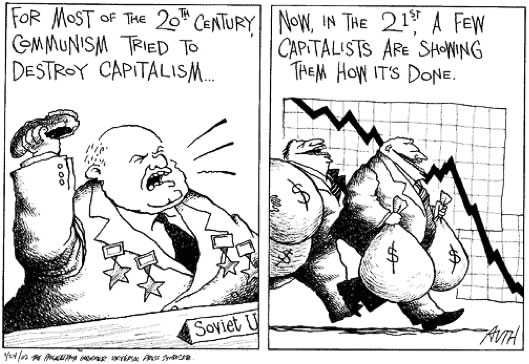
Growing poverty, unemployment and equality around the world indicate capitalism is a scam and must be scrapped, Cosatu president Sidumo Dlamini said on Thursday.

“The world is looking for a way out,” Dlamini told delegates attending the sixth Presidential Council of the World Federation of Trade Unions in Johannesburg, according to a copy of his speech.

“It is unfortunate that when this inhuman system has been exposed at all levels of society, the left forces in the world do not speak with one voice and present their own alternatives.”

Dlamini urged union leaders to find alternatives to present to society, “given the glaring failures of capitalism”.

He said it was unacceptable that out of the seven billion people on earth, more than 925 million remained hungry and without hope.

“How can this happen and the world keeps quiet to openly point out that capitalism has failed humanity?”

A recent report by the International Labour Organisation shows that about 1.1 billion people in the world are either unemployed or living in poverty.

Dlamini told union leaders they carried a heavy burden to provide answers to the unemployed.

“It is us, the left axis in the world, who must provide an answer on how to build the 600 million jobs needed to sustain economic growth and maintain social stability,” he said.

“It is us who must table a solution before society on how to address unemployment by the more than 74.8 million youths who are part of the 3.3 billion global labour force.”