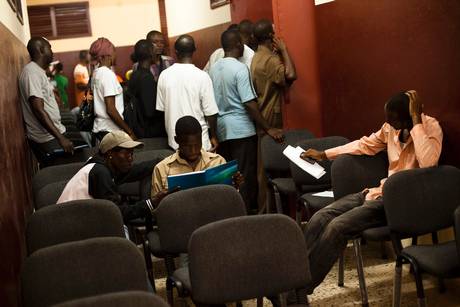
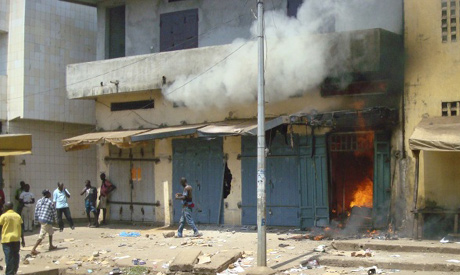
Liberian officials fear Ebola could soon spread through the capital’s largest slum after residents raided a quarantine center for suspected patients and took items including blood-stained sheets and mattresses.
The violence in the West Point slum occurred late Saturday and was led by residents angry that patients were brought to the holding center from other parts of Monrovia, Tolbert Nyenswah, assistant health minister, said Sunday. It was not immediately clear how many patients had been at the center.
West Point residents went on a “looting spree,” stealing items from the clinic that were likely infected, said a senior police official, who insisted on anonymity because he was not authorized to brief the press. The residents took medical equipment and mattresses and sheets that had bloodstains, he said.
“All between the houses you could see people fleeing with items looted from the patients,” the official said, adding that he now feared “the whole of West Point will be infected.”
Some of the looted items were visibly stained with blood, vomit and excrement, said Richard Kieh, who lives in the area.
The incident creates a new challenge for Liberian health officials who were already struggling to contain the outbreak.
Liberian police restored order to the West Point neighborhood Sunday. Sitting on land between the Montserrado River and the Atlantic Ocean, West Point is home to at least 50,000 people, according to a 2012 survey.
Distrust of government runs high in West Point, with rumors regularly circulating that the government plans to clear the slum out entirely.
Though there had been talk of putting West Point under quarantine should Ebola break out there, assistant health minister Nyenswah said Sunday no such step has been taken. “West Point is not yet quarantined as being reported,” he said.
Ebola has killed 1,145 people in West Africa, including 413 in Liberia, according to the World Health Organization.
Other countries across Africa are grappling to prevent Ebola’s spread with travel restrictions, suspensions of airline flights, public health messages and quarantines.
Nigeria appears to be making progress in containing the disease. The country has 12 confirmed cases of Ebola, all of which stem from direct contact with the Liberian-American man who flew to Nigeria late last month while ill. He infected several health workers before dying.
Since then three others have died in Nigeria from Ebola, according to figures released over the weekend.
One Nigerian doctor has survived the disease and was sent home Saturday night and five others confirmed with Ebola have almost fully recovered, said the Health Minister Onyebuchi Chukwu in a statement Saturday night.
The most important part of containing the disease is to track all those who had contact with Ebola patients and to closely monitor them in order to quarantine if they show any symptoms. Nigeria had 242 people under surveillance but now 61 have been cleared and released, after completing the 21-day quarantine period without showing any signs of Ebola, said the health ministry.
In East Africa, Kenya will bar passengers traveling from the three West African countries badly hit by the Ebola outbreak. The suspension is effective midnight Tuesday for all ports of entry for people traveling from or through Sierra Leone, Guinea and Liberia, said Kenya’s Health Ministry. Nigeria was not included in the ban, which also allows entry to health professionals and Kenyans returning from those countries.
Following the government’s announcement Saturday, Kenya Airways said it would suspend flights to Liberia and Sierra Leone. Kenya Airways, a major transport provider in Africa flies more than 70 flights a week to West Africa.
Several airlines have already suspended flights to Sierra Leone, Guinea and Liberia, including British Airways, Emirates Airlines, Arik Air and ASKY Airlines.
Officials in Cameroon, which borders Nigeria, announced Friday it would suspend all flights from all four Ebola-affected countries. Korean Air announced on Thursday it would temporarily halt its service to Kenya despite the fact there are no cases of Ebola in the country.
Meanwhile in India, three persons from Ebola-affected Nigeria, who arrived here Saturday morning, have been admitted to the Ram Manohar Lohia Hospital in Delhi for screening and treatment if required. The three Nigerians, aged 79, 37 and 4 years had fever and their tests were being done at the National Centre for Disease Control (NCDC), Delhi, an official release said here.
In addition to this, a 32-year-old Indian from Durg in Chhattisgarh who returned from Nigeria has been admitted to a hospital in Bhilai. His samples are also being tested at NCDC, the release said. WHO has said air travel, even from Ebola-affected countries, is low-risk for transmission of the disease.
Spanish priest Miguel Pajares, 75, the first European infected by a strain of Ebola that has killed more than 1,000 people in West Africa, has died in hospital in Madrid, a spokeswoman for the city’s health authorities said on Tuesday.
The spokeswoman declined to say when Pajares, who was airlifted from Liberia on August 7 after contracting the disease while working for a non-governmental organization in the African country, had died.
The priest was being treated in the Carlos III hospital, where he had been in quarantine since his return from Africa.
The Health Ministry said he was being treated with the experimental drug ZMapp, manufactured by U.S. company Mapp Biopharmaceutical. Two U.S. aid workers infected by the disease have shown some signs of improvements since being given the drug.
Pajares was repatriated with co-worker Juliana Bohi, a nun who has tested negative for Ebola.
The Ebola drug given to two Americans and the Spanish priest has been sent to treat infected doctors in two West African countries, and the supply of the medicine is now gone, its manufacturer said.
Countries including Nigeria and Liberia had requested the drug, called ZMapp. Mapp Biopharmaceutical Inc., based in San Diego, said it has complied with every request for the drug that was authorized by legal and regulatory authorities. The drug was provided at no cost, according to Mapp.
“It is our understanding that all patients offered treatment, treated, or expected to be treated were or are highly capable of providing informed consent for the use of an experimental drug not yet evaluated for safety in animals or people,” the company said yesterday in a statement.
More than 100 Bishops, Pastors, General Overseers, Prophets, Evangelists and other Ministers of the Gospel, under the auspices of the Liberia Council of Churches (LCC), converged Wednesday at the edifice of the St. Stephen Episcopal Church in Monrovia, Liberia to deliberate on the Church’s role in and response to the Ebola epidemic.
The meeting was called by Archbishop Jonathan B.B. Hart, President of the LCC, who was also recently elected and enthroned Archbishop of the Internal Province of West Africa.
The men of God, mainstream Episcopalians and non-denominational evangelicals alike, unanimously endorsed the following resolution:
That God is angry with Liberia, and that Ebola is a plague. Liberians have to pray and seek God’s forgiveness over the corruption and immoral acts (such as homosexualism, etc.) that continue to penetrate our society. As Christians, we must repent and seek God’s forgiveness.
That a three-day indoor fast and prayer across the nation be observed, commencing next Wednesday, August 6th, and concluding Friday, August 8th.
That an inter-denominational committee be constituted to present said resolution to government.
That if government is in agreement, the Republic of Liberia be locked up for three days of fast and prayer. All movement should be restricted during those three days. People should stay at home for three days of silence, fasting and prayer.
Africa’s deadliest ever Ebola epidemic in West Africa has officially claimed well over 600 lives, and unofficially many more.
Following the death of a Liberian government worker two days ago who collapsed in the international airport of Nigeria’s 20-million megacity, Lagos announced a “red alert” with Nigeria clamping down into a quasi-quarantine state, sending specialists to airports and seaports for containment.
In Sierra Leone, where many have more faith in traditional medicine, this has culminated in crowds gathered outside clinics and hospitals to protest against what they see as a conspiracy, in some cases clashing with police as they threatened to burn down the buildings and remove the patients.
One of Liberia’s most high-profile doctors has died of Ebola, officials said Sunday, and an American physician was being treated for the deadly virus, highlighting the risks facing health workers trying to combat an outbreak that has killed more than 670 people in West Africa — the largest ever recorded.
A second American, a missionary working in the Liberian capital, was also taken ill and was being treated in isolation there, said the pastor of a North Carolina church that sponsored her work.
Dr. Samuel Brisbane, a top Liberian health official, was treating Ebola patients at the country’s largest hospital, the John F. Kennedy Memorial Medical Center in Monrovia, when he fell ill. He died on Saturday. A Ugandan doctor died earlier this month.
The American physician, 33-year-old Dr. Kent Brantly, was in Liberia helping to respond to the outbreak that has killed 129 people nationwide when he fell ill, according to the North Carolina-based medical charity, Samaritan’s Purse.
He was receiving intensive medical care in a Monrovia hospital and was in stable condition, according to a spokeswoman for the aid group, Melissa Strickland.
The American missionary, Nancy Writebol, was gravely ill and in isolation in Monrovia.
Samaritan’s Purse spokeswoman Melissa Strickland says Dr Brantly’s wife and children had been living with him in Africa but are currently in the US.
The epidemic has a mortality rate of between 60% and 90%.
The head doctor fighting the deadly tropical virus Ebola in Sierra Leone has himself caught the disease, the government said.
The 39-year-old Sheik Umar Khan, hailed as a “national hero” by the health ministry, was leading the fight to control an outbreak that has killed 206 people in the West African country. Ebola kills up to 90 percent of those infected and there is no cure or vaccine.
Across Guinea, Liberia and Sierra Leone, more than 600 people have died from the illness, according to the World Health Organisation, placing great strain on the health systems of some of Africa’s poorest countries.
Khan, a Sierra Leonean virologist credited with treating more than 100 Ebola victims, has been transferred to a treatment ward run by medical charity Medecins Sans Frontieres, according to the statement released late on Tuesday by the president’s office.
“Health workers are prone to the disease because we are the first port of call for somebody who is sickened by disease. Even with the full protective clothing you put on, you are at risk,” Khan said earlier.
Three days ago, three nurses working in the same Ebola treatment centre alongside Khan died from the disease.
The Ebola outbreak started in Guinea’s remote southeast in February and has since spread across the region.
The Ebola Virus Disease (EVD) outbreak in West Africa has hit a new “milestone” as the World Health Organization reports in an update today than the number of cases have exceeded 1,000. The global health agency says the current epidemic trend of EVD outbreak in Sierra Leone and Liberia remains serious, with 67 new cases and 19 deaths reported from 15 – 17 July 2014.
While no new cases were reported from Guinea, 22 new cases with 10 deaths were reported from Liberia; and in Sierra Leone, 45 new cases and 9 deaths were tallied. These numbers include laboratory-confirmed, probable, and suspect cases and deaths of EVD.
The WHO says as of 17 July 2014, the cumulative number of cases attributed to EVD in the three countries stands at 1,048, including 632 deaths. The breakdown by country is as follows:
Guinea, 410 cases (301 confirmed, 95 probable, and 14 suspected) and 310 deaths (203 confirmed, 95 probable, and 12 suspected); Liberia, 196 cases (76 confirmed, 56 probable, and 64 suspected) and 116 deaths (54 confirmed, 40 probable, and 22 suspected); and Sierra Leone, 442 cases (368 confirmed, 48 probable, and 26 suspected) and 206 deaths (165 confirmed, 35 probable, and 6 suspected).
The EVD outbreak, the largest in history, began six months ago in Guinea.
Liberia’s president warned Monday that anyone caught hiding suspected Ebola patients will be prosecuted.
Ellen Johnson Sirleaf’s comments on Monday dispelled rumors in Liberia that the outbreak isn’t real.
Her warning came just days after Sierra Leone issued a similar warning, saying some patients had discharged themselves from the hospital and had gone into hiding.
Sirleaf expressed concern that some patients had been kept in homes and churches instead of receiving medical attention.
“Let this warning go out: Anyone found or reported to be holding suspected Ebola cases in homes or prayer houses can be prosecuted under the law of Liberia,” Sirleaf said.
Kenema, on the frontline of Sierra Leone’s fight against Ebola, is located in the diamond-rich east. It is the West African nation’s third largest city.
Health workers have encountered resistance throughout the region ever since Ebola cases were first confirmed in March, and some have even been attacked.
At the Moala checkpoint on the road to Liberia, masked health workers take the temperature of all travelers to monitor for anyone who might be carrying a fever.
But many still put faith in traditional methods.
At the same Moala checkpoint, police and soldiers tied herbal rope bracelets around travellers’ wrists, telling them a local traditional healer had been told in a dream that doing so could ward off Ebola.
The outbreak of the disease in West Africa is already the deadliest on record, with 635 cases and 367 fatalities, according to the latest World Health Organization numbers. A majority of the deaths — 280 — have been in Guinea where cases were first reported.
In an update released Monday, Liberia’s health ministry said the country had recorded 49 deaths as a result of Ebola, 26 of which were confirmed by laboratory tests.
There is no cure for the deadly disease which has an incubation period of two to 21 days and starts with fever and fatigue before descending into headaches, vomiting, violent diarrhea and then multiple organ failure and massive internal bleeding.
The deadly Ebola virus could solve France’s immigration problems “in three months”, Jean-Marie Le Pen, founder and honorary president of France’s far-Right Front National, has said.
Medical charity Medecins Sans Frontieres (MSF) says Ebola is “out of control”, located in at least 60 places across Guinea, Liberia and Sierra Leone.
The Ebola outbreak ravaging West Africa is “totally out of control,” according to a senior official for Doctors Without Borders (MSF), who says the medical group is stretched to the limit in responding.
The outbreak has caused more deaths than any other of the disease, said another official with the medical charity. Ebola has been linked to more than 330 deaths in Guinea, Sierra Leone and Liberia, according to the World Health Organization.
International organizations and the governments involved need to send in more health experts and increase public education messages about how to stop the spread of the disease, Bart Janssens, the director of operations for the medical group in Brussels, told The Associated Press on Friday.
“The reality is clear that the epidemic is now in a second wave,” Janssens said. “And, for me, it is totally out of control.”
The Ebola virus, which causes internal bleeding and organ failure, spreads through direct contact with infected people. There is no cure or vaccine, so containing an outbreak focuses on supportive care for the ill and isolating them to limit the spread of the virus.
The current outbreak, which began in Guinea either late last year or early this year, had appeared to slow before picking up pace again in recent weeks, including spreading to the Liberian capital for the first time.
“This is the highest outbreak on record and has the highest number of deaths, so this is unprecedented so far,” said Armand Sprecher, a public health specialist with Doctors Without Borders.
According to the WHO, the highest previous death toll was in the first recorded Ebola outbreak in Congo in 1976, when 280 deaths were reported. Because Ebola often touches remote areas and the first cases sometimes go unrecognized, it is likely that there are deaths that go uncounted during outbreaks.
The multiple locations of the current outbreak and its movement across borders make it one of the “most challenging Ebola outbreaks ever,” Fadela Chaib, a spokeswoman for the World Health Organization, said earlier in the week.
But Janssens’ description of the Ebola outbreak was even more alarming, and he warned that the countries involved had not recognized the gravity of the situation. He criticized WHO for not doing enough to prod local leaders; the U.N. health agency did not immediately respond to requests for comment.
“There needs to be a real political commitment that this is a very big emergency,” he said. “Otherwise, it will continue to spread, and for sure it will spread to more countries.”
But Tolbert Nyenswah, Liberia’s deputy minister of health, said the highest levels of government are working to contain the outbreak, noting that Liberia had a long period with no new cases before this second wave.
Julia Duncan Cassell, Liberia’s Minister of Gender and Development
The Liberian president, Ellen Johnson Shireaf, has appeared on Liberian television on Monday to denounce the country’s epidemic of child rape, calling it one of Liberia’s “biggest challenges” and “a growing concern”.
“It is shameful that this continues to mar the image of our country,” Sirleaf said.
She said current legislation was undermined by “families of victims who are easily compromised, by the lack of evidence, and by sympathetic judges” and called on communities to do more to bring rapists to justice.
“I chaired a meeting of women leaders… who are working on a program that will call on religious, traditional and community leaders, parents, teachers, women and youth groups to become agents of change and commit to take action to prevent sexual violence, as this is everyone’s responsibility,” she said.
“We need your support also, to ensure that our children and our women are safe.”
According to Liberia’s Gender Ministry, ” 65 percent of the 1,002 cases reported in 2013 concerned victims aged between three and 14, yet just 137 cases came to court with only 49 rapists convicted”. In a statement to journalists, the Gender Ministry also said: “As a result of rape 10 children from eight counties between the ages of three and 14 died during the year 2013. In some of the cases the perpetrators are still at large.”
The Gender Ministry deplored the habit of families to coverr up the rape if the attacker is related to the victim. There was also a lack of qualified medical personnel.
“Parents are compromising the cases because mostly the perpetrators are relatives or friends. We can say that the figure could be at least three times this if parents were not compromising,” the ministry said.
However, many people eschew the Western-style court and medical system and prefer “mediation by community elders or village chiefs”.
The website Global Post reported on a recent case, unbeknown to most of the outside world, whereby a 14-year-old girl Olivia Zinnah was buried here on 22 December, “after suffering years of pain and surgeries following a rape when she was 7”.
Olivia Zinnah
Although the country’s Gender Ministry made efforts to draw attention to Zinnah’s death, her passing went unremarked but for a few stories in local media. Zinnah, who died of an infection in a Monrovia hospital a week before Christmas, was the fourth girl this year to succumb to rape-related injuries in this West African nation of four million, the ministry said.
For three years after her 2005 violation in a rural area outside Monrovia, Zinnah received only traditional healing, which can include herbs and sorcery. She was not taken to a doctor. Police were not called. When her uncle Lawrence Samuel came to visit the family in 2008, he was shocked to see Olivia in a terrible state, with poorly treated wounds and a systemic infection.
“She was almost decomposed from the infection,” said Samuel, 70.
Samuel asked women in the family what had happened and they told him Olivia had been raped by a family member, he said. Samuel reported the crime and named the suspect to the police, brought his niece to Monrovia for medical care, and contacted the Ministry of Gender, he said.
Ministry officials took on Olivia’s case, paying for her medical treatment and four surgeries, the last of which left her with a colostomy bag.
“We did everything we could to save her,” said Gender Minister Julia Duncan Cassell.
Doctors Without Borders (DWB) in 2011 reported that 92 percent of females treated for rape in its Liberia facilities were under 18. A DWB study published in November said that of about 1,500 females treated in Monrovia clinics in 2008 and 2009 after rape, four out of 10 were younger than 12 and one in 10 were younger than 5. “Half the survivors were children aged 13 years or younger and included infants and toddlers,” the report said.
Because sexual violence so often goes unreported, it’s impossible to know the true scale of the child-rape problem here. In many cases, families of raped children accept money from the rapist to hush up the crime, Cassell said. In Olivia’s case, it does not appear her family accepted any money, but once the girl’s uncle reported the crime, the rest of the family shunned both Olivia and her mother, Cassell said. That common social penalty imposed on those who break silence around rape cases combines with the payoffs to deter reporting and foster impunity for rapists, the minister said.
“There are a lot of other Olivias out there that we don’t know about,” Cassell said.
Deputy Gender Minister Annette Kiawu played a central role in the ministry’s intervention in Olivia’s case.
“For her it was difficult,” Kiawu said. “She always had an urge to want to play like the other children. You would see her once in a while laughing, or trying to jump around. She used to smile every now and then.”
Although linkages have been drawn between widespread sexual violence during Liberia’s 14 years of civil war and the current levels of sexual violence, Cassell said the causes of Liberia’s epidemic child rape go beyond the fallout from conflict that ended a decade ago. Poverty leads to the settlements and thus to impunity; poor education leads to a lack of understanding among males of the physical and emotional damage caused by rape; high rates of teen pregnancy lead to lots of mothers unequipped to secure girls from predators, Cassell said.
“You’ve got a 16-year-old girl with two children already,” Cassell said. “How does she know how to protect her children?”
The alleged perpetrator of Olivia’s rape was arrested, but released without prosecution. Gender ministry officials are investigating to determine why he went free, and plan to get the case reopened. “He needs to pay for that,” Cassell said.
Her ministry paid for Olivia’s funeral, and ministry officials were on hand to discuss the case with a handful of local media, part of Cassell’s effort to bring attention onto the child-rape issue, and build awareness among the populace about the need to prevent and report sexual violence. So far, there’s been no significant public reaction to the death of Olivia here or abroad. – News agencies and Global Post website
In a recent article in the Sunday Independent, Gillian Schutte mistakenly blames so-called “white conservative narratives” for the appalling sexual violence that is sweeping South Africa at present. As rape is notoriously underreported, most estimates put the number of such crimes at more than a million per year or approximately three thousand per day.
The macabre forms of dehumanising torture during farm murders provide another clue to the societal breakdown that is occurring in our country. Even calling it “our country” might be a malapropism in that Afrikaners like myself are no longer considered full citizens in an Afro-Saxon state that is slouching towards some incarnation of Mugabe’s Zimbabwe or, better still, Charles Taylor’s Liberia. This week, Taylor’s conviction as a war criminal was confirmed by an international court, the first head of state to be jailed for such crimes committed in Sierra Leone while he was in office.
South Africa has become a sadists’ apocalypse. No amount of “reframing”, circumlocution or leftist pseudo-intellectualism can disguise it any longer. Nor can the seemingly desperate massaging of the crime statistics. In the age of social media, people communicate their horror and despair at being captives in this, our “paradise of cruelty”. Policing our language as in the cowardly attack upon Louise Mabille is a poor substitute for the lack of policing elsewhere.
As the twentieth century has shown, utopias are always dangerous, be they fascist or communist. Every utopia has turned into its mirror image, a dystopia replete with genocide. South Africa’s pursuit of a racial biopolitics known as “transformation”, as well as extreme forms of cultural relativism, have unleashed hitherto unknown social consequences. In the domain of sexual violence at least, the country has earned the dubious title of “rape capital of the world” and it regularly tops international murder tables too.
Understanding the causes of this immense violence, unknown in peacetime, represents a rare analytical challenge. None of the usual explanations actually fit. The same people denouncing “colonialism” are the most accomplished colonialists in their slavish subordination to US or British racial discourse and political correctness.
However, neither Britain nor America has absorbed any significant African cultural influence so it is of no use applying the sociology of New York or London to an outbreak of sadistic violence in Limpopo province. It is risible to see ostensibly educated people constantly blaming either “apartheid” or “poverty” for the horrors and cruelties afflicting this society.
The retreat of Afrikaner power in South Africa has been coterminous with the resurgence of African belief systems, including witchcraft and ritual murders. In the early nineties South Africa experienced hundreds of killings associated with witchcraft and occult beliefs, leading to the Commission of Inquiry into Witchcraft Violence and Ritual Murders. We still do not understand the role that occult beliefs played during the revolution, especially in establishing hegemonic black politics and racial nationalism. The necklace, that symbol of revolution, is pregnant with ethnographic and cultural meaning. There is also evidence that young “comrades” intimidated traditional healers to extract money from clients and that the accusation of being a witch was used to eliminate political opponents.
Mrs. Winnie Madikizala-Mandela, that international heroine and former wife of Nelson Mandela, subscribed to the Maoist doctrine – ‘kill one, scare a thousand’ – that support is gained through terror and horror. She notoriously stated in 1986:
…with our boxes of matches and our necklaces we shall liberate this country.
A necklace killing whereby a tyre is placed around the victim’s neck, filled with petrol and then set alight
Child and even baby rape is another ghastly phenomenon indicating that South Africa has navigated to a new, alien moral code. Stating that white men sometimes do it in some other country too, hardly mitigates the particular horror that it has assumed here.
The British Guardian ran an article on 12 March 2009 entitled, “Raped and killed for being a lesbian: South Africa ignores ‘corrective’ attacks“. The Guardian’s website contains an accompanying video interview with lesbian rape victims, as well as young black men who are outspoken in their support of “corrective rape”. One of them says:
Me, I have no time to rape them, but if there are some of the other guys who want to teach them the way, they must rape them, they must rock them.
But perhaps white conservatives are a bigger problem: they might go to church or caution their children against drugs and sexual promiscuity, which would undermine the libertine morals that so many have advocated for so long in South Africa. In Hillbrow, as recounted to me by a former policeman, young white female drug addicts are employed as prostitutes by Nigerian gangsters. When they are no longer useful to their pimps, they simply get injected with heroine and pushed off highrise buildings in what gets officially recorded by the police as “suicides”. In South Africa, the crime reality show is so much better than the fiction.
The country’s academics are all but ignoring the scourge of rape, including infant rape, judging from the paucity of published articles in the field. To some extent they have acculturated to the witch-hunting culture in persecuting dissidents in their own ranks. Otherwise they engage in repetitive denunciations of “patriarchy” as if there were still a father left somewhere that has not been killed.
South Africa’s “transformed” universities have been turned into the “armed brothels” Erik von Kuehnelt-Leddihn spoke about when he said:
Rousseau is the grandfather of the concentration camps and also of those armed brothels that we continue to call universities. We have with us on one hand the Old Left, a finished product of L’éducation sentimentale, with its bent for social engineering and its tendency to identify its own plans and policies with the volonté générale; on the other the New Left which has taken up the slogan Retournons à la nature! exemplified in the rabble of unwashed, unkempt, debauched, unbridled ignoble savages who look to the Third World of the underdeveloped for inspiration. Its heroes are Chairman Mao with his Little Red Book, Ché Guevara, Ho Chi Minh, Holden Roberto, the Harlem criminals and the pistol-packing priests.*
That is why leftist university intellectuals find any form of criticism of traditional African culture to be inherently “racist” and eschew references to practices such as ukuthwala(the kidnapping and forced marriage of young maidens). Recent legislation has placed about 18 million black South Africans under so-called customary law in which such practices are legal.
Everybody in South Africa, whether white or black, fears a witch-hunt in some or other form. Especially the kind of witch-hunt whereby you are called a “racist”, lose your tenured university job and spend the rest of your life in ignominy. Therefore white academics are completely silent on ukuthwalaor the so-called “virgin cleansing myth” if the professors do not actually deny in writing that such phenomena exist!
Here and there information filters through the iron curtain of political correctness. The only academic article worth reading on the “virgin cleansing myth” is that by Suzanne Leclerc-Madlala which appeared in The African Journal of AIDS Research in 2002 under the title, “On The Virgin Cleansing Myth: Gendered Bodies, AIDS and Ethnomedicine“. It provides a fascinating glimpse into the psycho-sexual paradigm in which, as she puts it, “virgin cleansing is believed to have both a therapeutic and a prophylactic effect” (against HIV-AIDS). Raping a child or a disabled person is therefore seen as a form of AIDS prevention or cure.
But even the virgin cleansing myth obliquely alluded to by Dr. Mabille in her critique of insipid Western feminism does not go far enough in explaining South Africa’s journey upriver into the heart of darkness. We really lack the concepts to understand the enormity of what we are faced with.
Much of what passes for analysis of sex and culture in South Africa consists of rehashed hippie or New Left thinking from 1960s America. Get liberated, man, is more or less the gist of it. Call it Marcuse on Durban Poison. Repression or any form of “holding back” is invariably seen as “bad”. But sometimes repression might be desirable, even imperative. Freud was old-fashioned enough to advocate a balance between the pleasure principle and the reality principle.
The old Afrikaner government, while encouraging African ethnic identities, saw fit to suppress witchcraft and ritual murder by making it a criminal offence. Prior to becoming the first president of a united South African republic, Charles Robberts Swart introduced the Suppression of Witchcraft Act 3 of 1957. To the principled cultural relativist, the act – which is still on the statute books – is an affront and he would probably agree with the Marquis de Sade that “morality is just geography misapplied”, meaning that a crime in one culture is a harmless pastime in another.
One could even argue that the very structure of the South African political system is tending towards sado-masochism. Last Sunday the new CEO of the liberal Institute of Race Relations, Dr Frans Cronjé, argued in Rapport that whites should assume a far more submissive role in South Africa, lest they expose themselves to some form of collective revenge during a Second Revolution. According to Cronjé, such a revolution will be
…a violent, racist and destructive transition from a reconciling democratic state to a hostile, black nationalist state… After the Second Revolution, white South Africans will lose their homes, their jobs and their businesses.
Apart from exhortations to submissiveness, white guilt and even “vows of silence” à la Samantha Vice of Rhodes University, South Africa’s academic sycophants contribute little to our grasp of contemporary violence. In this respect, French literature is more instructive. Sade’s amoral theory of nature, of course. But also his notion of the sovereignty of sexual instincts that should not be tamed by any man-made law or religious scruple.
The Marquis de Sade had a disciple in the surrealist author Georges Bataille who espoused a theory of “transgression”. He took an interest in violence, punishment and eroticism. Bataille also collected photographs of Chinese executions which included horrific torture.
South Africa’s army of sadists regularly commit acts that shock a weaker Eurocentric sensibility. At the same time they are creating a world without limits, revelling in a new-found innocence that to them must represent the perfect freedom, the sovereignty of Sade’s libertine who pursues excess in celebration of pristine nature, a nature that punishes the weak and rewards the strong. To impose one’s will on a woman is also a gift of nature to all men. As Sade writes in Philosophy in the Bedroom:
If then it becomes incontestable that we have received from Nature the right indiscriminately to express our wishes to all women, it likewise becomes incontestable that we have the right to compel their submission, not exclusively, for I should then be contradicting myself, but temporarily. It cannot be denied that we have the right to decree laws that compel woman to yield to the flames of him who would have her; violence itself being one of that right’s effects, we can employ it lawfully. Indeed! has Nature not proven that we have that right, by bestowing upon us the strength to bend women to our will?**
Human rights or even a puritanical code such as feminism is not incompatible with sadism. As Bataille would argue, morality is needed for transgression to take place.
Sylvia Plath wrote in her poem “Daddy” that “Every woman adores a Fascist”. She was wrong. Every woman adores a sadist. Especially if she happens to be a feminist.
* Erik van Kuehnelt-Leddihn. “The Western Dilemma: Calvin or Rousseau?” in Modern Age, Winter 1971, p. 55.
** The Marquis de Sade. The complete Justine, Philosophy in the Bedroom and other writings, transl. RIchard Seaver and Austryn Wainhouse. New York: Grove Press, 1965, p. 319.
Victims of the bloody regime of Liberian warlord Charles Taylor spoke of their relief after his 50-year jail term for war crimes and crimes against humanity in Sierra Leone was upheld by an international court on Thursday.
The final verdict handed down by the UN-backed Special Court for Sierra Leone (SCSL) draws a line under a seven-year trial of the 65-year-old former Liberian president, sentenced in May last year for “some of the most heinous crimes in human history”.
“As a government, we believe that justice has been done and impunity is over,” Sierra Leone government spokesman Abdulai Bayraytay told AFP.
“The message for sitting heads of state not only in Africa but beyond is that when you are in power you must exercise it judiciously, have respect for the rule of law and human rights and uphold the dignity of others.”
Around 100 people, including human rights activists and survivors of the Sierra Leone civil war, watched a live broadcast of the ruling in the capital Freetown.
For Sullay Turay, who lost a hand and a foot to Taylor-backed rebels, the outcome “showed that no matter what you do, justice will finally catch up with you and this is what has happened in Taylor’s case.”
The former warlord, who was jailed initially for 50 years for arming rebels during Sierra Leone’s brutal 1990s civil war, is likely to spend the rest of his life behind bars, possibly in a British jail.
He sparked a 13-year civil war in his own country when he led a rebellion in 1989 to oust President Samuel Doe which deteriorated into one of Africa’s bloodiest conflicts.
His National Patriotic Front of Liberia (NPFL) earned a reputation for extreme violence, conscripting child soldiers and terrorising citizens of certain ethnic groups.
After taking Monrovia, Taylor was elected president in 1997, but violence again erupted in 1999 when another rebellion started and he lost control of much of the country, fleeing in 2003 to Nigeria.
The conflicts resulted in 270,000 deaths, with many civilians displaced and several thousand becoming victims of atrocities, according to the United Nations.
As Liberia’s president from 1997 to 2003, Taylor supported Revolutionary United Front rebels in neighbouring Sierra Leone by supplying them with guns and ammunition as they waged a campaign of terror during a civil war that claimed 120,000 lives between 1991 and 2002.
He was finally arrested and transferred to The Hague in 2006, where he was convicted in 2012 of aiding and abetting the rebels during the conflict, known for its mutilations, drugged child soldiers and sex slaves, trial judges found.
“Full justice has now been done and the victims should move on with their lives. The violations they suffered have been addressed through the judicial process,” said Ibrahim Tommy, chairman of the Centre for Accountability and the Rule of Law campaign group.
“The government now should work to strengthen the justice system and work for the socio-economic prosperity of the victims.”
Some victims of the conflict remain bitter and voiced frustration that Taylor had not received the 80-year sentence requested by the prosecution.
“Let Taylor rot in jail. I only wish he would have served his sentence in an African prison to suffer the more,” said Freetown taxi driver Andrew Lebbie.
But there was also a note of reconciliation among the crowd gathered for the ruling in Freetown.
“Forgiveness is all I would ask for. The court should have tempered justice with mercy,” said vicar Sam Fergusson.
But Taylor has never been charged for his role in Liberia’s bloody history, only that in neighbouring Sierra Leone. – AFP
Former Liberian President Charles Taylor will hear Thursday whether appeals judges uphold or overturn his landmark conviction and 50-year sentence for aiding murderous rebels in Sierra Leone’s civil war.
Taylor, 65, became the first former head of state convicted by an international war crimes court since World War II when the Special Court for Sierra Leone found him guilty on April 26, 2012, of 11 counts of war crimes and crimes against humanity including terrorism, murder, rape and using child soldiers.
Judges said he provided crucial aid to rebels and helped plan attacks in return for “blood diamonds” mined by slave laborers in Sierra Leone and political influence in the volatile West African region. His conviction was hailed as ushering in a new era of accountability for heads of state.
“The trial and judgment of Charles Taylor sets out a clear marker that even those at the highest levels of power can be held to account,” Elise Keppler, associate international justice director at Human Rights Watch said in a statement. “The Taylor trial, and the Sierra Leone Special Court’s work overall, have made a major contribution to justice for brutal crimes committed during Sierra Leone’s conflict.”
About 50,000 people died in the 11-year civil war that ended in 2002. Thousands more were left mutilated in a conflict that became known for the extreme cruelty of rival rebel groups who gained international notoriety for hacking off the limbs of their victims and carving their groups’ initials into opponents. The rebels developed gruesome terms for the mutilations that became their chilling trademark: They would offer their victims the choice of “long sleeves” or “short sleeves” – having their hands hacked off or their arms sliced off above the elbow.
Taylor was convicted not only of aiding and abetting Sierra Leone rebels from Liberia, but also for actually planning some of the attacks carried out by Sierra Leone rebel groups, the Revolutionary United Front and the Armed Forces Revolutionary Council.
It isn’t clear if the Sierra Leone court’s appeal panel will take into account a February appeals judgment by the U.N. Yugoslav war crimes tribunal that acquitted the former chief of staff of the Yugoslav National Army, Gen. Momcilo Perisic, of aiding forces fighting in a neighboring country. Perisic was freed after appeals judges said it hadn’t been proven that he sent supplies to Bosnian Serb forces with the “specific intent” that they be used to commit atrocities.
The ruling was seen as raising the bar on the level of proof needed to uphold such aiding and abetting charges, though the Sierra Leone court isn’t bound to follow in the Yugoslav tribunal’s footsteps.
Taylor’s lawyers say he should be acquitted on all counts. Prosecutors asked appeals judges to rule that he was even more closely involved in the crimes in Sierra Leone than was laid out in his original conviction and urged judges to increase Taylor’s sentence to 80 years, saying the 50-year sentence wasn’t “reflective of the inherent gravity of the totality of his criminal conduct and overall culpability.”
If Taylor’s sentence is upheld, he will be transferred to Britain, which has agreed to provide a cell for him.
Taylor’s trial was moved from the Special Court of Sierra Leone’s headquarters in the capital, Freetown, to the Netherlands because of fears it could destabilize the West African region if held in Sierra Leone.
The Taylor appeals ruling will be the final judgment at the court, which indicted 13 of the main architects of the atrocities in Sierra Leone. Two died before trial and one more remains unaccounted for and possibly dead. Another died before hearing a verdict and all the others were tried and convicted.
The court’s trial chamber in Freetown will be converted to house Sierra Leone’s Supreme Court in the future. Another part of the court is being turned into a peace museum and its detention facility has been put to use as a prison by local authorities. – AP
Not one of the nearly 25,000 students applying for one of Africa’s two state-run universities has passed the entrance exam, to the surprise of the country’s education minister. So the University of Liberia faces a new term with no first years turning up to class.
Etmonia David-Tarpeh, who described the widespread failure as “like mass murder”, plans to meet with university officials after school-leavers paid a fee of $25 each to take the test, only to see their dreams dashed.
Speaking to the BBC Focus on Africa programme, she said: “I know there are a lot of weaknesses in the schools but for a whole group of people to take exams and every single one of them to fail, I have my doubts about that. I’d really like to see the results of the students.”
A bloody civil war that ended a decade ago has left the education system in tatters, with many schools deprived of the simplest education resources and in dire need of qualified teachers. But a lack of enthusiasm and a basic grasp of English are behind the latest shocking statistic, a university spokesperson has said.
Defending the university’s decision, spokesman Momodu Getaweh confirmed that it would not be changing its stance, arguing that the government must put the war behind them and act fast on students’ complete ignorance of the “mechanics” of English.
Dozens of people were wounded Monday in ethnic clashes in the west African state of Guinea, officials told AFP, after petrol station guards killed a youth from a rival tribe.
A police source said the violence broke out in the southern forest region when the guards from the Guerze tribe accused the youth, an ethnic Konianke, of stealing before torturing and beating him.
The victim’s family told their fellow Konianke tribespeople who “rose up against these medieval practices” in the town of Koule, the source said.
The violence spread to the nearby provincial capital N’Zerekore, 570 kilometres (350 miles) southeast of Conakry, leaving dozens injured and several homes destroyed.
Security forces deployed to break up the fighting had been unable to restore calm in N’Zerekore by the afternoon, witnesses told AFP, while the police source said there were “dozens wounded by machetes”.
“The two communities are now fighting with machetes, axes, sticks and stones. I cannot say the exact number of casualties in the districts or even the number in hospital. The situation is extremely serious,” he added.
“Since the clashes broke out in Koule overnight and moved to N’Zerekore, we have registered one death and at least 50 injured, 20 in Koule and 30 in N’Zerekore,” a hospital source told AFP.
Communal violence is common in the region, near the border with Liberia, where clashes between the two tribes regularly break out over religious and other grievances. The indigenous Guerze are mostly Christian or animist, while the Koniankes — seen as newcomers — are Muslims considered to be close to Liberia’s Mandingo ethnic community.
In Liberia’s civil war, which ended in 2003, rebels fighting the forces of then president Charles Taylor drew much of their support from the Mandingo community.
The Guerze, known as Kpelle in Liberia, were generally considered to be supporters of forces loyal to Taylor, who was jailed last year for “aiding and abetting” war crimes in neighbouring Sierra Leone. – AFP
This website uses cookies to improve your experience. We'll assume you're ok with this, but you can opt-out if you wish. Cookie settingsACCEPT
Privacy & Cookies Policy
Privacy Overview
This website uses cookies to improve your experience while you navigate through the website. Out of these cookies, the cookies that are categorized as necessary are stored on your browser as they are essential for the working of basic functionalities of the website. We also use third-party cookies that help us analyze and understand how you use this website. These cookies will be stored in your browser only with your consent. You also have the option to opt-out of these cookies. But opting out of some of these cookies may have an effect on your browsing experience.
Necessary cookies are absolutely essential for the website to function properly. This category only includes cookies that ensures basic functionalities and security features of the website. These cookies do not store any personal information.
Any cookies that may not be particularly necessary for the website to function and is used specifically to collect user personal data via analytics, ads, other embedded contents are termed as non-necessary cookies. It is mandatory to procure user consent prior to running these cookies on your website.