North West Premier Thandi Modise’s office says the purchase of a R1.3 million vehicle was above board and ordered before Finance Minister Pravin Gordhan announced austerity measures.
Modise recently purchased a BMW 750i despite Gordhan’s announcement last year that excessive spending on cars, travel, accommodation and other luxuries would be curbed.
Her office insists that the decision to purchase the vehicle was taken by the Department of Public Works and was below the 70 percent limit prescribed by the ministerial handbook.
Modise’s spokesperson Lesiba Kgwele says it is unfair to blame the premier who had no choice in the matter.
“The question of morality goes way beyond this particular transaction. In this particular instance, we want to insist that the premier didn’t defy any cabinet directives.”
East Germany and the African National Congress shared a special bond: not only the government, but also the public in the communist state supported the anti-apartheid movement in South Africa.
Heavily armed police forces pushing along black children and teenagers, beating them with clubs, shooting with live ammunition. The disturbing images of the Soweto Uprising shocked the world in June of 1976.
Some 15,000 students in the South African township protested against a new rule that said they’d only be able to take exams in Afrikaans, the language of most white South Africans. They accused the apartheid regime of massively limiting their access to education.
Authorities said 575 people died in the dispute, but the protesters themselves said the number of victims was much higher. Years of unrest followed and led to international protest.
Soweto as catalyst
For Christine Müller from Leipzig, then in communist East Germany, the Soweto uprising was a “defining moment.” She still remembers the effect the pictures had on her. “This rage enveloped me, because I felt so helpless,” Müller told DW. “I thought that we needed to do something immediately.”
Christine Müller
Christine Müller says seeing the pictures from Soweto made her feel ‘helpless’
She researched the topic and looked for fellow supporters. For decades, she worked in church groups that advocated solidarity with the anti-apartheid movement. Today, Müller is the head of the “One World” working group at the Protestant Church of Saxony. For Müller, her involvement is an expression of her Christian faith.
“‘Apartheid’ means exclusion,” she said. “And that’s not just about the victims of racism in South Africa, but more generally about the excluded, who don’t get a piece of the pie when it comes to wealth and power.”
Involuntary union of church and state
East German stamp exalting African wars of liberation
In East Germany, the Protestant church was a main source of political opposition. But the authoritarian government was also involved in the fight against apartheid. That made for an unusual alliance.
The communist leadership in East Berlin described its support for liberation movements as anti-imperialistic solidarity. But East Germany also had pragmatic goals at heart: the government wanted to raise its country’s profile on the world stage. Until the 1970s, it lacked diplomatic ties to western nations because democratic West Germany regarded itself as the only legitimate successor state to the wartime regime. West Germany’s Hallstein Doctrine of 1955 considered it an “unfriendly act” when other countries established diplomatic relations with the East.
Together with the US and Britain, West Germany was among the countries with the strongest ties to the apartheid regime in Pretoria. The West German Protestant church (EKD) was largely mute on the issue. Support for the African National Congress (ANC) and its imprisoned member Nelson Mandela tended to come from leftist groups. That led to angry disputes within the church.
In contrast, the East German government generally regarded any independent social movements as a threat. That didn’t make the anti-apartheid efforts of grassroots groups, or of the East German government, any less worthy, historian Ilona Schleicher said. In the face of the situation in Soweto and other examples of brutal violence against blacks, political persuasion and worldview weren’t of any importance, she said: “Every human being, no matter whether they oppose their state or not, reacts the same to those pictures if they’re really human: with compassion, solidarity and the desire to help.”
Fighting for democracy under communism
But the lack of democracy in East Germany cast a shadow over its anti-apartheid stance, Schleicher said: “They were fighting for something they didn’t have in their own country.” She experienced the anti-apartheid movement as the wife of an East German diplomat in southern Africa. That influenced her stance. “As a working-class child, I grew up with the promises of socialism,” Schleicher told DW. “For me, everything in East Germany looked right. The realization that many things were not in fact right in our country only came to me much later, and also because of the experiences we had abroad.”
On the ground in South Africa, she saw that the liberation fighters didn’t care about who helped them or what their motivation was. “What counted was the actual support.” The ANC profited from East German support in various ways. Instructors and teachers worked in ANC training centers in Tanzania and universities in East Germany accepted black South African students. To make this possible, the official Solidarity Committee collected donations in the population.
When the ANC began using violence against its oppressors in the 1960s, East Germany continued to support it. The Solidarity Committee sent paramilitary equipment including camouflage fabric, binoculars and rubber boats. And instructors trained more than 1,000 resistance fighters in Africa, but also in a secret military camp in the East German village of Teterow.
Apartheid support in West Germany
At the same time in West Germany, companies like Daimler-Benz, Siemens and Deutsche Bank invested in South Africa, and thus provided a form of support to the apartheid regime and its violations of human rights – knowing that they had the West German government on their side.
ANC supporters in the East did experience a crisis of conscience, Müller said: “That was the problem for many of my fellow Christians who said ‘We can’t support our government’s anti-imperialistic politics.'” That’s why she was even happier when the apartheid laws were abandoned in 1990, the year East Germany itself ceased to exist, and in 1994, when Nelson Mandela was elected as the first black president. Müller said that was a nice affirmation for her efforts, even though things are far from perfect in South Africa. – Deutsche Welle
STATEMENT ON THE PASSING OF CDE NELSON ROLIHLAHLA MANDELA
AFRICAN NATIONAL CONGRESS
Secretary General’s Office
Comrades and friends,
The Mandela family,
Fellow South Africans,
“In the life of every nation, there arise men who leave an indelible and eternal stamp on the history of their peoples; men who are both products and makers of history. And when they pass they leave a vision of a new and better life and the tools with which to win and build it.”
With deep sorrow and a profound sense of loss, the African National Congress received the sad news of the passing of our Isithwalandwe and former President, Comrade Nelson Rolihlahla Mandela.
Our nation has lost a colossus, an epitome of humility, equality, justice, peace and the hope of millions; here and abroad.
Madiba loved South Africa. We recall the strength of his fist punching the air as he stepped out of prison after 27 years; and his sternness during the negotiations for the freedom of our beloved country. We celebrate his ever-present smile, the cheerful Madiba jive, his love for children and great respect for the women of this country.
The large African Boabab, who loved Africa as much as he loved South Africa, has fallen. Its trunk and seeds will nourish the earth for decades to come.
Nelson Mandela, Isithwalandwe – Seaparankwe, born in the village of Qunu in the erstwhile Bantustan of the Transkei, recognised the burden of colonial and racial oppression and exploitation. He then joined the African National Congress in 1942. He was convinced by the belief his wise tutor, Walter Sisulu, had in the ANC as the means to effect change in South Africa. As he said,
“Sometimes one can judge an organization by the people who belong to it, and I knew that I would be proud to belong to any organization of which Walter was a member”.
He loved the ANC. Hence his frequent words that upon his death he would join “the nearest branch of the ANC in heaven”
In his lifetime of struggle through the African National Congress, he assumed and was assigned various leadership positions. He served with distinction. He was part of the ANC leadership collective and did not make decisions without first reflecting with his comrades. Yet he would fight for the principle of what was the right thing to do.
Madiba was also a member of the South African Communist Party, where he served in the Central Committee.
His was a choice to not only be a product but the maker of his and his people’s history.
Soon after prison he took the mantle of the President of the ANC and, ultimately the country – becoming the first President of a democratic South Africa. He worked tirelessly for the ANC and a free South Africa. He hated racism and bigotry; sought a united, non-racial, non-sexist and democratic society where all are equal. As he said while in prison,
“Ours is not to ask for equality on a lower scale; Ours is to fight to win on an equal but higher level”.
He passed the baton to the younger generation of his beloved movement, the ANC, to carry on with the vision of bringing about an equal and just society. The ANC continues in this task as set forth by him and those of his generation, living and deceased. Indeed, men and women such as Nelson Mandela,
“… when they pass they leave a vision of a new and better life and the tools with which to win and build it.
His life gives us the courage to push forward for development and progress towards ending hunger and poverty. As we said of him while still alive, and we say so now,
“We have you, Madiba, as our nearest and brightest star to guide us on our way. We will not get lost.”
To the entire family of Mandela, we extend our heartfelt condolences. He was as much yours as he was ours, probably his dedication to the ANC family robbed you of a father. We will, from this minute on, as always, walk this journey with you to the end. To his friends, in the ANC and across the globe and across all divide, be comforted. To the people of South Africa, may your hearts be not in distress. He lives in each and every one of you and in your homes, because he gave of himself to all of us.
Let us celebrate the gift of his life from this moment on. Let us honour his memory in a dignified way as his leadership and stature deserves. Let us participate in all the activities organised in his honour in a disciplined and respectful manner, until he is laid to rest.
EFF leader Julius Malema praised Winnie Madikizela-Mandela and said should be honoured for her struggle for liberation. Madikizela-Mandela, as a struggle icon could have become president of the country, he said.
“If we do not honour Winnie Mandela, it means the apartheid propaganda has succeeded. To defeat the propaganda we have to honour the remaining revolutionary.”
Malema said that allegations about lawyer Dali Mpofu, who left the ANC and joined the EFF last month, and Madikizela-Mandela having an affair were not true.
“This man does not have the potential to sleep with his mother. Winnie is Mpofu’s mother.”
Malema claimed ANC leaders benefited from investors as far back as the early 1990s. He mentioned leaders by name, saying they benefited from foreign companies currently operating in the country.
Madikizela-Mandela, Malema said, was the “only cadre of the revolution”.
Malema said Madikizela-Mandela will not join the Economic Freedom Fighters.
“She deeply identifies herself with the ANC. Asking her to join the EFF is like asking her to let go of herself and who she truly is,” he told supporters outside the Polokwane High Court.
Malema failed earlier in the day to persuade the court to withdraw criminal charges against him.
Judge Ephraim Makgoba ruled that the case against him would go ahead next year as scheduled, unless the National Prosecuting Authority decided to drop the charges.
The ANC in Limpopo was served a court interdict at its Peter Mokaba regional conference in Polokwane on Sunday, the party’s provincial task team said.
“Members of the ANC are interdicting us because they not happy with the result of the conference,” convenor Elleck Nchabeleng said.
“Our legal team is busy studying the interdict and conference will proceed as scheduled, our response will follow later.”
He would not comment further on the matter.
The SABC reported that Economic Freedom Fighters leader Julius Malema’s former ally Lehlogonolo Masoga was elected chairman of the region on Sunday.
Masoga is also MEC for roads and transport in Limpopo.
Masoga and Malema reportedly fell out in 2010 during the African National Congress Youth League’s provincial conference in Makhado.
This was after Masoga accused Malema of dictating how the conference should have been run.
Masoga was subsequently suspended from the ANC after he took the party to court over alleged maladministration in the way the conference was run.
According to the SABC, a group of delegates walked out of the Polokwane conference on Sunday saying some people had been denied the opportunity to vote. – Sapa
Government departments and other public entities wasted almost R31-billion in unauthorised, irregular and fruitless spending during the financial year to the end of March.
This is according to a consolidated general audit report for the 2012-2013 financial year released in parliament yesterday by outgoing auditor-general Terence Nombembe.
Nombembe lambasted the government for not implementing his recommendations for improving financial controls.
Government departments awarded R233-million in tenders to companies in which public servants or their close family members had an interest – even though Public Service and Administration Minister Lindiwe Sisulu has prepared legislation to ban public servants from trading with the state.
The report identified several areas in which the risk of incurring unauthorised, irregular or fruitless spending was greatest, including: poor supply-chain management, weak IT systems, lax human resources management and poor preparation of financial statements.
Nombembe criticised cabinet ministers, saying “it is apparent that almost half of the executive authorities do not yet have a direct impact” in turning around the poor financial management of their departments.
The report found:
That 32 government departments incurred R2.3-billion in unauthorised expenditure;
That 294 departments and public entities irregularly spent R26.4-billion; and
That 227 entities and departments incurred fruitless and wasteful expenditure of R2.1-billion, with four provincial departments being responsible for half that amount.
Nombembe said most of the improper expenditure was in provincial departments of health, education, and public works “right across the country”.
Sisulu said that – together with Minister in the Presidency for Performance Monitoring and Evaluation Collins Chabane – she would ensure that all ministers were able to supervise financial management in their departments.
“Politicians must take accountability for what happens in their departments,” she said. – timeslive.co.za
A request has been made to declare the graves of Hendrik Verwoerd and his assassin Dimitri Tsafendas national heritage sites.
The request came from ANC Eastern Cape MPL Christian Martins in a letter to the National Heritage Council of SA, released to the media on Monday.
Martins argues in the letter that South Africa’s history would be incomplete without Verwoerd, referred to as the “architect of apartheid”.
Verwoerd served as South Africa’s prime minister from September 2, 1958 to September 6, 1966, when he was stabbed by Tsafendas in the then House of Assembly in Parliament.
“Dimitri Tsafendas and Hendrik Verwoerd arguably changed the course of post-war South African history more than any other, when Tsafendas stabbed to death the ‘architect of apartheid’,” said Martins.
Martins said that while Tsafendas was declared unfit to stand trial due to insanity, research showed Tsafendas knew what he was doing and planned the assassination well in advance.
“And further research clearly shows that this act of Tsafendas was politically motivated, aggravated by the heinous racial prejudices that Verwoerd exploited to try to entrench white rule on the subcontinent.”
It was Martin’s opinion that rather than forgetting these important role-players in the country’s history, homage should be bestowed upon Tsafendas, a hero and martyr for the cause of the South African people.
“The assassination of Verwoerd was our exodus from the policies, laws and by-laws articulated and crafted by Verwoerd,” he said.
“Verwoerd inculcated in South Africans a belief that those who opposed apartheid or criticised it either misunderstood the policy or were dangerous communists.”
This led to violence which drove black leaders into exile and quenched internal opposition, giving birth to a form of leadership within many mass movements that saw South Africa transformed to democracy.
“Shared opposition and shared passion for apartheid shaped South Africa and for that we have to honour and remember the oppressed and the oppressor, the villain and the hero,” said Martins.
Martins was punished by the Eastern Cape legislature’s ethics committee in September for referring to the Democratic Alliance as peacocks in October last year.
He was penalised one months salary and suspended from participating in the activities of the legislature for 30 days from October 1. – Sapa
Diepsloot, a black township north of Johannesburg.
Some Diepsloot residents angered by the killing of two children vowed on Friday to vote for the Economic Freedom Fighters in general elections next year.
“In other countries if you kill you get killed, but in South Africa you are awarded with a comfortable life in prison. You eat healthy food and you have a television,” said Reneilwe Mokwena, 34, a mother of four.
Another mother, Darksha Fenyane, 36, said the two of them would be voting for the EFF, saying President Jacob Zuma had let them down.
“We voted for him not knowing he is like this. He must not come here because we will hurt him,” said Fenyane.
The bodies of two-year-old Yonelisa Mali and her cousin Zandile Mali, three, were found on Tuesday. They were reported missing at the weekend.
Four men appeared in the Pretoria Magistrate’s Court on Friday on charges of rape and murder. The case was postponed to Thursday for the men to apply for Legal Aid.
A fifth man, who was arrested early Friday morning in Alexandra, would appear in the court on Monday.
Gauteng premier Nomvula Mokonyane urged Diepsloot residents to support the family of the two toddlers.
“This is something that must never happen to anybody’s child,” she said outside the family’s home in Diepsloot, north of Johannesburg.
She said police received information which helped them make the arrests.
“What has happened today [Friday] in Diepsloot is a demonstration that community and police relationship are very important. Their partnership can go a long way.
“Now that the suspect has been arrested let’s all rally behind the family give them the necessary support. Give the mothers space to grieve the loss of their children so that they can find closure.”
She told reporters the family was thankful and looking forward to a swift prosecution of the perpetrators.
Earlier, residents gathered outside the police station to protest about the murders. They demanded that police release the fifth man so they could burn him.
Police were in the area as Economic Freedom Fighters supporters and African National Congress supporters clashed. EFF supporters accused ANC supporters of beating them. – Sapa
Economic Freedom Fighters supporters accused ANC supporters of beating them up in Diepsloot on Friday.
Residents supporting the EFF stood outside the Diepsloot police station but were not allowed in.
They complained about being shut out saying the police were supposed to provide a place of safety.
Residents refused to speak to the media. However, one EFF supporter said he planned to open a case with the police.
Earlier, angry Diepsloot residents gathered outside the local police station protesting about the murder of two toddlers.
They demanded that police release to them a fifth man arrested earlier in the day so they could burn him.
The bodies of two-year-old Yonelisa Mali and her cousin Zandile Mali, three, were found on Tuesday. They were reported missing at the weekend.
Four men are expected to appear in the Pretoria Magistrate’s Court on Friday on charges of rape and murder.
There was a heavy police presence in the area.
The African National Congress Youth League marched to the police station to hand over a memorandum.
“We raised a lot of grievances that we have as a community here in Diepsloot on issues of crime and drugs,” ANCYL national task team co-ordinator Mzwandile Masina said after handing over the memorandum.
“Now we want to work with the community to ensure there’s peace in the area. We want visible policing at all times.”
Residents supporting the ANC and those supporting Julius Malema’s EFF clashed in the streets.
EFF supporters in red berets sang songs mocking President Jacob Zuma.
“If you are a person who is voting for Zuma you are not to be trusted,” they sang in Sesotho.
Some residents ripped up ANC placards.
Others started banging on a car when they saw a person in an ANC T-shirt inside. Police intervened. – Sapa
I went on my first protest march yesterday – another item checked on the ‘things everyone should do before they die’ list. I attended the Red October march. According to the media reports on the march I must have turned into a right wing, fascist, Nazi, apartheid supporting crazy since I moved here. That’s not true. I was brought up in London, one of the most diverse cities on the face of the planet and I marvel at the fantastic range of cultures that this earth plays host to. Anyone who knows me knows that I don’t give a flying monkeys whether you are white, black or green with sky blue polka dots – AND THAT HAS NOT CHANGED.
I also don’t recognise the caricature of the protest that was presented by the media – maybe I’m mistaken and I turned up at a different protest….
I have to say, I was hesitant at turning up yesterday. I was worried that this event would be hijacked by racist groups looking for a publicity opportunity. I was worried that the message of Red October would be kidnapped.
I was pleasantly surprised by what I experienced; the protesters in Pretoria were respectful but wanted to get their point heard. I, personally, heard no bigoted racism, no derogatory name calling or incitement to violence. I saw people who were sick and tired of the fear that crime causes in this country – people who were saying enough is enough. I identified with the Red October cause after reading the content of the letter sent to the Presidency setting out the reasons for the protest:
Urgent attention to the lack of security on South African farms and the lack of attention to farm murders in general
Urgent attention to the continuing violence against women
Urgent attention to police action regarding murder and crimes committed against the people of South Africa by foreigners streaming across our borders
Urgent attention to the lack of quality education for all our children, respecting their culture, language, religion and heritage
Urgent attention to the lack of service delivery, the preservation of our natural water resources and the lack of control over the theft of electricity
Urgent attention to the legal processes and lack of justice with regard to the detaining of prisoners without proper due course
Urgent attention to expedient trials and harsher sentences of criminals found guilty of violent crime, i.e. murder and rape
Nothing racist in that lot – no calls for return to apartheid, no we’re better than you, no bigoted name calling, no incitement to violence, no mention that this should be limited to white people in any way, shape or form!
But when the protest was reported in the media it was characterised as a bunch of Afrikaners demanding special treatment over anyone else, making outlandish, untrue statements and generally being a bit racist. It was an eye opening experience of selective reporting and has taught me the lesson that the ‘news’ is actually about 99% opinion and spin and the remaining space left to fact is filled by cherry-picked information to back up the preconceptions of the person and/or agency presenting the story.
So, let’s answer the criticisms leveled at Red October.
In 2009 white people represented 1.8% of murder victims, but make up 8% of the population.
By this statement E news is trying to indicate that white people, especially Afrikaners, are not victimized and are, in fact, nice and safe and complaining about nothing. Anyone fearing ‘white genocide’ is clearly a delusional fantasist.
Up until this point, any figures quoted by groups worried about the degree of violence focused on white populations were discredited as the South African Police Service does not routinely collect data on the ethnicity of victims and perpetrators of murder. Obviously that doesn’t make nice convincing TV news, so E has gone through the archives until they found a 4 year old statistic gathering dust in a corner. Want to disprove groups who spend an awful lot of effort trying to document murder rates through the devotion of their time to collating anecdotal reporting? Then where is your carefully researched analysis of murder over the past 19 years? Where is your statistical analysis of last year’s crime statistics that were released last month? Where is your evidence of the reliability of your single snapshot statistic from 2009?
So, let’s leave statistics aside – as Benjamin Disraeli reportedly said: “There are three kinds of lies: lies, damned lies, and statistics.”
What is verifiable is the horrific brutality and savagery of farm murders in South Africa; if you have a strong stomach, Google it. Torture, rape, murder and mutilation are a legitimate and reasonable part of robbery or a wage dispute? I didn’t think so.
This march is ridiculous as it only focusses on crime against white people
I refer you back to the motivation for the protest above. This was against all crime, all murder, all rape, all violent attacks. No one in this country should have to live in fear. Yes, the focus shifted towards white victims of brutal farm attacks, but these were the people who could be bothered to get off their backsides and make a stand.
If all those who criticised the march on that basis stood up and arranged a protest against the complete lack of control that the ANC government has over crime in this country, then we’d attend that one too. But you haven’t, so we can’t.
The additional demand to scrap racial quotas such as Affirmative Action, Black Economic Empowerment, etc, etc, proves that Red October is a front for racists who wish to return to apartheid.
It has escaped reporting, but organisers and speakers took great pains to point out that this is by no means a call to return to apartheid and that the system was fundamentally wrong.
All forms of discrimination are fundamentally wrong. None of them are positive. The ANC, however, insist on applying racial quotas and conditions on all areas of commerce and employment. How will it ever be fair that someone has to hand over large percentages of the business that they have worked hard to establish and make successful, just due to their skin colour?
The motivation for this protest also highlights the issue of education, asking for quality education for ALL children in this country. The ANC has had 19 years to focus on education, ensuring that every person can compete for jobs based on their abilities and qualifications rather than the melanin content of their skin. They have failed spectacularly – the government can’t even get textbooks into schools for the start of the school year! In order to cover for their incompetence and lack of motivation in this area, they impose employment quotas to give a thin veneer of success.
In the face of a difficult and hostile job market, many white families have had to rely on their entrepreneurial abilities to make a living. If you can’t get a job, you have to work for yourself in order to survive. The new focus of the government has now been to attack white ownership of business, to demand that anyone who has worked hard to establish a successful, profitable company now hands over a percentage of what they built up to black ownership.
There is one group determined to keep race a flashpoint in South Africa and that is the ANC. The ANC are just as obsessed with race as apartheid was, possibly more so.
As the title of this piece indicated, this experience has been a real eye opener. Caricatures mindlessly spouted by the media are being used unfairly to silence people’s concerns. I guess there are none so blind as those that refuse to see, and deaf as those that refuse to hear.
A mob chanting that they will burn the headmaster of an old and prestigious high school east of Johannesburg yesterday marched on the school, led by local politicians from the South African Communist Party and the ANC.
One of the ANC-Communist apparatchiks who participated in yesterday’s march in Heidelberg, Recato Eberwein, had previously written on a blog:
I personally hope genocide happens. Then we get rid of amabhunu’s that life (sic) in cuckoo land. Kill a Boer, Kill a Farmer. Until Jesus comes we the ANC will rule
The ANC-Communist Party provincial government in Gauteng is currently on an offensive to stamp out Afrikaans in schools under its radical MEC, Ms. Barbara Creecy, a self-confessed Marxist revolutionary.
After an incident during which a black pupil at Volkskool Heidelberg had tried to kill a white classmate, the school suspended the pupil concerned, pending a disciplinary hearing. Due to the race of the suspended pupil, it was immediately denounced as racism by local ANC-Communist Party officials.
After a previous protest had been prohibited by court order, a march was held yesterday to protest against the suspension of the murderous pupil, as well as 10 others who had been investigated for drug possession and abuse. This too, was denounced as “racism”.
Mr. Johan Bester, the school governing body’s representative for safety and security, said the suspended pupils were suspected of taking drugs.
“We have a drug monitoring system and we regularly test pupils for drugs,” said Bester.
“If they test positive they are suspended and we put them on a programme to help them.”
Anglo-black genocide pact
A retired historian in Nigel, a nearby town, told praag.org: “What we are seeing are old rancours coming to the fore. During the Anglo-Boer War the British military in these parts had encouraged armed Bantu men to kill and rape the Boer women. Boer civilians were also put into concentration camps where they were starved to death or left without water.
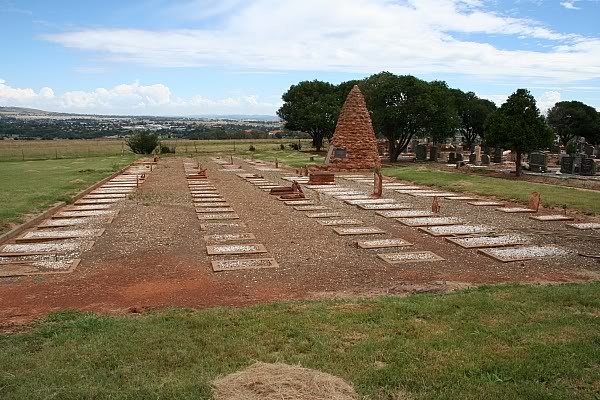
Children’s graves at the British concentration camp site in Heidelberg Photo: Boerevryheid
“This particular high school was founded just after the war, in a desperate attempt to save the Afrikaans language from being extirpated by the British administration. The fact that the school is today highly successful, displined and one of the top-performing schools in the province, is just too much to bear for Mrs. Creecy and pro-British genocidaires who are still nursing the Afrikaner hatred from hundred years ago.”
The mob was demanding that the century-old patriotic name of the school be changed to that of a local communist, Robert Nkosi. Another member of the South African Communist Party, Archie Mokonane of the South African Communist Party (SACP) told the crowd that the school was racist because it taught in Afrikaans.
“English is the language of proletarian internationalism, therefore all other languages are racist. Those people in Europe who teach in Dutch or German or French are racists too!”
Sipho Nhlengethwa, a local ANC councillor, said they would campaign for the school to be named after Obed Nkosi, a terrorist from Ratanda, the black township in the area. “This is our public school now, we have conquered the Boers,” said Nhlengethwa.
Regional leaders from the ANC, SA Communist Party, Cosatu and the Young Communist League handed over a memorandum of demands.
They want the school’s civilian governing body to be dissolved and replaced with a revolutionary communist council of “education workers”.
‘We will necklace them, we will burn them’
Young Red Guards chanting “we will necklace them, we will burn them”, referring to the Afrikaner pupils at Heidelberg Volkskool, disrupted and brought to a halt all education in the black township of Ratanda. School children were forced to participate in the protest, with both primary and high schools being deserted for the rest of the day. Bystanders put the number of marchers at 8 000. Teachers had told children that there would be no classes on Monday as “everybody had to march against the Afrikaner cockroaches”.
Volkskool was also accused of being racist because there were white players in the rugby team, with some members of the mob claiming that governmental race quotas for rugby only allowed one or two white players per team. “We want no whites in the team, it hurts our eyes to see whites,” said one.
A spokesman for the school blamed the inflamed racial tensions in the town on the provincial government’s failure to build an extra English-language high school, as promised in 1998. Cornelius Human, a member of the school’s governing body responsible for its legal affairs, said:
“What we found ourselves in was just a situation with wild allegations, with no substance – and we’re expected to act on them. It’s exactly the same situation that we have now.”
In hundred years, not much has changed in Heidelberg. The British concentration camp has gone, leaving a children’s graveyard like so many others in South Africa, but the hatred of Afrikaner children has stayed.
There was still a place in the country where blacks were called bantus, delegates, and homelanders, the ANC’s KwaZulu-Natal leader Senzo Mchunu said in Durban on Sunday.
“It is the same people in the Western Cape who call us refugees,” he told a rally marking the start of the party’s 2014 election campaign.
“They are calling us bantus. They refer to us as representatives. [They are] referring to us as delegates, referring to us as homelanders, natives,” he told thousands of African National Congress supporters at Princess Magogo Stadium in KwaMashu.
He warned supporters of people trying to secure votes in the Lindelani area of neighbouring Ntuzuma. Mchunu did not name the Democratic Alliance or Zille. On Saturday, DA leader Helen Zille visited the area. She said she saw no reason why the DA could win control of the eThekwini municipality in 2016.
Mchunu urged supporters to not to resort to violence.
“There is no need for comrades to engage in violent activities, whether it comes from a comrade or a non-comrade.”
He received a rousing welcome when he arrived at the stadium and walked around greeting supporters. A sea of yellow T-shirts emblazoned with a photograph of President Jacob Zuma swayed to the rhythm of the music blaring across the venue.
Mchunu said: “Peace, political tolerance and delivery will be a part of our campaign to deepen democracy in our country.”
He urged the youth to be patient and grab every opportunity that came their way.
“In the near future we are going to succeed to create job opportunities.”
The party faithful were urged to make sure the ANC would be ruled by the “green, black, and gold”, the ruling party’s colours.
He said the party had delivered infrastructure, from houses to roads and water, and had freed the country from apartheid.
Officers from both the police and the eThekwini metro police kept watch outside the stadium while ANC marshals ensured order inside the venue.
Several buses and minibus taxis were used to ferry supporters to the event. The rally was the first led by Mchunu since he was elected premier of the province on September 26. His predecessor Zweli Mkhize resigned as premier of KwaZulu-Natal to become the party’s full-time treasurer general. – Sapa
A meeting of the ANC’s biggest branch in the Western Cape erupted in chaos this weekend when some of its members attacked others with knobkieries and pangas.
Four of the party’s members were rushed to a nearby hospital with head and back injuries.
The branch in Ward 40 Gugulethu met on Saturday evening in a rush to meet the deadline of nominating who should represent the party in next year’s provincial and national elections. The branch has 1 496 members and is expected to send 19 delegates to the list conference.
This represents nearly four percent of the 480 delegates at the party’s provincial list conference on October 19. This is the branch in which former ANC councillor Andile Lili and Loyiso Nkohla have large support and which ANC MPL Mcebisi Skwatsha belongs to.
Skwatsha was at the national executive committee meeting in Johannesburg at the weekend.
Other ANC heavyweights from the branch are Parliament’s Deputy Speaker Nomaindia Mfeketo and former chief whip Tony Yengeni.
Dullah Omar regional secretary Vuyiso Tyhalisisu said it was dark when the attack took place at the Baptist Church Hall in Barcelona informal settlement, Gugulethu.
Some members were still busy with registration. The meeting did not quorate at that time,” he said.
Tyhalisisu said a group of 15 people on the back of a white bakkie stopped outside and walked to the hall.
“They had knobkieries and pangas and started attacking people. People ran in every direction,” Tyhalisisu said. “The meeting never started.”
He said some ANC members were identified among the group.
Tyhalisisu said four of its members suffered head and back injuries and were taken to the KTC Day Hospital.
“They were discharged after a few hours,” he said.
Tyhalisisu said the ANC’s regional executive council (REC) had received information that the group had been given alcohol at a nearby tavern before the meeting.
“It is a serious issue. Some of our members would be too scared in the future to come to meetings for fear this could happen to them,” he said.
He said the branch will call those members identified to a disciplinary hearing.
ANC provincial secretary Songezo Mjongile said the party’s provincial executive committee (PEC) met on Monday and discussed the attack. He condemned the attack and said the PEC will investigate.
Police spokesman Tembinkosi Kinana said police had been called to the church hall after the assault.
“The suspects who could not be identified at the time fled in a white bakkie.
“Police have opened a charge of intent to cause grievous bodily harm,” he said. – Cape Times
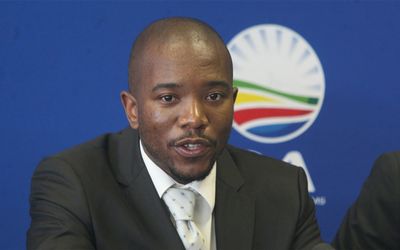
EFF leader Julius Malema was wrong to say that the ANC-led government is worse than the apartheid government, DA spokesman Mmusi Maimane said on Monday.
“You may have heard Julius Malema saying over the weekend that the ANC is worse than apartheid. It is wrong to create this impression among South Africans,” he said in a speech prepared for delivery.
“Apartheid was worse because it was a system of entrenched racism. Apartheid was worse because we couldn’t vote out apartheid. In fact, we couldn’t vote at all.”
The Economic Freedom Fighters’ leader said at the rally in Lethabong near Rustenburg, North West, on Saturday that black people would never own land under the African National Congress.
“Our struggle is about land. [Former president Nelson] Mandela was arrested for demanding land,” Malema said.
Maimane said “the sacrifice that so many made for our freedom” had to be remembered.
“Like so many others where I grew up, I used to be an ANC supporter. I believed that the ANC could bring about a better life for me and my family,” he said.
“Since then I have seen how that once proud movement has lost its way under the current leadership.”
He said apartheid was forced on the people against their will, while the ANC was “not compulsory”.
“The ANC is a political party in a democracy. We can vote for another party if we feel let down by the one in power.” – Sapa
This website uses cookies to improve your experience. We'll assume you're ok with this, but you can opt-out if you wish. Cookie settingsACCEPT
Privacy & Cookies Policy
Privacy Overview
This website uses cookies to improve your experience while you navigate through the website. Out of these cookies, the cookies that are categorized as necessary are stored on your browser as they are essential for the working of basic functionalities of the website. We also use third-party cookies that help us analyze and understand how you use this website. These cookies will be stored in your browser only with your consent. You also have the option to opt-out of these cookies. But opting out of some of these cookies may have an effect on your browsing experience.
Necessary cookies are absolutely essential for the website to function properly. This category only includes cookies that ensures basic functionalities and security features of the website. These cookies do not store any personal information.
Any cookies that may not be particularly necessary for the website to function and is used specifically to collect user personal data via analytics, ads, other embedded contents are termed as non-necessary cookies. It is mandatory to procure user consent prior to running these cookies on your website.