Russia ratifies $100 billion BRICS development bank

The Russian State Duma has ratified the $100 billion BRICS bank that’ll serve as a pool of money for infrastructure projects in Russia, Brazil, India, China and South Africa, and challenge the dominance of the Western-led World Bank and the IMF.

The New Development Bank is expected to start fully functioning by the end of 2015, according to the Russian Finance Ministry.

Russia has agreed to provide $2 billion dollars from the federal budget for the bank over the next seven years.

It will have three-tiers of corporate governance, with a Board of Governors, Board of Directors and a President.

The bank’s board of directors will hold its first meeting in Ufa in Russia in April. Russian Finance Minister Anton Siluanov is likely to become the bank’s first Chairman of the Board of Governors, according to Deputy Finance Minister Sergei Storchak talking on the Russia 24 TV channel.

The decision to establish the BRICS bank, along with a $100 billion reserve currency pool, was made in July 2014. Each of the five member countries is expected to allocate an equal share of the $50 billion startup capital that will be expanded to $100 billion.

The bank will be headquartered in Shanghai, India will serve as the first five-year rotating president, and the first Chairman of the Board of Directors will come from Brazil.

Source: RT

China shuts down obscene dating sites

China’s Internet regulator has shut 65 dating and other match-making websites after accusing them of spreading obscene content and allowing registration with false names, Xinhua state news agency said on Tuesday.

Sites closed included ones with names like “Get a one-night stand” and “Playing with you net”, Xinhua said, citing the Cyberspace Administration of China.

“These websites allowed the use of false identities at will to register … or spread obscene and lascivious content,” the report said. “The circumstances were serious and the effects terrible.”

State media said last week that the regulator would target fraud on dating websites and other online match-making sites.

China exercises tight control over the Internet, saying that it is needed to ensure social stability and morality and to protect consumers, brushing off concerns of censorship from rights groups.

Source: Reuters

Pope pivots to Asia

Pope Francis’ real interest is geopolitics.

In less than two years in office, Francis has nudged the conversation away from sex to such as matters as Cuba-U.S. relations and climate change. In September, he will become the first religious leader who serves as a head of state to address a joint session of Congress.

Pope John Paul II was single-minded in the pursuit of ending Communism in the 1980s, while Pope Benedict XVI was a gaffe-prone bookworm fretting over relativism.

Francis, in contrast, is making his own pivot towards Asia. He already has been twice to the region shunned by his predecessor with a view not only to refilling pews, but also gaining traction with the rising powers.

The challenge for Francis — who is from a religious order that proselytized in China in the 16th century — is how to work with China today. The Vatican and the world’s most populous country have been at odds since 1951 over, among many things, the right to ordain bishops.

Francis, who says he would go to Beijing tomorrow, has a secret corridor with the new leadership for diplomatic messages. There have been small gestures on both sides: Francis didn’t see the Dalai Lama in Rome; doing so would have incensed Chinese authorities. President Xi Jinping allowed Francis to fly in China’s airspace, the first time a pope was granted that right.

China has about 12 million Catholics — three times the number in Ireland — compared with a mere 300,000 in Taiwan.

The gap between the pope’s knowledge and effectiveness may be large. Francis has dived into tough international conflicts including Korea, Cuba and Palestine and not all has gone well.

While he brought attention to the plight of Palestinians by praying in Bethlehem near graffiti that read “Free Palestine,” his visit was followed by violence against the Palestinians.

He was much more successful with Cuba, secretly hosting delegations from there and the U.S. and playing a vital role in the prisoner exchanges that led to renewed relations after half a century.

He has announced plans to shrink the bureaucracy that runs the church, removed executives at the mismanaged Vatican Bank and told cardinals to abandon their limousines and catch the bus.

At the bank, he’s brought a measure of transparency following allegations of illegal behavior and poor oversight. The bank now publishes an annual report, has closed 2,000 accounts and undertaken a review of 18,000 clients.

Source: Bloomberg

Hawaiian independence attracts Chinese interest

China has suggested arming Hawaii’s independence activists in retaliation for U.S. arms sales to Taiwan and recently threatened to challenge American sovereignty by making legal claims to the Pacific islands as its territory.

Chinese threats to back several groups of Hawaiian independence activists who want to restore the islands’ constitutional monarchy, ousted in a U.S.-backed coup over a century ago, has raised concerns that military facilities on the strategic central Pacific archipelago are threatened at a time when the Obama administration is engaged in a major shift toward Asia as part of its military and diplomatic rebalance.

Michael Pillsbury, a Pentagon consultant and author of the recent book 100 Year Marathon, said Chinese military hawks, known as “ying pai,” told him they are ready to provide arms to Hawaiian independence activists in retaliation for U.S. arms sales to Taiwan.

“Beijing’s extraordinary sensitivity to American arms sales to Taiwan—even one bullet or a spare tire for a jeep—often provokes angry words,” said Pillsbury who has held talks with 35 Chinese generals in recent years.

“A favorite comparison the ying pai has made to me is ‘How would the Pentagon like it if we provide arms to our friends in Hawaiian independence movement?’” he said. “I was incredulous because I had never heard of such a movement in Hawaii, but, after checking I met a few of them.”

Pillsbury said Chinese backing for the independence movement would be a concern. Some U.S. archival material shows U.S. authorities acted on their own in the 1898 annexation, he said, something Congress later investigated.

Pillsbury’s book, published last week, reveals that Chinese hawks in the military and Communist Party are a key part of a 100-year strategy to vanquish and eventually overtake the United States as the world’s leading power in the coming decades.

Another indicator of Chinese interest in fomenting unrest in Hawaii surfaced in 2012, when then-Secretary of State Hillary Clinton revealed Beijing had threatened to assert legal, territorial claims over Hawaii.

Clinton said U.S. ownership of Hawaii came up during talks with the Chinese after she pushed back against Beijing’s destabilizing territorial activities in the South China Sea.

“At one point in one of my long discussions about this, one of my Chinese interlocutors said, ‘Well, we could claim Hawaii,’” she said. “I said, ‘Well, go ahead, and we’ll go to arbitration and prove we own it. That’s what we want you to do.’”

The Hawaii sovereignty movement is made up at least 10 groups that are seeking some form of independence from the United States and the re-establishment of the monarchy ousted in 1893, with the support of the U.S. government and a company of U.S. Marines.

The movement is non-violent and its protests in recent years have been limited to temporary takeovers of government facilities.

Source: freebeacon.com

China slams US weapons to Ukraine

China is against Washington’s plans to provide Ukraine with weapons, the country’s Foreign Ministry spokesperson Hua Chunying said on Monday.

“China calls for the political settlement of the crisis in Ukraine as this meets the interests of all the sides. People in eastern Ukraine now are more in need of peace rather than weapons,” the diplomat stressed, commenting on the US plans.

Beijing welcomes and supports the active mediation efforts, which have been recently taken by the parties to ease tensions in eastern Ukraine and resolve the crisis by political means, she said.

China urges all the sides to refrain from any actions that could lead to an increase in confrontation or affect the negotiation process, the Chinese Foreign Ministry’s spokesperson said.

“China will continue playing a constructive role in the political settlement of the crisis in Ukraine,” the diplomat said.

Last Sunday, the New York Times newspaper reported that the Unites States considered supplying arms to Ukrainian forces.

Source: Itar-TASS

China’s yuan joins top five curriencies

China’s yuan has become one of the five most widely used currencies in global payments, an international financial transactions agency announced Wednesday.

The yuan passed the Canadian and Australian dollars in popularity in December, according to the Society for Worldwide Interbank Financial Telecommunication, which provides communications between financial institutions and companies. It said the yuan now ranks behind the dollar, the euro, the British pound and Japanese yen.

The change is an “important milestone,” and confirms the yuan’s transition from an emerging to a “business as usual” currency, said Wim Raymaekers, Swift’s head of banking markets, in a statement.

Beijing has signed agreements with a number of foreign financial centers including London to become hubs for clearing yuan transactions.

The yuan, also known as the renminbi, accounted for 2.17 percent of global payments in December, behind the yen’s share of 2.69, according to Swift. The U.S. dollar’s share is about 45 percent.

Global payments in yuan increased by 20.3 percent in December, outpacing overall payments growth of 14.9 percent, according to Swift.

Source: AP

US a dangerous ally says former Oz premier

In his new book titled “Dangerous Allies,” Malcolm Fraser, the former prime minister of Australia worries that the Canberra’s dependence on the United States will eventually bring the nation into a direct conflict with China. His words echo those of Georgetown University professor Amitai Etzioni in and article he wrote for the Diplomat on Jan. 20.

Australia has always been strategically dependent on other great powers since gaining independence in 1901. It relied on the United Kingdom until World War II and then transfered that dependence to the United States afterwards. The relationship grew stronger with the signing of the Australia, New Zealand, United States Security Treaty in 1951. Fraser said that the treaty does not require the US to defend Australia, only needing to “consult” it in case of an attack.

In Fraser’s book, he describes how Australia’s blind faith in the UK before World War II left the country unprepared for war. He then goes on to say that currently many feel more vulnerable because of the country’s dependence on the United States. What Fraser and many Australian leaders fears most is that the United States will get Australia involved in a conflict not of its own making. “Australia effectively ceded to America the ability to decide when Australia goes to war,” said Fraser.

Fraser labelled the United States a “dangerous ally” as Australia has become progressively more enmeshed in American strategic and military affairs since the end of Cold War.

Just as with the armed conflicts in the Middle East, Fraser said that the conflict in Ukraine took place partially due to Washington’s attempt to include Ukraine in NATO. He went on to blame the United States lack of historical understanding towards Russia on the matter.

Washington’s policy to “contain” China can eventually lead to trouble for Australia. Believing that the United States will eventually use Australia as a base to attack China, Fraser suggested the removal of all American military facilities from Darwin in the north and Pine Gap in the center of the country as soon as possible. The former Australian leader added that the country should be more independent of the United States in both defense and foreign affairs. While recommending that Australia shore up its diplomatic activities throughout Asia and at the UN, he also suggested an increase in defense spending to 3% of the country’s GDP.

Source: China Times

Soviet-style reactors struggling with US nuclear fuel

Ukrainian energy sector workers are facing technical problems with American nuclear fuel loading into the Soviet-type reactors

China is ready to sell fuel for nuclear power plants in Ukraine and Eastern Europe, a China National Nuclear Corporation (CNNC) source told TASS on Friday on the sidelines of the World Nuclear Spotlight forum.

According to the source, Chinese companies intend to sell the fuel to the countries that operate various types of Soviet-and Russian-made NPPs. Aside from Ukraine, China is viewing the possibility of exporting nuclear fuel to Hungary and Romania.

The source said Ukrainian energy sector workers are facing technical problems with American nuclear fuel loading into the Soviet-type reactors.

At the moment China is actively buying uranium mines with a view to exporting uranium to other countries in the foreseeable future.

Asked about Russia’s possible claims to the Chinese manufacturers of nuclear fuel, he said that “there are no special restrictions.” “Despite the related agreements, the Russian side is unlikely to stop the supplies,” said the CNNC representative.

Russia and China have been actively developing co-operation in the nuclear sphere for many years. For example, State Atomic Energy Corporation Rosatom and CNNC signed a protocol to launch the discussion of possible formats of co-operation in the sphere of construction of nuclear power plants in third countries.

China implements significant policy shift

China has understood Washington’s geopolitical game.

The year 2015 might thus be one of the most decisive and interesting in modern history with China implementing a policy decision that will transform the world over the next decade.

On November 29, 2014, a little-noted but highly significant meeting took place in Beijing. Xi Jinping, Chinese President and Chairman of the Central Military Commission, delivered what was called “An Important Address”.

The official Foreign Ministry statement on the meeting confirms it was indeed “important.” The powerful central leadership has announced an official a strategic global shift in Chinese foreign policy.

China has defined Russia, as well as the BRICS economies, including Africa, as the future and has ceased calling itself a developing country.

In his address to the meeting, President Xi highlighted a sub-category of developing countries beyond the Great Powers, namely: “Major Developing Powers (kuoda fazhanzhong de guojia). China will “expand cooperation and closely integrate our country’s development” with the designated Major Developing Powers, Xi declared.

According to Chinese intellectuals, these are countries who “support reform of the international order”.

It includes Russia, Brazil, South Africa, India, Indonesia, and Mexico, that is, China’s BRICS partners, as well as Indonesia and Mexico.

China believes in an Asian “community of shared destiny” too, implying closer economic and diplomatic ties with South Korea, Japan, India, Indonesia, even Vietnam and the Philippines.

China has furthermore declared a freeze in China-UK diplomatic relations following a meeting by the Cameron government with the Dalai Lama.

China recently signed not one, but several gigantic energy deals with Russian state companies Gazprom and Rozneft, allowing Russia to offset the growing threat to her west European energy exports, a life-and-death issue for the Russian economy.

Russia will deliver 40% of China’s natural gas and explore new areas of cooperation between Russian Armed Forces and the Chinese PLA.


North Korea accepts Russian invitation to Victory Day Parade

Russia has invited North Korean leader Kim Jong Un to attend a May ceremony marking the end of World War II, in what would be Kim’s first foreign visit since taking the helm of the reclusive state in 2011, Japan’s Asahi Shimbun daily said Wednesday.

Kim would probably meet Russian President Vladimir Putin, as North Korea backs Russia in the Ukraine crisis and Moscow needs Pyongyang’s cooperation in boosting natural gas exports to South Korea, the newspaper said, quoting unnamed diplomatic sources.

It was unclear whether Kim would accept the invitation, the Asahi said.

But the North Korean leader accepted an invitation to visit Moscow, South Korea’s Yonhap news agency reported on Tuesday.

“North Korea is seeking to deepen both diplomatic and economic ties with Russia at a time when its political relationship with China remains chilly,” the agency said.

North Korea is seeking closer ties with Russia as it faces international criticism over accusations of human rights abuses and its nuclear program.

Putin held talks with Kim’s personal envoy last month and called for deeper ties with North Korea to improve regional security.

Russian Foreign Minister Sergei Lavrov has said North Korea was ready to resume stalled international talks on its nuclear program.

North Korea, South Korea, Japan, China, Russia and the United States began talks in 2003 to rid the Korean Peninsula of nuclear weapons, but they were suspended after Pyongyang tested nuclear devices in 2006 and 2009.

US President Barack Obama is not going to visit Russia any time soon, Mark Stroh, the National Security Council spokesman told the Sputnik news agency on Monday.

“At this time, the President has no plans to travel to Russia in the near future,” Stroh said.

Brazil and Russia may exit BRICS warns phrasemaker

Brazil and Russia’s membership of the BRICs may expire by the end of this decade if they fail to revive their flagging economies, according to Jim O’Neill, the former Goldman Sachs Group Inc. chief economist who coined the acronym.

Asked if he would still group Brazil, Russia, India and China together as emerging market powerhouses as he did in 2001, O’Neill said in an e-mail “I might be tempted to call it just ’IC’ or if the next three years are the same as the last for Brazil and Russia I might in 2019!!”

The BRIC grouping will be dragged down by a 1.8 percent contraction in Russia and less than 1 percent expansion in Brazil, according to the median estimate of economists surveyed by Bloomberg News. China is seen growing 7 percent and India 5.5 percent.

The BRICs were still booming as recently as 2007 with Russia expanding 8.5 percent and Brazil in excess of 6 percent that year. The bull market in commodities that helped propel growth in those nations has since ended, while Russia has been battered by sanctions linked to the crisis in Ukraine and Brazil has grappled with an unprecedented corruption scandal involving its state-owned oil company.

“It is tough for the BRIC countries to all repeat their remarkable growth rates” of the first decade of this century, said O’Neill, a Bloomberg View columnist and former chairman of Goldman Sachs Asset Management International. (GSGEPPA) “There was a lot of very powerful and fortuitous forces taking place, some of which have now gone.”

The growth slump this year isn’t a new normal though and O’Neill sees expansion in Brazil and Russia partially recovering, helping the BRICs average about 6 percent growth per annum this decade — still more than double the average for the Group of Seven nations.

Their share of global gross domestic product will “rise sharply,” he said.

O’Neill had previously estimated average annual growth of 6.6 percent for the BRICs this decade, a pace it was close to achieving through last year mainly because China exceeded the 7.5 percent annual average growth he estimated for the first three years, he said.

Unlike Brazil and Russia, China is embracing economic change while India, after the election of Narendra Modi as prime minister and benefiting from low oil prices and a young labor pool, may have brighter prospects this decade than last, O’Neill said.

With China and India spurring growth, the BRICs will remain the most dominant and positive force in the world economy “easily,” said O’Neill.

China growing at 7 percent will add about $1 trillion nominally to global output every year, O’Neill said. When measured by purchasing power parity, China’s growth adds twice as much as the U.S.’s, he said. India expanding at 6 percent will add twice as much as the U.K. in those terms, he said.

Source: Bloomberg

China starts payments with Russia in national currencies

China will start swaps and forwards between the yuan and the national currencies of Russia, Malaysia and New Zealand on December 29, the China Foreign Exchange Trade System (CFETS) reported Friday.

Earlier in December, China’s Minister of Commerce Gao Hucheng claimed that China could increase the usage of yuan in trade with Russia amid the ruble’s depreciation, which falls in line with China’s intention to increase the usage of national currencies in international payments in order to weaken the US dollar’s dominance in global finance and promote the yuan as an alternative.

In October, the Russian Central Bank and the People’s Bank of China reached a three-year agreement on currency swaps worth 150 billion yuan (over $24 billion).

Both the Russian and the Chinese leaders have repeatedly praised the decision, saying it would bring positive effects for the countries’ economies and currencies.

The main benefits of mutual payments in national currencies are the absence of charges for the conversion of the currencies, direct payments and higher transparency in relations between the banks.

Copyright © 2014 Sputnik News

Fracking, climate change, solar in the security mix

The global oil market is going through an upheaval, with non-OPEC production led by North American producers surging while OPEC’s traditional price-setting role changes. First, US oil production and proven oil reserve growth over the past several years is astonishing. Despite the current oil price decline, US oil production growth in 2015 is expected to grow around 1 million barrels per day. However, those growth rates probably won’t be sustained over the long term.

Second, if you look at the world’s largest oil reserve holders and countries that have reserve-to-production ratios in excess of 100 years, they are almost exclusively OPEC members. The cartel’s market influence has diminished in the face of robust non-OPEC production, but the group’s power is likely to endure over the long term purely due to the sheer volume of oil its members collectively control.

The Saudis will remain the de facto leaders of OPEC until another country can build comparable spare production capacity, which in the Saudis case is currently around 2 mmb/d. Saudi Arabia has 266 billion barrels of proven high-quality, cheap-to-produce oil reserves. The US, in contrast, boasts only 44.2 billion barrels of mostly expensive-to-produce oil reserves. Technology is a wild card that has the potential to unlock additional petroleum resources and reduce production costs, but it would be a mistake to discount Saudi Arabia’s power as an oil country, particularly over the long term.

That means, of course, that the Bahrain-based Fifth Fleet will remain a key asset. Add the Iranian nuclear talks, the predations of the Islamic State of Iraq and the Levant (ISIL), and the simmering tensions between Israel and its neighbors to the oil that flow through the Strait of Hormuz and there seems little doubt we will keep substantial naval, air and expeditionary forces in the area for the foreseeable future.
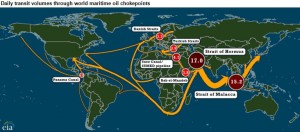
Oil-sea-routes-map

But these shifting energy markets raises larger strategic questions.

Colin spoke with one of the wisest analysts about the energy sector and its national security implications, Tony Cordesman of the Center for Strategic and International Studies. A former senior Pentagon and NATO official, Cordesman also served as director of policy and planning for resource applications at the Department of Energy. He doesn’t foresee any immediate major strategic shifts created by the energy market changes. At the same time, he acknowledges that major technological and market shifts have usually gone unnoticed until they hit us in the face.

Cordesman points to the solar and nuclear markets, where we have all been expecting or hoping for major technological breakthroughs “since the Nixon administration.” Then he notes that, in the oil market, “no one predicted that the most critical technological breakthrough would prove to be fracking.” Can we expect a breakthrough in the solar, nuclear or biofuel arenas? “It may take 25 to 50 years or it will happen almost without warning,” he predicts.

The current situation in the alternative energy world: We’re seeing the strong growth of renewable energy, albeit from a low base. The growth rate of installed US solar power capacity has been impressive, but that growth rate has slipped in the past few years as the technology has gained market share. “U.S. solar power capacity would need to grow at an annual rate of 22 percent in order for solar to provide 10 percent of the nation’s electricity in 2030, from less than 1 percent now,” Breaking Energy recently reported.

Wind and solar are used to generate electricity but coal will remain a significant source of US power generation for decades, although its market share looks likely to decline — for environmental reasons. The renewable energy story is important, and while it is changing the way utilities do business, wind and solar are only beginning to compete with fossil fuels on price. In most cases, their competitiveness is a result of tax incentives often referred to as subsidies. Also, the intermittent nature of these resources is a technical challenge that must be overcome in order to efficiently integrate large volumes of wind and solar energy into the power grid during times of peak demand. Creative financing and technological advances – particularly in energy storage – will help renewable electricity sources compete over time, but coal and natural gas will remain significant components of the US power generation mix for the foreseeable future.

At the international level, the issue of burning coal to generate power is far more complex. It is cheap and represents a comparatively cost-effective way to electrify large portions of the global population that currently have no access to power. Indeed, nine countries are collectively about to build roughly 550 gigawatts of new coal-fired capacity over the next two and a half decades.

And Then, Climate Change

In many ways, reducing emissions from coal-fired power generation is the key to dealing with climate change. China has been acting to address coal plant emissions due to its dangerous air pollution levels, which is an important piece of the climate change puzzle.

This poses a great conundrum for China. The Communist Party’s leaders are trying to forge a China united between rural and urban areas and that requires huge and fast economic development — much of it dependent on the use of cheap and readily available coal. Weaning themselves off of coal may be promising in terms of reducing emissions, but Cordesman says they are unlikely to be able to accept the economic tradeoffs.

For the same reasons, many other developing countries including India, Bangladesh and Pakistan are increasing their coal-fired power generation fleets.

Some think the ship has already sailed on preventing the impacts of climate change and now focus on adapting to extreme weather and other consequences as opposed to mitigating emissions such that they limit global temperatures from increasing more than 2 degrees Celsius.

Optimists remain however, and international agreements are not the only thing to focus on when thinking about what the world is doing to address the issue. “At every level—individuals, families, cities, states, provinces, even multinational corporations—efforts to cut CO2 are underway,” David Biello, associate editor for environment and energy at Scientific American, wrote in a recent post. He goes on to point out, “these are first steps and they are coming at a quickening pace, which suggest a possible future free of catastrophic climate change. More and faster should be the new slogan for action to address global warming. How much more and how much faster should be the only issue for negotiation.”

Chinese blogger predicted AirAsia’s disappearance

A mysterious Chinese blogger has provoked a storm of speculation online over claims he predicted the disappearance of an AirAsia flight thirteen days before one vanished.

In a series of posts which have gone viral, the man appears to warn that the airline would be targeted by a shadowy group he calls the ‘Black Hand’ which he claims brought down Malaysian Airlines flights MH17 and MH370 earlier this year.

An AirAsia flight went missing with 162 people on board after losing contact en route from Surabaya in Indonesia to Singapore in the third crisis for a Malaysian carrier this year.

Since its disappearance, social media users have reacted with astonishment at the apparent prediction, while others claim the posts were probably just edited afterwards to make it look authentic.

In one comment on December 15, which has been loosely translated by a Reddit member, the blogger apparently warns: ‘Black hand has hijacked and shot down MH370 and MH17.

‘This has pretty much killed the sixth largest airline: Malaysian airline.
‘Now the black hand are targeting AirAsia to ruin this airline cause (sic) it too belong to Malaysia.

‘Given how powerful the black hand are I suggest that all Chinese thinking about travelling to avoid AirAisa, so that you don’t disappear like those on MH370.’

Since the disappearance of Flight 8051, many have reacted with astonishment at the apparent prediction, with speculation rife that he was a Chinese intelligence official or a hacker who had obtained information from the group allegedly responsible.

Source: Daily Mail