Protests errupt in Zuurbekom

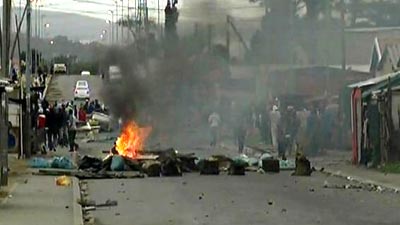
zuurbekomProtests erupted in Zuurbekom, between Lenasia and Protea, in Johannesburg on Wednesday morning, said metro police.

Chief Superintendent Wayne Minnaar said protesters were burning tyres and had obstructed Impala road and the N12.

“This will affect traffic going to and from Westonaria and the Protea area,” said Minnaar.

He advised motorists to use alternative routes.

It was unclear what the protests were about. – Sapa

Excessive violence ‘baffles’ SA researchers

Prof Zinn
Prof Zinn

Professor Rudolph Zinn, a professor in policing and forensic investigations at Unisa, said the continuous use of excessive violence in robberies was something that continued to leave many South African researchers baffled.

Zinn said while many prisoners he has interviewed had stated that they usually resorted to violence to force their victims to comply during robberies, the extreme torture and violence are cause for concern.

He also said alcohol and drugs could not be blamed as most prisoners had said that when they went to commit a crime, they preferred to be sober so that they didn’t do anything that might result in them leaving evidence behind.

“They say… that it is very important to do that in such a short period of time so as not to get caught. However, that still does not explain the type of violence accompanying this crime.” – IOL

Showdown looms at Water Sisulu University

walter-sisulu-universityA show down is looming between management of the Water Sisulu University and students in the Eastern Cape as the 12 o’clock deadline to vacate the premises nears.

The university says the move to vacate the residences is for the safety of students but they have threatened to resist it on the grounds that management must address the workers’ demands.

Staff are on strike demanding a salary increase of 8% while the university is offering 4.25%.

Students’ spokesperson, Lusanda Thutha says they will resist any attempt to vacate them legally or otherwise. “We are not going anywhere. It cannot be good that we have been told through Facebook that we have to leave and vacate the premises because we know that we never applied through Facebook,” says Thutha.

She says that every decision that has to be taken about students has to involve the leadership of the students. Meanwhile, the university’s spokesperson Angela Church says that students have started to go home.

Church, has warned against resistance. “We issued the notice on Tuesday that they must vacate the residences. We did extend the deadline to Friday August 30. We need our students to vacate the residences for their own safety and security as the situation around the WSU campuses is very volatile. Some of our students have been injured in skirmishes with police and we cannot put them at risk any further,” she says.

“We will assess the situation after  5 o’clock on Friday,” Church added.

Armed robbers shoot two, hijack pair

crime-gunA gang of armed robbers hit the Oriental City market in Bruma on Wednesday morning, firing shots and wounding two shop owners who were rushed to hospital.

The thieves made off with an undisclosed sum of money.


Shortly after 9am a gang of 12 robbers stormed a shop in the flea market. They ordered the shop owners – two brothers – to hand over all their money.


According to police spokesman Constable Thabo Malatji, the robbers shot the shopowners and fled in a white Mercedes-Benz Vito.

“As they drove out, they collided against a silver BMW. They jumped out of the Vito and hijacked two vehicles, a white Toyota Avanza and a silver Peugeot,” Malatji said. – The Star

Unrest closes Walter Sisulu University indefinitely

Walter Sisulu University

Students have been told to vacate the Walter Sisulu University, in the Eastern Cape, because of labour trouble, administrator Lourens van Staden said on Tuesday.

“The volatile situation that is unfolding has made it impossible for management to risk or to guarantee the safety and well-being of our students and the communities in which they live,” he said in a statement.

“We therefore regret to announce that all students are to vacate university premises, university residences and university rented accommodation with immediate effect.”

He said the labour deadlock had dragged on for five weeks.

“The response to the offer made by management to staff last week has not been sufficiently conclusive to enable classes to resume,” Van Staden said.

“The university does not want to keep students waiting on campus indefinitely.”

Van Staden said management would continue seeking ways to resolve the dispute.

“The decision to send students home does not mean that the academic year is lost,” he said.

“All efforts will be made to put alternative arrangements in place in order to complete this second semester.” Sapa

More suicides in SA than USA, UK

depressedThe South African Depression and Anxiety Group (SADAG) says South Africa has an extremely high suicide rate that needs to be addressed urgently.

According to SADAG, 23 people commit suicide every day countrywide and a further 230 attempt to.

That is more suicides than America and the UK.

SADAG spokesperson Cassey Chambers says the fact that one in every five South Africans suffer from a mental illness could be one of the major contributors to this problem.

She says different factors contribute to the country’s high suicide rate.

“We’ve got so many external stresses and triggers. We are exposed to so much trauma, crime and violence. We also see a breakdown of the family unit, so there’s more separation, divorce and abuse.”

Chambers says the issue could be addressed with more recourses and access to help.

“We run the country’s only suicide crisis line. We get about 400 calls a day of people looking for help. That number of 400 calls per day has increased over the last two years.” – EWN

Army determined to crush Egypt’s Brotherhood

sinaibusMilitants killed 25 policemen on Monday in the deadliest attack of its kind in years, as Egypt’s army-installed rulers escalated a campaign to crush ousted president Mohamed Morsi’s Muslim Brotherhood.

The assailants fired rocket-propelled grenades at two buses carrying police in the Sinai Peninsula, security sources said, just hours after 37 Brotherhood prisoners died in police custody.

The bloodshed came after Egypt’s military chief vowed a “forceful” response to violence roiling the Arab world’s most populous nation.

Judicial sources said new accusations of inciting the deaths of protesters had been levelled against Morsi, who has been held in a secret location since the military deposed him on July 3.

Meanwhile, Former president Hosni Mubarak won conditional release  in the third of four cases against him, but remained in detention on the fourth, judicial sources added.

The Sinai attack raised fears of a return to the wave of deadly Islamist violence that swept the country in the 1990’s.

Egypt is struggling to put a lid on a deep political crisis and violence that has killed almost 900 people in days of clashes between Islamist protesters and security forces across the country.

Western states have condemned the violence and are threatening to cut off billions of dollars in aid, though Saudi Arabia said Monday that Arab nations would step in to fill any gap.

Morsi loyalists vowed new demonstrations on Monday, although a day earlier they had cancelled some marches citing security
concerns.

The interior ministry said 25 policeman were killed and two injured in the Sinai attack, which it blamed on “armed terrorist groups”.

A border official said afterwards that the Rafah crossing with the Palestinian Gaza Strip, near where the attack occurred, would be closed.

Security sources said another policemen was killed in the northern city of El-Arish, bringing to at least 75 the number of security force members killed in the Sinai since the army toppled Morsi.

The security situation in the Sinai has deteriorated sharply in the past weeks, with near daily attacks by militants targeting police and military installations.

Elsewhere, bloodshed sparked by the August 14 security force crackdown on pro-Morsi protest camps in Cairo showed little sign of abating.

Authorities said 37 Islamist detainees died after police fired tear gas in a bid to free an officer taken hostage by prisoners, as the inmates were being transferred to a north Cairo jail.

However, the Brotherhood, the once-banned movement from which Morsi hailed, held the police accountable, accusing them of “murder”. They said the incident affirmed “the intentional violence aimed at opponents of the coup, and the cold-blooded killing of which they are targets”. – Sapa

Saudi will bankroll Egypt after crackdown sees Western aid withdrawn

Minister al-Faisal
Saudi Foreign Minister al-Faisal

Saudi Foreign Minister Prince Saud al-Faisal on Monday pledged to fill any financial gaps left by Western countries withdrawing aid from Egypt over its crackdown on Muslim Brotherhood protesters that has left hundreds dead since last week.

“To those who had declared they are stopping aid to Egypt or are waving such a threat, the Arab and Muslim nations are wealthy with their people and resources and will not shy away from offering a helping hand to Egypt,” he told state news agency SPA.

Meanwhile, Egypt’s public prosecutor ordered on Monday the detention of deposed President Mohamed Morsi for 15 days pending an investigation into allegations he participated in “violent acts”, state news agency MENA said.

On Thursday, Egyptian judicial authorities extended Mursi’s detention period for 30 days in a separate case.

Morsi, who was overthrown by the army on July 3, is being held at an undisclosed location on allegations of murder and spying. The new case centres on protests that took place in front of the presidential palace last December, MENA said. – Reuters

Egypt military issues warning to ‘biased’ Western journalists

pressegyptThe Egyptian government isn’t very happy with the way in which foreign journalists are covering the military crackdown on pro-Morsi protesters in the country, a conflict that has left over 800 people dead and thousands injured in just a few days. The State Information Service sent a notice to foreign correspondents in the country on Saturday claiming that “that some media coverage has steered away from objectivity and neutrality,” adding that “Egypt is feeling severe bitterness towards some Western media coverage that is biased to the Muslim Brotherhood.”

The memo lays out a number of points on which the Egyptian government would like to see a change in rhetoric:

Despite an escalation by the Muslim Brotherhood and supporters of the ousted president, police men, in cooperation with the Armed Forces men and through popular assistance, managed to carry out all missions assigned to them and were able to control the security situation in face of the terrorist attempts by the Muslim Brotherhood to fling the country into violence.

The implicit warning is just the latest of many signs of a disconnect between the interpretation of the last month or so by many Egyptians — where more or less the Islamist factions of the country stand against the military, who are supported by moderates, Christians, and secularists — and by the international community. As President Obama feels pressure to call the military overthrow of a democratically-elected (but deeply unpopular) president in Egypt a ‘coup’ as the violence continues in Egypt, those loyal to the military have long believed that the west is too sympathetic towards the Muslim Brotherhood. And now, it looks like that sentiment is being released on many of the journalists there to cover it.

During the past few days, the Committee to Project Journalists marked the milestone of 1,000 journalists killed since 1992, after multiple journalist deaths in Egypt. And a growing number of western correspondents, along with Egyptian correspondents and organizations not seen as loyal to the interim government, have been attacked while doing their jobs in Egypt, often by what appear to be vigilante-style crowds loyal to the Egyptian military (although there have been reports of violence against journalists instigated by both sides). Today, the army had to step in and rescue two journalists (Matt Bradley of the Wall Street Journal and Alastair Beach from UK Independent) from such a crowd at a Cairo mosque, as the military and pro-Morsi supporters exchanged gunfire. On Friday, journalist Jared Malsin, reporting for Time, was caught in an anti-Morsi crowd on the 15 May Bridge in Cairo. Malsin, an experienced reporter who speaks Arabic, described his confrontation with a pro-military vigilante group while trying to leave the bridge:

A man grabbed me by the arm, then a whole group seized me. Within seconds I was lifted off the ground while a whole crowd of men ripped my camera from my hands and my medical kit from the strap on my thigh. One man slapped me across the face, knocking my glasses to the pavement.
Somehow, cooler heads prevailed. More men joined the group, pulling me out of the crowd and returning my glasses and medical kit. Cliff had managed to secure the camera but two of his own had been stolen.
Speaking to the Atlantic Wire, Malsin said that after this experience “it became vividly clear to me that dynamics of street protests in Egypt have changed. The level of violence is more lethal.” He added, “The rules that applied six months ago don’t apply anymore.”

Another example: the Guardian’s correspondent, Patrick Kingsley, was roughed up and delivered to police by a group of teenagers.

Others have been confronted:

Obviously, dangerous conditions on the ground for journalists are translating to dangerous conditions for everyone. Democracy Now’s Sharif Kouddous explained as much to ABC News on Saturday, saying “It’s a dangerous situation for any citizen or any person to be out here. It’s always more difficult if you have a camera, you’re a target.” – theatlanticwire.com

EU warns Egypt it ‘will review ties’

eulawmakersEuropean Union leaders Herman Van Rompuy and Jose Manuel Barroso warned Egypt’s army and interim government Sunday the bloc would review its ties with the country unless the violence ended.

Further escalation could have “unpredictable consequences” for Egypt and its neighbours, the presidents of the European Council and European Commission said.

“This path will not succeed. It is crucial that violence ends immediately,” they said.

The 28-nation bloc would continue efforts to promote an end to violence, resumption of political dialogue, and return to a democratic process, the statement added.

“To this effect, together with its member states, the EU will urgently review in the coming days its relations with Egypt and adopt measures aimed at pursuing these goals.”

Senior diplomats from the 28 EU nations will Monday hold emergency talks on Egypt in Brussels in which they are expected to call for a snap meeting of foreign ministers within the next days.

The EU has pledged nearly five billion euros in loans and grants for Egypt for 2012-2013 and said shortly after the July 3 ouster of president Mohamed Morsi that aid provisions would be “under constant review” as the situation evolved.

“While all should exert maximum restraint, we underline the particular responsibility of the interim authorities and of the army in bringing clashes to a halt,” Van Rompuy and Barroso said.

“The calls for democracy and fundamental freedoms from the Egyptian population cannot be disregarded, much less washed away in blood.”

They regretted that international efforts and proposals for building bridges were set aside and confrontation chosen instead, and said there was no alternative to dialogue.

“All the Egyptian political forces must recommit to the country’s democratic future and engage in a political process leading to the early holding of elections and the establishment of a civilian government,” they said.

“The violence and the killings of these last days cannot be justified nor condoned. Human rights must be respected and upheld. Political prisoners should be released.”

The leaders of Germany and France, President Francois Hollande and Chancellor Angela Merkel, last week raised the spectre of the EU rethinking its cooperation with Egyptian authorities and called for a swift meeting of the bloc’s foreign ministers.

The next scheduled meeting of EU foreign ministers is in the Lithuanian capital, Vilnius, on September 6 and 7. – AFP

Who’s killing whom? Speak up, Bill O’Reilly!

mercer_ilanaby Ilana Mercer

[followbutton username=’IlanaMercer’ count=’true’ lang=’en’ theme=’light’]

Like Ilana Mercer’s Facebook page

Beggars can’t be choosers. Those who’ve never hesitated to tell the truth about the hue of hatred in America are elated. Someone more powerful has stepped up to help do the work so few will do.

In 2010, Bill O’Reilly became the first member of mainstream media to briefly broach a taboo topic: the color of crime in the US. In his July 13th “Talking Points” memo, the famous talker alluded to rates at which blacks commit violent crime proportionate to their numbers in society.

Then as now, Mr. O’Reilly came straight out andsaidthis:

“African-Americans make up 13 percent of the population, but according to the Justice Department, they comprise 39 percent of violent crime convictions. Thirty-six percent of all murders in America are committed by African-Americans, and 90 percent of black homicide victims are killed by other blacks.”

The Bureau of Justice’s statisticians confirm the long-standing trends to which Mr. O’Reilly alluded. The report,“Homicide Trends in the United States, 1980-2008, “states: “Blacks were disproportionately represented as both homicide victims and offenders,” and were eight times more likely to murder than whites.

Everyone is, however, tripping over one another to show-off their admiration for Bill O’Reilly. That’s premature.

So elatedare the truth-tellersthat some have even missed that Bill and the blond brigade of Fox News—in the person of Kirsten Powers and others—are beating on breast about “intraracial” crime-patterns only. Or black-on-black crime. In so doing, these comfort-zone commentators deflect from the white-hot issue of black-on-white violence. You see, blacks are also more likely to murder whites than the reverse. This likelihood is a trend which O’Reilly and the gang are submerging by emphasizing only the “intraracial” nature of most murders.

They are in “good” company. The Bureau of Justice Statistics does the same—and worse: It often inflates white violent crime by conflating whites with Hispanics.
Into the Cannibal's Pot

Thus while 84 percent of white victims were killed by whites, and 93 percent of black victims were killed by blacks; a hell of a lot of whites are killed by blacks, while few blacks are offed by whites.

As regards“stranger homicide,”blacks murder whites four times more often than whites murder blacks. Put differently, black-on-white murders constituted 20 percent of the known sample of “stranger homicides.” White-on-black murders constituted 5 percent of the same sample. (Given the direction of the aggression, one wonders whether some in the white cohort were not engaged in self-defense.)

When, then, will Bill O’Reilly and the simple-minded Ms. Powers pipe-up about interracial violent—”the ugliest form of racism in America,” in Pat Buchanan’s always-candid assessment?”

After researching the FBI numbers for ‘Suicide of a Superpower,'”Mr. Buchanan concluded: “An analysis of ‘single offender victimization figures’ from the FBI for 2007 finds blacks committed 433,934 crimes against whites, eight times the 55,685 whites committed against blacks. Interracial rape is almost exclusively black on white – with 14,000 assaults on white women by African Americans in 2007. … Though blacks are outnumbered 5-to-1 in the population by whites, they commit eight times as many crimes against whites as the reverse. By those 2007 numbers, a black male was 40 times as likely to assault a white person as the reverse.”

In “Into the Cannibal’s Pot: Lessons for America from Post-Apartheid South Africa,” this writer went back to the 2005 Bureau of Justice’s Statistics of “Homicide trends in the U.S.” Despite blacks comprising a mere 12.3 percent of the population, to whites’ 75.1 percent, in 2005, there were 10,285 black murderers to 8,350 white murderers. The crime of rape is most certainly anything but “intraracial.” As the BJS’s 2005 “Criminal Victimization Statistical Tables” reveal, blacks, at 12.3 percent of the population, were responsible for 36 percent of the 111,490 incidents in which whites were raped. And blacks committed 100 percent of the 36,620 incidents in which blacks were raped.

The legendary miscegenation of the much-maligned white male: could that too be a myth? Not one black woman or man—0.0 percent—was ravished by a Caucasian.

These unidirectional victimization patterns endure behind bars, seconds Human Rights Watch. “White inmates are disproportionately targeted for abuse.” A report titled “No Escape: Male Rape in U.S. Prisons” found that, “Inter-racial sexual abuse is common only to the extent that it involves white non-Hispanic prisoners being abused by African Americans or Hispanics.” “A form of revenge for white dominance of blacks in outside society” is how Human Rights Watch dignified the sexual subjugation of white by black inmates.

To counter evidence of the color of crime, America’s own self-styled anti-racism activists will typically claim that whites make up most of the population and are therefore natural targets for crimes. The probability of a black encountering a white is simply many times the reverse, their argument goes. However, interracial encounter rates do not account for the sheer hatred manifested in the appalling attacks on vulnerable white Americans. Interracial encounter rates fail to explain away what was done to the white American couple from Knoxville, Tenn., in 2007. Or to the four whites from Wichita, Kans., who were slain by blacks in 2000.

It is the “deep and dark reality buried in the hearts of the individuals who butchered twenty-one-year-old Channon Christian and twenty-three-year-old Hugh Christopher Newsom in Knoxville,” to which “American jurists and journalists, politicians and pundits are oblivious, for the most.” Or so I contended in“Into the Cannibal’s Pot.”

“Five blacks—four men and a woman—anally raped Hugh, then shot him to death, wrapped his body in bedding, soaked it in gasoline and set it alight. He was the lucky one. Channon, his fair and fragile-looking friend, was repeatedly gang raped by the four men—vaginally, anally and orally. Before she died, her murderers poured a household cleaner down her throat, in an effort to cleanse away DNA. She was left to die, either from the bleeding caused ‘by the tearing,’ or from asphyxiation. Knoxville officials would not say. She was then stuffed in a garbage can like trash.”

White trash.

Similarly, probabilities belie the stalking and savaging, in 2008, of a Columbia University student at the hands of Robert Williams; he black, she white. Her nineteen-hour ordeal ended with Williams setting the twenty-three-year-old student on fire. It began with Williams raping the girl orally, vaginally, and anally, pouring bleach in her eyes, boiling water on her body, slicing her face and slitting her eyelids with a carving knife.

The telltales of racial hatred were seared into the mangled white bodies of these victims andmany more like them. This the swirl of statistics conceals.

In the context of black-on-black violence, the self-celebrating media—Mr. O’Reilly and the parade of T & A that goes for commentary on cable—are currently breathing fire over the black family’s demise. To get my attention, they’ll have to get as fired-up about the white-hot hatred behind black-on-white menace and murder.

[followbutton username=’IlanaMercer’ count=’true’ lang=’en’ theme=’light’]

Like Ilana Mercer’s Facebook page

©2013 By ILANA MERCER

For syndication rights to http://BarelyABlog.com or http://IlanaMercer.com, contact ilana@ilanamercer.com. Read more.

Egypt declares State of Emergency

egyptsoeEgypt declared a month-long state of emergency on Wednesday as violence raged across the country following a crackdown on supporters of ousted president Mohamed Morsi.

The nationwide state of emergency, announced by a presidency statement read out on state television, began at 4pm (2pm GMT).

The exceptional measures came as “the security and order of the nation face danger due to deliberate sabotage, and attacks on public and private buildings and the loss of life by extremist groups,” the presidency said.

Interim president Adly Mansour “has tasked the armed forces, in cooperation with the police, to take all necessary measures to maintain security and order and to protect public and private property and the lives of citizens.”

The emergency was imposed come as clashes raged around the country after police moved in to disperse two pro-Morsi camps in Cairo.

At least 124 were killed in the Rabaa al-Adawiya camp alone, according to an AFP count.

KwaDukuza protests calm after promises

Kwadukuza
KwaDukuza protest

KwaZulu-Natal Human Settlements MEC Ravi Pillay says he is confident that there will be no further service delivery protests and disruptions in KwaDukuza on the north coast.

Earlier this week residents barricaded the R102 with rocks and burning tyres and disrupted schooling.

One of the issues the residents raised was that of a lack of housing delivery. Pillay yesterday held a meeting with the community.

He says residents wanted reassurance that the housing project was on track. Pillay says, “The project is on track in the planning stages and I gave them a detailed report in the lay out plans that have been done.”

Pillay adds that they agreed to re configure the project steering committee to get better representation from the communities, to ensure that there is more effective communication with them.

He says he is confident that normality will resume. – SABC

Why I am ashamed of being South African

By definition, excess stands outside reason. (Georges Bataille)

South Africa is known as the rape and murder capital of the world. But that sounds almost anodyne, telling us nothing about the millions of psychos let loose by this crazy government and its many foreign backers.

Just this morning I learned about the macabre murder of a woman of Italian extraction, Vivien Ponté. She was tied up, presumably raped, then slaughtered (there were blood stains all over) and finally set alight upon her own double bed. The Johannesburg Beeld published a picture of her charred bed.

roodt_dan_wikiThe mainstream media in South Africa have long ceased to keep us informed of all the murders in the country, especially black-on-white murders. The 200 foreign correspondents from the world’s major news media based in Johannesburg generally eschew reporting on anything that would disturb their carefully constructed myth of South Africa as a liberal democracy with a “model constitution”. According to them, our pristine utopia is only occasionally marred by the presence of “die-hard white racists” and people who commit speech crimes like using the “k-word” or even just insinuating that all is not well in Mandelatopia.

Murder, rape, burning women on their beds? What’s that? These incidents almost never make it into print in international English and if they do, they are carefully sanitised so as to remove the grisly, unspeakable, dehumanising details. Currently there is almost a pandemic of child rapes. Even toddlers and babies are regularly subjected to sexual violence. In one case, the maniac of Thokoza, a 42-year old black man called Sifiso Makhubo, raped 34 underage girls and two adult women before he was finally arrested. Makhubo believed that raping girls as young as ten could cure him of HIV-Aids. Of course, in the process he infected many of them. The fact that he conveniently committed suicide on the eve of his trial, did nothing to expiate his crimes.

Sifiso Makhubo
Sifiso Makhubo

I must confess: I am ashamed to bear the South African nationality. I cringe whenever someone pronounces the phrase “We South Africans…” To me, everything about South Africa is tainted by the wave of sadistic violence, corruption and mediocrity that have swept the country since 1994. The flag, the anthem, the constitution, our very identity, have all been blighted by our “transformation” – that politically correct cliché – into a criminal, deviant society.

One cannot be proud of anything in South Africa, except perhaps the Drakensberg mountains and the Kruger National Park. Appropriately, the ANC government wants to rename the Kruger and inside its animals, such as rhinos, are being poached. So even there, decay has already set in. Maybe they will rename the Drakensberg too, after some terrorist like Magoo’s Bar bomber Robert McBride or Abu Bakr Ismail, the “commander” – so-called – of the Church Street bomb.

South Africa is a social and political Chernobyl. The disaster predates the leftist coup of 1994 and may be traced to the very foundation of the current state in 1910. Britain, too, committed war crimes and atrocities on our soil during the Anglo-Boer war, but those were swept under the carpet for the sake of “reconciliation between the two white races, English and Afrikaners” as it was put at the time. Boer women and children were harassed, raped and made to starve in the British concentration camps. Many of the atrocities were committed by so-called “armed blacks” that the English employed to terrorise Boer civilians.

So South Africa was more or less conceived in the British camps. It is the fruit of a forced union, then as now. The rape and rapine that Britain and its black helpers visited upon us in 1900 would become the sediment of the slimy and shameful compromises and forgetfulness of politicians. Alas, during the twentieth century we had few leaders of integrity. Verwoerd was a rare exception and without him we would not have been a republic now. For that he was vilified and finally assassinated.

Ruins of the Château de Lacoste in the Vaucluse department, home of the Marquis de Sade

Remarkably, South Africa has largely escaped war on its own soil for more than a century, even though we participated in both world wars on the Allied side. “Never a good deed shall go unpunished,” as the saying goes, and for our loyalty to Britain and the US we have been crucified, calumnied and finally incarcerated in this putative “New South Africa”. Except it is not new. It is old, very old, primitive, even primaeval. It wears the grimace of ancient rituals, killings, human sacrifices. If 1994 were a “liberation” at all, it was the liberation of Freud’s two primal drives: Eros and Thanatos, the latter being the death drive. When the two of them combine, as they have in South Africa, you encounter the set of impulses that still bear the name of an eighteenth-century French writer, the Marquis de Sade.

Every South African is a sadist. The utter perversity and complete lack of any moral compass in our society testify to the almost pristine state of amoral utopia that we have reached: a paradise of cruelty. Everything is permitted; everyone may be bought or bought off and everyone will look the other way, either because they are in on the deal or out of fear.

People often ask me: “If you are so ashamed and disgusted by South Africa, why don’t you leave?” I think the short answer is that, given the decades of slander directed at Afrikaners, most other countries would rather welcome a Rwandan war criminal than an Afrikaans writer, so no other state would have me. But then, I ask myself, if our women could “walk barefoot over the Drakensberg” as Susanna Smit famously put it, why should we simply abandon our land to these squads of sadists? The more complex answer is that a place as sick as South Africa needs a few psychiatrists, a few sane people to at least write up the manic convulsions of the patient.

It feels as if I have only broached the subject. There is so much more to say and to explain, of how we got to be inmates in this, our sadists’ castle.

This could well turn into a series, on the shame of being South African.