
Two students, one black, ‘lynched’ in France

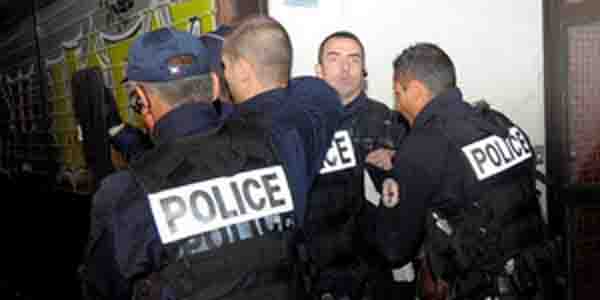
French police escort a suspect into custody

French police on Tuesday arrested 12 suspects over the killing of two students lynched by a mob armed with hammers, baseball bats and knives.

The killings last Friday in the Echirolles suburb of Grenoble sparked outrage in France and prompted President Francois Hollande to travel to the southeastern city late Monday to visit the families of the dead young men.

Hollande was accosted as he visited the poor suburb by a local resident who lambasted security forces for failing to stop the violence she said was plaguing the area.

Interior Minister Manuel Valls also travelled to the city and on Tuesday denounced what he called a “massacre” and vowed that the killers would be tracked down.

Three suspects, who may be of most interest and all have convictions for violent crimes, are still on the run, prosecutor Jean-Yves Coquillat told reporters.

Kevin Noubissi and Sofiane Tadburt, both aged 21, were beaten and stabbed to death by a gang of about a dozen people in a park. Noubissi was stabbed seven to eight times, and Tadburt 30 times, the prosecutor said.

The gang was reportedly seeking vengeance after a minor incident outside a high school involving Noubissi’s younger brother.

Funerals for the two friends were due to take place Wednesday at the local mosque.

On Tuesday evening police said about 10,000 people took part in a memorial march to honour the two young men, who were said by friends and families to be model students.

Participants marched in silence while carrying white balloons and holding up placards showing photos of the victims.

Most of those arrested Tuesday in Grenoble were aged between 18 and 21, and most have criminal records, officials said.

No one has admitted guilt, the prosecutor added.

Two brothers, both in the military, were the first to be arrested in the case, police said, after being brought in for questioning on Monday. One was found near Grenoble, the other in a town about 500 kilometres (300 miles) away.

Their mother was also brought in for questioning Tuesday. – AFP

New York criminals prefer Apple devices

New York

The New York Police Department is deploying a surge of detectives to patrol an increasingly mean new beat: Facebook and other social networks.

Police Commissioner Raymond Kelly said Tuesday that he’s doubling the number of detectives assigned to combating local teen gangs and that increased surveillance of social networks will be a major part of the strategy.

The gangs under scrutiny are not the big, established outfits like the Bloods and Crips, which are well known around the United States, but neighborhood groups fighting over loyalties often to just one part of a housing project or other limited turf.

“Under a program we’ve named Operation Crew Cut, the Department intends to double the size of its Gang Division from approximately 150 detectives to 300 phased in over a period of time,” Kelly said in prepared remarks to a police conference in San Diego, California.

The propensity of the social media addicted youths to use Facebook and other networks to “brag about their murderous exploits” means detectives will be watching their screens, as much as the streets.

“In addition to tracking the admissions of criminal conduct and plans of future crimes by crew members on Facebook, You Tube and elsewhere, the division will be responsible for maintaining a dictionary of sorts with a continually updated lexicon employed by crews as a kind of code,” Kelly said.

Officers will infiltrate gangs under online aliases registered with their superiors. They will also be allowed to use untraceable Internet cards on their laptops.

Kelly, who runs one of the world’s most technologically advanced police departments, with a rapidly growing surveillance capability, said measures were being taken to ensure that monitoring the networks does not go too far.

“Recently, we issued new guidelines for officers using social media as part of criminal investigations. We did this to instill the proper balance between the investigative potential of social network sites and privacy expectations,” he said.

The initiative reflects a shift in crime away from murder, which is down 18 percent so far this year, Kelly said.

However, overall crime is up four percent, largely due to a wave of teen-on-teen thefts, especially involving iPods and other Apple products.

“Like the impact on the economy itself, the allure of Apple devices has affected New York City’s crime rate,” Kelly said. “In 2002, we recorded a total of 86 thefts of Apple products in all of New York City. Last year that number was 13,233.” – AFP

Black rapist gets life sentence

A KwaZulu-Natal man was jailed for life plus 90 years on Tuesday for rape and robbery, police said.

Sibongiseni Sibisi, 32, was earlier found guilty by the High Court in Pietermaritzburg, said Captain Thulani Zwane.

He committed the crimes in the Inchanga area during 2010 and 2011.

“Sibisi would go to different households, where the victims were either alone or with minors, and rape them before robbing them of their belongings.”

Sibisi faced four counts of rape and assault and that of robbery with aggravating circumstances.

“He further threatened to kill his victims should they report the incidents,” Zwane said. – Sapa

My witchdoctor raped me

Generic witchdoctor/sangoma

A sangoma from Soweto was arrested on Tuesday morning for allegedly raping a woman who had gone to him for healing, Gauteng police said.

The 50-year-old man invited the woman to his residence to carry out a cleansing ritual on Monday night because she believed she was cursed with bad luck, spokesman Captain Kay Makhubela said.

“She was instructed to buy a white chicken and when she arrived with it… the chicken was killed and the blood was mixed with water and medication.”

The sangoma then ordered the 37-year-old to take a bath in another room and not wear clothes after she was done.

“Then he went into the room and told her she was healed. All of a sudden, he was on top of her and he raped her,” said Makhubela.

The man later threw the bath water out and said she was healed of the bad luck.

A case of rape was opened. – Sapa

Boeremeisie lost in translation

I’ve been feeling down, worried and most of all uninspired. The reason behind this psychological semi-breakdown I am having is the environment I work in and the state of our country. You get up for work every day; it pays your bills, keeps a roof over your head and food in your belly. It is something we all have to do: work, work, work, until you drop dead – is what my father always says. So I work and now I want to drop dead. What is the use of being at a job that firstly, you find no challenge in, secondly, gives you no growth, thirdly, is in an economy where jobs are really scarce and fourthly, (and my more important point), drains your soul, your sense of being? A job that breaks your spirit and tries to kill the person you are? I have been asking myself that for many months now.

You cannot explain the feeling to anyone who has not been in the same situation. You have been trying to keep your head high, trying to stay positive, trying to keep your sense of being a person, but the people at your workplace have a nasty habit of breaking your last thread of strength. When that last piece is barely hanging from your heart, you lose your sense of being, you lose your motivation, you lose your drive, you lose you. The things that used to hold joy in your life, becomes stale in your mouth and you sink deeper into the pit of darkness. You notice the world outside of your office and realize that you have been sinking into a hole of oppression, or “reverse apartheid”, of rape, of murder, of genocide. You find yourself living in a country that wants to eradicate your language, your history, your culture. You work with people who support those views, but there are also the few who don’t. You find yourself in a situation where you have trouble separating the country and the workplace and the pit becomes ever deeper. How do you ever deal with such feelings? How do you stand up for what you believe in without compromising your position?

Surviving in a multicultural country, constantly adapting to others and their way of doing things, their views, can make one feel depressed. Soon we will all be on anti-depressants just to cope with a day at the office.

[ad 1]

My solution: I decided to see a professional to help me with this particular situation and feelings I have. I started this blog/journal/diary – call it what you will. Maybe a daily or weekly dose of scribbles will get my frustrations out and I will be able to breathe the fresh air and freedom I so long for.

You probably don’t want to hear about my troubles, but maybe, just maybe you can give advice, or tell me to take a hike. Or maybe you can see yourself in my thoughts and find comfort in the journey we face together.

So let us start making sense of this life we find ourselves in and let us not forget where we come from and the strength of our forefathers (and -mothers).
Yolande du Plessis is a blogger from Pretoria. Read her opinions here.

White oldie population explosion

A major study published by the United Nations has warned that the growing numbers of white and Asian elderly people presented significant challenges to welfare, pension and health care systems in both developing and developed nations.

And it bemoans the fact that skills and knowledge that older people have acquired are going to waste in societies rather than being used to their full.

Ageism is an infinitely more serious problem in Britain today than racism, sexism, fattism, homophobia, islamophobia and all the other imaginary nonsense the pc cadres drivel on about, says oldies.

The UN rightly says that what the older person has in the way of knowledge and experience is criminally wasted and/or ignored.

As a society, we are obsessed with IQ. But wisdom is far more important, they say. The consequences are obvious to those over 50, but rarely to younger observers

Richard Blewitt, chief executive of HelpAge International, which collaborated on the report, Ageing in the 21st Century says: “We must fully recognise that the vast majority of people will live into old age,” he added. “By revolutionising our approach and investing in people as they age we can build stronger, wealthier societies.”

Calling the ageing demographic a “megatrend that is transforming economies and societies around the world”, the report estimated that one in nine people of the world’s population of seven million are over 60.

The size of the elderly population is expected to swell by 200 million within 10 years past the one billion mark and soar to two billion by 2050, it forecast.

The number of centenarians in the world is projected to increase from fewer than 316,600 in 2011 to 3.2 million in 2050.

In Britain there are projected to be half a million centenarians by 2066, with one third of babies born in 2012 expected to celebrate their 100th birthday, according to Government statistics cited.

“The expected growth of the population of older persons should not be an excuse not to act but rather seen as a call to action. A well supported old age is in the interest of all generations,” said the 192-page report, which was released in Tokyo, to coincide with International Older Persons Day.

Japan is the only country with an older population of more than 30 per cent, but by 2050, 64 countries are expected to achieve that proportion including Britain.

The report warned that the skills and knowledge that older people have acquired are going to waste, with many of them underemployed, underactive and more likely to become a drain on a nation’s resources. Britain is among several European countries that have passed laws against employers discriminating against the elderly but progress has been uneven, said Mr Blewitt.

However successive British governments, like many others, tend to indulge in hand-wringing about the cost of caring for the elderly, he said, rather than exploiting what they had to offer.

Many have skills that would be immensely useful to the voluntary sector but have hardly been tapped on a mass scale. The report calls such opportunities the “longevity dividend”.

“Rather than burying our head in the sand and saying old people are going to ruin our economy, we have to see the opportunity in this,” said Mr Blewitt.

Ageing, said the report, “is a triumph of development”.

“Increasing longevity is one of humanity’s greatest achievements. People live longer because of improved nutrition, sanitation, medical advances, health care, education and economic well-being,” it continued.

But it warned that the most serious impact of ageing populations would be in developing countries without safety nets or adequate legal protection in place for older people.

In nations now dominated by young workers, urban migration has eroded traditional care of the elderly in extended families, as young parents have left for the cities. The trend has also tended to leave the elderly acting as primary carers of their grandchildren. In rural China, the study estimated that there are 52 million grandchildren looked after by their grandparents.

China was praised by the report for introducing a national pension of £5 a month, but for every developing country that does have some kind of similar scheme, there are nine that do not.

The report expressed concern “about the multiple discrimination experienced by older persons, particularly older women, including access to jobs and health care, subjection to abuse, denial of the right to own and inherit property and lack of basic minimum income and social security”.


Obama ignores black child soldiers

U.S. President Barack Obama, for the third year in a row, has waived almost all U.S. sanctions that would punish certain countries that use child soldiers. Most of the countries are in Africa and child soldiers are mostly black.

Late Friday afternoon, Obama issued a presidential memorandum waiving penalties under the Child Soldiers Protection Act of 2008 for Libya, South Sudan, and Yemen, penalties that Congress put in place to prevent U.S. arms sales to countries determined by the State Department to be the worst abusers of child soldiers in their militaries. The president also partially waived sanctions against the Democratic Republic of the Congo to allow some military training and arms sales to that country.

Human rights advocates saw the waivers as harmful to the goal of using U.S. influence to urge countries that receive military assistance to move away from using child soldiers and contradictory to the rhetoric Obama used in his speech.

“After such a strong statement against the exploitation of children, it seems bizarre that Obama would give a pass to countries using children in their armed forces and using U.S. tax money to do that,” said Jesse Eaves, the senior policy advisor for child protection at World Vision.

The Obama administration doesn’t want to upset its relationships with countries that it needs for security cooperation, but the blanket use of waivers is allowing the administration to avoid the law’s intent, which was to use force the U.S. government to put a greater priority on human rights and child protection when doling out military aid, he said.

“The intent in this law was to use this waiver authority only in extreme circumstances, yet this has become an annual thing and this has become the default of this administration,” Eaves said.

The Romney campaign has made Obama’s record on human rights a feature of its foreign-policy critique, with top advisors accusing the president of deprioritizing the issue, often in sweeping terms.

“Barack Obama has broken with a tradition that goes back to Woodrow Wilson about human rights and values animating our foreign policy. This administration has not been an effective voice for human rights,” said Romney campaign senior advisor for foreign policy Rich Williamson, who also served as George W. Bush‘s special envoy to Sudan, told The Cable in July.

Bush signed the child-soldiers law in 2008. It prohibits U.S. military education and training, foreign military financing, and other defense-related assistance to countries that actively recruit troops under the age of 18. Countries are designated as violators if the State Department’s annual Trafficking in Persons report identifies them as recruiting child soldiers. The original bill was sponsored by Sen. Dick Durbin (D-IL).

Obama first waived the sanctions in 2010, the first year they were to go into effect. At that time, the White House failed to inform Congress or the NGO community of its decision in advance, setting off a fierce backlash. A justification memo obtained by The Cable at the time made several security-related arguments for the waivers. Sudan was going through a fragile transition, for example. Yemen was crucial to counterterrorism cooperation, the administration argued.

But NSC Senior Director for Multilateral Affairs Samantha Power told NGO leaders at the time that the waivers would not become a recurring event.

“Our judgment was: Brand them, name them, shame them, and then try to leverage assistance in a fashion to make this work,” Power said, saying the administration wanted to give the violator countries one more year to show progress. “Our judgment is we’ll work from inside the tent.”

But the next year, in 2011, Obama waived almost all the sanctions once again, using largely the same justifications, except that the administration argued that the law didn’t apply to South Sudan because it wasn’t a country until July 2011. Rep. Jeff Fortenberry (R-NE) tried to pass new legislation to force Obama to notify Congress before issuing the waivers.

Fortenberry called the decision an “assault on human dignity,” and said, “Good citizens of this country who do not want to be complicit in this grave human rights abuse must challenge this administration.”

This year, the State Department held a briefing for NGO leaders and human rights activists to answer questions about the waivers and try to ally their concerns.

“They are addressing the concerns of the legislation in a more pragmatic and useful way than in the past, but they still have a ways to go and this was a clear missed opportunity,” Rachel Stohl, a senior associate at the Stimson Center who attended the briefing, told The Cable. “You want the waivers to be used very sparingly but some of these countries get the waiver every year.”

Stohl rejects the administration’s argument that countries like South Sudan are so fragile that they can’t be leaned on to do better on human rights.

“I would argue that this is exactly the right time to make clear what the parameters are,” she said.

Jo Becker, advocacy director for the children’s rights division at Human Rights Watch, told The Cable that where the United States has used some pressure, such as in the DRC, where there was a partial cutoff of military aid last year, there was a positive effect.

“After years of foot-dragging, Congo is close to signing a U.N. action plan to end its use of child soldiers,” she said. “But in other countries with child soldiers, including South Sudan, Libya, and Yemen, the U.S. continues to squander its leverage by giving military aid with no conditions.”


Boer women and children died ‘due to backwardness’

The emaciated Lizzie van Zyl. She and other children died in British concentrations camps due to 'Boer backwardness', claims UCT academic

A letter writer in Business Day, as well as an academic at the University of Cape Town, Elizabeth van Heyningen, claim that Boer women and children died in British concentration camps during the Anglo-Boer war because they were “backward” and did not know about soap and water.

Van Heyningen implies that it was really a “myth” that Afrikaners were “civilised Europeans… and not dirty African peasants”.

In her reply yesterday to a previous letter by Dr. Dan Roodt of PRAAG, Pauline Morris of Johannesburg writes:

I REFER to Dan Roodt’s Apartheid revisionism no threat (Letters, September 25). Mr Roodt must realise that historical revisionism applies to all history.

Let’s take the Anglo-Boer War which it seems is the bedrock of Afrikaner identity. A focus feeding this identity is the “genocide” of women and children in the refugee or concentration camps by the British.

I have been reading and interpreting letters that have recently been uncovered in a family archive in Sweden. One of the writers was a medical doctor who served in an ambulance on the side of the Boers at the Ladysmith front, and then in their retreat to the Biggarsberg after the British relieved the siege of Ladysmith.

The opinions expressed by this doctor support the recent research finding on these camps by historian Elizabeth van Heyningen that the “atrocities” in these camps were exaggerated into mythical proportions to support Afrikaner nationalism in the 1920s and 1930s.

The reality as I understand it is that there were many cultural and socioeconomic factors that exacerbated the deaths in the camps. Many of those in the camps were very poor bywoners, and many were indigent. Also, not surprisingly the “modern” medicine administered at the time by the British was unfamiliar to the Boer population who had been living in isolation for so many years.

I agree that we “need to find our own truth, commensurate with our own reality.” This means opening up a critical debate on the realities of the Boer War concentration camps. I take it this will pose no threat to yourself and other Afrikaners.

In an article published in the journal Historia 55,2, November 2010, pp 12-33, Elizabeth van Heyningen, a professor of history at the University of Cape Town, suggests that it was really a “myth” that Afrikaners were “civilised Europeans… and not dirty African peasants”.

She quotes from the British “Blue Books” which blamed the Boers themselves for dying of hunger and disease in the camps:

“The high death rate among the children, I would like to emphasise again, is in no way due to want of care or dereliction of duty on the part of those responsible for this camp. It is, in my opinion, due to the people themselves; to their dirty habits both as regards their own personal cleanliness and the cleanliness of their children and their surroundings; to their prejudices; their ignorance; and their distrust of others, even their own nationality, when their advice runs counter to their own preconceived and antiquated ideas. This is specially noted in connection with their treatment of the sick, to their rooted objection to soap and water, and to hospitals.”

According to Van Heyningen, the mortality rate in the camps, where 34 000 women and mostly children died, was not much higher than in Afrikaner towns in the Cape before the “civilised” British introduced public health reforms in the 1880s:

“Lack of sanitation was not confined to the camps. The Boer laagers, when they remained stationery for any length of time, were filthy. A number of commentators remarked on the insanitary state of the laagers besieging Mafeking. Flies were a major problem because the offal of slaughtered animals was never cleared away. The interiors of the wagons and tents were black with the “little devils” and flies flew into the mouths of the burghers as they struggled to eat. The stench from the latrines, built too close to the laager, was unbearable, the Rev Abraham Stafleu complained. Paardeberg and Modderspruit, too, were gripped by disease and foreign doctors attached to the Boer forces, particularly, were critical of the lack of hygiene in the Boer laagers.

“Lack of sanitation was certainly not unique to the Boer republics. The camps have been seen too much in isolation, as sui generis, a unique experience. In the Cape Colony, as public health reforms were introduced by modernising doctors from the 1880s, and district surgeons’ reports and statistics were published, it became clear that many country towns lacked effective sanitation and mortality rates, especially those of children, were very high indeed.”

Elizabeth van Heyningen argues that the vast majority of the camp inmates were lower-class bywoners or “white trash” who knew nothing about basic hygiene and therefore died of their own accord. She then goes on to explain how Afrikaner nationalists have misrepresented the British concentration camps that were really an attempt at “poverty relief” for Afrikaners instead of the military exercise against the Boer civilian population that they were. She also glosses over the burning down of most of Northern South Africa by the British sodiers, leaving the civilian population without food, to be herded into camps where many were again denied food or placed on below-subsistence rations.

Van Heyningen equally neglects to mention the many reports of poisoning by the camp commanders and nursing staff of inmates under the pretext of administering “medicine”.

Writing in Die Burger on 10 July 2010, journalist and historian Marthinus van Bart offered the following criticism of Van Heyningen’s jingoist apology for the British concentration camps:

“Other experts have emphasised that the main reasons for the deaths were malnutrition and lack of food, exposure, polluted food and water, a dearth of soap and other cleaning aids, open furrow toilets and the bucket system, the serious overpopulation of the camps, immunity deficiency, little or no fuel to boil water or do cooking, the denial of the disaster and inaction to set things right after the British opposition had demanded it in parliament in London.”

In the 2001 documentary Scorched Earth “it was indicated that the women and children were civilians against whom war was literally conducted. Their farms (more than 30 000) and furniture were burnt down, food and livestock were destroyed, they were molested and raped, and they were violently herded into the camps.

[ad 1]

“Up to 18 people were divided into a single bell-shaped tent – mostly old, worn-down army tents giving no protection against the scorching Karoo sun, rain and wind storms, bouts of hail and snow. Diseases like pneumonia were widespread due to exposure to the elements, which was worsened by malnutritiion and deficient medication.

“The toilet facilities were one bucket for every 300 people. In one camp there were only 28 bucket toilets for 4 600 inmates. The toilet holes of many camps were 1 km from the tents.

“Most people suffered from diarrhea due to the polluted water and bad meat. Water was limited to one bucket per family per day, in other cases to one small kettle of water per day – not even a cup of water per person per day.

“There was mostly no water for washing, either their bodies or clothes and bedlinen. The elderly and children who fell into the toilet furrows could not be properly washed afterwards.

“In addition families of burghers in the field were placed on half rations, a diabolical plan to slowly but surely exterminate these inmates. That was one of the notorious Methods of Barbarism to which historian S.B. Spies refers in his book.

“There were approximately 235 000 camp inmates and 240 000 soldiers that had to be fed by the British army. The deficient infrastructure made a disaster inevitable.”

Launch Declaration: Coalition for a Free Palestine

Coalition for a Free Palestine Launch Declaration

The historic launch of the Coalition for a Free Palestine (CfP) which took place Friday 28th September was a resounding success. Political parties, trade unions, faith based organisations, student movements and human rights groups spoke passionately about the freedom of Palestine; the CfP adopted a founding document, program of action and deceleration. Please see the declaration below:

Launch Declaration

28 September 2012

Johannesburg, South Africa

“The temptation in our situation is to speak in muffled tones about an issue such as the right of the people of Palestine to a state of their own. We can easily be enticed to read reconciliation and fairness as meaning parity between justice and injustice. Having achieved our own freedom, we can fall into the trap of washing our hands of difficulties that others face. Yet we would be less than human if we did so. It behoves all South Africans, themselves erstwhile beneficiaries of generous international support to stand up and be counted among those contributing actively to the cause of freedom and justice. “

Nelson Mandela, 4 December 1997

We, South Africans comprising of various organisations and institutions have over the years acted in solidarity with the Palestinians who are living under Israeli Apartheid and have been dispossessed in various waves of ethnic cleansing;

Gathered at Cosatu House, the headquarters of our country’s largest federation of trade unions, in Johannesburg on 28th September 2012;

Deeply conscious of the limitations of our society’s transformations and the long walk that our country still has to undertake towards a more just life for all, free from poverty, economic exploitation, sexism, racism and xenophobia;

Fully aware of the interconnectedness of all human suffering and the debt of solidarity that we owe each other and firmly believing that an injury to one, is an injury to all;

Rejecting the patent untruths of imperialism that this is a dispute by religious groups and those that attempt to set themselves up as honest brokers;

Expressing grave concern at the contravention of the UN resolutions and breach of international humanitarian law;

Mindful of

1. Apartheid Israel’s ongoing collective punishment of Palestinians through the occupation and siege of Gaza;

2. The occupation of the West Bank, including East Jerusalem, and the continued construction of the illegal Apartheid Wall and e.g. the equally illegal and repugnant resettlement policies, eviction of families and communities, the demolition of homes and villages and land grab;

3. The contempt for the will of the Palestinian people displayed by Israel, the US, Canada, the EU and others after the free and open Palestinian elections of 2006;

4. The war crimes committed by apartheid Israel during the invasion of Gaza in 2009, and the 2010 massacre;

5. The continuing discrimination and repression faced by Palestinians within apartheid Israel;

6. The continued exile of millions of Palestinian refugees;

7. The knowledge that many governments have given and continue to provide apartheid Israel direct economic, financial, military and diplomatic support and allow it to behave with impunity;

8. The role of various institutions of global governance in obstructing diplomatic efforts by Palestinians towards their liberation;

9. The role of governments and multi-national corporations, in cooperation with apartheid Israel, in the plundering of Palestinian land and natural resources as well as entrenching apartheid, masquerading these as assistance to the Palestinian people.

Reaffirm our commitment to:

1. Palestinian self-determination

2. Ending the occupation

3. Oblige apartheid Israel to end complete disregard of UN and regional resolutions

4. Equal rights for all within historic Palestine

5. The full right of return for Palestinian refugees

6. The United Palestinian call of July 2005 for Boycott, Divestment and Sanctions (BDS) against Israel

7. Ending imperialism and support the prosecution of perpetrators of violations of Palestinian rights

Deeply aware of how our own suffering under apartheid and colonialism was reduced by those opposed to our freedom to a dispute between Black and White people;

Asserting that even-handedness between oppressed and oppressor is escapism, acquiescence, cowardice at the very least and, at worst, complicity;

Immensely indebted to the international community – particularly those from the Frontline Countries in Southern Africa, the Non-Aligned movement and the numerous solidarity formations in Europe, North America and elsewhere who threw their lot in with the oppressed South African people despite their governments’ overwhelming support for the apartheid regime;

Respectful of the observations that the veterans and leaders of our own liberation struggle who have spoken of the daily persecution and humiliation of Palestinians in the shadow of Apartheid Israel; some of these observations include:

Israel’s policy towards her neighbouring Arab states clearly unmasks the true nature and character of the regime in Tel Aviv. It is this blatant arrogance, this open aggressiveness towards her neighbours and the ruthless oppression and exploitation of the Arab people of Palestine which compares Israel more and more to apartheid South Africa. The essence is that under the influence of exclusive nationalist ideologies both Afrikaner nationalists and Israeli Zionists, think and act towards the indigenous majorities in their countries and towards their neighbouring states with the callous inhumanity of all who consider others to be of “inferior races” and less human. (Alfred Nzo, Post-Apartheid SA’s first Foreign Minister)

I never tire of speaking about the very deep distress in my visits to the Holy Land; they remind me so much of what happened to us black people in South Africa.I have seen the humiliation of the Palestinians at checkpoints and roadblocks, suffering like we did when young white police officers prevented us from moving about. My heart aches. (Archbishop Desmond M. Tutu, Nobel Peace Prize Winner)

The left and progressive forces need to intensive struggles against racism, anti-Semitism and other forms of xenophobia as critical components of the struggle against the depredations of capitalism and imperialism. Most critically we call upon all left forces globally to intensive solidarity activities with the Palestinian people and their just struggle, and to pressure particularly European governments and the US to facilitate a just solution to the Palestinian and other Middle East problems. (Blade Nzimande, Secretary General of the South African Communist Party and Minister of Higher Education)

Many aspects of Israel’s occupation surpass those of the apartheid regime. Israel’s large-scale destruction of Palestinian homes, levelling of agricultural lands, military incursions and targeted assassinations of Palestinians far exceed any similar practices in apartheid South Africa. No wall was ever built to separate blacks and whites. (Professor John Dugard. Special Rapporteur on Palestine to the United Nations Human Rights Council)

It is perhaps the most pressing moral and ethical challenge of our time, in this the opening years of the 21st Century, that all of us in this world who are fortunate enough to be free should express our total support and solidarity with the Palestinian people in this hour of perhaps their greatest suffering and need but at the same time a period where their infinite and unconquerable courage and determination shines through. They will achieve their right to self-determination and join the liberated and independent nations of this world. They will survive and win and be able to contribute their great talents and energy in helping us all build a more prosperous and just world for this and future generations. I place myself unreservedly in the camp of all those who believe that justice for Palestine means peace, security and justice for all in the Holy Land be they Christians, Jews, Muslims or non-believers, be they Israelis or Palestinians. This is a just cause which should be supported by the entire international community, by all governments and people of whatever origin, with the same passion that enabled the anti-apartheid movement to see the birth of a non-racist, non-sexist, inclusive democratic South Africa. (Ronnie Kasrills, Former Leader of our country’s Liberation Army, Mkhonto we Sizwe and former Minister of Water Affairs and Intelligence)

I support a similar call for sanctions against the state of Israel as we had against Apartheid South Africa – Absolutely! Pressure, pressure, pressure from every side and in as many ways as possible: trade sanctions, economic sanctions, financial sanctions, banking sanctions, sports sanctions, cultural sanctions; I’m talking from our own experience. In the beginning we had very broad sanctions and only late in the 1980s did we learn to have targeted sanctions. So you must look to see where the Israelis are most vulnerable; where is the strongest link to the outside community? And you must have strong international solidarity; that’s the only way it will work. You have to remember that for years and years and years when we built up the sanctions campaign it was not with governments in the West. They came on board very, very late. (Professor Allan Boesak, Former Patron of the United Democratic Front)

Our role as activists in the face of what President Nelson Mandela called the greatest moral issue of our time is to raise our voices and mobilise others to stand united in solidarity with the oppressed masses of Palestine and others in the world. For to echo Che Guevara ‘as long as there is a single human being in the world suffering under the yoke of oppression, our struggle cannot be over. (Marius Fransman, Deputy Minister, Department of International Relations and Cooperation)

The occupation wall that the Israeli army has built and continues to build cuts through Palestinian land, separating farmers from their farms. Palestinian farmers experience the daily torture of trying to get to their farms. They have to go through checkpoints that are opened and closed at unpredictable times to tend their olive trees. Many times they are not allowed to and they watch through the barbed wire as their olive trees die – as they and their families get reduced to poverty. (Pregs Govender, SA Human Rights Commissioner)

Clearly, apartheid was a well-planned and oiled machine of racial segregation, designed from the very beginning to oppress, exploit and dehumanise Black South Africans, especially Black workers and the Black working class. While there are a number of differences between the situation of Black South African workers and Palestinian workers, the oppression and exploitation faced by the Black South African working class and the Palestinian working class resemble each other in many respects, while the Israeli Jewish working class resembles the White labour aristocracy in South Africa. (Zwelinzima Vavi, General Secretary of Congress of South African Trade Unions)

Therefore;

Renew our commitment to act in solidarity with the oppressed Palestinians inside the occupied territories, in the diaspora and within the Zionist state of Israel;

Agree to;

1. The founding principles, organisational structure, and coordination for an effective Coalition for a Free Palestine (CFP)

2. Implement a sustained programme of action and solidarity activities in support of Palestine. We particularly pledge our support to the following practical programmes/campaign actions:

2.1. Build mass education, research, and monitoring capacity for strengthening our campaign actions in support of the cause of the Palestinian people.

2.2. Build an international anti-apartheid movement against Israel with a specific focus on our region and the African continent;

2.3. Establish networked links and specific campaign actions with Palestinian organisations in the Occcupied Territories, inside apartheid Israel and the Palestinian diaspora particularly those in refugee camps;

2.4. Mainstream Israel as an apartheid state and expose Israel’s apartheid policies and practices;

2.5. Take stock of, raise the profile of, and build support for the Palestinian cause in all national, regional, continental and international fora;

2.6. Actively respond to and support the call from virtually all of Palestinian civil society for a Boycott of Israel in the broadest possible manner, Disinvestment from companies which deal with Israel and advancing sanctions against the Israeli regime (BDS);

2.7. Challenge the increasing use of the Israeli lobby and others (albeit in ignorance) in using the Bible, the Christian faith and religiosity in the service of apartheid; and support the prophetic (Palestinian) religious leadership – Christian, Muslim and Jewish – who, in the words of the Kairos Palestine Document poignantly remind us that “The injustice against the Palestinian people which is the Israeli occupation, is an evil that must be resisted.”

2.8. Launch a media offensive that highlights the plight of the Palestinian people under occupation and apartheid and exposes the media for their unbalanced coverage of the Palestinian question and the deliberate distortion of information relating to the struggle of the Palestinian people.

3. Continue to build the relationship between the various formations comprising the CFP and to welcome new organisations wishing to join the CFP.

4. Create public awareness around the CFP and its solidarity Program of Action

5. Build links with and support the work and programmes of other solidarity movements in order to give meaning to our belief that injustice anywhere is a threat to justice everywhere

Call upon our government to immediately end the trade with companies complicit in the Israeli Occupation and Settlements, to terminate diplomatic relations with the State of Israel until it abides by international law and to continue its support for Palestinian self-determination.

In fulfilling our objectives we undertake to adhere to the following guiding principles:

1. We derive our legitimacy from the people in whose name we are waging or supporting this struggle, the Palestinians themselves;

2. Subscribe to the principle of consultation, transparency, accountability and honesty in carrying out support work, raising resources, and advancing progressive views on the issues around Palestine’

3. Recognise the independence of individual organisations making up the Coalition, respecting our differences yet being a common voice built around the needs and aspirations of the Palestinian people;

4. Respect for each other’s organisations and structures and the leadership of the Palestinian people’s organisations engaged in the liberation struggle.

5. Open and frank, yet comradely, critical engagement on issues of principle and views relating to activities to advance the Palestinian struggle;

6. Prioritise the needs of the people and organisations directly involved in the liberation struggle of Palestine;

7. Recognise and affirm the right of the Palestinian people to resist their oppression and fight for their freedom and respect their means of doing so.

8. While rejecting with contempt the attempts to equate criticisms of Israel as anti-Semitism, or all Jewish people with Zionists, we oppose all forms of discrimination – including anti-Semitism and xenophobia – which sully our vision of a world wherein the dignity of all human beings are respected.

9. Develop close cooperation and solidarity with Palestinian organisations and other solidarity groups, including those comrades who conduct the struggle within the apartheid state of Israel.

10. Play our role in mobilising and participating in a coordinated international anti-apartheid movement such as the movement that assisted us in our liberation from apartheid with a special focus on Southern Africa and the rest of the continent.

Issued by Dr Stiaan van der Merwe, CfP National Working Committee Member and Tahir Sema, CfP National Working Committee Member and Convenor, October 1 2012

20-year sentence for Security Minister’s drug-dealing wife

Sheryl Cwele, at the time of her crime the Minister of Security's wife

The prison sentences of Sheryl Cwele — former wife of State Security Minister Siyabonga Cwele — and her co-accused were increased to 20 years on Monday.

“The effects of their deeds on the community at large far outweigh their personal circumstances and justify a long term of imprisonment,” the Supreme Court of Appeal concluded.

Cwele and Frank Nabolisa were found guilty in May 2011 of drug dealing by the Pietermaritzburg High Court and sentenced to 12 years imprisonment each.

Cwele, 50, appealed to the SCA against her conviction only, while Nabolisa appealed both his conviction and sentence.

Both pleaded not guilty to conspiring to deal in drugs, to procuring a woman, Charmaine Moss, to collect drugs in Turkey, and to procuring another woman, Tessa Beetge, to smuggle cocaine from South America.

Nabolisa had been in custody until now, while Cwele was out on R100,000 bail.

A full bench in an unanimous judgment, said in many similar cases the drug courier or “mule” got caught, while the handler — the real dealer or importer — remained safe in the background to carry on with his or her evil deeds.

SCA President Lex Mpati said in this case it was only through the courage and determination of Beetge’s mother that the real culprits were brought to book.

The SCA judgment held that Cwele and Nabolisa, by being involved in the drug trade, had reconciled themselves to sowing the seeds of destruction, directly and indirectly, in the lives of a number of people, including children.

The SCA held that Nabolisa sent Beetge to South America to collect cocaine and bring it back to South Africa.

“It is the only reasonable inference to be drawn from the totality of the proved facts,” the judge said.

The SCA found it might well be that Cwele played a lesser role in the whole enterprise, but as a qualified nurse she must have known the dangers inherent in the use of drugs.

“Yet she was a willing partner in the commission of the crime, who befriended and preyed on vulnerable women in furtherance of the criminal enterprise.”

The judge said on the facts the “inference was irresistible (compelling)” that Cwele must have known that Beetge was being asked to ferry cocaine to South Africa.

The SCA held the trial court was correct in treating Cwele and Nabolisa equally. The court dismissed their appeals against their convictions.

It found the 12-year prison sentence imposed on each of them by the trial court disturbingly inappropriate. The high court’s sentences were replaced with a sentence of 20 years’ imprisonment for each of them. – Sapa

Hundreds at Corrie Sanders’s funeral

Mike Sanders (brother) and Dean Sanders (son) carry Corrie Sanders's casket from the NG Church, Wonderpark, Pretoria

Hundreds of friends and relatives of former world heavyweight boxing champion Corrie Sanders filled the Wonderpark NG church in Pretoria North for his funeral on Monday morning.

Slides of Sanders were projected onto a wall with Josh Groban’s song ‘You Raise Me Up’ playing in the background.

His mother Alida and brother Mike, along with other family members, were visibly emotional as proceedings started.

Chris Gericke would conduct the service.

Sanders won the World Boxing Organisation’s heavyweight title in March 2003 by dropping Ukrainian Wladimir Klitsckho in the second round in Hanover, Germany. He retired five years later.

He was at the Thatch Haven Country Lodge, in Brits, on September 22 when armed robbers entered and began firing shots at random.

Sanders was hit in the hand and stomach and died in the Kalafong hospital the next day.

Earlier on Monday, the three men accused of murdering Sanders appeared in the Brits Magistrate’s Court.

Paida Fish, 19, Samuel Mabena, 27, and Chris Moyo, 25, each face one count of murder and three charges of robbery with aggravating circumstances.

The matter was postponed to October 8 for further investigation. The men will remain in custody.

Mabena also appeared in court on Monday in connection with the murder of farmer Mauritz Oberholzer near Brits on September 5. This matter was postponed until Tuesday.

The three were arrested in the Oukasie informal settlement, near Brits, on Thursday after police received a tip-off, police spokesman Brigadier Thulani Ngubane said last week.

At the address where the men were arrested, police recovered a cellphone, vehicle key, purse, handbag, and cash believed to have been stolen during the robbery in which Sanders was shot.

“Police then went to a second address and a third suspect was arrested,” Ngubane said.

The three men are Zimbabweans.

Outside court, members of the Oukasie SA National Civic Organisation protested.

“Our Constitution is failing us because criminals go free,” Michael Mhlongo said.

“They have taken our champion. We are sending our condolences to the Sanders family.”

He said the home affairs department had failed by letting foreigners into the country as they had no legal documents and therefore could not be traced if they committed crimes.

One man held up a poster which read: “They took Lucky Dube now it’s Corrie Sanders. Enough is enough with illegal foreigners. No bail.” – Sapa

Marikana massacre scene inspected

A rock on Marikana Hill

By Genevieve Quintal and Jonisayi Maromo

A judicial inquiry into the shooting of striking Lonmin platinum workers at Marikana in August concluded an inspection on Monday of the hills where the workers were killed.

Two North West crime scene experts led retired judge Ian Farlam and his team around the area where 34 miners were shot dead by police.

Warrant Officer Patrick Thamae pointed out where bodies were found near the main hill, where the mineworkers assembled in the days leading up to the shooting on August 16.

A large crowd of observers and advocates representing the different parties followed Farlam and the experts.

Thamae pointed out the place where seven bodies were found. Another five were found next to a kraal, he said.

Farlam asked him to show the commission where barbed wire was rolled by police on the day of the shooting.

The commission was then taken a few hundred metres further, to where a single body had been found.

Thamae said the body was found “in the road”.

Cartridge cases of various calibres had been found near the body, he said.

He told the commission a number of R5 rifle and pistol cartridges were found lying in areas surrounding the hill, where police were believed to have been standing at the time of the shooting.

In another area, pistol cartridges and rubber bullets were discovered.

Another crime scene expert, Captain Apollo Mohlaki, led the commission in inspecting a small hill.

Mohlaki pointed out where bodies had been found.

He also showed the judge the place where traditional weapons recovered from the protesters were heaped.

The judge held an umbrella to shield himself from the sun as he was helped up the steep hill.

Large boulders on the hill were chipped by bullets.

The procession inspected other areas where other bodies and bullet cartridges were discovered. The locations had been marked with yellow paint.

Mohlaki pointed out bullet markings and drops of blood on some of the boulders surrounding the small hill.

A group of miners, arrested after the shooting and since released on bail, stood watching on the sidelines of the commission’s inspection. They would not talk to the media.

The workers are represented by advocate Dali Mpofu, who defended expelled ANC Youth League president Julius Malema during his disciplinary hearing.

During the inspection, Mpofu stopped to speak to his clients.

He told Farlam they wanted to point out that three or four helicopters had hovered over the scene on the day of the shooting.

Earlier, the mineworkers undertook their own scene inspection, separately from that of the judicial commission of inquiry.

A miner showed Association of Mineworkers and Construction Union (Amcu) leader Joseph Mathunjwa areas where striking mine workers were shot by the police.

He pointed to an area surrounded by rocks where a body was found, and indicated that the miner was shot from a helicopter above.

[ad 1]

Mathunjwa, wearing a white Amcu T-shirt, took photographs and asked questions.

Before the formal inspection started, residents from the nearby informal settlement approached the scene, singing struggle songs and carrying placards reading: “Don’t let the police get away with murder”.

The crowd shouted “amandla, awethu” while they danced.

A group of policemen stood watching.

The 34 miners were killed and 78 were wounded when police opened fire on them while trying to disperse a group of protesters near Lonmin’s platinum mine in Marikana in August.

Some reports since the event have suggested that several miners were shot dead among rocks a distance from where the police clashed with workers.

The commission’s inspection in loco continues on Tuesday, when the mine hostels, informal settlements and formal settlements will be visited.

The commission will also inspect shafts and any other areas deemed important to the inquiry. – Sapa

Public works department in financial disarray

Financial chaos continues to dog the public works department, according to the Auditor General (AG).

This resulted in AG Terence Nombembe giving the department another disclaimer for the 2011/12 financial year — one of the worst audit opinions possible.

Nombembe said he could not rely on information provided by the department about, among other things, how many properties it owned and leased to sister departments and other state entities, and the accuracy of irregular, fruitless and wasteful expenditure.

“I was unable to obtain sufficient appropriate audit evidence to satisfy myself as to the completeness of irregular expenditure relating to the current year stated at R171,127,000 (2011: R1,396,000).”

The department’s financial statements indicated there was over R69 million in fruitless and wasteful expenditure.

Nombembe said he could not rely on this figure either, as the department did not have a system in place to identify this type of spending.

The lease problems at the department continued.

“I was unable to obtain sufficient appropriate audit evidence for operating lease expenditure transactions with an estimated value of R48,513,867,” said Nombembe.

Action against department officials accused of wrongdoing was lacking in various instances.

“Investigations have not been conducted into all allegations of financial misconduct committed by officials, as required by treasury regulations.”

As a result of this failure, disciplinary steps were also not taken against officials suspected of such conduct.

On the supply chain management side, the department was faring poorly by contravening treasury regulations and procuring goods and services of a transaction value higher than R500,000.

Nombembe took aim at officials who played a part in awarding relatives, friends, partners or associates lucrative public works contracts

Some of these officials had not been sanctioned for fraud and corruption.

The department’s leadership was criticised for not holding officials accountable for their actions.

“Instability in key leadership positions had a negative impact in providing effective leadership in the department.”

There have been various changes and turnaround plans in the department in the past few years.

Public works has had three ministers at its helm in the past two years following Cabinet reshuffles by President Jacob Zuma. – Sapa

Foreign powers could stir up domestic conflict in SA

Chrchill... had 15 million Germans displaced

by Ewald Wessels

ALLISTER Sparks labels the 1913 Land Act “the original sin of all SA’s racist laws” (It’s time to end the disruptive migrant labour system, September 26), but he neglects to mention a critical fact: the 1913 Land Act was the work of a commission appointed by Lord Alfred Milner, under the chairmanship of Sir Godfrey Lagden, soon after the occupation of the Transvaal and the Orange Free State by the armed forces of the British Empire.

Not only did the Lagden Commission, which consulted closely with the mining industry, recommend a separation of land ownership along racial lines but it also created the system of pass laws that regulated labour influx into the towns and cities.

British thinking of the era, about matters of this kind, is illustrated by a statement that Sir Winston Churchill made in the House of Commons in 1944 to justify the expulsion of ethnic Germans from Eastern Europe.

“Expulsion”, he said, “is the method which, in so far as we have been able to see, will be the most satisfactory and lasting. There will be no mixture of populations to cause endless trouble… ” This was “grand apartheid” by another name. According to historians, about 500,000 to 1,5-million people died in the process of its enforcement in Europe.

It is not surprising that facts of this kind are seldom mentioned — the British empire benefited from a “divide and rule” strategy in SA. And it was convenient for its apologists to deflect the blame for the consequences of its actions onto “white” South Africans. Land alienation is a case in point.

[ad 1]

The Xhosas were subjugated by imperial armies in a series of wars between 1811 and 1853. The Zulus fell victim to an imperial army in 1879 and the Pedi soon after in the same year (in the campaign against the Pedi the imperial force was aided by a Swazi contingent) and, finally, the Boers in the brutal war of 1899 to 1902.

While South Africans must certainly share the blame for messing up their own affairs (and, to be fair, apart from the damage that it suffered, SA gained much from the British empire), the interests of the entire community would be best served by healing internal divisions through mutual understanding.

It is the future that is important and the past is relevant only insofar as it reveals potential future hazards that should be avoided. The continuing potential for foreign forces to stir up domestic conflict to weaken SA and gain control over the country’s natural resources, as the British empire once did, is one such potential hazard.