Gunman kills 6 people in attack on Sikh temple

OAK CREEK, Wis. (AP) — An unidentified gunman killed six people at a Sikh temple in suburban Milwaukee on Sunday in a rampage that left terrified congregants hiding in closets and others texting friends outside for help. The suspect was killed outside the temple in a shootout with police officers.

Police called the attack an act of domestic terrorism by a suspect federal authorities described as a white man in his 40s, but neither provided further details or suggested a possible motive, including whether he specifically targeted the Sikh temple.

“We never thought this could happen to our community,” said Devendar Nagra, 48, of Mount Pleasant, whose sister escaped injury by hiding as the gunman fired in the temple’s kitchen. “We never did anything wrong to anyone.”

Late Sunday, the investigation appeared to move beyond the temple as police, federal agents and the county sheriff’s bomb squad swarmed a neighborhood in nearby Cudahy, evacuated several homes and searched a duplex. Bureau of Alcohol, Tobacco, Firearms and Explosives agent Tom Ahern said warrants were being served at the home of the gunman.

“He did not speak, he just began shooting,” said Harpreet Singh, relaying a description of the attack from the wife of his uncle, temple president Satwant Singh Kaleka.

Singh said Satpal Kaleka told him she was in the front room when the shooter walked in. She said the 6-foot-tall bald white man – who worshippers said they had never before seen at the temple – seemed like he had a purpose and knew where he was going.

Oak Creek Police Chief John Edwards said police expected to release more information Monday. He said the FBI will lead the investigation because the shootings are being treated as domestic terrorism, or an attack that originated inside the U.S.

“While the FBI is investigating whether this matter might be an act of domestic terrorism, no motive has been determined at this time,” Teresa Carlson, Special Agent in Charge with the agency’s Milwaukee division, said in a Sunday night statement.

During a chaotic few hours after the first shots were fired around 10:30 a.m., police in tactical gear and carrying assault rifles surrounded the Sikh Temple of Wisconsin with armored vehicles and ambulances. Witnesses struggled with unrealized fears that several shooters were holding women and children hostage inside.

One of the first officers to respond to frantic 911 calls seeking help was shot several times as he tended to a wounded victim, and was in critical condition along with two other victims Sunday night, authorities said. Police said the officer was expected to survive.

Jatinder Mangat, 38, of Racine, another nephew of the temple’s president, said his uncle was among those shot, but he didn’t know the extent of his injuries. When Mangat later learned people had died, he said “it was like the heart just sat down.”

Edwards said the gunman “ambushed” one of the first officers to arrive at the temple as the officer, a 20-year veteran with tactical experience, tended to a victim outside. A second officer then exchanged gunfire with the suspect, who was fatally shot. Police had earlier said the officer who was shot killed the suspected shooter.

Tactical units went through the temple and found four people dead inside and two outside, in addition to the shooter.

Gurpreet Kaur, 24, of Oak Creek, said her mother and a group of about 14 other women were preparing a meal in the temple kitchen when the gunman entered and started firing. Kaur said her mother felt two bullets fly by her as the group fled to the pantry. Her mother suffered what Kaur thought was shrapnel wound in her foot.

“These are people I’ve grown up with,” she said. “They’re like aunts and uncles to me. To see our community to go through something like this is numbing.”

Many Sikhs in the U.S. worship on Sundays at a temple, or gurdwara, and a typical service consists of meditation and singing in a prayer room where worshippers remove their shoes and sit on the floor. Worshippers gather afterward for a meal that is open to community members, regardless of their religious beliefs.

Kaur said she spent the afternoon serving as a translator between law enforcement and survivors at a nearby bowling alley. Police investigators kept witnesses inside the bowling alley’s basement into the evening.

“We don’t even know who’s downstairs,” Ravi P. Singh, 25, of Greenfield, said after going to the bowling alley to see if he could get more information about what had happened.

Sixteen-year-old LeRon Bridges, of Oak Creek, works at the bowling alley said police brought people from the temple over in two armored trucks. At one point, about 50 to 60 people were at the bowling alley, including police officers questioning witnesses and paramedics treating victims’ wounds, he said.

“They were just hysterical,” Bridges said. “There were kids. One big load came out of the truck.”

Sikhism is a monotheistic faith founded more than 500 years ago in South Asia. It has roughly 27 million followers worldwide. Observant Sikhs do not cut their hair; male followers often cover their heads with turbans – which are considered sacred – and refrain from shaving their beards. There are roughly 500,000 Sikhs in the U.S., according to estimates. The majority worldwide live in India.

The Sikh Temple of Wisconsin started in 1997 with about 25 families who gathered in community halls in Milwaukee. Construction on the current temple in Oak Creek began in 2006, according to the temple’s website.

Sikh rights groups have reported a rise in bias attacks since the Sept. 11 terrorist attacks. The Washington-based Sikh Coalition has reported more than 700 incidents in the U.S. since 9/11, which advocates blame on anti-Islamic sentiment. Sikhs are not Muslims, but their long beards and turbans often cause them to be mistaken for Muslims, advocates say.

Police in New York and Chicago issued statements saying they were giving Sikh temples in those cities additional attention as a precaution after the shooting, which also came two weeks after a gunman killed 12 people at movie theater in Colorado.

Valarie Kaur, who chronicled violence against Sikh Americans in the 2006 documentary “Divided We Fall,” was returning to her home in New Haven, Conn., after speaking at a White House conference Friday when she heard about the shootings.

Even though the gunman’s motives were a mystery Sunday, Kaur said the shootings reopened wounds in a community whose members have found themselves frequent targets of hate-based attacks since Sept. 11.

“We are experiencing it as a hate crime,” she said. “Every Sikh American today is hurting, grieving and afraid.”

Mary Robinson has confidence in South Africa’s ‘humanity’

South Africa had to realise its opportunities before its humanity would fully emerge, former United Nations High Commissioner for Human Rights Mary Robinson said on Sunday.

The country had to work to overcome several problems, including the Protection of State Information Bill, poverty and inequality, and gender-based violence.

Former Irish president Robinson was delivering the 10th annual Nelson Mandela lecture in Cape Town.

“My challenge today is to speak to you, South Africans, as your friend,” she said.

“A true friend tells you not only what you want to hear, but also what you need to hear.”

Robinson said she was speaking on the 50th anniversary of former president Mandela’s arrest and the centenary of the ANC’s founding.

“Anniversaries are a good time to take stock,” she said.

Accountability and transparency were required for citizens to remain stewards of democracy.

So, it was with great concern that she had followed the progress of South Africa’s protection of state information legislation.

A law that cloaked the workings of state actors and interfered with the exposure and investigation of corruption would be certain to increase levels of corruption.

“The public interest demands that basic truth, of having both transparency and accountability in government,” she said.

“Secrecy is the enemy of truth in this regard.”

South Africa’s national plan of action for human rights, launched in 1997, stated that democracy was irreconcilable with racial inequality, social injustice, poverty, crime, violence, and disregard for human rights.

She was shocked by the disparity of wealth in South Africa.

“Where you witness extremes of wealth side by side with dire poverty within the same country, it is more divisive than an overall condition of poverty,” she said.

Levels of crime and violence in some areas, such as Lavender Hill or Khayelitsha, meant that people were living in unmanageably traumatic situations.

South Africa was a young democracy, but its citizens had to ask some uncomfortable questions about the underperformance of the education system, high illiteracy, and disparity in resource allocation.

“You have both the positive resource and the acute problem of a young population with high unemployment and a deficit of skills,” she said.

Young people needed support and resources to complete their education and learn skills before accessing a job market where jobs could be found.

Citizenship and common purpose were the essential bedrock to realising freedom, truth and democracy.

In South Africa, as in many countries, there was a lack of trust in traditional institutions of democracy, such as the ability of Parliament and local authorities to tackle corruption and inequality.

However, technology could empower ordinary people and introduce new ways of holding the government accountable.

Ushahidi software had come about in response to a call to repurpose Google Maps for Kenya to identify where violence was occurring, and its extent.

It had since been repurposed to map diseases and many other types of crisis mapping.

One local authority in Ireland was using it to map potholes.

“The potential of this technology to map, and provide data, on incidents of corruption, on non-attendance of teachers at schools, and so on, could make these problems much more visible and increase the possibility of accountability,” she said.

South African women were well represented in government, with 41 percent of Cabinet positions, five out of nine provincial premiers, and 42 percent of Parliamentary seats.

But twice as many women as men had HIV and over 66 000 cases of sexual offences, some against young children, were reported from 2010 to 2011.

A 2009 study by the African Development Bank found that South Africa had focused on representative equality at the expense of policies which would change the lives of the majority of women.

“This is clearly a challenge which women leaders in South Africa must take up — not just political leaders, but women in business, in law, in the unions, and in leadership at local level,” she said.

Men, too, had to see this as a priority.

Sustainable development could not be achieved with zero tolerance of gender-based violence and a full commitment to gender equality.

South Africa had a great opportunity to draw on its strengths, renew its vision, and continue to build its nation.

“I have every confidence in South Africa realising the opportunities for its humanity to fully emerge,” she said. – Sapa

Curiosity lands successfully on Mars

The Curiosity rover

The most high-tech Mars rover ever built has landed on the red planet.

NASA says it received a signal from the Curiosity rover Sunday night after a plunge through the Martian atmosphere described as “seven minutes of terror.”

The rover is the size of a small car, so engineers had to come up with a new way to set it down. For the first time, cables were used to lower the rover inside of a giant crater.

At $2.5 billion, it’s the most ambitious and priciest Mars mission yet. For the next two years, the rover will drill into rocks and scoop up soil. It will be exploring whether the planet’s environment could have supported life in the form of microscopic organisms.

The Curiosity rover survived a harrowing landing on Mars early Monday in a never-before-tried technique that saw it lowered to the surface of the Red Planet like a spider on a string, the US space agency said. – DPA

Hillary Clinton arrives in South Africa to see Mandela

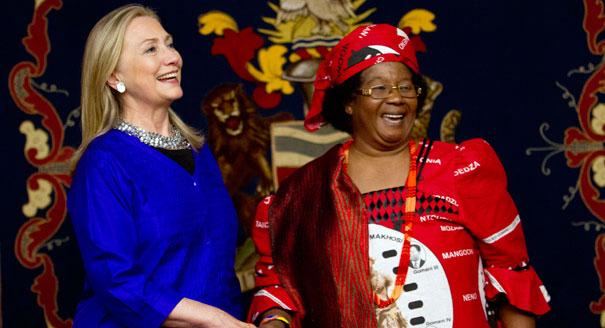
Hillary Clinton and President Joyce Banda of Malawi

US Secretary of State Hillary Clinton is to meet with South Africa’s anti-apartheid hero Nelson Mandela on Monday, the State Department said, hours after her arrival on the latest leg of her Africa tour.

The luncheon with the 94-year-old former president will take place in Qunu, a village in the country’s southeast.

Clinton, who met schoolgirls and Africa’s second woman president during an unprecedented visit to Malawi Sunday before jetting to South Africa, will be in Johannesburg, Pretoria and Cape Town until Thursday morning.

While in South Africa, Clinton is also expected to meet with senior government officials, as well as senior representatives from the South African private sector.

The State Department announced earlier it was partnering with the US Chamber of Commerce to lead a business delegation of approximately 10 senior US executives to the three cities Clinton is visiting.

“South Africa is the leading market in Africa for American goods, and the United States is both an important export market and a source of foreign direct investment for South Africa,” it said.

Members of the business delegation were said to include senior executives from Black & Veatch, Boeing, Chevron, EMD/Caterpillar, FedEx Express, GE, Symbion, Trimble, Wal-Mart, and Zanbato.

A trade mission meanwhile includes the heads of the Overseas Private Investment Corporation, the Export-Import Bank of the United States, the US Trade and Development Agency, as well as Robert Hormats, under secretary of state for economic growth, energy and the environment, and Francisco Sanchez, under secretary of commerce for international trade.

“The mission showcases our commitment to highlighting investment opportunities in Sub-Saharan Africa, particularly in infrastructure, the State Department said.

After trips to Nigeria and Benin, Clinton is due to travel to Turkey Saturday for talks on the conflict in Syria. – Sapa

White genocide, full-blown communism looming in South Africa

by Alex Newman, New American

While most of the world refuses to acknowledge what is happening in largely communist-controlled South Africa, the non-profit group Genocide Watch declared last month that preparations for genocidal atrocities against white South African farmers were underway and that the early phases of genocide had possibly already begun. In the long run, Genocide Watch chief Dr. Gregory Stanton explained, powerful communist forces also hope to abolish private-property ownership and crush all potential resistance.

According to experts and official figures, at least 3,000 white farmers in South Africa, known as Boers, have been brutally massacred over the last decade. Many more, including children and even infants, have also been raped or tortured so savagely that mere words could not possibly convey the horror. And the problem is growing worse, international human rights monitors and South African exiles say.

The South African government, dominated by the communist-backed African National Congress (ANC), has responded to the surging wave of racist murders by denying the phenomenon, implausibly claiming that many of the attacks are simply regular crimes. Despite fierce criticism, authorities also stopped tracking statistics that would provide a more accurate picture of what is truly going on in the so-called “Rainbow Nation.”

In many cases, the murders are simply classified as “burglaries” and ignored, so the true murder figures are certainly much higher than officials admit. The police, meanwhile, are often involved in the murders or at least the cover-ups, multiple sources report. A white South African exile living in the United States told The New American that when victims are able to defend themselves or apprehend the would-be perpetrators, many of the perpetrators are found to be affiliated with the ruling ANC or its youth wing.

Experts are not buying the government’s cover-up. “The farm murders, we have become convinced, are not accidental,” said Dr. Stanton of Genocide Watch during a fact-finding mission to South Africa last month. It was very clear that the massacres were not common crimes, he added — especially because of the absolute barbarity used against the victims. “We don’t know exactly who is planning them yet, but what we are calling for is an international investigation that will try and determine who is planning these murders.”

Indeed, most honest analysts concede that the thousands of brutal killings and tens of thousands of attacks are part of a broader pattern. And according to Dr. Stanton, who was also involved in the anti-Apartheid movement in South Africa and has decades of experience examining genocide and communist terror, the trend points toward a troubled future for the nation.

“Things of this sort are what I have seen before in other genocides,” he said of the murdered white farmers, pointing to several examples including a victim’s body that was left with an open Bible on top and other murder victims who were tortured, disemboweled, raped, or worse. “This is what has happened in Burundi, it’s what happened in Rwanda. It has happened in many other places in the world.”

Speaking in Pretoria at an event organized by the anti-communist Transvaal Agricultural Union, Dr. Stanton also slammed the effort to dehumanize whites in South Africa by portraying them as “settlers.” The label is meant to paint Afrikaner white farmers — descendants of Northern Europeans who arrived centuries ago — as people who do not belong there.

It is the same process that happened prior to the infamous genocide against Christian Armenians in Turkey, Stanton explained. The dehumanization phenomenon also occurred against the Jewish people in Germany under the National Socialist (Nazi) regime of mass-murderer Adolf Hitler, well before the Nazi tyrant began implementing his monstrous “final solution.”

Unfortunately, South Africa might be next in line, experts believe. “Whenever you have that kind of dehumanization … you have the beginning of that downward spiral into genocide,” Stanton noted, adding that the situation in South Africa had already moved beyond that stage. The next phase before extermination, which began years ago in South Africa, is organizing to actually carry it out.

“We are worried that there are organized groups that are in fact doing that planning,” Stanton continued during his speech. “It became clear to us that the [ANC] Youth League was this kind of organization — it was planning this kind of genocidal massacre and also the forced displacement of whites from South Africa.”

Genocide Watch raised its alert level for South Africa from stage five to stage six — the eighth and final stage is denial after the fact — when then-ANC Youth League boss Julius Malema began openly singing a racist song aimed at inciting murder against white South African farmers: “Shoot the Boer” and “Kill the Boer.” Described by the anti-genocide group as a “racist Marxist-Leninist,” Malema has also been quoted as saying that “all whites are criminals” and threatening to steal white farmers’ land by force.

“This is the kind of talk that of course is not only pre-genocidal, it also comes before crimes against humanity,” Dr. Stanton said, urging everyone to remember that they are all members of the human race. “Those who would be deniers, and who would try to ignore the warning signs in this country, I think are ignoring the facts.”

There is also increasing “polarization,” where the target population — white farmers in this case — and even moderates are portrayed as an “enemy,” Stanton explained about the march to genocide. And that phenomenon is ever-more apparent in South Africa, leading Genocide Watch to classify South Africa as being close to the final stages of genocide in July of this year.

The issue of land distribution, which has become one of the key drivers of the downward spiral, is also among the greatest concerns. The white minority in South Africa still owns much of the land despite ANC promises to redistribute it to blacks. But the re-distribution that has occurred — like in neighboring Zimbabwe — has largely resulted in failure.

Despite the atrocious track record so far, extremists including elements of the ANC-dominated government are now hoping to expropriate land from white farmers quicker, with some factions even arguing that it should be done with no compensation at all. And the communist agenda, like virtually everywhere else where forcible land redistribution has been adopted, has even broader goals.

“Whatever system of land tenure is adopted in South Africa, the communists — in the long run — have in mind to take away all private property. That should never be forgotten,” Stanton warned, noting that he had lived in communist-run countries before. “Every place you go where communists have taken over, they take away private ownership because private ownership gives people the power — the economic power — to oppose their government. Once you have taken that away, there is no basis on which you can have the economic power to oppose the government.”

Meanwhile, the South African government is stepping up efforts to disarm the struggling white farms, too — stripping them of their final line of defense. As has consistently been the case throughout history, of course, disarmament is always a necessary precursor to totalitarianism and the eventual mass slaughter of target groups. In fact, arms in the hands of citizens are often the final barrier to complete enslavement and even extermination.

“The government has disbanded the commando units of white farmers that once protected their farms, and has passed laws to confiscate the farmers’ weapons,” Genocide Watch noted on its website in an update about South Africa posted last month. “Disarmament of a targeted group is one of the surest early warning signs of future genocidal killings.”

The exile who spoke with TNA said that many of the guns confiscated from whites by officials have later been found at the gruesome murder scenes of white farmers. Even mere possession of an “unregistered” or “unlicensed” weapon — licenses have become extraordinarily difficult to obtain, if not impossible — can result in jail time. And in South Africa, especially for white farmers, that is a virtual death sentence, with widespread rape and HIV infections being the norm.

Dr. Stanton promised the Afrikaners that he would be visiting the U.S. Embassy and bringing the issue to the attention of world leaders. However, he also urged them not to give up their guns and to continue resisting against the communist “ideology” espoused by so many of the political and party leaders that now dominate the nation’s coercive government apparatus.

The United Nations defines genocide as “the deliberate and systematic destruction, in whole or in part, of an ethnic, racial, religious, or national group.” The term also includes actions other than simply wholesale slaughter, though. According to the UN, among the crimes that can constitute genocide are causing serious harm to members of a specific minority group, deliberately inflicting conditions on the minority aimed at bringing about its destruction in whole or in part, seeking to prevent births among the targeted population, and forcibly transferring minority children to others.

Activists and exiles argue that many of those conditions have already been met — and any single one can technically constitute genocide if it is part of a systematic attempt to destroy a particular group. Meanwhile, experts say that the government is encouraging the problem, actively discriminating against whites, and in many cases even facilitating the on-going atrocities.

Not all South Africans — especially city dwellers — are convinced that there is an on-going genocide in their country, or even that one may be coming. Indeed, the vast majority of blacks and whites would simply like to live in peace with each other, and there are plenty of other problems facing South Africa at the same time. However, virtually everyone agrees that without solutions, the precarious situation in the “Rainbow Nation” will continue to deteriorate, going from bad to worse.

Many activists seeking to draw attention to the issue are calling on European governments and the United States to immediately begin accepting especially vulnerable white refugees from South Africa as a high priority. There are less than five million whites in the country, about 10 percent of the population, down from almost a quarter decades ago. Analysts say that giving them asylum, however, may prove tough politically — partly because it could expose the precious establishment myths of Nelson Mandela and his ANC as being “heroic” so-called “freedom fighters.”

Unsurprisingly, the establishment press has barely reported a word about the looming potential calamity. And by the time the world media finally catches on, many analysts worry that it might be too late.

This is a shortened version of the original article.

‘Sondag’ newspaper must publish front-page apology to Dan Roodt

The Press Ombudsman has ordered weekly newspaper Sondag to publish a front page apology to Dan Roodt for publishing a defamatory article linking the Afrikaans writer and activist to an internet sex site.

Deputy ombudsman Johann Retief found that the March 3 article created “considerable and unnecessary” damage to Roodt’s public image.

The article told of a website encouraging Afrikaners to procreate to ensure the survival of the minority group.

It said the site was managed by “a sidekick” of Roodt and a contributor to Praag, Roodt’s Afrikaans language activism group and website.

Roodt complained that the article wrongly suggested that he and his organisation ran a pornographic site. He denied any involvement with the site. – Sapa

Hillary’s next blood-inspired hoedown

If you care about rebels the world over, as Sens. John McCain, Joseph Lieberman and Lindsey Graham think you ought to, consider the fate of one brave rebel. Stacked as they are with The Dictator’s judges, the courts in this rebel’s country want to place him behind bars for shooting a predator on his property. Ursus arctos horribilis is a wild and extremely dangerous carnivore that thrives in the northwestern parts of this dictator’s dominion.

The tribesman is guilty of no more than aggressively repelling from human habitat a creature that had become brazen, making itself at home near the man’s six young children, as they frolicked.

It used to be that the country’s tribesmen instilled fear in encroaching beasts, animal and human. But due to decades of cultural and legal emasculation, under a succession of like-minded dictators, the queered men folk are no longer licensed to protect home and hearth. If they do, they risk losing their liberty.

One man’s freedom fighter is another man’s terrorist. Our rebel’s plight would never be popularized by CNN’s Anderson Cooper or the rest of America’s journalistic priesthood. For he is an American, one among many.

“Jeremy M. Hill, 33, pleaded not guilty in U.S. District Court to killing a grizzly bear with a rifle on his 20-acre property near Porthill, Idaho, at the Canadian border.

At least five of Mr. Hill’s six young kids, ranging in age from 14 years to 10 months, were home when their dad killed a brown bear that had gone after penned pigs the kids had been raising.

I wonder how many Syrian rebels or regulars President Bashar al-Assad has arrested for shooting wild animals that had threatened their families.

If given the choice, this scribe would choose the absolute right to defend life and property over the democratic vote, any day.

Fighters for the family and the farm are never “rebels.” Or so McCain, Lieberman and Graham would impatiently insist. Wresting dominion from the distributive state: now that’s the defining battle of an “authentic” freedom fighter.

Order lIana Mercer’s brilliant polemical work, “Into the Cannibal’s Pot: Lessons for America from Post-Apartheid South Africa”

Speaking of our Syrian soul mates, the Free Syria Army, aka “The Rebels”: By now you’ve viewed their handiwork. Purity of arms is not exactly their military or moral motto. In footage uploaded to the Internet Aug. 2, members of the Free Syria Army were captured committing war crimes. They lined up pro-government militia against a wall in the city of Aleppo and mowed them down.

Where have we seen a similar scene before? Yes, yes, on YouTube. But YouTube is not a place, America; Libya is.

Backed by American drones and French fighter jets above, another bunch of rebels to whom the U.S. took a shine intercepted Col. Moammar Gadhafi as he fled his hometown of Sirte, dragged him from his vehicle and lynched him then and there.

To these rebels’ blood-curdling harangues of “Allahu Akbar,” Hillary Rodham Clinton added her own ululation. “We came, we saw, he died!” cackled the secretary of state in solidarity, when tidings arrived of the actions of her thugs of choice.

America’s three neoconservative amigos, aforementioned, consider the Syrian rebels and the Syrian people one and the same. McCain, Lieberman and Graham advocate providing their side in the Syrian civil war with “weapons, tactical intelligence, communications equipment, financing, medical supplies” and much more.

Political illiteracy being a precondition for political office, these “three blind mice,” naturally, don’t know Shia from Shinola. Grasping Syria’s ethnic and religious mix is clearly beyond the ken of one John McCain.

A new book, “Revolt in Syria: Eye-witness to the Uprising,” might guide the perplexed in peeling back the onion of the Syrian enigma.

“To put it simply,” writes its Times Literary Supplement reviewer, “the Alawite sect, to which Bashar al-Assad belongs, is favored by the regime. The Christians are in a similar position. Therefore, both of these groups support the government. The Sunnis are a marginalized majority, so many turn to political Islam to find a voice. The Kurds are non-Arabs in an ‘Arab Republic.’ Many do not feel Syrian and even support Israel. Damascenes are isolated and care little for anything outside Damascus.”

The analysis in “Revolt in Syria” makes it clear that the divisions between the factions are in flux. “There are Sunnis who ‘would die for the president,’” as are there anti-government Christians.

The recent slaughter perpetrated by her preferred sect has yet to elicit Secretary Clinton’s familiar hee-haws.

Given her history in Libya, Hillary is likely postponing the hoedown for when her proxies eliminate Bashar al-Assad.

Race an issue while white South African swimmers win gold

Chad le Clos with his gold medal, not good for South Africa's image as a "black" country

While white South African swimmers, Cameron van den Burgh and Chad Le Clos, have won  gold medals at the Olympic games in London, complaints that  “Team SA” is “too white” have surfaced. In a country where affirmative action requires black majorities everywhere, even racial quotas for sports teams, the sight of two young white men winning gold medals have jarred local sensibilities.

On Twitter, one member of the black elite tweeted “Whites will be hugged by the likes of @Sentletse @Mabine_Seabe @khayadlanga because of that Gold. #2012London I’ll wait for Caster’s Bronze”. Caster refers to Caster Semenya, the black female 800m athlete whose career has been marred by a controversy about her gender.

Whereas white faces are almost never shown in leadership positions on state TV, many of the black presenters for the Olympic games have enthused about “our gold medals” won by the the two white swimmers.

Sapa reports that former ANC Youth League president Julius Malema has defended the racial make-up of the SA Olympic team after suggestions that it was too white.

Malema was asked about the team during an interview with British Sky News on Tuesday.

The Sky News interviewer said: “It did strike me that there weren’t many black faces in the group for a black majority country.”

Malema said the team members were chosen because they were qualified.

“We think that we’re a non-racial country and all South Africans who have qualified to make Team SA should carry the flag proudly, and we support them,” he said.

“It’s not [any] more about the issue of colour.”

Malema said there was still a problem with poor communities not having access to sport. Sport Minister Fikile Mbalula was working to resolve this.

“It’s quite a serious challenge, but we’re still very proud of our Team SA,” Malema said.

Mitt Romney’s ‘comments racist and out of touch’

Mitt Romney

JERUSALEM – Mitt Romney told Jewish donors Monday that their culture is part of what has allowed them to be more economically successful than the nearby Palestinians, outraging Palestinian leaders who called his comments racist and out of touch.

“As you come here and you see the GDP per capita, for instance, in Israel which is about $21,000 dollars, and compare that with the GDP per capita just across the areas managed by the Palestinian Authority, which is more like $10,000 per capita, you notice such a dramatically stark difference in economic vitality,” the Republican presidential candidate told about 40 wealthy donors who breakfasted around a U-shaped table at the luxurious King David Hotel.

The reaction of Palestinian leaders to Romney’s comments was swift and pointed.

“What is this man doing here?” said Saeb Erekat, a top Palestinian official. “Yesterday, he destroyed negotiations by saying Jerusalem is the capital of Israel, and today he is saying Israeli culture is more advanced than Palestinian culture. Isn’t this racism?”

The economic disparity between the Israelis and the Palestinians is actually much greater than Romney stated. Israel had a per capita gross domestic product of about $31,000 in 2011, while the West Bank and Gaza had a per capita GDP of just over $1,500, according to the World Bank.

Romney, seated next to billionaire casino owner Sheldon Adelson at the head of the table, told donors at his fundraiser that he had read books and relied on his own business experience to understand why the difference is so great.

“And as I come here and I look out over this city and consider the accomplishments of the people of this nation, I recognize the power of at least culture and a few other things,” Romney said, citing an innovative business climate, the Jewish history of thriving in difficult circumstances and the “hand of providence.”

Romney, in comparing the Israeli and Palestinian economies, made no mention of the fact that Israel has controlled the West Bank, Gaza Strip and east Jerusalem since capturing them in the 1967 war. Israel withdrew from Gaza in 2005, but continues to control access, and has enforced a crippling border blockade since the Islamic militant Hamas seized the territory in 2007.

In the West Bank, Israel retains overall control, and Palestinians only have limited self-rule. Israel controls all border crossings in and out of the West Bank, and continues to restrict Palestinian trade and movement.

The World Bank and the International Monetary Fund have said repeatedly that the Palestinian economy can only grow if Israel lifts those restrictions.

“It’s Israeli occupiers and Palestinians under occupation, and that’s why Palestinians cannot realize their potential,” Erekat said.

The breakfast with top donors – including Adelson, New York Jets owner Woody Johnson and hedge fund manager Paul Singer – concluded Romney’s visit to Israel, the second leg of a three-nation overseas tour designed to bolster the his foreign policy credentials.

Standing on Israeli soil for the first time as the GOP’s presumptive presidential nominee, Romney on Sunday declared Jerusalem to be the capital of the Jewish state and said the United States has promised never to “look away from our passion and commitment to Israel.”

The status of Jerusalem is a critical issue in peace talks between the Israelis and the Palestinians.

During his visit to Israel, Romney did not meet with Palestinian President Mahmoud Abbas or visit the West Bank. He held a brief meeting with Palestinian Prime Minister Salam Fayyad.

Romney’s campaign says his trip abroad, which began in England last week, is aimed at improving the former Massachusetts governor’s foreign policy experience through a series of meetings with foreign leaders. The candidate has largely avoided direct criticism of U.S. President Barack Obama while on foreign soil.

The Jerusalem fundraiser, however, was a political event that raised more than $1 million for Romney’s campaign. It marks at least the second finance event during his tour. The first, in London, attracted about 250 people to a $2,500 per person fundraiser.

Both presidential candidates have aggressively courted American donors living abroad, a practice that is legal and has been used for decades.

Romney’s declaration that Jerusalem is Israel’s capital was keeping with claims made by Israeli governments for decades, even though the United States, like other nations, maintains its embassy in Tel Aviv.

His remarks on the subject during his speech drew a standing ovation from his audience, which included Adelson, the American businessman who has promised to donate more than $100 million to help defeat Obama.

Adelson was among a several donors who flew to Israel for a day of sightseeing with Romney in addition to private meetings with top Israeli officials.

A group of donors also met with a top aide to President Benjamin Netanyahu, one donor said on the condition of anonymity to discuss private meetings.

Romney met with Netanyahu and other leaders before his speech Sunday. He also visited the Western Wall, Judaism’s holiest site, where he was mobbed by worshippers.

In his remarks, Romney steered clear of overt criticism of Obama, even though he said the threat of a nuclear-armed Iran “has only become worse” in the past five years.

Romney flew to the Middle East from Britain, where he caused a stir by questioning whether officials there were fully prepared for the Olympic Games. A stop in Poland will complete his trip.

Four years ago, Obama visited Israel as a presidential candidate, part of a five-nation trip meant to establish his own foreign policy credentials.

A goal of Romney’s overseas trip is to demonstrate his confidence on the world stage, but his stop in Israel also was designed to appeal to evangelical voters at home and to cut into Obama’s support among Jewish voters and donors. A Gallup survey of Jewish voters released Friday showed Obama with a 68-25 edge over Romney.

Romney and other Republicans have said Obama is insufficiently supportive of Israel.

Nadine Gordimer describes South African education system as a ‘wreck’

Nadine Gordimer, Nobel laureate for literature in 1991

Nobel literature prize winner Nadine Gordimer poured scorn on South Africa’s education system on Tuesday as “a wreck” over the failure to deliver textbooks to thousands of public schools.

The scandal has caused a national furore after leaving more than 5,000 rural schools without textbooks for more than six months of the academic year in a damning measure of South Africa’s schooling 18 years into democracy.

“Our education system is a wreck. It’s a shamble. I can’t believe that three-quarters of the year have gone by and so many of our schools, especially in the rural areas, have been without textbooks,” said Gordimer, 88, on SAFM public radio news.

“It is the (education) minister’s responsibility to see that the books are ordered in time and delivered. How can you teach people to read if there are no books to read from?”

President Jacob Zuma is facing increasing calls to fire Education Minister Angie Motshekga. On Monday, he said he was waiting for a final report from a team he appointed to investigate the debacle.

The education department was found to have violated students’ rights to education after being taken to court and was ordered to remedy the situation.

But a probe revealed that 22 percent of schools in the northern Limpopo region were still without learning materials earlier this month despite a scramble by authorities to get the missing books to schools.

The criticism by Gordimer, who had several works banned by the apartheid regime, comes after peace laureate Desmond Tutu said democratic icon Nelson Mandela would be reduced to tears if he knew the poor state of public schools.

Education is South Africa’s single biggest budget item, but schools are hobbled by poor management and low standards. – SAPA

Names and dates of recent South African political killings

Following on our story, Political killings in South Africa are about money, here is a list of those killed, together with dates:

– June 27, 2007

Govan Mbeki municipality deputy mayor Thandi Mtsweni was killed in Secunda, Mpumalanga for allegedly investigating tender irregularities.

She was shot dead by two gunmen when she arrived home with her husband and 14-year-old son.

The municipality’s mayor Sipho Nkosi was arrested for allegedly hiring hitmen to kill her.

– January 4, 2009

Mbombela municipality speaker Jimmy Mohlala, who blew the whistle on alleged corruption in a 2010 construction project was shot dead in his Nelspruit house.

Mohlala had blown the whistle on Mbombela municipal manager Jacob Dladla who was accused of manipulating 2010 construction contracts.

Mohlala was also investigating a fraud case involving a company belonging to Bobby Motaung, Kaizer Chiefs football club chairman, which was responsible for the construction of the Mbombela Stadium.

– January 22, 2009

Inkosi Mbongeleni Zondi, the grandson of a famous Zulu King and a strong ally of ANC president Jacob Zuma, was shot dead in Durban’s Umlazi township.

Zondi was travelling along Stimela Avenue when his car was sprayed with bullets.

– January 22, 2009

The chairman of the ANC Youth League in Umgababa on the south coast of KwaZulu-Natal, Sthembiso Cele, was shot.

He was shot through the window of his house. He was taken to hospital but died the next day.

– January 31, 2009

ANC leader Bongani Ngcobo was shot in Nongoma in northern KwaZulu-Natal.

Ngcobo was allegedly shot by an Inkatha Freedom Party councillor in full view of his colleagues at the ANC offices in that area.

– March 5, 2009

ANC member Jabulani Khumalo was shot dead in Nongoma, northern KwaZulu-Natal.

He was shot outside the gate of St Benedictine Hospital where he worked.

IFP councillor Hezekiah ‘Fish’ Ngwenya was arrested for Khumalo’s murder.

– March 14, 2009

North West municipal councillor Moss Phakoe was shot dead outside his home in Rustenburg.

This was after handing over a dossier detailing corruption in the municipality to high-ranking ANC officials, including secretary general Gwede Mantashe and Zuma.

Former Rustenburg mayor Matthews Wolmarans and his bodyguard were arrested and jailed for Phakoe’s murder.

– January 8, 2010

Sammy Mpatlanyane, the spokesman for the Mpumalanga department of culture, sport and recreation was gunned down in his house in Nelspruit.

His murder was blamed on the same people who killed Mohlala.

– October 8, 2010

Controversial Mpumalanga politician James Nkambule was found dead. He collapsed and died at his home in Mjindini.

It was first reported that Nkambule, a Congress of the People member at the time, had been ill and died as a result. However, It had later been reported that a confidential autopsy report showed he had been poisoned.

He was allegedly connected to the alleged existence of a hit list in the province.

– January 5, 2011

Johan Ndlovu, chief whip of Ehlanzeni District was shot, a few kilometres from his home in Thulamahashe, in the Mhala district. Ndlovu’s family discovered his body under a bush in Thulamahashe, the day after he disappeared.

In October that same year Life Khoza, 22, was jailed for 35 years for killing Ndlovu.

– March 1, 2011

ANC KwaZulu-Natal councillor Wiseman Mshibe was shot dead in his driveway in Montclair, Durban.

Although wounded five times, he managed to drive to the KFC in Montclair for help. Someone took him to St Augustine’s Hospital, but he later died.

– July 11, 2011

ANC eThekwini regional secretary Sbu Sibiya was shot dead at his home in Inanda, Durban.

It was believed that his killing was part of a pattern of the assassination of political leaders in the KwaZulu-Natal.

– August 7, 2011

Senior National Freedom Party member and traditional headman Thintabantu Mthembu was shot in KwaNgenetsheni near Vryheid in northern KwaZulu-Natal.

– August 7, 2011

NFP leader in the eThekwini Municipality Gundu Makhanya was shot and killed just outside his home in Chatsworth outside Durban.

– 18 September, 2011

NFP member Sipho Mtshali was gunned down on his way home from a meeting at the Vosloorus hostel in Boksburg, east of Johannesburg.

– Since the NFP’s formation in 2011, 15 members had been killed in separate incidents by September.

– May 1, 2012

Bongani Shelembe, chairman of the Msinga branch, and youth secretary Lungisile Zuma were shot dead when they were driving back from the party’s constituency meeting in Msinga, northern KwaZulu-Natal.

– June 30, 2012

ANC Hibiscus Coast councillor Wandile Mkhize was killed in a drive-by shooting in Manaba, Margate, a few days after the party’s national policy conference.

The motive for the attack was not known.

– July 21, 2012

NFP member, Thamsanqa Mnyango, was shot dead.

Mnyango’s murder brought to 22 the number of NFP members killed since the formation of the party. – SAPA

Political killings in South Africa are about money

Political killings in South Africa are not about political dominance but about getting to the trough first. For a list of those murdered, see Names and dates of recent South African political killings

“Some of these guys literally come out of severe poverty and if they get kicked out they will be back there.” said deputy CEO of the SA Institute of Race Relations Frans Cronje.

“The stakes are high… it’s about money.”

The number of politicians murdered the past five years has escalated, especially between 2010 and 2012.

KwaZulu-Natal and Mpumalanga seem to be the worst affected — with 41 and five killed respectively.

Around the country, at least 46 officials from various political parties have been gunned down around the country.

Cronje said: “Yes South Africa is a democracy… but I can’t think of another country that has this problem.

“We [the institute] have been hard pressed to find a single person killed over an idea. It all depends on tenders and corruption.”

He said the issue had been swept under the carpet for far too long and was something that would become very controversial in the next five years.

Historically, KwaZulu-Natal has been a test-bed since the late 80s, and to this day it is still seen as a political killing ground.

ANC KwaZulu-Natal secretary Sihle Zikalala said the party had quite a few officials killed in the last two years, but was difficult to pinpoint motives.

“We have called for serious interventions to crack all these cases. It’s destabilising the party.”

Zikalala said the ANC did not want to accuse another political party, especially not before a full investigation was conducted.

IFP MP Albert Mncwango said political tension in KwaZulu-Natal was because of the IFP breakaway group the National Freedom Party.

Mncwango said quite a number of councillors in his party had been killed the past five years.

“A rough figure, which is subject to verification, is around 10. We believe it was always politically motivated,” he said.

“They took place especially around the Natal Midlands and these murders escalated when there were internal ructions which gave rise to the NFP.”

Former IFP chairwoman Zanele Magwaza-Msibi and her backers launched the new opposition to the IFP in January 2011.

The NFP has said 22 of its members have been murdered since its launch. Many of these murders had been blamed on the IFP.

Mncwango said this was unfortunate.

“In all their murders, that they say are politically motivated, I can’t think of any IFP member who has been apprehended.”

NFP general secretary Nhlanhla Khubisa said the party had never blamed other political parties for the spate of murders.

“We say its politically motivated because it started immediately when the party was formed and of course in some cases there was some kind of political intolerance.”

Khubisa did however say that it was not NFP members killing other NFP members.

“We a threat to somebody, somewhere.”

So is political intolerance in South Africa too high?

According to Zikalala it is.

“It is a problem and the problem of political assassinations is a serious one,” he said.

Mncwango said there was a new brand of political intolerance in the country.

It was no longer about parties defending their political strongholds.

“We have a new kind of political intolerance which has to do with tenderpreneurship,” he said.

“This is becoming a huge influence in politics and a source of internal ructions in parties.”

Because the IFP was not running government it did not hand out tenders and so it had minimal infighting, said Mncwango.

Zikalala said the problem surrounding tenders could not be ruled out but that would form part of the ANC’s investigation into the reason for political murders.

Khubisa said there needed to be a change of mind set amongst members of political parties across the political landscape.

“At some point some kind of political education is needed across all parties,” he said.

Five politicians have also been murdered in Mpumalanga since 2007.

There have been allegations of a hit list circulating in the province which had the names of provincial politicians on it.

The list apparently targeted people who stood in the way of access to 2010 Soccer World Cup tenders.

It was said to be compiled, funded and executed by ANC members.

Two people, Jimmy Mohlala and Sammy Mpatlanyane, whose names were on the alleged hit list, had been murdered in 2009 and 2010.

Cronje concluded that ANC policy was killing off parts of the party.

“Look at the ANC… money has brought it to where it is.”

Material gain, said Cronje, went hand in hand with politics.

This was especially true in a country such as South Africa where the previously poor were now in power.

“The fight for tenders is desperate,” Cronje said. – SAPA

For a list of those murdered, see Names and dates of recent South African political killings

Verwoerd pumped millions into black education

by H.S. Brink

Firstly, blaming HF Verwoerd for the textbook mess is nonsensical at best and for your newspaper to portray Verwoerd as the “architect of apartheid” is a false representation.

Those who perpetuate this lie may well be referred to a book by David Walsh called The Roots of Segregation – Native Policy in Natal (1845-1910), published in 1971.

The foreword says: “(Lord) Shepstone’s policy was the precursor of the later policy of segregation, which in turn has been called apartheid, separate development and separate freedoms.”

Walsh in his conclusion writes: “It is a myth that apartheid is the exclusive product of Afrikaner nationalism: it’s antecedents are to be found in Natal.”

When the National Party came to power in 1948 it inherited a disorderly schooling system for blacks that was run mainly by Anglican and Catholic churches.

The 1951 Eiselen report on black education revealed shocking facts. Admission to school was subject to baptism. Parental participation was non-existent. Most black children had never been to school. Illiteracy was rife.

No indigenous language was tolerated and  English was the sole medium of instruction for education.

Part of subsidised teachers’ salaries landed in church coffers. Some priests and nuns got a pittance.

In Taung, as was the practice elsewhere, the community built the church which doubled up as one massive classroom for 500 scholars.

In and around Mafeking 25 000 scholars had 56 classrooms between them.

Verwoerd changed all this with an orderly system, pumping millions of pounds into black education, plus the £2 million representing the total tax contribution by blacks.

Additionally, a special levy was placed on urban property taxes to build schools and alleviate the backlog in black education, and so on and so forth.

Yet President Jacob Zuma, who believed in liberation before education, accuses Verwoerd of putting black people “back for centuries”.

One cannot but wonder who put the rest of Africa back for centuries?

As for the pretext of Afrikaans being the cause of the 1976 school uprising, think again.

The two schools that were in the forefront of the Soweto riots did not receive tutoring in Afrikaans in any subject.

Also, an  advisory board’s polling of all black schools’ governing bodies revealed that 64% approved of Afrikaans and English as mediums of education.

Zuma’s promotion of the “second revolution”, where scholars such as Hector Pieterson will undoubtedly be used again as pawns in a communist game, will indeed put South Africa back for centuries.

‘South African mines will be nationalised and land expropriated’

South Africa’s mines will be nationalised and land will be expropriated, ANC Youth League deputy president Ronald Lamola said on Monday.

“Leadership of the ANC might be afraid to say ‘nationalisation’ and ‘expropriation of land without compensation’, but the policy conference has clearly demonstrated the power and the mobility of the young lions,” Lamola said in Johannesburg.

“The policy conference [of the ANC held in June] had unanimously, clearly stated that the strategic mines of South Africa must be nationalised for the benefit of all South Africans.”

Lamola was reporting back on the ANC’s policy conference, the role of the youth league, and reflecting on former president Nelson Mandela’s contribution to the struggle.

“Comrades, we have won the debate on nationalisation,” he told the league’s Dr Mxolisi Majombozi branch at the University of the Witwatersrand.

“Even the African National Congress… they say we are at the point where we must look in terms of which minerals to nationalise.”

Lamola urged young professionals to play their part by suggesting which minerals needed to be placed in the state’s hands as part of the fight for “economic freedom”.

“We have stated with this opportunity that has been given to us that we must now identify strategic minerals to be nationalised,” he told the cheering crowd.

He said land should be given back to its rightful owners.

“The police conference has also stated clearly that the expropriation of illegally taken land by the Boers and the British colonies must be expropriated without compensation,” Lamola added.

“[We] should thank branches of the ANC that they have now taken it upon themselves to fight for economic freedom.”

Lamola said the Youth League should defend its views and ensure these were made policy at the ANC’s elective conference, to be held in Mangaung in December.

Earlier on Monday, ANC secretary-general Gwede Mantashe rejected wholesale nationalisation.

“Wholesale nationalisation is not an option, it’s costly it’s unsustainable.”

The party did however support state intervention in the economy. – SAPA